
- Home
- »
- Plastics, Polymers & Resins
- »
-
Textile-to-Polymer Recycling Market Size, Share Report 2033GVR Report cover

Textile-to-Polymer Recycling Market (2026 - 2033)
Size, Share & Trends Analysis Report By Polymer Type (Polyester/PET, Polyamide, Polypropylene, Polyurethane, Acrylic), By End Use (Apparel & textiles, Automotive, Home furnishings, Packaging, Consumer goods), By Region, And Segment Forecasts
Market Size, 2025
$144.3MMarket Estimate, 2026
$165.2MMarket Forecast, 2033
$441.0MCAGR, 2026–2033
15.1%Textile-to-Polymer Recycling Market Summary
The global textile-to-polymer recycling market size was valued at USD 144.3 million in 2025 and is projected to grow from USD 165.2 million in 2026 to USD 441.0 million by 2033, at a CAGR of 15.1% from 2026 to 2033. Asia Pacific dominated the global market, accounting for a revenue share of 56.1% in 2025. The textile-to-polymer recycling industry’s growth is driven by rising textile waste generation, stricter waste management regulations, and increasing demand for recycled polymer feedstocks.
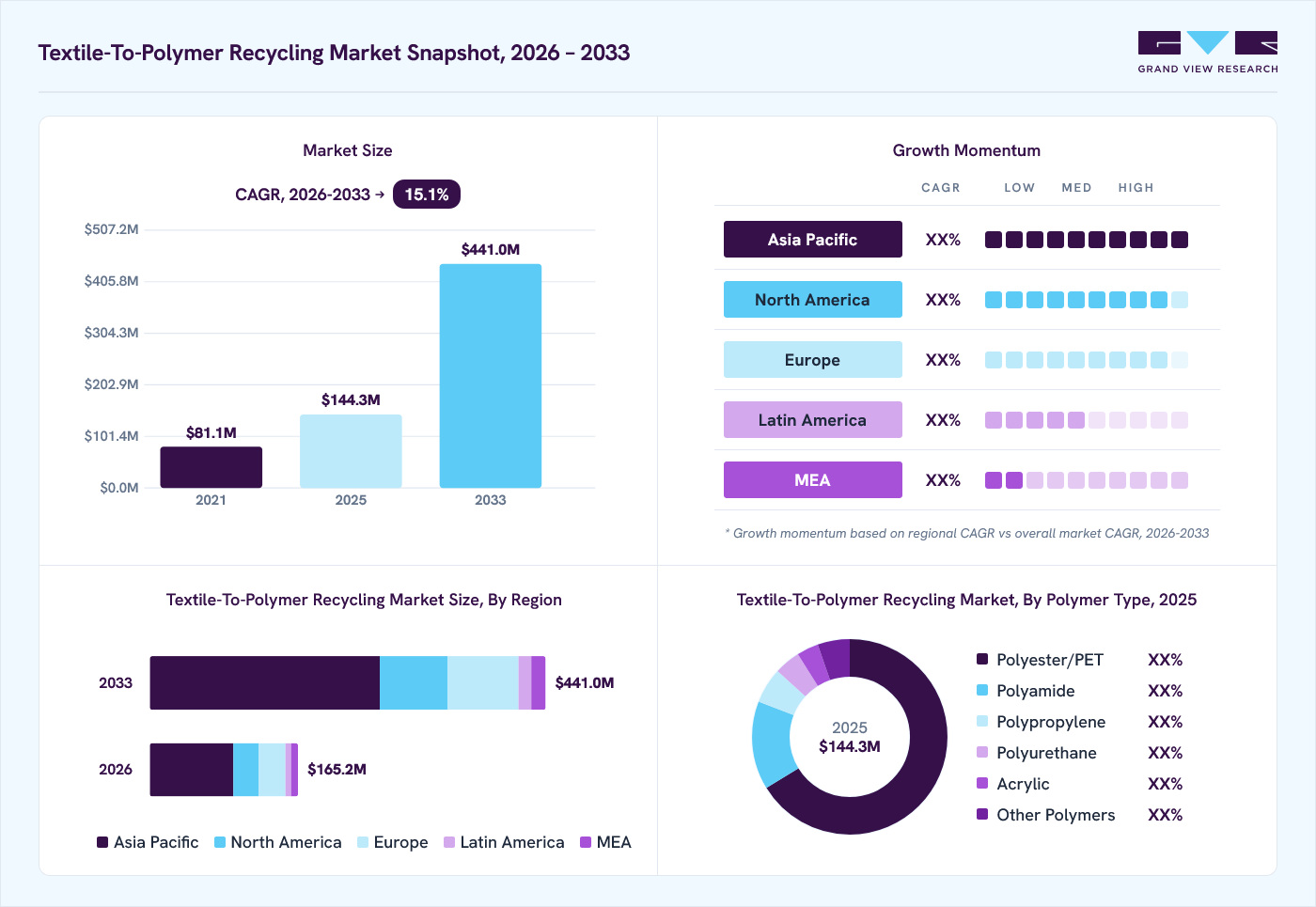 Source: Grand View Research, IR Documents, Primary Interviews, Paid DatabasesTo learn more about this report,
 Download Free Sample Report
 Key Market Trends & Insights
- By polymer type: Polyamide segment is expected to grow at a CAGR of 16.2% from 2026 to 2033, in terms of revenue.
- By end use: Automotive segment is expected to grow at a 16.1% CAGR from 2026 to 2033, in terms of revenue.
Regional Highlights
- Largest regional market: Asia Pacific (56.1% revenue share, 2025)
- By country: China held the largest market share in 2025.
Market Size & Forecast
- Market Size in 2025: USD 144.3 Million
- Estimated Market Size in 2026: USD 165.2 Million
- Projected Market Size by 2033: USD 441.0 Million
- CAGR (2026-2033): 15.1%
Three ways to get this report
Buy it, customize it, or ask a question.Ask an Analyst
Analyst response in 1 business day
- AccessReport author, directly
- Reply timeWithin 1 working day
- No sales callDirect answer only
- FormatEmail reply
- CostFree, no cost
Get the Full Report
What the study covers
- FormatsPDF · Excel · Dashboard
- Timeline2026–2033 annual, 2025 base
- Coverage20+ countries, 5 regions
- Companies10+ key players profiled
Customize the Report
20% free customization
- IncludeCountries, segments, points
- TailorTo your product definition
- ExtendDeeper competitor detail
- OrA fully bespoke study
- Turnaround5–10 working days
Growing adoption of circular economy practices is encouraging textile manufacturers to recover polyester, nylon, and other synthetic polymers from discarded fabrics. Expanding investments in mechanical and chemical recycling technologies are improving material recovery and polymer quality. Additionally, recycled content targets and sustainability commitments are strengthening demand for recycled textile-derived polymers across apparel, automotive, packaging, and industrial applications.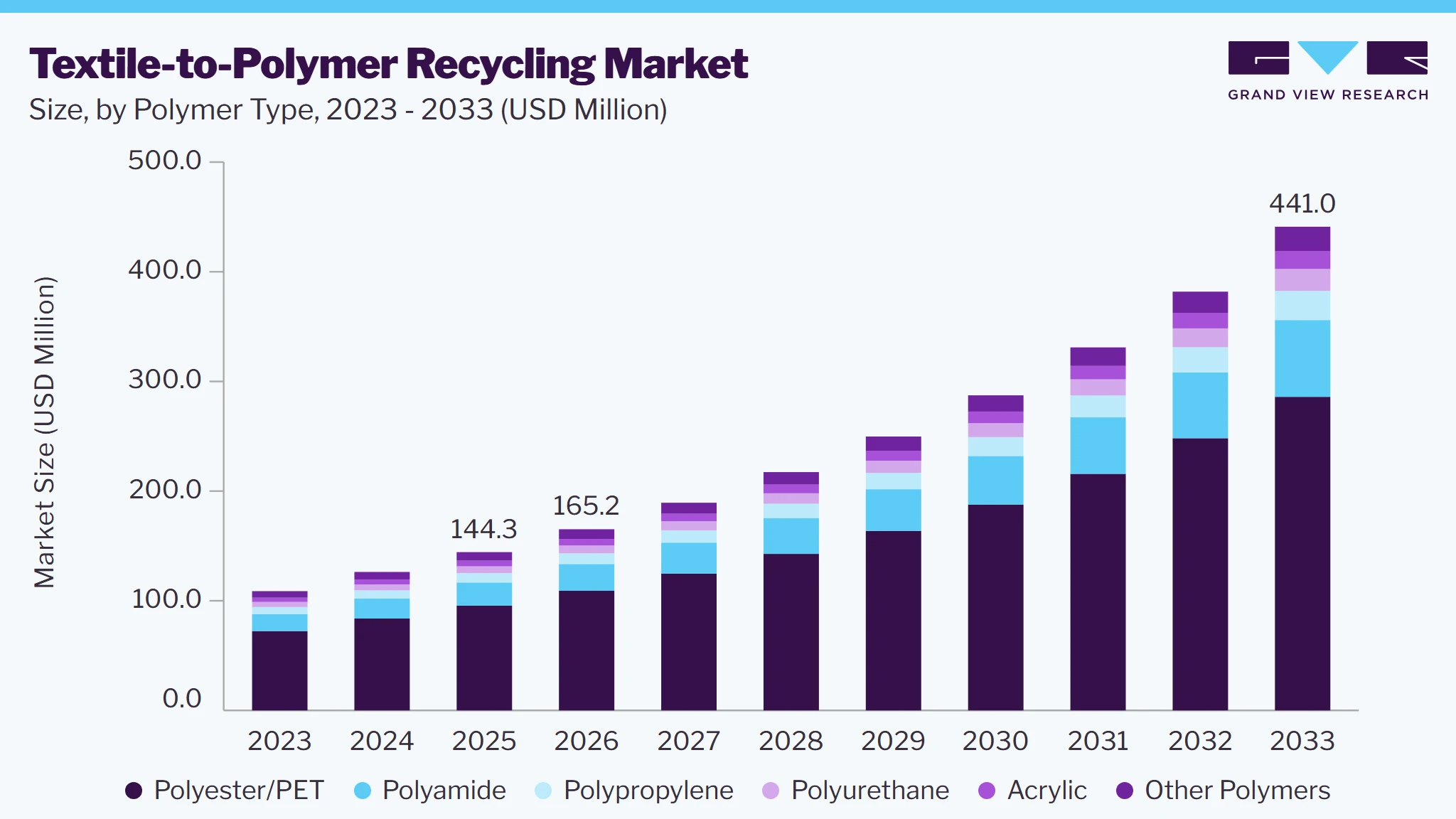 To learn more about this report, Download Free Sample Report
 The textile-to-polymer recycling market is shifting from bottle-derived recycled feedstocks toward textile-to-textile polymer recovery. Polyester remains the primary target because discarded PET textiles can be mechanically or chemically converted into secondary polymer feedstocks. According to Textile Exchange, recycled polyester production reached about 9.3 million tonnes in 2024, while textile waste is gaining prominence amid rising competition for recycled PET bottles. Chemical recycling is also progressing as producers seek virgin-like polymer quality from complex textile waste streams.
Market Dynamics
Stronger textile waste collection requirements and circularity policies are expanding the volume of recoverable feedstock available to recycling operators. According to the European Environment Agency, the EU generated about 6.94 million tonnes of textile waste in 2022, while the average household textile capture rate remained just under 15%. This indicates a substantial volume of textile waste remains in mixed municipal waste streams and is largely unavailable for recycling.
Mandatory separate collection of textile waste across EU Member States from 2025 is expected to improve capture rates and redirect more discarded textiles toward reuse and recycling. The policy shift is also increasing the need for collection networks, automated and manual sorting, preprocessing, and specialized recycling capacity. For textile-to-polymer recycling, higher collection volumes can improve feedstock availability for polyester/PET, polyamide, polypropylene, polyurethane, and other synthetic polymer recovery. It can also support investment in technologies capable of separating blended and contaminated textile streams, thereby improving the conversion of waste textiles into secondary polymer feedstocks.
Feedstock heterogeneity remains a significant constraint because post-consumer textiles contain mixed fibers, dyes, finishes, elastane, coatings, and non-textile components. These materials complicate sorting and can reduce polymer yield and quality. According to the European Environment Agency, synthetic textile recycling remains technically and economically challenging, while effective recycling requires improved collection, accurate sorting, and adequate processing capacity. High preprocessing costs and inconsistent feedstock supply can therefore weaken the economics of recycling, particularly for chemical recycling routes.
A major opportunity exists in high-purity polymer recovery from blended and contaminated textiles. Current recycling economics favor relatively clean mono-material streams, leaving significant volumes of polyester-cotton blends, elastane-containing fabrics, coatings, and chemically treated textiles underutilized. Advanced dissolution, selective depolymerization, and automated sorting can separate polymer fractions while improving feedstock quality. Developing integrated systems that combine identification, fiber separation, contaminant removal, and polymer regeneration can expand the addressable waste base and support higher-value recycled polymers.
Market Concentration & Characteristics
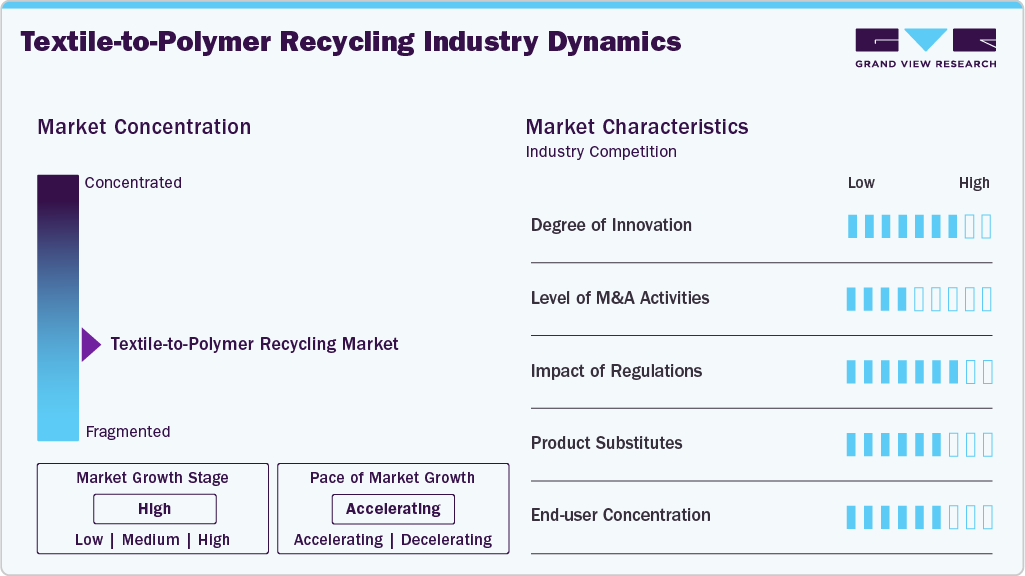
The market growth stage is high, and the pace of growth is accelerating. The textile-to-polymer recycling market exhibits fragmentation, with key players dominating the industry landscape. Major companies such as UNIFI, Ambercycle, Syre, CARBIOS, JEPLAN, Ioniqa, GR3N, Earth Protex, Ecosis, Kipaş fibR-e, and others play a significant role in shaping the market dynamics. These leading players often drive innovation in the market by introducing new products, technologies, and materials to meet the industry's evolving demands.
The textile-to-polymer recycling industry is experiencing high technological innovation as recyclers move beyond conventional mechanical processing toward chemical and enzymatic recovery. Current development focuses on handling complex polyester textiles while achieving polymer quality comparable with virgin materials. According to Carbios, in 2026, industrial trials demonstrated more than 95% conversion of complex post-consumer PET textile waste within 24 hours through enzymatic depolymerization. Selective separation, improved pretreatment, and advanced sorting are further expanding the range of viable textile feedstocks.
 To learn more about this report, Download Free Sample Report
 Regulatory intervention is becoming a major demand catalyst for textile-to-polymer recycling by improving collection, producer accountability, and recycled-material demand. The EU revised its Waste Framework Directive in October 2025, introducing mandatory extended producer responsibility schemes for textiles and footwear. Separate textile collection requirements are also increasing recoverable feedstock volumes. In addition, ecodesign requirements and future recycled-content provisions are expected to strengthen investment in sorting and polymer recovery infrastructure.
Analyst Perspective
The market is expected to evolve into a value-driven circular materials industry over the next 5 to 10 years. Polyester/PET and polyamide will remain key growth drivers, supported by demand from apparel, automotive, home furnishings, and technical textiles. Chemical, enzymatic, and hybrid recycling technologies will gain traction as mechanical recycling faces limitations with mixed and contaminated waste. Regulatory requirements, recycled-content mandates, and brand sustainability commitments will drive demand for traceable, high-quality recycled polymers. Competitive advantage will increasingly depend on virgin-equivalent quality, certified materials, closed-loop supply chains, proprietary technologies, production scale, and strategic partnerships. However, inconsistent feedstock quality, high preprocessing costs, scale-up risks, competition from virgin polymers, and fragmented collection infrastructure will challenge profitability. Success will depend on securing reliable textile waste streams while ensuring cost competitiveness and consistent material performance.
Polymer Type Insights
The polyester/PET dominated the textile-to-polymer recycling market with a revenue share of 66.4% in 2025, and is forecast to grow at a CAGR of 14.8% from 2026 to 2033. Polyester/PET has the strongest structural advantage due to its scale in global fiber production and its established recycling infrastructure. According to Textile Exchange, polyester accounted for 59% of global fiber production in 2025, reaching 82.5 million tonnes. Recycled polyester production increased to approximately 9.7 million tonnes, but 97% was still sourced from plastic bottles. Textile-to-textile feedstock, therefore, represents a significant substitution opportunity. Improving chemical depolymerization and purification technologies can redirect textile waste into higher-value PET production while reducing dependence on bottle-derived feedstocks.
The polyamide segment is expected to expand at a 16.2% CAGR in the textile-to-polymer recycling market over the forecast period. Polyamide demand is being supported by advances in recycling technologies capable of processing complex textile compositions. According to current industry developments, recycled PA6 can now accommodate challenging feedstocks containing blends such as PA6 and elastane, while maintaining properties comparable to those of virgin material. According to BASF, its first commercial recycled PA6 plant began operations in Shanghai in 2025 with an annual capacity of 500 tonnes. These developments improve the viability of closed-loop nylon supply chains for performance apparel and technical textiles.
End Use Insights
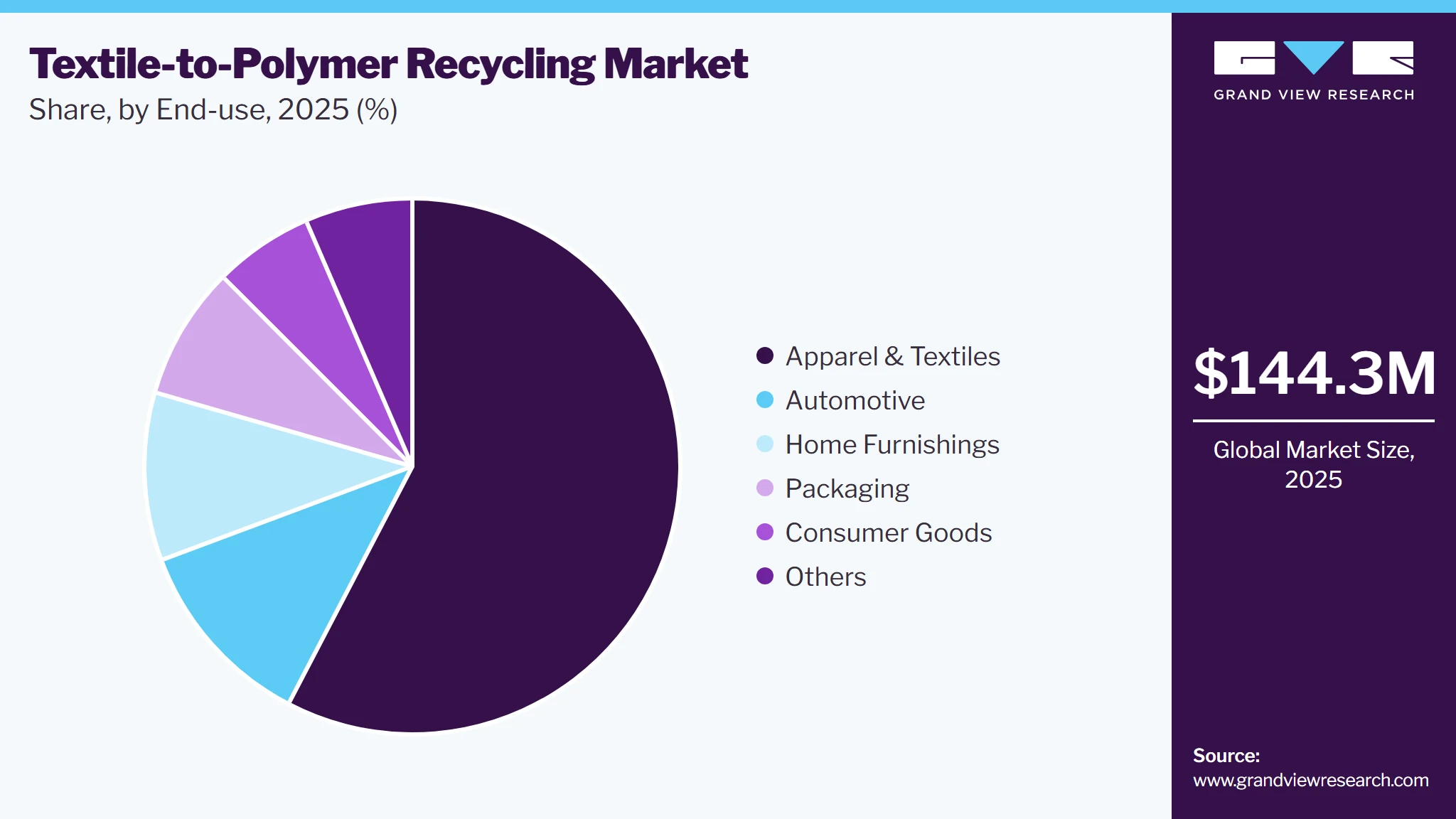
The apparel & textiles segment led the textile-to-polymer recycling industry, accounting for a revenue share of 57.7% in 2025, and is projected to grow at a 14.3% CAGR from 2026 to 2033. Apparel and textiles remain the primary end-use opportunity because recycled polymers can be directly converted into new fibers, yarns, fabrics, and finished garments. The key growth driver is the transition from recycled-content sourcing toward genuine textile-to-textile loops. According to Carbios, industrial-scale trials in 2026 successfully produced recycled polyester T-shirts from complex textile and plastic waste, with performance matching virgin polyester. This strengthens the case for closed-loop apparel production.
 To learn more about this report, Download Free Sample Report
 The automotive segment is expected to grow at the fastest CAGR of 16.1% over the forecast period. Automotive applications are creating a higher-value outlet for recycled polymers because recycled materials must satisfy stringent mechanical, thermal, dimensional, and chemical requirements. According to Aquafil, regenerated nylon can withstand demanding vehicle conditions and maintain performance through multiple regeneration cycles. According to BASF in 2025, chemical recycling technologies demonstrated that they enabled contaminated PA6 from end-of-life vehicles to be converted into high-quality compounds for technically demanding automotive components. This creates potential for closed-loop polymer sourcing across automotive interiors and engineered components.
Regional Insights
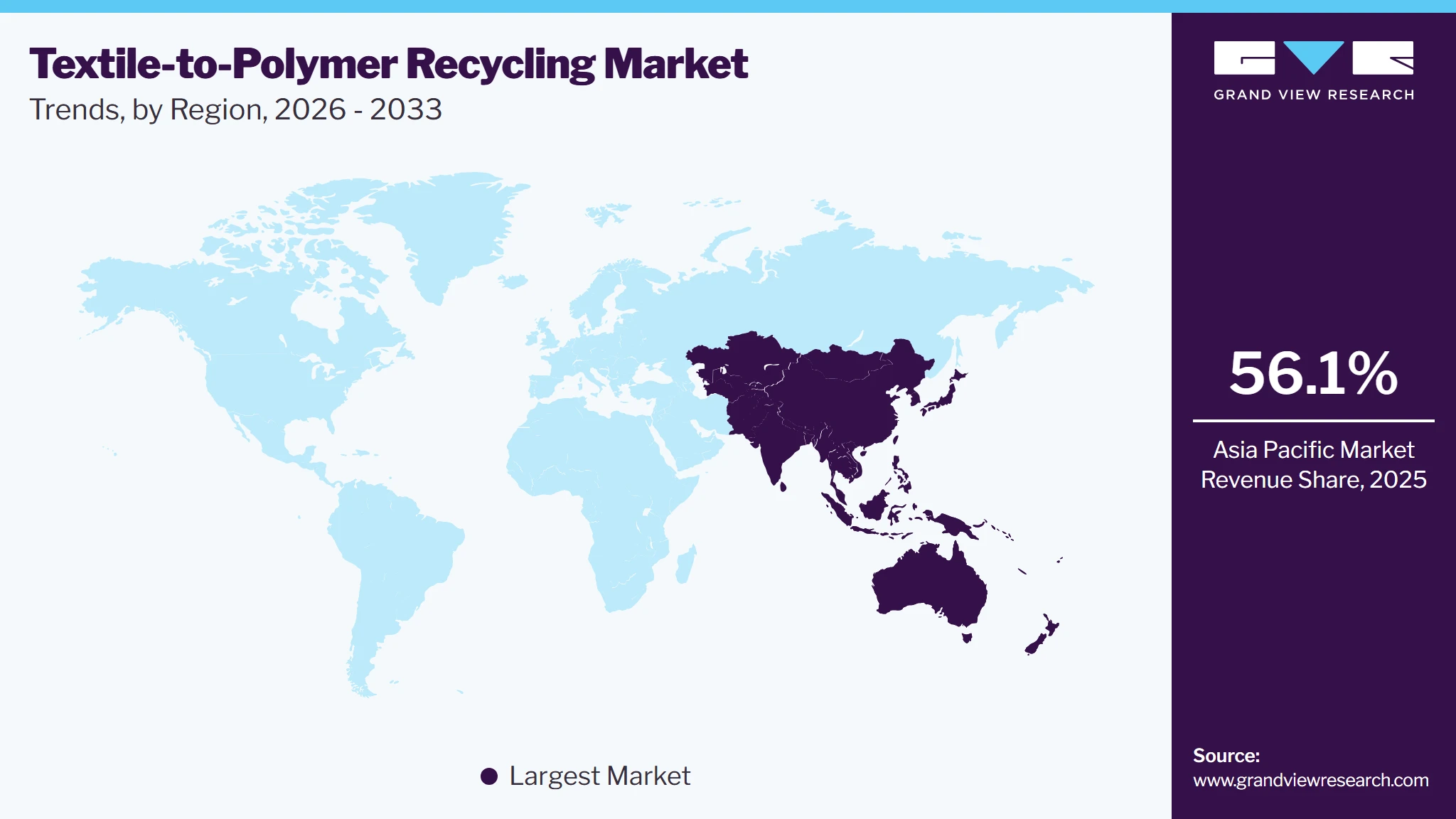
The Asia Pacific textile-to-polymer recycling market held the largest revenue share of 56.1% in 2025. The region is expected to grow at the fastest CAGR of 15.6% over the forecast period. Asia Pacific benefits from its concentration of textile manufacturing, fiber production, and polymer processing capabilities. The region offers strong access to both pre-consumer textile waste and post-consumer material, supporting localized recycling supply chains. India is also strengthening its domestic recovery ecosystem. In March 2026, the Ministry of Textiles released a national mapping of India's textile waste value chain, reporting 7.1 million tonnes of annual textile waste and emphasizing the need for stronger recovery, recycling, and circularity infrastructure. These developments support regional polymer feedstock availability.
 To learn more about this report, Download Free Sample Report
 The China textile-to-polymer recycling market has a significant structural advantage due to the country’s extensive textile manufacturing base and established recycled-fiber industry. Government policy increasingly emphasizes higher-value utilization rather than low-grade textile recovery. In July 2026, a new Chinese standard for recycled textile fiber classification and content labeling came into effect, improving material identification and transparency across the textile supply chain. Clearer standards can facilitate quality control and strengthen demand for recycled PET and PA6 feedstocks. China therefore remains important for scaling textile-derived polymer processing.
North America Textile-to-Polymer Recycling Market Trends
North America is gaining momentum from policy-led collection systems and new domestic recycling capacity. The region has strong polyester consumption and established waste-management infrastructure, creating favorable conditions for converting post-consumer textiles into polymer feedstock. In January 2026, Reju announced plans for a $390 million textile regeneration hub in Rochester, New York, its first North American facility, targeting the recovery of polyester textile waste at a commercial scale. Such investments can improve regional feedstock security and reduce dependence on imported recycled polymer.
U.S. Textile-to-Polymer Recycling Market Trends
The U.S. textile-to-polymer recycling industry is being supported by state-level producer responsibility measures and investment in textile recovery infrastructure. California's Responsible Textile Recovery Act requires covered producers to participate in an approved producer responsibility organization, strengthening collection and downstream recycling systems. In February 2026, CalRecycle approved Landbell USA as the producer responsibility organization, with covered producers required to join by July 2026. This framework should improve textile collection volumes and create a more predictable feedstock base for polymer regeneration.
Europe Textile-to-Polymer Recycling Market Trends
Europe is the most regulation-intensive regional market, creating strong incentives for textile collection, sorting, and polymer recovery. The revised Waste Framework Directive requires EU Member States to establish extended producer responsibility systems for textiles and footwear. In July 2026, EU rules prohibiting large companies from destroying unsold clothes and footwear entered into application, directing businesses toward reuse and more resource-efficient management. These measures increase the availability of recoverable textile material and strengthen the commercial case for advanced polymer recycling.
Latin America Textile-to-Polymer Recycling Market Trends
Latin America's opportunity is linked to expanding textile production, improving waste governance, and emerging circular-economy frameworks. Brazil, Mexico, and Colombia are developing mechanisms to improve textile collection, reuse, recycling, and sustainable procurement. In July 2026, the One Planet Network assessed textile circularity in Brazil, Colombia, and Mexico, identifying policy, capacity building, eco-labeling, and sustainable public procurement as mechanisms to accelerate textile recycling. These measures can gradually convert fragmented textile waste streams into usable polymer feedstocks.
Middle East and Africa Textile-to-Polymer Recycling Market Trends
The Middle East & Africa textile-to-polymer recycling industry remains less developed but offers substantial long-term potential as waste-management systems modernize. Rising urbanization and textile consumption are increasing the need for resource recovery. In January 2026, the World Bank reported that the Middle East and North Africa generated more than 155 million tonnes of waste annually, while less than 10% was recycled, highlighting significant infrastructure gaps. Investments in collection, sorting, and circular-economy infrastructure could progressively create feedstock channels for textile-to-polymer recycling.
Key Textile-to-Polymer Recycling Company Insights
Some of the key players operating in the market include Earth Protex and CARBIOS.
-
Earth Protex has established a commercial textile-to-textile polyester platform through its Tex2Tex technology. The system converts textile waste into recycled polyester pellets, staple fiber, and filament, with a stated capacity of 120 kt/year. Its partner network spans Asia, Europe, and the Americas, supporting broad market access. The company also offers GRS-certified products for apparel, footwear, home textiles, automotive, and technical applications.
-
CARBIOS is advancing textile-to-polymer recycling through enzymatic PET depolymerization designed to recover polyester from complex waste streams. Its technology targets virgin-equivalent recycled PET while addressing textiles that are difficult to process through conventional mechanical recycling. The company is progressing toward industrial commercialization through demonstration-scale operations and licensing, positioning its technology as a potential platform for large-scale textile-to-textile polyester recovery.
Ambercycle and Syre are some of the emerging participants in the textile-to-polymer recycling market.
-
Ambercycle is developing molecular regeneration technology that converts discarded polyester textiles into regenerated polyester materials with properties comparable to virgin polymers. Its strategy focuses specifically on textile-to-textile circularity rather than conventional bottle-to-fiber recycling. The company is expanding commercialization through partnerships with major fashion and textile stakeholders, supporting the development of a closed-loop supply chain for polyester waste and strengthening its position among emerging advanced textile recycling specialists.
-
Syre is building a large-scale textile-to-textile recycling platform focused initially on polyester. Its technology produces circular polyester with quality comparable to virgin material and can reduce carbon emissions by up to 85% compared with oil-based virgin polyester. The company plans multiple global plants and targets 3 million metric tons of circular polyester production by 2032. Its emphasis on hyperscale production distinguishes it from smaller technology-focused recyclers.
Key Textile-to-Polymer Recycling Companies
The following key companies have been profiled for this study of the textile-to-polymer recycling market.
-
UNIFI
-
Ambercycle
-
Syre
-
CARBIOS
-
JEPLAN
-
Ioniqa
-
GR3N
-
Earth Protex
-
Ecosis
-
Kipaş fibR-e
Competitive Benchmarking
Operating Strategies
Competitive Edge
Weakness
Mature Players: UNIFI; CARBIOS; JEPLAN; Ioniqa; GR3N; Earth Protex
- Maintain established polyester recycling, depolymerization, enzymatic recovery, molecular recycling, and regenerated-fiber platforms targeting textile waste.
- Expand recycled PET and polyester feedstocks across apparel, home textiles, automotive, footwear, packaging, and industrial applications.
- Increase commercial-scale capacity, technology licensing, collection partnerships, textile sorting, pretreatment, and closed-loop supply arrangements across major textile-producing and consuming regions.
- Established recycling technologies and commercial platforms support conversion of textile waste into higher-quality recycled polymer feedstocks.
- Broad technical capabilities spanning mechanical, chemical, molecular, and enzymatic recycling provide multiple routes for processing diverse polyester waste streams.
- Established customer relationships, certifications, technology partnerships, and downstream applications improve polymer qualification and support textile-to-textile adoption.
- Advanced chemical and enzymatic recycling processes require higher capital investment, specialized equipment, and controlled feedstock preparation.
- Textile blends, dyes, finishes, elastane, and contaminants can reduce polymer recovery efficiency and increase pretreatment requirements.
- Commercial-scale operations remain dependent on consistent textile waste collection, sorting quality, and competitive recycled-polymer economics.
Emerging Players: Ambercycle; Syre; Ecosis; Kipaş fibR-e
- Focus on scaling textile-to-textile polyester recovery through molecular recycling, depolymerization, regenerated PET production, and integrated recycling facilities.
- Develop virgin-quality recycled polyester pellets, polymers, fibers, and application-specific materials for apparel, footwear, automotive, home textiles, and technical applications.
- Accelerate commercialization through strategic partnerships, offtake agreements, regional manufacturing facilities, textile waste suppliers, brand collaborations, and technology development partnerships.
- Focused business models enable rapid development of dedicated textile-to-polymer technologies and closed-loop polyester supply chains.
- Specialized molecular and chemical recycling platforms can address textile waste that is unsuitable for conventional mechanical recycling.
- Strategic partnerships with textile producers, brands, technology providers, and waste suppliers can accelerate market access, feedstock security, product qualification, and production scale-up.
- Relatively limited operating history and installed capacity can constrain supply reliability for large-volume textile customers.
- Commercialization depends on successful scale-up of emerging recycling technologies and achievement of cost competitiveness with virgin and conventional recycled polyester.
- Dependence on external collection networks and strategic partners can create variability in feedstock availability, quality, production timelines, and geographic market coverage.
Recent Developments
-
In April 2026, Syre and JEPLAN announced a strategic partnership to accelerate commercial-scale textile-to-textile polyester recycling. The companies will combine Syre’s technology integration capabilities with JEPLAN’s chemical recycling expertise, targeting multi-ton volumes of recycled polyester in late 2026 for spinning validation and brand product development.
-
In March 2025, BASF started its first commercial loopamid plant at its Shanghai site, with an annual capacity of 500 metric tons of recycled polyamide 6 made entirely from textile waste. The facility supports textile-to-textile recycling of challenging PA6 materials, including blends containing elastane, for sustainable textile applications.
Textile-to-Polymer Recycling Market Report Scope
Report Attribute
Details
Market size in 2025
USD 144.3 million
Estimated market size in 2026
USD 165.2 million
Projected market size by 2033
USD 441.0 million
Growth rate
CAGR of 15.1% from 2026 to 2033
Historical data
2021 - 2025
Forecast period
2026 - 2033
Quantitative units
Revenue in USD million/billion, volume in Kilotons, and CAGR from 2026 to 2033
Report coverage
Revenue & volume forecast, competitive landscape, growth factors, and trends
Segments covered
Polymer type, end use, region
Regional scope
North America; Europe; Asia Pacific; Latin America; Middle East & Africa
Country Scope
U.S.; Canada; Mexico; Germany; UK; France; Italy; Spain; China; India; Japan; South Korea; Australia; Brazil; Argentina; Saudi Arabia; UAE; South Africa
Key companies profiled
UNIFI; Ambercycle; Syre; CARBIOS; JEPLAN; Ioniqa; GR3N; Earth Protex; Ecosis; Kipaş fibR-e
Customization scope
Free report customization (equivalent to up to 8 analyst working days) with purchase. Addition or alteration to country, regional & segment scope
Pricing and purchase options
Avail customized purchase options to meet your exact research needs. Explore purchase options
Global Textile-to-Polymer Recycling Market Report Segmentation
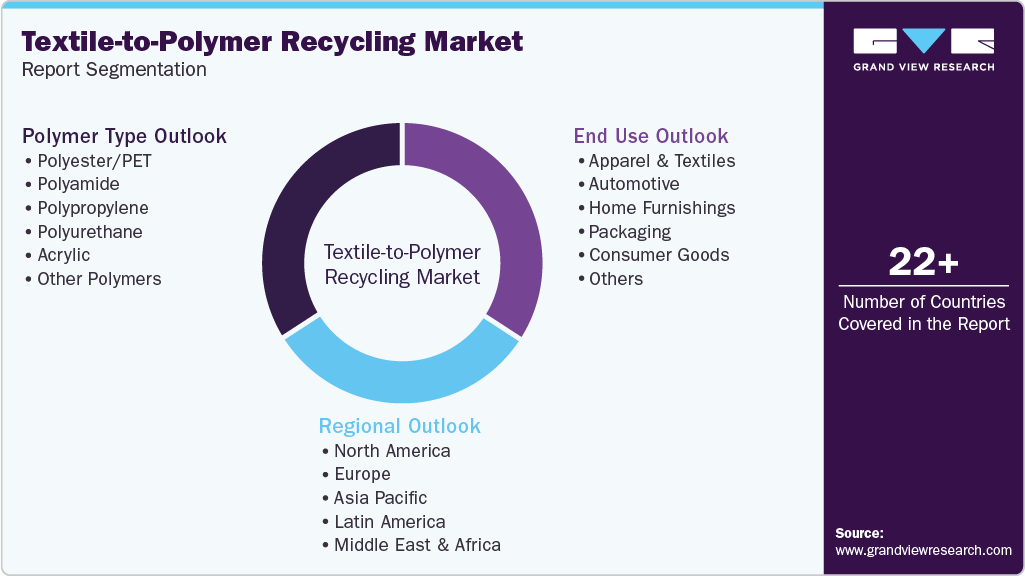
This report forecasts revenue & volume growth at the global, regional & country levels and provides an analysis of the latest industry trends across sub-segments from 2021 to 2033. For this study, Grand View Research has segmented the global textile-to-polymer recycling market report based on polymer type, end use, and region:
 To learn more about this report, Download Free Sample Report
 -
Polymer Type Outlook (Volume, Kilotons; Revenue, USD Million, 2021 - 2033)
-
Polyester/PET
-
Polyamide
-
Polypropylene
-
Polyurethane
-
Acrylic
-
Other polymers
-
-
End Use Outlook (Volume, Kilotons; Revenue, USD Million, 2021 - 2033)
-
Apparel & textiles
-
Automotive
-
Home furnishings
-
Packaging
-
Consumer goods
-
Others
-
-
Regional Outlook (Volume, Kilotons; Revenue, USD Million, 2021 - 2033)
-
North America
-
U.S.
-
Canada
-
Mexico
-
-
Europe
-
Germany
-
UK
-
France
-
Italy
-
Spain
-
-
Asia Pacific
-
China
-
India
-
Japan
-
South Korea
-
Australia
-
-
Latin America
-
Brazil
-
Argentina
-
-
Middle East & Africa
-
Saudi Arabia
-
UAE
-
South Africa
-
-
Research Methodology
The textile-to-polymer recycling market figures in this report are based on a proven research process that combines executive interviews with secondary research from proprietary databases, company filings, and recognized regulatory and institutional sources. Market size is built through value-chain sizing - reconciling supply-side and demand-side estimates - and triangulated with bottom-up and top-down approaches. Every estimate passes multiple levels of expert validation before publication, with each textile-to-polymer recycling segment quantified using the revenue-capture definitions in the table below.
Segment Definition
Segment - Polymer Type
Revenue capture definition
Polyester/PET
Revenue is captured through textile-derived PET processed into recycled flakes, pellets, chips, fibers, yarns, and polymer feedstocks for apparel, home textiles, automotive, packaging, and consumer products. Feedstock includes post-consumer polyester garments, textile cutting waste, and polyester-rich blends. Manufacturers evaluate recycled PET based on purity, intrinsic viscosity, color, molecular weight, contamination, and recycled content. Growing textile-to-textile recycling and demand for recycled polyester support segment expansion.
Polyamide
Revenue is generated through discarded nylon textiles and industrial polyamide waste converted into recycled PA6 or other polyamide pellets, fibers, yarns, and compounds. Feedstock includes apparel, carpets, fishing-related textiles, and manufacturing scrap. Manufacturers assess recycled polyamide based on polymer purity, molecular weight, tensile performance, abrasion resistance, thermal stability, and processing compatibility. Increasing use of recycled nylon in performance apparel, footwear, automotive, and technical textiles supports demand.
Polypropylene
Revenue is captured through textile-derived polypropylene recovered from carpets, woven fabrics, nonwovens, industrial textiles, and post-consumer textile products and converted into recycled pellets, compounds, fibers, and molded materials. Manufacturers evaluate grades based on melt flow, contamination, stiffness, impact resistance, color, and processing consistency. Expanding recovery of polypropylene-rich textiles and demand for recycled-content materials in consumer products, automotive components, and industrial applications support market development.
Polyurethane
Revenue is generated through polyurethane textile waste, particularly flexible foam, coated fabrics, synthetic leather, and composite textile materials, processed into recovered polymers, polyols, or secondary polyurethane feedstocks. Manufacturers focus on chemical composition, purity, foam structure, additive content, and compatibility with downstream formulations. Chemical recycling and glycolysis-based recovery can improve material utilization. Growing demand for circular foams, synthetic leather, footwear, automotive interiors, and furniture materials supports development of recycled polyurethane.
Acrylic
Revenue is captured through acrylic textile waste, including acrylic fibers, yarns, blends, and manufacturing scraps, processed into recovered polymer feedstocks, fibers, or compounds. Manufacturers assess recycled acrylic based on polymer purity, fiber length, color consistency, molecular characteristics, and spinning or processing performance. Recycling remains more challenging than PET because acrylic textiles can contain blends, dyes, and finishing chemicals. Improved sorting and fiber-to-fiber recycling technologies can increase recovery and support applications in apparel, home textiles, and consumer products.
Other polymers
Revenue is generated through textile-derived polymers such as elastane, polycarbonate, polystyrene, and specialty engineering polymers recovered from blended, coated, and technical textile streams. Applications depend on polymer composition, separation efficiency, contamination levels, and recovery economics. Manufacturers evaluate recycled materials based on purity, mechanical properties, thermal performance, compatibility, and traceability. Advances in automated sorting, selective dissolution, chemical recycling, and polymer separation can improve recovery from complex textile waste streams.
Segment - End Use
Revenue capture definition
Apparel & textiles
Revenue is captured through textile-derived recycled polymers converted into fibers, filaments, yarns, fabrics, footwear materials, and finished apparel products. Demand is supported by textile-to-textile recycling targets, brand commitments, recycled-content requirements, and growing pressure to reduce reliance on virgin polymers. Manufacturers prioritize fiber quality, tensile strength, color consistency, dyeability, durability, and traceability. Polyester and polyamide represent the primary opportunities because established spinning and textile-processing infrastructure can accommodate recycled feedstocks.
Automotive
Revenue is generated through recycled textile polymers used in seat fabrics, carpets, interior trim, acoustic materials, headliners, molded components, and selected engineering applications. Automotive manufacturers assess recycled polymers against stringent requirements for mechanical strength, thermal stability, dimensional consistency, odor, emissions, appearance, and durability. Textile-derived polyamide and polyester can support lightweighting and recycled-content objectives. Increasing circularity requirements across automotive supply chains are encouraging suppliers to qualify recovered textile polymers for higher-value vehicle applications.
Home furnishings
Revenue is captured through recycled textile polymers used in carpets, upholstery, curtains, bedding, cushions, furniture fabrics, and other household textile products. Demand is supported by large volumes of polyester and polyamide textiles used across residential and commercial interiors. Manufacturers evaluate recycled materials based on softness, abrasion resistance, color consistency, fiber strength, durability, and processing performance. Textile-to-textile recycling can provide manufacturers with a localized feedstock source while supporting recycled-content and circular-material objectives in furnishings.
Packaging
Revenue is generated through textile-derived polymer feedstocks converted into bottles, containers, films, trays, closures, and other packaging formats, primarily where recovered PET meets required quality specifications. Manufacturers evaluate recycled PET based on purity, intrinsic viscosity, color, melt performance, mechanical properties, and contamination. Food-contact applications require additional purification and regulatory qualification. Although packaging is a secondary outlet compared with textile applications, high-quality PET recovery can create a valuable demand channel for recycled textile-derived polymer.
Consumer goods
Revenue is captured through recycled textile polymers used in footwear, luggage, accessories, sporting goods, household products, toys, and durable consumer items. Demand is influenced by brand-level recycled-content commitments and consumer preference for products incorporating recovered materials. Manufacturers assess recycled polymers based on appearance, strength, durability, processing consistency, color, and traceability. Polyester, polyamide, polypropylene, and polyurethane offer opportunities across different product categories, particularly where recycled content can be incorporated without compromising functional performance.
Others
Revenue is generated through textile-derived recycled polymers used in industrial textiles, electronics, medical products, agriculture, filtration, technical components, and specialty applications. Demand varies by polymer type and required performance characteristics. Manufacturers focus on purity, thermal and mechanical properties, chemical resistance, consistency, and application-specific certification. Advanced recycling and separation technologies can broaden the addressable feedstock base by recovering polymers from coated, blended, and technically complex textile waste streams that are unsuitable for conventional mechanical recycling.
Estimation Model
Layer No.
Layer Name
Key Question
Description
1
Top-Down Textile-to-Polymer Recycling Demand Assessment Layer
What defines overall market demand?
Establishes global demand for polymers recovered from textile waste, including polyester/PET, polyamide, polypropylene, polyurethane, acrylic, and other polymers. The layer assesses textile waste availability, collection rates, recycling capacity, polymer recovery, material quality, and demand for recycled polymers.
2
End-use Demand Validation Layer
Where is demand concentrated?
Maps textile-to-polymer recycling demand across apparel & textiles, automotive, home furnishings, packaging, consumer goods, and other applications. Demand is validated through the adoption of recycled content, material specifications, brand commitments, manufacturing activity, and circular-material procurement.
3
Consumption-to-Revenue Conversion Layer
How is demand monetized?
Converts recycled polymer consumption into market revenue using polymer type, recovery technology, purity, quality, processing method, application requirements, production scale, and prevailing recycled polymer prices. Premiums for high-purity, certified, traceable, and application-specific grades are also assessed.
4
Regional Demand Verification Layer
Where is demand validated?
Validates demand across North America, Europe, Asia Pacific, Latin America, and Middle East & Africa. The analysis considers textile waste generation, collection infrastructure, recycling capacity, regulations, recycled-content requirements, textile manufacturing, polymer demand, and regional trade flows.
Delivered Customizations
This report has been delivered with the following In-depth customizations
Client Request
Customization Delivered
Value Adds
Regional Segmentation
Textile-to-polymer recycling demand analyzed across key regions and major country markets based on textile waste generation, collection systems, recycling infrastructure, regulatory frameworks, polymer availability, and end-use demand.
Identifies regional growth pockets and supports geographic market prioritization based on feedstock availability, recycling capacity, and downstream polymer demand.
Competitive Benchmarking
Key participants benchmarked by textile waste processing capabilities, recycling technologies, recycled polymer portfolio, processing capacity, geographic presence, partnerships, technology platforms, and downstream applications.
Enables comparison of competitive positioning, technology maturity, commercial scale, market reach, and strategic capabilities across mature and emerging players.
Technology Assessment
Mechanical, chemical, molecular, enzymatic, and hybrid recycling routes evaluated based on feedstock compatibility, polymer recovery, product quality, scalability, processing requirements, and commercial maturity.
Supports technology selection and identifies opportunities for process optimization, scale-up, technology licensing, and development of higher-quality recycled polymer feedstocks.
About the Author(s)
Plastics, Polymers & Resins Research Team
Bulk Chemicals · Plastics, Polymers & ResinsThis report was authored by the plastics, polymers & resins research team at Grand View Research - comprising two research analysts, one senior research analyst, and one industry expert - with specialized expertise in the plastics, polymers & resins segment of the bulk chemicals industry. All findings are based on proprietary bulk chemicals databases, executive interviews, and regulatory analysis, subject to internal peer review prior to publication.
Last Updated:
Speak to Analyst

Customize this report to your needs - add regions, segments, or data points, with 20% free customization.
Or view our licence options:


ISO 9001:2015 & 27001:2022 Certified
We are GDPR and CCPA compliant! Your transaction & personal information is safe and secure. For more details, please read our privacy policy.


