
- Home
- »
- Automotive & Transportation
- »
-
Time Critical Logistics Market Size & Share Report, 2035GVR Report cover

Time Critical Logistics Market (2027 - 2035)
Size, Share & Trends Analysis Report By Service Type (Air Charter Services, Dedicated Ground Services), By Mode Of Transport (Air, Road), By Application, By End-user Industry, By Region, And Segment Forecasts
Market Size, 2026
$15.5BMarket Estimate, 2027
$16.6BMarket Forecast, 2035
$30.6BCAGR, 2027–2035
8.0%Time Critical Logistics Market Summary
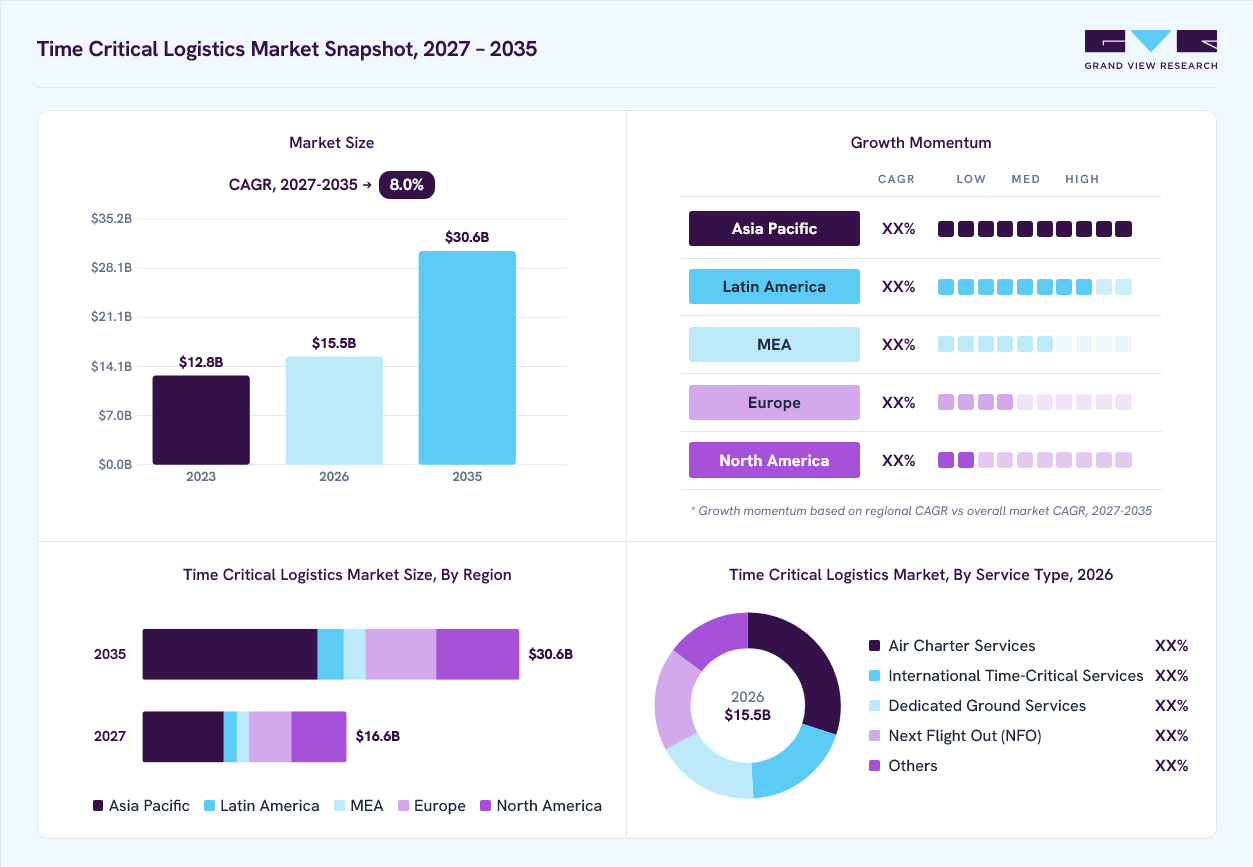
The global time critical logistics market size was valued at USD 15.5 billion in 2026 and is projected to grow from USD 16.6 billion in 2027 to USD 30.6 billion by 2035, at a CAGR of 8.0% from 2027 to 2035. Asia pacific dominated the market, accounting for a revenue share of 38.2% in 2026. The rising need to move urgent, high-value, and production-critical shipments within defined time windows is driving the growth of the time critical logistics market.
 Source: Grand View Research, IR Documents, Primary Interviews, Paid DatabasesTo learn more about this report,
 Download Free Sample Report
Key Market Trends & Insights
- By service type: Air charter services segment led the market and accounted for 29.5% of the global revenue in 2025.
- By mode of transport: Air segment led the market and accounted for 37.8% of the global revenue in 2025.
- By application: Emergency Shipments segment accounted for the largest share of global revenue in 2025.
- By end-user industry: Healthcare & pharmaceuticals segment accounted for the largest market revenue share in 2025.
Regional Highlights
- Largest regional market: Asia Pacific (38.2% revenue share, 2026)
- By country: China held the largest market share in 2026.
Market Size & Forecast
- Market size in 2026: USD 15.5 Billion
- Estimated market size in 2027: USD 16.6 Billion
- Projected market size by 2035: USD 30.6 Billion
- CAGR (2027-2035): 8.0%
Prism AI by Grand View Research Free to tryAsk a question about the time critical logistics marketTry asking✓Every figure cited from GVR research Prefer the report? Download free sample →
The increasing demand for rapid transportation of high-value and time-sensitive goods is a major driver of the time critical logistics market. Industries such as pharmaceuticals, healthcare, automotive, aerospace, electronics, and e-commerce rely on expedited logistics services to ensure the timely movement of essential products, medical supplies, spare parts, and critical components. Delays in transportation often result in production interruptions, inventory shortages, and financial losses, encouraging businesses to adopt priority shipping, express delivery, and dedicated transportation solutions. Furthermore, rising cross-border trade and the expansion of global supply chains are strengthening the demand for reliable, time-bound logistics services.The integration of digital technologies, real-time shipment tracking, and predictive analytics is a prominent trend in the time critical logistics market. Logistics providers are increasingly adopting artificial intelligence, Internet of Things (IoT), automated sorting systems, and digital freight management platforms to improve shipment visibility and operational coordination. These technologies support continuous monitoring of shipment location, transportation conditions, and estimated delivery schedules, enabling businesses to identify potential delays and adjust delivery routes. Additionally, the adoption of digital data-sharing standards, such as IATA ONE Record, is improving information exchange among airlines, freight forwarders, and other supply chain participants.
 To learn more about this report, Download Free Sample Report
Government regulations governing transportation safety, cargo security, customs clearance, and the handling of specialized goods influence the operations of the time critical logistics market. Air cargo operators and logistics providers must comply with International Air Transport Association (IATA) Dangerous Goods Regulations, International Civil Aviation Organization (ICAO) safety standards, and applicable national aviation and customs requirements. Pharmaceutical shipments also require adherence to Good Distribution Practices (GDP) to maintain product quality and temperature-controlled conditions throughout transportation and storage. Compliance with these requirements increases operational responsibilities for service providers, particularly when managing international shipments across multiple regulatory jurisdictions.
High operational costs associated with expedited transportation and specialised logistics infrastructure are a major restraint for the time critical logistics market. Priority air freight, dedicated vehicles, temperature-controlled storage, specialised handling equipment, and continuous shipment monitoring require substantial capital investment and recurring operating expenditure. Furthermore, fluctuations in aviation fuel prices, limited cargo capacity, airport congestion, and labour shortages increase transportation costs and create challenges in maintaining consistent delivery schedules. These cost pressures affect the profitability of logistics providers and limit the adoption of premium time-critical services among small and medium-sized businesses.
Market Dynamics
The time critical logistics market is shaped by the need for speed, reliability, and control in moving urgent and high-value shipments. Demand is supported by lean manufacturing, growth in pharmaceutical and life sciences supply chains, aircraft-on-ground and defense readiness requirements, and the global distribution of component suppliers. Providers are responding with expanded charter capacity, dedicated courier terminals, digital booking and tracking tools, and 24/7 operations desks. At the same time, fuel costs, capacity constraints, and regulatory compliance requirements continue to influence pricing and service design, and they define the competitive environment for integrators, freight forwarders, cargo airlines, charter brokers, and specialist operators.
The rising demand for urgent, high-value, and production-critical shipments is driving the growth of the time critical logistics market. Manufacturers operating just-in-time and lean inventory models depend on the timely arrival of components, since a single missing part can stop a production line. Healthcare and pharmaceutical supply chains require rapid transport of temperature-sensitive medicines, vaccines, clinical materials, and medical devices, while aerospace and defense operators require immediate delivery of spare parts to return aircraft and equipment to service. These requirements encourage shippers to use dedicated charters, next-flight-out services, and dedicated vehicles when scheduled freight cannot meet the delivery window.
Service providers are responding by expanding air and road capacity, operating 24/7 control centers, and investing in shipment tracking, customs expertise, and specialized handling. Integrators, freight forwarders, cargo airlines, and charter specialists are positioning dedicated time-critical offerings alongside their standard networks. The ability to secure aircraft or vehicles within hours, combined with end-to-end shipment visibility, increases the value of time-critical services for customers and supports continued investment in dedicated infrastructure such as courier terminals and charter sourcing networks.
The high cost per shipment and the volatility of available capacity remain significant restraints on market expansion. Dedicated aircraft, exclusive-use vehicles, and priority handling are priced at a premium to scheduled air freight and standard road services, and pricing is influenced by fuel costs, aircraft availability, airport and handling charges, and the urgency of the request. During periods of constrained air cargo capacity or disrupted flight schedules, charter prices and next-flight-out rates can increase sharply, and finding suitable aircraft at short notice becomes more difficult.
Regulatory requirements add further complexity, as cross-border shipments are subject to customs clearance, export control, aviation security, and dangerous-goods regulations that can extend lead times or require specialized documentation. These cost and compliance factors limit the use of time-critical services to consignments where the cost of delay is higher than the cost of transport, and they restrict adoption among price-sensitive shippers and in regions with limited airport infrastructure or customs efficiency.
The expansion of healthcare, pharmaceutical, and aerospace supply chains creates a significant opportunity for the time critical logistics market. Growth in biologics, clinical trial materials, cell and gene therapies, and temperature-sensitive medicines increases the volume of shipments that require controlled conditions, documentation, and short transit times. In aerospace and defense, the need to reduce aircraft-on-ground time and to deliver spare parts and mission-critical components to remote locations supports demand for on-demand charters and dedicated courier services.
The opportunity is particularly strong for providers that combine air charter access, validated handling processes, customs expertise, and digital shipment visibility. Investments in courier terminals near airport apron areas, global charter sourcing networks, and online quotation and booking platforms enable faster response and greater transparency for customers. Providers with established airline relationships, global office networks, and specialized handling capabilities are positioned to serve these industries, and the use of data-driven tracking is expected to improve service reliability and customer retention.
Market Concentration & Characteristics
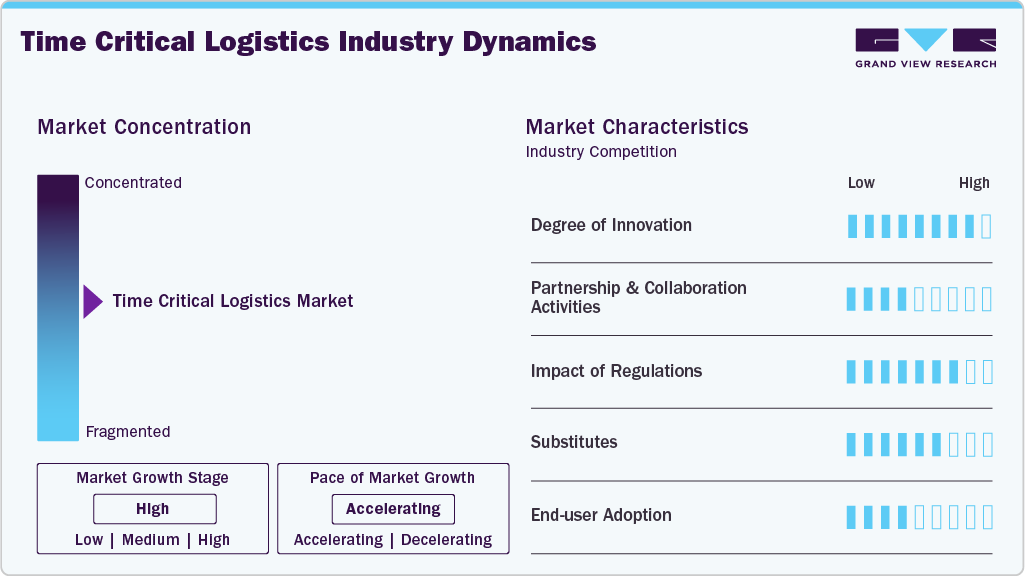
The time critical logistics market is moderately consolidated. Global integrators and forwarders, including Kuehne+Nagel, UPS, FedEx, DHL Group, and DSV, hold substantial network scale, while cargo airlines such as Lufthansa Cargo and specialist operators such as time:matters, Air Charter Service, Chapman Freeborn Airchartering, and Priority Freight serve on-demand and emergency requirements. Entry barriers include access to aircraft and operator networks, 24/7 operational capability, customs and regulatory expertise, and established customer relationships. The market is characterized by a high degree of innovation, driven by digital tracking, booking platforms, and specialized handling. Partnerships and collaborations are present at a medium level, particularly between airlines, handlers, charter brokers, and ground transport providers. Regulations have a moderate-to-high impact, as aviation security, customs, and dangerous-goods requirements affect operations.
 To learn more about this report, Download Free Sample Report
The market is also in a growth stage with an accelerating pace of growth, supported by demand from healthcare, aerospace, and industrial customers. End-user adoption remains moderate, since time-critical services are used selectively for urgent and high-value consignments owing to their cost. The availability of substitutes is relatively high, as scheduled air freight, standard express services, and surface transport can serve some of the same shipments at lower prices when delivery windows allow. However, the need for guaranteed delivery times, dedicated capacity, shipment visibility, and handling of sensitive cargo helps time-critical providers maintain their position. Overall, the combination of moderate consolidation, high innovation, accelerating growth, and regulatory complexity makes the time critical logistics market distinct from the broader freight and express market.
Analyst Perspective
The time critical logistics market is positioned for continued growth, supported by demand for speed, reliability, and control in the movement of urgent and high-value cargo. Air charter services, air transport, emergency shipments, and healthcare & pharmaceuticals form the leading and fastest-growing segments in their respective categories, while international time-critical services, road transport, spare parts logistics, and aerospace & defense are growing at a moderate pace. Investment is focused on charter sourcing capability, courier terminals, digital booking and tracking platforms, and validated handling for sensitive cargo. At the same time, providers are combining integrated air and road networks with 24/7 operations desks and customs expertise. The competitive landscape is therefore defined by network reach, response time, specialized handling capability, and digital shipment visibility.
Service Type Insights
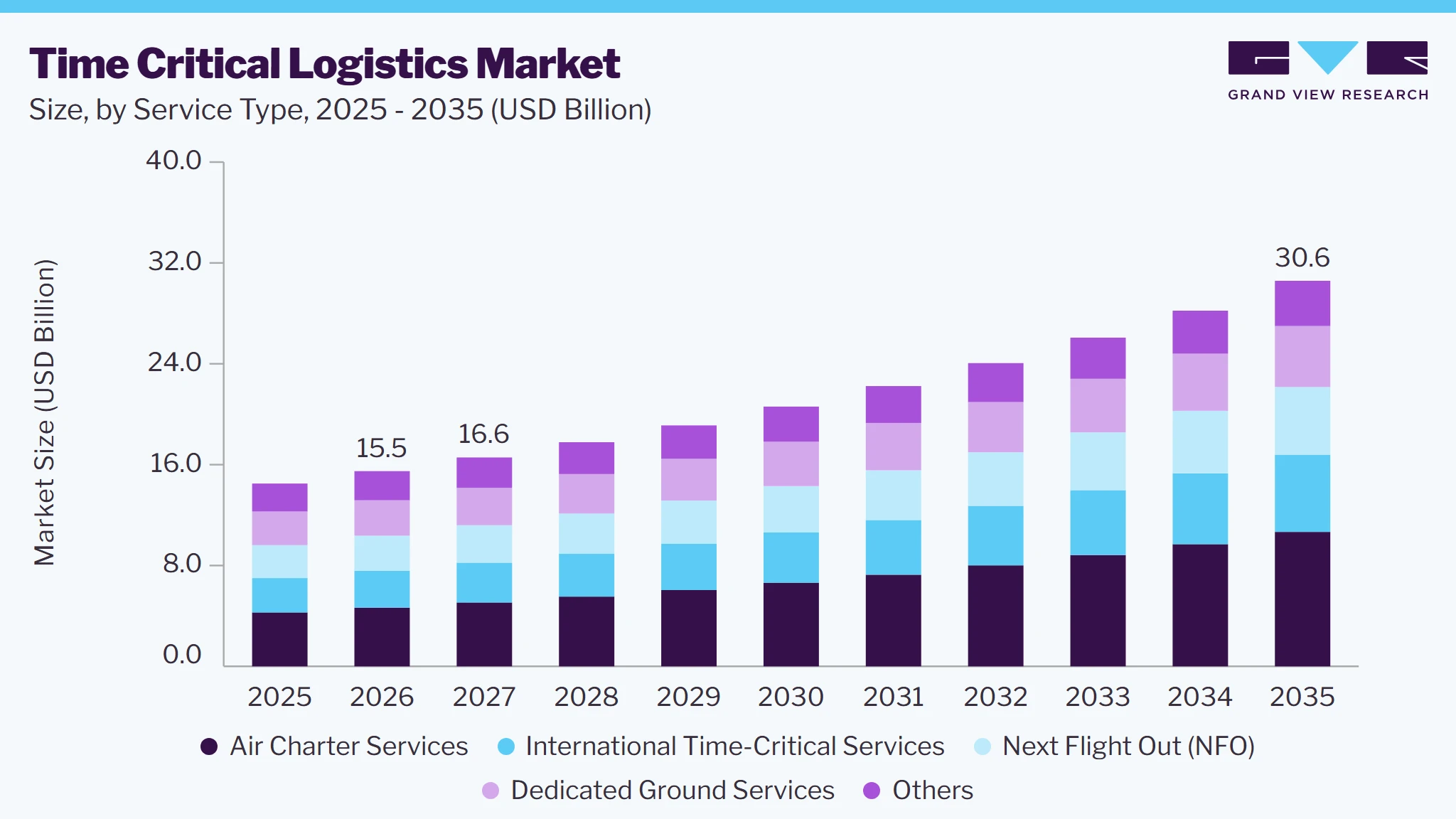
Based on service type, the air charter services segment accounted for 29.5% of the global revenue in 2025 and is the fastest-growing segment over the forecast period. Demand is driven by shipments that cannot be accommodated on scheduled services, including urgent spare parts, medical and pharmaceutical consignments, oversized or heavy cargo, and production-line components. Charter operators and brokers arrange dedicated aircraft within hours, together with ground handling and customs coordination. Providers such as Air Charter Service, Chapman Freeborn Airchartering, and Priority Freight offer on-demand charter and time-critical solutions. The ability to control departure time, routing, and capacity supports the growth of this segment.
The international time-critical services segment is growing at a moderate pace over the forecast period. Cross-border shipments with defined delivery windows require coordination of air and road legs, customs clearance, and documentation. Express and time-definite services offered by integrators and forwarders, including DHL Group, FedEx, UPS, DSV, and Kuehne+Nagel, address this requirement for industrial and healthcare customers. Growth in this segment is steadier than in air charter services, as it relies on scheduled network capacity and standardized service levels rather than dedicated, on-demand aircraft.
Mode Of Transport Insights
Based on mode of transport, the air segment accounted for 37.8% of the global revenue in 2025 and is the fastest-growing mode over the forecast period. Air transport offers the shortest transit times over long distances and provides access to charter aircraft, next-flight-out capacity on scheduled passenger and cargo flights, and dedicated freighter capacity. These attributes make air the preferred mode for urgent healthcare, aerospace, and production-critical consignments moving across continents. Cargo airlines such as Lufthansa Cargo and specialist operators such as time:matters support this segment through priority handling, courier terminals, and round-the-clock shipment monitoring.
The road segment is growing at a moderate pace over the forecast period. Road transport supports time-critical delivery over short and medium distances, including dedicated vehicle services within Europe and North America, as well as first-mile and last-mile movements to and from airports. Dedicated vehicles with direct routing and no intermediate handling allow shipments to be delivered within defined time windows. Growth in this segment is supported by cross-border manufacturing supply chains and the need for ground connections to air freight, although longer transit times over long distances limit its growth relative to air.
Application Insights
Based on application, the emergency shipments segment accounted for the largest share of global revenue in 2025 and is the fastest-growing application over the forecast period. Emergency shipments are unplanned, urgent consignments that require immediate dispatch, such as aircraft-on-ground parts, line-stoppage components, medical supplies, and equipment needed to resume operations after a failure. Customers value round-the-clock availability, rapid response times, and the ability to mobilize aircraft or vehicles within hours. Providers operate 24/7 control centers and dedicated courier services to handle these requests, and the high cost of downtime for manufacturers, hospitals, and aerospace operators supports the growth of this segment.
The spare parts logistics segment is growing at a moderate pace over the forecast period. Spare parts logistics involves the rapid movement of service and replacement parts to maintain equipment uptime across aerospace, industrial, automotive, and technology installations. Unlike emergency shipments, a larger share of these movements is planned or semi-planned, supported by forward stocking locations and service-level agreements with providers. Providers offer same-day and next-day delivery from regional hubs, and this structured demand supports steady growth in the segment.
End-user Industry Insights
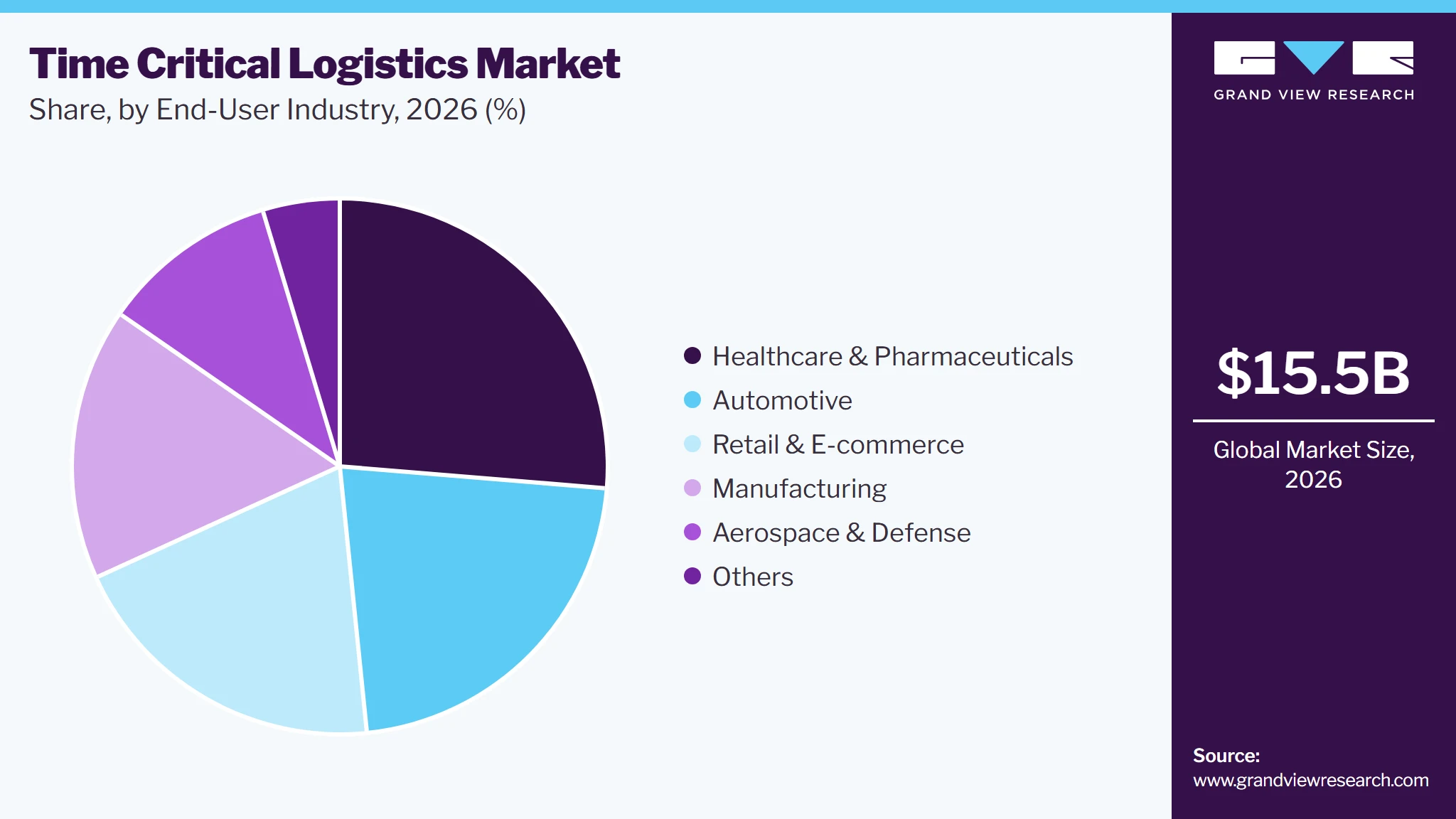
Based on end-user industry, the healthcare & pharmaceuticals segment accounted for the largest market revenue share in 2025 and is the fastest-growing industry over the forecast period. Healthcare and pharmaceutical customers require rapid transport of temperature-sensitive medicines, vaccines, clinical trial materials, biological samples, and medical devices, often under controlled conditions and strict documentation requirements. Delays can affect patient treatment and product integrity, which increases the use of charters, next-flight-out services, and dedicated courier solutions. Providers offer validated handling, temperature monitoring, and customs support to meet these requirements, and growth in biologics and clinical research continues to support the segment.
 To learn more about this report, Download Free Sample Report
The aerospace & defense segment is growing at a moderate pace over the forecast period. Aerospace and defense customers use time-critical logistics to deliver spare parts, tooling, and mission-critical components that reduce aircraft-on-ground time and support equipment readiness. These shipments are often high in value and subject to export control, security, and documentation requirements, which favors providers with specialized handling and compliance expertise. Demand is supported by the maintenance requirements of commercial and military fleets, although the more structured and planned nature of many requirements results in slower growth than in healthcare & pharmaceuticals.
Regional Insights
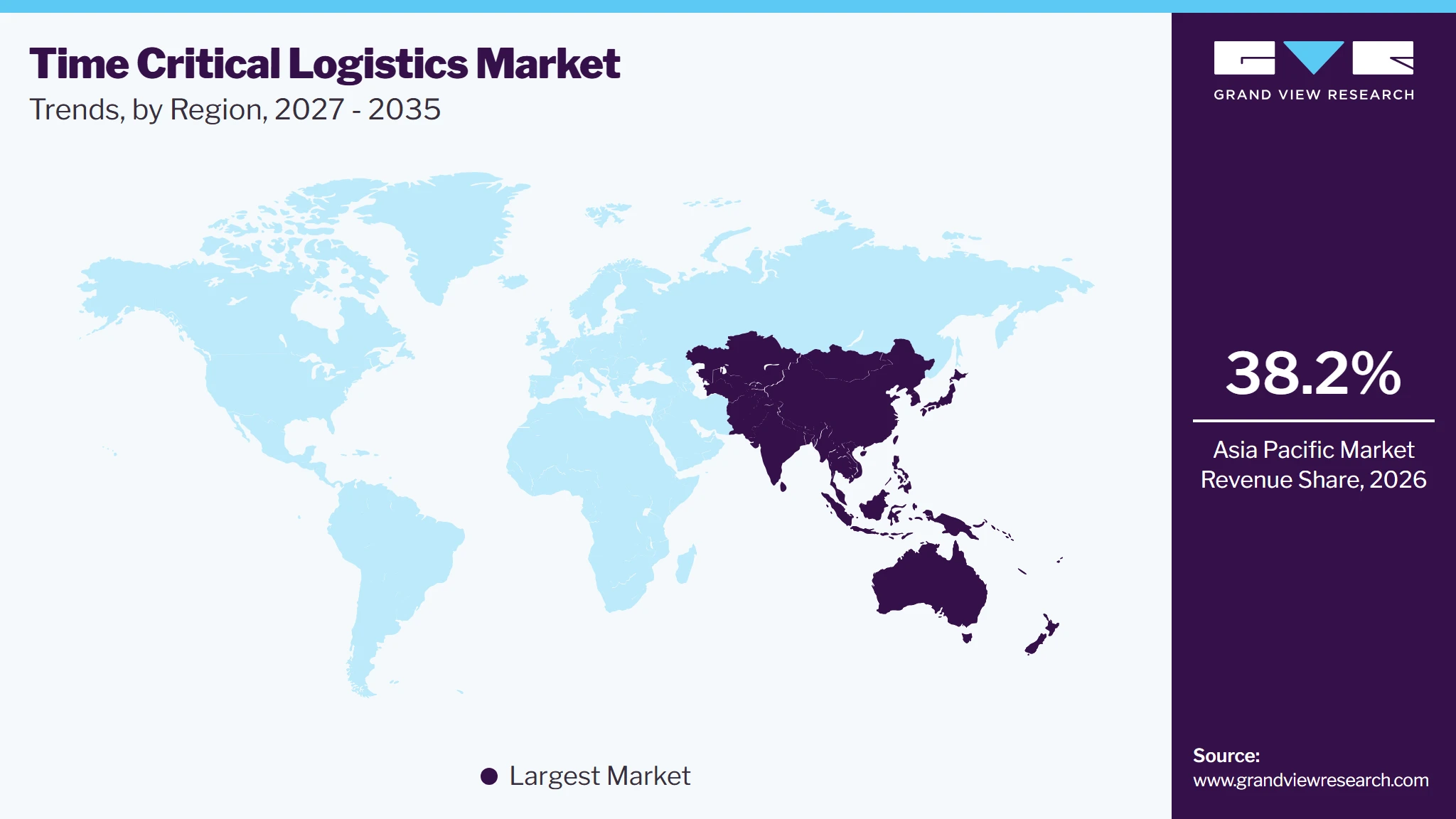
The Asia Pacific time critical logistics market led the global market and accounted for 38.2% of the global revenue in 2025 and is growing at the fastest CAGR over the forecast period. Expanding manufacturing, electronics, and semiconductor production, together with growth in pharmaceutical and healthcare supply chains, is increasing demand for urgent cross-border shipments. The region's role as a source of components for global production networks creates a need for rapid air freight when supply disruptions occur. Investments in airport cargo infrastructure and the expansion of international provider networks are supporting the use of time-critical services.
 To learn more about this report, Download Free Sample Report
China Time Critical Logistics Market Trends
China held a dominant share in the Asia Pacific time critical logistics market. The country is a major manufacturing and export base for electronics, automotive components, and industrial equipment, and it hosts large air cargo hubs. Demand for urgent component shipments to overseas production sites and for time-sensitive healthcare products supports the use of air charter and express services. Providers such as time:matters operate courier terminals at Chinese airports, including Shanghai Pudong, to handle time-critical shipments.
Japan time critical logistics market is growing at a significant CAGR over the forecast period. Japan has a strong base of precision manufacturing, automotive, electronics, and healthcare industries that depend on the timely supply of components and medical products. Demand for urgent spare parts and temperature-sensitive pharmaceutical shipments supports the use of air-based time-critical services, and the country's connections with Asian and global air cargo networks support international shipments.
Europe Time Critical Logistics Market Trends
The Europe time critical logistics market held a significant share of the market in 2025. The region has a dense network of airports, cargo hubs, cross-border road connections, and a concentration of automotive, aerospace, and pharmaceutical manufacturing. Several leading providers, including Kuehne+Nagel, DHL Group, DSV, Lufthansa Cargo, and time:matters, are headquartered in Europe. This combination of industrial demand and logistics infrastructure supports the use of time-critical air and road services across the region.
U.K. time critical logistics market is supported by demand from aerospace, defense, automotive, and life sciences customers that require rapid cross-border and domestic transport. London is a base for air charter brokers, including Air Charter Service, and Priority Freight operates from Dover, England. Post-Brexit customs requirements have increased the need for providers with in-house customs clearance capability, which supports demand for specialist time-critical services.
Germany held a substantial share in the Europe time critical logistics market. The country has a large automotive, machinery, and pharmaceutical manufacturing base, as well as major air cargo hubs such as Frankfurt. Demand for urgent spare parts and production-critical components is high among manufacturers operating just-in-time supply chains. Lufthansa Cargo, DHL Group, and time:matters are headquartered in Germany, which supports the availability of dedicated courier, charter, and express services.
North America Time Critical Logistics Market Trends
North America time critical logistics market held a significant share of the market in 2025. The region has a large base of healthcare, aerospace, and defense customers, and a high number of urgent domestic shipments that are served by integrators and dedicated vehicle providers. UPS, FedEx, and air charter providers support rapid movement across long domestic distances, and demand for aircraft-on-ground parts and pharmaceutical shipments contributes to market growth.
The U.S. time critical logistics market held the largest market share in North America. The U.S. has a large aerospace and defense sector, a significant pharmaceutical and biotechnology industry, and extensive air cargo infrastructure. UPS and FedEx are headquartered in the U.S. and operate time-critical offerings alongside their express networks, while charter brokers and specialist operators serve urgent and oversized shipments. These factors support demand for air charter, emergency, and dedicated vehicle services.
Key Time Critical Logistics Company Insights
Key players operating in the time critical logistics market include Kuehne+Nagel, UPS, FedEx, DHL Group, DSV, Lufthansa Cargo, time:matters, Air Charter Service, Chapman Freeborn Airchartering, and Priority Freight. Key players in the time critical logistics market are strengthening their air and road capabilities, charter access, customs expertise, and digital tracking to serve urgent and high-value shipments. Integrators and forwarders offer time-definite services across global networks, cargo airlines provide priority handling for critical cargo, and charter brokers and specialist operators arrange dedicated aircraft and vehicles on demand for industries such as healthcare, aerospace, defense, and automotive.
-
Kuehne+Nagel is a global logistics provider. The company offers sea logistics, air logistics, road logistics, and contract logistics services through a worldwide network of offices. Its air logistics offer includes expedited and charter solutions for time-sensitive cargo.
-
UPS is a package delivery and supply chain company. The company provides domestic and international package delivery, freight forwarding, and supply chain services, including time-definite express services for urgent shipments.
Key Time Critical Logistics Companies:
The following key companies have been profiled for this study on the time critical logistics market.
-
Kuehne+Nagel
-
UPS
-
FedEx
-
DHL Group
-
DSV
-
Lufthansa Cargo
-
time:matters
-
Air Charter Service
-
Chapman Freeborn Airchartering
-
Priority Freight
Competitive Benchmarking
Operating Strategies
Competitive Edge
Weaknesses
Mature Players: Kuehne+Nagel, UPS, FedEx, DHL Group, DSV, Lufthansa Cargo
- Mature players in the time critical logistics market focus on integrated global air, road, and sea networks, time-definite express services, priority handling for critical cargo, customs expertise, and digital shipment tracking, supported by large customer bases across industries.
- Mature players gain a competitive advantage through extensive network coverage, owned or contracted air capacity, established customer relationships, brand recognition, and the ability to combine time-critical services with standard freight, express, and contract logistics offerings.
- These companies often face challenges related to the complexity of serving urgent, non-standard requests within large standardized networks, while higher costs per shipment for premium services and exposure to fuel and capacity fluctuations can affect pricing and margins.
Emerging Players: time:matters, Air Charter Service, Chapman Freeborn Airchartering, Priority Freight
- Emerging and specialist players in the time critical logistics market focus on on-demand charter sourcing, next-flight-out and courier services, 24/7 emergency response, dedicated vehicle and air solutions, and customized logistics for urgent and complex shipments in specific industries.
- Specialist players gain market traction through rapid response times, flexibility in arranging aircraft and vehicles, access to global operator and partner networks, and focused expertise in sectors such as automotive, aerospace, defense, and life sciences.
- Specialist players face limitations due to smaller operational scale, dependence on third-party aircraft, vehicle, and handling capacity, and exposure to volatility in charter prices and aircraft availability, which can constrain margins and capacity during peak demand.
Recent Developments
-
In June 2025, DHL Aviation launched Xcelerate, a premium airport-to-airport cargo service for urgent shipments. It offers guaranteed cargo capacity, priority handling, shorter transit times, last-minute cargo acceptance and dedicated shipment monitoring, strengthening DHL's time-critical logistics capabilities.
-
In June 2025, Kuehne+Nagel and SATS introduced an expedited aircraft-parts delivery service at Singapore Changi Airport to address AOG emergencies. The solution supports faster delivery of critical aircraft components and improves shipment visibility, helping airlines reduce aircraft downtime.
Time Critical Logistics Market Report Scope
Report Attribute
Details
Market size in 2026
USD 15.5 billion
Estimated market size in 2027
USD 16.6 billion
Revenue forecast in 2035
USD 30.6 billion
Growth Rate
CAGR of 8.0% from 2027 to 2035
Base year for estimation
2026
Historical data
2023 - 2025
Forecast period
2027 - 2035
Quantitative units
Revenue in USD billion and CAGR from 2027 to 2035
Report coverage
Revenue forecast, company ranking, competitive landscape, growth factors, and trends
Segments covered
Service type, mode of transport, application, end-user industry, and region
Regional scope
North America, Europe, Asia Pacific, Latin America, MEA
Country scope
U.S., Canada, Mexico, Germany, U.K., France, China, Japan, India, South Korea, Australia, Brazil, KSA, UAE, and South Africa
Key companies profiled
Kuehne+Nagel, UPS, FedEx, DHL Group, DSV, Lufthansa Cargo, time:matters, Air Charter Service, Chapman Freeborn Airchartering, and Priority Freight
Customization scope
Free report customization (equivalent up to 8 analysts working days) with purchase. Addition or alteration to country, regional & segment scope.
Pricing and purchase options
Avail customized purchase options to meet your exact research needs. Explore purchase options
Global Time Critical Logistics Market Report Segmentation
The report forecasts revenue growth at global, regional, and country levels and provides an analysis of the latest industry trends in each of the sub-segments from 2023 to 2035. For the purpose of this study, Grand View Research has segmented the global time critical logistics market based on service type, mode of transport, application, end-user industry, and region.
-
Service Type Outlook (Revenue, USD Billion, 2023 - 2035)
-
Air Charter Services
-
Next Flight Out (NFO)
-
Dedicated Ground Services
-
International Time-Critical Services
-
Others
-
-
Mode of Transport Outlook (Revenue, USD Billion, 2023 - 2035)
-
Air
-
Road
-
Rail
-
Sea
-
-
Application Outlook (Revenue, USD Billion, 2023 - 2035)
-
Emergency Shipments
-
Just-in-Time Delivery
-
Spare Parts Logistics
-
Others
-
-
End-user Industry Outlook (Revenue, USD Billion, 2023 - 2035)
-
Healthcare & Pharmaceuticals
-
Automotive
-
Aerospace & Defense
-
Manufacturing
-
Retail & E-commerce
-
Others
-
-
Regional Outlook (Revenue, USD Billion, 2023 - 2035)
-
North America
-
U.S.
-
Canada
-
Mexico
-
-
Europe
-
Germany
-
U.K.
-
France
-
-
Asia Pacific
-
China
-
India
-
Japan
-
South Korea
-
Australia
-
-
Latin America
-
Brazil
-
-
Middle East & Africa (MEA)
-
UAE
-
Kingdom of Saudi Arabia (KSA)
-
South Africa
-
-
Research Methodology
The time critical logistics market figures in this report are based on a proven research process that combines executive interviews with secondary research from proprietary databases, company filings, and recognized regulatory and institutional sources. Market size is built through value-chain sizing-reconciling supply-side and demand-side estimates-and triangulated with bottom-up and top-down approaches. Every estimate passes multiple levels of expert validation before publication, with each time critical logistics segment quantified using the revenue-capture definitions in the table below.
Segment Definition
Segment - Service Type
Revenue capture definition
Air Charter Services
The segment revenue is generated from dedicated chartered aircraft services arranged for urgent, high-value, or oversized shipments, including revenue from full and part charters, ad-hoc and on-demand charter flights, and associated handling and ground coordination services.
Next Flight Out (NFO)
The segment revenue is generated from expedited shipment services that move cargo on the next available commercial flight, including revenue from same-day and next-day air express, courier-accompanied consignments, and associated airport handling and tracking services.
Dedicated Ground Services
The segment revenue is generated from exclusive, point-to-point ground transportation using dedicated vehicles and drivers, including revenue from expedited trucking, van and courier services, and temperature-controlled or specialized ground handling.
International Time-Critical Services
The segment revenue is generated from cross-border time-definite shipment services, including revenue from international express and expedited freight, customs clearance support, multimodal coordination, and end-to-end tracked delivery of urgent consignments.
Others
The segment revenue is generated from other time-critical logistics services not classified above, including revenue from onboard courier services, white-glove and specialized handling, and value-added services supporting urgent deliveries.
Segment - Mode of Transport
Revenue capture definition
Air
The segment revenue is generated from time-critical shipments transported by air, including revenue from chartered aircraft, scheduled passenger and cargo flights, and associated airport handling and express services.
Road
The segment revenue is generated from time-critical shipments transported by road, including revenue from dedicated trucks, vans, and courier vehicles, expedited line-haul services, and temperature-controlled or specialized ground transportation.
Rail
The segment revenue is generated from time-critical shipments transported by rail, including revenue from expedited container and freight rail services, intermodal rail connections, and time-definite rail cargo solutions.
Sea
The segment revenue is generated from time-critical shipments transported by sea, including revenue from expedited ocean freight, fast-ferry and short-sea services, and priority vessel handling for time-sensitive cargo.
Segment - Application
Revenue capture definition
Emergency Shipments
The segment revenue is generated from unplanned, urgent shipments requiring immediate dispatch, including revenue from critical medical supplies, disaster-relief cargo, and other life- or operation-critical consignments.
Just-in-Time Delivery
The segment revenue is generated from precisely scheduled deliveries synchronized with production or retail demand, including revenue from line-side delivery, scheduled expedited transport, and inventory replenishment services that minimize stock holding.
Spare Parts Logistics
The segment revenue is generated from the rapid movement and distribution of spare and service parts, including revenue from expedited parts delivery, forward-stocking and warehousing, and aircraft-on-ground (AOG) and machine-downtime response services.
Others
The segment revenue is generated from other time-critical logistics applications, including revenue from trade-show and event cargo, high-value goods, and other time-definite delivery requirements not classified above.
Segment - End-User Industry
Revenue capture definition
Healthcare & Pharmaceuticals
The segment revenue is generated from time-critical logistics services for healthcare and pharmaceutical customers, including revenue from temperature-controlled pharmaceuticals, clinical trial materials, medical devices, and organ and biological sample transport.
Automotive
The segment revenue is generated from time-critical logistics services for automotive manufacturers and suppliers, including revenue from line-stoppage prevention, just-in-time component delivery, and expedited spare parts and prototype shipments.
Aerospace & Defense
The segment revenue is generated from time-critical logistics services for aerospace and defense customers, including revenue from aircraft-on-ground parts, defense and military supplies, and secure, specialized handling of high-value components.
Manufacturing
The segment revenue is generated from time-critical logistics services for industrial and general manufacturing customers, including revenue from production-critical components, machinery spare parts, and expedited raw material and finished goods delivery.
Retail & E-commerce
The segment revenue is generated from time-critical logistics services for retail and e-commerce customers, including revenue from same-day and next-day deliveries, peak-season replenishment, and expedited fulfillment of high-value or perishable goods.
Others
The segment revenue is generated from time-critical logistics services for other end-user industries, including revenue from energy, technology and electronics, financial and legal documents, and other sectors requiring time-definite delivery.
Estimation Model
Layer Name
Key Question
Description
Industry & Service Universe Assessment
What constitutes the Time Critical Logistics Market?
The estimation begins by defining the time critical logistics universe based on delivery urgency, shipment value, defined delivery windows, and the use of dedicated or priority transport capacity. The assessment distinguishes time-critical services, such as air charter, next-flight-out, dedicated ground, and time-definite international services, from standard freight and express services. Provider service portfolios, network capabilities, and customer industries are evaluated to establish the addressable market universe.
Volume & Shipment Assessment
How many time-critical shipments and charter movements are carried?
This layer estimates annual time-critical shipment, charter, and dedicated vehicle volumes across service type, mode of transport, application, end-user industry, and region, using provider disclosures, airport and cargo statistics, and industry association data.
Revenue & Yield Assessment
What revenue is generated by time-critical services?
The model applies estimated average revenue per shipment or charter movement to volumes across relevant market segments and regions, accounting for premium pricing, fuel surcharges, and handling and customs charges, and validates the results against reported provider revenues.
Market Validation & Forecasting
How will the market develop during the forecast period?
The final layer validates estimated revenue against provider strategies, capacity additions, network expansions, service launches, and industry demand trends, and develops the forecast based on growth in healthcare, aerospace, and manufacturing supply chains, air cargo capacity, and regulatory developments.
Delivered Customization
We have successfully delivered the following deep-dive customizations:
Client Request
Customization Delivered
Value Adds
Regional Time Critical Logistics Market Opportunity Assessment
Country/region-wise market sizing and forecasts
Analysis of demand, adoption trends, and regulatory landscape
Identification of high-growth regions and investment hotspots
Identified region-specific growth opportunities
Supported expansion and go-to-market strategy
Enabled informed regional investment decisions
Cross-Segmentation Analysis for the Time Critical Logistics Market
Criss-cross market analysis by service type, mode of transport, application, price range
Demand and adoption assessment across key segments
Segment attractiveness and growth potential benchmarking
Identified high-potential market segments
Supported targeted service type positioning and marketing strategy
Improved customer and segment prioritization
Competitive Benchmarking and Strategic Positioning in the Time Critical Logistics Market
Benchmarking of key competitors across service types, pricing, partnerships, and innovation
Comparative assessment of market share, capabilities, and strategies
Analysis of competitive strengths, gaps, and differentiation areas
Identified competitive white spaces and growth gaps
Supported strategic positioning and differentiation
Enabled data-driven competitive strategy development
About the Author(s)
Automotive & Transportation Research Team
Technology · Automotive & TransportationThis report was authored by the automotive & transportation research team at Grand View Research - comprising two research analysts, one senior research analyst, and one industry expert - with specialized expertise in the automotive & transportation segment of the technology industry. All findings are based on proprietary technology databases, executive interviews, and regulatory analysis, subject to internal peer review prior to publication.
Last Updated:
Speak to Analyst

Customize this report to your needs - add regions, segments, or data points, with 20% free customization.
Or view our licence options:


ISO 9001:2015 & 27001:2022 Certified
We are GDPR and CCPA compliant! Your transaction & personal information is safe and secure. For more details, please read our privacy policy.


