
- Home
- »
- Plastics, Polymers & Resins
- »
-
Titanium Dioxide-Polymer UV Protection Market Report, 2033GVR Report cover

Titanium Dioxide-Polymer UV Protection Market (2026 - 2033)
Size, Share & Trends Analysis Report By Polymer Type (Polyethylene (PE), Polypropylene (PP)), By Application (Construction, Automotive), By Region, And Segment Forecasts
Market Size, 2025
$1.1BMarket Estimate, 2026
$1.2BMarket Forecast, 2033
$1.7BCAGR, 2026–2033
5.7%Titanium Dioxide-Polymer UV Protection Market Summary
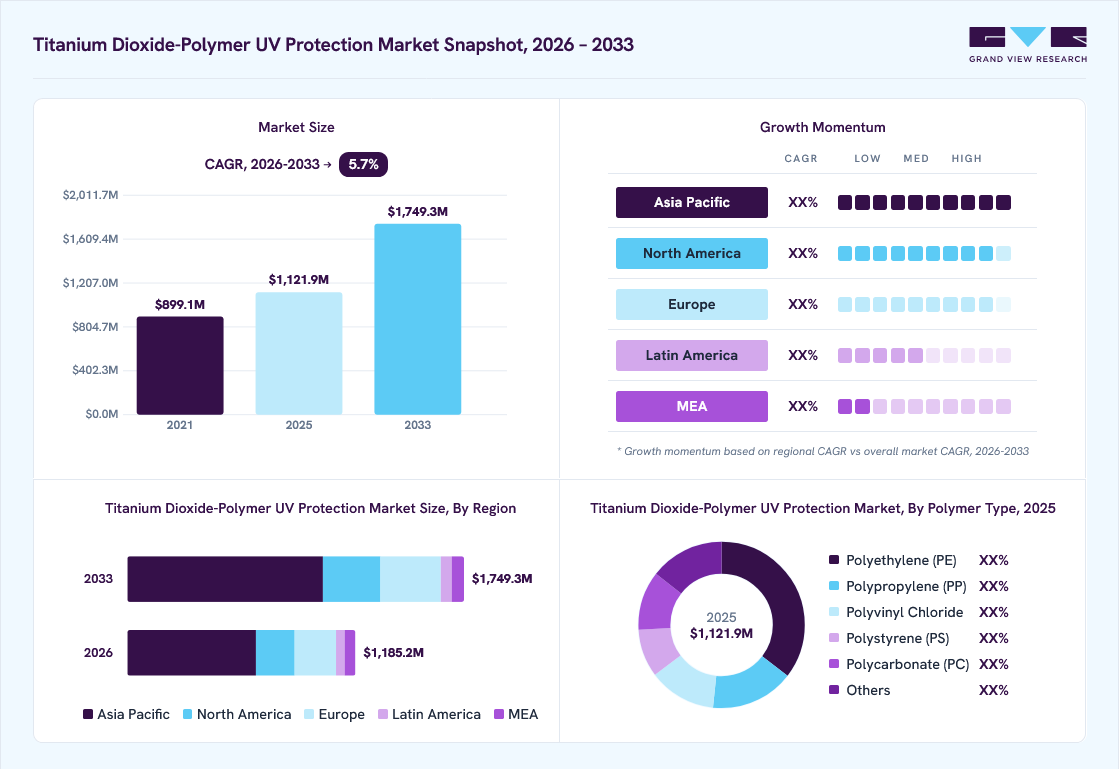
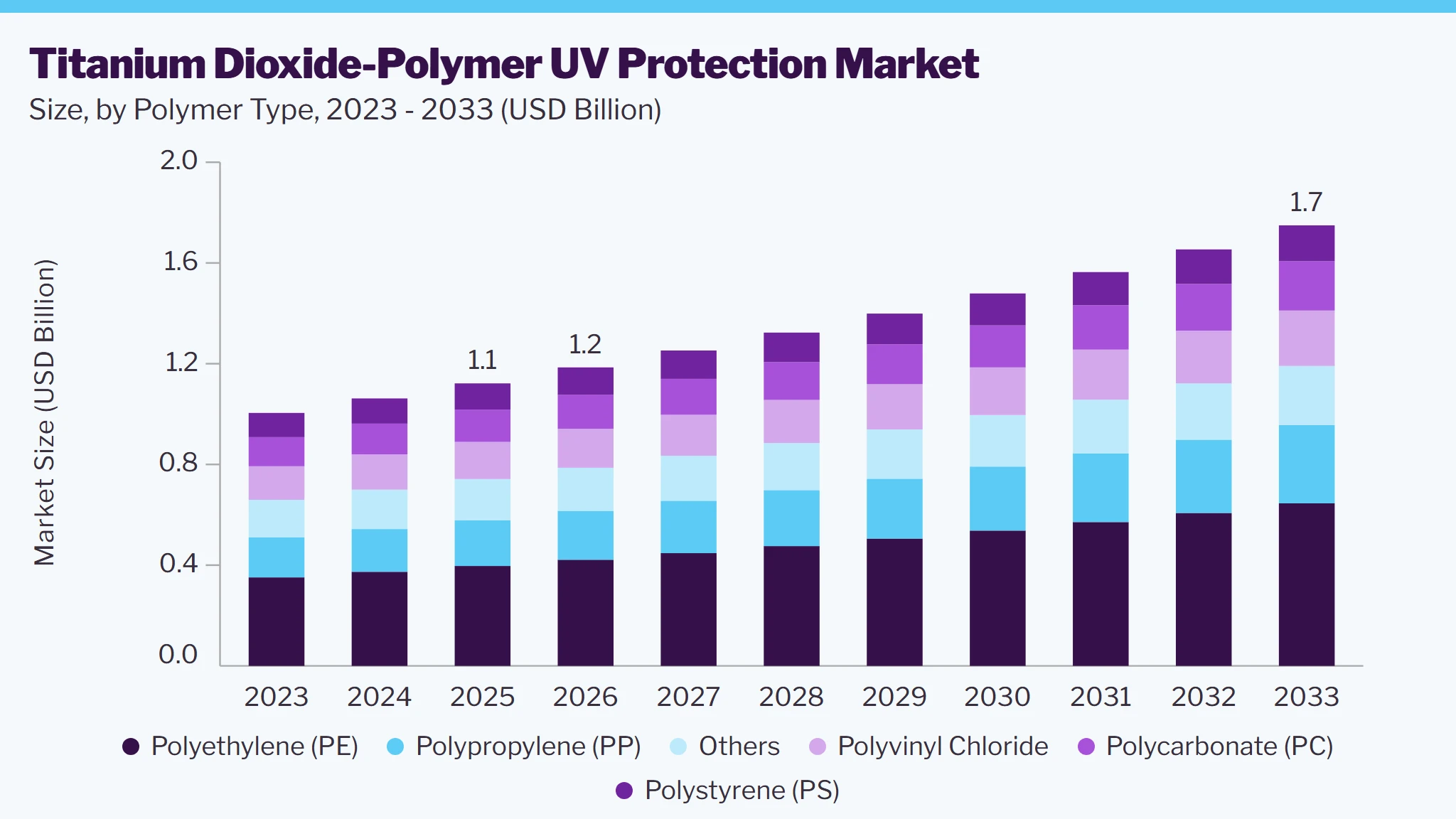
The global titanium dioxide-polymer UV protection market size was valued at USD 1.1 billion in 2025 and is projected to grow from USD 1.2 billion in 2026 to USD 1.7 billion by 2033, growing at a CAGR of 5.7% from 2026 to 2033. Asia Pacific dominated the market, accounting for the largest revenue share of 56.1% in 2025. The market is driven by increasing demand for UV-resistant polymers in automotive, construction, packaging, and agricultural applications.
 Source: Grand View Research, IR Documents, Primary Interviews, Paid DatabasesTo learn more about this report,
 Download Free Sample Report
 Key Market Trends & Insights
- By polymer type: The polypropylene (PP) segment is anticipated to grow at a CAGR of 7.0%.
- By application: The automotive segment is expected to grow at a 6.8% revenue CAGR from 2026 to 2033.
Regional Highlights
- Largest regional market: Asia Pacific (56.1% revenue share, 2025)
- Fastest-growing regional market: Asia Pacific (highest CAGR, 2026-2033)
- By country: India held the largest market share in 2025
Market Size & Forecast
- Market size in 2025: USD 1.1 billion
- Estimated market size in 2026: USD 1.2 Billion
- Projected market size by 2033: USD 1.7 billion
- CAGR (2026 - 2033): 5.7%
Three ways to get this report
Buy it, customize it, or ask a question.Ask an Analyst
A direct answer, usually in 1 working day
- AccessReport author, directly
- Reply timeWithin 1 working day
- No sales callDirect answer only
- FormatEmail reply
- CostFree, no cost
Get the Full Report
What the study covers
- FormatsPDF · Excel · Dashboard
- Timeline2026–2033 annual, 2025 base
- Coverage20+ countries, 5 regions
- Companies10+ key players profiled
Customize the Report
20% free customization
- IncludeCountries, segments, points
- TailorTo your product definition
- ExtendDeeper competitor detail
- OrA fully bespoke study
- Turnaround5–10 working days
Growing exposure to sunlight and weathering necessitates materials that prevent discoloration, cracking, and degradation. Rising adoption of durable outdoor products, expanding infrastructure development, and advancements in titanium dioxide dispersion technologies further support market growth. Increasing demand for lightweight, high-performance polymers with enhanced weather resistance also creates opportunities for market expansion.
 To learn more about this report, Download Free Sample Report
 The market is witnessing a shift toward engineered polymer formulations with improved UV stability and outdoor durability. Manufacturers are optimizing TiO₂ particle dispersion, surface treatment, and loading levels to balance UV shielding with polymer transparency, mechanical strength, and processing efficiency. Rutile-grade titanium dioxide is gaining relevance in applications requiring weather resistance. Surface-modified particles are also being evaluated to reduce photocatalytic degradation in susceptible polymer matrices. These developments support advanced UV-resistant films, automotive components, and construction materials.
Market Dynamics
Increasing demand for weather-resistant polymer products is driving titanium dioxide consumption in outdoor applications. Prolonged exposure to ultraviolet radiation accelerates polymer oxidation, resulting in color fading, surface cracking, brittleness, and reduced mechanical strength. Rutile-grade titanium dioxide, particularly when treated with protective surface coatings, provides opacity, pigmentation, and enhanced resistance to weathering. Its use in PVC, polyurethane, and polyolefin systems enhances polymer durability in demanding outdoor environments and under extended service conditions.
Automotive exterior components, building profiles, agricultural films, and outdoor coatings increasingly require materials that can withstand prolonged solar exposure and temperature fluctuations. Manufacturers incorporate titanium dioxide pigments to improve color retention, surface protection, and product longevity. Growing construction activity, automotive production, and agricultural film applications are supporting demand for durable polymer formulations. Enhanced weather resistance helps reduce premature material degradation, maintenance requirements, and replacement frequency, strengthening titanium dioxide adoption in outdoor polymer products.
Photocatalytic activity in titanium dioxide can undermine polymer durability, particularly when unsuitable grades or inadequate surface treatments are used. UV exposure may generate reactive species that accelerate oxidation in susceptible polymer matrices. This creates a formulation challenge for manufacturers seeking simultaneous UV protection, optical performance, and long-term weather resistance. Additional surface treatment, dispersion control, and compatibility testing increase development complexity and material costs. These factors can restrict adoption in transparent polymers and applications requiring strict appearance retention.
The development of surface-engineered titanium dioxide offers opportunities for high-performance polymer UV protection. Inorganic coatings based on silica, alumina, or zirconia can reduce TiO₂ photocatalytic activity while preserving UV-shielding performance. This supports applications requiring transparent or light-colored materials, including polycarbonate, PMMA, and specialty coatings. Advanced deposition methods also enable thin protective TiO₂ layers with strong adhesion and visible-light transparency. Commercial opportunities exist in premium optical plastics, automotive glazing, and high-durability protective films.
Market Concentration & Characteristics
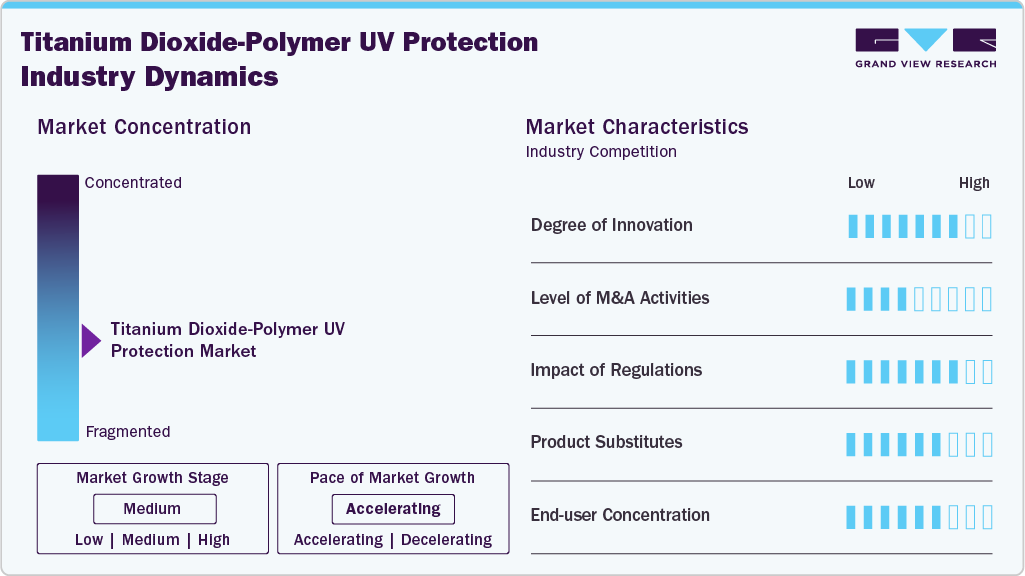
The market growth stage is medium, and growth is accelerating. The market exhibits fragmentation, with key players dominating the industry landscape. Major companies such as The Chemours Company, Tronox Holdings plc, KRONOS Worldwide, Inc., LB Group Co., Ltd., Venator Materials PLC, Tayca Corporation, Ishihara Sangyo Kaisha, Ltd., PRECHEZA a.s., Cinkarna Celje, d.d., Sakai Chemical Industry Co., Ltd., and others play a significant role in shaping the market dynamics. These leading players often drive innovation in the market by introducing new products, technologies, and materials to meet the industry's evolving demands.
Innovation in the titanium dioxide-polymer UV protection industry is concentrated on surface engineering and dispersion performance rather than fundamental material substitution. Producers are developing treated TiO₂ grades that improve weather resistance while limiting photocatalytic reactions in polymer matrices. Chemours, for example, uses silica encapsulation in Ti-Pure R-105 to reduce interaction between TiO₂ and polymers, supporting gloss retention and resistance to chalking in outdoor PVC. Such developments enable higher durability, better processing, and longer service life in demanding exterior polymer applications.
 To learn more about this report, Download Free Sample Report
 Regulatory developments are reshaping TiO₂ handling and compliance requirements, particularly in Europe. In August 2025, the Court of Justice of the European Union upheld the annulment of the EU harmonized classification of certain TiO₂ powders as Carcinogenic Category 2 by inhalation. The European Commission subsequently published a December 2025 notice confirming that this classification no longer applies under the annulled provisions. This reduces regulatory uncertainty for TiO₂ suppliers and polymer processors, although workplace exposure controls and broader chemical-safety obligations remain important.
Analyst Perspective
The titanium dioxide-polymer UV protection market is expected to shift from volume-led pigment demand toward value-led, application-specific performance over the next few years. Growth will remain anchored in construction, automotive, agriculture, electrical and electronics, and outdoor consumer products, where longer polymer service life and weatherability are increasingly important. Innovation will center on surface-treated TiO₂, improved dispersion, lower loading requirements, and grades optimized for PE, PP, PVC, engineering plastics, and specialty compounds. Major suppliers are strengthening production integration, technical support, and sustainability programs, while Chemours and Tronox demonstrate continued focus on differentiated TiO₂ portfolios and responsible manufacturing. Regulatory scrutiny, energy and feedstock volatility, regional overcapacity, logistics disruption, and pricing pressure will constrain margins. Sustainability will increasingly influence supplier selection through lower-emission production, resource efficiency, and supply-chain transparency. Market leaders will therefore differentiate through pigment engineering, integrated raw-material access, geographic manufacturing, formulation expertise, customer co-development, and reliable supply. Overall, competitive advantage is likely to migrate from cost and scale toward performance, sustainability, and application-specific value creation.
Polymer Type Insights
Polyethylene (PE) dominated the market across polymer-type segmentation in terms of revenue, accounting for 35.4% market share in 2025, and is forecast to grow at a 6.3% CAGR from 2026 to 2033. Polyethylene demand for UV-protective formulations is supported by its extensive use in outdoor films and infrastructure products. PE is widely used in agricultural films, geomembranes, pipes, and construction membranes, where it is exposed to solar radiation, and photodegradation can reduce flexibility and mechanical integrity. TiO₂ provides UV screening while also delivering opacity and color retention. This makes treated TiO₂ grades relevant to long-service PE formulations. Growth in durable agricultural and construction plastics is therefore creating a sustained need for effective UV protection within PE systems.
The polypropylene (PP) segment is expected to expand at a 7.0% CAGR over the forecast period. Polypropylene represents an important demand segment because its applications increasingly extend into sunlight-exposed automotive and outdoor components. UV exposure can initiate oxidation and embrittlement in PP, particularly where components operate for prolonged periods outdoors. TiO₂ pigments can provide UV screening while maintaining whiteness and opacity in molded parts. The automotive industry's continued use of lightweight polypropylene components increases the need for weatherable formulations. Demand is therefore linked to the development of PP compounds that combine UV resistance with surface appearance and long-term dimensional performance.
Application Insights
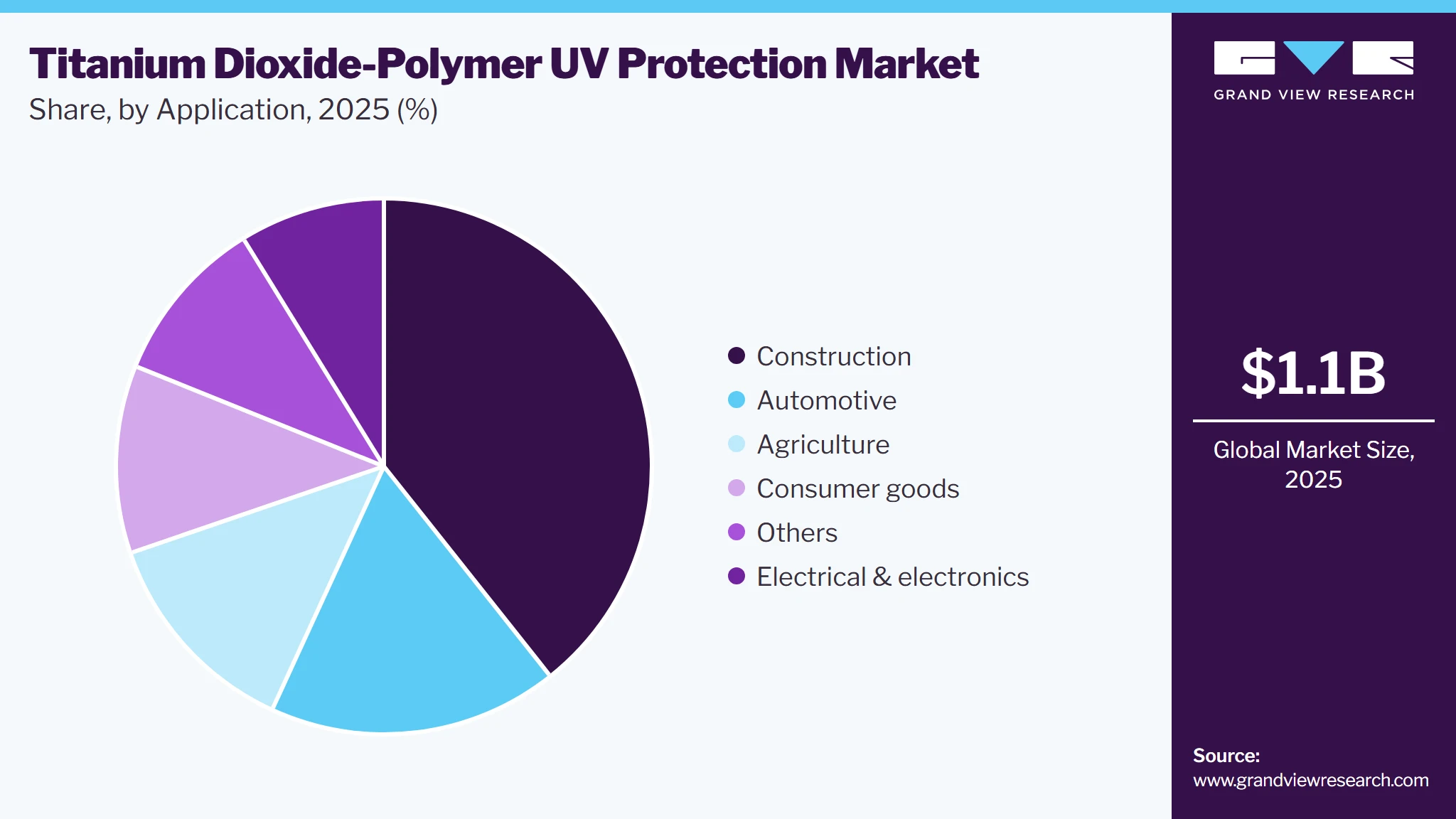
The construction segment led the market by application, accounting for 39.3% of revenue in 2025, and is projected to grow at a 6.2% CAGR from 2026 to 2033. Construction applications are driven by the need to extend the service life of polymer products exposed continuously to solar radiation and weathering. PVC profiles, roofing membranes, polymer sheets, pipes, and exterior building products can experience discoloration and loss of mechanical performance under prolonged UV exposure. TiO₂ improves UV shielding while providing opacity and color stability. Increasing emphasis on durable building envelopes and low-maintenance materials supports its use in outdoor polymer formulations. The demand opportunity is strongest where polymer components require sustained appearance and performance under severe environmental exposure.
 To learn more about this report, Download Free Sample Report
 The automotive segment is expected to grow at the fastest CAGR of 6.8% over the forecast period. Automotive applications are increasingly dependent on UV-stable polymers as manufacturers expand the use of lightweight plastics across exterior and interior components. PP, PE, polycarbonate, and polymer composites can experience fading, surface degradation, and property loss under prolonged exposure to sunlight. TiO₂-based protection helps improve weather resistance while maintaining consistent color and surface appearance. The transition toward lightweight vehicles, including electric vehicles, is expanding the use of polymers in demanding environments. Consequently, automotive compounders are seeking TiO₂ grades with strong dispersion, weathering performance, and compatibility with engineered polymer systems.
Regional Insights
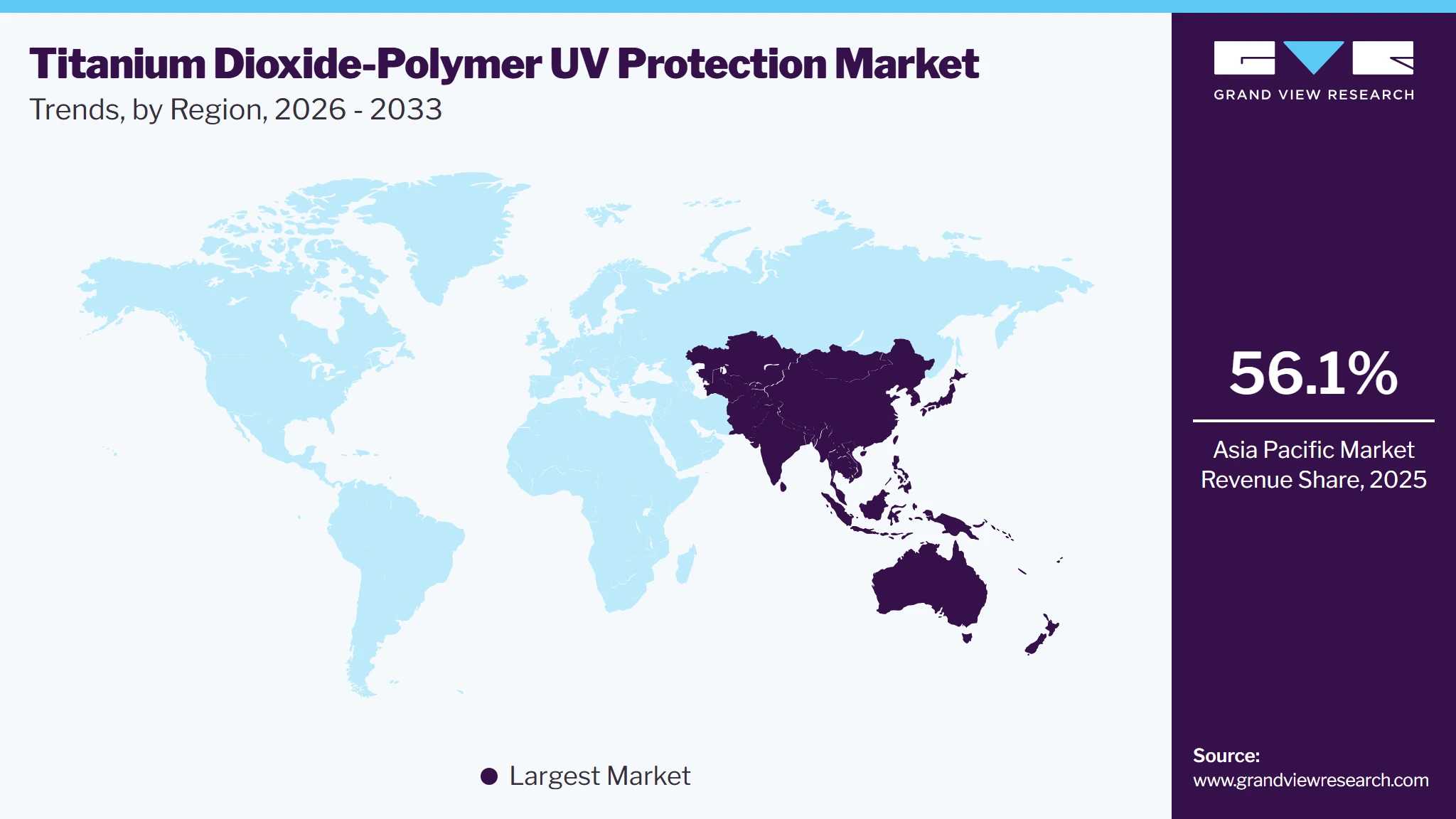
The Asia Pacific titanium dioxide-polymer UV protection market held the largest revenue share of 56.1% in 2025. The region is expected to grow at a CAGR of 6.2% over the forecast period. Asia Pacific is a major demand center due to its concentration of polymer processing and automotive manufacturing. OICA reported that the region produced approximately 59.2 million vehicles in 2025, representing more than 61% of global production. China, Japan, India, South Korea, and Southeast Asia offer substantial opportunities for the consumption of UV-stabilized PE, PP, PVC, and engineering polymers. Rapid industrial expansion and extensive outdoor exposure create sustained requirements for TiO₂-based protection in automotive parts, construction plastics, agricultural films, and infrastructure applications.
 To learn more about this report, Download Free Sample Report
 India Titanium Dioxide-Polymer UV Protection Market Trends
The titanium dioxide-polymer UV protection market in India is being supported by simultaneous expansion in automotive manufacturing, infrastructure, and polymer processing. OICA data show that India produced about 6.49 million vehicles in 2025, including passenger and commercial vehicles. This enlarges the addressable base for UV-resistant PP, PE, PVC, and engineered polymer components. Strong solar radiation across much of the country also increases the importance of weatherability. Demand is consequently developing around durable automotive parts, pipes, roofing materials, agricultural films, and outdoor construction products.
North America Titanium Dioxide-Polymer UV Protection Market Trends
The titanium dioxide-polymer UV protection market in North America is supported by the region’s established use of engineered plastics in outdoor infrastructure, construction products, packaging, and transportation. The market benefits from mature compound development capabilities and stringent performance expectations for long-service polymer products. TiO₂ is particularly relevant when manufacturers require simultaneous opacity, color retention, and weather resistance. Continued investment in resilient infrastructure and advanced polymer formulations is sustaining demand for treated TiO₂ grades capable of withstanding prolonged solar exposure and temperature fluctuations.
The U.S. titanium dioxide-polymer UV protection market is underpinned by the scale and sophistication of its plastics manufacturing base. The U.S. plastics industry generated about USD 551 billion in shipments in 2024, providing a broad downstream platform for UV-resistant polymer formulations. Demand is concentrated in construction materials, automotive components, outdoor products, and industrial plastics. The presence of major TiO₂ suppliers and compounders further supports the adoption of surface-treated grades designed to improve weatherability, dispersion, and long-term polymer performance.
Europe Titanium Dioxide-Polymer UV Protection Market Trends
The titanium dioxide-polymer UV protection market in Europe is increasingly shaped by requirements for long-life, high-performance polymer products rather than simple volume expansion. Automotive manufacturing remains a significant outlet, although regional vehicle production was broadly flat in 2025. OICA reported European production of approximately 17.2 million vehicles that year. TiO₂-based UV protection, therefore, remains relevant for exterior automotive components, construction profiles, membranes, and specialty plastics. Greater emphasis on material durability, product lifetime, and resource efficiency also encourages processors to optimize pigment efficiency and formulation performance.
Latin America Titanium Dioxide-Polymer UV Protection Market Trends
The titanium dioxide-polymer UV protection market in Latin America offers growth potential through expanding automotive production, construction activity, and outdoor polymer consumption. Brazil remains the principal regional manufacturing base, producing approximately 2.64 million vehicles in 2025, according to OICA data. The region’s strong solar exposure increases the performance requirements of agricultural films, pipes, roofing materials, packaging, and automotive plastics. These conditions support the use of TiO₂ grades that provide UV screening, opacity, and color stability. Growing infrastructure investment further expands applications for weather-resistant polymer products.
Middle East and Africa Titanium Dioxide-Polymer UV Protection Market Trends
The titanium dioxide-polymer UV protection market in MEA demand is closely linked to severe climatic exposure and infrastructure development. High solar intensity, elevated temperatures, and outdoor operating conditions increase the risk of degradation for polymer products used in construction, water systems, transportation, and industrial infrastructure. The World Bank reports substantial ongoing industrial and construction activity across the Middle East, North Africa, and neighboring markets. In Africa, rapid urbanization is creating additional infrastructure requirements. These conditions support demand for UV-resistant polymer formulations with extended service life.
Key Titanium Dioxide-Polymer UV Protection Company Insights
Some of the key players operating in the market include The Chemours Company and Tayca Corporation
-
The Chemours Company maintains a strong position in titanium dioxide-polymer UV protection through its broad Ti-Pure portfolio for plastics. Its R-105 grade uses silica encapsulation to limit TiO₂-polymer interactions and improve outdoor weatherability, while R-350 targets polyolefins with enhanced durability, dispersion, and resistance to UV-induced discoloration. The company also offers sustainability-focused TS grades for plastics, strengthening its position in higher-performance and lower-impact polymer formulations.
-
Tayca Corporation strengthens the market through its TITANIX TiO₂ portfolio and micro titanium dioxide technologies. Its products serve plastics and other polymer-related applications, while its expertise in particle-size control, surface modification, and dispersion supports formulation performance. Tayca also develops micro-TiO₂ grades with strong UV-blocking properties, creating opportunities in specialty polymer, automotive, and outdoor applications requiring enhanced UV resistance and material durability.
PRECHEZA a.s. and Sakai Chemical Industry Co., Ltd. are some of the emerging participants.
-
PRECHEZA a.s. strengthens its market position through its PRETIOX portfolio, which includes surface-treated rutile grades designed for demanding plastics. PRETIOX RG18P offers climatic resistance for polyolefins, PVC, engineering plastics, and exterior products, while RGX targets masterbatches and thin films. The company exports more than 90% of its production, providing a broad international reach across Europe, the Americas, Asia, Africa, and the Middle East.
-
Sakai Chemical Industry Co., Ltd. offers a broad titanium dioxide portfolio for plastics, films, engineering plastics, and masterbatches. Its differentiated grades target high weather resistance, color fastness, dispersibility, and low moisture volatility. Rutile grades such as R-21, R-24, R-62N, and R-45M are positioned for weather-resistant polymer applications, supporting UV protection and long-term appearance retention.
Key Titanium Dioxide-Polymer UV Protection Companies
The following key companies have been profiled for this study on the titanium dioxide-polymer UV protection market.
-
The Chemours Company
-
Tronox Holdings plc
-
KRONOS Worldwide, Inc.
-
LB Group Co., Ltd.
-
Venator Materials PLC
-
Tayca Corporation
-
Ishihara Sangyo Kaisha, Ltd.
-
PRECHEZA a.s.
-
Cinkarna Celje, d.d.
-
Sakai Chemical Industry Co., Ltd.
Company Categorization
Operating Strategies
Competitive Edge
Weakness
Mature Players: The Chemours Company, Tronox Holdings plc, KRONOS Worldwide, Inc., LB Group Co., Ltd., Venator Materials PLC, Ishihara Sangyo Kaisha, Ltd., Tayca Corporation
- Maintain broad TiO₂ portfolios covering rutile and specialty grades for plastics, masterbatches, films, coatings, automotive components, construction products, and other weather-sensitive applications.
- Invest in surface treatment, particle-size control, dispersion, weatherability, color retention, and photocatalytic activity management to improve polymer UV protection.
- Strengthen global manufacturing, distribution, technical service, application development, and customer formulation support across major polymer-processing regions.
- Established TiO₂ manufacturing expertise enables consistent pigment quality, dispersion, opacity, UV screening, and weathering performance across demanding polymer applications.
- Broad-grade portfolios allow suppliers to address polyolefins, PVC, engineering plastics, films, masterbatches, and outdoor polymer products with application-specific formulations.
- Global production and technical networks support customer qualification, formulation optimization, and reliable supply for large multinational polymer processors.
- Large-scale mining, pigment production, and global distribution infrastructure can increase operating costs and capital requirements.
- Broad exposure to coatings, plastics, and other TiO₂ applications increases sensitivity to cyclical industrial demand and pigment price competition.
- Advanced polymer grades require precise surface treatment and dispersion control, increasing formulation complexity and development costs.
Emerging Players: PRECHEZA a.s., Cinkarna Celje, d.d., Sakai Chemical Industry Co., Ltd.
- Focus on specialized TiO₂ grades for plastics, masterbatches, films, engineering polymers, and other applications requiring UV resistance and weatherability.
- Develop grades with controlled particle characteristics, surface treatment, dispersibility, color stability, and outdoor durability.
- Expand through regional manufacturing, application-focused product development, technical support, and closer collaboration with polymer compounders and processors.
- Specialized product portfolios enable targeted development for polymer applications requiring UV screening, high weather resistance, color retention, and processing stability.
- Regional manufacturing and focused technical capabilities can support responsive customer service and application-specific grade development.
- Benefits from specialized TiO₂ grades for films, engineering plastics, and masterbatches, strengthening its position in performance-oriented polymer applications.
- Smaller production scale and narrower global distribution networks can limit the ability to compete with the largest multinational TiO₂ suppliers.
- Greater regional concentration can increase exposure to local demand cycles, logistics costs, and customer qualification requirements.
- Specialized portfolios may create higher dependence on selected polymer applications and regional markets.
Recent Developments
-
In January 2026, Tronox announced the permanent closure of its Fuzhou titanium dioxide pigment facility in China. The move formed part of the company’s global capacity optimization in response to weak market conditions and high operating costs, reshaping regional TiO₂ supply available for downstream polymer and plastics applications.
-
In February 2025, Chemours launched Ti-Pure TS-6706, a TMP- and TME-free titanium dioxide grade based on its established R-706 platform. The product broadens TiO₂ options for plastics and other applications where pigment performance, processing characteristics, and formulation requirements are important.
Titanium Dioxide-Polymer UV Protection Market Report Scope
Report Attribute
Details
Market size in 2025
USD 1.1 billion
Estimated market size in 2026
USD 1.2 billion
Projected market size by 2033
USD 1.7 billion
Growth rate
CAGR of 5.7% from 2026 to 2033
Historical data
2021 - 2025
Forecast period
2026 - 2033
Quantitative units
Revenue in USD billion, volume in kilotons, and CAGR from 2026 to 2033
Report coverage
Revenue & volume forecast, competitive landscape, growth factors, and trends
Segments covered
Polymer type, application, region
Regional scope
North America; Europe; Asia Pacific; Latin America; Middle East & Africa
Country scope
U.S.; Canada; Mexico; Europe; Germany; UK; France; Italy; Spain; China; India; Japan; South Korea; Australia; Brazil; Argentina; Saudi Arabia; UAE; South Africa
Key companies profiled
The Chemours Company; Tronox Holdings plc; KRONOS Worldwide, Inc.; LB Group Co., Ltd.; Venator Materials PLC; Tayca Corporation; Ishihara Sangyo Kaisha, Ltd.; PRECHEZA a.s.; Cinkarna Celje, d.d.; Sakai Chemical Industry Co., Ltd.
Customization scope
Free report customization (equivalent to up to 8 analyst working days) with purchase. Addition or alteration to country, regional & segment scope
Pricing and purchase options
Avail customized purchase options to meet your exact research needs. Explore purchase options
Global Titanium Dioxide-Polymer UV Protection Market Report Segmentation
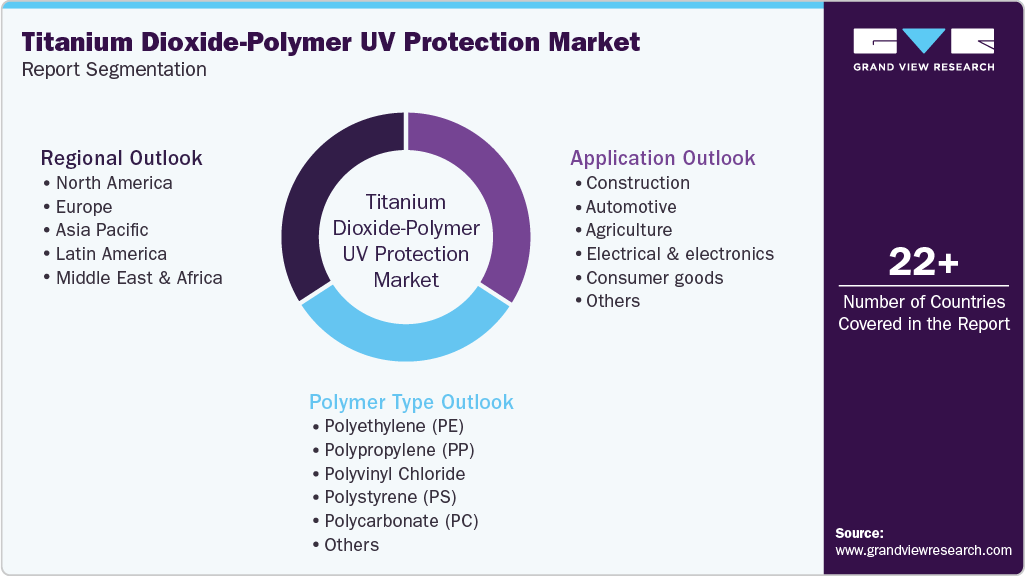
This report forecasts revenue growth at the global, regional, and country levels and provides an analysis of the latest industry trends across sub-segments from 2021 to 2033. For this study, Grand View Research has segmented the global titanium dioxide-polymer UV protection market report based on polymer type, application, and region:
 To learn more about this report, Download Free Sample Report
 -
Polymer Type Outlook (Volume, Kilotons; Revenue, USD Million, 2021 - 2033)
-
Polyethylene (PE)
-
Polypropylene (PP)
-
Polyvinyl Chloride
-
Polystyrene (PS)
-
Polycarbonate (PC)
-
Others
-
-
Application Outlook (Volume, Kilotons; Revenue, USD Million, 2021 - 2033)
-
Construction
-
Automotive
-
Agriculture
-
Electrical & electronics
-
Consumer goods
-
Others
-
-
Regional Outlook (Volume, Kilotons; Revenue, USD Million, 2021 - 2033)
-
North America
-
U.S.
-
Canada
-
Mexico
-
-
Europe
-
Germany
-
UK
-
France
-
Italy
-
Spain
-
-
Asia Pacific
-
China
-
India
-
Japan
-
South Korea
-
Australia
-
-
Latin America
-
Brazil
-
Argentina
-
-
Middle East & Africa
-
Saudi Arabia
-
UAE
-
South Africa
-
-
Research Methodology
The titanium dioxide-polymer UV protection market figures in this report are based on a proven research process that combines executive interviews with secondary research from proprietary databases, company filings, and recognized regulatory and institutional sources. Market size is built through value-chain sizing-reconciling supply-side and demand-side estimates-and triangulated with bottom-up and top-down approaches. Every estimate passes multiple levels of expert validation before publication, with each titanium dioxide-polymer UV protection segment quantified using the revenue-capture definitions in the table below.
Segment Definition
Segment - Polymer Type
Revenue capture definition
Polyethylene (PE)
Revenue is captured through titanium dioxide-polymer UV protection incorporated into PE formulations to improve resistance to ultraviolet radiation, weathering, discoloration, and mechanical degradation. Applications include agricultural films, geomembranes, pipes, construction membranes, packaging, and outdoor products. TiO₂ provides UV screening, opacity, and color retention, supporting longer service life in PE products exposed to prolonged sunlight and demanding outdoor conditions.
Polypropylene (PP)
Revenue is generated from titanium dioxide-polymer UV protection used in PP compounds, films, molded components, and masterbatches that require improved weatherability and resistance to UV-induced oxidation. Key applications include automotive parts, outdoor furniture, packaging, appliances, construction products, and industrial components. Surface-treated TiO₂ grades support UV screening, color stability, and appearance retention while maintaining dispersion and processing performance within PP matrices.
Polyvinyl Chloride (PVC)
Revenue is captured through titanium dioxide-polymer UV protection incorporated into PVC formulations for exterior profiles, roofing membranes, pipes, siding, flooring, and construction products. TiO₂ helps limit UV-induced discoloration, surface degradation, and loss of mechanical properties while providing opacity and whiteness. Demand is supported by the extensive use of rigid and flexible PVC in outdoor construction applications requiring prolonged resistance to solar radiation and weathering.
Polystyrene (PS)
Revenue is generated through titanium dioxide-polymer UV protection used in PS products where improved resistance to sunlight, color fading, and surface degradation is required. Applications include outdoor consumer products, packaging, appliances, insulation systems, and specialty molded components. TiO₂ contributes UV screening, opacity, and color retention, enabling PS formulations to maintain appearance and functional properties during exposure to light and outdoor environmental conditions.
Polycarbonate (PC)
Revenue is captured through titanium dioxide-polymer UV protection incorporated into PC formulations and components requiring enhanced resistance to ultraviolet exposure, discoloration, and surface degradation. Applications include automotive components, lighting systems, glazing, electrical housings, outdoor equipment, and protective panels. Specialized TiO₂ formulations can provide UV shielding while maintaining the optical, mechanical, and processing characteristics required from high-performance polycarbonate products.
Others
Revenue comes from titanium dioxide-polymer UV protection used with additional polymer systems such as polyurethane, acrylics, ABS, polyamide, polyester, and specialty polymer composites. These formulations are developed for applications requiring specific combinations of UV resistance, weatherability, color stability, transparency, mechanical durability, and processing performance. Demand varies according to polymer chemistry, outdoor exposure, required service life, pigment dispersion, and compatibility with the selected polymer matrix.
Segment - Application
Revenue capture definition
Construction
Revenue is generated through titanium dioxide-polymer UV protection used in roofing membranes, PVC profiles, siding, pipes, geomembranes, insulation materials, polymer sheets, and other exterior construction products. These materials require resistance to prolonged solar radiation, temperature variation, and weathering. TiO₂ provides UV screening, opacity, whiteness, and color retention, helping polymer-based construction products maintain appearance and mechanical performance throughout extended outdoor service periods.
Automotive
Revenue is captured through titanium dioxide-polymer UV protection incorporated into automotive polymer components exposed to sunlight and elevated temperatures. Applications include exterior trim, body components, lighting elements, interior parts, under-hood plastics, and selected electric-vehicle components. UV-resistant TiO₂ formulations help minimize fading, chalking, embrittlement, and surface degradation. Demand is supported by increasing polymer utilization for lightweight vehicle components and the requirement for long-term appearance and durability.
Agriculture
Revenue is generated through titanium dioxide-polymer UV protection used in agricultural films, greenhouse coverings, irrigation components, crop-protection materials, and other outdoor polymer products. Continuous solar exposure can accelerate polymer degradation and shorten product life. TiO₂-based formulations provide UV screening and help maintain film strength, optical properties, and dimensional stability. Demand is linked to protected cultivation, durable agricultural films, and increasing use of polymer materials in water-efficient farming systems.
Electrical & electronics
Revenue is captured through titanium dioxide-polymer UV protection used in electrical housings, connectors, appliances, lighting components, cable systems, and electronic enclosures requiring resistance to UV exposure and environmental degradation. TiO₂ can improve color stability, opacity, and weatherability in polymer components used in indoor and outdoor electrical systems. Demand is supported by increasing deployment of polymer-based components in electronics, power infrastructure, telecommunications equipment, and outdoor electrical installations.
Consumer goods
Revenue is generated through titanium dioxide-polymer UV protection incorporated into outdoor furniture, sporting goods, household products, toys, storage products, packaging, and other consumer polymer articles. UV protection helps preserve color, surface appearance, and mechanical integrity during prolonged light exposure. Demand is supported by consumer preference for durable outdoor products and manufacturers' efforts to extend product life through weather-resistant polymer formulations that combine UV protection with attractive appearance and processing efficiency.
Others
Revenue comes from titanium dioxide-polymer UV protection used in additional applications such as packaging, industrial equipment, infrastructure components, marine products, textiles, recreational products, and outdoor machinery. These applications require varying levels of UV resistance, weatherability, color retention, and mechanical durability. Demand depends on exposure intensity, polymer selection, required service life, regulatory requirements, and the ability of TiO₂-containing formulations to deliver consistent UV shielding without compromising processing or end-product performance.
Estimation Model
Layer Name
Key Question
Description
Top-Down Titanium Dioxide-Polymer UV Protection Demand Assessment Layer
What defines overall market demand?
Establishes overall global demand for titanium dioxide-polymer UV protection across PE, PP, PVC, PS, PC, and other polymer types used in construction, automotive, agriculture, electrical & electronics, consumer goods, and other outdoor or UV-exposed applications. The layer evaluates polymer consumption, TiO₂ incorporation, UV exposure intensity, weatherability requirements, product durability, and adoption of UV-resistant polymer formulations.
Application Demand Validation Layer
Where is demand concentrated?
Maps demand across construction, automotive, agriculture, electrical & electronics, consumer goods, and other applications based on solar exposure, weathering severity, required service life, color retention, opacity, mechanical stability, and resistance to UV-induced polymer degradation. The layer validates application demand by assessing the use of TiO₂-containing PE, PP, PVC, PS, PC, and specialty polymer formulations in outdoor and sunlight-exposed products.
Consumption-to-Revenue Conversion Layer
How is demand monetized?
Converts titanium dioxide-polymer UV protection consumption into market revenue using polymer type, TiO₂ grade, rutile or specialty grade, surface treatment, particle characteristics, loading level, dispersion performance, UV resistance, weatherability, application requirements, production scale, manufacturing costs, and prevailing pricing structures. The layer also considers premiums associated with surface-treated and high-performance TiO₂ grades offering enhanced weatherability, color stability, dispersion, processing efficiency, and long-term polymer durability.
Regional Demand Verification Layer
Where is demand validated?
Validates market demand across North America, U.S., Asia Pacific, India, Europe, Latin America, and Middle East & Africa using polymer production, automotive manufacturing, construction activity, agricultural film consumption, electrical and electronics production, outdoor product demand, TiO₂ manufacturing capacity, import and supply patterns, regulatory requirements, and formulation technology adoption. The layer also evaluates regional solar exposure, infrastructure development, polymer-processing capabilities, and demand for durable UV-resistant materials.
Delivered Customizations
This report has been delivered with the following In-depth customizations
Client Request
Customization Delivered
Value Adds
Regional segmentation
The market was segmented across North America, U.S., Asia Pacific, India, Europe, Latin America, and Middle East & Africa, with region-specific assessment of polymer processing activity, outdoor exposure, construction demand, automotive production, agricultural films, and infrastructure development.
Provides a localized view of demand conditions and identifies regions where UV-resistant polymer applications are expanding. It also helps distinguish mature consumption centers from emerging demand markets.
Competitive benchmarking
Competitive benchmarking covered The Chemours Company, Tronox Holdings plc, KRONOS Worldwide, LB Group, Venator Materials, Ishihara Sangyo Kaisha, Tayca, PRECHEZA, Cinkarna Celje, and Sakai Chemical Industry. Companies were assessed using revenue scale, geographical presence, TiO₂ product breadth, plastics portfolio, weatherability capabilities, application coverage, and strategic positioning.
Establishes a structured view of competitive intensity and differentiates large-scale TiO₂ producers from specialized and regionally positioned suppliers. It also highlights product and application-level competitive advantages.
Opportunity assessment
Opportunity assessment focused on applications where UV protection delivers measurable polymer-performance benefits, including exterior building products, PE and PP films, agricultural films, automotive components, masterbatches, engineering plastics, outdoor furniture, roofing membranes, and infrastructure products. Emerging opportunities were linked to higher-weatherability grades, surface-engineered TiO₂, improved dispersion, durable polymer formulations, and longer product service life.
Identifies commercially attractive application spaces beyond conventional white pigmentation. The assessment connects formulation innovation with durability, reduced replacement frequency, longer service life, and increasing performance requirements for outdoor polymer products.
Frequently Asked Questions About This Report
Rising demand for UV-resistant polymers in automotive, construction, packaging, and agriculture is driving titanium dioxide adoption, supported by infrastructure growth, outdoor applications, improved dispersion technologies, and demand for lightweight polymers with enhanced weather resistance.
The Asia Pacific Titanium Dioxide-Polymer UV Protection market accounted for the largest share of 56.1% market size in 2025.
India was the leading player in the Titanium Dioxide-Polymer UV Protection market and is expected to grow at a compound annual growth rate of 8.5%.
Based on application, the construction segment accounted for the largest share of 39.3% market size in 2025. Construction demand is driven by growing use of UV-resistant PVC profiles, roofing membranes, pipes, and polymer sheets requiring long-term weatherability, color retention, and structural durability.
The global titanium dioxide-polymer UV protection market was estimated at around USD 1.1 billion in the year 2025 and is expected to reach around USD 1.2 billion in 2026.
The global titanium dioxide-polymer UV protection market is expected to grow at a compound annual growth rate of 5.7% from 2026 to 2033 to reach around 1.7 billion by 2033.
The polyethylene (PE) in the titanium dioxide-polymer UV protection industry led the plastics in the polymer type market in 2025 with a 35.4% share. Demand is driven by growing use of PE agricultural films, geomembranes, pipes, construction membranes, and outdoor products requiring UV resistance, color retention, and extended service life.
The key players in the titanium dioxide-polymer UV protection market are The Chemours Company, Tronox Holdings plc, KRONOS Worldwide, Inc., LB Group Co., Ltd., Venator Materials PLC, Tayca Corporation, Ishihara Sangyo Kaisha, Ltd., PRECHEZA a.s., Cinkarna Celje, d.d., and Sakai Chemical Industry Co., Ltd.
The polypropylene (PP) segment, based on polymer type, is expected to grow at a CAGR of 7.0% for the forecast period.
About the Author(s)
Plastics, Polymers & Resins Research Team
Bulk Chemicals · Plastics, Polymers & ResinsThis report was authored by the plastics, polymers & resins research team at Grand View Research - comprising two research analysts, one senior research analyst, and one industry expert - with specialized expertise in the plastics, polymers & resins segment of the bulk chemicals industry. All findings are based on proprietary bulk chemicals databases, executive interviews, and regulatory analysis, subject to internal peer review prior to publication.
Last Updated:
Speak to Analyst

Customize this report to your needs - add regions, segments, or data points, with 20% free customization.
Or view our licence options:


ISO 9001:2015 & 27001:2022 Certified
We are GDPR and CCPA compliant! Your transaction & personal information is safe and secure. For more details, please read our privacy policy.


