
- Home
- »
- Next Generation Technologies
- »
-
Travel Rewards Credit Cards Market Size Report, 2026-2033GVR Report cover

Travel Rewards Credit Cards Market (2026 - 2033)
Size, Share & Trends Analysis Report By Card Type (Personal, Business, Co-Branded, Non-Co-Branded), By Card Network, By Distribution Channel, By Application, By End Use, By Region, And Segment Forecasts
Market Size, 2025
$200.1BMarket Estimate, 2026
$211.1BMarket Forecast, 2033
$375.2BCAGR, 2026–2033
8.6%Travel Rewards Credit Cards Market Summary
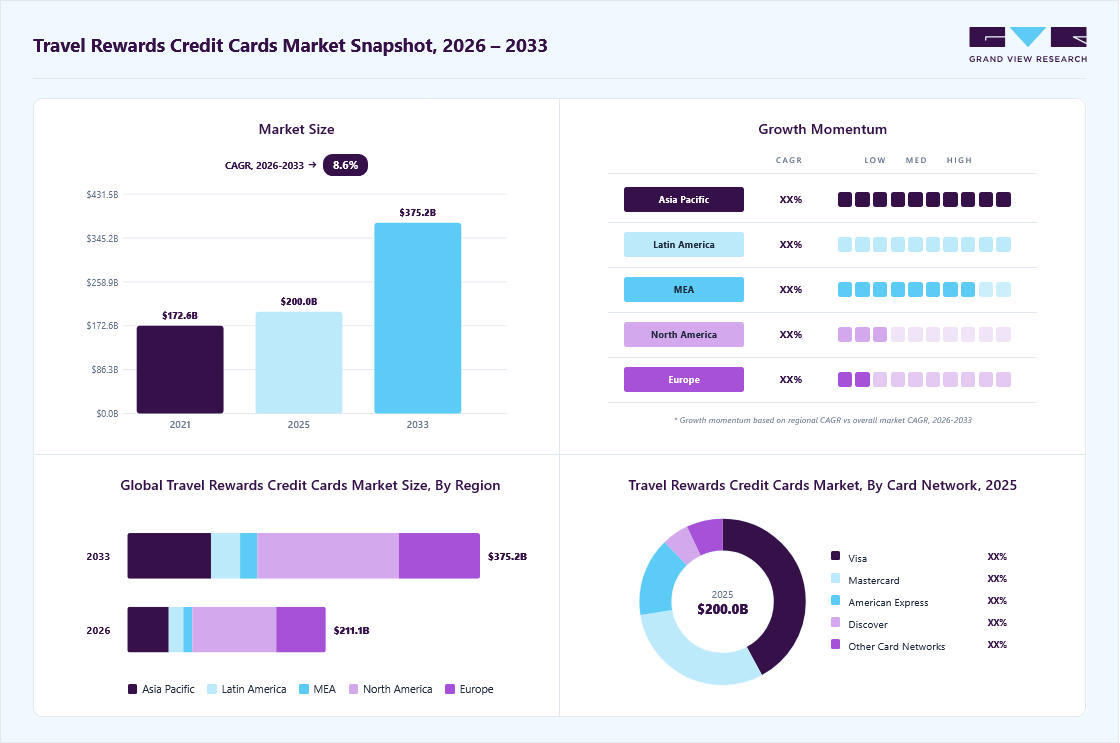
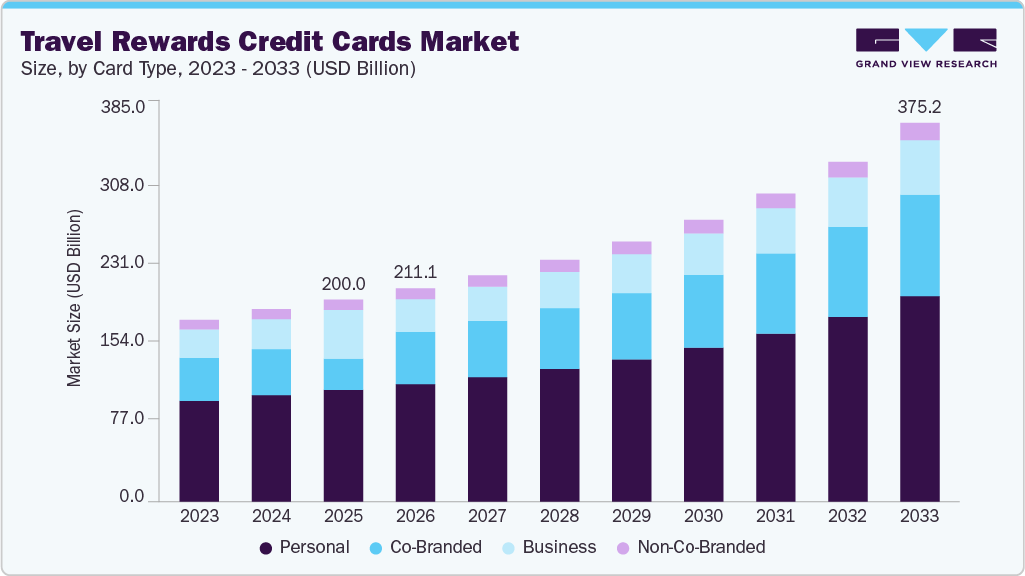
The global travel rewards credit cards market size was valued at USD 200.1 billion in 2025 and is projected to grow from USD 211.1 billion in 2026 to USD 375.2 billion by 2033, at a CAGR of 8.6% from 2026 to 2033. The North America held the largest share of 42.6% of the global market in 2025. The increasing demand for travel and tourism is driving the growth of the market.
 Source: Grand View Research, IR Documents, Primary Interviews, Paid DatabasesTo learn more about this report,
 Download Free Sample Report
 Key Market Trends & Insights
- By card type: Personal card segment held the largest share of 55.25% in 2025.
- By card network: Visa segment held the largest share in 2025.
- By distribution channel: Banks segment held the largest share in 2025.
- By application: Domestic travel segment held the largest share in 2025.
Regional Highlights
- Largest regional market: North America (42.6% revenue share, 2025)
- Fastest-growing regional market: Asia Pacific (highest CAGR, 2026-2033)
- By country: The U.S. led the North America market in 2025.
Market Size & Forecast
- Market size in 2025: USD 200.1 Billion
- Estimated market size in 2026: USD 211.1 Billion
- Projected market size by 2033: USD 375.2 Billion
- CAGR (2026-2033): 8.6%
Three ways to get this report
Buy it, customize it, or ask a question.Ask an Analyst
Analyst response in 1 business day
- AccessReport author, directly
- Reply timeWithin 1 working day
- No sales callDirect answer only
- FormatEmail reply
- CostFree, no cost
Get the Full Report
What the study covers
- FormatsPDF · Excel · Dashboard
- Timeline2026–2033 annual, 2025 base
- Coverage20+ countries, 5 regions
- Companies10+ key players profiled
Customize the Report
20% free customization
- IncludeCountries, segments, points
- TailorTo your product definition
- ExtendDeeper competitor detail
- OrA fully bespoke study
- Turnaround5–10 working days
With the rise in travel expenditure, consumers are adopting travel rewards credit cards to earn points and benefits, thereby incentivizing higher spending. These cards enable users to offset future travel costs or access premium services such as seat upgrades and airport lounge access. Simultaneously, credit card providers are witnessing increased usage and engagement across their rewards programs, prompting them to enhance offerings with incentives such as bonus miles and accelerated rewards on travel-related transactions. This increasing adoption, coupled with an evolving value proposition, is contributing to the expansion of both the travel and credit card markets.
 To learn more about this report, Download Free Sample Report
 The integration of mobile and digital wallets is driving demand for travel rewards credit cards. This integration allows users to add their cards to mobile wallets such as Apple Pay, Google Pay, and Samsung Pay. These technologies enhance the convenience of using travel rewards cards. In addition, mobile wallets often provide real-time reward tracking, enabling users to monitor and redeem points or miles instantly. The added security features, such as biometric authentication, also help build trust and reduce fraud concerns, making users more comfortable using their cards for mobile payments. As a result, consumers are more likely to engage with and continue using travel rewards cards, which leads to higher transaction volumes and greater rewards accumulation. Moreover, the rising adoption of mobile wallets, coupled with growing demand for reward-based credit cards, is driving growth in the digital payments ecosystem.
High annual fees on travel rewards credit cards, often amounting to hundreds of dollars, pose a challenge for consumers, especially those who travel infrequently. In addition, the complexity of understanding the full range of benefits and ensuring that the cardholder uses them effectively can deter some consumers from adopting premium cards. The upfront cost, coupled with the need for high travel spending to justify the card’s value, can limit the appeal of premium travel rewards cards, particularly among infrequent travelers and lower-income consumers.
Card Type Insights
The personal segment accounted for the largest share of 55.25% in 2025. Personal travel rewards credit cards are widely adopted across consumer segments due to their seamless integration with everyday spending and lifestyle needs. These cards enable the accumulation of rewards on routine purchases, making them highly suitable for individuals seeking to enhance their travel experiences without requiring dedicated travel-related expenditure. In addition, they offer cost efficiencies through benefits such as cashback, points, or miles that can be redeemed for travel expenses, thereby reducing the overall cost of travel. Their compatibility with digital wallets and mobile payment systems further strengthens their position as the preferred card type among individuals aiming to maximize rewards while managing personal finances effectively.
The Co-branded segment is expected to grow at the fastest CAGR during the forecast period. The co-branded segment is witnessing significant growth, driven by strategic partnerships between financial institutions and travel service providers such as airlines, hotels, and online travel platforms. These collaborations enable card issuers to offer highly targeted rewards, including airline miles, hotel loyalty points, priority boarding, and exclusive discounts, thereby enhancing the overall value proposition for frequent travelers. Co-branded travel rewards credit cards also benefit from strong brand affinity, as consumers are more likely to adopt cards associated with trusted travel brands they regularly engage with. In addition, the integration of loyalty programs with credit card offerings allows for seamless accumulation and redemption of rewards, further improving customer retention and usage.
Card Network Insights
The visa segment accounted for the largest share in 2025. Visa-based travel rewards credit cards are widely used across sectors such as retail, travel, and e-commerce, where seamless transactions and value-added rewards are highly sought after. Their extensive merchant acceptance, compatibility with diverse payment platforms, and availability across multiple tiers (e.g., Classic, Gold, and Platinum) make them a preferred choice for both frequent travelers and occasional users. In addition, the emphasis on travel-specific perks, including airline miles, hotel loyalty points, and priority services, aligns with the growing demand for enhanced travel experiences. As consumers increasingly shift toward digital and cashless payment methods, these cards are being integrated with mobile wallets and digital platforms, further supporting their adoption and market growth.
The American Express segment is expected to witness the fastest CAGR over the forecast period. Premium offerings from American Express, such as the American Express Platinum Card and American Express Gold Card, play a key role in driving the travel rewards credit cards market by attracting affluent consumers seeking luxury and exclusive benefits. These cards provide high-value perks, including access to over 1,550 airport lounges, comprehensive travel insurance, and concierge services, making them particularly appealing to frequent travelers. The strong value proposition of these premium benefits is driving demand within the high-end segment of the market.
Distribution Channel Insights
The banks segment accounted for the largest share in 2025. This segment plays a crucial role in the market due to its extensive reach, established infrastructure, and large customer base. Banks serve as the primary distributors of travel rewards credit cards, offering these products to a broad range of consumers, from everyday spenders to high-income travelers. They also leverage existing customer relationships to promote and issue co-branded credit cards in partnership with airlines, hotel chains, and other travel service providers. Additionally, banks utilize both traditional channels, such as in-branch promotions, and digital platforms, including mobile banking applications and websites, to enhance product visibility and accessibility. With the growing demand for cashless transactions and digital wallets, banks are further strengthening distribution by integrating credit cards with mobile payment solutions and enabling seamless online application processes, thereby improving customer access and driving card adoption.
The online platform segment is expected to grow at a significant CAGR during the forecast period. The online platforms segment is driven by the increasing adoption of digital channels for travel booking and financial services. This includes both issuer-led platforms such as Chase Travel and Amex Fine Hotels & Resorts, as well as third-party online travel agencies (OTAs), which provide seamless and convenient booking experiences. These platforms enable users to compare options, book travel services, and earn rewards on transactions involving flights, hotels, and car rentals. Additionally, issuer-integrated platforms offer enhanced benefits such as exclusive rewards, personalized deals, and accelerated points accumulation, encouraging users to transact within their ecosystem. The growing preference for convenience, digital accessibility, and value-added services is driving the adoption of online platforms, thereby strengthening their role as a key distribution channel.
Application Insights
The domestic travel segment accounted for the largest share in 2025. The rising popularity of local tourism, supported by improved transportation infrastructure and a growing number of budget-friendly accommodations, has encouraged more frequent domestic travel. Travel rewards credit cards are well-aligned with this trend, as they offer benefits on everyday travel-related expenses such as fuel, dining, and hotel stays, enabling users to earn rewards even on short-distance trips. In addition, the convenience of digital payments and mobile wallet integration has made it easier for consumers to use credit cards across a wide range of domestic merchants. As consumers continue to prioritize affordability, flexibility, and frequent travel experiences, the demand for travel rewards credit cards within the domestic travel segment is expected to remain strong.
The online booking segment is expected to grow at the fastest CAGR during the forecast period. The rise of flexible redemption options on non-co-branded travel cards is driving market growth. These cards enable users to book across multiple providers without brand restrictions and allow cardholders to earn and redeem rewards across various airlines, hotels, and travel services. This approach appeals to consumers seeking greater choice and the ability to maximize rewards across diverse travel expenses. The flexibility to book with any airline or hotel, combined with the growing demand for personalized travel experiences, is accelerating the shift toward non-co-branded cards.
End Use Insights
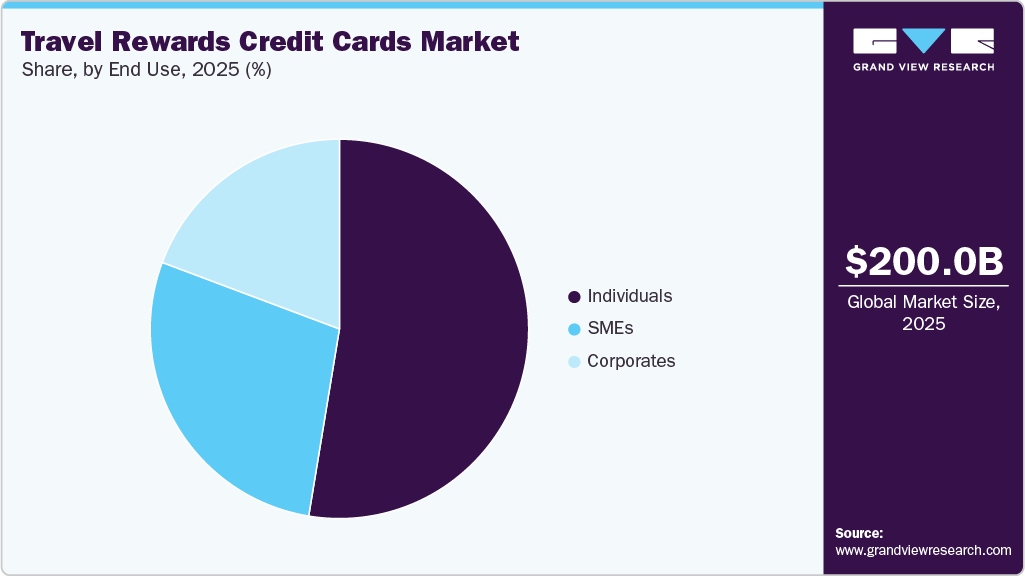
The individuals segment accounted for the largest share in 2025. The segment is driven by the growing preference for flexibility and personalization in travel and rewards usage. Individual consumers increasingly favor travel rewards credit cards that allow them to earn and redeem points across multiple airlines, hotels, and travel service providers, rather than being restricted to a single brand. This flexibility enables users to tailor their travel plans based on convenience, pricing, and personal preferences. Additionally, the ability to accumulate rewards through both everyday spending and travel-related expenses enhances the overall value proposition for individual users. As demand for personalized travel experiences continues to rise, consumers are increasingly shifting toward cards that offer greater choice and redemption flexibility, thereby driving adoption within the segment.
 To learn more about this report, Download Free Sample Report
 The SMEs segment is expected to grow at the fastest CAGR during the forecast period. The Small and Medium Enterprises (SMEs) segment plays a significant role in the travel rewards credit cards market, as these cards are widely used to manage business-related expenses. They are particularly valued for their ability to accumulate rewards such as miles or cashback, which can be strategically redeemed to offset travel and operational costs. In addition, SMEs benefit from the flexibility of credit card usage, supporting improved cash flow management while earning rewards on routine expenditures. The increasing reliance on card-based payments for business spending, combined with the ability to maximize savings through reward redemption, is driving the adoption of travel rewards credit cards among SMEs to enhance cost efficiency and business travel experiences.
Regional Insights
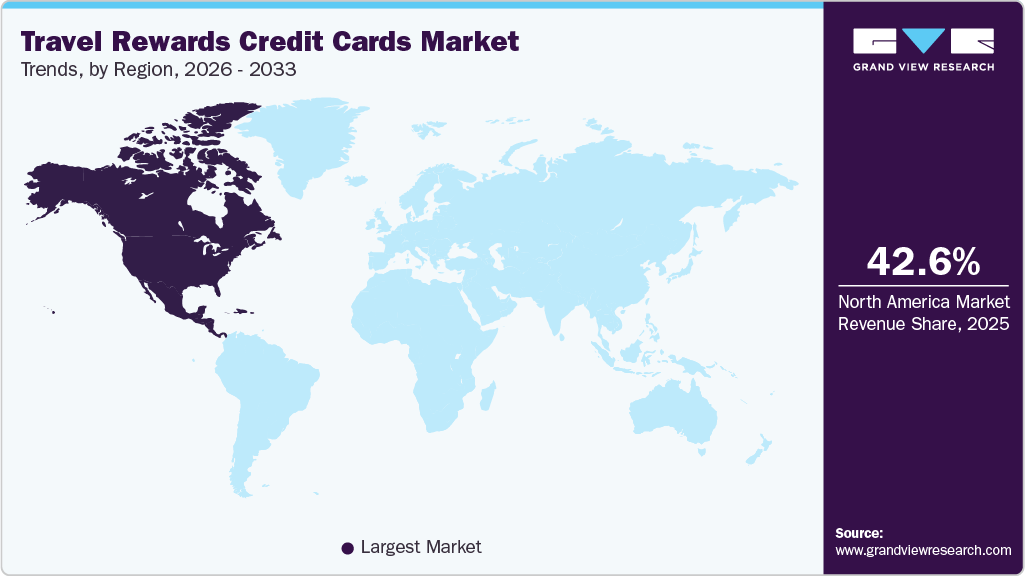
North America travel rewards credit cards market held the largest share of 42.6% in 2025. The increasing popularity of road trips and weekend getaways has boosted domestic travel activity, thereby creating additional growth opportunities for travel rewards credit cards. These cards incentivize short-distance travel by offering rewards on routine travel-related expenditures such as fuel, accommodation, and dining. As consumers increasingly prefer driving vacations and nearby destinations, they are able to accumulate points, cashback, or miles on everyday travel spending. These rewards can later be redeemed for future travel bookings, enhancing the overall value proposition of such trips and strengthening consumer engagement with travel rewards programs.
 To learn more about this report, Download Free Sample Report
 U.S. Travel Rewards Credit Cards Market Trends
The travel rewards credit cards market in the U.S. held a dominant share in 2025. Major credit card issuers in the U.S., such as American Express and JPMorgan Chase & Co., have developed robust loyalty programs through strategic partnerships with airlines, hotel chains, and travel companies. These collaborations enable cardholders to earn exclusive rewards, including airline miles, hotel points, and travel discounts, tailored to their spending and travel preferences. As a result, consumers benefit from enhanced value and personalized travel experiences, which strengthen their loyalty toward both the card issuers and their travel partners.
Europe Travel Rewards Credit Cards Market Trends
The travel rewards credit cards market in Europe held a significant share in 2025. The European travel rewards credit card industry is witnessing steady growth, driven by the increasing entry of fintech players offering innovative and personalized reward structures. Fintech competitors are introducing flexible rewards programs, such as RevPoints, that allow consumers to tailor benefits based on their spending and travel preferences. These players are using mobile-first platforms and advanced data analytics to enhance customer engagement through real-time rewards tracking and seamless redemption. The market is further supported by the growing preference for app-based financial services, which is encouraging wider adoption of personalized travel rewards credit cards across Europe.
The UK travel rewards credit cards market held a significant share in 2025. The UK market is driven by the recovery in travel demand and increasing consumer preference for value-added financial products. Following the easing of travel restrictions, both domestic and international tourism have rebounded strongly, with consumers increasingly using credit cards to earn rewards on travel-related spending. The market is further supported by the rising adoption of digital banking and mobile payment platforms, which enable seamless access to rewards tracking and redemption.
Asia Pacific Travel Rewards Credit Cards Market Trends
The travel rewards credit cards market in Asia Pacific is expected to grow at the fastest CAGR over the forecast period, driven by the rapid expansion of the middle-class population and rising disposable incomes across key economies such as China, India, and Southeast Asia. As economic development accelerates in the region, an increasing number of consumers are gaining the financial capacity to undertake both domestic and international travel. This growing travel propensity is fueling demand for travel rewards credit cards, which offer benefits such as airline discounts, hotel rewards, and exclusive travel perks. In addition, rising income levels are encouraging consumers to use these cards as a means to optimize travel spending and enhance affordability through reward accumulation.
The China travel rewards credit cards market is expected to grow at the fastest CAGR over the forecast period. As Chinese consumers become more affluent, demand for luxury travel and premium travel experiences is increasing. Travel rewards credit cards are gaining traction as they offer exclusive benefits such as airport lounge access, priority boarding, and comprehensive travel insurance. These value-added perks enhance the overall travel experience, making such cards particularly attractive to high-income consumers. As a result, rising preferences for premium and experience-driven travel are contributing to the growing adoption of these cards in China.
The travel rewards credit cards market in India is expected to grow at the fastest CAGR over the forecast period. Indian credit card issuers partnered with major airlines like IndiGo and Air India, as well as hotel chains such as OYO and Taj Hotels, to create co-branded credit cards. These cards offer tailored rewards, such as frequent flyer miles and hotel points, that cater specifically to the travel needs of Indian consumers. By providing specialized benefits, these cards attract travelers who want to maximize their spending on flights, hotel stays, and other travel-related expenses.
Key Travel Rewards Credit Card Companies Insights
Some of the key companies in the travel rewards credit card market include JPMorgan Chase & Co., Capital One, Marriott International, Inc., Wells Fargo, and Southwest Airlines Co., among others. These companies focus on product innovation, R&D, and strategic initiatives such as new product launches, business expansions, partnerships, collaborations, and mergers and acquisitions.
-
Capital One Financial Corporation transformed the credit card industry more than 25 years ago by leveraging data and technology. It is one of the most well-known banking brands in the U.S., serving over 100 million customers across a broad range of financial services. The company offers products including credit cards, checking and savings accounts, auto loans, business banking, commercial banking, Capital One Shopping, and CreditWise.
-
JPMorgan Chase & Co. is a leading U.S.-based financial services firm with a global presence. The company serves consumers and small businesses by offering a wide range of financial products and services, including personal banking, credit cards, mortgages, auto financing, investment advisory, small business lending, and payment processing.
Key Travel Rewards Credit Card Companies:
The following key companies have been profiled for this study on the travel rewards credit card market.
- JPMorgan Chase & Co.
- Capital One
- American Express
- Marriott International, Inc.
- Wells Fargo
- Southwest Airlines Co.
- Bank of America Corporation
- HSBC Group
- U.S. Bank
- TD Bank
Recent Developments
-
In August 2025, American Express and Marriott International announced enhanced co-branded credit cards in Japan, aimed at delivering premium travel and lifestyle experiences. The updated Marriott Bonvoy American Express Premium Card and Marriott Bonvoy American Express Card offer improved benefits, including accelerated points accumulation on everyday and travel-related spending. Card members can earn rewards through the Marriott Bonvoy program and redeem them for hotel stays, upgrades, and exclusive travel experiences. The cards also provide elite status benefits such as Gold or Platinum membership, which unlock perks like room upgrades and late check-outs. This partnership reflects growing demand in Japan for premium travel experiences and strengthens the integration of loyalty programs with credit card offerings.
-
In March 2025, JPMorgan Chase & Co. and United Airlines announced a major refresh of their co-branded United MileagePlus credit card portfolio. The updated cards introduced enhanced travel benefits, including improved rewards redemption options, expanded travel credits, and additional perks for frequent flyers. The overhaul also strengthened the integration between credit card spending and the United MileagePlus, allowing cardmembers to earn rewards more efficiently. In addition, the refreshed offerings included expanded travel protections such as improved insurance coverage and lifestyle benefits aimed at increasing card value. Overall, the initiative was designed to deliver greater value to travelers while deepening customer engagement within the United-Chase partnership.
Travel Rewards Credit Cards Market Report Scope
Report Attribute
Details
Market size in 2025
USD 200.1 billion
Estimated market size in 2026
USD 211.1 billion
Projected market size by 2033
USD 375.2 billion
Growth rate
CAGR of 8.6% from 2026 to 2033
Base year for estimation
2025
Historical data
2021 - 2024
Forecast period
2026 - 2033
Quantitative units
Revenue in USD million/billion, and CAGR from 2026 to 2033
Report coverage
Revenue forecast, company market share, competitive landscape, growth factors, and trends
Segments covered
Card type, card network, distribution channel, application, end use, region
Regional scope
North America; Europe; Asia Pacific; Latin America; MEA
Country scope
U.S.; Canada; Mexico; UK; Germany; France; China; India; Japan; Australia; South Korea; Brazil; Kingdom of Saudi Arabia (KSA); UAE; South Africa
Key companies profiled
JPMorgan Chase & Co.; Capital One; American Express; Marriott International, Inc.; Wells Fargo; Southwest Airlines Co.; Bank of America Corporation; HSBC Group; U.S. Bank; TD Bank
Customization scope
Free report customization (equivalent up to 8 analysts working days) with purchase. Addition or alteration to country, regional & segment scope.
Pricing and purchase options
Avail customized purchase options to meet your exact research needs. Explore purchase options
Global Travel Rewards Credit Cards Market Report Segmentation
This report forecasts revenue growth at global, regional, and country levels and provides an analysis of the latest industry trends in each of the sub-segments from 2021 to 2033. For this study, Grand View Research has segmented the global travel rewards credit cards market report based on card type, card networks, distribution channel, application, end use, and region:
-
Card Type Outlook (Revenue, USD Million, 2021 - 2033)
-
Personal
-
Business
-
Co-Branded
-
Non-Co-Branded
-
-
Card Network Outlook (Revenue, USD Million, 2021 - 2033)
-
Visa
-
Mastercard
-
American Express
-
Discover
-
Other Card Networks
-
-
Distribution Channel Outlook (Revenue, USD Million, 2021 - 2033)
-
Banks
-
Online Platforms
-
Direct Sales
-
-
Application Outlook (Revenue, USD Million, 2021 - 2033)
-
Domestic Travel
-
International Travel
-
Online Booking
-
-
End Use Outlook (Revenue, USD Million, 2021 - 2033)
-
Individuals
-
SMEs
-
Corporates
-
-
Regional Outlook (Revenue, USD Million, 2021 - 2033)
-
North America
-
U.S.
-
Canada
-
Mexico
-
-
Europe
-
UK
-
Germany
-
France
-
-
Asia Pacific
-
China
-
India
-
Japan
-
South Korea
-
Australia
-
-
Latin America
-
Brazil
-
-
Middle East & Africa (MEA)
-
KSA
-
UAE
-
South Africa
-
-
Frequently Asked Questions About This Report
Asia Pacific is the fastest-growing region over the forecast period.
The individuals segment held the largest revenue share in 2025, while SMEs is the fastest-growing segment.
The personal segment led with a 55.3% revenue share in 2025, while co-branded is the fastest-growing card type.
Visa segment held the largest revenue share in 2025, while American Express is the fastest-growing card network.
Domestic travel segment held the largest share in 2025, while online booking is the fastest-growing application.
The global travel rewards credit cards market size was valued at USD 200.1 billion in 2025 and is estimated at USD 211.1 billion for 2026.
Key players include JPMorgan Chase & Co.; Capital One; American Express; Marriott International, Inc.; Wells Fargo; Southwest Airlines Co.; Bank of America Corporation; HSBC Group; U.S. Bank; TD Bank.
The global travel rewards credit cards market is expected to grow at a CAGR of 8.6% from 2026 to 2033, reaching USD 375.2 billion by 2033.
The North America travel rewards credit cards market held a dominant position with a share of 42.6% in 2025. The increasing popularity of road trips and weekend getaways has boosted domestic travel activity, thereby creating additional growth opportunities for travel rewards credit cards.
The growth of the market can be attributed to rising consumer preference for travel-linked incentives and experiential spending, driving demand for credit cards that offer rewards such as air miles, hotel stays, and cashback on travel expenses.
About the Author(s)
Next Generation Technologies Research Team
Technology · Next Generation TechnologiesThis report was authored by the next generation technologies research team at Grand View Research - comprising two research analysts, one senior research analyst, and one industry expert - with specialized expertise in the next generation technologies segment of the technology industry. All findings are based on proprietary technology databases, executive interviews, and regulatory analysis, subject to internal peer review prior to publication.
Last Updated:
Speak to Analyst

Customize this report to your needs - add regions, segments, or data points, with 20% free customization.
Or view our licence options:


ISO 9001:2015 & 27001:2022 Certified
We are GDPR and CCPA compliant! Your transaction & personal information is safe and secure. For more details, please read our privacy policy.


