
- Home
- »
- Advanced Interior Materials
- »
-
Ulrafiltration Market Size, Share & Trends Report, 2026-2033GVR Report cover

Ultrafiltration Market (2026 - 2033)
Size, Share & Trends Analysis Report By Type (Polymeric, Ceramic), By Module (Hollow Fiber, Tubular, Plate & Frame), By Application (Municipal Treatment, Industrial Treatment, Food & Beverage), By Region, And Segment Forecasts
Market Size, 2025
$3.0BMarket Estimate, 2026
$3.2BMarket Forecast, 2033
$4.6BCAGR, 2026–2033
5.4%Ultrafiltration Market Summary
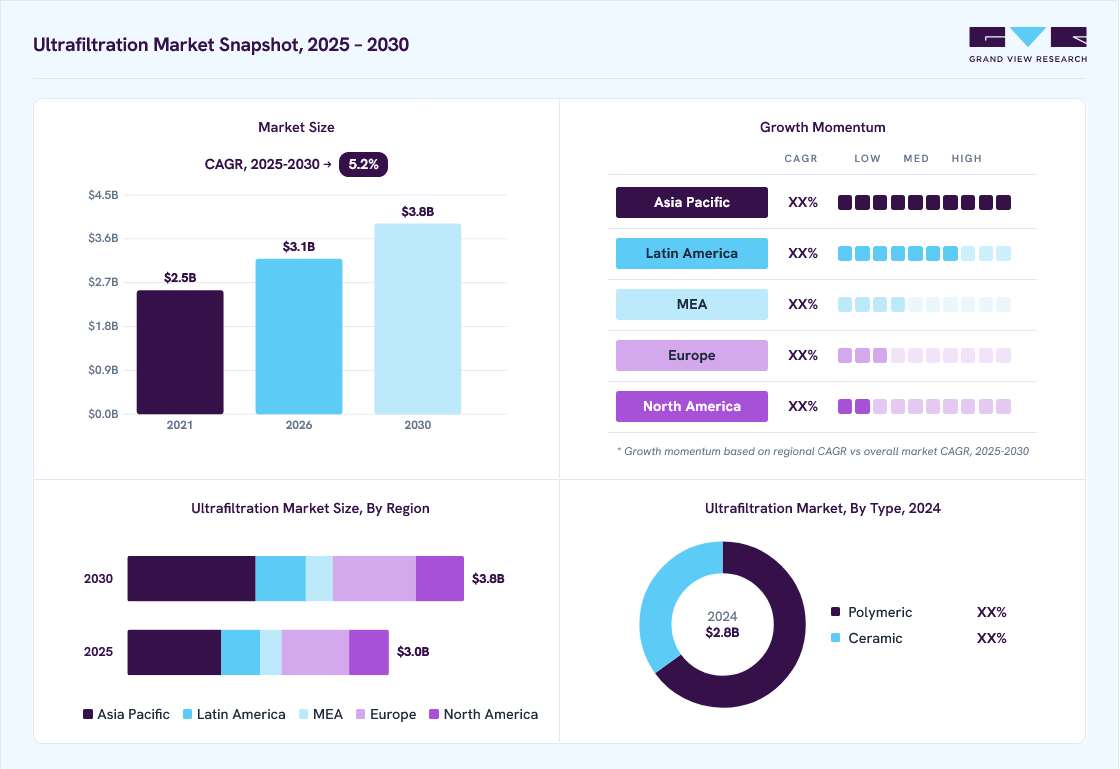
The global ultrafiltration market size was valued at USD 3.0 billion in 2025 and is projected to grow from USD 3.2 billion in 2026 to USD 4.6 billion by 2033, growing at a CAGR of 5.4% from 2026 to 2033. Asia Pacific dominated the market, accounting for the largest global share of 36.0% in 2025. The ultrafiltration market is experiencing significant growth, driven by the increasing need for efficient water treatment and separation processes across various industries.
 Source: Grand View Research, IR Documents, Primary Interviews, Paid DatabasesTo learn more about this report,
 Download Free Sample Report
 Key Market Trends & Insights
- By type: Polymeric segment held the largest revenue share of 64.8% in 2025.
- By module: Tubular segment held the largest revenue share of 50.5% in 2025.
- By application: Industrial treatment segment held the largest share of 62.6% in 2025.
Regional Highlights
- Largest regional market: Asia Pacific (36.0% revenue share, 2025)
- By country: China held the largest share of Asia Pacific in 2025.
Market Size & Forecast
- Market size in 2025: USD 3.0 Billion
- Estimated market size in 2026: USD 3.2 Billion
- Projected market size by 2033: USD 4.6 Billion
- CAGR (2026-2033): 5.4%
GVR research-powered AIAsk Prism AI about the ultrafiltration marketGet cited answers from GVR research on market growth, segments, regulations and forecasts.Start with✓ Source-linked answers ✓ Market-specific context ✓ Traceable figuresExplore Prism AI ↗
This technology is particularly in demand due to its ability to effectively remove suspended solids, bacteria, and other impurities from water and liquids without the need for chemicals, making it an environmentally friendly solution. The adoption of ultrafiltration is expanding beyond municipal water treatment to industries such as food & beverage, pharmaceuticals, and chemicals, where high-quality separation and purification are essential for product integrity and regulatory compliance. To learn more about this report, Download Free Sample Report
 In addition, the market is being shaped by ongoing technological advancements, with new membrane materials and system designs that improve filtration efficiency, reduce fouling, and lower operational costs. The development of more durable and cost-effective polymeric membranes has opened new opportunities in industrial applications that require large-scale filtration. As water scarcity becomes an increasingly critical global issue, ultrafiltration is playing a key role in wastewater reuse and resource recovery, with governments and industries investing in sustainable water treatment solutions.
Market Dynamics
The ultrafiltration market is shaped by advancements in membrane materials, module design, and automation technologies that improve filtration efficiency, membrane lifespan, and overall system performance. The availability and cost of raw materials used in polymeric and ceramic membranes, along with manufacturing complexity, influence production costs and product pricing. Stringent regulations governing drinking water quality, wastewater discharge, and industrial effluent treatment continue to drive adoption across municipal and industrial sectors. In addition, rising investments in water reuse and recycling projects, desalination pretreatment, and sustainable water management initiatives are expanding market opportunities. Growing demand from the food & beverage, pharmaceutical, and chemical industries for high-purity process water and efficient separation technologies, coupled with ongoing innovation in energy-efficient and fouling-resistant membranes, further shapes market dynamics and the evolution of the ultrafiltration value chain.
The growing demand for water reuse and recycling is a major driver of the ultrafiltration market. Increasing water scarcity, rapid urbanization, and stricter environmental regulations are encouraging municipalities and industries to adopt advanced water treatment technologies that enable the recovery and reuse of wastewater. Ultrafiltration systems effectively remove suspended solids, bacteria, viruses, and other contaminants, making them an essential component of water reclamation and recycling processes. As governments and industries prioritize sustainable water management, investments in water reuse infrastructure continue to support market growth.
High operating and membrane maintenance costs remain a significant challenge for the ultrafiltration market. Membranes are subject to fouling, scaling, and gradual performance degradation, requiring periodic cleaning and replacement to maintain filtration efficiency. These recurring expenses, along with costs associated with chemicals, energy, and system maintenance, increase the total cost of ownership. Therefore, organizations with limited budgets may delay investments in ultrafiltration systems or opt for lower-cost treatment alternatives.
The expanding semiconductor and electronics manufacturing industry presents a significant growth opportunity for the ultrafiltration market. These industries require ultra-pure water for wafer fabrication, component cleaning, and precision manufacturing processes, where even trace contaminants can affect product quality and yield. Ultrafiltration plays a critical role in removing fine particulates, microorganisms, and colloidal impurities before subsequent purification stages. With increasing global investments in semiconductor fabrication facilities and electronics production, demand for high-performance ultrafiltration systems is expected to grow steadily.
Market Concentration & Characteristics
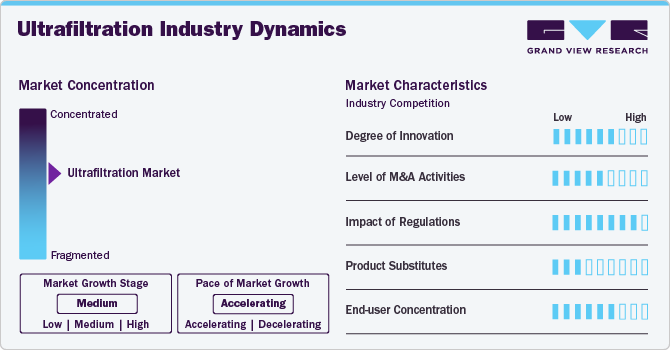
The ultrafiltration market is characterized by moderate industry concentration, with several key players dominating the market, but a growing number of smaller and regional companies also contributing to the market dynamics. Major global players such as 3M, Pall Corporation, and Veolia hold a significant market share, offering a wide range of ultrafiltration membranes and systems for industrial, municipal, and commercial applications. Despite the presence of these large corporations, the market is becoming more fragmented due to the increasing demand for specialized filtration solutions tailored to specific industries and regions.
One of the primary characteristics of the ultrafiltration industry is its high technological innovation. Companies are investing heavily in research and development to produce membranes with better performance characteristics, such as higher permeability, greater resistance to fouling, and enhanced durability. These innovations are aimed at meeting the diverse needs of industries like food and beverage, water treatment, pharmaceuticals, and chemicals, where both high filtration efficiency and cost-effectiveness are essential. The development of new materials, such as ceramic and composite membranes, is also contributing to the industry’s growth by expanding the range of applications for ultrafiltration systems.
 To learn more about this report, Download Free Sample Report
 Another defining characteristic of the ultrafiltration market is the increasing demand for sustainability and environmental responsibility. As water scarcity continues to pose challenges worldwide, industries are adopting ultrafiltration technologies to enable water reuse and reduce waste. The growing emphasis on eco-friendly solutions has driven the demand for low-energy, high-performance membranes that can reduce operational costs and carbon footprints. Many companies are also focusing on enhancing their filtration systems to treat industrial wastewater, facilitating more sustainable practices in water-intensive industries such as textiles and food processing.
The ultrafiltration market also faces price competition and market entry from regional players who provide cost-effective solutions that cater to emerging markets and smaller applications. As demand for ultrafiltration technology grows in developing regions like Asia Pacific, Latin America, and the Middle East, companies are introducing affordable, region-specific products that offer competitive pricing. This has made it increasingly important for leading players to differentiate themselves not only through product performance but also through value-added services like system integration, maintenance, and support. The combination of innovation, sustainability, and competitive pricing is shaping the competitive landscape of the ultrafiltration industry.
Analyst Perspective
The ultrafiltration market is driven by increasing water scarcity, stricter water quality and wastewater discharge regulations, and growing investments in water reuse and sustainable water management. Rising demand from municipal utilities and industries such as food & beverage, pharmaceuticals, and chemicals continues to support market expansion. Technological advancements in fouling-resistant membranes, high-performance polymeric and ceramic materials, and smart monitoring systems are improving operational efficiency and reducing lifecycle costs. However, macroeconomic factors such as rising energy prices, inflation, and geopolitical disruptions can increase manufacturing and project costs while affecting membrane supply chains. Despite these challenges, expanding investments in desalination pretreatment, zero liquid discharge (ZLD) systems, and high-purity water applications in the semiconductor and pharmaceutical industries are expected to create significant long-term growth opportunities.
Type Insights
Based on type, the polymeric segment led the market with the largest revenue share of 64.8% in 2025. Polymeric ultrafiltration membranes are made from synthetic polymers such as polysulfone, polyvinylidene fluoride (PVDF), and polyethersulfone, offering a cost-effective and versatile solution for various filtration applications. These membranes are widely used in water treatment, food & beverage processing, and pharmaceuticals due to their efficient ability to separate suspended solids, bacteria, and macromolecules.
The ceramic type segment is expected to grow at a considerable CAGR of 5.9% over the forecast period in terms of revenue. Ceramic ultrafiltration membranes are made from durable materials such as alumina, zirconia, or titanium oxide, providing ideal chemical resistance, high thermal stability, and extended lifespan. These membranes are particularly suited for harsh operating conditions, such as industrial wastewater treatment, high-temperature processes, and applications with aggressive chemicals. Ceramic membranes tend to have lower fouling rates compared to polymeric membranes and can be cleaned more easily, making them ideal for long-term, heavy-duty use.
Module Insights
Based on module, the tubular segment led the market with the largest revenue share of 50.5% in 2025. Tubular modular ultrafiltration systems use cylindrical tubes with membrane elements inside, designed for high-flow applications that involve viscous liquids or large particulate matter. This modular design allows for a more robust filtration process, as the tubes can handle high dirt loads and are less prone to fouling compared to other membrane types.
 To learn more about this report, Download Free Sample Report
 The hollow fiber module segment is expected to grow at a considerable CAGR of 6.4% over the forecast period. Hollow fiber modular ultrafiltration membranes consist of small, flexible fibers arranged in bundles within a casing, creating a large surface area for efficient filtration. These modules are widely used in water treatment and industrial processes due to their compact design, high flux rates, and ease of maintenance. The hollow fibers are effective at removing suspended solids, bacteria, and other contaminants, and their design helps reduce fouling by facilitating better cleaning and backwashing.
Application Insights
Based on application, the industrial treatment segment led the market with the largest revenue share of 62.6% in 2025. In industrial treatment applications, ultrafiltration plays a crucial role in purifying process water, recycling wastewater, and improving product quality across various sectors, including food and beverage, pharmaceuticals, and chemical manufacturing. Ultrafiltration membranes are capable of removing suspended particles, microorganisms, and macromolecules, ensuring that water used in industrial processes is clean and free from contaminants.
The municipal application segment is expected to grow at a considerable CAGR of 5.8% over the forecast period, in terms of revenue. In municipal water treatment, ultrafiltration is increasingly being used to provide a high level of filtration for both drinking water and wastewater. Ultrafiltration membranes effectively remove suspended solids, bacteria, viruses, and other contaminants, ensuring that water meets stringent health and safety standards.
Regional Insights
Asia Pacific dominated the ulrafiltration market with the largest revenue share of 36.0% in 2025. Asia Pacific is experiencing significant growth in the ultrafiltration market, driven by rapid urbanization, industrialization, and rising pollution levels. Countries such as China, India, and Japan are leading the demand for ultrafiltration systems, particularly in water treatment, food processing, and wastewater management. Increasing investments in infrastructure and environmental sustainability initiatives are further fueling the market growth.
 To learn more about this report, Download Free Sample Report
 China Ultrafiltration Market Trends
The ulrafiltration market in China held the largest share in the Asia Pacific region in 2025. China ultrafiltration market held the highest revenue share in the Asia Pacific market. China’s ultrafiltration market is growing rapidly due to the country’s rising industrialization, water pollution issues, and need for advanced water treatment systems. The government’s focus on environmental protection and water reuse is promoting the adoption of ultrafiltration technologies.
The ultrafiltration market in the India is expected to grow at a CAGR of 7.3% from 2026 to 2033. India’s ultrafiltration market is expanding as the country faces challenges related to water scarcity, pollution, and industrial wastewater treatment. The demand for ultrafiltration is increasing in sectors such as water treatment, agriculture, and food & beverage.
North America Ultrafiltration Market Trends
The ultrafiltration market in North America is expanding, driven by increased water treatment regulations, industrial growth, and a focus on sustainable water management. Rising concerns over water scarcity and wastewater recycling are pushing demand for ultrafiltration solutions across various sectors. The region is investing in advanced filtration technologies to meet environmental goals and improve water reuse.
U.S. Ultrafiltration Market Trends
The ultrafiltration market in the U.S. is expected to grow at a CAGR of 3.7% from 2026 to 2033. In the U.S., ultrafiltration technology is gaining popularity in municipal water treatment, industrial wastewater processing, and food & beverage industries. The focus on improving water quality standards and addressing water scarcity issues fuels market growth. In addition, government regulations and incentives for water recycling are contributing to the increasing adoption of ultrafiltration systems.
The ultrafiltration market in the Canada is expected to grow at a CAGR of 4.3% from 2026 to 2033. Canada’s ultrafiltration market is witnessing growth, particularly in industrial water treatment and municipal systems, due to the country's emphasis on sustainable water practices. With rising concerns over water conservation and pollution control, Canadian industries are turning to ultrafiltration for wastewater treatment and resource recovery.
Europe Ultrafiltration Market Trends
The ultrafiltration market in Europe is driven by stringent environmental regulations, a focus on sustainable water management, and the need for efficient wastewater treatment systems. Countries across the region are adopting ultrafiltration technology for both municipal and industrial applications, ensuring better water quality and compliance with environmental standards.
Germany's ultrafiltration market held 17.2% share in the European market. Germany is a leading market for ultrafiltration in Europe, with strong demand in industries such as water treatment, pharmaceuticals, and food processing. The country’s commitment to environmental sustainability and water conservation drives the use of ultrafiltration systems.
UK’s ultrafiltration market is driven by growing need for water treatment solutions to address urbanization and water scarcity issues. Ultrafiltration is increasingly used in both municipal water filtration and industrial applications.
Middle East & Africa Ultrafiltration Market Trends
The ultrafiltration market in the Middle East & Africa is expanding due to the region’s need for efficient water treatment solutions in arid and water-scarce areas. Countries like Saudi Arabia are investing heavily in desalination and water recycling technologies, where ultrafiltration plays a key role in providing clean water. The growing demand for industrial water treatment is also driving market growth.
Saudi Arabia’s ultrafiltration market is growing due to the country’s focus on overcoming water scarcity and improving wastewater management. As part of its Vision 2030 plan, the government is investing in advanced water treatment technologies, including ultrafiltration, to ensure sustainable water use. The industrial sector, particularly oil & gas, is also driving the demand for ultrafiltration systems to treat wastewater and enhance water reuse.
Latin America Ultrafiltration Market Trends
In Latin America, ultrafiltration adoption is on the rise due to growing concerns over water pollution and limited freshwater resources. Countries like Brazil are increasingly investing in ultrafiltration for municipal water treatment and industrial applications. The market is driven by the need for efficient wastewater treatment solutions and government initiatives aimed at improving water sustainability.
Brazil is witnessing growth in the ultrafiltration market, driven by the need for better water quality management and pollution control. With increasing industrialization, particularly in the oil and gas, mining, and agriculture sectors, ultrafiltration technology is becoming essential for wastewater treatment and recycling.
Key ultrafiltration Company Insights
Some of the key players operating in the market include Merck KGaA and Pall Corporation among others.
-
Merck KGaA, Darmstadt, Germany, is a global science and technology company known for its leadership in the fields of healthcare, life sciences, and performance materials. With a rich history spanning over 350 years, Merck KGaA operates in over 70 countries, offering innovative products in pharmaceuticals, biotechnology, and laboratory research. The company's extensive portfolio includes ultrafiltration technologies used in life sciences for bioprocessing and water treatment, providing advanced solutions to improve the quality and efficiency of filtration in industries ranging from pharmaceuticals to food & beverage.
-
Pall Corporation, a division of Danaher Corporation, is a leading provider of filtration, separation, and purification technologies. With more than 70 years of experience, Pall serves a wide range of industries, including life sciences, healthcare, food & beverage, and industrial processes. The company’s ultrafiltration products are integral in ensuring the purity and safety of critical processes, including water treatment and pharmaceutical manufacturing.
Key Ultrafiltration Companies:
The following key companies have been profiled for this study on the ultrafiltration market.
-
Berghof Membrane Technology GmbH (BMT)
-
Applied Membranes, Inc.
-
PALL CORPORATION
-
MERCK KGAA
-
3M
-
AECOM
-
Trucent
-
DuPont
-
Genex Utility
-
Pentair plc
-
FUMATECH BWT GmbH
-
Synder Filtration, Inc.
-
STERLITECH CORPORATION
Competitive Benchmarking
Category
Operating Strategies
Competitive Edge
Weakness
Established Players (e.g., DuPont, PALL CORPORATION, Pentair PLC)
- Focus on expanding comprehensive membrane portfolios, investing in R&D, strengthening global manufacturing and distribution networks, and securing long-term contracts across municipal, industrial, pharmaceutical, and food & beverage sectors.
- They also emphasize investments in product innovation, strategic partnerships, and aftermarket support to maintain market leadership.
- Strong global brand recognition, broad product offerings, advanced membrane technologies, extensive installed base, robust financial resources, and well-established sales and service networks enable them to serve diverse applications worldwide.
- Higher operating costs and premium pricing can reduce competitiveness in cost-sensitive markets.
- Their large organizational structures may also slow product customization and responsiveness to niche customer requirements.
Emerging & Regional Players (e.g., Synder Filtration, Inc., Berghof Membrane Technology GmbH (BMT), regional players)
- Focus on specialized membrane technologies, customized filtration solutions, and application-specific systems targeting niche industrial markets.
- They compete through technical expertise, product flexibility, and close customer collaboration rather than scale.
- Strong specialization in selected membrane technologies, faster customization capabilities, agile product development, and the ability to address unique customer requirements in high-value applications.
- Limited global presence, smaller manufacturing capacity, lower brand recognition, and comparatively fewer financial resources restrict their ability to compete for large municipal and multinational infrastructure projects.
Recent Developments
-
In September 2024, Sartorius launched the Vivaflow SU, a groundbreaking solution that sets a new benchmark for laboratory-specific tangential flow filtration (TFF). Engineered for improved usability and versatility, the Vivaflow SU enables more efficient and sustainable ultrafiltration and diafiltration processes, accommodating feed volumes from 100 to 1,000 mL.
Ultrafiltration Market Report Scope
Report Attribute
Details
Market size value in 2025
USD 3.0 billion
Market size value in 2026
USD 3.2 billion
Revenue forecast in 2033
USD 4.6 billion
Growth rate
CAGR of 5.4% from 2026 to 2033
Base year for estimation
2025
Historical data
2021 - 2024
Forecast period
2026 - 2033
Quantitative units
Revenue in USD billion, and CAGR from 2026 to 2033
Report coverage
Revenue forecast, company ranking, competitive landscape, growth factors, and trends
Segments covered
Type, module, application, region
Regional scope
North America; Europe; Asia Pacific; Latin America; Middle East & Africa
Country scope
U.S.; Canada; Mexico; Germany; UK; France; Italy; Spain; Japan; China; India; Australia; South Korea; Brazil; Argentina; Saudi Arabia; UAE
Key companies profiled
Berghof Membrane Technology GmbH (BMT); Applied Membranes, Inc.; PALL CORPORATION; MERCK KGAA; 3M; AECOM; Trucent; DuPont; Genex Utility; Pentair plc; FUMATECH BWT GmbH; Synder Filtration, Inc.; STERLITECH CORPORATION
Customization scope
Free report customization (equivalent up to 8 analysts' working days) with purchase. Addition or alteration to country, regional & segment scope.
Pricing and purchase options
Avail customized purchase options to meet your exact research needs. Explore purchase options
Global Ultrafiltration Market Segmentation
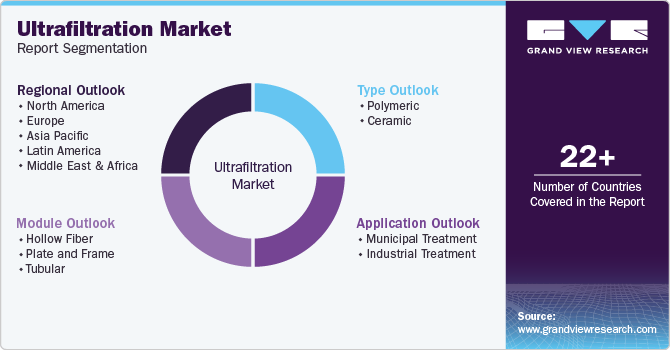
This report forecasts revenue growth at global, regional & country levels and provides an analysis on the industry trends in each of the sub-segments from 2021 to 2033. For the purpose of this study, Grand View Research has segmented the ultrafiltration market on the basis of type, module, application, and region:
 To learn more about this report, Download Free Sample Report
 -
Type Outlook (Revenue, USD Million, 2021 - 2033)
-
Polymeric
-
Ceramic
-
-
Module Outlook (Revenue, USD Million, 2021 - 2033)
-
Hollow Fiber
-
Plate and Frame
-
Tubular
-
-
Application Outlook (Revenue, USD Million, 2021 - 2033)
-
Municipal Treatment
-
Industrial Treatment
-
Food and Beverage
-
Pharmaceutical Processing
-
Chemical and Petrochemical Processing
-
Others
-
-
-
Regional Outlook (Revenue, USD Million, 2021 - 2033)
-
North America
-
U.S.
-
Canada
-
Mexico
-
-
Europe
-
Germany
-
UK
-
France
-
Italy
-
Spain
-
-
Asia Pacific
-
China
-
India
-
Japan
-
Australia
-
South Korea
-
-
Latin America
-
Brazil
-
Argentina
-
-
Middle East & Africa
-
Saudi Arabia
-
UAE
-
-
Research Methodology
The ultrafiltration market figures in this report are based on a proven research process that combines executive interviews with secondary research from proprietary databases, company filings, and recognized regulatory and institutional sources. Market size is built through value-chain sizing - reconciling supply-side and demand-side estimates - and triangulated with bottom-up and top-down approaches. Every estimate passes multiple levels of expert validation before publication, with each ultrafiltration segment quantified using the revenue-capture definitions in the table below.
Segment Definition
Segment - Type
Revenue Capture Definition
Polymeric
This segment captures revenue from the sale of polymeric ultrafiltration membranes, modules, and systems used across municipal, industrial, food & beverage, pharmaceutical, chemical, and other filtration applications. Polymeric ultrafiltration membranes are manufactured using polymer-based materials.
Ceramic
This segment captures revenue from the sale of ceramic ultrafiltration membranes, modules, and systems used primarily in industrial, food & beverage, pharmaceutical, and chemical processing applications. Ceramic ultrafiltration membranes are inorganic membranes designed for high-temperature and chemically demanding applications.
Segment - Module
Revenue Capture Definition
Hollow Fiber
This segment captures revenue from the sale of hollow fiber ultrafiltration modules and systems used in water and wastewater treatment as well as industrial process filtration. Hollow fiber modules consist of bundles of fine membrane fibers offering a high filtration surface area.
Plate and Frame
This segment captures revenue from the sale of plate and frame ultrafiltration modules and systems used in industrial processing and specialty filtration applications. Plate and frame modules use flat-sheet membranes mounted between support plates.
Tubular
This segment captures revenue from the sale of tubular ultrafiltration modules and systems used mainly in industrial wastewater treatment and process separation. Tubular modules incorporate membranes housed within rigid tubes for handling high-solids feed streams.
Segment - Application
Revenue Capture Definition
Municipal Treatment
This segment includes the use of ultrafiltration systems in drinking water production and municipal wastewater treatment. Revenue is captured from ultrafiltration products sold for municipal water and wastewater facilities.
Industrial Treatment
This segment covers ultrafiltration used for industrial water purification, wastewater treatment, and water reuse. Revenue is captured from ultrafiltration products sold to industrial facilities across multiple sectors. This segment is further divided into the segments food and beverage, pharmaceutical processing, chemical and petrochemical processing, and other industrial applications.
Estimation Model
Layer Name
Key Question
Description
Addressable End-Use Base Layer
Which industries represent the addressable demand for ultrafiltration systems?
Quantify water treatment demand across municipal treatment, industrial treatment, food & beverage, pharmaceutical processing, chemical & petrochemical processing, and other end-use sectors. Assess treatment capacity, water reuse requirements, and filtration intensity by region.
Technology Penetration Layer
What share of water treatment demand is served by ultrafiltration?
Estimate ultrafiltration adoption across each end-use based on regulatory requirements, water quality standards, process water needs, wastewater recycling, and replacement demand. Allocate demand by membrane type (polymeric, ceramic) and module type (hollow fiber, plate & frame, tubular).
Manufacturer Revenue Layer
How is the market supplied by industry participants?
Analyze revenues of leading ultrafiltration membrane and system manufacturers using annual reports, business segment disclosures, product portfolios, regional presence, and capacity expansions. Estimate the contribution of organized and regional suppliers.
Market Reconciliation Layer
How is the final market size derived?
Reconcile demand-side estimates with manufacturer revenue analysis and trade flows. Validate segment-wise and regional allocations to derive the overall ultrafiltration market size and forecast.
Delivered Customizations
This report has been delivered with the following In-depth customizations
Client Request
Customization Delivered
Value Adds
Competitive Benchmarking
The competitive analysis was strengthened through benchmarking of leading market participants based on product portfolio, technology capabilities, strategic initiatives, geographic presence, and end-use focus. This provided a comparative view of competitive positioning within the ultrafiltration market.
The benchmarking exercise helps stakeholders understand competitive strengths, identify market gaps, and evaluate differentiation strategies adopted by leading companies. These insights support strategic decision-making related to partnerships, product positioning, market entry, and long-term competitive planning.
Regional Segmentation
The study entailed a detailed regional assessment, providing market estimates and forecasts across major geographic regions and key countries. The analysis examined regional demand patterns, regulatory landscape, industrial development, and infrastructure investments influencing ultrafiltration adoption, enabling a comprehensive understanding of regional growth dynamics.
This regional assessment helps identify high-growth markets, prioritize geographic expansion strategies, and understand region-specific demand drivers. It also supports investment planning by highlighting areas with increasing water treatment requirements, industrialization, and regulatory-driven opportunities.
Opportunity assessment
The report was expanded to evaluate emerging growth avenues across applications, membrane technologies, and end-use industries. The assessment identified areas with strong future demand potential, considering evolving water treatment requirements, technology adoption trends, and industrial investments.
The opportunity assessment enables stakeholders to focus on high-potential market segments, align product development with evolving customer requirements, and identify investment areas that offer sustainable long-term revenue growth while mitigating market risks.
Frequently Asked Questions About This Report
The global ultrafiltration market is expected to grow at a CAGR of 5.4% from 2026 to 2030, reaching USD 4.6 billion by 2033.
Asia Pacific dominated with a 36.0% revenue share in 2025.
The global ultrafiltration market size was valued at USD 3.0 billion in 2023 and is estimated at USD 3.2 billion for 2026.
Some of the key players operating in the ultrafiltration market include Berghof Membrane Technology GmbH (BMT), Applied Membranes, Inc., PALL CORPORATION, MERCK KGAA, 3M, AECOM, Trucent, DuPont, Genex Utility, Pentair plc, FUMATECH BWT GmbH, Synder Filtration, Inc., STERLITECH CORPORATION.
The polymeric segment led the market with the largest revenue share of 64.8% in 2025.
The tubular segment accounted for the largest revenue share in 2025.
The industrial treatment segment accounted for the largest revenue share of 62.6% in 2025.
Asia Pacific is anticipated to be one of the fastest-growing regional markets over the forecast period.
Key factors include increasing demand for water and wastewater treatment solutions, rising adoption of advanced filtration technologies, growing industrialization, increasing need for clean water, and expanding applications across food & beverage, pharmaceutical, and biotechnology industries.
About the Author(s)
Advanced Interior Materials Research Team
Advanced Materials · Advanced Interior MaterialsThis report was authored by the advanced interior materials research team at Grand View Research - comprising two research analysts, one senior research analyst, and one industry expert - with specialized expertise in the advanced interior materials segment of the advanced materials industry. All findings are based on proprietary advanced materials databases, executive interviews, and regulatory analysis, subject to internal peer review prior to publication.
Last Updated:
Speak to Analyst

Customize this report to your needs - add regions, segments, or data points, with 20% free customization.
Or view our licence options:


ISO 9001:2015 & 27001:2022 Certified
We are GDPR and CCPA compliant! Your transaction & personal information is safe and secure. For more details, please read our privacy policy.


