
- Home
- »
- Healthcare IT
- »
-
Ultrasound AI Market Size And Share Report, 2026-2033GVR Report cover

Ultrasound AI Market (2026 - 2033) Size, Share & Trends Analysis Report By Component (Hardware/AI-enabled Devices, Software), By Application/Modality (Radiology, Urology, Obstetrics & Gynecology), By End-use, By Region, And Segment Forecasts
Market Size, 2025
$1.8BMarket Estimate, 2026
$2.3BMarket Forecast, 2033
$13.6BCAGR, 2026–2033
28.6%Ultrasound AI Market Overview
The global ultrasound AI market size was valued at USD 1.8 billion in 2025 and is projected to grow from USD 2.3 billion in 2026 to USD 13.6 billion by 2033, at a CAGR of 28.6% from 2026 to 2033. The market in north america dominated with a revenue share of 52.0% in 2025. Rising demand for accurate and early disease detection, rapid growth in imaging volumes, and government initiatives and regulatory support are significant factors contributing to market growth.
 Source: Grand View Research, IR Documents, Primary Interviews, Paid DatabasesTo learn more about this report,
 Download Free Sample Report
Key Market Trends & Insights
- By component: Hardware/AI-enabled devices held the largest market share of over 48% in 2025.
- By application/modality: Cardiology/echocardiography segment held the highest market share of over 38% in 2025.
- By end-use: Hospitals segment held the largest market share of over 48% in 2025.
Regional Highlights
- Largest regional market: North America (52.0% revenue share, 2025)
- Fastest-growing regional market: Asia Pacific (highest CAGR, 2026-2033)
- By country: The U.S. held the largest market share in 2025.
Market Size & Forecast
- Market size in 2025: USD 1.8 billion
- Estimated market size in 2026: USD 2.3 billion
- Projected market size by 2033: USD 13.6 billion
- CAGR (2026-2033): 28.6%
Prism AI by Grand View Research Free to tryAsk a question about the ultrasound AI marketTry asking✓Every figure cited from GVR research Prefer the report? Download free sample →
In addition, growing emphasis on cost-efficiency in healthcare delivery and technological advancements in machine learning, NLP, and computer vision are some other factors fueling market growth further. The increasing demand for precise early disease detection is driving market growth. The rising global prevalence of cancer, cardiovascular, and neurological disorders underscores the need for advanced imaging to facilitate timely interventions. Moreover, AI-powered analysis is essential for identifying subtle anomalies that are likely to be overlooked during manual review. For instance, according to a meta-analysis of 18 studies published in the AJMC in December 2025, found ultrasound-based AI models diagnose ovarian cancer more accurately than sonographers, with an internal validation sensitivity/specificity of 0.95 and AUC 0.98 of 95% and external validation AUC 0.91 compared to sonographers exhibiting a sensitivity of 0.83 (95% CI, 0.62-0.94), a specificity of 0.84.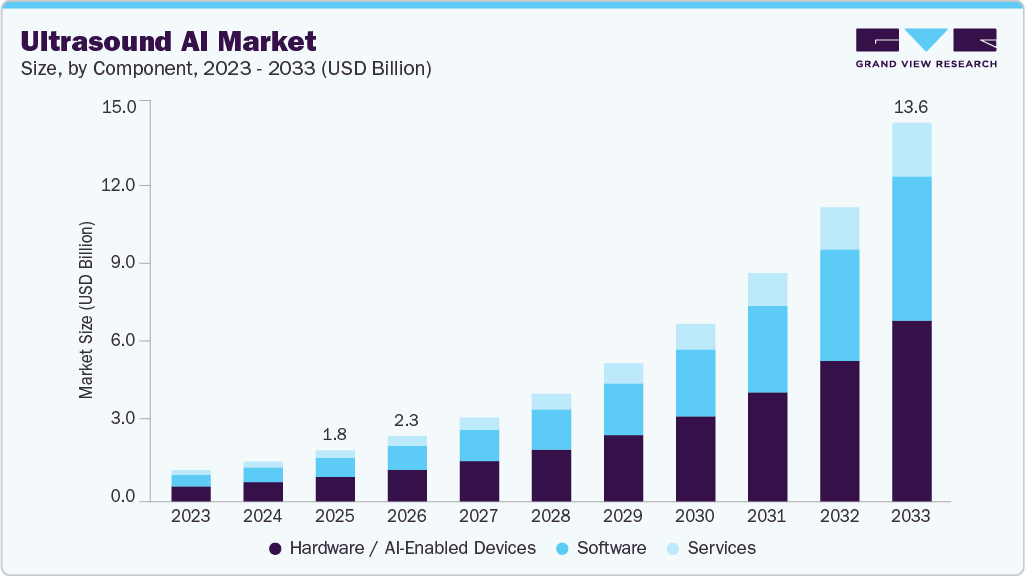 To learn more about this report, Download Free Sample Report
In addition, automated measurements and risk assessments enhance diagnostic reliability by reducing inconsistencies among radiologists and supporting personalized therapies. Recent developments, such as Exo’s April 2024 FDA-cleared AI tools for heart failure and lung evaluation on the Exo Iris portable ultrasound, illustrate technological progress. The prioritization of value-based care further accelerates the integration of AI ultrasound solutions across healthcare systems.
Moreover, technological advancements in machine learning, natural language processing, and computer vision fuel the growth of AI in the ultrasound industry. Deep learning algorithms are improving in accuracy, enabling more reliable interpretation of complex imaging modalities. For instance, according to a study published in the Nature Scientific Reports Journal in January 2026, Researchers developed a deep learning model using squeeze-and-excitation capsule networks and convolutional bidirectional LSTM (CBLSTM) for diagnosing gallbladder diseases from ultrasound images. This approach analyzes sequences of frames to detect gallstones, cholecystitis, and other disorders with high accuracy, outperforming traditional manual methods.
Furthermore, workforce shortages and skill gaps in sonography are significant drivers propelling market growth further. Healthcare systems face shortages of experienced sonographers and radiologists, and AI-guided scanning assists less experienced operators. Automated view recognition and real-time guidance reduce training requirements. For instance, an article titled “AI-driven innovations in pediatric ultrasound imaging and analysis” published in News Medical Life Sciences Journal in November 2025, highlights how AI is transforming pediatric ultrasound by reducing operator dependence, stabilizing image quality, and enabling quantitative analysis. AI enhances structural recognition, automates standardized measurements, and supports non-expert clinicians in diagnosis across multiple organ systems, from screening to decision support, while highlighting technical advances, unmet challenges, and future research directions, including multi-disease and personalized, trial-validated models.
Market Concentration & Characteristics
The chart below illustrates the relationship between industry concentration, industry characteristics, and industry participants. The x-axis represents the level of industry concentration, ranging from low to high. The y-axis represents various industry characteristics, including industry competition, level of partnerships & collaboration activities, degree of innovation, impact of regulations, and regional expansion. The market is slightly fragmented. Moreover, several emerging players are entering the market, thereby contributing to increased fragmentation within the market. The degree of innovation is high. The level of merger & acquisition activities is moderate. Moreover, the impact of regulations and the regional expansion of industry is high.
The AI in the ultrasound industry is characterized by constant innovation, with a strong focus on launching new platforms and devices to leverage administrative tasks, improve diagnostic accuracy, and enhance care delivery. Prominent players are launching advanced solutions to sustain a competitive advantage. In addition, growing regulatory approvals propel market growth further. For instance, in September 2025, Ultrasound AI received a U.S. patent for an AI system that determines clinical or laboratory values directly from ultrasound images. This expands their portfolio, which includes three U.S. patents and two international ones, for the prediction of premature birth using ultrasound for gestational age and delivery timing.
 To learn more about this report, Download Free Sample Report
The industry is experiencing a moderate level of merger and acquisition activities undertaken by several key players. This is due to the desire to gain a competitive advantage in the industry, enhance technological capabilities, and consolidate in a rapidly growing market.
Regulations, such as HIPAA in the U.S. and the GDPR in Europe, establish standards for safeguarding patient data privacy and security. Compliance with these regulations is crucial for AI applications in healthcare to ensure the safe and secure handling of patient information, reducing the risk of data breaches and unauthorized access.
The industry is witnessing high geographical expansion. Companies within the AI in ultrasound industry seek geographic expansion strategies to maintain their foothold in emerging markets and attract customers from these regions. In April 2025, Philips launched the AI-enabled Elevate Platform upgrade for EPIQ Elite ultrasound at UltraFest 2025.
Component Insights
Based on component, hardware/AI-enabled devices held the largest market share of over 48% in 2025. These devices support real-time image acquisition, automated analysis, and faster reporting, reducing reliance on post-processing software. Integration of AI improves accuracy in detecting abnormalities, enhances image quality, and minimizes operator variability. For instance, in November 2025, Samsung launched the R20 ultrasound system, a premium platform for general imaging powered by Crystal Architecture, which provides superior image clarity, uniformity, resolution, and penetration. It features AI tools such as Live LiverAssist for real-time detection of suspicious liver lesions, Live BreastAssist with BI-RADS classification for breast lesions, auto-measurement for structures, and Deep USFF for fat fraction quantification, correlating with MRI-PDFF.
“The R20 embodies Samsung’s commitment to advancing healthcare through intelligent innovation. With AI at its core and a focus on both image excellence and clinician comfort, the R20 is a paradigm shift in ultrasound technology, helping doctors ensure detection of lesions during live scanning.”
-Atantra Das Gupta, Head of HME Business, Samsung India.
The software and platform segment is expected to grow at the fastest CAGR during the forecast period. These solutions include advanced image recognition software, workflow management platforms, and cloud-based AI services integrated with PACS and RIS systems. By providing automated detection of abnormalities and risk stratification, they enhance diagnostic accuracy and efficiency. Cloud-based AI platforms facilitate remote collaboration, second opinions, and access to advanced analytics for smaller healthcare providers.
Application/Modality Insights
Based on application/modality, the cardiology/echocardiography segment held the largest revenue share of over 38% in 2025 due to the rising prevalence of cardiovascular diseases. AI automates ejection fraction calculation, strain analysis, and valve quantification. Moreover, deep learning models detect regional wall motion abnormalities with enhanced sensitivity. Doppler flow quantification eliminates manual tracing errors in stenosis assessment. 3D echo reconstruction enables precise sizing of the left atrial appendage for stroke prevention. Stress echo AI identifies ischemia patterns faster than visual interpretation. For instance, in August 2025, Philips launched the Transcend Plus software upgrade for EPIQ CVx and Affiniti CVx cardiac ultrasound systems. Integrates 26 FDA-cleared AI applications automating ejection fraction, wall motion, chamber volumes, and tricuspid valve measurements for heart failure and valve disease.
The obstetrics & gynecology segment is anticipated to grow at the fastest CAGR from 2026 to 2033. Automated fetal biometry, gestational age estimation, and anatomical plane recognition reduce operator dependency. AI helps detect structural anomalies at earlier stages. Standardized measurements improve screening reliability. Moreover, workflow automation shortens exam time, thereby driving the segment’s growth.
End Use Insights
Based on end use, the hospitals segment held the largest market share of over 48% in 2025, driven by their need to manage large patient volumes and diverse imaging modalities. Hospitals are adopting AI solutions to support diagnostic accuracy, reduce reporting backlogs, and streamline clinical decision-making. Integrating AI into ultrasound radiology departments helps standardize image interpretations, lowering the chances of diagnostic errors.
 To learn more about this report, Download Free Sample Report
The diagnostic imaging centers segment is anticipated to grow at the fastest CAGR from 2026 to 2033. Diagnostic imaging centers are increasingly adopting AI solutions to enhance efficiency, accuracy, and competitiveness. These centers handle high imaging volumes daily, making automation and advanced analytics essential for optimizing turnaround times. AI-driven tools assist radiologists by detecting anomalies, flagging urgent cases, automating routine measurements, and reducing workload pressure. In addition, diagnostic imaging centers benefit from AI integration into scheduling, workflow, and reporting processes, enabling seamless patient management.
Regional Insights
The North America ultrasound AI market accounted for the largest revenue share of over 52.0% in 2025. This is attributed to the high prevalence of chronic diseases, strong reimbursement frameworks, and rapid integration of AI into digital health ecosystems. The U.S. leads with significant FDA clearances for AI-powered diagnostic and therapeutic devices, ensuring regulatory support for innovation. Moreover, rising collaborations between technology companies and healthcare providers further fuel innovation.
 To learn more about this report, Download Free Sample Report
U.S. Ultrasound AI Market Trends
The ultrasound AI market in the U.S. held the largest market share in 2025. The country has witnessed a surge in approvals for AI-powered imaging devices, reflecting robust innovation in healthcare technology. For instance, in August 2025, Philips announced an investment of over USD 150 million in U.S. manufacturing and R&D. Key expansion targets include the Reedsville, PA facility, which produces AI-enabled ultrasound systems, with plans to add 24,000 sq ft of manufacturing space and 40,000 sq ft of warehouse space.
“The proposed planned expansion of our manufacturing facilities is a demonstration of our deep commitment to the U.S. region. Each year, Philips spends $900 million in R&D in the U.S. to drive innovation and deliver cutting-edge technology that empowers healthcare professionals to diagnose, treat, and monitor patients more effectively. Increasing our manufacturing and R&D capabilities will create jobs and accelerate our ability to deliver better care for more people with innovative AI-enabled solutions.”
- Jeff DiLullo, Chief Region Leader, Philips North AmericaEurope Ultrasound AI Market Trends
The ultrasound AI market in Europe is expected to witness significant growth during the forecast period. This is attributed to the widespread adoption of AI technologies in healthcare and increasing investments by government and private organizations. Moreover, integrating 5G with healthcare drives Europe's market by enabling faster, more reliable connectivity for advanced medical technologies. For instance, in March 2025, Philips unveiled AI-powered enhancements for the Compact Ultrasound 5500CV. This portable cardiac system reduces scan times by 50% through Auto Measure for 2D/Doppler, is compatible with X7-2t/X8-2t TEE transducers, and is suitable for pediatric/neonatal exams with S12-4.
“With the new capabilities of Compact Ultrasound 5500CV, we advance portable ultrasound, ensuring healthcare providers get both mobility and high-quality imaging, while also maximizing their investment through our comprehensive ultrasound services. AI-driven features like Auto Measure streamline workflows by automating key cardiac measurements, while Live 3D TEE imaging provides real-time, high-resolution visualization. By bringing premium-level technology into a compact, accessible solution, we empower clinicians to deliver fast, accurate diagnoses across diverse care settings, improving patient outcomes and expanding access to advanced cardiac imaging.”-David Handler, Business Leader, Cardiology Ultrasound at Philips.
The UK ultrasound AI market is expected to grow over the forecast period, owing to the robust healthcare infrastructure and increasing investments in AI technologies to enhance medical diagnosis and patient care. Government-led digital health initiatives accelerate AI adoption in medical imaging. NHS England promotes AI deployment through funding programs and regulatory sandboxes. Strong integration with PACS and electronic patient records supports scalability.
The ultrasound AI market in Germany is expected to grow at the fastest CAGR during the forecast period. This growth is attributed to increasing investments in healthcare technology and robust healthcare infrastructure. In addition, favorable government initiatives and insurance coverage, coupled with the country’s focus on integrating AI into nationwide healthcare systems, propel market growth further.
Asia Pacific Ultrasound AI Market Trends
The ultrasound AI market in the Asia Pacific is expected to grow at the fastest CAGR in the coming years. This growth is attributed to the rising healthcare expenditure, increasing adoption of AI in healthcare, and growing prevalence of chronic diseases. Countries such as China, Japan, South Korea, and India are leading innovation through government-backed AI healthcare policies. Moreover, collaborations between key market players expedite market growth.
India ultrasound AI market is expanding rapidly, driven by the high prevalence of hypertension, government health initiatives, and technological innovation. Furthermore, the market is experiencing a growing adoption of AI technologies by healthcare providers in the country. For instance, in July 2025, DDMM Heart Institute in Nadiad became western India's first to install Siemens Healthineers' Acuson Origin AI-powered cardiac ultrasound. The system features real-time cardiac view recognition, 2D/4D HeartAI for automated contouring and quantification of all four chambers without ECG dependency.
ultrasound AI market in Japan is expected to grow rapidly, owing to technological advancements, a growing geriatric population, increasing healthcare expenditure, and the rapid adoption of artificial intelligence in healthcare. Moreover, increasing public and private funding, coupled with the rapid adoption of telehealth solutions, is expected to propel market growth further.
Latin America Ultrasound AI Market Trends
The ultrasound AI market in Latin America is anticipated to grow at a significant CAGR over the forecast period. This is attributed to the growing awareness about AI technologies, increasing government spending, and growing advancements in healthcare infrastructure.
Middle East & Africa Ultrasound AI Market Trends
The ultrasound AI market in the MEA is expected to grow at a significant CAGR over the forecast period. The market is characterized by a dynamic landscape driven by the growing adoption of technologically advanced medical devices, increasing healthcare expenditures, and supportive government policies. Significant integration of AI in healthcare technology across the region contributes to market growth further. Countries such as Saudi Arabia and the UAE are integrating AI into healthcare infrastructure under strategic visions such as Saudi Vision 2033 and the UAE National Strategy for Artificial Intelligence 2031.
Key Ultrasound AI Company Insights
Key players operating in the market are undertaking various initiatives to strengthen their market presence and increase the reach of their products and services. Strategies such as new product launches and partnerships play a key role in propelling market growth.
Key Ultrasound AI Companies:
The following are the leading companies in the ultrasound AI market. These companies collectively hold the largest market share and dictate industry trends.
- GE Healthcare
- Koninklijke Philips N.V.
- Siemens Healthineers
- EchoNous Inc.
- UltraSight
- iCardio.ai
- Sonio SAS (a SAMSUNG Company)
- Koios Medical
- SamsungHealthcare.com
- FUJIFILM Corporation
- Clarius
- Caption Care
- Us2.ai
Recent Developments
-
In November 2025, GE HealthCare and RadNet’s DeepHealth plan to expand their AI imaging collaboration globally, integrating GE ultrasound with DeepHealth’s Thyroid Suite and TechLive remote scanning.
-
In September 2025, GE HealthCare's Vivid iq cardiovascular ultrasound system was launched to the International Space Station via SpaceX's Falcon 9 and Northrop Grumman's Cygnus, docking with the ISS.
-
In June 2025, RadNet acquired See-Mode Technologies, integrating its FDA-cleared AI for ultrasound imaging into DeepHealth's portfolio. See-Mode's solutions detect/characterize thyroid nodules and breast lesions, generating standardized reports to boost diagnostic accuracy.
-
In July 2025, Apollo Hospitals and Siemens Healthineers announced a research collaboration to develop AI-enabled ultrasound imaging solutions for liver disease management in India. The partnership targets Metabolic Dysfunction-Associated Steatotic Liver Disease (MASLD), affecting 9-32% of the population, particularly those with obesity and diabetes. Focus areas include quantitative ultrasound, early detection, risk stratification, and therapy monitoring.
-
In March 2025, Wipro GE Healthcare launched Versana Premier R3, an AI-enabled "Made in India" ultrasound system. AI tools include Whizz workflows, automated measurements (follicle, biometry, ejection fraction), Scan Assistant, and self-learning onboarding for clinicians.
-
In February 2025, Sonio Suspect AI received FDA clearance for fetal anomaly detection, improving reader performance by 22 points (AUC from 69% to 91%).
“By combining real-time AI quality control with AI-driven anomaly detection, Sonio supports ultrasound providers from exhaustive documentation to accurate diagnosis. Our technology is designed to help health-care providers detect issues early and streamline processes, ultimately improving the care every patient receives.”
-Cecile Brosset, the CEO and co-founder at Sonio.
Ultrasound AI Market Report Scope
Report Attribute
Details
Market size in 2025
USD 1.8 billion
Estimated market size in 2026
USD 2.3 billion
Projected market size by 2033
USD 13.6 billion
Growth rate
CAGR of 28.6% from 2026 to 2033
Actual data
2021 - 2025
Forecast period
2026 - 2033
Quantitative units
Revenue in USD million/billion and CAGR from 2025 to 2033
Report coverage
Revenue forecast, company ranking, competitive landscape, growth factors, and trends
Segments covered
Component, application/modality, end use, region
Regional scope
North America; Europe; Asia Pacific; Latin America; MEA
Country scope
U.S.; Canada; Mexico; Germany; UK; France; Italy; Spain; Denmark; Sweden; Norway; China; Japan; India; South Korea; Australia; Thailand; Brazil; Argentina; South Africa; Saudi Arabia; UAE; Kuwait
Key companies profiled
GE Healthcare; Koninklijke Philips N.V.; Siemens Healthineers; EchoNous Inc.; UltraSight; iCardio.ai; Sonio SAS (a SAMSUNG Company); Koios Medical; SamsungHealthcare.com; FUJIFILM Corporation; Clarius; Caption Care; Us2.ai
Customization scope
Free report customization (equivalent up to 8 analysts working days) with purchase. Addition or alteration to country, regional & segment scope.
Pricing and purchase options
Avail customized purchase options to meet your exact research needs. Explore purchase options
Global Ultrasound AI Market Report Segmentation
This report forecasts revenue growth at global, regional, and country levels and provides an analysis of the latest industry trends in each of the sub-segments from 2021 to 2033. For this study, Grand View Research has segmented the global ultrasound AI market report based on component, application/modality, end use, and region:
 To learn more about this report, Download Free Sample Report
-
Component Outlook (Revenue, USD Million, 2021 - 2033)
-
Hardware/ AI-enabled Devices
-
Portable systems
-
Cart-based systems
-
Handheld ultrasound probes
-
-
Software
-
Services
-
-
Application/Modality Outlook (Revenue, USD Million, 2021 - 2033)
-
Cardiology / Echocardiography
-
Radiology
-
Obstetrics & Gynecology
-
Urology
-
Others
-
-
End Use Outlook (Revenue, USD Million, 2021 - 2033)
-
Hospitals
-
Diagnostic Imaging Centers
-
Ambulatory Surgical/Outpatient Centers
-
Others
-
-
Regional Outlook (Revenue, USD Million, 2021 - 2033)
-
North America
-
U.S.
-
Canada
-
Mexico
-
-
Europe
-
Germany
-
UK
-
France
-
Italy
-
Spain
-
Denmark
-
Sweden
-
Norway
-
-
Asia Pacific
-
China
-
Japan
-
India
-
South Korea
-
Australia
-
Thailand
-
-
Latin America
-
Brazil
-
Argentina
-
-
MEA
-
South Africa
-
Saudi Arabia
-
UAE
-
Kuwait
-
-
Frequently Asked Questions About This Report
North America dominated with a 52.0% revenue share in 2025.
Asia Pacific is the fastest-growing region over the forecast period.
Cardiology/echocardiography segment led with over 38% revenue share in 2025, while bstetrics & gynecology is the fastest-growing segment.
Hospitals segment held the largest revenue share of over 48% in 2025, while diagnostic imaging centers segment is the fastest-growing segment.
The global ultrasound AI market size was estimated at USD 1.8 billion in 2025 and is expected to reach USD 2.3 billion in 2026.
The global ultrasound AI market is expected to grow at a compound annual growth rate of 28.6% from 2026 to 2033 to reach USD 13.6 billion by 2033.
Some key players operating in the ultrasound AI market include GE Healthcare; Koninklijke Philips N.V.; Siemens Healthineers; EchoNous Inc.; UltraSight; iCardio.ai; Sonio SAS (a SAMSUNG Company); Koios Medical; SamsungHealthcare.com; FUJIFILM Corporation; Clarius; Caption Care; Us2.ai
Key factors that are driving the ultrasound AI market are rising demand for accurate and early disease detection, rapid growth in imaging volumes, and government initiatives and regulatory support. In addition, growing emphasis on cost-efficiency in healthcare delivery and technological advancements in machine learning, natural language processing, and computer vision are some other factors fueling market growth further.
The hardware/AI-enabled devices segment held the largest market share of over 48% in 2025.
About the Author(s)
Healthcare IT Research Team
Healthcare · Healthcare ITThis report was authored by the healthcare it research team at Grand View Research - comprising two research analysts, one senior research analyst, and one industry expert - with specialized expertise in the healthcare it segment of the healthcare industry. All findings are based on proprietary healthcare databases, executive interviews, and regulatory analysis, subject to internal peer review prior to publication.
Last Updated:
Speak to Analyst

Customize this report to your needs - add regions, segments, or data points, with 20% free customization.
Or view our licence options:


ISO 9001:2015 & 27001:2022 Certified
We are GDPR and CCPA compliant! Your transaction & personal information is safe and secure. For more details, please read our privacy policy.


