
- Home
- »
- Conventional Energy
- »
-
Unconventional Gas Market Size & Share Report 2027-2035GVR Report cover

Unconventional Gas Market (2027 - 2035)
Size, Share & Trends Analysis Report By Resource Type (Shale Gas, Tight Gas, CBM, Others), By Extraction Technology (Horizontal Drilling, Hydraulic Fracturing), By Application, By Region, And Segment Forecasts
Market Size, 2026
$316.5BMarket Estimate, 2027
$323.5BMarket Forecast, 2035
$413.0BCAGR, 2027–2035
2.8%Unconventional Gas Market Summary
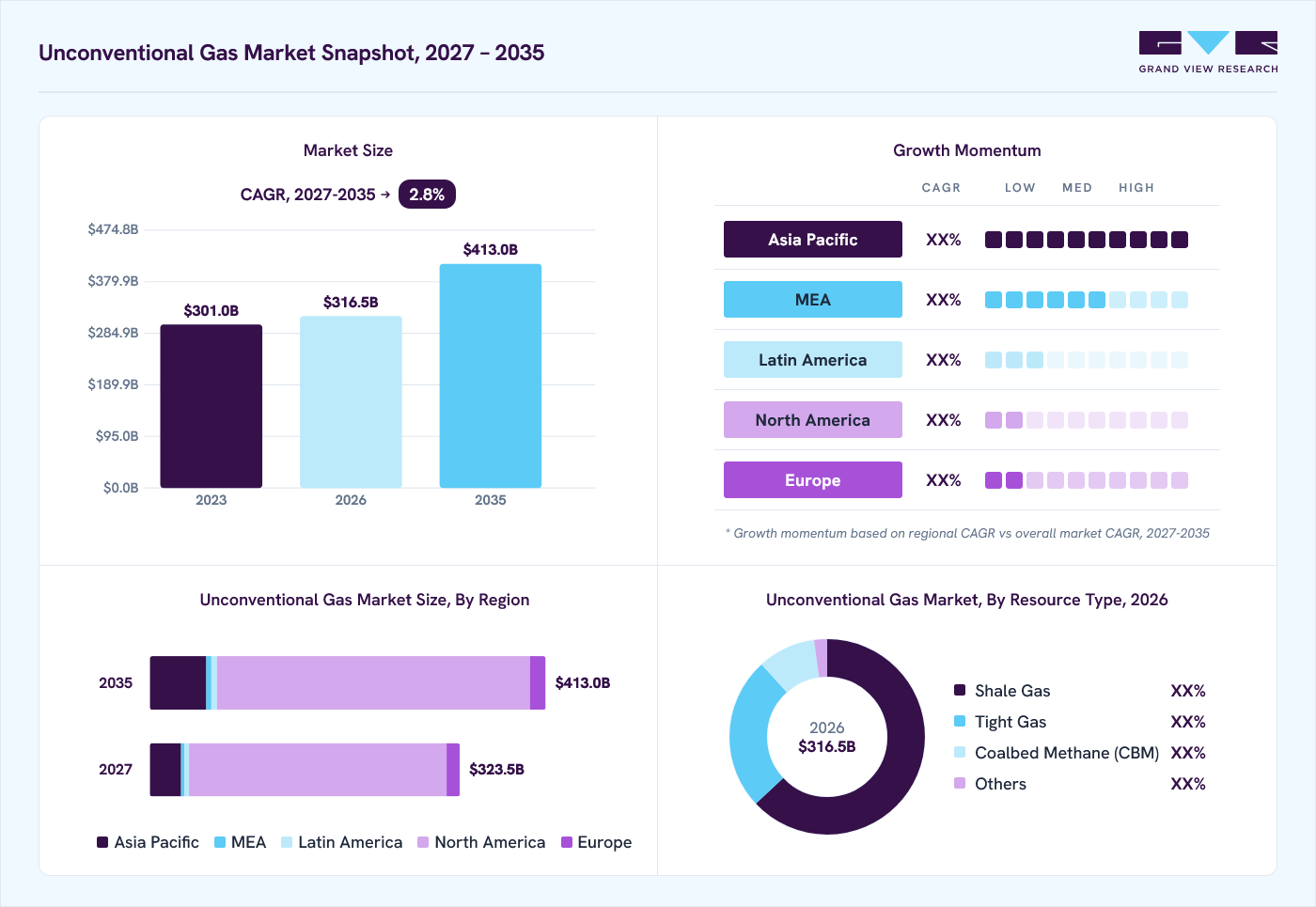
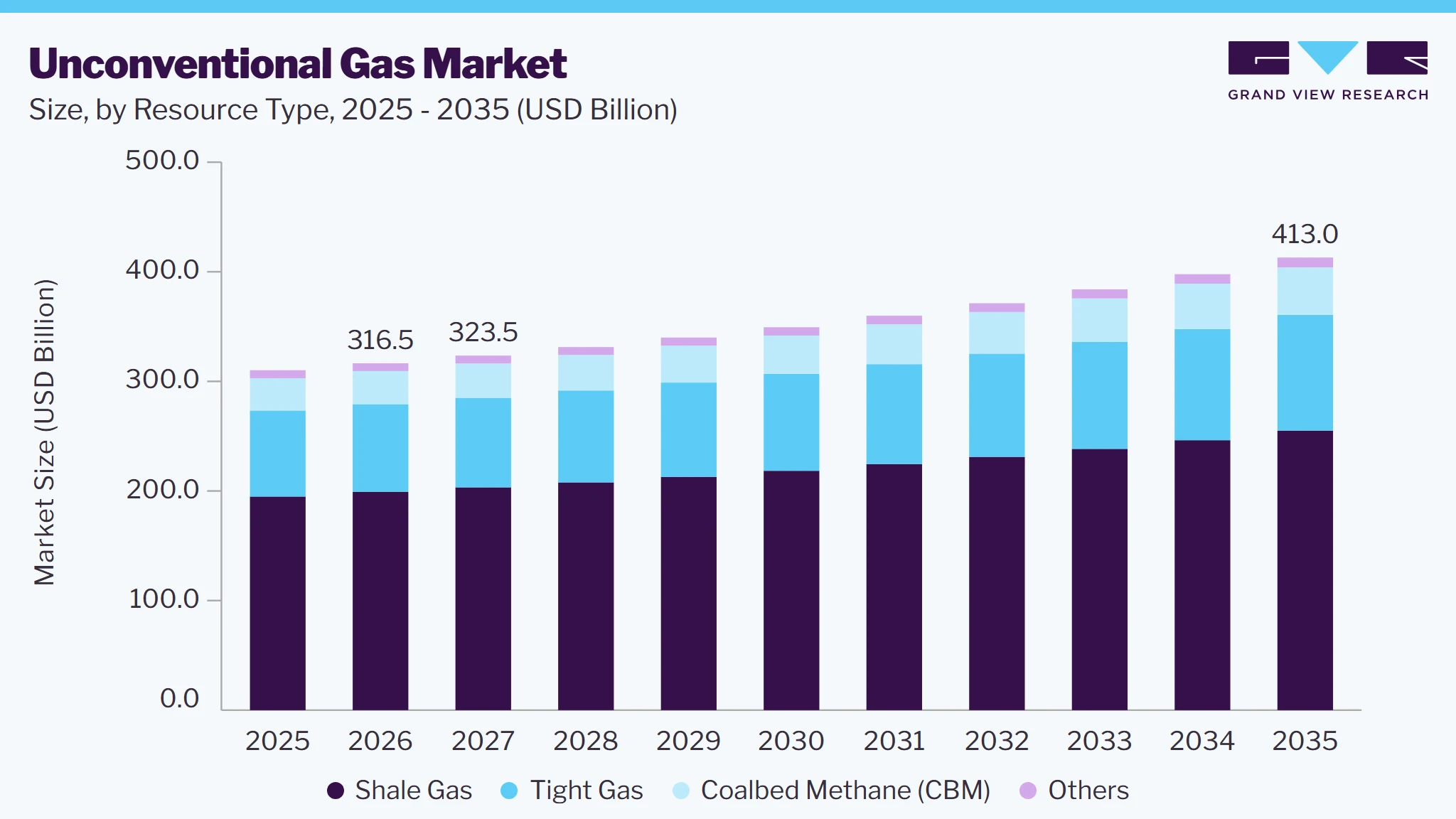
The unconventional gas market size was valued at USD 316.5 billion in 2026 and is projected to grow from USD 323.5 billion in 2027 to USD 413.0 billion by 2035, at a CAGR of 2.8% from 2027 to 2035. North America unconventional gas market held the largest revenue share of 83.5% in 2026. The market is driven by rising global natural gas demand and increasing investments in the exploration and production of unconventional gas resources.
 Source: Grand View Research, IR Documents, Primary Interviews, Paid DatabasesTo learn more about this report,
 Download Free Sample Report
Key Market Trends & Insights
- The shale gas segment held the largest revenue share of 63.0% in 2026.
- The horizontal drilling segment dominated the market with a revenue share of 62.4% in 2026.
- The power generation segment captured the largest revenue share of 34.4% in 2026.
Regional Highlights
- Largest regional market: North America (83.5% revenue share, 2026)
- Fastest-growing regional market: Asia Pacific (highest CAGR, 2027-2035)
Market Size & Forecast
- Market size in 2026: USD 316.5 Billion
- Estimated market size in 2027: USD 323.5 Billion
- Projected market size in 2035: USD 413.0 Billion
- CAGR (2027-2035): 2.8%
Prism AI by Grand View Research Free to tryAsk a question about the unconventional gas marketTry asking✓Every figure cited from GVR research Prefer the report? Download free sample →Advancements in horizontal drilling and hydraulic fracturing technologies are improving extraction efficiency and enabling access to previously uneconomical shale gas, tight gas, and coalbed methane reserves, while growing energy security concerns are supporting market expansion.
 To learn more about this report, Download Free Sample Report
Market Dynamics
The unconventional gas market is driven by rising global energy demand, increasing focus on energy security, and the growing need to diversify natural gas supply sources. Technological advancements in hydraulic fracturing and horizontal drilling have improved extraction efficiency, enabling access to previously uneconomical shale gas, tight gas, and coalbed methane reserves. Increasing investments in exploration and production activities, particularly across resource-rich regions, are further supporting market growth. However, high extraction costs, environmental concerns associated with hydraulic fracturing, water-intensive operations, and stringent regulatory requirements continue to challenge market expansion.
Growing concerns over energy security and dependence on imported natural gas are driving investments in unconventional gas exploration and production. Countries are increasingly developing domestic shale gas, tight gas, and coalbed methane reserves to diversify energy supplies, reduce exposure to international price volatility, and strengthen supply reliability. Advancements in horizontal drilling and hydraulic fracturing are further enabling the commercial extraction of previously inaccessible reserves, supporting domestic production and reducing import dependence.
In September 2025, China's largest shale gas production base in the southern Sichuan Basin surpassed 100 billion cubic meters in cumulative production. The field added 237 new wells during January-August 2025, with annual production expected to exceed 16 billion cubic meters by year-end, highlighting China's efforts to strengthen domestic gas supplies and reduce dependence on imported energy.
Environmental concerns associated with unconventional gas extraction, particularly hydraulic fracturing, act as a key restraint on market growth. High water consumption, wastewater disposal challenges, groundwater contamination risks, induced seismicity, and methane emissions have increased scrutiny of extraction activities. Governments are introducing stricter environmental regulations, monitoring requirements, and permitting procedures, increasing compliance costs and operational complexities for producers. These factors can delay exploration projects, restrict drilling activities, and affect the commercial viability of unconventional gas resources.
Increasing regulatory scrutiny of methane emissions and growing industry commitments toward reducing greenhouse gas emissions are creating emerging business opportunities in methane monitoring and leak detection services across the unconventional gas value chain. Companies can capitalize on this opportunity by deploying drone-based inspections, satellite monitoring, IoT-enabled sensors, and AI-driven analytics to identify, quantify, and mitigate methane leaks across wellheads, gathering pipelines, and processing facilities. These solutions enable gas producers to improve emissions management, meet regulatory requirements, enhance operational efficiency, and strengthen the environmental credentials of their natural gas supplies.
Analyst Perspective
The global unconventional gas market is positioned for gradual growth as countries seek to strengthen energy security, diversify gas supply, and reduce dependence on conventional and imported resources. Shale gas, tight gas, and coalbed methane offer significant development potential, supported by advances in horizontal drilling, hydraulic fracturing, and reservoir characterization. However, commercialization remains highly dependent on resource economics, regulatory frameworks, environmental considerations, infrastructure readiness, and access to capital. North America is expected to remain a mature benchmark market, while opportunities across Asia Pacific, Latin America, and the Middle East & Africa will be shaped by domestic resource potential and policy support.
Resource Type Insights
The shale gas segment dominated the market with the largest revenue share of 63.0% in 2026. This is driven by the extensive availability of shale gas reserves across major producing economies, particularly the U.S., which has established a strong production base through advanced horizontal drilling and hydraulic fracturing techniques. Continuous improvements in extraction efficiency, well productivity, and drilling economics have strengthened the commercial viability of shale gas resources. Established pipeline networks, processing facilities, and export infrastructure support large-scale production and distribution, reinforcing the segment's leading market position.
The Coalbed Methane (CBM) segment is expected to grow at the fastest CAGR of 4.0% from 2027 to 2035. This growth is supported by increasing efforts to recover methane from coal seams, improve domestic gas availability, and reduce dependence on conventional natural gas imports. Advancements in drilling and dewatering technologies are improving methane recovery rates and making previously uneconomical coalbed reserves commercially viable. Growing interest in utilizing CBM as a lower-emission alternative to coal in power generation and industrial applications is supporting segment expansion.
Extraction Technology Insights
The horizontal drilling segment held the largest revenue share of 62.4% in 2026. This dominance is attributed to the ability of horizontal drilling to access larger portions of unconventional gas reservoirs through extended wellbores, improving resource recovery and overall, well productivity. The technique enables operators to extract gas from low-permeability formations, particularly shale and tight gas reservoirs, while reducing the need for multiple vertical wells. Continuous improvements in drilling precision, directional control, and operational efficiency have further strengthened its adoption across unconventional gas exploration and production activities.
The hydraulic fracturing segment is expected to register a CAGR of 1.8% from 2027to 2035. Continued investments in unconventional gas exploration, particularly across shale and tight gas formations, are sustaining demand for hydraulic fracturing techniques. Improvements in fracturing fluid formulations, proppant technologies, and well stimulation methods are helping operators enhance gas recovery from low-permeability reservoirs. The need to maximize output from existing wells and improve the commercial viability of unconventional gas resources is supporting the segment's growth.
Application Insights
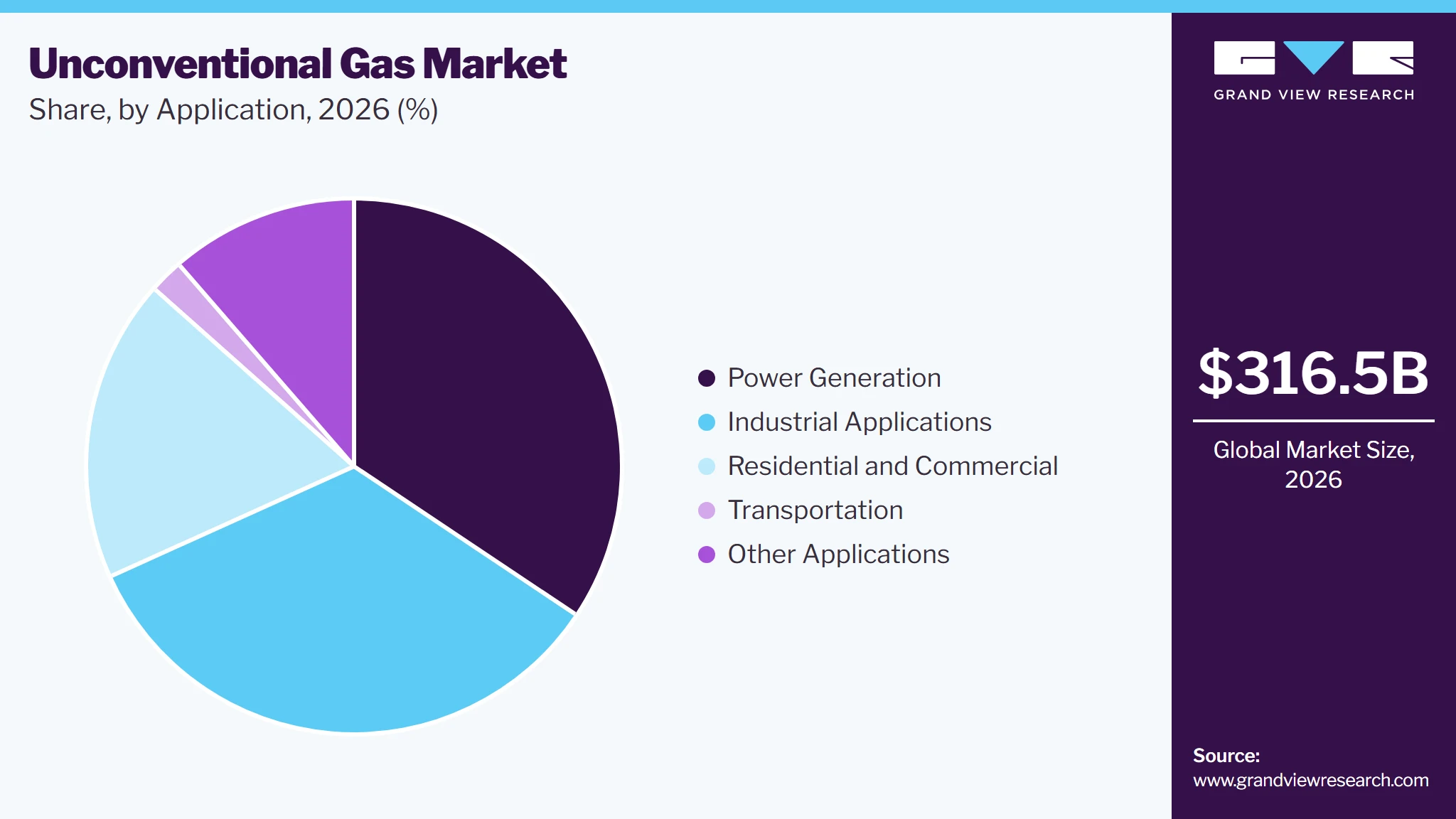
Power generation captured the market with a revenue share of 34.4% in 2026. Rising electricity consumption and the expansion of gas-fired power generation capacity are supporting the segment's leading position. Unconventional natural gas, particularly shale gas and tight gas, provides a readily available fuel source for meeting baseload and peak electricity demand. The operational flexibility of gas-fired power plants, shorter startup times, and ability to complement intermittent renewable energy generation are strengthening demand across power generation applications.
 To learn more about this report, Download Free Sample Report
The transportation segment is projected to register the fastest CAGR of 6.5% during 2026 to 2033. Increasing adoption of natural gas as an alternative transportation fuel is supporting segment expansion, particularly through the growing use of CNG and LNG in heavy-duty vehicles, commercial fleets, and long-haul transportation. The availability of unconventional gas resources is strengthening domestic fuel supplies, while efforts to reduce vehicular emissions and diversify transportation energy sources are encouraging investments in natural gas-powered mobility infrastructure.
Regional Insights
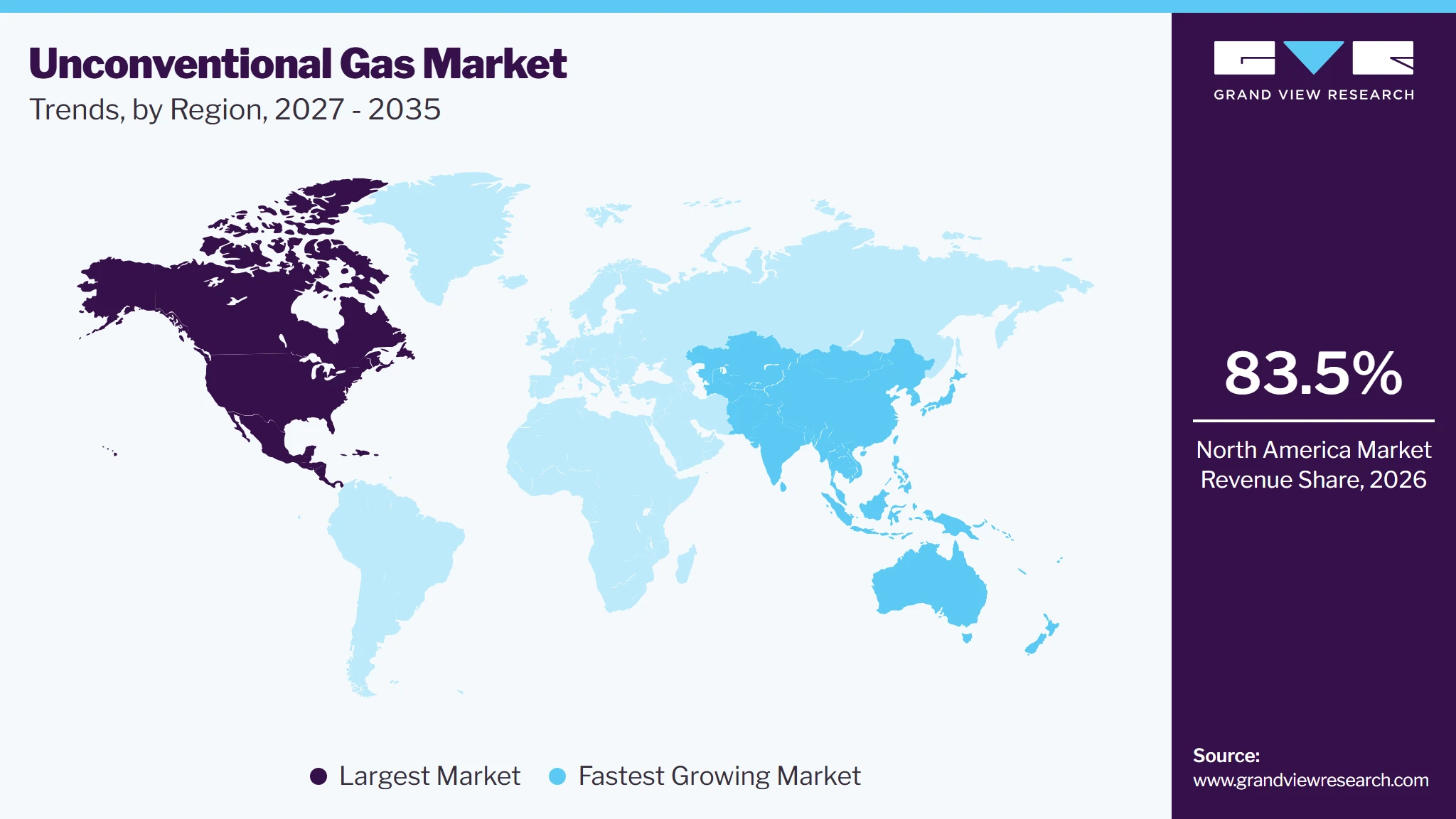
North America represented the leading regional market for unconventional gas with a revenue share of 83.5% in 2026. This is supported by extensive shale gas and tight gas reserves, established production infrastructure, and advanced drilling technologies. The U.S. and Canada account for most of the regional production, driven by extensive exploration activities across major formations such as the Marcellus, Haynesville, Permian, and Montney. Growing LNG export capacity, industrial gas consumption, and technological improvements in hydraulic fracturing are further supporting market expansion.
 To learn more about this report, Download Free Sample Report
U.S. Unconventional Gas Market Trends
The U.S. unconventional gas market is characterized by high production efficiency, large-scale shale development, and continuous improvements in well productivity. The Appalachian Basin, particularly the Marcellus and Utica formations, remains an important source of dry natural gas, while the Haynesville formation supports growing demand from LNG export facilities along the Gulf Coast. In addition, associated gas production from the Permian Basin contributes significantly to domestic supply. Increasing investments in pipeline connectivity, processing facilities, and LNG export capacity are creating opportunities for upstream producers and infrastructure operators.
Asia Pacific Unconventional Gas Market Trends
Asia Pacific is expected to register the fastest CAGR of 7.6% for the forecast period. The region’s market is expanding as countries seek to reduce dependence on imported natural gas and strengthen domestic energy production. China, Australia, and India are among the countries exploring shale gas, coalbed methane, and tight gas resources to diversify their energy mix. Rising electricity consumption, industrial expansion, and increasing investments in exploration and production technologies are supporting regional development. However, geological complexities, water availability constraints, and infrastructure limitations continue to influence the commercial viability of unconventional gas projects.
China's unconventional gas market is characterized by large-scale state-backed exploration, technological localization, and the development of complex geological formations. The Sichuan Basin remains a major shale gas production hub, while the Ordos and other resource-rich basins support coalbed methane and tight gas development. Domestic energy companies are increasingly deploying advanced geological modeling, precision fracturing, and horizontal drilling techniques to improve well productivity. These developments are strengthening China's position as a major unconventional gas producer and creating opportunities for drilling contractors, equipment suppliers, and gas processing companies.
Europe Unconventional Gas Market Trends
The Europe region's unconventional gas market is shaped by efforts to develop domestic hydrocarbon resources and the varying regulatory approaches adopted by individual countries. Poland and Romania continue to assess shale gas potential, while the UK has maintained a cautious approach toward hydraulic fracturing. Romania's ongoing development of conventional offshore gas resources also reflects the region's broader efforts to expand domestic production. However, restrictions on fracking, environmental considerations, and limited commercially proven unconventional reserves are likely to influence the pace of market development.
Latin America Unconventional Gas Market Trends
Latin America's unconventional gas market is largely concentrated in Argentina, where the Vaca Muerta formation represents a significant opportunity for large-scale shale gas development. Increasing participation from international energy companies, upstream capital investments, and the expansion of gas transportation infrastructure are supporting the commercialization of these resources. Argentina is also positioning itself as a potential LNG exporter, creating opportunities to monetize surplus production. In August 2026, Argentina's government reported that natural gas production from Vaca Muerta reached 96.5 million cubic meters per day in July 2026, representing a 5.9% year-over-year increase.
Middle East & Africa Unconventional Gas Market Trends
The Middle East & Africa market is increasingly attracting investment through large-scale unconventional gas development programs, particularly in Saudi Arabia. Saudi Aramco's Jafurah field is emerging as a major shale gas development, while South Ghawar supports the country's tight gas production portfolio. In Africa, Algeria and South Africa offer potential for shale gas development, although commercial progress remains at an earlier stage. In February 2026, Saudi Aramco announced the commencement of production at the Jafurah unconventional gas field, targeting sales gas production of 2 billion cubic feet per day by 2030.
Key Unconventional Gas Company Insights
Some of the key players operating in the global unconventional gas market include Chevron Corporation and CNPC, among others.
-
Chevron Corporation is a major integrated energy company with significant involvement in unconventional oil and gas development, particularly across the U.S. and Argentina. The company develops shale and tight resources in the Permian Basin across Texas and New Mexico, as well as the Denver-Julesburg Basin in Colorado. In Argentina, Chevron participates in the development of the Vaca Muerta shale formation through its interests in the Loma Campana and Narambuena concessions. The company leverages horizontal drilling, hydraulic fracturing, and integrated infrastructure to improve productivity and operational efficiency.
-
CNPC is a prominent state-owned energy company and one of China's leading unconventional gas producers, with operations spanning shale gas, tight gas, and coalbed methane. The company focuses on developing unconventional resources across the Sichuan Basin and other resource-rich regions, using advanced drilling, hydraulic fracturing, and geological assessment technologies. CNPC has achieved significant progress in deep shale gas extraction, including commercially viable production from the deeper Cambrian formations in the Sichuan Basin. Its unconventional gas activities support China's domestic natural gas supply and contribute to the country's efforts to expand indigenous energy production.
Key Unconventional Gas Companies
The following key companies have been profiled for this study on the unconventional gas market.
-
BP p.l.c.
-
Chevron Corporation
-
CNPC
-
ConocoPhillips Company
-
EQT
-
Essar
-
Exxon Mobil Corporation
-
Saudi Arabian Oil Co.
-
Shell plc
-
TotalEnergies
Competitive Benchmarking
Category
Operating Strategies
Competitive Edge
Weakness
Established Players (BP p.l.c., Chevron Corporation, CNPC, ConocoPhillips Company, Exxon Mobil Corporation, Saudi Arabian Oil Co., Shell plc, TotalEnergies)
- Focus on large-scale exploration and development of shale gas, tight gas, and coalbed methane reserves across resource-rich basins.
- Invest in advanced extraction technologies, including horizontal drilling, hydraulic fracturing, and enhanced reservoir characterization.
- Expand production capacity through strategic acquisitions, joint ventures, and partnerships with regional energy companies.
- Established presence across major unconventional gas-producing regions, supported by extensive resource portfolios and production assets.
- Strong financial capabilities and access to capital for large-scale exploration, drilling, and infrastructure development.
- Advanced technological expertise in unconventional reservoir development and extraction.
- High capital expenditure requirements associated with exploration, drilling, hydraulic fracturing, and infrastructure development.
- Exposure to natural gas price volatility, changing market demand, and fluctuations in drilling economics.
- Environmental scrutiny related to methane emissions, water consumption, wastewater disposal, and hydraulic fracturing.
Emerging Players (EQT, Essar)
- Pursue selective investments in upstream hydrocarbon exploration and development opportunities.
- Explore partnerships, joint ventures, and strategic collaborations to access technical expertise and resource opportunities.
- Focus on developing commercially viable energy assets while leveraging existing capabilities across the broader energy value chain.
- Ability to leverage existing relationships and business capabilities across the energy and infrastructure sectors.
- Potential to establish strategic partnerships with established exploration and production companies.
- Greater flexibility in evaluating selective investment opportunities compared with large integrated energy companies.
- Comparatively limited established unconventional gas production footprint against major global producers.
- Lower scale of dedicated unconventional gas operations and technical capabilities.
- Dependence on partnerships and external expertise for complex drilling and extraction activities.
Recent Developments
- In February 2026, Saudi Aramco announced the commencement of production at the Jafurah unconventional gas field in Saudi Arabia, following the start of initial shale gas production in December 2025. The project, spanning approximately 17,000 square kilometers, holds estimated resources of 229 trillion cubic feet of raw gas and 75 billion barrels of condensate. Aramco aims to achieve production capacity of 2 billion standard cubic feet of sales gas per day by 2030, supported by investments in advanced drilling, stimulation, and well productivity technologies.
Unconventional Gas Report Scope
Report Attribute
Details
Market Definition
The market represents revenue generated from the sales of unconventional gases across various applications such as transportation, power generation, etc.
Market size value in 2026
USD 316.5 billion
Market size value in 2027
USD 323.5 billion
Revenue forecast in 2035
USD 413.0 billion
Growth Rate
CAGR of 2.8% from 2027 to 2035
Base year for estimation
2026
Historical data
2023 - 2025
Forecast period
2027 - 2035
Quantitative Units
Revenue in USD Million and CAGR from 2027 to 2035
Report coverage
Revenue forecast, competitive landscape, growth factors, and trends
Segments covered
Resource type, extraction technology, application, and region
Regional scope
North America, Europe, Asia Pacific, Latin America, Middle East & Africa
Country scope
U.S., Canada, Mexico, Germany, Romania, Poland, China, India, Australia, Indonesia, Brazil, Argentina, UAE, Saudi Arabia, South Africa
Key companies profiled
BP p.l.c., Chevron Corporation, CNPC, ConocoPhillips Company, EQT, Essar, Exxon Mobil Corporation, Saudi Arabian Oil Co., Shell plc, TotalEnergies
Customization scope
Free report customization (equivalent up to 8 analysts working days) with purchase. Addition or alteration to country, regional & segment scope.
Pricing and purchase options
Avail customized purchase options to meet your exact research needs. Explore purchase options
Global Unconventional Gas Market Report Segmentation
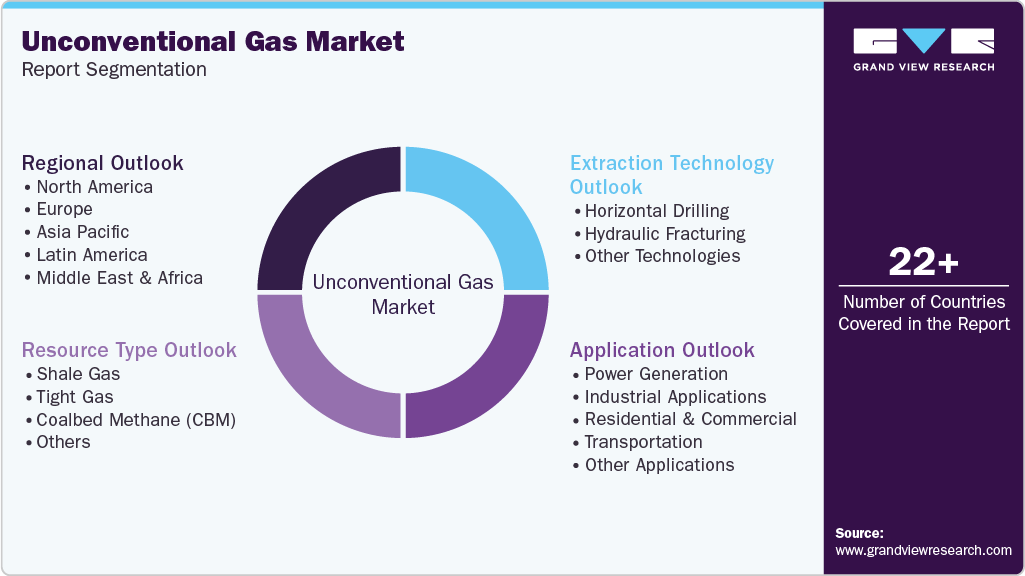
This report forecasts revenue growth at global, regional, and country levels and provides an analysis of the latest industry trends in each of the sub-segments from 2023 to 2035. For the purpose of this study, Grand View Research has segmented the global unconventional gas market report on the basis of resource type, extraction technology, application, and region.
 To learn more about this report, Download Free Sample Report
-
Resource Type Outlook (Revenue, USD Million; Volume, BCM; 2023 - 2035)
-
Shale Gas
-
Tight Gas
-
Coalbed Methane (CBM)
-
Others
-
-
Extraction Technology Outlook (Revenue, USD Million; Volume, BCM; 2023 - 2035)
-
Horizontal Drilling
-
Hydraulic Fracturing
-
Other Technologies
-
-
Application Outlook (Revenue, USD Million; Volume, BCM; 2023 - 2035)
-
Power Generation
-
Industrial Applications
-
Residential and Commercial
-
Transportation
-
Other Applications
-
-
Regional Outlook (Revenue, USD Million; Volume, BCM; 2023 - 2035)
-
North America
-
U.S.
-
Canada
-
Mexico
-
-
Europe
-
Germany
-
Romania
-
Poland
-
-
Asia Pacific
-
China
-
India
-
Australia
-
Indonesia
-
-
Latin America
-
Brazil
-
Argentina
-
-
Middle East & Africa
-
Saudi Arabia
-
UAE
-
South Africa
-
-
Research Methodology
The unconventional gas market figures in this report are based on a proven research process that combines executive interviews with secondary research from proprietary databases, company filings, and recognized regulatory and institutional sources. Market size is built through value-chain sizing-reconciling supply-side and demand-side estimates-and triangulated with bottom-up and top-down approaches. Every estimate passes multiple levels of expert validation before publication, with each unconventional gas segment quantified using the revenue-capture definitions in the table below.
Segment Definition
Segment - Resource Type
Revenue capture definition
Shale Gas
Revenue generated from the sale of natural gas extracted from shale formations.
Tight Gas
Revenue generated from the sale of natural gas extracted from low-permeability sandstone and carbonate reservoirs.
Coalbed Methane (CBM)
Revenue generated from the sale of methane gas extracted from coal seams.
Others
Revenue generated from the sale of gas extracted from other unconventional resources, including gas hydrates.
Segment - Extraction Technology
Revenue capture definition
Horizontal Drilling
Revenue generated from the sale of unconventional gas extracted using horizontal drilling techniques.
Hydraulic Fracturing
Revenue generated from the sale of unconventional gas extracted using hydraulic fracturing techniques.
Other Technologies
Revenue generated from the sale of unconventional gas extracted using other extraction technologies.
Segment - Application
Revenue capture definition
Power Generation
Revenue generated from the sale of unconventional gas for electricity generation.
Industrial Applications
Revenue generated from the sale of unconventional gas for industrial consumption.
Residential and Commercial
Revenue generated from the sale of unconventional gas for residential and commercial consumption.
Transportation
Revenue generated from the sale of unconventional gas for use as transportation fuel, including CNG and LNG.
Other Applications
Revenue generated from the sale of unconventional gas for other applications, including hydrogen production and specialized uses.
Estimation Model
Layer Name
Key Question
Description
Demand Layer
Which factors generate demand for unconventional gas?
Assess demand driven by rising natural gas consumption, increasing energy security concerns, declining conventional gas reserves, growing industrial energy requirements, and investments in domestic shale gas, tight gas, and coalbed methane production.
Resource Type Layer
Which unconventional gas resources generate market revenue?
Evaluate revenue across shale gas, tight gas, coalbed methane (CBM), and other unconventional gas resources based on their production potential, commercial availability, and contribution to natural gas supply.
Extraction Technology & Application Layer
Which extraction technologies and end-use applications generate market revenue?
Assess revenue across horizontal drilling, hydraulic fracturing, and other extraction technologies, along with power generation, industrial applications, residential and commercial consumption, transportation, and other applications.
Revenue Layer
How is market revenue generated?
Market revenue is quantified through the sales of unconventional natural gas, including shale gas, tight gas, and coalbed methane. Revenue is analyzed across resource types, extraction technologies, and end-use applications, considering gas production volumes and realized selling prices across regional markets.
Delivered Customizations
This report has been delivered with the following In-depth customizations
Client Request
Customization Delivered
Value Adds
Competitive Benchmarking
Conducted a detailed assessment of established and emerging unconventional gas producers based on resource portfolio, production capacity, acreage position, extraction technologies, operational presence, partnerships, production volumes, and overall market positioning.
Helps the client understand competitive strengths, benchmark production capabilities, identify technological advantages, and assess the positioning of key market participants.
Cross segmentation Analysis
Analyzed shale gas, tight gas, and coalbed methane across extraction technologies, including horizontal drilling, hydraulic fracturing, and other methods, along with end-use applications such as power generation, industrial consumption, residential and commercial use, transportation, and other applications.
Enables the client to understand resource-specific demand patterns, evaluate extraction technology adoption, identify high-potential resource and application combinations, and prioritize market opportunities.
Regional Opportunity Assessment
Evaluated unconventional gas market potential across key geographic markets by analyzing recoverable reserves, production trends, exploration and production investments, regulatory frameworks, pipeline infrastructure, domestic gas demand, and government initiatives supporting unconventional gas development.
Enables identification of high-potential regions, emerging production hubs, key investment opportunities, and markets offering favorable conditions for unconventional gas exploration and commercialization.
About the Author(s)
Conventional Energy Research Team
Energy & Power · Conventional EnergyThis report was authored by the conventional energy research team at Grand View Research - comprising two research analysts, one senior research analyst, and one industry expert - with specialized expertise in the conventional energy segment of the energy & power industry. All findings are based on proprietary energy & power databases, executive interviews, and regulatory analysis, subject to internal peer review prior to publication.
Last Updated:
Speak to Analyst

Customize this report to your needs - add regions, segments, or data points, with 20% free customization.
Or view our licence options:


ISO 9001:2015 & 27001:2022 Certified
We are GDPR and CCPA compliant! Your transaction & personal information is safe and secure. For more details, please read our privacy policy.


