
- Home
- »
- Network Security
- »
-
Unified Endpoint Management Market Report, 2026-2033GVR Report cover

Unified Endpoint Management Market (2026 - 2033)
Size, Share & Trends Analysis Report By Component (Solutions, Services), By Organization Size, By Vertical (BFSI, Telecom & IT, Retail), By Region, And Segment Forecasts
Market Size, 2025
$8.2BMarket Estimate, 2026
$10.0BMarket Forecast, 2033
$26.6BCAGR, 2026–2033
15.0%Unified Endpoint Management Market Summary
The global unified endpoint management market size was valued at USD 8.2 billion in 2025 and is projected to grow from USD 10.0 billion in 2026 to USD 26.6 billion by 2033, at a CAGR of 15.0% from 2026 to 2033. North America dominated the market and accounted for the largest revenue share of over 35.0% in 2025. Organizations are increasingly transitioning and adopting higher endpoint models to meet the hardware requirements for the updated OS systems. With the growing use of endpoints such as laptops, tablets, mobile phones, and desktops across enterprises, the need to manage them with a single platform increases. Thus, the demand for a unified solution is growing with the adoption of advanced endpoints among organizations. The rise in the trend of implementing policies that allow personal devices to access organizational data is another factor driving market growth.
Key Market Trends & Insights
- By vertical: The telecom & IT segment accounted for the largest revenue share of over 25.0% in 2025.
- By component: The solution segment accounted for the largest revenue share of over 65.0% in 2025.
- By organization size: The large enterprise segment accounted for the largest revenue share of around 70.0% in 2025.
Regional Highlights
- Largest regional market: North America (35.0% revenue share, 2025)
- Fastest-growing regional market: Asia Pacific (highest CAGR, 2026-2033)
Market Size & Forecast
- Market size in 2025: USD 8.2 Billion
- Estimated market size in 2026: USD 10.0 Billion
- Projected market size by 2033: USD 26.6 Billion
- CAGR (2026-2033): 15.0%
Three ways to get this report
Buy it, customize it, or ask a question.Ask an Analyst
Analyst response in 1 business day
- AccessReport author, directly
- Reply timeWithin 1 working day
- No sales callDirect answer only
- FormatEmail reply
- CostFree, no cost
Get the Full Report
What the study covers
- FormatsPDF · Excel · Dashboard
- Timeline2026–2033 annual, 2025 base
- Coverage20+ countries, 5 regions
- Companies10+ key players profiled
Customize the Report
20% free customization
- IncludeCountries, segments, points
- TailorTo your product definition
- ExtendDeeper competitor detail
- OrA fully bespoke study
- Turnaround5–10 working days
The market has gained immense popularity owing to its diverse approach to managing endpoint devices. From mobile security to mobile device and Vertical management to enterprise mobility management, all are uniformly managed through a single platform or solution. Moreover, the unified platform or solution also helps enterprises comply with stringent government regulations and policies. For instance, IBM MaaS360 is a unified endpoint management (UEM) platform that encrypts and secures every database and its contents while maintaining GDPR policy. Furthermore, the platform offers IT and security admins extensive auditing and reporting capabilities, which help meet GDPR compliance requirements easily. Source: Grand View Research, IR Documents, Primary Interviews, Paid DatabasesTo learn more about this report,
 Download Free Sample Report
 Increasing data flowing through devices such as smartphones, tablets, and laptops, and rising cyberattacks such as identity theft and fraud are influencing the need to establish data protection regulations. Due to the rising cyber threats directed at governments and private businesses, the importance of opting for an efficient solution that manages a huge fleet of devices connected to the network is increasing. Organizations are becoming familiar with the laws and are spending heavily on deploying unified endpoint management solutions that help them safeguard the data and comply with stringent government regulations and policies. Thus, large and small enterprises demand a unified endpoint management solution that provides enhanced visibility across the network, strengthens IT Security, improves the user experience, and reduces management costs.
UEM vendors are integrating artificial intelligence and machine learning technologies into UEM solutions to enhance and automate core capabilities, such as Vertical and content management, endpoint security, and remote access and control. An AI-powered UEM solution also provides advanced endpoint security by tracking login time, malware attacks, geo-location, behavioral patterns, automated breaches, and more. It helps end users mitigate cyberattacks and effectively automate the management of endpoint devices across private and corporate networks. Such advanced technologies are expected to increase the adoption of UEM solutions, thereby bolstering market growth.
Market Dynamics
The growing adoption of heterogeneous or mobility devices that use third-party networks other than the organization’s network is the other factor stimulating the need for UEM solutions. Using third-party networks increases not only cyber threat risks but also increases the complexities for the IT administrators to manage endpoints that are pushed out of the organization's network. As a result, it becomes difficult for the security and IT admins to track and manage endpoints in real-time. According to the Identity Theft Resource Center (ITRC), data breaches in the U.S. hit a record high in 2025, with 3,322 reported incidents. This reflects a 4% increase from the previous year. In addition, cyberattacks are the main cause, accounting for 80% of data breaches. They mainly target personally identifiable information, including Social Security numbers and bank account details. Hence, to support such circumstances effortlessly, UEM solutions allow admins with a unified approach to monitor and configure endpoints easily from a central location. It, in turn, increases the adoption of UEM solutions among enterprises.
The unified endpoint management solution has many advantages; however, businesses face challenges when implementing these solutions. Often, this happens as older IT systems may not work with current UEM solutions. As a result, companies incur additional costs and face complex installation processes. IT departments accustomed to traditional device management systems might delay implementation. High implementation costs and the need for specific skills to use this software also create barriers in certain industries. Different IT setups, operating systems, and various endpoints make deployment difficult.
Analyst Perspective
The Unified Endpoint Management (UEM) market is growing due to the rapid shift to remote and hybrid work models, increased mobility within organizations, and rising concerns about endpoint security and compliance. As companies handle more devices, including smartphones, laptops, tablets, desktops, and IoT endpoints, UEM solutions offer a single platform to simplify device management, enforce security, and deploy applications. The market's growth is fueled by the rising need for cloud-based management solutions, zero-trust security frameworks, and the use of artificial intelligence for automated endpoint monitoring and threat detection. The key benefit for market players will come from expanding platform compatibility, improving security features, and building partnerships with cloud service providers and cybersecurity companies.
Component Insights
The solution segment accounted for the largest revenue share of over 65.0% in 2025. The need for a platform that provides endpoint management and security capabilities in a single console is driving segment growth. Furthermore, advancements and continuous upgrades in the platform are other factors responsible for segment growth. Additionally, the growing demand for cloud-based solutions and the SaaS-based model also anticipates the development of segment growth. According to the European Commission, the percentage of businesses using paid cloud computing services rose from 45.3% in 2023 to 52.7% in 2025. In 2025, e-mail, office software, and file storage were the most popular paid cloud services. 85.2%, 71.7%, and 71.5% of businesses reported using these services, respectively.
The services segment is expected to grow at the fastest CAGR of around 17.0% during the forecast period. The need for appropriate consulting services before implementing the UEM solution drives the service market. The UEM vendors assess the existing IT infrastructure and thereby guide the enterprises to implement UEM solutions, either on premises or on the cloud. Furthermore, UEM vendors also provide enterprises with a mix of managed services, training, and support services to ensure the effective management of devices and secure business data shared through endpoints.
Organization Size Insights
The large enterprise segment accounted for the largest revenue share of around 70.0% in 2025. The increasing adoption of network components, the Internet of Things (IoT) devices, and endpoints is the primary factor responsible for the segment growth. In addition, rising adoption of cloud computing among large enterprises is driving strong demand for unified endpoint management solutions to securely manage diverse, complex endpoints across multi-cloud environments. According to the European Commission, the share of businesses using paid cloud computing services was especially high among large companies. In 2025, 84.67% reported buying these services, which is an increase of 6.9% compared to 2023. Furthermore, the increasing risk of cyber threats and the need to manage the endpoints in the existing complex IT environment are other factors augmenting the market growth.
The small and medium enterprises size segment is estimated to register the fastest CAGR of over 18.0% over the forecast period. The growing adoption of cloud-based solutions and the need to secure enterprise mobile devices are the major factors driving the market among SMEs. Moreover, the increasing practices of BYOD policies and the need to manage compliance requirements bolstered segment growth. Additionally, the rising spending on IT assets and the need to reduce operational costs are expected to favor the segment's growth over the forecast period.
Vertical Insights
The telecom & IT segment held the largest revenue share of over 25.0% in 2025. The increased spending on IT services and solutions to manage and improve their productivity is one factor contributing to the segment's growth. The IT and telecom industries use complex IT networks and dedicated servers to manage overall IT assets and the flow of applications across organizations. Maintaining all the endpoints consistently without failure increases pressure on the system administrators. Hence, IT and telecom enterprises are adopting UEM solutions to overcome such complications. Furthermore, the need to uniformly maintain client and existing projects supported by third-party service providers is fueling the market growth.
The healthcare segment is expected to grow at the fastest CAGR of over 18.0% over the forecast period. The factors attributable to the segment growth are the technological advancement in the healthcare sector and the growing adoption of blood pressure monitors, wearable devices, and other cloud-based devices. Furthermore, the increasing usage of mobile devices and other IoT devices to facilitate remote communication and collaboration, and provide better services by sharing critical information over endpoints, increases cyber threat risks and pressure on IT asset management admins. Thus, the growing need to optimize such lifesaving systems and to secure patients' and healthcare facility data is driving the adoption of UEM solutions.
Regional Insights
The North America unified endpoint management industry dominated the market and accounted for the largest revenue share of over 35.0% in 2025. Furthermore, the region is expected to dominate the market over the forecast period. The growing investment by enterprises in advanced technologies to streamline operations is a key driver of the regional market. Moreover, many UEM vendors and their continuous attempts to offer security solutions while providing high-quality endpoint management features surge the regional market. Furthermore, early availability and adoption of technology across the North American region have been one of the main reasons for the high adoption of the UEM solution. Additionally, the high number of IT and capital markets and their diversified businesses worldwide call for efficient management of endpoint devices and have contributed to the market growth in this region.
 To learn more about this report, Download Free Sample Report
 Asia Pacific Unified Endpoint Management Market Trends
The unified endpoint management industry in the Asia Pacific is expected to grow at the fastest CAGR of over 16.5% during the forecast period, owing to the high proliferation of endpoint devices in this region. The massive working population across emerging economies in the Asia Pacific is expected to increase the adoption of endpoint devices, thereby fueling the market growth. According to the Asia-Pacific edition of the World Employment and Social 2025 May Update for the 2025 employment outlook, the International Labor Organization (ILO) estimated that employment in the region would grow by 1.7%, which is about 34 million jobs. In addition, the increasing adoption of mobile devices across enterprises and IoT applications is one of the major factors responsible for regional market growth. Furthermore, the rise in BYOD policies and cloud-based solutions is another factor triggering regional market growth. Additionally, the trend toward a digital workplace and modernization in data centers is anticipated to boost market growth over the forecast period.
Key Unified Endpoint Management Company Insights
Leading companies in the Unified Endpoint Management market are using several key growth strategies to improve their competitive position. They are investing heavily in product innovation by incorporating technologies such as AI, machine learning, and automation for better threat detection, predictive analytics, and smoother device management. Platform integration is a major focus, with vendors creating seamless systems that link UEM solutions with cloud platforms, endpoint security, and Zero Trust architectures to boost customer retention and cross-selling. They are also forming strategic partnerships with MSPs, resellers, and technology providers to expand distribution channels and accelerate market reach.
-
In May 2026, N-able, Inc., a global leader in cybersecurity solutions focused on business resilience, announced a native integration between HaloPSA and Cove Data Protection. This integration automates ticket creation for backup alerts. It speeds up response times and lowers operational risk. Building on N-able’s current HaloPSA integrations, including its Unified Endpoint Management (UEM) platform, the solution expands PSA workflows for quicker triage and better overall business resilience.
-
In April 2026, QBS Software UK&I announced a new partnership with Baramundi Software GmbH, a provider of Unified Endpoint Management (UEM) solutions. This collaboration strengthens QBS Software’s vendor portfolio and gives reseller partners in the UK and Ireland better access to endpoint management tools. Baramundi’s UEM platform enables organizations to manage and secure their entire IT infrastructure from a single interface. It offers important features such as process automation, asset inventory, patch management, security management, software deployment, and endpoint control.
Key Unified Endpoint Management Companies
The following key companies have been profiled for this study on the unified endpoint management market.
-
42Gears Mobility Systems Pvt Ltd.
-
BlackBerry Limited
-
Citrix Systems, Inc.
-
IBM Corporation
-
Matrix42 GmbH
-
Microsoft Corporation
-
Ivanti
-
SOTI Inc.
-
Zoho Corporation Pvt. Ltd.
-
VMware, Inc.
-
Sophos Ltd.
Unified Endpoint Management Market Report Scope
Report Attribute
Details
Market size in 2025
USD 8.2 billion
Estimated market size in 2026
USD 10.0 billion
Projected market size by 2033
USD 26.6 billion
Growth rate
CAGR of 15.0% from 2026 to 2033
Base year for estimation
2025
Historical data
2021 - 2024
Forecast period
2026 - 2033
Quantitative units
Revenue in USD billion and CAGR from 2026 to 2033
Report coverage
Revenue forecast, company ranking, competitive landscape, growth factors, and trends
Segments covered
Component, organization size, vertical, region
Regional Scope
North America; Europe; Asia Pacific; Latin America; Middle East & Africa
Country Scope
U.S.; Canada; U.K.; Germany; France; China; Japan; India; Australia; South Korea; Brazil; Mexico; Saudi Arabia; South Africa; UAE
Key companies profiled
42Gears Mobility Systems Pvt Ltd.; BlackBerry Limited; Citrix Systems, Inc.; IBM Corporation; Matrix42 GmbH; Microsoft; Ivanti; SOTI Inc.; Zoho Corporation Pvt. Ltd.; VMware, Inc.; Sophos Ltd.
Customization scope
Free report customization (equivalent up to 8 analysts working days) with purchase. Addition or alteration to country, regional & segment scope.
Pricing and purchase options
Avail of customized purchase options to meet your exact research needs. Explore purchase options
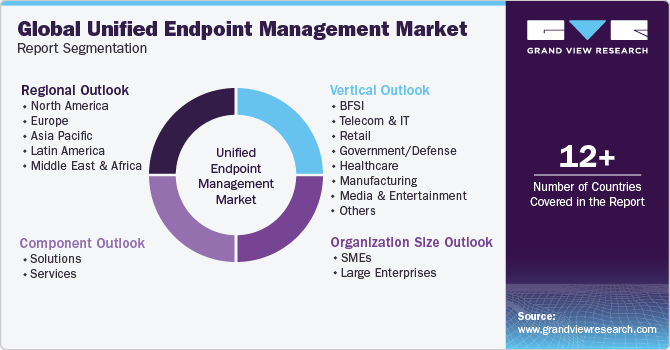
Global Unified Endpoint Management Market Report Segmentation
This report forecasts revenue growth at the regional, and country levels and provides an analysis on the latest industry trends and opportunities in each of the sub-segments from 2021 to 2033. For this study, Grand View Research has segmented the global unified endpoint management market report on the basis of component, organization size, vertical, and region:
 To learn more about this report, Download Free Sample Report
 -
Component Outlook (Revenue, USD Million, 2021 - 2033)
-
Solutions
-
Services
-
Professional Service
-
Managed Service
-
-
-
Organization Size Outlook (Revenue, USD Million, 2021 - 2033)
-
SMEs
-
Large Enterprises
-
-
Vertical Outlook (Revenue, USD Million, 2021 - 2033)
-
BFSI
-
Telecom & IT
-
Retail
-
Government/Defense
-
Healthcare
-
Manufacturing
-
Media & Entertainment
-
Others
-
-
Regional Outlook (Revenue, USD Million, 2021 - 2033)
-
North America
-
U.S.
-
Canada
-
-
Europe
-
U.K.
-
Germany
-
France
-
-
Asia Pacific
-
China
-
Japan
-
India
-
Australia
-
South Korea
-
-
Latin America
-
Brazil
-
Mexico
-
-
Middle East and Africa
-
Saudi Arabia
-
South Africa
-
UAE
-
-
Frequently Asked Questions About This Report
The global unified endpoint management market is expected to grow at a compound annual growth rate of 15.0% from 2026 to 2033 to reach USD 26.6 billion by 2033.
The large enterprise segment accounted for the largest revenue share of around 70.0% in 2025.
The global unified endpoint management market size was valued at USD 8.2 billion in 2025 and is expected to reach USD 10.0 billion in 2026.
Some of the key players operating in the unified endpoint management market include 42Gears Mobility Systems Pvt Ltd.; BlackBerry Limited; Citrix Systems, Inc.; IBM Corporation; Matrix42 GmbH; Microsoft; Ivanti; SOTI Inc.; Zoho Corporation Pvt. Ltd.; VMware, Inc.; Sophos Ltd.
North America dominated the market and accounted for the largest revenue share of over 35.0% in 2025
About the Author(s)
Network Security Research Team
Technology · Network SecurityThis report was authored by the network security research team at Grand View Research - comprising two research analysts, one senior research analyst, and one industry expert - with specialized expertise in the network security segment of the technology industry. All findings are based on proprietary technology databases, executive interviews, and regulatory analysis, subject to internal peer review prior to publication.
Last Updated:
Speak to Analyst

Customize this report to your needs - add regions, segments, or data points, with 20% free customization.
Or view our licence options:


ISO 9001:2015 & 27001:2022 Certified
We are GDPR and CCPA compliant! Your transaction & personal information is safe and secure. For more details, please read our privacy policy.


