U.S. AI in Spine Surgery Market Summary
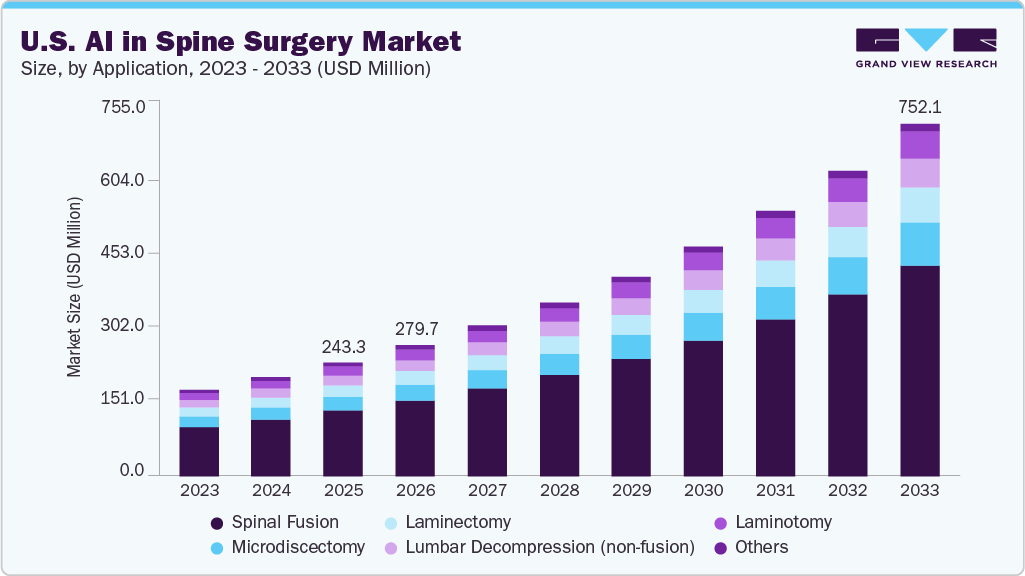
The U.S. AI in spine surgery market size was estimated at USD 243.34 million in 2025 and is projected to reach USD 752.13 million by 2033, growing at a CAGR of 15.18% from 2026 to 2033. The increasing prevalence of degenerative spine conditions, the need for greater surgical precision, fewer revision surgeries, better implant positioning, and the widespread adoption of robotic-assisted surgical platforms and advanced navigation systems are significant factors contributing to market growth.
Key Market Trends & Insights
- Based on functionality, the pre-op planning & personalization segment held the largest market share of 59.67% in 2025.
- Based on application, the spinal fusion segment held the largest market share of 57.85% in 2025.
- Based on end use, the hospitals segment held the largest market share of 65.35% in 2025.
Market Size & Forecast
- 2025 Market Size: USD 243.34 Million
- 2033 Projected Market Size: USD 752.13 Million
- CAGR (2026-2033): 15.18%
The U.S. has a high prevalence of degenerative spine conditions, such as spinal stenosis, spondylolisthesis, disc degeneration, and scoliosis. An aging population and high obesity rates have increased the need for spinal fusion and decompression procedures. Each year, the country performs over 900,000 spine surgeries, ranging from minimally invasive decompression and spinal cord stimulator placements to complex spinal deformity corrections and spinal cord tumor resections, according to data published in the PubMed Central Journal in August 2025. This large procedural volume supports the integration of AI technologies in spine surgery.
Moreover, the need for greater surgical precision, fewer revision surgeries, and better implant positioning is driving the adoption of AI-enabled robotic and navigation platforms in U.S. hospitals and ambulatory surgery centers. In addition, spine surgeons in the U.S. are early adopters of image-guided and data-driven technologies. AI enhances preoperative planning, intraoperative accuracy, and predictive analytics for patient selection. Hospitals leverage AI-enabled spine platforms to reduce complications, improve screw placement accuracy, and shorten operative times.
Moreover, the U.S. healthcare system has widespread adoption of robotic-assisted surgical platforms and advanced navigation systems. Major academic medical centers and large health systems actively invest in AI-integrated surgical technologies to enhance clinical outcomes and institutional competitiveness. For instance, in February 2026, Carlsmed announced the first aprevo Bilateral Posterior Lumbar Interbody Fusion (PLIF) procedure performed at the University of Colorado Hospital in Denver. The AI-planned, 3D-printed patient-specific implants expand the aprevo platform's versatility across lumbar approaches.
Healthcare systems are increasingly leveraging big data and predictive analytics to personalize treatment pathways. AI tools in spine surgery enable preoperative simulation, implant selection optimization, and prediction of complication risk based on patient-specific anatomical and clinical data. Precision medicine initiatives and integration with electronic health records enhance AI model performance. Surgeons use AI-generated insights to improve procedural planning and alignment strategies. The growing emphasis on data-driven clinical decision-making supports widespread integration of AI technologies into spine surgery workflows. For instance, in November 2025, Proprio, an AI-powered surgical intelligence company, partnered with the Harms Study Group to create a research collaborative linking real-time intraoperative data from Proprio’s Paradigm platform with HSG’s global spine deformity outcomes registry. The integrated dataset is likely to automate data capture, enhance registry quality, and support multicenter AI-driven studies to optimize pediatric spine surgery.
Market Concentration & Characteristics
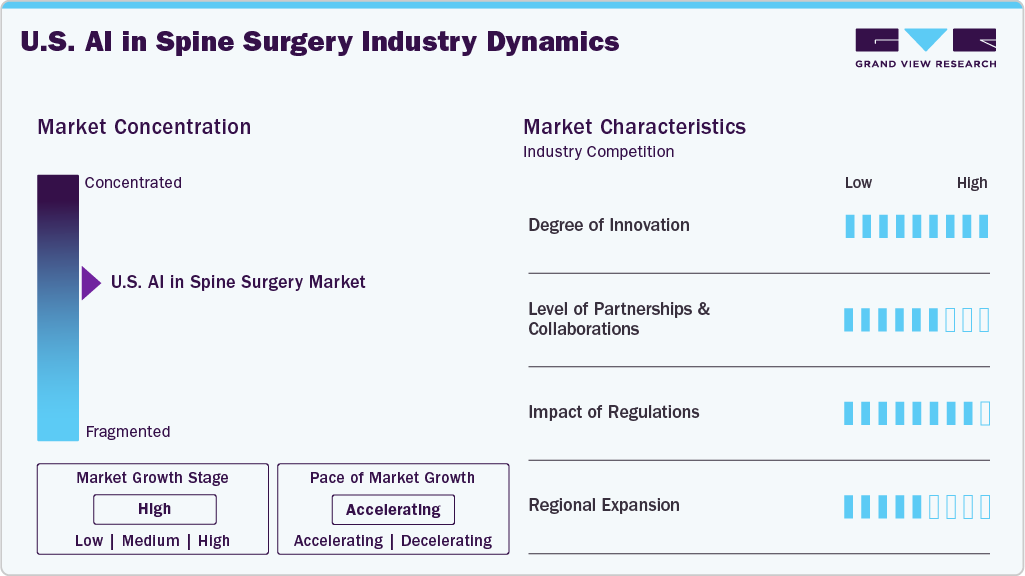
The chart below illustrates the relationship between industry concentration, industry characteristics, and industry participants. The x-axis represents the level of industry concentration, ranging from low to high. The y-axis represents various industry characteristics, including industry competition, levels of partnerships & collaboration, degree of innovation, impact of regulations, and regional expansion. The market is slightly consolidated. However, several emerging players are entering the market, thereby contributing to fragmentation within the market. The degree of innovation and the impact of regulations are high. Moreover, the level of partnerships & collaborations, as well as the industry's regional expansion, is moderate.
THE U.S. AI in the spine surgery market is characterized by constant innovation, with a strong focus on launching new platforms and programs. For instance, in December 2025, Carlsmed began the U.S. launch of its Aprevo technology platform for cervical fusion surgeries, extending its personalized spine system that combines AI-driven preoperative planning with 3D-printed, patient-specific interbody implants.
“We are excited to bring the aprevo platform to cervical fusion procedures, representing an important milestone in our mission to transform spine surgery. With positive clinical feedback from our first 50+ cases, strong reimbursement support and accelerating demand, we believe our cervical system has the potential to redefine the standard of care in cervical spine surgery.”
- Mike Cordonnier, chair and CEO of Carlsmed
The industry is experiencing a moderate level of partnerships & collaborations undertaken by several key players. This is due to the desire to gain a competitive advantage in the industry, enhance technological capabilities, and consolidate in a rapidly growing market.
Regulations, such as the HIPAA in the U.S., establish standards for safeguarding patient data privacy and security. Compliance with these regulations is crucial for AI applications in healthcare to ensure the safe and secure handling of patient information, reducing the risk of data breaches and unauthorized access.
The industry is witnessing moderate geographical expansion. Companies within the AI in spine surgery industry seek geographic expansion strategies to maintain their foothold in the market.
Functionality Insights
The pre-op planning & personalization segment led the U.S. AI in spine surgery industry, accounting for the largest revenue share of 59.67% in 2025. This segment focuses on alignment optimization, deformity correction planning, and patient-specific construct design. AI platforms process CT and MRI datasets to generate three-dimensional anatomical reconstructions and quantify spinopelvic parameters. Clinical adoption is driven by the need to improve sagittal balance restoration and reduce revision risk. Integration with hospital imaging infrastructure supports seamless incorporation into pre-surgical workflows.
Moreover, personalization capabilities further strengthen this segment by enabling AI-driven design of patient-specific interbody cages, pedicle screw trajectories, and customized fixation constructs. For instance, Carlsmed's aprevo is an AI-powered personalized spine surgery platform combining preoperative CT-based 3D modeling, machine learning surgical planning, and custom 3D-printed interbody fusion implants for lumbar and cervical procedures.
The diagnostic decision support segment is expected to grow at the fastest CAGR during the forecast period. Diagnostic decision support systems use machine learning algorithms to interpret MRI and CT scans, identify spinal pathologies, and quantify degenerative changes. Moreover, decision-support tools assist surgeons in determining surgical candidacy, selecting the appropriate level of care, and risk-stratifying patients. These platforms support value-based care models by minimizing diagnostic errors and unnecessary procedures.
Application Insights
The spinal fusion segment led the U.S. AI in spine surgery market, accounting for the largest revenue share of 57.85% in 2025, due to the high procedural volume of lumbar and cervical fusion surgeries. AI technologies support pre-operative planning, implant sizing, screw trajectory optimization, and alignment correction modeling. AI integration in spine fusion procedures enhances intraoperative accuracy through navigation support and data-driven decision guidance. Compatibility with robotic-assisted platforms further strengthens clinical utility in complex fusion cases. Moreover, this segment is projected to grow at the fastest CAGR during the forecast period.
The microdiscectomy segment is anticipated to grow significantly from 2026 to 2033. The growth is driven by the high incidence of lumbar disc herniation and radiculopathy requiring surgical intervention. AI integration in microdiscectomy also improves workflow efficiency and postoperative outcome prediction. Predictive analytics assess recurrence risk, patient recovery timelines, and potential complications based on demographic and clinical variables. These insights support patient selection and informed consent discussions.
End Use Insights
The hospitals segment dominated the U.S. AI in spine surgery market, accounting for the largest share of 65.35% in 2025, due to high surgical volumes and access to advanced infrastructure. These institutions possess integrated imaging systems, robotic platforms, and digital operating rooms that support AI deployment. Capital budgets in hospital systems enable procurement of enterprise-level AI software and analytics platforms.
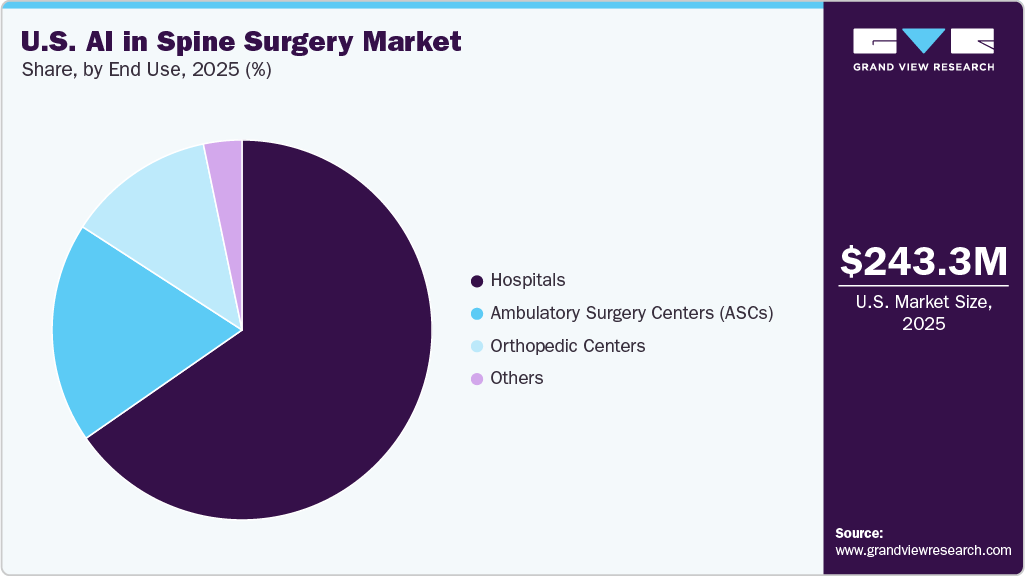
The Ambulatory Surgery Centers (ASCs) segment is anticipated to grow at the fastest CAGR from 2026 to 2033. The ASCs segment is expanding due to the shift of eligible spine procedures to outpatient settings. Minimally invasive spine surgeries, including microdiscectomy and select fusion procedures, are increasingly performed in ASCs to reduce costs and improve patient convenience. AI-enabled preoperative planning and diagnostic decision-support tools enhance case selection and procedural precision in resource-optimized environments.
Key U.S. AI in Spine Surgery Company Insights
Key players operating in the U.S. AI in spine surgery market are undertaking various initiatives to strengthen their market presence and increase the reach of their products and services. Strategies such as new product launches and partnerships play a key role in propelling market growth.
Key U.S. AI in Spine Surgery Companies:
- Globus Medical
- Medtronic
- Orthofix (7D Surgical tech)
- Augmedics
- DePuy Synthes (Johnson & Johnson MedTech)
- Carlsmed
- Surgical Theater, Inc.
Recent Developments
-
In October 2025, Surgical Theater received FDA 510(k) clearance for the next-generation SyncAR Spine, an AI-powered XR platform that integrates with Medtronic StealthStation navigation. It features AI vertebra segmentation, Advanced Decompression Planning for resection mapping, and Segmental Fusion, maintaining pre-op model alignment with intra-op CT despite patient positioning changes.
-
In April 2025, Proprio received FDA 510(k) clearance for its Paradigm AI surgical guidance platform, the first enabling real-time intraoperative 3D measurements during spine procedures.
-
In September 2024, Medtronic expanded its AiBLE spine surgery ecosystem at the North American Spine Society (NASS) with O-arm 4.3 software (AI dose reduction, longest 3D scan), UNiD ASI MRI Vision, Mazor 5.1 robotics, and ModuLeX implants.
-
In July 2024, ATEC launched EOS Insight, a cloud-based spine surgery platform powered by EOSedge imaging and AI. Key features include AI-driven alignment assessment with rapid measurements and benchmarking, 3D surgical planning simulations using patient-specific spine models, contoured rods for constructs, intra-operative reconciliation, and post-op analytics for longitudinal insights.
“Relying on EOS Insight, I entered surgery with an efficient, AI-driven customized plan, precise alignment measurements and rods pre-contoured for the long construct. The technology increased my confidence in the operating room. I was able to compare my progress to the pre-operative plan throughout the surgery, then perform a final reconciliation prior to its completion. EOS Insight is truly the most comprehensive spine innovation I’ve witnessed in my 35-year clinical tenure.”
-David G. Schwartz, MD, and Craig McMains, MD.
U.S. AI in Spine Surgery Market Report Scope
|
Report Attribute
|
Details
|
|
Market size value in 2026
|
USD 279.67 million
|
|
Revenue forecast in 2033
|
USD 752.13 million
|
|
Growth rate
|
CAGR of 15.18% from 2026 to 2033
|
|
Actual data
|
2021 - 2024
|
|
Forecast period
|
2025 - 2033
|
|
Quantitative units
|
Revenue in USD million/billion and CAGR from 2026 to 2033
|
|
Report coverage
|
Revenue forecast, company ranking, competitive landscape, growth factors, and trends
|
|
Segments covered
|
Functionality, application, end use
|
|
Country scope
|
U.S.
|
|
Key companies profiled
|
Globus Medical; Medtronic; Orthofix (7D Surgical tech); Augmedics; DePuy Synthes (Johnson & Johnson MedTech); Carlsmed; Surgical Theater, Inc.
|
|
Customization scope
|
Free report customization (equivalent up to 8 analysts working days) with purchase. Addition or alteration to country, regional & segment scope.
|
|
Pricing and purchase options
|
Avail customized purchase options to meet your exact research needs. Explore purchase options
|
U.S. AI in Spine Surgery Market Report Segmentation
This report forecasts revenue growth at the country level and provides an analysis of the latest industry trends in each of the sub-segments from 2021 to 2033. For this study, Grand View Research has segmented the U.S. AI in spine surgery market report based on functionality, application, and end use:
-
Functionality Outlook (Revenue, USD Million, 2021 - 2033)
-
Pre-op planning & personalization (alignment/planning, patient-specific constructs)
-
Intraoperation guidance / navigation / AR / digital execution
-
Diagnostic decision support
-
Application Outlook (Revenue, USD Million, 2021 - 2033)
-
End Use Outlook (Revenue, USD Million, 2021 - 2033)
Frequently Asked Questions About This Report
b. The U.S. AI in spine surgery market size was estimated at USD 243.3 million in 2025 and is expected to reach USD 279.7 million in 2026.
b. The U.S. AI in spine surgery market is expected to grow at a compound annual growth rate of 15.2% from 2026 to 2033 to reach USD 752.1 million by 2033.
b. The pre-op planning & personalization segment held the largest market share of over 59% in 2025.
b. Some key players operating in the U.S. AI in spine surgery market include Globus Medical; Medtronic; Orthofix (7D Surgical tech); Augmedics; DePuy Synthes (Johnson & Johnson MedTech); Carlsmed; Surgical Theater, Inc.
b. Key factors that are driving the U.S. AI in spine surgery market are increasing prevalence of degenerative spine conditions, need for greater surgical precision, fewer revision surgeries, and better implant positioning, and widespread adoption of robotic-assisted surgical platforms and advanced navigation systems.

 Download Sample Report
















