U.S. Antiseptic And Disinfectant Market Summary
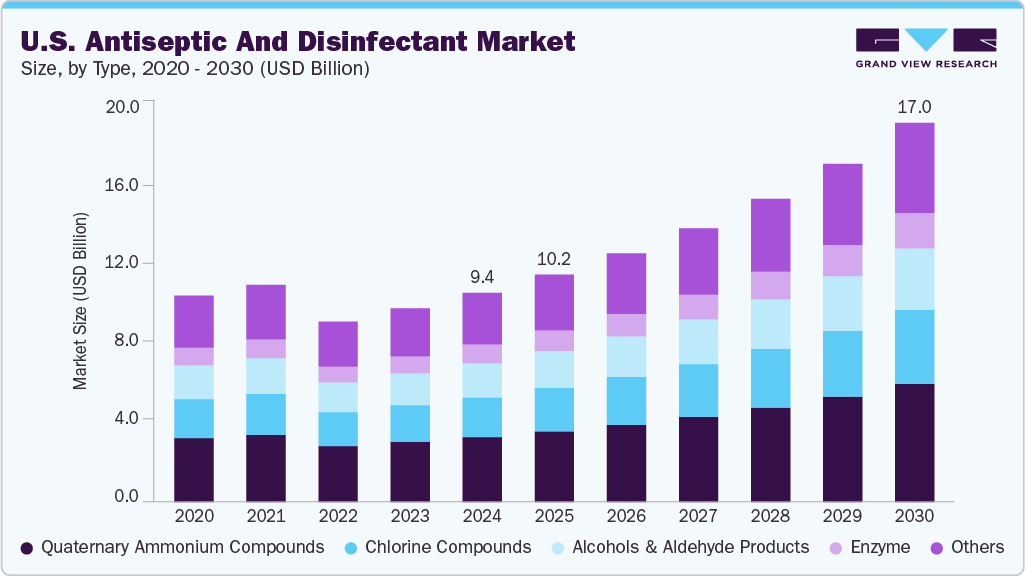
The U.S. antiseptic and disinfectant market size was valued at USD 9.41 billion in 2024 and is projected to reach USD 17.07 billion by 2030, growing at a CAGR of 10.8% from 2025 to 2030. An increase in the prevalence of diseases, such as influenza, hepatitis A, typhoid, cholera, and dengue, is one of the major factors driving the antiseptic & disinfectant market growth.
Key Market Trends & Insights
- In terms of segment, quaternary ammonium compounds accounted for a revenue of USD 2.921.6 million in 2024.
- Enzyme is the most lucrative type segment registering the fastest growth during the forecast period.
- By type, the quaternary ammonium compounds segment dominated the market with a 31.0% revenue share in 2024.
Market Size & Forecast
- 2024 Market Size: USD 9,411.4 Million
- 2030 Projected Market Size: USD 17,071.6 Million
- CAGR (2025-2030): 10.8%
According to the Centers for Disease Control and Prevention (CDC), the 2023 - 2024 flu season led to an estimated 40 million illnesses, 470,000 hospitalizations, and 28,000 deaths in the U.S. The need for effective disinfection in both healthcare and community settings drives the U.S. antiseptic and disinfectant industry. The increasing number of surgical and inpatient medical procedures in the U.S. significantly drives demand for antiseptics and disinfectants. Each procedure requires stringent sterilization protocols and aseptic practices to minimize the risk of healthcare-associated infections. The growing prevalence of chronic diseases and an aging population are contributing to higher hospitalization rates. This sustained patient volume increases surface contamination risks, reinforcing the need for consistent and effective disinfection practices across healthcare facilities.
Regulatory organizations such as the U.S. Environmental Protection Agency (EPA) and the Food and Drug Administration (FDA) play a vital role in shaping the U.S. industry. These agencies enforce strict standards for product efficacy, safety, and labeling, particularly in healthcare environments. The EPA mandates that hospital-grade disinfectants undergo rigorous testing to prove effectiveness against a broad range of pathogens. Meanwhile, the FDA oversees the safety and formulation of antiseptics used on patients. This regulatory environment encourages manufacturers to innovate and drives healthcare providers to adopt compliant, high-quality disinfection solutions.
Market Concentration & Characteristics
The industry growth stage is high, and the pace of growth is accelerating. The U.S. antiseptic and disinfectant industry is characterized by a moderate degree of innovation, driving the demand for safer, faster-acting, and environmentally friendly formulations. Companies invest in bio-based and non-toxic alternatives, enzymatic cleaners, and smart packaging. Product differentiation through EPA-approved efficacy claims and rapid disinfection time is a key competitive strategy. Innovation is driven by demand in sectors such as healthcare, food processing, and public transport. For instance, in June 2023, Reckitt’s Lysol launched the first EPA-approved air sanitizer in the U.S., designed to kill 99.9% of airborne viruses and bacteria. Unlike traditional air fresheners or surface disinfectants, the product targets airborne pathogens such as influenza and coronavirus.
The U.S. antiseptic and disinfectant industry is characterized by moderate Mergers and Acquisitions (M&A), and strategic partnerships among key players aim to expand their product portfolios and geographic presence. Consolidation trends are evident among mid- and large-sized manufacturers, particularly in medical disinfectants and specialty cleaning agents. Collaborations with biotech firms and material science companies also support innovation pipelines. M&A activity enhances market share, regulatory compliance capabilities, and distribution networks.
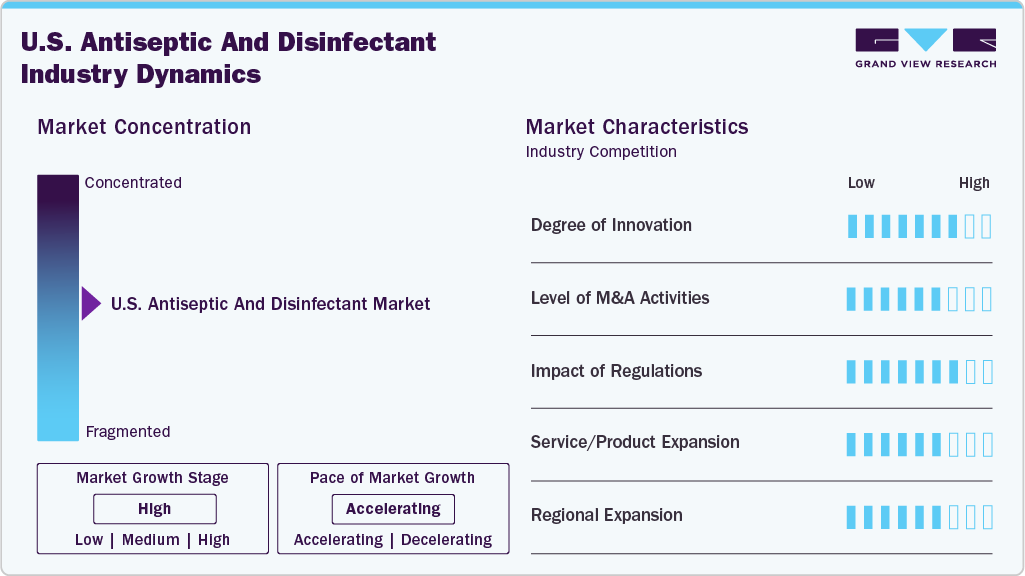
Regulatory oversight from agencies such as the EPA and FDA significantly impacts market dynamics. These organizations establish stringent requirements for formulation safety, efficacy testing, and labeling, particularly for healthcare and food-related applications. Compliance with evolving standards often requires ongoing R&D investment and can delay product launches. The clear regulatory pathways also help ensure product credibility and boost consumer and institutional confidence.
Type Insights
The quaternary ammonium compounds segment dominated the market with a 31.0% revenue share in 2024. This dominance can be attributed to their broad-spectrum antimicrobial efficacy against bacteria, viruses, and fungi. Quaternary Ammonium Compounds (QACs) are extensively utilized in hospital-grade disinfectants for surfaces, instruments, and non-critical medical equipment due to their low toxicity, ease of formulation, and residual antimicrobial properties. Furthermore, their cost-effectiveness and material compatibility make them a preferred choice across various healthcare settings. The consistent demand for routine disinfection of high-touch surfaces further reinforces the segment's growth.
The enzyme segment is expected to register the fastest CAGR of 11.8% during the forecast period from 2025 to 2030. The segment's growth can be attributed to increasing demand for environmentally friendly and biodegradable disinfection solutions. These products utilize naturally derived enzymes to degrade organic matter and eliminate pathogens without leaving toxic residues. Their adoption is particularly prominent in sensitive environments such as pediatric care units, food processing facilities, and sustainably certified buildings.
Product Type Insights
The medical device disinfectants segment dominated the market with the largest revenue share in 2024. This is primarily due to the stringent sterilization requirements for reusable medical equipment such as surgical tools, endoscopes, and diagnostic instruments. These disinfectants are essential for preventing device-associated infections and maintaining compliance with CDC, EPA, and FDA standards. The rising number of surgical procedures and hospital admissions further supports segment growth. Increased awareness regarding Hospital-acquired Infections (HAIs) also drives demand for high-level device disinfectants in the U.S. antiseptic and disinfectant industry.
The enzymatic cleaners segment is expected to grow at the fastest rate over the forecast period. These cleaners use bioactive enzymes to break down organic material such as blood, tissue, and bodily fluids, making them ideal for pre-cleaning surgical instruments and devices. Their growing popularity stems from their biodegradability, safety profile, and effectiveness in removing bioburden without damaging sensitive instruments. Healthcare facilities move toward sustainable and less toxic solutions, and enzymatic cleaners are increasingly being adopted across acute and ambulatory care settings.
End Use Insights
The hospital segment dominated the market and had the largest revenue share in 2024. This dominance can be attributed to the high inpatient admissions, surgical procedures, and intensive infection control requirements. Hospitals rely extensively on disinfectants and antiseptics to maintain sterile environments, prevent HAIs, and comply with CDC and EPA standards. High-touch surface cleaning, surgical-site preparation, and equipment sterilization are routine applications supporting consistent demand. The presence of specialized departments such as Intensive Care Unit (ICUs) and operating rooms further amplifies consumption volumes. In 2023, over 38,000 hospitals and healthcare facilities actively reported data to the CDC’s National Healthcare Safety Network (NHSN), the nation’s largest HAI surveillance system, supporting nationwide infection prevention and control efforts.
The clinics segment is expected to witness significant growth during the forecast period, driven by the rising number of outpatient visits and the expansion of ambulatory care services. As more patients seek care in cost-effective and accessible clinical settings, maintaining strict hygiene standards has become a priority. Clinics are increasingly investing in advanced disinfectants and antiseptics to reduce infection risks and ensure patient safety. Regulatory oversight and patient awareness have also contributed to the adoption of surface and instrument disinfectants. This trend is particularly notable in dermatology, dental, and diagnostic clinics across urban and suburban areas.
Sales Channel Insights
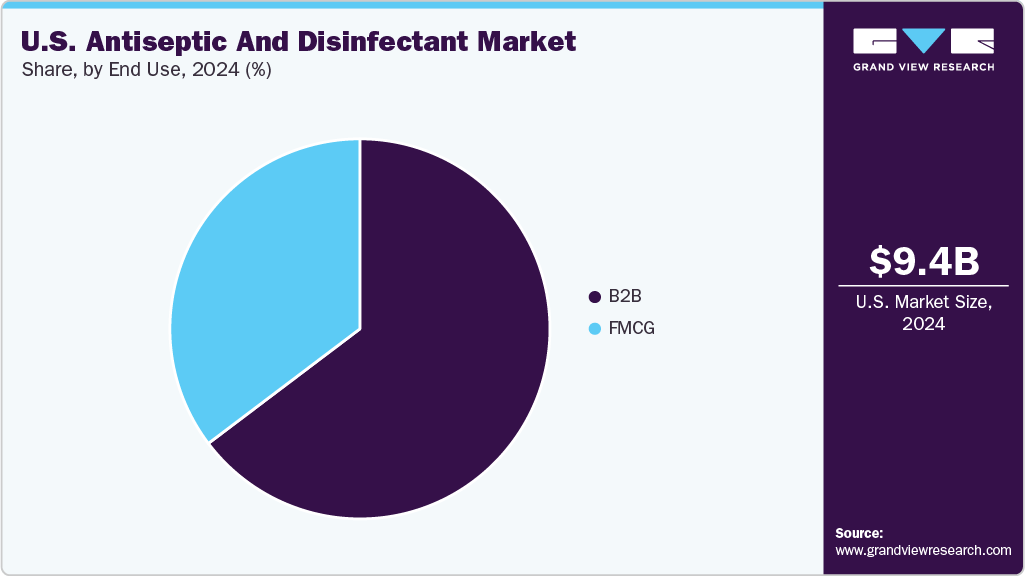
The B2B segment dominated the market with the largest revenue share in 2024. This dominance can be attributed to bulk purchasing from hospitals, clinics, diagnostic labs, long-term care centers, and cleaning service providers. These institutions require a steady and large-scale supply of disinfection products to meet regulatory standards and infection control protocols. Long-term contracts, institutional partnerships, and direct procurement channels ensure consistent demand. Rising investments in hospital infrastructure and public health facilities support the continued dominance of the B2B segment.
The FMCG segment is expected to be the fastest-growing segment over the forecast period, due to increasing consumer awareness about hygiene and infection prevention in residential sites. Growing concerns over seasonal illnesses and viral outbreaks have boosted retail sales of antiseptics, disinfectant sprays, wipes, and sanitizers. Large-scale product availability across supermarkets, pharmacies, e-commerce, and convenience stores further accelerates segment growth. Manufacturers are also introducing innovative, eco-friendly, and ready-to-use products tailored for households, contributing to rapid adoption in this category.
Key U.S. Antiseptic And Disinfectant Company Insights
Some key players in the U.S. antiseptic and disinfectant industry are 3M and Steris Plc.
-
3M is a diversified technology company that offers a comprehensive range of antiseptic and disinfectant products, including surface cleaners, surgical site preparations, and hand hygiene solutions. The company supports healthcare facilities with products designed to enhance infection control protocols and meet regulatory standards.
-
Steris Plc, a medical equipment manufacturer, provides various sterilization and disinfection solutions tailored for surgical, endoscopy, and critical care settings. Its product line includes chemical disinfectants, high-level sterilants, and equipment to maintain aseptic conditions in healthcare environments.
Key U.S. Antiseptic And Disinfectant Companies:
- 3M
- RECKITT BENCKISER GROUP PLC
- Steris Plc
- Kimberly-Clark Worldwide, Inc.
- Bio-Cide International, Inc. (Kemin Industries, Inc.)
- Cardinal Health
- BD
- Johnson & Johnson
Recent Development
-
In July 2024, Ecolab launched Disinfectant 1 Wipe, the first EPA-registered disinfectant wipe 100% plastic-free and readily degradable. Prepared entirely from wood pulp fibers, the wipe offers 1-minute hospital-grade disinfection, expanding Ecolab’s solutions for cleaning patient rooms and surgical instruments in healthcare facilities.
-
In June 2023, Parker Laboratories received FDA clearance for Tristel ULT, a high-level disinfecting foam for ultrasound probes used on skin and within body cavities.
-
In April 2023, SC Johnson launched its new FamilyGuard brand, a line of disinfectant products designed to help protect families by eliminating germs on frequently touched hard, non-porous surfaces.
U.S. Antiseptic And Disinfectant Market Report Scope
|
Report Attribute
|
Details
|
|
Market size value in 2025
|
USD 10.23 billion
|
|
Revenue forecast in 2030
|
USD 17.07 billion
|
|
Growth Rate
|
CAGR of 10.8% from 2025 to 2030
|
|
Base year for estimation
|
2024
|
|
Historical data
|
2018 - 2023
|
|
Forecast period
|
2025 - 2030
|
|
Report updated
|
July 2025
|
|
Quantitative units
|
Revenue in USD million and CAGR from 2025 to 2030
|
|
Report coverage
|
Revenue forecast, company ranking, competitive landscape, growth factors, and trends
|
|
Segments covered
|
Type, product type, end use, and sales channel
|
|
Key companies profiled
|
3M; Reckitt Benckiser; Steris Plc; Kimberly-Clark Corporation; Bio-Cide International, Inc.; Cardinal Health; BD; Johnson & Johnson
|
|
Customization scope
|
Free report customization (equivalent up to 8 analysts working days) with purchase. Addition or alteration to the country, and segment scope.
|
|
Pricing and purchase options
|
Avail customized purchase options to meet your exact research needs. Explore purchase options
|
U.S. Antiseptic And Disinfectant Market Report Segmentation
This report forecasts revenue growth at the country level and analyzes the latest industry trends in each of the sub-segments from 2018 to 2030. For this study, Grand View Research has segmented the U.S. antiseptic and disinfectant market report based on type, product type, end use, and sales channel:
-
Type Outlook (Revenue, USD Million, 2018 - 2030)
-
Product Type Outlook (Revenue, USD Million, 2018 - 2030)
-
End Use Outlook (Revenue, USD Million, 2018 - 2030)
-
Sales Channel Outlook (Revenue, USD Million, 2018 - 2030)

 Download Sample Report