U.S. Copper Alloys For Connector Market Summary
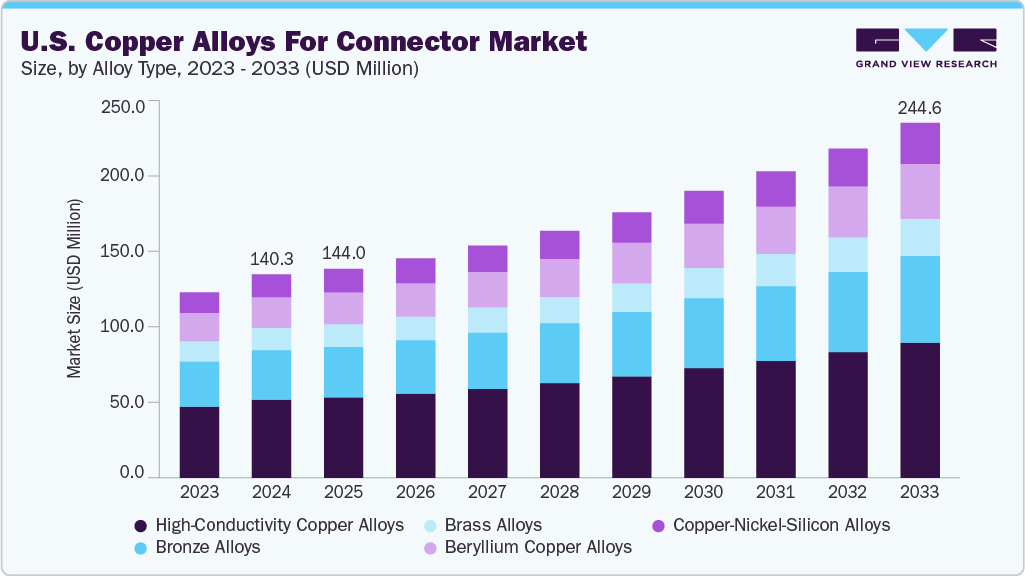
The U.S. copper alloys for connector market size was estimated at USD 140.3 million in 2024 and is projected to reach USD 244.6 million by 2033, at a CAGR of 6.8% from 2025 to 2033. The shift toward electric and hybrid vehicles in the U.S. is a significant growth driver for copper alloy connectors market.
Key Market Trends & Insights
- The U.S. copper alloys for connector market is expected to grow at a substantial CAGR of 6.8% from 2025 to 2033.
- By alloy type, high-conductivity copper alloys accounted for the largest market revenue share of over 38.0% in 2024.
- By end use, the telecommunications & data centers segment is anticipated to register the fastest CAGR of 7.2% from 2025 to 2033..
Market Size & Forecast
- 2024 Market Size: USD 140.3 Million
- 2033 Projected Market Size: USD 244.6 Million
- CAGR (2025-2033): 6.8%
As electric vehicles (EVs) require more complex and high-performance electrical systems than internal combustion engine vehicles, the demand for connectors with excellent conductivity and corrosion resistance has surged. Copper alloys, such as beryllium copper and brass, are preferred due to their mechanical strength and reliability under thermal stress. The increasing EV penetration, supported by government incentives and environmental mandates, drives connector demand across power distribution units, battery systems, and electronic control modules.
The ongoing digital transformation in the U.S. economy is fueling investments in data centers, cloud infrastructure, and next-gen telecommunication networks. The rollout of 5G has amplified the need for high-speed, reliable connections, especially in densely packed circuit environments. These connectors enable high-frequency signal transmission in telecom base stations, routers, and servers, owing to their excellent signal integrity and durability. As bandwidth and data transmission demands rise, such components become indispensable in modern connectivity solutions.
The U.S. manufacturing sector is increasingly adopting automation, robotics, and smart factory concepts to enhance productivity and operational efficiency. These systems rely heavily on robust and precise electrical connectivity, especially in harsh industrial environments. Copper-based alloys, known for their excellent machinability and high strength-to-weight ratio, are widely used in connectors for sensors, actuators, and control systems. Ongoing investments in Industry 4.0 technologies and the reshoring of production are broadening their application across various sectors.
The miniaturization trend in consumer electronics, smartphones, laptops, and wearables has created strong demand for compact, high-performance connection solutions. Copper alloys are essential in producing ultra-small, high-density types that maintain functionality under frequent mechanical stress. As consumer preferences shift toward multifunctional, portable devices, U.S.-based electronics manufacturers are adopting premium-grade materials to ensure reliability. Additionally, the rise of smart home devices and IoT platforms further drives market growth.
The transition to a cleaner energy mix in the U.S., including solar, wind, and energy storage, requires a modernized grid with efficient and durable connectivity. These connectors are crucial in photovoltaic systems, wind turbines, inverters, and batteries due to their corrosion resistance and high current capacity. Government programs promoting renewables and grid upgrades boost demand for high-quality components in utility-scale and distributed energy installations.
Drivers, Opportunities & Restraints
In the U.S., demand for high-performance connectors is surging across EVs, aerospace, and electronics. The federal push toward clean energy and transportation, supported by subsidies and EV infrastructure expansion, accelerates the need for advanced electrical components. Alloys like beryllium copper and phosphor bronze are widely used due to their superior conductivity, formability, and corrosion resistance, making them ideal for battery systems, infotainment modules, and power distribution. Additionally, the aggressive rollout of 5G and expansion of data centers are driving requirements for components that ensure reliable signal transmission and thermal stability.
Significant growth opportunities exist through domestic manufacturing incentives and reshoring efforts. The U.S. government's commitment to strengthening semiconductor and electronics supply chains provides a favorable environment for local production. Solar and wind energy investments also support rising demand for robust connectors that perform under extreme conditions. Meanwhile, advanced medical devices, defense systems, and aerospace applications open high-margin segments where precision-engineered copper-based materials are essential for performance and reliability.
However, the market faces several challenges. Raw material cost volatility, especially for copper and alloying elements like beryllium, poses a financial risk to producers. Regulatory compliance with OSHA and EPA standards, particularly beryllium handling, adds to manufacturing complexity. Moreover, competition from lower-cost imports and alternative materials like aluminum or conductive polymers in low-voltage applications may limit market expansion, especially within budget-conscious consumer electronics sectors.
Alloy Type Insights
High-conductivity copper alloys held the revenue share of 38.5% in 2024. The high-conductivity copper alloys segment in the U.S. copper alloys for connector industry is witnessing steady growth, due to the rising demand for EVs and renewable energy systems. These applications require materials that offer excellent electrical conductivity to ensure efficient power transmission. High-conductivity copper alloys, such as copper-beryllium and copper-nickel-silicon, are widely used in EV connectors, battery systems, and charging stations. Additionally, government support for clean energy and infrastructure upgrades in the U.S. is further boosting the use of these alloys in various automotive and power applications.
The copper-nickel-silicon alloys segment is anticipated to register the fastest CAGR over the forecast period. Copper-nickel-silicon (CuNiSi) alloys are experiencing rising demand in the U.S. connector market due to their excellent combination of high electrical conductivity, strength, and resistance to stress relaxation. These properties make them ideal for high-reliability connectors in automotive electronics, aerospace systems, and industrial automation. As vehicles and machines become more electronically sophisticated, manufacturers require connector materials that maintain performance under heat and mechanical stress, where CuNiSi alloys excel.
End Use Insights
Telecommunications & data centers held the revenue share of 29.6% in 2024. The rising number of hyperscale data centers and the growing demand for low-latency communication networks boost the consumption of copper alloy-based connectors. These facilities operate 24/7 and demand materials that can handle high electrical loads without degrading over time. Copper alloys balance electrical efficiency, corrosion resistance, and mechanical strength, making them ideal for dense connector arrays. As the digital economy grows, especially with AI, IoT, and big data applications, this segment is expected to remain a major contributor to the market's expansion.
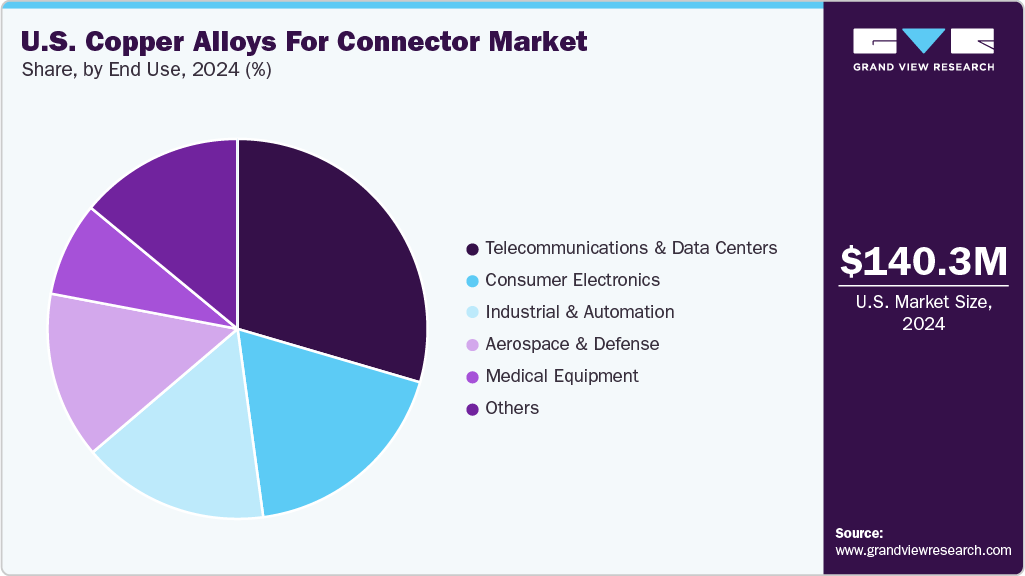
The medical equipment segment is anticipated to grow significantly over the forecast period, due to the increasing reliance on advanced electronic medical devices. MRI machines, patient monitoring systems, diagnostic instruments, and surgical tools require highly reliable electrical connectors to ensure consistent performance and patient safety. Copper alloys, particularly copper-nickel-silicon and copper-beryllium, are used in these connectors because they offer excellent electrical conductivity, corrosion resistance, and mechanical strength, even in sterilization environments.
Key U.S. Copper Alloys for Connector Company Insights
Some of the key players operating in the market include IBC Advanced Alloys, AMETEK Inc., and others
-
IBC Advanced Alloys is a U.S.-based advanced materials company that develops and manufactures specialized alloys and rare metal-based products. Headquartered in Franklin, Indiana, the company operates through two key divisions: Copper Alloys and Engineered Materials. IBC focuses on serving high-performance markets such as aerospace, defense, automotive, telecommunications, and industrial applications. Its vertically integrated operations allow it to control production from raw materials to finished components, helping maintain quality, cost efficiency, and supply chain reliability.
-
AMETEK Inc. is a leading U.S.-based manufacturer of advanced electronic instruments and electromechanical devices. It has two main business segments: the Electronic Instruments Group, which produces precision measuring and monitoring instruments, and the Electromechanical Group, which supplies specialty metals, motors, and thermal management systems. AMETEK serves various industries, including aerospace, defense, healthcare, energy, and industrial manufacturing. In the copper alloys market for connectors, AMETEK offers high-performance materials such as its Pfinodal copper alloy, which is known for its excellent strength, electrical conductivity, and resistance to wear.
Key U.S. Copper Alloys for Connector Companies:
- AMPCO METAL
- IBC Advanced Alloys
- Belmont Metals
- AMETEK Inc.
- Carter Alloys Co
- GEMCO Mfg Co., Inc.
- Nexans
- Wieland Group
- thyssenkrupp Materials Services GmbH
- NGK INSULATORS, LTD.
- Mitsubishi Materials Corporation
Recent Developments
- In January 2025, Wieland announced a landmark USD 500 million investment to modernize and expand its East Alton, Illinois, facility. The project includes the installation of a state-of-the-art hot rolling mill aimed at increasing and improving the production of critical copper components used in electric vehicles, EV charging infrastructure, and renewable energy production. This expansion underscores Wieland’s commitment to technological advancement, sustainability, and meeting the evolving needs of its extensive North American customer base.
U.S. Copper Alloys for Connector Market Report Scope
|
Report Attribute
|
Details
|
|
Market size value in 2025
|
USD 144.0 million
|
|
Revenue forecast in 2033
|
USD 244.6 million
|
|
Growth rate
|
CAGR of 6.8% from 2025 to 2033
|
|
Base year for estimation
|
2024
|
|
Historical data
|
2021 - 2023
|
|
Forecast period
|
2025 - 2033
|
|
Quantitative units
|
Revenue in USD million, volume in kilotons, and CAGR from 2025 to 2033
|
|
Report coverage
|
Volume forecast, revenue forecast, competitive landscape, growth factors, and trends
|
|
Segments covered
|
Alloy type, end use
|
|
Country scope
|
U.S.
|
|
Key companies profiled
|
AMPCO METAL; IBC Advanced Alloys; Belmont Metals; AMETEK Inc.; Carter Alloys Co; GEMCO Mfg Co., Inc.; Nexans; Wieland Group; thyssenkrupp Materials Services GmbH; NGK INSULATORS, LTD.; Mitsubishi Materials Corporation
|
|
Customization scope
|
Free report customization (equivalent up to 8 analysts working days) with purchase. Addition or alteration to country, regional & segment scope.
|
|
Pricing and purchase options
|
Avail customized purchase options to meet your exact research needs. Explore purchase options
|
U.S. Copper Alloys For Connector Market Report Segmentation
This report forecasts volume & revenue and volume growth at the U.S. level and provides an analysis of the latest industry trends in each of the sub-segments from 2021 to 2033. For this study, Grand View Research has segmented the U.S. copper alloys for connector market report based on alloy type and end use:
-
Alloy Type Outlook (Volume, Kilotons; Revenue, USD Million, 2021 - 2033)
-
End Use Outlook (Volume, Kilotons; Revenue, USD Million, 2021 - 2033)
Frequently Asked Questions About This Report
b. The U.S. copper alloys for connector market size was estimated at USD 140.3 million in 2024 and is expected to reach USD 144.0 million in 2025.
b. The U.S. copper alloys for connector market is expected to grow at a compound annual growth rate of 6.8% from 2025 to 2033 to reach USD 244.6 million by 2033.
b. The high-conductivity copper alloys segment dominated the market with a revenue share of 38.5% in 2024.
b. Some of the key players of the U.S. copper alloys for connector market are IBC Advanced Alloys, Belmont Metals, AMETEK Inc., Carter Alloys Co, GEMCO Mfg Co., Inc., Nexans, Wieland Group, thyssenkrupp Materials Services GmbH, NGK INSULATORS, LTD., Mitsubishi Materials Corporation, and others.
b. The key factor driving the growth of the U.S. copper alloys for connector market is the increasing demand for high-performance electrical and electronic components that require materials with excellent conductivity, strength, and corrosion resistance.

 Download Sample Report
















