
- Home
- »
- Paints, Coatings & Printing Inks
- »
-
U.S. Dispersing Agents Market Size, Industry Report, 2033GVR Report cover

U.S. Dispersing Agents Market (2026 - 2033) Size, Share & Trends Analysis Report By Product (Water-borne, Other Product Types), By Structure (Anionic, Non-ionic, Hydrophilic, Amphoteric), By End Use (Paints, Coatings & Inks, Adhesives & Sealants), And Segment Forecasts
Market Size, 2025
$427.2MMarket Estimate, 2026
$451.2MMarket Forecast, 2033
$673.9MCAGR, 2026–2033
5.9%U.S. Dispersing Agents Market Summary
The U.S. dispersing agents market size was estimated at USD 427.2 million in 2025 and is projected to reach USD 673.9 million by 2033, growing at a CAGR of 5.9% from 2026 to 2033. The growth is driven by the growing demand for high-performance coatings, paints, and inks across construction, automotive, and industrial manufacturing sectors.
Key Market Trends & Insights
- By product, the water-borne segment dominated the market with a share of 79.3% in 2025.
- By structure, the hydrophilic segment is expected to grow at the fastest CAGR of 6.6% from 2026 to 2033.
- By end use, the paints, coatings & inks segment held the largest market share of 38.6% in 2025.
Market Size & Forecasts
- 2025 Market Size: USD 427.2 Million
- 2033 Projected Market Size: USD 673.9 Million
- CAGR (2026-2033): 5.9%
Three ways to get this report
Buy it, customize it, or ask a question.Ask an Analyst
Analyst response in 1 business day
- AccessReport author, directly
- Reply timeWithin 1 working day
- No sales callDirect answer only
- FormatEmail reply
- CostFree, no cost
Get the Full Report
What the study covers
- FormatsPDF · Excel · Dashboard
- Timeline2026–2033 annual, 2025 base
- Coverage20+ countries, 5 regions
- Companies10+ key players profiled
Customize the Report
20% free customization
- IncludeCountries, segments, points
- TailorTo your product definition
- ExtendDeeper competitor detail
- OrA fully bespoke study
- Turnaround5–10 working days
Dispersing Agents play a critical role in improving pigment stability, color consistency, and product durability, making them essential in advanced formulation technologies. The increasing adoption of water-based and low-VOC coatings in the U.S., supported by stringent environmental regulations and sustainability goals, is further accelerating demand for efficient dispersing agents that enhance formulation performance while reducing environmental impact. The expanding use of dispersants in oil & gas, agriculture, and household detergent industries. In the oilfield sector, dispersants are widely used in drilling fluids and enhanced oil recovery applications to improve operational efficiency. Source: Grand View Research, IR Documents, Primary Interviews, Paid DatabasesTo learn more about this report,
 Download Free Sample Report
 The growing focus on sustainable, bio-based chemical formulations presents significant growth opportunities for the U.S. dispersants industry. Manufacturers are investing in the development of eco-friendly dispersants derived from renewable raw materials to comply with evolving environmental regulations and meet the sustainability expectations of end-use industries. This transition toward green chemistry is expected to create new revenue streams, particularly in paints & coatings, personal care, and agricultural applications, where environmentally responsible ingredients are gaining importance.
Market Concentration & Characteristics
The U.S. dispersing agents market is moderately fragmented, with the presence of several multinational chemical manufacturers and specialized formulation companies competing across diverse end-use industries. Market participants focus on product innovation, sustainability initiatives, and strategic collaborations to strengthen their competitive positioning. Leading companies are actively investing in research and development activities to introduce high-performance polymeric and bio-based dispersants that meet evolving regulatory standards and customer requirements. In addition, mergers, acquisitions, and capacity expansion strategies are commonly observed as companies aim to expand their product portfolios and enhance their regional distribution networks.
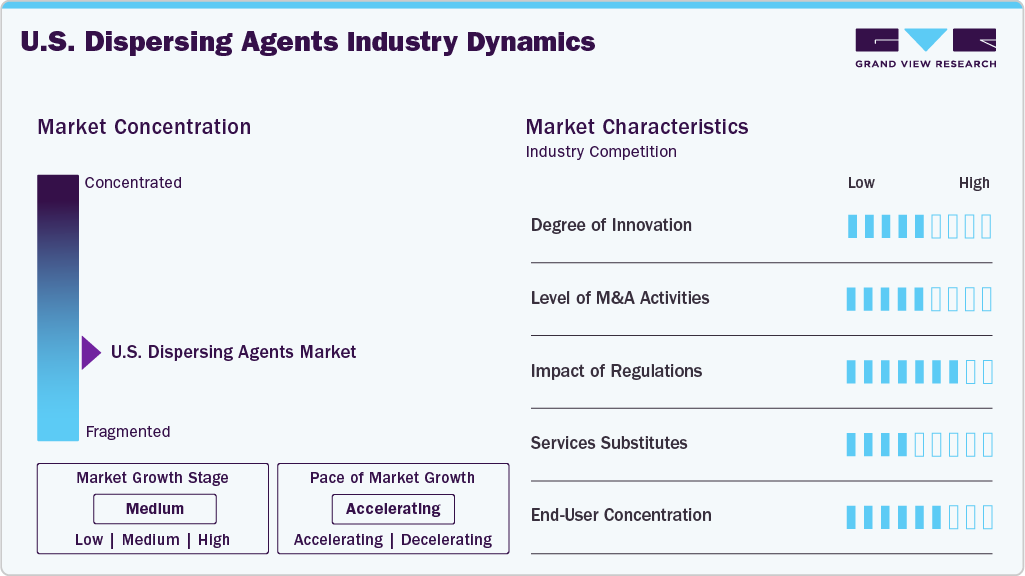 To learn more about this report, Download Free Sample Report
 The market is characterized by strong demand from paints & coatings, oil & gas, detergents, agriculture, and pharmaceutical applications, where dispersants are essential for improving stability, consistency, and process efficiency. Technological advancements in formulation chemistry and the growing shift toward water-based, environmentally friendly products are shaping industry trends across the U.S. market. Manufacturers are increasingly emphasizing customized solutions tailored to specific industrial applications, while regulatory compliance and sustainability considerations continue to influence product development and end-user purchasing decisions.
Product Insights
The water-borne segment dominated the U.S. dispersing agent market in 2025, accounting for a 79.3% share. This position is driven by increasing environmental regulations and the growing preference for low-VOC and eco-friendly formulations across paints & coatings, adhesives, and industrial applications. These dispersants offer improved pigment dispersion, enhanced formulation stability, and reduced environmental impact, making them highly suitable for sustainable manufacturing practices. Rising investments in green coating technologies and water-based industrial systems are further contributing to segment growth across the U.S. market.
The other product types segment is expected to grow during the forecast period. The segment growth is driven by the expanding use of specialty dispersants in niche industrial applications, including advanced materials, electronic formulations, and customized chemical processing solutions. The increasing demand for high-performance additives with multifunctional properties, along with ongoing innovation in specialty chemical formulations, is expected to drive market expansion. The growing focus on application-specific dispersant technologies is creating new opportunities for manufacturers operating within this segment.
Structure Insights
The anionic segment dominated the U.S. dispersants industry, accounting for a revenue share of 37.9% in 2025. The strong market position of anionic dispersants is attributed to their extensive use in detergents, paints & coatings, agrochemicals, and oilfield applications due to their excellent dispersion efficiency and cost-effectiveness. These dispersants are widely preferred for stabilizing solid particles and improving formulation performance in industrial processes. Increasing demand for high-performance cleaning products and water-based coating systems across the U.S. continues to support the growth of the anionic segment.
 To learn more about this report, Download Free Sample Report
 The hydrophilic segment is expected to grow at a CAGR of 6.6% during the forecast period. This growth is driven by rising demand for advanced dispersant technologies in aqueous formulations and environmentally sustainable applications. Hydrophilic dispersants provide enhanced compatibility with water-based systems, improved particle wetting, and better formulation stability, making them suitable for coatings, pharmaceuticals, and specialty chemical applications. The growing emphasis on eco-friendly products and the ongoing transition toward low-emission industrial formulations are expected to create favorable growth opportunities for this segment in the coming years.
End Use Insights
Paints, coatings & inks dominated the U.S. dispersing agents market with a revenue share of 38.6% in 2025. This is driven by the increasing demand for high-quality architectural and industrial coatings that require effective pigment dispersion, enhanced color stability, and improved application properties. Rapid growth in construction activities, automotive refinishing, and industrial manufacturing across the U.S. has further supported the consumption of dispersants in coating formulations. The growing transition toward water-based and low-VOC coatings is accelerating the adoption of advanced dispersant technologies that improve product performance while meeting environmental standards.
The paints, coatings & inks segment is expected to grow at a CAGR of 6.2% during the forecast period, driven by rising demand from construction, packaging, automotive, and electronics industries. Dispersing Agents are increasingly used in paints, coatings & inks formulations to improve consistency, particle stabilization, and processing efficiency. The growing focus on lightweight materials, durable bonding solutions, and sustainable packaging applications is contributing to segment growth. Increasing investments in infrastructure development and advanced manufacturing technologies in the U.S. are expected to create favorable opportunities for dispersant manufacturers serving the adhesives & sealants industry.
Key U.S. Dispersing Agents Company Insights
Some key players operating in the market include Dow Inc.; Ashland; and Lubrizol.
-
Dow Inc. is one of the leading participants in the U.S. dispersants market, offering a broad portfolio of dispersing agents and specialty additives for industrial applications, including oil & gas, water treatment, coatings, and construction chemicals. The company focuses on advanced material science and sustainable chemical technologies to support evolving environmental and performance requirements across end-use industries. Dow’s dispersant solutions are widely utilized in drilling fluids, hydraulic fracturing, and industrial processing applications where efficient particle stabilization and operational performance are critical.
-
Lubrizol is a prominent manufacturer of high-performance dispersants and specialty additives used in paints, coatings, inks, plastics, composites, and advanced industrial formulations. The company is recognized for its Solsperse and Solplus hyperdispersant technologies, which provide enhanced pigment stabilization, improved gloss, higher color strength, and low-VOC formulation capabilities. Lubrizol emphasizes sustainability and product innovation by developing bio-based, environmentally friendly dispersant solutions tailored to evolving customer and regulatory demands.
Key U.S. Dispersing Agents Companies:
- Dow Inc.
- Ashland.
- Lubrizol
- Elementis PLC
- Eastman Chemical Company
- Michelman, Inc.
- SNF
- Huntsman
- US Poly Chemical Corp
- Eagle Chemicals
Recent Developments
-
In 2026, Lubrizol introduced Solsperse 82510 Hyperdispersant, a high-performance dispersant designed for solvent-borne coatings, inks, and pigment concentrates, supporting the advancement of the U.S. dispersants market. The product offers enhanced pigment stability, improved gloss, better color strength, and reduced viscosity, helping manufacturers achieve superior formulation performance across industrial and automotive applications. Its broad compatibility with multiple pigment and solvent systems also enables greater formulation flexibility and streamlined production processes. This development highlights the industry's increasing focus on innovative, high-efficiency dispersant technologies that improve product quality and operational efficiency across end-use sectors.
-
In 2026, Lubrizol introduced Solsperse W90C, a high-efficiency aqueous polymeric dispersant developed for water-based coatings and inks, contributing to innovation in the U.S. dispersants industry. The product improves pigment dispersion, reduces viscosity, enhances color development, and improves formulation stability, enabling manufacturers to achieve higher performance in demanding printing and coating applications. Its compatibility with both resin-free and resin-containing systems supports wider adoption in flexographic, gravure, and inkjet printing technologies. This development reflects the growing market emphasis on advanced water-based dispersant solutions that align with sustainability trends and the increasing demand for high-quality, environmentally friendly formulations.
U.S. Dispersing Agents Market Report Scope
Report Attribute
Details
Market size value in 2026
USD 452.2 million
Revenue forecast in 2033
USD 673.9 million
Growth rate
CAGR of 5.9% from 2026 to 2033
Actual data
2021 - 2024
Forecast period
2026 - 2033
Quantitative units
Volume in kilotons, revenue in USD million/billion, and CAGR from 2026 to 2033
Report coverage
Volume & revenue forecast, company ranking, competitive landscape, growth factors, and trends
Segments covered
Product, structure, end use
Key companies profiled
Dow Inc.; Ashland; Lubrizol; Elementis PLC; Eastman Chemical Company; Michelman, Inc.; SNF; Huntsman; US Poly Chemical Corp; Eagle Chemicals
Customization scope
Free report customization (equivalent upto 8 analysts working days) with purchase. Addition or alteration to country, regional & segment scope.
Pricing and purchase options
Avail customized purchase options to meet your exact research needs. Explore purchase options
U.S. Dispersing Agents Market Report Segmentation
This report forecasts volume & revenue growth at the country level and provides an analysis of the latest industry trends in each of the sub-segments from 2021 to 2033. For this study, Grand View Research has segmented the U.S. dispersants market report based on product, structure, and end use:
-
Product Outlook (Volume, Kilotons; Revenue, USD Million, 2021 - 2033)
-
Water-borne
-
Other Product Types
-
-
Structure Outlook (Volume, Kilotons; Revenue, USD Million, 2021 - 2033)
-
Anionic
-
Non-ionic
-
Hydrophilic
-
Amphoteric
-
Other Structure
-
-
End-Use Outlook (Volume, Kilotons; Revenue, USD Million, 2021 - 2033)
-
Paints, Coatings & Inks
-
Adhesives & Sealants
-
Personal Care & Cosmetics
-
Agriculture
-
Construction
-
Household and Industrial/Institutional Cleaning
-
Other End-Uses
-
Frequently Asked Questions About This Report
The U.S. dispersing agents market was estimated at USD 427.2 million in 2025 and is expected to reach USD 452.2 million in 2026
The U.S. dispersing agents market is expected to grow at a compound annual growth rate of 5.9% from 2026 to 2033 to reach USD 673.9 million by 2033
Paints, coatings & inks dominated the market with a revenue share of 38.6% in 2025. This is driven by the increasing demand for high-quality architectural and industrial coatings that require effective pigment dispersion, enhanced color stability, and improved application properties. Rapid growth in construction activities, automotive refinishing, and industrial manufacturing across the U.S. has further supported the consumption of dispersants in coating formulations
Some key players operating in the U.S. dispersing agents market include Dow Inc, Ashland, Lubrizol, Elementis PLC, Eastman Chemical Company, Michelman, Inc., SNF, Huntsman, US Poly Chemical Corp, Eagle Chemicals
The growth of the market is driven by the growing demand for high-performance coatings, paints, and inks across construction, automotive, and industrial manufacturing sectors. Dispersants play a critical role in improving pigment stability, color consistency, and product durability, making them essential in advanced formulation technologies.
About the Author(s)
Paints, Coatings & Printing Inks Research Team
Bulk Chemicals · Paints, Coatings & Printing InksThis report was authored by the paints, coatings & printing inks research team at Grand View Research - comprising two research analysts, one senior research analyst, and one industry expert - with specialized expertise in the paints, coatings & printing inks segment of the bulk chemicals industry. All findings are based on proprietary bulk chemicals databases, executive interviews, and regulatory analysis, subject to internal peer review prior to publication.
Last Updated:
Speak to Analyst

Customize this report to your needs - add regions, segments, or data points, with 20% free customization.
Or view our licence options:


ISO 9001:2015 & 27001:2022 Certified
We are GDPR and CCPA compliant! Your transaction & personal information is safe and secure. For more details, please read our privacy policy.


