
- Home
- »
- Clinical Diagnostics
- »
-
U.S. Drug Testing Market Size & Share, Industry Report, 2033GVR Report cover
![U.S. Drug Testing Market Size, Share & Trends Report]()
U.S. Drug Testing Market (2026 - 2033) Size, Share & Trends Analysis Report By Product (Consumables, Instruments), By Sample (Urine Samples), By Drug (Alcohol, Opioids), By End Use (Drug Testing Laboratories, Workplaces, Hospitals), And Segment Forecasts
U.S. Drug Testing Market Summary
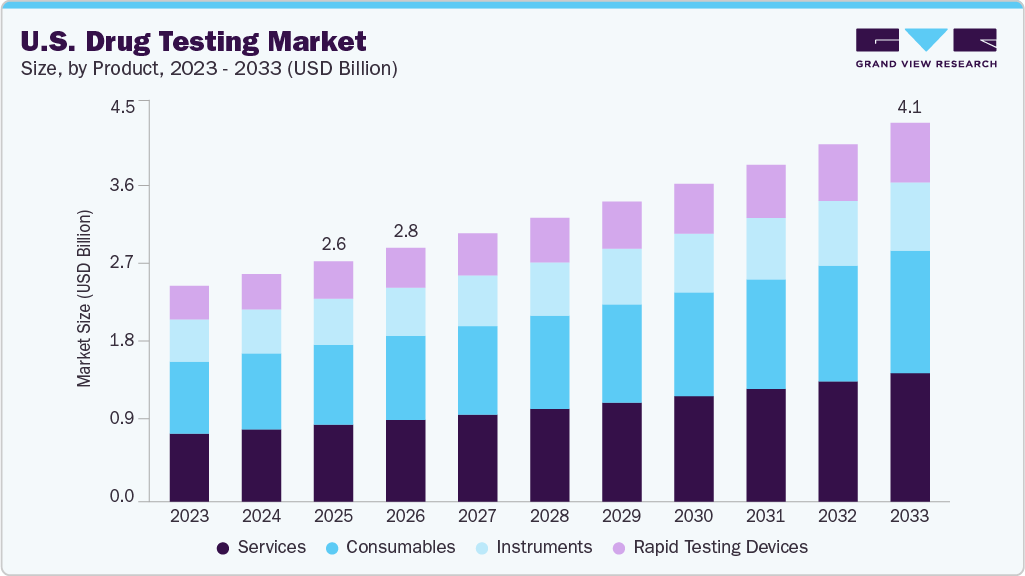
The U.S. drug testing market size was estimated at USD 2.62 billion in 2025, projected to reach USD 4.13 billion by 2033, expanding at a CAGR of 5.89% from 2026 to 2033. The growth of the market is driven by rising prevalence of substance abuse, stringent regulations requiring drug & alcohol testing, and growing government efforts to curb substance abuse in the U.S.
According to the Substance Abuse and Mental Health Services Administration (SAMHSA) 2024 national survey on drug use and health, about 73.6 million Americans aged twelve or older (25.5%) reported using illicit drugs in the past year. Cannabis remains the commonly used illicit drug, with around 64.2 million users, followed by substances such as hallucinogens, prescription opioids, and cocaine.
Furthermore, growing emphasis on workplace safety and compliance across industries is also supporting the expansion of the U.S. drug testing market. Many employer liability issues are driving the adoption of pre-employment, random, and post-incident drug testing programs, supporting market demand. The expansion of drug testing across workplaces and healthcare settings further contributes to growth. Moreover, the U.S. government actively promotes national campaigns to raise awareness about the dangers of substance abuse. Programs such as “National Drug & Alcohol Facts Week” and the DEA’s educational outreach provide schools, communities, and workplaces with resources to prevent drug misuse.
The increasing prevalence of substance abuse in the U.S. has significantly raised the demand for drug testing solutions. The ongoing opioid crisis has also increased the need for monitoring and testing programs across healthcare, workplace, and law enforcement sectors. According to the Centers for Disease Control and Prevention (CDC), the U.S. recorded over 107,000 drug overdose deaths in 2023, highlighting the serious public health impact of drug misuse. These rising cases of substance misuse and overdose are encouraging governments, employers, and healthcare providers to adopt regular drug screening and monitoring programs, which is supporting the growth of the U.S. drug testing market.
Substance abuse in the workplace has been rising in recent years, increasing the need for drug testing solutions in the U.S. As per the Quest Diagnostics Drug Testing Index (2024), the overall positive drug test rate in the combined U.S. workforce remained at 4.6% in 2023, maintaining the highest levels observed in more than two decades and considerably higher than the historic low of 3.5% recorded between 2010 and 2012. As per the Centers for Disease Control and Prevention, more recent provisional data indicate that approximately 80,391 drug overdose deaths were recorded in the U.S. in 2024, showing a significant decline compared to 110,037 deaths reported in 2023. Although the number of fatalities has decreased, drug overdose and substance abuse continue to remain major public health concerns in the country. The persistence of drug-related deaths highlights the ongoing need for effective monitoring, prevention programs, and drug testing solutions across healthcare, law enforcement, and workplace settings.
Enforcement of stringent laws by the U.S. government mandating alcohol and drug testing for safety purposes is anticipated to drive the demand for drug testing products. For instance, in May 2023, the U.S. Department of Transportation introduced a final rule allowing oral fluid drug testing as an alternative to urine testing for federally regulated transportation employees. The regulation applies to safety-sensitive workers such as truck drivers, pilots, and transit operators, where substance use can pose serious safety risks. The rule expands testing options for employers and strengthens compliance with federal workplace drug and alcohol testing programs, thereby increasing the demand for drug testing kits, laboratory services, and related technologies in the U.S. market.
The U.S. federal government has implemented comprehensive programs to promote drug-free workplaces across both public and private sectors. Agencies such as the Substance Abuse and Mental Health Services Administration (SAMHSA) and the Department of Labor encourage employers to adopt drug testing policies, employee assistance programs, and substance abuse education initiatives. These programs aim to reduce workplace accidents, improve productivity, and ensure regulatory compliance. Employers who participate often receive guidance, resources, and incentives to maintain a safe and healthy workforce. In addition, these initiatives help raise awareness among employees about the risks of substance abuse and the importance of seeking help when needed. By fostering a culture of safety and prevention, these programs contribute to overall workplace well-being and long-term organizational efficiency.
Market Concentration & Characteristics
The degree of innovation in the U.S. drug testing market is moderate to high, driven by continuous advancements in analytical technologies and rapid testing solutions. Sophisticated instruments such as liquid chromatography and mass spectrometry systems have significantly improved accuracy, sensitivity, and capabilities, particularly in large laboratories. At the same time, the development of rapid diagnostic kits, including breakthrough-designated devices approved by the FDA, is enhancing point-of-care testing. However, complex regulatory requirements and cost-intensive infrastructure limit widespread innovation, especially among smaller players, keeping overall innovation at a balanced yet progressive level.
Mergers and acquisitions in the market have increasingly been focused on expanding their service portfolios, strengthening technological capabilities, and increasing market presence. Companies are actively acquiring specialized testing and analytical service providers to enhance their diagnostic offerings and improve regulatory compliance capabilities. For instance, in April 2025, Premier Biotech completed the acquisition of certain assets comprising OraSure Technologies substance abuse testing business line, along with the Mexican subsidiary of Green Earth Biomedical LLC (GEM). The acquisition expands Premier Biotech’s oral-fluid toxicology testing portfolio and strengthens its distribution capabilities in Mexico and Latin America, supporting the company’s strategy to enhance its position in the drug testing and toxicology diagnostics market.
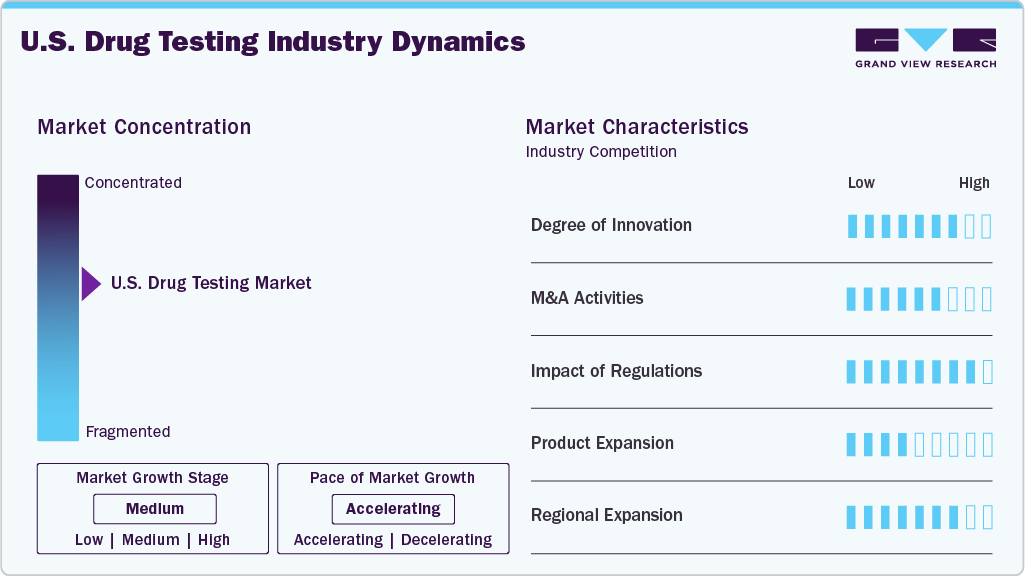
The regulatory framework for drug testing in the U.S. significantly impacts market growth by enforcing strict standards and ensuring widespread adoption across industries. Agencies such as the Substance Abuse and Mental Health Services Administration and the U.S. Department of Transportation establish guidelines for testing procedures, laboratory certification, and workplace compliance, particularly in safety-sensitive roles. In addition, varying state laws, along with regulations under the Americans with Disabilities Act and the Health Insurance Portability and Accountability Act, ensure employee protection and data confidentiality, while reimbursement policies under government programs further support the adoption of drug testing services.
Product expansion in the U.S. drug testing market is strong, driven by regulatory compliance, technological advancements, and changing substance use patterns. Companies are broadening portfolios with rapid point-of-care kits, multi-drug panels, and advanced laboratory solutions like mass spectrometry, alongside portable devices and digital reporting platforms. Regulatory standards from the Substance Abuse and Mental Health Services Administration and U.S. Department of Transportation, plus rising opioid and synthetic drug use, are accelerating innovation and adoption, making product expansion a key market growth driver.
Product Insights
The consumables segment is expected to grow significantly during the forecast period. Consumables play an important role in drug testing, they are widely used for improving confirmation testing. In June 2023, almost 100,000 xylazine test strips were procured after the introduction of a new statewide ordering system by the Office of Addiction Services and Supports. This would enable the public & clinicians to obtain the essential damage mitigation tool to combat the hazards linked to xylazine and its growing illegal drug trade by offering free test strips. This initiative is expected to drive market growth. The increasing approvals and launches of novel consumables that provide enhanced solutions to make drug testing easy, accurate, & fast are expected to accelerate the market growth.
Services segment is projected to experience the fastest compound annual growth rate (CAGR) of during the forecast period. This growth is driven by the presence of many organizations providing efficient and technologically advanced drug testing services. The services segment includes program interfaces for operating instruments, conducting analysis, and interpreting results. For instance, the Institute of Environmental Science and Research (ESR) offers a fully integrated, computerized solution for drug abuse testing programs with access to over 10,000 clinics and collecting locations across the U.S. It can also make testing easy worldwide through American or foreign laboratories. To support public safety and government agencies, an increase in strategic initiatives undertaken by various companies, such as new launches, acquisitions, collaborations, and partnerships, is anticipated to propel the segment growth
Sample Insights
Urine sample segment accounted for largest market share of 57.15% in 2025, due to their affordability, wide acceptance by regulators, and they can detect many different drugs. Urine testing is often used for workplace drug screening, law enforcement, rehab centers, and clinical labs, especially in programs run by DOT and SAMHSA. Large lab service providers and diagnostic companies play a big role in urine drug testing in the U.S. Quest Diagnostics and Labcorp handle millions of urine drug tests each year, offering panels that check for many types of drugs. Companies such as Abbott Laboratories, Siemens Healthineers, and Thermo Fisher Scientific provide the reagents and automated machines needed for high-volume urine testing in labs. Another advantage of urine sample collection is its noninvasiveness, unlike blood samples. Moreover, the concentration of drugs and metabolites is much higher in urine compared to blood.
Oral fluid samples segment is likely to grow at fastest growth rate of over the forecast period. Saliva-based oral fluid samples are becoming more popular in the U.S. drug testing market as they are easy to collect, less likely to be tampered with, and can show recent drug use. Several companies have introduced specialized oral fluid drug testing devices to meet growing demand for on-site screening. OraSure Technologies makes oral fluid collection devices for quick drug screening at work and in clinics. Abbott Laboratories also has fast saliva-based tests used in healthcare and workplace health programs. Premier Biotech and other companies also make oral fluid test kits that can find drugs such as THC, cocaine, opioids, and amphetamines in just a few minutes, which are improving the adoption rate of oral fluid sample collection for fast and reliable results, accelerating market growth.
Drug Insight
Cannabis/Marijuana segment led the market, accounting for 25.33% of the revenue share in 2025. This is mainly because THC use is widespread and most workplace drug screenings include it. Even though more states are legalizing cannabis for medical and recreational use, many employers still require marijuana testing as part of their drug-free workplace policies. This is especially true in transportation, healthcare, manufacturing, and construction. Leading diagnostic companies and laboratory service providers play an important role in cannabis testing programs across the country. Quest Diagnostics and Labcorp provide comprehensive marijuana screening services as part of multi-drug testing panels for employers and government agencies. Companies such as Abbott Laboratories, Siemens Healthineers, and Thermo Fisher Scientific make toxicology kits and instruments for lab-based THC testing. As per the National Center for Drug Abuse Statistics, around 2% of people aged 12 or above tried marijuana for the first time. According to the data published by the National Institute on Drug Abuse, after alcohol, marijuana is the second most common drug tested by drivers involved in accidents in the U.S. Hence, the high rate of marijuana abuse is anticipated to drive the demand for its testing solutions during the forecast period.
Opioids segment is likely to grow at fastest growth rate over the forecast period. Opioids, also called narcotics, are types of drugs that include pain relievers. Increasing opioid use by athletes and at workplaces is anticipated to grow the demand for opioid testing products Opioid testing takes place in many areas, such as hospitals, workplace drug screening programs, pain clinics, rehab centers, and the criminal justice system. As per the data published by the Substance Abuse and Mental Health Services Administration (SAMHSA), in 2020, around 9.5 million people in the U.S. had opioid use disorder (including heroin abuse and prescription pain relievers). Furthermore, WHO stated that about 25% of 80% of deaths caused by opioid were related to opioid overdose. In the U.S., opioid use among athletes and at the workplace has steadily increased, as per the data published by the National Council on Alcoholism and Drug Dependence, around 8% of female athletes and 12% of male athletes used prescription opioids in a year. Hence this drives the demand for opioid testing products.
End use Insights
Drug testing laboratories segment led the market, accounting for 43.99% of the revenue share in 2025, because they offer high-throughput testing capabilities and nationwide laboratory networks. Quest Diagnostics and Labcorp have top drug testing labs in the U.S. They process millions of samples each year for employers, government agencies, and healthcare providers. These companies provide a wide range of drug testing panels, specimen collection services, and digital reporting systems to help organizations stay compliant with regulations. Specialized labs such as Omega Laboratories and Psychemedics Corporation focus on hair drug testing, which is often used in workplace screenings and legal cases. As the need for accurate confirmatory testing and regulatory compliance grows, drug testing labs continue to be a vital part of the U.S. drug testing market.
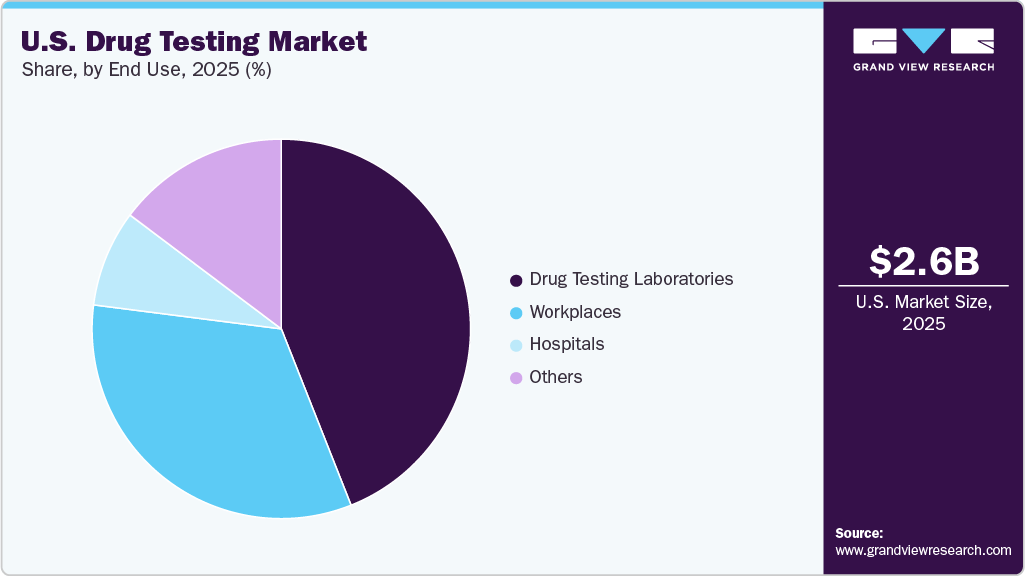
Workplaces segment is anticipated to grow at fastest growth rate over the forecasted period as organizations are key end users of drug testing as most organizations conduct pre-employment drug tests and tests during employment. According to the U.S. Department of Justice, Office of Justice Programs estimates that up to 9.4 million workers in the U.S. use illicit drugs at the workplace Among them, nearly 57.9% are aged 18 to 64 years full-time employed workers. In addition, according to a report published by Ohio State News in July 2025, almost 1 in 10 workers in their 30s uses alcohol, marijuana or hard drugs such as cocaine while on the job in the U.S. Moreover, providers adapt to this change by providing rapid tests and corporate drug testing services to gain a competitive edge.
Key U.S. Drug Testing Company Insights
The competitive scenario in the U.S. drug testing market is high, with key players are focusing on strengthening their market position through product innovation, and strategic collaborations. Emerging players are focusing on specialized drug testing services due to increasing emphasis on rapid drug testing devices and point of care screening technologies
Key U.S. Drug Testing Companies:
- Quest Diagnostics Incorporated
- Abbott
- Laboratory Corporation of America Holdings (LabCorp)
- Thermo Fisher Scientific, Inc.
- OraSure Technologies, Inc
- Psychemedics Corporation
- Omega Laboratories, Inc
- Premier Biotech, Inc
- Alfa Scientific Designs, Inc
Recent Developments
-
In June 2025, Cannabix Technologies reported that Omega Laboratories delivered a Validation Packet for its laboratory-developed test method tied to Cannabix’s Marijuana Breath Test (MBT) technology, as part of ongoing research and analytical method development. The validation, performed in Omega’s ISO/IEC 17025-accredited laboratory, included simultaneous quantification of 9-THC, 8-THC, CBD and CBN from breath aerosols collected via Cannabix’s Breath Collection Unit (BCU) and Breath Cartridges.
-
In June 2024, Premier Biotech announced the acquisition of Desert Tox, LLC, a laboratory testing provider certified by the Substance Abuse and Mental Health Services Administration (SAMHSA). The acquisition strengthens Premier Biotech’s toxicology testing capabilities and expands its laboratory service offerings across workplace, occupational health, and government drug testing markets. It also enhances the company’s ability to provide comprehensive oral fluid and urine-based drug testing solutions to customers across the U.S.
-
In January 2024, OraSure Technologies, Inc. announced its investment and strategic distribution partnership with Sapphiros, a consumer diagnostics company. OraSure will lead Sapphiros’ Series B financing and gain exclusive distribution rights to several innovative diagnostic products. This partnership aims to enhance OraSure’s product offerings and accelerate revenue growth, with initial product distribution starting in 2024 and additional launches planned for 2025.
U.S. Drug Testing Market Report Scope
Report Attribute
Details
Market size value in 2026
USD 2.76 billion
Revenue forecast in 2033
USD 4.13 billion
Growth rate
CAGR of 5.89% from 2026 to 2033
Actual data
2021 - 2025
Forecast period
2026 - 2033
Quantitative units
Revenue in USD million/billion, and CAGR from 2026 to 2033
Report coverage
Revenue forecast, company ranking, competitive landscape, growth factors, and trends
Segments covered
Product, sample type, drug type, end use
Country scope
U.S.
Key companies profiled
Quest Diagnostics Incorporated; Abbott; Laboratory Corporation of America Holdings (LabCorp); Thermo Fisher Scientific, Inc.; OraSure Technologies, Inc; Psychemedics Corporation; Omega Laboratories, Inc; Premier Biotech, Inc; Alfa Scientific Designs, Inc
Customization scope
Free report customization (equivalent up to 8 analysts working days) with purchase. Addition or alteration to country, regional & segment scope.
Pricing and purchase options
Avail customized purchase options to meet your exact research needs. Explore purchase options
U.S. Drug Testing Market Report Segmentation
This report forecasts revenue growth at country levels and provides an analysis on the latest industry trends and opportunities in each of the sub-segments from 2021 to 2033. For the purpose of this study, Grand View Research has segmented the U.S. drug testing market report on the basis of test, application, and end use.
-
Product Outlook (Revenue, USD Million, 2021 - 2033)
-
Consumables
-
Instruments
-
Rapid Testing Devices
-
Services
-
-
Sample Type Outlook (Revenue, USD Million, 2021 - 2033)
-
Urine Samples
-
Oral Fluid Samples
-
Hair Samples
-
Other Samples
-
-
Drug Type Outlook (Revenue, USD Million, 2021 - 2033)
-
Alcohol
-
Cannabis/Marijuana
-
Cocaine
-
Opioids
-
Amphetamine & Methamphetamine
-
LSD
-
Others
-
-
End Use Outlook (Revenue, USD Million, 2021 - 2033)
-
Drug Testing Laboratories
-
Workplaces
-
Hospitals
-
Others
-
Frequently Asked Questions About This Report
The U.S. drug testing market size was valued at USD 2.62 billion in 2025, projected to reach USD 4.13 billion by 2033, expanding at a compound annual growth rate (CAGR) of 5.89% from 2025 to 2033.
The U.S. drug testing market size was valued at USD 2.62 billion in 2025, projected to reach USD 4.13 billion by 2033, expanding at a compound annual growth rate (CAGR) of 5.89% from 2025 to 2033.
Urine sample segment accounted for largest market share of 57.15% in 2025, due to their affordability, wide acceptance by regulators, and they can detect many different drugs.
Key companies profiled includes Quest Diagnostics Incorporated, Abbott ,Laboratory Corporation of America Holdings (LabCorp), Thermo Fisher Scientific, Inc., OraSure Technologies, Inc, Psychemedics Corporation, Omega Laboratories, Inc, Premier Biotech, Inc, Alfa Scientific Designs, Inc
The growth of the market is driven by rising prevalence of substance abuse, stringent regulations requiring drug & alcohol testing, and growing government efforts to curb substance abuse in the U.S.
About the Author(s)
Clinical Diagnostics Research Team
Healthcare · Clinical DiagnosticsThis report was authored by the clinical diagnostics research team at Grand View Research - comprising two research analysts, one senior research analyst, and one industry expert - with specialized expertise in the clinical diagnostics segment of the healthcare industry. All findings are based on proprietary healthcare databases, executive interviews, and regulatory analysis, subject to internal peer review prior to publication.
Last Updated:
Speak to Analyst


Customize this report to your needs — add regions, segments, or data points, with 20% free customization.
Or view our licence options:


ISO 9001:2015 & 27001:2022 Certified
We are GDPR and CCPA compliant! Your transaction & personal information is safe and secure. For more details, please read our privacy policy.


