
- Home
- »
- Beauty & Personal Care
- »
-
U.S. Eye Color Cosmetics Market Size & Share Report, 2033GVR Report cover

U.S. Eye Color Cosmetics Market (2026 - 2033)
Size, Share & Trends Analysis Report By Product (Eye Shadow, Eye Liner, Mascara, Eye Pencil, False Eyelashes), By Product By Price Tier, By Product By Type, By Product By Distribution Channel, And Segment Forecasts
Market Size, 2025
$5.4BMarket Estimate, 2026
$5.9BMarket Forecast, 2033
$10.8BCAGR, 2026–2033
9.0%U.S. Eye Color Cosmetics Market Summary
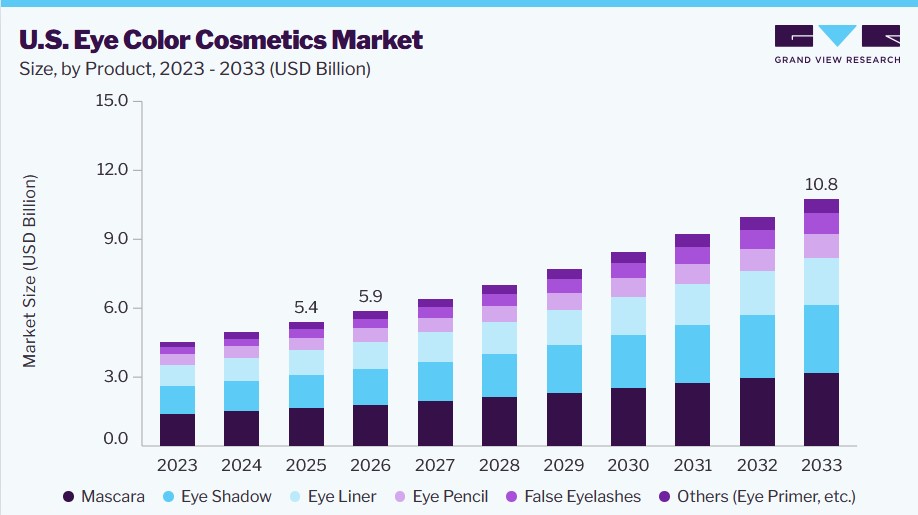
The U.S. eye color cosmetics market size was valued at USD 5.4 billion in 2025 and is projected to grow from USD 5.9 billion in 2026 to USD 10.8 billion in 2033, at a CAGR of 9.0% from 2026 to 2033. The market growth is driven by higher consumer spending on beauty, increased demand for long-wear and waterproof products, interest in premium and clean formulations, and ongoing innovation in eyeshadows, eyeliners, and false eyelashes. Expanding e-commerce and specialty beauty retail channels are also driving product adoption and creating new growth opportunities.
Key Market Trends & Insights
- By product: Mascara dominated the U.S. eye color cosmetics industry, accounting for a revenue share of 30.7% in 2025.
- By product by price tier: Mass/entry mascara held the largest revenue share of 48.4% in 2025.
- By product by type: Conventional/synthetic mascara held the largest revenue share of 90.7% in 2025.
- By product by distribution channel: Sales of mascara through specialty beauty stores held the largest revenue share of 26.4% in 2025.
Market Size & Forecast
- Market size in 2025: USD 5.4 billion
- Estimated market size in 2026: USD 5.9 billion
- Projected market size by 2033: USD 10.8 billion
- CAGR (2026-2033): 9.0%
Three ways to get this report
Buy it, customize it, or ask a question.Ask an Analyst
Analyst response in 1 business day
- AccessReport author, directly
- Reply timeWithin 1 working day
- No sales callDirect answer only
- FormatEmail reply
- CostFree, no cost
Get the Full Report
What the study covers
- FormatsPDF · Excel · Dashboard
- Timeline2026–2033 annual, 2025 base
- Coverage20+ countries, 5 regions
- Companies10+ key players profiled
Customize the Report
20% free customization
- IncludeCountries, segments, points
- TailorTo your product definition
- ExtendDeeper competitor detail
- OrA fully bespoke study
- Turnaround5–10 working days
Rising consumer interest in beauty experimentation and personalized makeup is increasing demand for eye color cosmetics in the U.S. Consumers are purchasing eyeshadows, eyeliners, mascaras, and false eyelashes to create varied looks for daily use and special occasions. Social media tutorials and creator content introduce new color combinations, finishes, and techniques, further driving product discovery. This demand for variety drives frequent purchases and supports sales across both mass-market and premium segments, fueling growth in the U.S. eye color cosmetics industry.
 Source: Grand View Research, IR Documents, Primary Interviews, Paid DatabasesTo learn more about this report,
 Download Free Sample Report
Increasing consumer emphasis on ingredient transparency, product quality, and ethical sourcing is driving demand for differentiated eye makeup in the U.S. A January 2025 survey of over 3,900 U.S. female beauty consumers found that 21% are motivated by clean-label claims when trying new color cosmetics, and 64% seek cruelty-free claims. These trends are prompting brands to develop vegan, cruelty-free, and ingredient-conscious eyeshadows, eyeliners, and mascaras to meet changing expectations. The focus on formulation and ethical claims is creating opportunities for premium products.
Rising demand for convenient, multifunctional beauty products is driving innovation in the U.S. eye color cosmetics market. Examples include mascaras formulated with lash-care ingredients, dual-ended eyeliner products, eyeshadow sticks, and primers designed to improve makeup longevity. In a January 2025 U.S. consumer study, 67% of respondents reported regularly purchasing multifunctional beauty products, while 67% expressed interest in mascara with lash-care ingredients.
Such preferences encourage manufacturers to develop products that simplify routines while offering differentiated performance. Ongoing innovation across textures, applicators, formulations, and product formats is therefore creating opportunities for continued growth in the eye color cosmetics industry.
Market Dynamics
Consumers are driving demand for long-wear eye makeup that maintains finish and color intensity during daily activities, social events, and exposure to heat and humidity. The desire to reduce frequent reapplication is increasing sales of waterproof mascaras, smudge-resistant eyeliners, crease-resistant eyeshadows, and highly pigmented products. Manufacturers are enhancing transfer resistance, texture, and applicator precision to ensure consistent performance in various conditions. These features are strengthening product differentiation and encouraging repeat purchases, which support growth in the U.S. eye color cosmetics market. For instance, in May 2026, Marc Jacobs Beauty relaunched its product line with Drawn This Way Longwear Eyeliner, Born Star Eyeshadow, and Flashes Mascara. These long-wear and performance-focused products demonstrate manufacturers’ commitment to meeting consumer demand for durable eye cosmetics that require minimal touch-ups. Such innovations highlight the importance of wear time and formulation performance in shaping purchasing decisions in the eye color cosmetics industry.
Concerns about eye irritation, allergic reactions, and ingredient compatibility may limit demand for eye makeup products in the U.S. Consumers with sensitive eyes or contact lenses often avoid mascaras, eyeliners, and eyeshadows that cause discomfort or raise safety concerns. These risks can reduce product trial and repeat purchases, especially when the suitability of the ingredients is unclear. Manufacturers must invest in formulation testing, quality control, and compliance with cosmetic safety requirements, which increases development costs. As a result, consumer adoption and market growth in the U.S. eye color cosmetics market may be constrained.
Rising demand for eye makeup with skincare benefits presents growth opportunities for U.S. manufacturers. Brands can expand their portfolios by offering mascaras with lash-conditioning ingredients, hydrating eyeshadows, and primers that enhance comfort and application. Using hydrating and conditioning ingredients helps differentiate products, attract ingredient-conscious consumers, and appeal to those seeking multifunctional beauty solutions. Ongoing investment in skincare-infused formulations can strengthen product value, support premium positioning, and drive growth in the eye color cosmetics industry.
Analyst Perspective
The U.S. eye color cosmetics market is evolving toward performance-driven, multifunctional, and personalized eye makeup, as consumers seek products that combine visual impact with comfortable wear and convenient application. Demand is shaped by interest in long-wearing mascaras, precision eyeliners, versatile eyeshadow palettes, and false eyelashes that accommodate both natural and dramatic looks. Brands are responding through formulation improvements, expanded shade ranges, innovative applicators, and product formats suited to different skill levels and occasions. At the same time, social media trends, beauty creator recommendations, and online product discovery are influencing purchasing decisions, while competition among mass-market, prestige, and luxury brands is driving continuous product differentiation across the eye color cosmetics industry.
Consumer Insights
 To learn more about this report, Download Free Sample Report
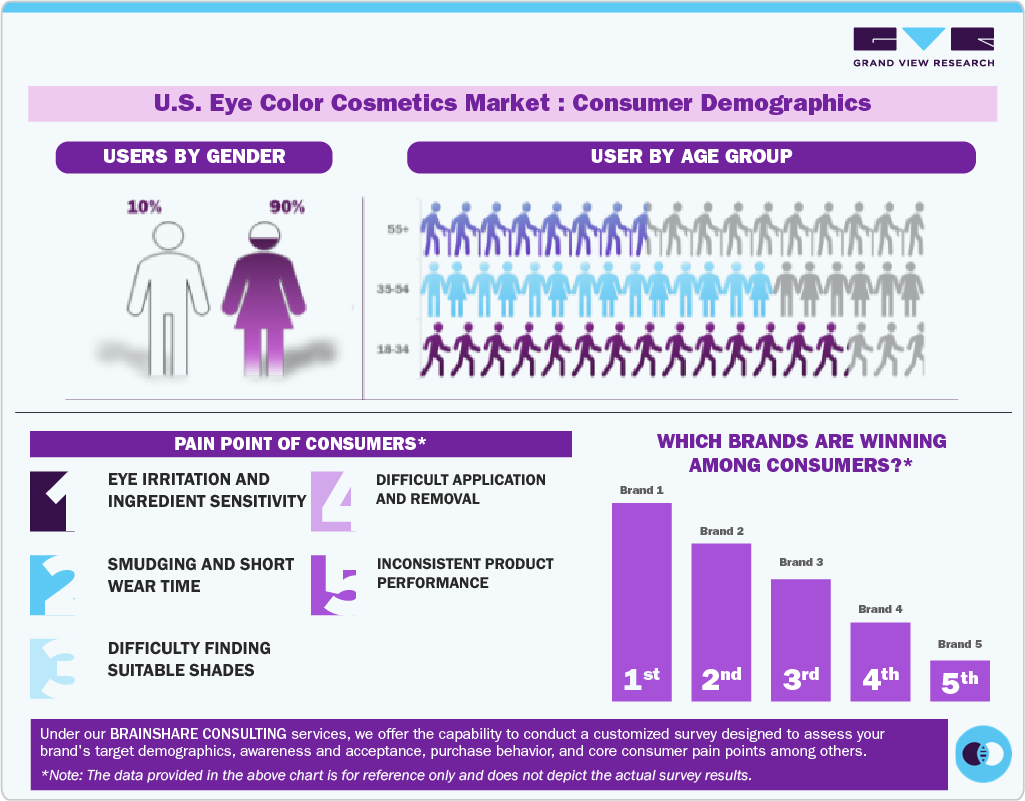
The U.S. eye color cosmetics market serves consumers across different genders and age groups, with purchasing behavior influenced by personal grooming preferences, beauty trends, product performance, and interest in experimenting with eye makeup. Demand spans everyday cosmetics, occasion-based makeup, and premium beauty products.
Users by Gender:
-
Female consumers account for the largest estimated share at 90%, reflecting their established use of eyeshadows, eyeliners, mascaras, eye pencils, and false eyelashes for everyday makeup, professional settings, and special occasions. Their purchasing preferences are influenced by shade variety, product performance, formulation, brand positioning, and emerging beauty trends.
-
Male consumers account for an estimated 10%, reflecting a smaller but emerging user segment interested in personal grooming, creative self-expression, and selected eye makeup products. Demand from this group may include eyeliner, mascara, and other products used for subtle definition or expressive makeup looks.
Users by Age Group:
Consumers aged 18-34 represent the largest estimated user group, driven by interest in beauty experimentation, social media makeup trends, influencer recommendations, and frequent discovery of new products. These consumers are more likely to explore diverse eyeshadow palettes, colored eyeliners, innovative mascara formats, and false eyelashes for everyday and occasion-based looks. Consumers aged 35-54 represent an important segment seeking dependable performance, convenient application, long-wear formulations, and products suited to professional and personal settings. Consumers aged 55 and above may prioritize comfortable application, easy-to-remove formulations, smudge-resistant products, and shades that complement their individual preferences.
Consumers in the U.S. eye color cosmetics market commonly face several challenges when selecting and using eye makeup products.
-
Eye irritation and ingredient sensitivity remain concerns, as certain formulations may cause discomfort, watering, or irritation among consumers with sensitive eyes.
-
Smudging and short wear can affect product satisfaction, particularly when mascara transfers, eyeliner fades, or eyeshadow creases during daily activities.
-
Difficulty finding suitable shades can make it challenging for consumers to identify colors and finishes that match their skin tone, eye color, and preferred makeup style.
-
Difficult application and removal can discourage use of products such as liquid eyeliner and false eyelashes, particularly among beginners, while waterproof formulations may require additional effort to remove.
- Inconsistent product performance can reduce consumer confidence when products exhibit uneven pigmentation, clumping, poor blending, or limited wear time, prompting consumers to switch brands or seek alternatives.
Product Insights
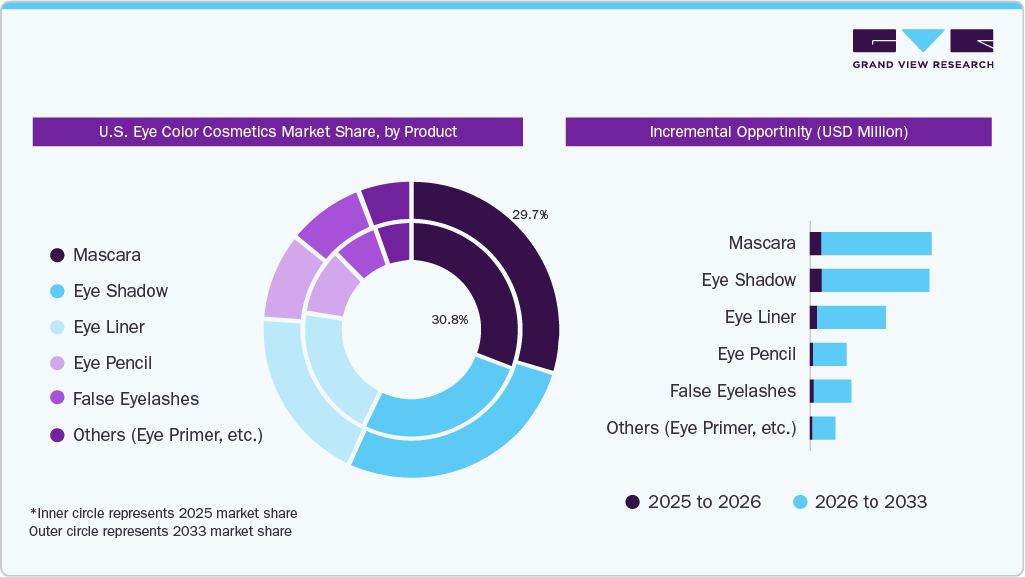
Mascara dominated the U.S. eye color cosmetics industry, accounting for a revenue share of 30.7% in 2025, driven by consumer demand for enhanced lash volume, length, curl, and definition. Consumers increasingly seek long-lasting, smudge-resistant, clump-free formulas that are easy to remove. Manufacturers are introducing tubing technology, innovative brush designs, and lash-care ingredients to differentiate their products and meet demand for both everyday and dramatic looks. Social media and online beauty platforms play a significant role in product discovery, enabling brands to promote new formulations and engage younger consumers. For instance, in 2026, L’Oréal Paris launched Extensionist Mascara, while Maybelline New York introduced Lash Sensational Sky Tubes, and Milani Cosmetics launched Highly Rated Lash Extensions XL Volumizing Tubing Mascara, emphasizing lash length, lift, volume, and smudge resistance.
 To learn more about this report, Download Free Sample Report
The false eyelashes segment is expected to grow at a CAGR of 11.8% from 2026 to 2033. False eyelashes are shifting from traditional full-strip designs to more customizable options that let consumers control placement, density, and appearance. Individual lashes and clusters provide flexibility for targeted volume or extension effects at home, while half lashes appeal to those seeking subtle enhancement. Magnetic and pre-glued styles eliminate the need for separate adhesives, making application easier for beginners. Growing demand for reusable products and a range of lash styles, from natural to dramatic, is prompting brands to expand their offerings for both everyday and special occasions. For instance, in February 2026, KISS’s imPRESS Lashes launched Strip Lash and Individual Lash Kits featuring patented pre-glued technology. The range offers customizable styles, including natural, voluminous, and wispy looks, with adhesive-free application designed to simplify at-home lash styling.
Product by Price Tier Insights
The mass/entry mascara segment dominated the U.S. eye color cosmetics market, accounting for a revenue share of 48.4% in 2025, characterized by affordable mascaras that deliver targeted lash effects, including added volume, length, curl, and definition. Consumers in this tier can choose products based on specific application needs without moving into premium price brackets. For instance, in July 2025, COVERGIRL launched Lash Blast Bond Mascara in the U.S. at a retail price of USD 10.48. The mass-market launch features a lash-bonding complex and a precision-curve brush, with up to 24 hours of clump-free, smudge-free, and flake-free wear. Available in multiple shades, including waterproof options, the product demonstrates how drugstore brands introduce performance-focused formulations at accessible price points.
The premium & luxury false eyelashes segment is expected to grow at a CAGR of 12.9% from 2026 to 2033, driven by consumers seeking false eyelashes that provide a refined appearance, specialized styling, and professional-quality results. Instead of focusing only on dramatic volume, shoppers are choosing lash designs suited to various eye shapes and occasions, such as subtle half lashes, wispy styles, and customizable clusters. Factors like reusability, soft materials, and precise placement influence purchasing decisions, as consumers weigh whether higher prices are justified by comfort, versatility, and repeated use. Social media tutorials and makeup artist recommendations also encourage shoppers to try premium lash systems, including self-adhesive and customizable kits that offer greater control over the final look. For instance, in June 2026, Lilly Lashes collaborated with Bratz to introduce a limited-edition false eyelash collection featuring four styles inspired by the dolls’ signature Y2K aesthetic. The launch aligns with premium consumer preferences for distinctive lash designs and trend-led styling, while its self-adhesive technology adds application convenience. The collaboration also demonstrates how exclusive, pop-culture-inspired collections can attract consumers seeking statement-making lashes for personalized beauty looks.
Product by Type Insights
The conventional/synthetic mascara segment dominated the U.S. eye color cosmetics industry, accounting for a revenue share of 90.7% in 2025. The market relies on established formulation technologies that ensure consistent pigment intensity, controlled application, and reliable performance at various price points. Synthetic film-forming agents and polymers enable manufacturers to create mascaras with features such as water resistance, flexible wear, and enhanced lash separation. Continued demand is supported by consumer familiarity with these formulas and their wide availability in both mass-market and prestige retail channels. However, brands must balance product performance with comfort and ease of removal, as consumers increasingly prioritize both efficacy and convenience. For instance, in December 2025, Urban Decay launched Tube Job Tubing Mascara in the U.S., featuring a lightweight, serum-infused formula designed to deliver length and lift with up to 24 hours of smudge-proof, flake-free wear. The formula incorporates peptides, hyaluronic acid, and vitamin B5, while its precision brush supports lash separation and definition. The launch reflects continued innovation in conventional mascara formulations through advanced film-forming technology and performance-focused ingredients.
The organic & natural false eyelashes segment is expected to grow at a CAGR of 16.5% from 2026 to 2033, driven by demand for vegan, cruelty-free, and environmentally conscious alternatives to standard false eyelashes. Consumers now consider the source of lash fibers and the environmental impact of packaging, not just the final look. In response, brands offer plant-based and biodegradable fibers, recyclable packaging, and reusable designs. For instance, KISS Sister Nature Vegan Mink False Eyelashes use 100% biodegradable synthetic fibers and are marketed as vegan and cruelty-free, with reusable wear and recyclable packaging. This trend highlights the industry's commitment to animal-free aesthetics, sustainable materials, and eco-friendly packaging.
Product by Distribution Channel Insights
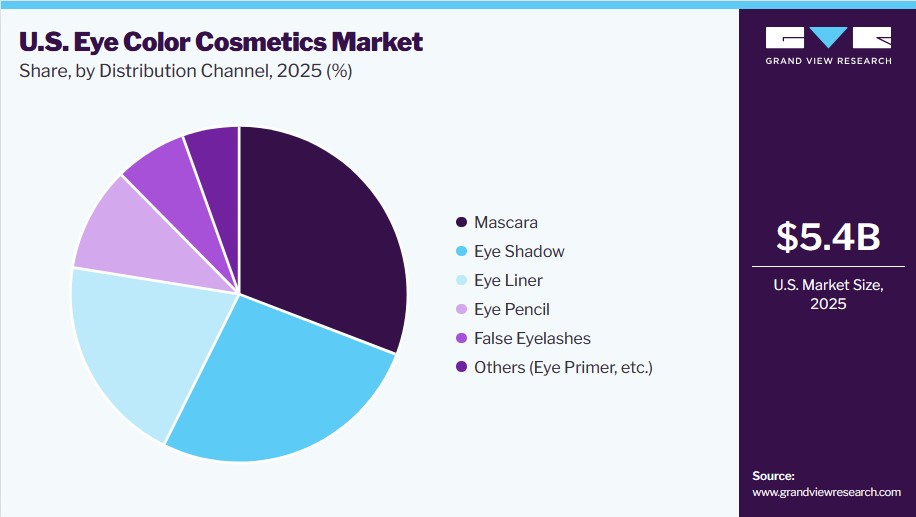
The specialty beauty stores mascara segment dominated the U.S. eye color cosmetics market, accounting for a revenue share of 26.4% in 2025, driven by curated brand assortments, product testing opportunities, and personalized beauty consultations. These stores enable consumers to compare formulas, brush designs, and performance claims across mass-market and prestige brands, supporting informed purchasing decisions. For instance, in February 2026, Lancôme launched Curl Goddess Mascara in the U.S. through specialty beauty retailers, including Sephora and Ulta Beauty. Priced at approximately USD 30, the premium product is designed to deliver pronounced curl and volume, with the brand claiming up to 30 hours of curl retention. Such launches reinforce the role of specialty retailers in the Eye Color Cosmetics Industry.
 To learn more about this report, Download Free Sample Report
The online/e-commerce false eyelashes segment is expected to grow at a CAGR of 13.7% from 2026 to 2033, driven by consumers’ ability to compare styles, lengths, materials, and application systems across brands, beyond the limited selection in physical stores. Tutorials, reviews, and creator demonstrations help shoppers evaluate lash designs and application methods, especially for cluster, individual, magnetic, and pre-glued options. E-commerce also allows niche and direct-to-consumer brands to reach customers seeking specific styles not widely available in stores. For instance, in February 2026, True Beauty Lashes partnered with Perfect Corp. to launch LashLovr, a digital experience offering virtual try-on and personalized lash recommendations based on eye shape and style preferences. This innovation addresses a key barrier to online purchasing by helping consumers visualize lash styles before buying, thereby strengthening digital product discovery in the eye color cosmetics industry.
Key U.S. Eye Color Cosmetics Company Insights
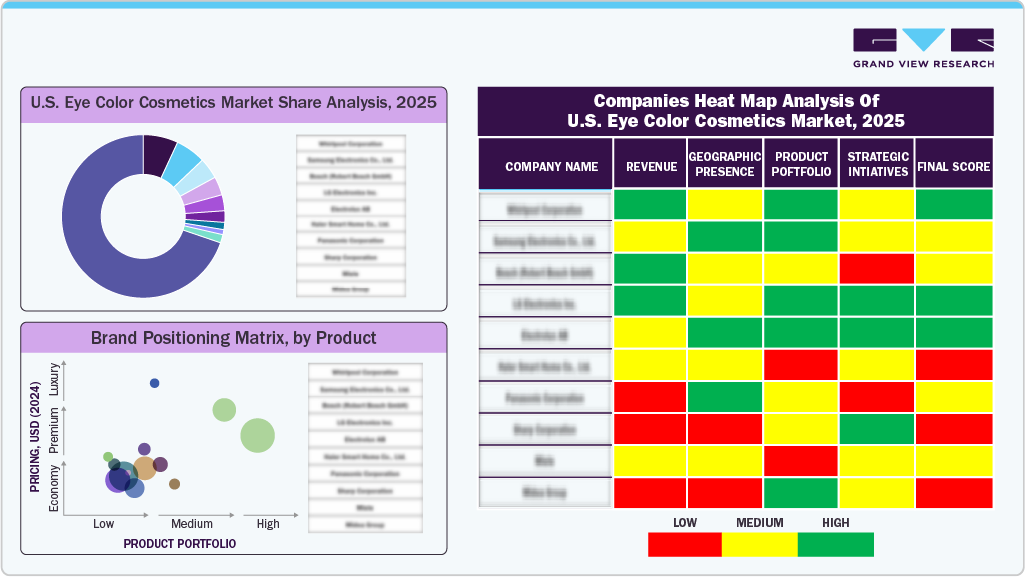
The U.S. eye color cosmetics market is characterized by competition among multinational beauty companies, prestige cosmetics groups, mass-market makeup brands, and premium beauty houses. Competition is shaped by brand recognition, product performance, pricing strategies, distribution reach, formulation innovation, and the ability to address diverse consumer preferences across mascara, eyeliner, eyeshadow, and false eyelashes. Companies compete through a broad product portfolio spanning mass-market, mid-range, and premium segments, while digital commerce, specialty beauty retailers, and brand-owned online stores provide additional routes to consumers. Market share varies by product category and price tier; therefore, the competitive positions of individual companies may differ across the broader eye color cosmetics industry.
-
Mass-Market & Value-Oriented Cosmetics Companies: L’Oréal S.A., Coty Inc., e.l.f. Beauty, Inc., and Revlon, Inc. compete through accessible pricing, broad product availability, and product ranges designed for everyday makeup and trend-led looks. L’Oréal leverages brands such as Maybelline New York to offer mascara, eyeliner, and eyeshadow across multiple price points. Coty competes through mass-market brands including COVERGIRL and Rimmel, while e.l.f. Beauty emphasizes affordable, trend-driven eye makeup, including eyeshadow palettes, eyeliners, and mascara. Revlon strengthens its position through products such as ColorStay eyeliners, eyeshadow palettes, and mascaras, targeting consumers seeking pigmentation, wear performance, and versatility at accessible prices.
-
Prestige & Professional Makeup Companies: The Estée Lauder Companies Inc., Shiseido Company, Limited, and KOSÉ Corporation compete through differentiated formulations, specialized product development, brand positioning, and premium retail distribution. The Estée Lauder Companies participates through makeup brands such as M·A·C, Bobbi Brown, Clinique, and Too Faced, which serve consumers seeking varied finishes, pigmentation, and application performance. Shiseido and KOSÉ compete in the beauty market through their beauty portfolios and makeup expertise, with opportunities to differentiate through product quality, formulation technology, and specialized eye makeup offerings. Their competitive performance depends on brand-level assortment, distribution in the U.S., and the ability to respond to changing consumer preferences.
-
Luxury & Premium Beauty Houses: LVMH Moët Hennessy Louis Vuitton SE, Chanel Limited, and Puig Brands, S.A. participate in the premium end of the Eye Color Cosmetics Market, where brand heritage, product design, exclusive assortments, and elevated retail experiences influence purchasing decisions. LVMH competes through beauty houses including Dior, Givenchy, Guerlain, Benefit Cosmetics, and Make Up For Ever, spanning luxury makeup and specialized eye products. Chanel differentiates its eye makeup portfolio through mascaras, eyeshadow palettes, and eyeliners offered in varied shades, textures, and finishes. Puig competes through its prestige beauty portfolio, including Charlotte Tilbury, with its eye makeup position shaped by premium-brand appeal, product innovation, and consumer engagement.
 To learn more about this report, Download Free Sample Report
Key U.S. Eye Color Cosmetics Companies:
-
L’Oréal S.A.
-
The Estée Lauder Companies Inc.
-
Coty Inc.
-
e.l.f. Beauty, Inc.
-
Revlon, Inc.
-
Shiseido Company, Limited
-
LVMH Moët Hennessy Louis Vuitton SE
-
Chanel Limited
-
KOSÉ Corporation
-
Puig Brands, S.A.
Competitive Benchmarking
Category
Operating Strategies
Competitive Edge
Key Challenges
Established Players: L’Oréal S.A.; The Estée Lauder Companies Inc.; Coty Inc.; Shiseido Company, Limited; LVMH Moët Hennessy Louis Vuitton SE; Chanel Limited; KOSÉ Corporation; Puig Brands, S.A.
Focus on broadening eye makeup portfolios across mascara, eyeshadow, eyeliner, eyebrow products, and primers to serve diverse consumer preferences and price tiers. Leverage established beauty brands, product innovation, premium positioning, and omnichannel distribution through department stores, specialty beauty retailers, e-commerce platforms, and selected mass-market channels. Invest in long-wear, waterproof, high-pigment, and skincare-inspired formulations while using brand collaborations, seasonal collections, and digital marketing to strengthen consumer engagement.
Strong brand recognition, extensive Product Portfolio, established consumer loyalty, and broad retail distribution. Premium brands benefit from prestige positioning, differentiated product design, and exclusive retail experiences, while multinational groups leverage research capabilities, marketing resources, and global supply chains to introduce new formulations and respond to evolving eye makeup trends.
High marketing and product-development costs, intense competition across mass and prestige price tiers, and the need to maintain brand relevance among trend-sensitive consumers. Premium pricing may limit accessibility for value-conscious shoppers, while shifting beauty preferences, competition from digitally native brands, and rising demand for affordable alternatives can pressure pricing and market share.
Emerging and Value-Focused Players: e.l.f. Beauty, Inc.; Revlon, Inc.
Emphasize accessible pricing, trend-responsive product launches, and products designed to deliver performance comparable to higher-priced alternatives. Utilize social media, influencer partnerships, digital campaigns, and online retail platforms to reach younger consumers and price-conscious shoppers. Expand offerings across mascara, eyeliner, eyeshadow, and brow products while responding to demand for easy-to-use formats, versatile shades, and long-wearing formulations.
Competitive pricing, strong appeal among value-conscious consumers, rapid response to digital beauty trends, and the ability to generate product visibility through online communities and influencer-led promotion. Affordable product ranges can encourage repeat purchases and experimentation, while focused marketing and streamlined product positioning help brands compete with established prestige labels.
Lower pricing can constrain margins, while heavy reliance on digital visibility and trend-driven demand may increase marketing pressure. Competition from established mass-market brands and premium companies offering entry-level products can limit differentiation. Maintaining consistent product performance, consumer trust, and sustained visibility across crowded retail and social media channels remains challenging.
Recent Developments
-
In March 2026, Rare Beauty launched its Essential Neutrals Eyeshadow Palette, an eight-shade collection featuring peach, copper, brown, pink, and taupe tones, alongside brown shade extensions for its Perfect Strokes Universal Volumizing Mascara and Perfect Strokes Matte Liquid Liner. The collection became available through RareBeauty.com and Ulta Beauty in the U.S., expanding the brand’s everyday eye makeup assortment with versatile neutral shades for creating defined and layered eye looks.
-
In July 2026, ILIA Beauty launched its Thru Line Waterproof Eyeliner, a sharp, blendable pencil eyeliner available in 10 matte and shimmer shades. Designed for up to 24-hour waterproof wear, the formula is suitable for sensitive eyes and can be used to define, line, or smudge along the lash line and waterline. The launch expands the brand’s eye makeup portfolio with a long-wearing pencil format for versatile eye looks.
U.S. Eye Color Cosmetics Market Report Scope
Report Attribute
Details
Market size in 2025
USD 5.4 billion
Estimated market size in 2026
USD 5.9 billion
Projected market size by 2033
USD 10.8 billion
Growth rate
CAGR of 9.0% from 2026 to 2033
Base year
2025
Actuals
2021 - 2024
Forecast period
2026 - 2033
Quantitative units
Revenue in USD billion and CAGR from 2026 to 2033
Report coverage
Revenue forecast, company ranking, competitive landscape, growth factors, and trends
Segments covered
Product, product by price tier, product by type, and product by distribution channel
Key companies profiled
L’Oréal S.A.; The Estée Lauder Companies Inc.; Coty Inc.; e.l.f. Beauty, Inc.; Revlon, Inc.; Shiseido Company, Limited; LVMH Moët Hennessy Louis Vuitton SE; Chanel Limited; KOSÉ Corporation; Puig Brands, S.A.
Customization scope
Free report customization (equivalent up to 8 analysts’ working days) with purchase. Addition or alteration to country, regional & segment scope.
Pricing and purchase options
Avail customized purchase options to meet your exact research needs. Explore purchase options
U.S. Eye Color Cosmetics Market Report Segmentation
This report forecasts revenue growth at the country level and provides an analysis of the latest trends and opportunities in each of the sub-segments from 2026 to 2033. For this study, Grand View Research has segmented the U.S. eye color cosmetics market report based on product, product by price tier, product by type, and product by distribution channel:
-
Product Outlook (Revenue, USD Billion, 2021 - 2033)
-
Eye Shadow
-
Eye Liner
-
Mascara
-
Eye Pencil
-
False Eyelashes
-
Others (Eye Primer, etc.)
-
-
Product by Price Tier Outlook (Revenue, USD Billion, 2021 - 2033)
-
Eye Shadow
-
Mass/Entry
-
Mid-Tier
-
Premium & Luxury
-
-
Eye Liner
-
Mass/Entry
-
Mid-Tier
-
Premium & Luxury
-
-
Mascara
-
Mass/Entry
-
Mid-Tier
-
Premium & Luxury
-
-
Eye Pencil
-
Mass/Entry
-
Mid-Tier
-
Premium & Luxury
-
-
False Eyelashes
-
Mass/Entry
-
Mid-Tier
-
Premium & Luxury
-
-
Others (Eye Primer, etc.)
-
Mass/Entry
-
Mid-Tier
-
Premium & Luxury
-
-
-
Product by Type Outlook (Revenue, USD Billion, 2021 - 2033)
-
Eye Shadow
-
Organic & Natural
-
Conventional/Synthetic
-
-
Eye Liner
-
Organic & Natural
-
Conventional/Synthetic
-
-
Mascara
-
Organic & Natural
-
Conventional/Synthetic
-
-
Eye Pencil
-
Organic & Natural
-
Conventional/Synthetic
-
-
False Eyelashes
-
Organic & Natural
-
Conventional/Synthetic
-
-
Others (Eye Primer, etc.)
-
Organic & Natural
-
Conventional/Synthetic
-
-
-
Product By Distribution Channel Outlook (Revenue, USD Billion, 2021 - 2033)
-
Eye Shadow
-
Hypermarkets & Supermarkets
-
Specialty Beauty Stores
-
Pharmacies & Drugstores
-
Online/E-commerce
-
Others (Department Stores, etc.)
-
-
Eye Liner
-
Hypermarkets & Supermarkets
-
Specialty Beauty Stores
-
Pharmacies & Drugstores
-
Online/E-commerce
-
Others (Department Stores, etc.)
-
-
Mascara
-
Hypermarkets & Supermarkets
-
Specialty Beauty Stores
-
Pharmacies & Drugstores
-
Online/E-commerce
-
Others (Department Stores, etc.)
-
-
Eye Pencil
-
Hypermarkets & Supermarkets
-
Specialty Beauty Stores
-
Pharmacies & Drugstores
-
Online/E-commerce
-
Others (Department Stores, etc.)
-
-
False Eyelashes
-
Hypermarkets & Supermarkets
-
Specialty Beauty Stores
-
Pharmacies & Drugstores
-
Online/E-commerce
-
Others (Department Stores, etc.)
-
-
Others (Eye Primer, etc.)
-
Hypermarkets & Supermarkets
-
Specialty Beauty Stores
-
Pharmacies & Drugstores
-
Online/E-commerce
-
Others (Department Stores, etc.)
-
-
Research Methodology
The U.S. eye color cosmetics market figures in this report are based on a proven research process that combines executive interviews with secondary research from proprietary databases, company filings, and recognized regulatory and institutional sources. Market size is built through value-chain sizing-reconciling supply-side and demand-side estimates-and triangulated with bottom-up and top-down approaches. Every estimate passes multiple levels of expert validation before publication, with each U.S. eye color cosmetics segment quantified using the revenue-capture definitions in the table below.
Segment Definition
Segment - Product
Revenue capture definition
Eye Shadow
Revenue from eye shadow products available in powder, cream, liquid, stick, and other formulations, designed to add color, dimension, and definition to the eyelids. Includes products across different finishes, such as matte, shimmer, metallic, and glitter, sold through retail and online distribution channels.
Eye Liner
Revenue from eye liner products available in liquid, gel, cream, felt-tip, and other formulations, designed to define the eyes and create different makeup effects. Includes products offering varied application styles, finishes, and wear characteristics, such as precision, smudge-resistant, and long-wear formulations.
Mascara
Revenue from mascara products designed to enhance eyelashes by providing volume, length, curl, definition, and color. Includes conventional, waterproof, washable, volumizing, lengthening, and other mascara formulations sold through retail and online channels.
Eye Pencil
Revenue from pencil-format eye makeup products used to define, line, and enhance the eyes, including kajal, kohl, and other eye pencils. Includes products available in different textures, colors, finishes, and formulations for application along the lash line, waterline, and eyelid.
False Eyelashes
Revenue from artificial eyelashes designed to enhance natural lash length, volume, and density. Includes strip lashes, individual and cluster lashes, magnetic eyelashes, and other false eyelash formats, along with associated products sold as part of false eyelash offerings.
Others (Eye Primer, etc.)
Revenue from other eye color cosmetics products not classified under the above categories, including eye primers, products designed to prepare eyelids for makeup application, and other complementary eye makeup products. Includes formulations intended to improve eyeshadow adhesion, color payoff, crease resistance, and wear duration.
Estimation Model
Layer
Key Question
Description
Target Consumer Layer
Who is likely to use eye makeup?
Defines the addressable consumer population in the U.S. based on age, makeup usage, beauty routines, and interest in eye enhancement products. Includes consumers purchasing products for everyday wear, professional use, and special occasions.
Product Adoption Layer
Which eye makeup products do consumers use?
Evaluates adoption across eyeshadow, eyeliner, mascara, eye pencils, false eyelashes, and other products such as eye primers. Considers usage intensity, product preferences, formulation requirements, and adoption of new beauty trends.
Purchase Conversion Layer
How frequently do consumers purchase?
Estimates the proportion of users who make purchases and their purchasing frequency across mass-market, mid-range, and premium or luxury products. Accounts for replenishment cycles, discretionary purchases, promotional activity, and purchasing through physical and online retail channels.
Monetization Layer
How much revenue is generated?
Calculates market revenue by multiplying estimated units sold by average selling prices across product categories and price tiers. Consolidates sales across retail and e-commerce channels, accounting for product mix and eliminating channel-level duplication to estimate total U.S. eye color cosmetics revenue.
Delivered Customizations
This report has been delivered with the following In-depth customizations
Client Request
Customization Delivered
Value Adds
U.S. Eye Color Cosmetics Consumer Preferences & Buying Behavior Analysis
Conducted a detailed assessment of consumer preferences and purchasing behavior across mascara, eyeliner, eyeshadow, eyebrow products, and eye primers, covering product performance, shade preferences, wear duration, waterproof formulations, price sensitivity, brand loyalty, and the influence of beauty trends and social media on purchasing decisions in the U.S. market.
Helps stakeholders identify high-potential consumer segments, understand evolving eye makeup preferences, evaluate purchasing drivers, and develop targeted Product Portfolio and marketing strategies aligned with consumer expectations.
U.S. Eye Makeup Product Innovation, Formulation & Market Trends
Evaluated emerging trends in long-wear and waterproof formulations, high-pigment eyeshadows, precision eyeliners, lash-enhancing mascaras, multifunctional eye makeup, and products incorporating skincare-inspired ingredients. Assessed demand for clean beauty, vegan formulations, inclusive shade ranges, convenient applicators, and premium product experiences across mass-market and prestige categories.
Provides insights into changing consumer expectations, supports product development and brand differentiation, identifies opportunities in premium and innovative formulations, and enables businesses to align product strategies with emerging beauty trends.
U.S. Eye Color Cosmetics Distribution Channels & Market Opportunity Assessment
Assessed growth opportunities across specialty beauty retailers, department stores, drugstores and pharmacies, supermarkets and hypermarkets, brand-owned websites, and online marketplaces. Evaluated the role of omnichannel retailing, influencer marketing, digital product discovery, online reviews, and virtual beauty tools in shaping purchasing decisions and expanding consumer reach across the U.S.
Supports investment decisions, channel expansion strategies, product launch planning, and marketing resource allocation by identifying high-potential retail channels, digital sales opportunities, consumer acquisition strategies, and avenues for strengthening market presence.
About the Author(s)
Beauty & Personal Care Research Team
Consumer Goods · Beauty & Personal CareThis report was authored by the beauty & personal care research team at Grand View Research - comprising two research analysts, one senior research analyst, and one industry expert - with specialized expertise in the beauty & personal care segment of the consumer goods industry. All findings are based on proprietary consumer goods databases, executive interviews, and regulatory analysis, subject to internal peer review prior to publication.
Last Updated:
Speak to Analyst

Customize this report to your needs - add regions, segments, or data points, with 20% free customization.
Or view our licence options:


ISO 9001:2015 & 27001:2022 Certified
We are GDPR and CCPA compliant! Your transaction & personal information is safe and secure. For more details, please read our privacy policy.


