
- Home
- »
- Beauty & Personal Care
- »
-
U.S. Face Color Cosmetics Market Size, Share Report, 2033GVR Report cover

U.S. Face Color Cosmetics Market (2026 - 2033)
Size, Share & Trends Analysis Report By Product (Foundation, Concealer, Blush & Bronzer, Highlighter, Powder), By Product By Price Tier, By Product By Type, By Product By Distribution Channel, And Segment Forecasts
Market Size, 2025
$9.0BMarket Estimate, 2026
$9.0BMarket Forecast, 2033
$16.5BCAGR, 2026–2033
7.8%U.S. Face Color Cosmetics Market Summary
The U.S. face color cosmetics market size was valued at USD 9.0 billion in 2025 and is expected to grow from USD 9.7 billion in 2026 to USD 16.5 billion in 2033, at a CAGR of 7.8% from 2026 to 2033. The market growth is driven by increasing consumer demand for complexion-enhancing products, rising interest in natural and skin-friendly makeup formulations, growing popularity of multifunctional products such as foundation with skincare benefits, and continued product innovation in long-wear, lightweight, and inclusive shade-range cosmetics.
Key Market Trends & Insights
- By product: Foundation category held the largest revenue share of 38.3% in 2025.
- By product by price tier: Mass/entry foundation held the largest revenue share of 42.4% in 2025.
- By product by type: Conventional/synthetic foundation held the largest revenue share of 76.6% in 2025.
- By product by distribution channel: Sales of foundation through the online/e-commerce channel held the largest revenue share of 27.7% in 2025.
Market Size & Forecast
- Market Size in 2025: USD 9.0 Billion
- Estimated Market Size in 2026: USD 9.7 Billion
- Projected Market Size by 2033: USD 16.5 Billion
- CAGR (2026-2033): 7.8%
Three ways to get this report
Buy it, customize it, or ask a question.Ask an Analyst
Analyst response in 1 business day
- AccessReport author, directly
- Reply timeWithin 1 working day
- No sales callDirect answer only
- FormatEmail reply
- CostFree, no cost
Get the Full Report
What the study covers
- FormatsPDF · Excel · Dashboard
- Timeline2026–2033 annual, 2025 base
- Coverage20+ countries, 5 regions
- Companies10+ key players profiled
Customize the Report
20% free customization
- IncludeCountries, segments, points
- TailorTo your product definition
- ExtendDeeper competitor detail
- OrA fully bespoke study
- Turnaround5–10 working days
The U.S. face color cosmetics industry is witnessing growth as consumers increasingly prioritize personalized makeup solutions, innovative complexion products, and convenient purchasing experiences across digital and retail channels. According to YouGov's 2025 data, 86% of regular makeup users in the U.S. purchased makeup in the preceding 12 months, compared with 34% of U.S. adults overall, highlighting the higher purchase engagement. In 2026, Tinuiti's survey of 1,050 U.S. beauty shoppers found that 30% purchased beauty products through TikTok Shop, underscoring the growing role of social commerce in beauty product discovery and purchase decisions. These purchasing behaviors create opportunities for brands to strengthen digital engagement and improve product accessibility across online and physical retail channels. Manufacturers can further differentiate their offerings through shade-inclusive portfolios, varied coverage options, and formulations tailored to diverse consumer preferences, supporting innovation across the face color cosmetics market.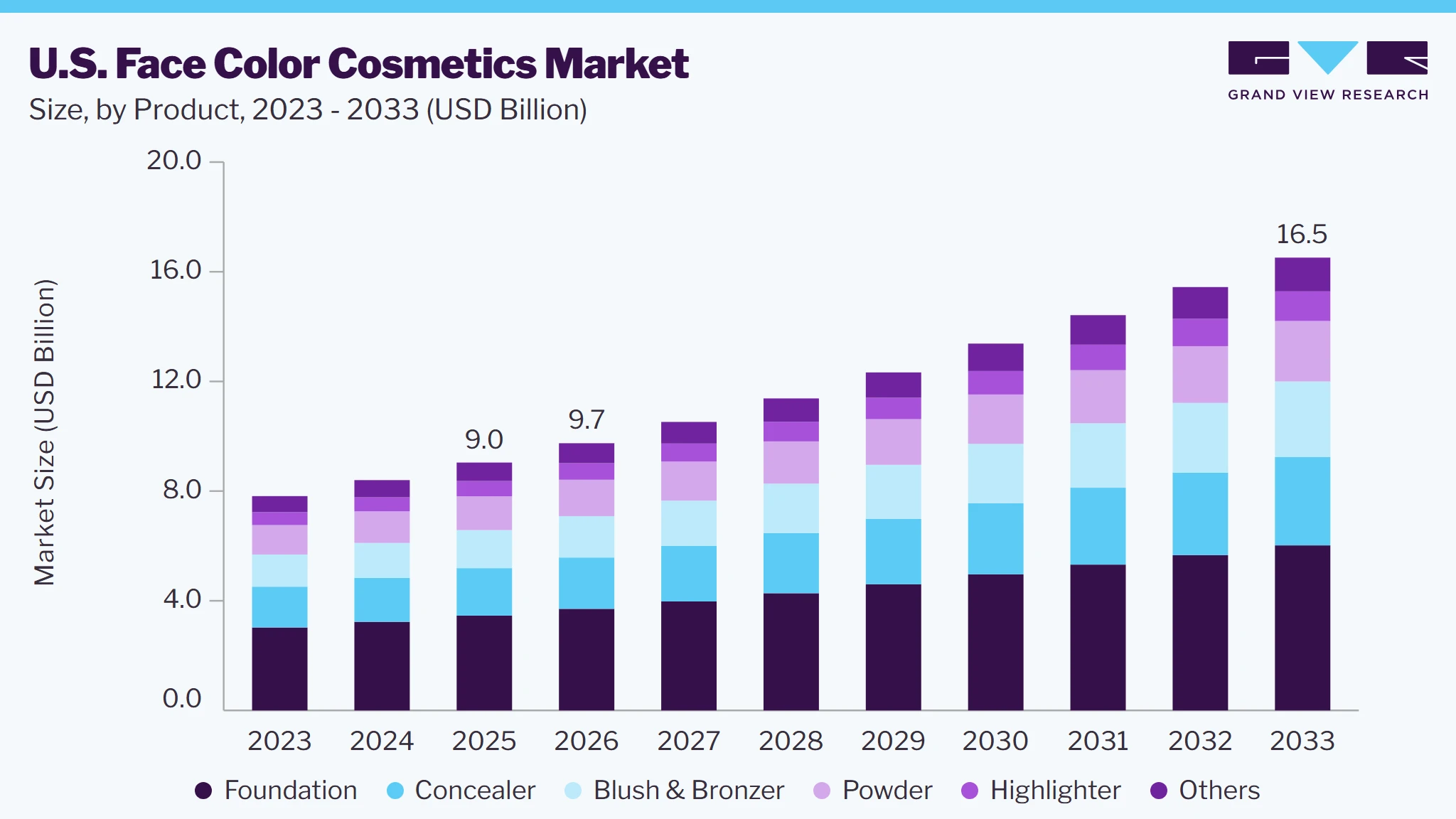 Source: Grand View Research, IR Documents, Primary Interviews, Paid DatabasesTo learn more about this report,
 Download Free Sample Report
Consumer preference for comfortable, durable, and skin-like makeup finishes is creating growth opportunities in the U.S. face color cosmetics market. Consumers are increasingly favoring lightweight foundations, buildable concealers, cream blushes, and liquid bronzers that blend easily, provide flexible coverage, and maintain a natural appearance throughout the day. The shift toward minimal makeup routines and soft-matte or radiant finishes is encouraging brands to develop products that balance performance with comfort. In addition, demand for transfer-resistant, sweat-resistant, and long-wearing formulations is supporting product innovation among manufacturers targeting consumers with busy lifestyles. These evolving preferences are encouraging brands to expand their complexion product ranges and differentiate offerings through texture, finish, and application performance, strengthening competition across the face color cosmetics industry.
Market Dynamics
Rising consumer demand for products that even skin tone, conceal imperfections, and provide a natural finish is driving growth in the U.S. face color cosmetics market. Consumers now prefer foundations, concealers, blushes, and bronzers that offer both aesthetic results and skincare benefits such as hydration, nourishment, and lightweight wear. The popularity of hybrid formulations is prompting brands to add skincare features to complexion products. For instance, in April 2026, Clarins launched its Double Serum Foundation, which combines makeup coverage with serum-based skincare to deliver a luminous finish and hydration. This launch demonstrates manufacturers’ efforts to meet consumer demand for products that streamline beauty routines while offering both complexion enhancement and skincare benefits. Additionally, broader shade ranges and buildable coverage are increasingly adopted among diverse skin tones and everyday users, further strengthening market demand.
Skin sensitivity concerns and potential adverse reactions to cosmetic ingredients may restrict growth in the U.S. face color cosmetics market by discouraging consumers from using certain foundations, concealers, blushes, and other complexion products. In September 2025, the U.S. Food and Drug Administration (FDA) launched a public dashboard to search for cosmetic adverse event reports, thereby increasing the visibility of reported product-related safety concerns. In March 2026, the FDA introduced its unified Adverse Event Monitoring System to improve access to adverse-event data. These developments highlight the ongoing need for cosmetic safety monitoring and may reinforce consumer caution regarding ingredients associated with irritation or allergic reactions. As a result, consumers may avoid certain formulations or switch to products perceived as suitable for sensitive skin, limiting demand for some conventional face cosmetics. Manufacturers may also face higher formulation, testing, and compliance costs to address safety concerns and maintain consumer trust.
The growing demand for personalized beauty solutions offers brands in the U.S. face color cosmetics market an opportunity to develop products for a wide range of skin tones, undertones, skin types, and coverage preferences. Consumers increasingly expect accurate shade matching and formulations that address concerns such as redness, uneven skin tone, oiliness, and dryness. Brands can meet this demand by expanding shade ranges, offering customizable complexion products, and implementing digital shade-matching tools to enhance product selection and reduce mismatched purchases. For instance, in 2025, L’Oréal Groupe advanced its beauty technology with AI-powered and virtual try-on solutions, allowing consumers to explore makeup shades digitally before buying. These technologies help improve the online shopping experience, boost consumer confidence, and broaden access to complexion products for diverse needs.
Analyst Perspective
The U.S. face color cosmetics market is evolving toward performance-driven, inclusive, and multifunctional makeup products, with consumers showing interest in complexion formulations that combine coverage, skin-like finishes, and skincare-inspired benefits. Demand is influenced by growing preference for diverse shade ranges, lightweight textures, long-wear performance, and versatile products such as cream blushes, bronzers, and highlighters. Beauty companies are expanding their product portfolios through formulation improvements, trend-responsive launches, and offerings across mass-market and prestige price tiers. Digital beauty content and virtual shade-matching technologies are also influencing product discovery and purchase decisions, encouraging brands to strengthen product differentiation and adapt to changing consumer preferences.
Consumer Insights
 To learn more about this report, Download Free Sample Report
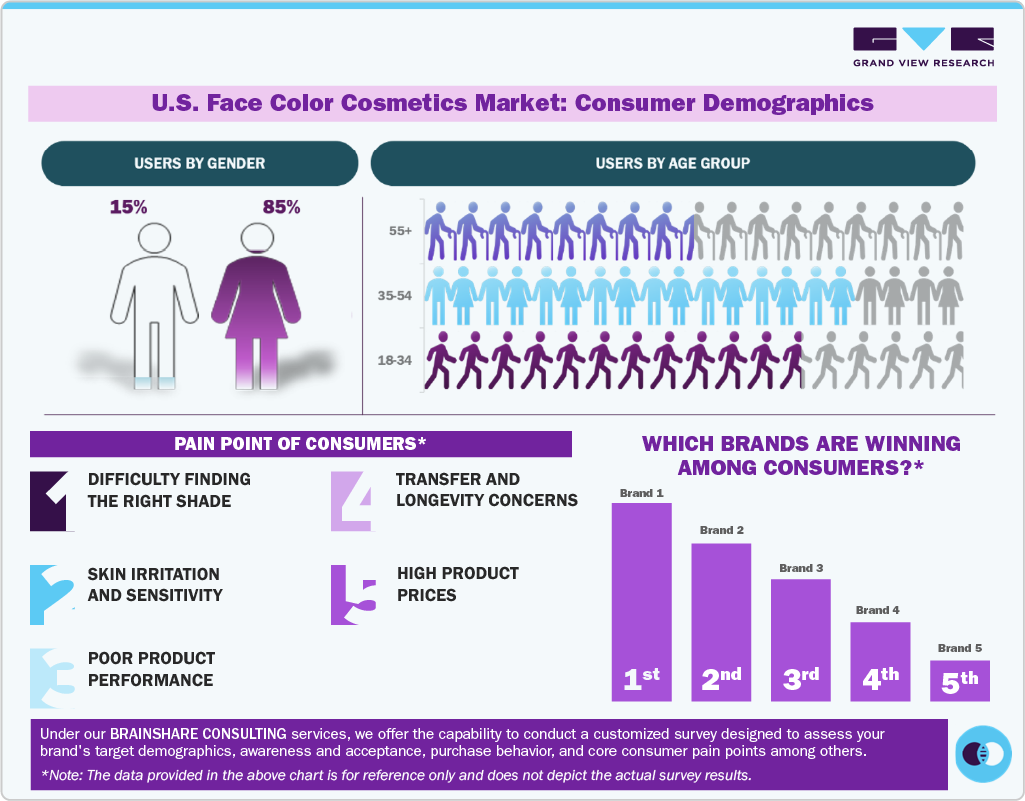
The U.S. face color cosmetics market serves consumers across diverse age groups and genders, with demand influenced by makeup preferences, complexion concerns, product performance, shade availability, and purchasing behavior.
Users by Gender:
-
Female consumers account for the largest share, estimated at 85%, reflecting the widespread adoption of face color cosmetics as part of everyday beauty routines. Demand is influenced by preferences for complexion enhancement, shade variety, long-wearing formulations, and products suited to different skin types and occasions.
-
Male consumers account for an estimated 15%, reflecting growing interest in complexion products for concealing blemishes, evening skin tone, and achieving natural-looking coverage. Preferences for lightweight formulations and discreet finishes create opportunities for brands to expand gender-inclusive product offerings.
Users by Age Group:
Consumers aged 35-54 represent an important potential user group in the U.S. face color cosmetics market, including individuals seeking reliable complexion products for everyday wear, professional settings, and special occasions. Their preferences may include buildable coverage, long-wearing performance, and formulations suited to changing skin needs. Consumers aged 55 and above may prioritize lightweight foundations, hydrating complexion products, and formulations that minimize the appearance of fine lines and uneven skin tone without settling into wrinkles. Consumers aged 18-34 are influenced by social media trends, beauty influencers, online product reviews, and experimentation with makeup styles. They may show interest in skin tints, liquid blushes, cream bronzers, and versatile complexion products that deliver natural-looking finishes.
Consumers in the U.S. commonly face several challenges when selecting and using complexion products in the color cosmetics market.
-
Difficulty finding the right shade remains a major concern, as differences in skin tone and undertone can make it challenging to identify suitable products, particularly when purchasing online.
-
Skin irritation and sensitivity can limit product choices for consumers who experience reactions to certain cosmetic ingredients, fragrances, or pigments.
-
Poor product performance can affect satisfaction when complexion products oxidize, crease, cake, separate, or fail to blend evenly throughout the day.
-
Transfer and longevity concerns can influence purchasing decisions, as makeup may fade, transfer onto clothing, or require frequent touch-ups during daily activities.
-
High product prices can discourage repeat purchases of premium complexion products, encouraging price-sensitive consumers to seek affordable alternatives without compromising coverage or finish.
Product Insights
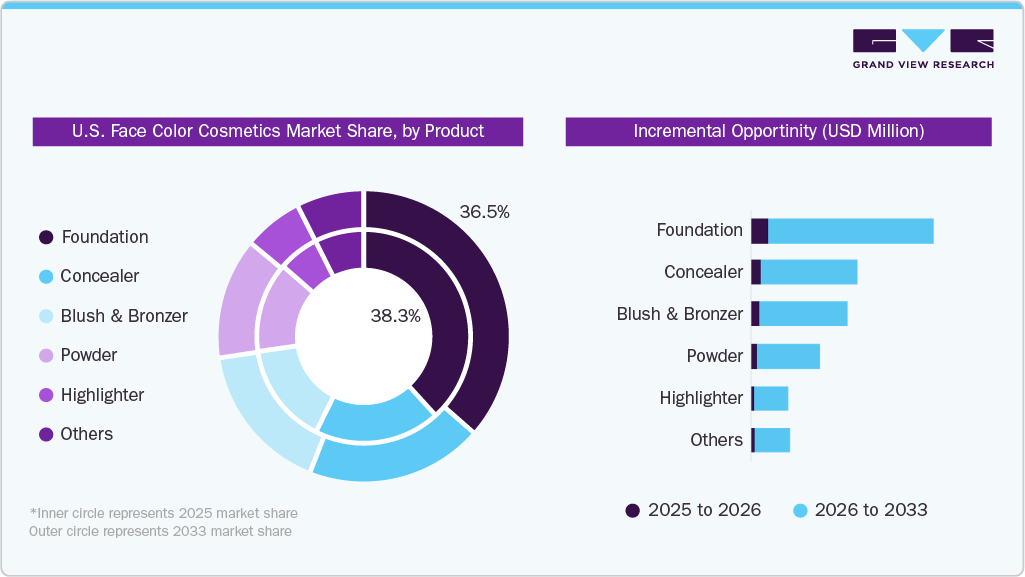
The foundation segment dominated the U.S. face color cosmetics industry, accounting for a revenue share of 38.3% in 2025, driven by consumer demand for even skin tone, buildable coverage, and long-lasting complexion enhancement. Consumers increasingly prefer lightweight textures, natural-looking finishes, and formulations tailored to different skin types, undertones, and coverage requirements. The growing popularity of serum foundations, skin tints, and hybrid makeup products that combine coverage with skincare benefits is encouraging manufacturers to introduce innovative formulations.
 To learn more about this report, Download Free Sample Report
In addition, expanding shade ranges and the availability of liquid, cream, powder, and stick foundations are improving product accessibility across diverse consumer groups. For instance, in May 2026, Mary Kay introduced its reformulated TimeWise 3D Foundation in 36 shades, available in matte and luminous finishes, using IntelliMatch technology informed by more than 3,000 data points from real skin tones. This launch reflects industry efforts to improve shade matching and expand complexion options for diverse consumers, supporting product innovation in the U.S. face color cosmetics market.
The blush and bronzer segment is expected to grow at a CAGR of 8.9% from 2026 to 2033, driven by rising consumer interest in facial color enhancement, contouring, and versatile makeup products. Blushes are gaining popularity in dewy, soft-matte, and high-pigment finishes, while bronzers are increasingly used to add warmth and definition to the complexion. The growing availability of cream-, liquid-, stick-, and balm-based formulations appeals to consumers seeking convenient application and buildable color. In addition, the demand for multi-use products and a wider range of shades is encouraging brands to expand their offerings across different skin tones and makeup preferences. Social media beauty trends and creator-led tutorials are further influencing product discovery and application techniques, creating opportunities for innovation in the market. For instance, in January 2026, Pixi Beauty expanded its On-the-Glow Blush collection with three new shades: Mauve, Cassis, and Chantilly. The multi-use balm stick is designed for application on the cheeks, lips, and eyes, reflecting manufacturers’ focus on versatile formats and convenient color cosmetics.
Product by Price Tier Insights
The mass/entry foundation segment dominated the U.S. face color cosmetics market, accounting for a revenue share of 42.4% in 2025, reflecting strong consumer demand for affordable complexion products and value-oriented makeup options. Brands such as e.l.f. Cosmetics; Wet n Wild; and NYX Professional Makeup compete in this tier by offering foundations at accessible prices across different coverage levels, finishes, and shade ranges. Affordable pricing enables consumers to experiment with new formulas and makeup trends while managing their beauty budgets, strengthening the position of entry-level foundations in the U.S. face color cosmetics industry. For instance, in September 2026, e.l.f. Cosmetics introduced its Soft Glam Satin Foundation, a budget-friendly satin-finish complexion product. The launch reflects how mass-market beauty brands continue to compete through accessible pricing and updated foundation formulations in the U.S.
The premium & luxury blush and bronzer segment is expected to grow at a CAGR of 9.1% from 2026 to 2033, driven by consumer interest in prestige beauty products, distinctive formulations, and refined makeup finishes. Luxury brands such as Dior, Chanel, and Gucci Beauty differentiate their offerings through premium packaging, curated shade ranges, and specialized product formulations. Demand for high-end cream blushes, finely milled powder bronzers, and innovative color technologies is attracting consumers seeking elevated makeup experiences and sophisticated finishes. For instance, in May 2025, Dior introduced its Backstage Rosy Glow Blush Stick in the U.S., featuring pH-activated color technology, a dewy finish, and a buildable formula infused with cherry oil. Priced at USD 44, the launch illustrates how luxury beauty brands are differentiating blush products through specialized formulations and premium positioning, creating opportunities for innovation in the market.
Product by Type Insights
The conventional/synthetic foundation segment dominated the U.S. face color cosmetics industry, accounting for a revenue share of 76.6% in 2025, reflecting its established position in everyday and professional makeup routines. These formulations offer manufacturers flexibility to develop products with varied coverage levels, finishes, and performance characteristics to meet diverse consumer preferences. Continued improvements in pigment dispersion, texture, and wear resistance are helping brands refine foundation performance across different skin types and undertones. For instance, in May 2026, YSL Beauty launched its Skin Affair Soft Glow Cushion Foundation in the U.S., featuring 31 shades, buildable medium coverage, and a lightweight formula designed to provide a breathable, soft-glow finish. This launch reflects continued product innovation in the face color cosmetics market.
The organic & natural blush and bronzer segment is expected to grow at a CAGR of 9.3% from 2026 to 2033, driven by the increasing consumer interest in ingredient transparency and makeup products featuring naturally derived ingredients. Brands are expanding their offerings with botanical oils, plant-based ingredients, and mineral pigments to appeal to consumers seeking alternatives to conventional formulations. Demand for products that combine makeup performance with skincare-inspired benefits is also creating opportunities for organic-focused cream blushes and bronzers. For instance, in June 2026, Ogee launched its certified-organic, skincare-infused makeup collection on Sephora.com, including Sculpted Face Sticks for blush and bronzer. The products feature creamy, buildable formulations designed to enhance natural color and facial definition, reflecting the growing presence of organic-focused products in the face color cosmetics industry.
Product by Distribution Channel Insights
Sales through the online/e-commerce foundation channel accounted for the largest revenue share of 27.7% in 2025, reflecting the importance of digital shade discovery and online product selection in complexion cosmetics. Foundation brands are investing in virtual shade-matching tools to help consumers identify suitable products without in-person testing. For instance, in August 2025, Mary Kay highlighted its AI Foundation Finder, which analyzes a user’s skin tone through a smartphone camera and recommends a matching foundation shade. Such tools help address uncertainty in shade selection and strengthen brands’ ability to convert online product searches into purchases in the U.S. face color cosmetics industry.
The sales of blush and bronzer through specialty beauty stores are expected to grow at a CAGR of 9.0% from 2026 to 2033. Specialty beauty stores support blush and bronzer sales by offering consumers access to prestige makeup brands, distinctive textures, and a range of shades suited to different complexions. In May 2026, Marc Jacobs Beauty announced its return with a refreshed color cosmetics collection, including the Joystick Buildable Cream Blush Stick and Legally Bronze Talc-Free Blurring Powder Bronzer. The products became available on Sephora.com in June 2026, with in-store availability scheduled for September 2026. This launch illustrates how specialty beauty retailers help introduce revamped prestige makeup collections and provide consumers in the U.S. with access to new blush and bronzer formulations.
Key U.S. Face Color Cosmetics Company Insights
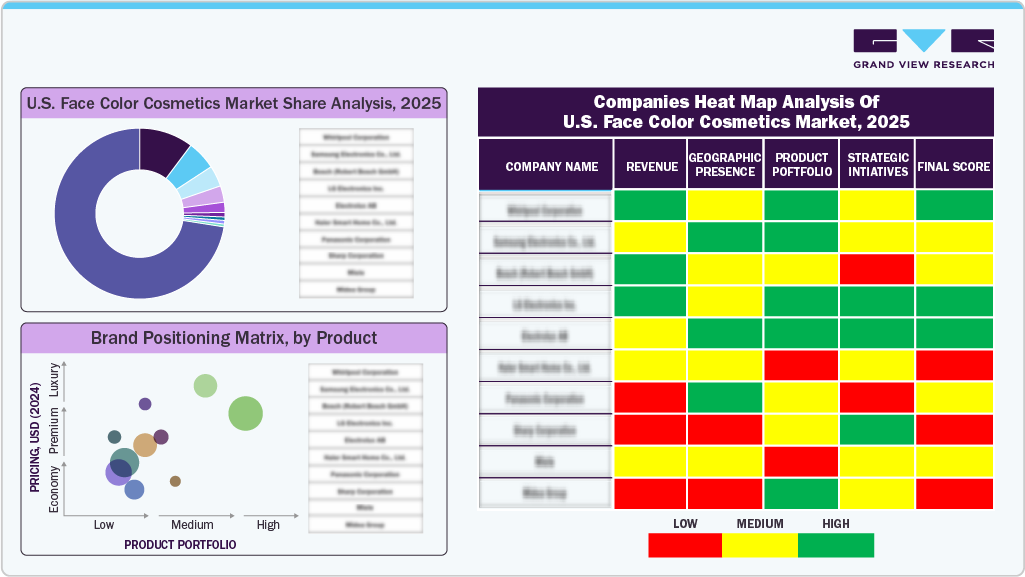
The U.S. face color cosmetics market is characterized by competition among global beauty groups, mass-market cosmetics manufacturers, prestige makeup brands, and specialty beauty businesses. Competition is primarily shaped by brand recognition, product innovation, shade inclusivity, formulation performance, pricing strategies, and the ability to respond to changing consumer preferences across foundation, concealer, blush, bronzer, and other face makeup categories.
-
Mass-Market Beauty Leaders: L’Oréal, e.l.f. Beauty, Procter & Gamble, and Revlon compete through accessible pricing, broad product assortments, and frequent product development across foundation, concealer, blush, bronzer, highlighter, and face powders. L’Oréal offers face makeup through brands such as L’Oréal Paris and Maybelline, with products spanning a range of coverage levels, finishes, and skin tones. e.l.f. Beauty strengthens its position through affordable, trend-responsive makeup, while Procter & Gamble competes through COVERGIRL’s complexion products, including foundations, blushes, and bronzers. Revlon differentiates its face makeup portfolio through long-wear foundations, concealers, powders, and blushes.
-
Prestige and Luxury Makeup Groups: The Estée Lauder Companies, LVMH, Shiseido Company, and Coty Inc. compete through established beauty brands, specialized formulations, premium positioning, and differentiated product experiences. The Estée Lauder Companies participates through brands such as Estée Lauder, M·A·C, Clinique, and Bobbi Brown Cosmetics, offering complexion products across professional and prestige makeup categories. LVMH competes through Dior Beauty, whose portfolio includes foundations, concealers, blushes, bronzers, and powders. Shiseido Company participates through NARS, known for its complexion products and cheek-color offerings, while Coty leverages brands such as Kylie Cosmetics and CoverGirl to serve different consumer preferences and price tiers.
-
Specialty and Trend-Driven Cosmetics Brands: Kendo Brands and e.l.f. Beauty strengthen competition through differentiated brand identities, social-media-driven product discovery, and products aligned with evolving makeup preferences. Kendo’s portfolio includes Fenty Beauty, which emphasizes complexion products and shade inclusivity, as well as other prestige beauty brands. These businesses compete through distinctive product concepts, diverse shade ranges, and launches that respond to consumer interest in natural-looking finishes, high-impact color, and versatile makeup formats.
-
Skincare-Infused and Innovative Face Makeup: The Estée Lauder Companies, Shiseido Company, L’Oréal, and KOSÉ Corporation compete through formulations that combine cosmetic performance with skincare-oriented features. Products featuring hydrating ingredients, lightweight textures, skin-like finishes, and long-wear properties help brands differentiate their foundations, concealers, and complexion enhancers. KOSÉ participates in the U.S. market through Tarte, which offers complexion products, as well as blushes, bronzers, and other face makeup. These companies use formulation development, brand positioning, and product diversification to address demand across everyday makeup and premium beauty routines.
 To learn more about this report, Download Free Sample Report
Key U.S. Face Color Cosmetics Companies
-
L’Oréal
-
Estée Lauder Companies
-
e.l.f. Beauty
-
Procter & Gamble
-
Revlon
-
Coty Inc.
-
LVMH
-
Shiseido Company
-
Kendo Brands
-
Kosé Corporation
Competitive Benchmarking
Category
Operating Strategies
Competitive Edge
Key Challenges
Established Players: L’Oréal USA; The Estée Lauder Companies Inc.; Coty Inc.; Revlon; Shiseido Americas
- Focus on broad face makeup portfolios spanning foundation, concealer, blush, bronzer, setting powder, and highlighter. These companies leverage established brand portfolios, extensive retail distribution, product innovation, and marketing investments to maintain visibility across mass-market and prestige beauty channels.
- Strong brand recognition, extensive product assortments, broad shade ranges, established retail relationships, and significant marketing capabilities support consumer reach and repeat purchases.
- Intense competition from affordable and prestige brands, high marketing expenditure, changing beauty trends, shade-inclusivity expectations, and pressure to maintain product differentiation across price points.
Emerging & Specialist Players: e.l.f. Beauty; Fenty Beauty; Huda Beauty; Haus Labs by Lady Gaga; Rare Beauty
- Emphasize differentiated face makeup products, inclusive shade ranges, accessible or premium pricing, and trend-driven launches. These brands use social media, influencer partnerships, direct-to-consumer channels, and specialty beauty retailers to attract specific consumer groups and expand their U.S. presence.
- Distinctive brand positioning, strong digital engagement, targeted product innovation, inclusive complexion products, and the ability to respond quickly to evolving consumer preferences.
- High customer-acquisition costs, competition for digital visibility, pressure to sustain product novelty, dependence on key retail and online channels, and challenges in scaling distribution while maintaining brand differentiation.
Recent Developments
-
In August 2026, Jung Saem Mool Beauty launched at Sephora U.S., expanding its distribution to Sephora.com and 34 stores nationwide. The launch introduced 10 Sephora-exclusive shades of its Essential Skin Nuder Cushion Foundation, spanning light to deep skin tones, alongside additional shades of Artist Cushion Blush Blur and the Artist Cushion Highlighter. The expansion strengthens the brand’s U.S. retail presence and broadens consumer access to Korean complexion and face color cosmetics.
-
In April 2025, M·A·C Cosmetics launched a revamped Studio Fix Powder Plus Foundation in 67 shades, featuring a talc-free formula, a blur-matte finish, and 24-hour oil control. The two-in-one foundation and setting powder offers customizable coverage, sweat- and water-resistance, and refillable packaging, strengthening the brand’s complexion portfolio by expanding shade inclusivity and offering multifunctional face makeup.
U.S. Face Color Cosmetics Market Report Scope
Report Attribute
Details
Market size in 2025
USD 9.0 billion
Estimated market size in 2026
USD 9.7 billion
Projected market size by 2033
USD 16.5 billion
Growth rate
CAGR of 7.8% from 2026 to 2033
Base year
2025
Actuals
2021 - 2024
Forecast period
2026 - 2033
Quantitative units
Revenue in USD billion and CAGR from 2026 to 2033
Report coverage
Revenue forecast, company ranking, competitive landscape, growth factors, and trends
Segments covered
Product, product by price tier, product by type, product by distribution channel
Key companies profiled
L’Oréal; Estée Lauder Companies; e.l.f. Beauty; Procter & Gamble; Revlon; Coty Inc.; LVMH; Shiseido Company; Kendo Brands; Kosé Corporation
Customization scope
Free report customization (equivalent up to 8 analysts’ working days) with purchase. Addition or alteration to country, regional & segment scope.
Pricing and purchase options
Avail customized purchase options to meet your exact research needs. Explore purchase options
U.S. Face Color Cosmetics Market Report Segmentation
This report forecasts revenue growth at the country level and provides an analysis of the latest trends and opportunities in each of the sub-segments from 2026 to 2033. For this study, Grand View Research has segmented the U.S. face color cosmetics market report based on product, product by price tier, product by type, and product by distribution channel:
-
Product Outlook (Revenue, USD Billion, 2021 - 2033)
-
Foundation
-
Concealer
-
Blush and Bronzer
-
Highlighter
-
Powder
-
Others
-
-
Product by Price Tier Outlook (Revenue, USD Billion, 2021 - 2033)
-
Foundation
-
Mass/Entry
-
Mid-Tier
-
Premium & Luxury
-
-
Concealer
-
Mass/Entry
-
Mid-Tier
-
Premium & Luxury
-
-
Blush and Bronzer
-
Mass/Entry
-
Mid-Tier
-
Premium & Luxury
-
-
Highlighter
-
Mass/Entry
-
Mid-Tier
-
Premium & Luxury
-
-
Powder
-
Mass/Entry
-
Mid-Tier
-
Premium & Luxury
-
-
Others
-
Mass/Entry
-
Mid-Tier
-
Premium & Luxury
-
-
-
Product by Type Outlook (Revenue, USD Billion, 2021 - 2033)
-
Foundation
-
Organic & Natural
-
Conventional/Synthetic
-
-
Concealer
-
Organic & Natural
-
Conventional/Synthetic
-
-
Blush and Bronzer
-
Organic & Natural
-
Conventional/Synthetic
-
-
Highlighter
-
Organic & Natural
-
Conventional/Synthetic
-
-
Powder
-
Organic & Natural
-
Conventional/Synthetic
-
-
Others
-
Organic & Natural
-
Conventional/Synthetic
-
-
-
Product by Distribution Channel Outlook (Revenue, USD Billion, 2021 - 2033)
-
Foundation
-
Hypermarkets & Supermarkets
-
Specialty Beauty Stores
-
Pharmacies & Drugstores
-
Online/E-commerce
-
Others
-
-
Concealer
-
Hypermarkets & Supermarkets
-
Specialty Beauty Stores
-
Pharmacies & Drugstores
-
Online/E-commerce
-
Others
-
-
Blush and Bronzer
-
Hypermarkets & Supermarkets
-
Specialty Beauty Stores
-
Pharmacies & Drugstores
-
Online/E-commerce
-
Others
-
-
Highlighter
-
Hypermarkets & Supermarkets
-
Specialty Beauty Stores
-
Pharmacies & Drugstores
-
Online/E-commerce
-
Others
-
-
Powder
-
Hypermarkets & Supermarkets
-
Specialty Beauty Stores
-
Pharmacies & Drugstores
-
Online/E-commerce
-
Others
-
-
Others
-
Hypermarkets & Supermarkets
-
Specialty Beauty Stores
-
Pharmacies & Drugstores
-
Online/E-commerce
-
Others
-
-
Research Methodology
The U.S. face color cosmetics market figures in this report are based on a proven research process that combines executive interviews with secondary research from proprietary databases, company filings, and recognized regulatory and institutional sources. Market size is built through value-chain sizing-reconciling supply-side and demand-side estimates-and triangulated with bottom-up and top-down approaches. Every estimate passes multiple levels of expert validation before publication, with each U.S. face color cosmetics segment quantified using the revenue-capture definitions in the table below.
Segment Definition
Segment - Product
Revenue capture definition
Foundation
Revenue from face makeup products designed to even out skin tone, provide coverage, and create a uniform complexion, including liquid, cream, powder, stick, and cushion foundations.
Concealer
Revenue from face makeup products formulated to conceal dark circles, blemishes, discoloration, and other skin imperfections, including liquid, cream, stick, and pot concealers.
Blush and Bronzer
Revenue from face makeup products used to add color, warmth, and definition to the complexion, including powder, cream, liquid, and stick blushes and bronzers.
Highlighter
Revenue from face makeup products designed to add radiance and luminosity to selected areas of the face, including powder, cream, liquid, and stick highlighters.
Powder
Revenue from face makeup powders used to set foundation and concealer, reduce shine, smooth the appearance of skin, or provide additional coverage, including loose, pressed, translucent, and tinted face powders.
Others
Revenue from other face color cosmetics not classified under the above segments, including contour products, face primers with color-correcting properties, and other specialized complexion-enhancing makeup products.
Estimation Model
Layer
Guiding Question
Description
Consumer Need & Target Base Layer
Who are the key consumers of face color cosmetics?
Identify U.S. consumers who use foundation, concealer, blush, bronzer, face powder, and highlighter across age groups, income levels, and make-up use occasions.
Market Accessibility Layer
Which consumers can access these products?
Filter consumers based on product availability, retail and e-commerce access, affordability, shade availability, brand accessibility, and preferred product formats.
Purchase Behavior Layer
Which consumers actively purchase?
Apply purchase conversion rates based on makeup usage frequency, repurchase cycles, spending patterns, product preferences, brand loyalty, and willingness to try new formulations.
Monetization Layer
How much revenue is generated?
Estimate revenue using the number of purchasing consumers, annual purchase frequency, average units purchased, average selling price, and spending across face makeup categories.
Delivered Customizations
This report has been delivered with the following In-depth customizations
Client Request
Customization Delivered
Value Adds
U.S. Face Color Cosmetics Market Demand, Consumer Preferences & Purchasing Behavior Analysis
Conducted a detailed assessment of consumer demand for face color cosmetics, covering product preferences, purchasing behavior, shade preferences, skin-tone inclusivity, preferred finishes, and buying patterns across consumer groups.
Helps stakeholders identify high-value consumer segments, understand evolving makeup preferences, and target product offerings toward consumer demand for inclusive shades, diverse finishes, and multifunctional face cosmetics.
U.S. Face Color Cosmetics Market Product Innovation, Customization & Beauty Trends
Evaluated innovation across face color cosmetics, including foundation, concealer, blush, bronzer, face powder, and highlighter, covering lightweight formulations, skinification, long-wear performance, shade customization, and emerging beauty trends.
Provides insights into evolving consumer expectations, supporting product differentiation through inclusive shade ranges, innovative formulations, multifunctional products, and personalized complexion makeup offerings.
U.S. Face Color Cosmetics Market Distribution & Competitive Landscape
Assessed distribution opportunities across specialty beauty retailers, department stores, mass merchandisers, drugstores, brand-owned websites, and e-commerce platforms, alongside the competitive positioning of established and emerging brands in the U.S. market.
Supports distribution and expansion decisions by identifying high-potential sales channels, competitive opportunities, and relevant consumer segments across mass-market and prestige face color cosmetics.
About the Author(s)
Beauty & Personal Care Research Team
Consumer Goods · Beauty & Personal CareThis report was authored by the beauty & personal care research team at Grand View Research - comprising two research analysts, one senior research analyst, and one industry expert - with specialized expertise in the beauty & personal care segment of the consumer goods industry. All findings are based on proprietary consumer goods databases, executive interviews, and regulatory analysis, subject to internal peer review prior to publication.
Last Updated:
Speak to Analyst

Customize this report to your needs - add regions, segments, or data points, with 20% free customization.
Or view our licence options:


ISO 9001:2015 & 27001:2022 Certified
We are GDPR and CCPA compliant! Your transaction & personal information is safe and secure. For more details, please read our privacy policy.


