U.S. Healthcare Factoring Services Market Summary
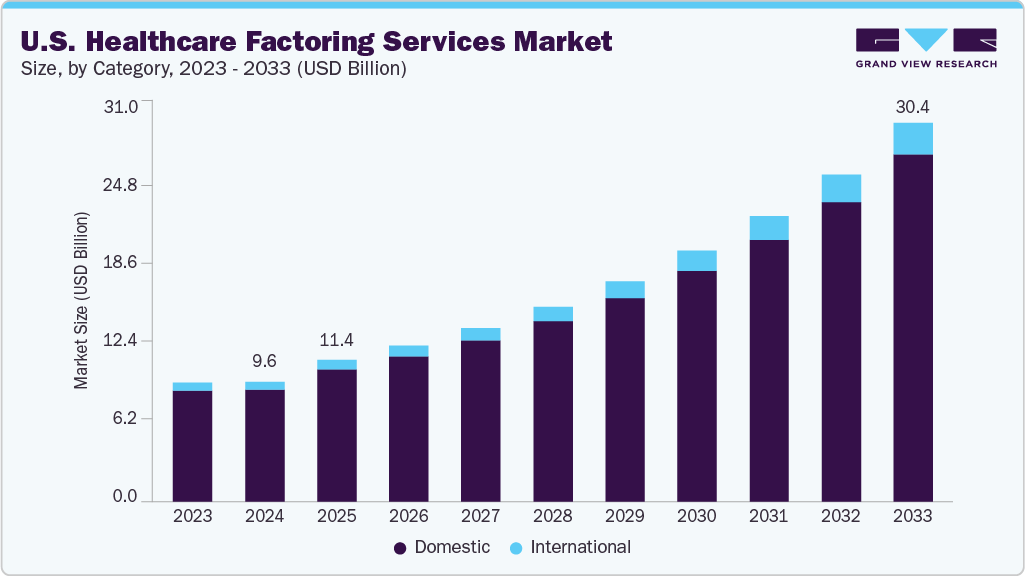
The U.S. healthcare factoring services market size was estimated at USD 9.63 billion in 2024, and is projected to reach USD 30.40 billion by 2033, growing at a CAGR of 13.1% from 2025 to 2033. The market growth is propelled by persistent staffing shortages, an aging population, and the rise of flexible care delivery, which together increase demand for temporary clinicians, travel nurses, and allied health professionals.
Key Market Trends & Insights
- By category, the domestic segment accounted for the largest share of 93.2% in 2024.
- By type, the recourse segment dominated with the largest share of 63.2% in 2024.
- By application, the medical staffing agencies segment dominated the market in 2024.
Market Size & Forecast
- 2024 Market Size: USD 9.63 Billion
- 2033 Projected Market Size: USD 30.40 Billion
- CAGR (2025-2033): 13.1%
Those staffing firms face tight cash-flow timing, with weekly payroll obligations versus slow hospital and payer reimbursements, creating a steady demand for invoice-conversion financing. Technology is reshaping how factors underwrite, service, and collect healthcare receivables. Automated revenue-cycle management, cloud platforms that integrate claim status and remittance data, and early AI tools for fraud detection and cash-flow forecasting are improving decision speed and pricing precision, enabling factors to offer faster advances and lower fees for lower-risk receivables. At the same time, digital marketplaces and APIs are expanding access for smaller agencies previously shut out of traditional factoring.
Investor interest is growing at the intersection of healthcare finance and fintech, as private equity and specialist debt funds allocate capital to staffing-focused factoring firms and fintech builders that automate underwriting and collections. Strategic investors see recurring, fee-based revenue and the opportunity to bundle ancillary services (such as payroll, insurance, and practice management), which has attracted larger rounds for health-ops technology builders and non-bank finance entrants. This activity is reflected in both dedicated staffing and factoring research, as well as broader health tech funding trends.
Regulatory risk is a central operational consideration for healthcare factors. Factors must navigate HIPAA requirements for protected health information. Be mindful of the Stark Law and the Anti-Kickback Statute when arranging transactions that could be perceived as influencing referrals or billing practices. State licensing and collections laws further complicate cross-jurisdictional receivable purchases. Recent clarifications and enforcement trends in health law highlight the importance of robust compliance programs and meticulous contract design among providers, agencies, and stakeholders.
Market restraints within the U.S. healthcare factoring sector primarily stem from reimbursement uncertainties, payer denials, and audit risks, all of which can diminish the pool of eligible receivables or necessitate higher reserve requirements. Additionally, the reputational and legal challenges associated with aggressive collection practices pose significant operational and compliance risks for factoring companies. Growing competition from traditional bank credit lines, emerging digital invoice financing platforms, and tightened underwriting standards following periods of increased default further constrain market expansion.
Category Insights
The domestic segment led the U.S. healthcare factoring services industry, accounting for the largest share of 93.2% in 2024. The growth of the domestic segment in U.S. healthcare factoring services is driven by an urgent need for liquidity among providers facing reimbursement delays and rising operational costs. This trend is largely fueled by small & medium-sized sized (SMBs) and smaller provider groups from home health agencies to medical billing firms seeking to plug cash flow gaps amidst a backdrop of delayed payer reimbursements and ballooning healthcare utilization, which drove national healthcare spending to nearly USD 4.8 trillion in 2023, a 7.5% rise year-over-year.
The international segment is expected to grow at the fastest CAGR during the forecast period. In the U.S., the growth of international healthcare factoring is driven by the nation’s strong integration into global healthcare supply chains. While the U.S. produces advanced medical technologies, it heavily imports APIs, generics, consumables, and electronic devices from countries such as China, India, Germany, and Switzerland. As hospitals and GPOs expand their overseas procurement, managing longer payment cycles and cross-border financial risks has become increasingly complex, driving demand for factoring services to improve cash flow, reduce payment delays, and mitigate currency risks.
Type Insights
The recourse segment led the U.S. healthcare factoring services, with the largest share of 63.2% in 2024. The recourse factoring segment continues to drive growth in the U.S. healthcare factoring services market, largely due to its lower cost structure and wider acceptance among small to mid-sized healthcare providers. In recourse arrangements, the healthcare provider retains the credit risk if the patient or insurer fails to pay, allowing factoring companies to offer more favorable advance rates and reduced fees compared to non-recourse options. This model appeals to medical billing firms, home health agencies, and outpatient centers that require fast and cost-effective working capital solutions, but are confident in the collectability of their receivables.
The non-recourse segment is expected to grow at the fastest CAGR during the forecast period. The segment is steadily gaining traction, particularly among providers seeking to mitigate financial exposure tied to uncertain payer performance. In non-recourse arrangements, the factoring company assumes the risk of non-payment in the event of debtor default, making it an attractive solution for healthcare organizations that deal with a high volume of third-party reimbursements, especially from commercial insurers and smaller payers with variable claims processing reliability. With administrative complexities and denial rates on the rise, many providers, including physician groups, medical staffing firms, and outpatient surgery centers, are turning to non-recourse factoring to safeguard against bad debt.
Application Insights
The medical staffing agencies segment dominated the U.S. healthcare factoring services industry in 2024. The growing use of medical staffing in the U.S. healthcare sector is driven by a rising demand for temporary clinicians and nurses, amid workforce shortages and an aging population. Staffing agencies face cash flow challenges due to delayed hospital reimbursements while needing to meet frequent payroll obligations. Factoring provides rapid working capital by converting invoices into cash. It offers flexible, contract-free financing that scales with growth, making it especially valuable for startups and mid-sized agencies that lack access to traditional credit.
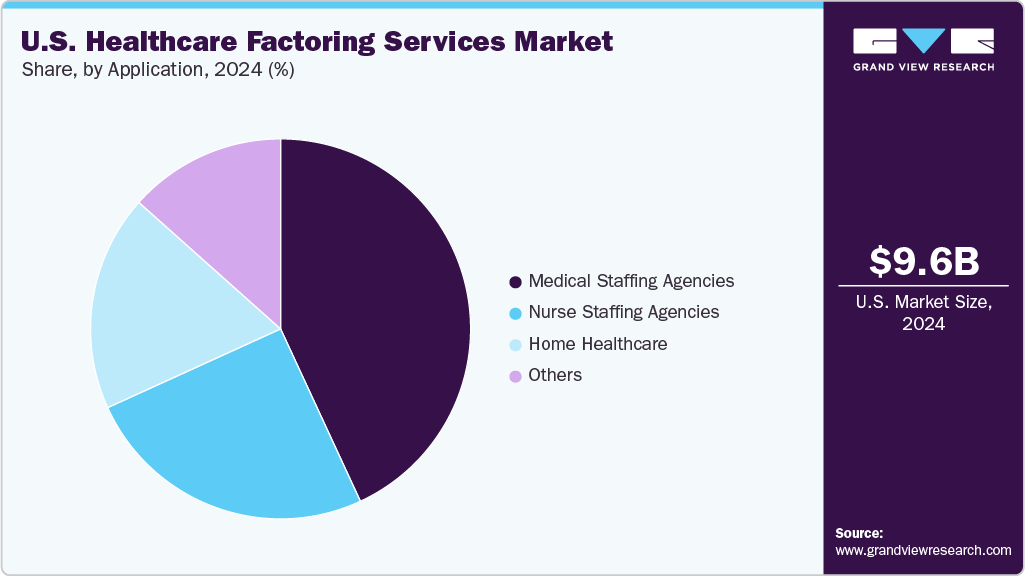
The home healthcare segment is projected to grow at a significant CAGR of 13.8% over the forecast period. The segment’s growth can be attributed to a combination of structural financial pressures and rising demand for in-home care services. As more agencies provide skilled nursing, personal care, and rehabilitative services to aging and chronically ill populations, they are increasingly burdened by delayed payments from Medicare, Medicaid, and third-party insurers, with reimbursement timelines often stretching 60 to 120 days. These delays strain working capital, particularly for smaller or recently established agencies that operate on thin margins and must cover weekly caregiver payroll, supply costs, and regulatory overhead. Factoring addresses this challenge by converting unpaid invoices into immediate cash, allowing providers to sustain operations and respond to growth opportunities.
Key U.S. Healthcare Factoring Services Company Insights
Some of the key companies in the U.S. healthcare factoring services market include eCapital Corp., REV Capital, PRN Funding LLC, and US MED Capital LLC. Organizations are focusing on increasing their customer base to gain a competitive edge in the industry. Therefore, key players are taking several strategic initiatives, including mergers and acquisitions, as well as partnerships with other major companies.
-
eCapital Corp is a prominent commercial finance provider specializing in receivables-based financing for small to mid-sized businesses. Through strategic acquisitions, including CNH Finance, the company has developed a dedicated division focused on healthcare receivables, serving hospitals, home health providers, and medical staffing agencies. eCapital combines deep industry knowledge with advanced technology to deliver services such as invoice factoring, asset-based lending, and payroll funding.
-
REV Capital is a rapidly growing factoring firm that supports clients across the U.S. and Canada. It offers tailored solutions for invoice factoring, with a strong focus on medical staffing agencies and healthcare service firms. The company provides same-day funding, back-office support, and tools for receivables management. Formerly known as Revolution Capital, the firm rebranded to REV Capital in 2022, emphasizing digital transformation and client-centric financing.
Key U.S. Healthcare Factoring Services Companies:
- eCapital Corp.
- REV Capital
- PRN Funding LLC
- US MED Capital LLC
- NeeBo Capital
- 1st Commercial Credit
- Factor Funding Co.
- Xynergy Healthcare Capital
- Copay Inc.
- Med Financial L.L.C
Recent Developments
-
In January 2025, 1st Commercial Credit completed a USD 7 million factoring facility for a staffing agency, enabling it to convert receivables into immediate working capital to support payroll and operational growth. The client serves various sectors, including clinical and healthcare staffing. This development underscores the company's ongoing commitment to supporting temporary staffing firms, including those operating in the healthcare sector, with flexible invoice factoring solutions.
-
In May 2022, eCapital acquired CNH Finance, a Connecticut-based specialty lender focused on the healthcare industry. The acquisition supports eCapital’s expansion into healthcare receivables financing, enhancing its portfolio with HIPAA-compliant factoring and ABL offerings tailored to providers such as hospitals, home health agencies, and nursing facilities. CNH’s integration provides eCapital with deeper sector expertise, positioning it as a strong player in medical accounts receivable (A/R) financing across the U.S.
U.S. Healthcare Factoring Services Market Report Scope
|
Report Attribute
|
Details
|
|
Market size value in 2025
|
USD 11.36 billion
|
|
Transaction volume forecast in 2033
|
USD 30.40 billion
|
|
Growth rate
|
CAGR of 13.1% from 2025 to 2033
|
|
Base year for estimation
|
2024
|
|
Historical data
|
2021 - 2024
|
|
Forecast period
|
2025 - 2033
|
|
Quantitative units
|
Transaction volume in USD million/billion and CAGR from 2025 to 2033
|
|
Report type
|
Transaction volume forecast, company ranking, competitive landscape, growth factors, and trends
|
|
Segments covered
|
Category, type, application
|
|
Key companies profiled
|
eCapital Corp.; REV Capital; PRN Funding LLC; US MED Capital LLC; NeeBo Capital; 1st Commercial Credit; Factor Funding Co.; Xynergy Healthcare Capital; Copay Inc.; Med Financial L.L.C
|
|
Customization scope
|
Free report customization (equivalent up to 8 analysts working days) with purchase. Addition or alteration to country, regional & segment scope.
|
|
Pricing and purchase options
|
Avail customized purchase options to meet your exact research needs. Explore purchase options
|
U.S. Healthcare Factoring Services Market Report Segmentation
This report forecasts transaction volume growth at the country level and provides an analysis of the latest industry trends in each of the sub-segments from 2021 to 2033. For this study, Grand View Research has segmented the U.S. healthcare factoring services market report based on category, type, and application:
-
Category Outlook (Transaction Volume, USD Million, 2021 - 2033)
-
Type Outlook (Transaction Volume, USD Million, 2021 - 2033)
-
Application Outlook (Transaction Volume, USD Million, 2021 - 2033)
Frequently Asked Questions About This Report
b. The U.S. healthcare factoring service market size was estimated at USD 9.63 billion in 2024 and is expected to reach USD 11.36 billion in 2025.
b. The U.S. healthcare factoring service market is expected to grow at a compound annual growth rate of 13.1% from 2025 to 2033 to reach USD 30.40 billion by 2033.
b. The domestic segment dominated the market in 2024 and accounted for the largest share of 93.2%. The growth of the domestic segment in U.S. healthcare factoring services is being driven by an urgent need for liquidity among providers facing reimbursement delays and rising operational costs.
b. Some key players operating in the U.S. healthcare factoring service market include eCapital Corp.; REV Capital; PRN Funding LLC; US MED Capital LLC; NeeBo Capital; 1st Commercial Credit; Factor Funding Co.; Xynergy Healthcare Capital; Copay Inc.; Med Financial L.L.C.
b. The market is propelled by persistent staffing shortages, an aging population, and the rise of flexible care delivery that together increase demand for temporary clinicians, travel nurses, and allied health professionals.

 Download Sample Report
















