
- Home
- »
- Healthcare IT
- »
-
U.S. Healthcare IT Software Market Size Report, 2026-2033GVR Report cover

U.S. Healthcare IT Software Market (2026 - 2033)
Size, Share & Trends Analysis Report By Software Type (Revenue Cycle Management Software, Tele-healthcare Software, eClinical Software, Cloud-based EHR & EMR Software) And Segment Forecasts
Market Size, 2025
$189.6BMarket Estimate, 2026
$216.5BMarket Forecast, 2033
$634.0BCAGR, 2026–2033
16.6%U.S. Healthcare IT Software Market Summary
The U.S. healthcare IT software market size was valued at USD 189.6 billion in 2025 and is projected to grow from USD 216.5 billion in 2026 to USD 634.0 billion by 2033, at a CAGR of 16.6% from 2026 to 2033. The increasing adoption of electronic health records (EHRs) and electronic medical records (EMRs), fueled by federal mandates and initiatives such as the HITECH Act, has significantly expanded the market. Rising demand for interoperability, a shift towards value-based care, and population health management have further accelerated the adoption of healthcare analytics software.
Key Market Trends & Insights
- By software type: Revenue cycle management software segment held the largest market share of 32.1% in 2025.
Market Size & Forecast
- Market size in 2025: USD 189.6 Billion
- Estimated market size in 2026: USD 216.5 Billion
- Projected market size by 2033: USD 634.0 Billion
- CAGR (2026-2033): 16.6%
Three ways to get this report
Buy it, customize it, or ask a question.Ask an Analyst
Analyst response in 1 business day
- AccessReport author, directly
- Reply timeWithin 1 working day
- No sales callDirect answer only
- FormatEmail reply
- CostFree, no cost
Get the Full Report
What the study covers
- FormatsPDF · Excel · Dashboard
- Timeline2026–2033 annual, 2025 base
- Coverage20+ countries, 5 regions
- Companies10+ key players profiled
Customize the Report
20% free customization
- IncludeCountries, segments, points
- TailorTo your product definition
- ExtendDeeper competitor detail
- OrA fully bespoke study
- Turnaround5–10 working days
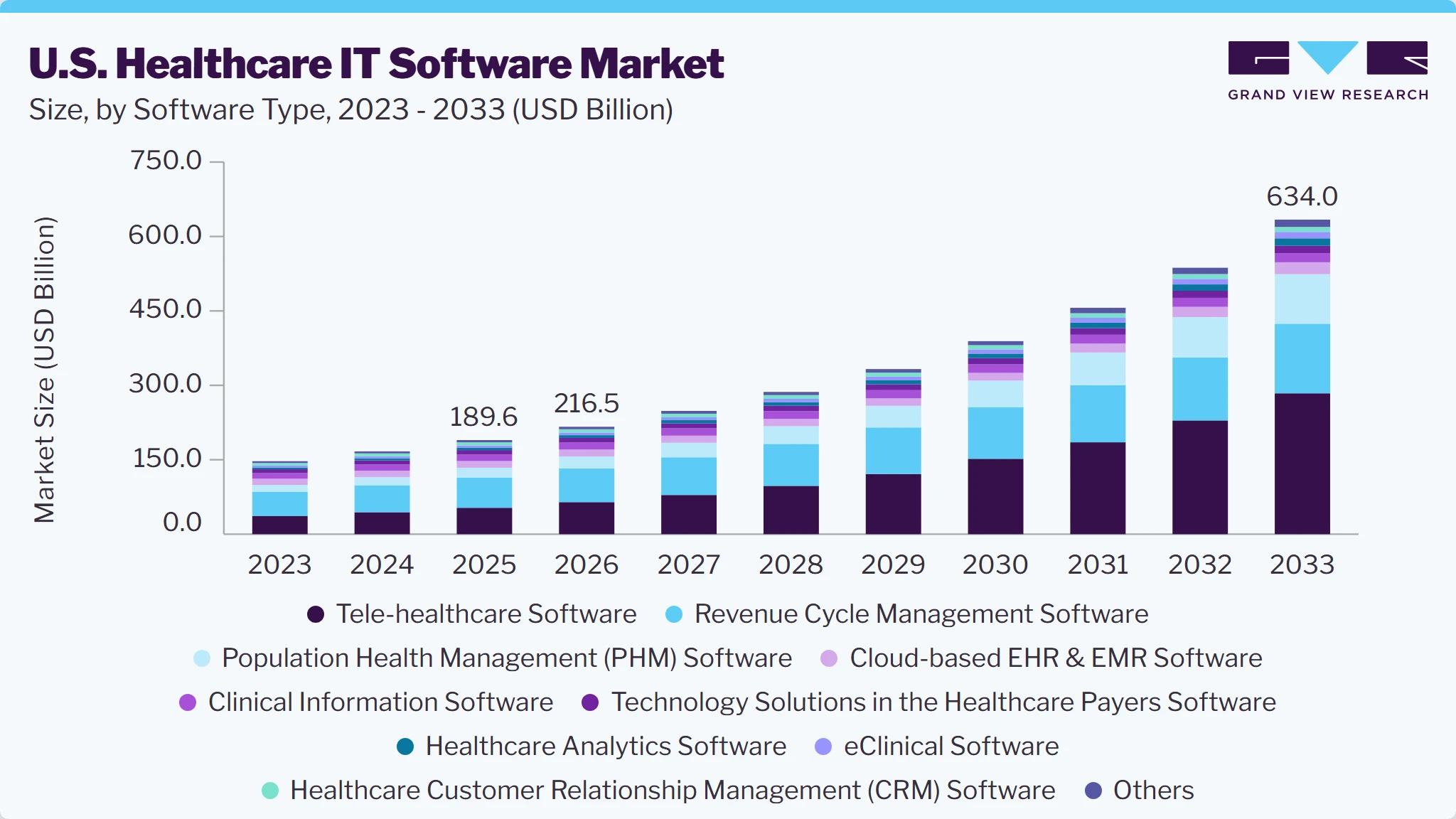 Source: Grand View Research, IR Documents, Primary Interviews, Paid DatabasesTo learn more about this report,
 Download Free Sample Report
Market Dynamics
The U.S. healthcare IT software market is growing due to the increasing adoption of electronic health records (EHRs), cloud-based healthcare platforms, artificial intelligence, telehealth, and healthcare analytics solutions. Healthcare organizations are investing in healthcare IT software to improve clinical workflows, enhance patient outcomes, strengthen interoperability, and optimize operational efficiency. However, concerns related to data privacy, cybersecurity, interoperability challenges, and high implementation and maintenance costs continue to restrain market growth. These factors are driving demand for secure, AI-enabled, cloud-based, and interoperable healthcare IT software solutions.
The widespread adoption of Electronic Health Records (EHR) and Electronic Medical Records (EMR) is a key driver of the U.S. healthcare IT software market. Healthcare providers are replacing paper-based records and legacy systems with digital EHR and EMR platforms to improve clinical documentation, patient record management, care coordination, and healthcare workflow efficiency.
According to the article published by National Center for Health Statistics in December 2025, approximately 95% of U.S. office-based physicians had adopted an electronic health record system, and 91% had adopted a certified EHR. This widespread adoption, coupled with the growing need for accurate, real-time patient information and seamless health information exchange across hospitals, physician practices, and ambulatory care centers, is further accelerating demand for EHR and EMR software solutions.
Data privacy and security concerns represent a major restraint in the U.S. healthcare IT software market, as the increasing digitization of sensitive patient information heightens the risk of cyberattacks, data breaches, and unauthorized access. Healthcare organizations face stringent compliance requirements under regulations such as HIPAA, HITECH, and state-level privacy laws, which can make implementing new technologies complex and costly.
In addition, rising ransomware attacks on hospitals and health systems have eroded trust and created barriers to adopting cloud-based or AI-powered solutions. For instance, in January 2025, Frederick Health Medical Group experienced a ransomware attack that compromised the personal and clinical data of approximately 934,326 patients. The breach involved unauthorized access to sensitive files, including names, Social Security numbers, medical information, and billing data. These concerns require substantial investments in cybersecurity infrastructure, encryption, and continuous monitoring, which can slow deployment and limit market growth, especially for smaller providers.
The integration of generative AI and agentic AI into healthcare IT software is a significant growth opportunity in the market. Companies are integrating AI-enabled software to automate administrative and clinical workflows, including medical coding, clinical documentation, prior authorization, revenue cycle management, and patient communication. The integration of AI into healthcare IT platforms is expected to improve operational efficiency, reduce administrative burden, and enhance productivity across healthcare providers and payers. For instance, in July 2025, Omega Healthcare expanded its collaboration with Microsoft to launch more than 20 generative and agentic AI solutions through Azure AI Foundry and the Omega Digital Platform. The solutions automate medical coding, denial management, appeals, correspondence processing, and call center operations, supporting the growing adoption of AI-enabled healthcare IT software across the U.S. healthcare sector.
Market Concentration & Characteristics
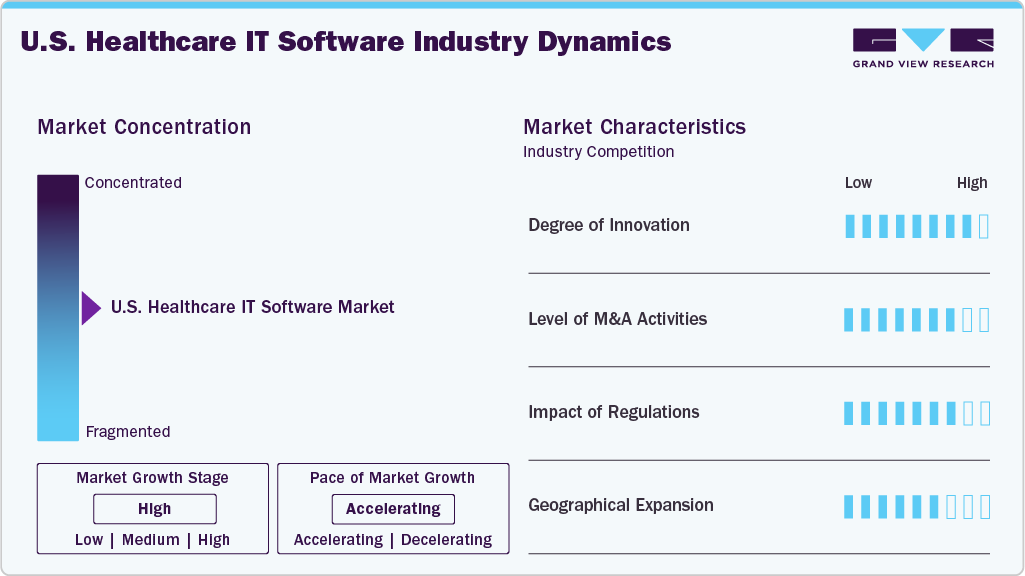
The U.S. healthcare IT software market is characterized by a high degree of innovation driven by advancements in generative AI, cloud computing, interoperability, predictive analytics, and intelligent automation. Vendors are integrating AI-powered capabilities into EHRs, clinical decision support, revenue cycle management, and patient engagement platforms to improve care quality and operational efficiency. For instance, in August 2025, Oracle launched its next-generation AI-driven Oracle Health EHR for U.S. ambulatory providers, featuring voice-first workflows and contextual AI to streamline clinical documentation and enhance patient care.
The level of M&A activity in the U.S. healthcare IT software market is high, as market players continue to acquire healthcare software and digital health firms to strengthen AI capabilities, interoperability, and healthcare data management. For instance, in March 2026, Infosys announced the acquisition of U.S.-based Optimum Healthcare IT for USD 465 million to expand its healthcare IT consulting, EHR implementation, cloud, and digital transformation capabilities across the U.S. healthcare sector.
 To learn more about this report, Download Free Sample Report
The impact of regulations is high in the U.S. healthcare IT software market, as healthcare organizations must comply with stringent federal requirements for patient data privacy, cybersecurity, interoperability, and electronic health information exchange. Regulations such as HIPAA, the HITECH Act, the 21st Century Cures Act, and the CMS Interoperability and Prior Authorization Final Rule are accelerating the adoption of secure, interoperable, and compliant healthcare IT software solutions with advanced security, audit, reporting, and data exchange capabilities.
Geographical expansion drives growth in the U.S. healthcare IT software connectivity solutions market by broadening market reach and increasing adoption in emerging regions. It allows providers to address diverse healthcare needs and regulatory environments, fostering innovation and tailored solutions. For instance, in June 2024, Synthesis Health secured three multisite contracts, including Tahoe Carson Radiology in Carson City, Nevada; Naugatuck Valley Radiology in Prospect, Connecticut; and Intermountain Medical Imaging in Boise, Idaho, enhancing its presence in the healthcare imaging sector. These contracts are expected to expand the company's reach and improve its service offerings across various healthcare facilities.
Case Study: AI-Enabled Telehealth App Development for U.S.-Based Digital Health Platform
Daffodil Software collaborated with a U.S. healthcare provider to develop a robust, AI-powered telehealth application that delivers intelligent symptom assessment, virtual consultations, and integrated care services.
Challenge:
The client aimed to launch a HIPAA-compliant telehealth solution that could automate symptom analysis, support remote consultations, manage patient data securely, and integrate with existing EHR systems and third-party services all while ensuring scalability and user-friendliness.
Solution:
Daffodil developed a mobile application featuring an AI-driven symptom tracker covering over 10,000 symptoms and conditions, along with modules for medication reminders, appointment booking, and provider communication. The platform adhered to HIPAA and HL7 standards and was built with interoperability to integrate with third-party services and provider systems.
Impact:
-
The solution was launched within the expected timeline due to Daffodil’s on-time deliverables.
-
Daffodil maintained a strong focus on quality throughout the project execution.
-
Daffodil is assisting the client in planning for new features and updates to enhance the app.
Analyst Perspective
The U.S. healthcare IT software market is undergoing rapid digital transformation, driven primarily by cloud-based platform adoption. Healthcare providers are heavily investing in electronic health records, telehealth, analytics, revenue cycle management, and AI tools to improve efficiency. This growth is heavily catalyzed by the convergence of generative AI, predictive analytics, and cloud computing across clinical workflows. Rather than mere add-ons, these advanced technologies are becoming foundational to next-generation care delivery models. However, adoption remains hindered by persistent headwinds like data privacy concerns, growing cybersecurity risks, and high integration costs. These friction points particularly delay technology deployment among smaller, resource-constrained provider organizations. Nonetheless, the overall market outlook stays exceptionally favorable due to strong regulatory support and digital health expansion. Driven by the ongoing transition toward value-based care, the sector remains well-positioned for sustained future momentum.
Software Type Insights
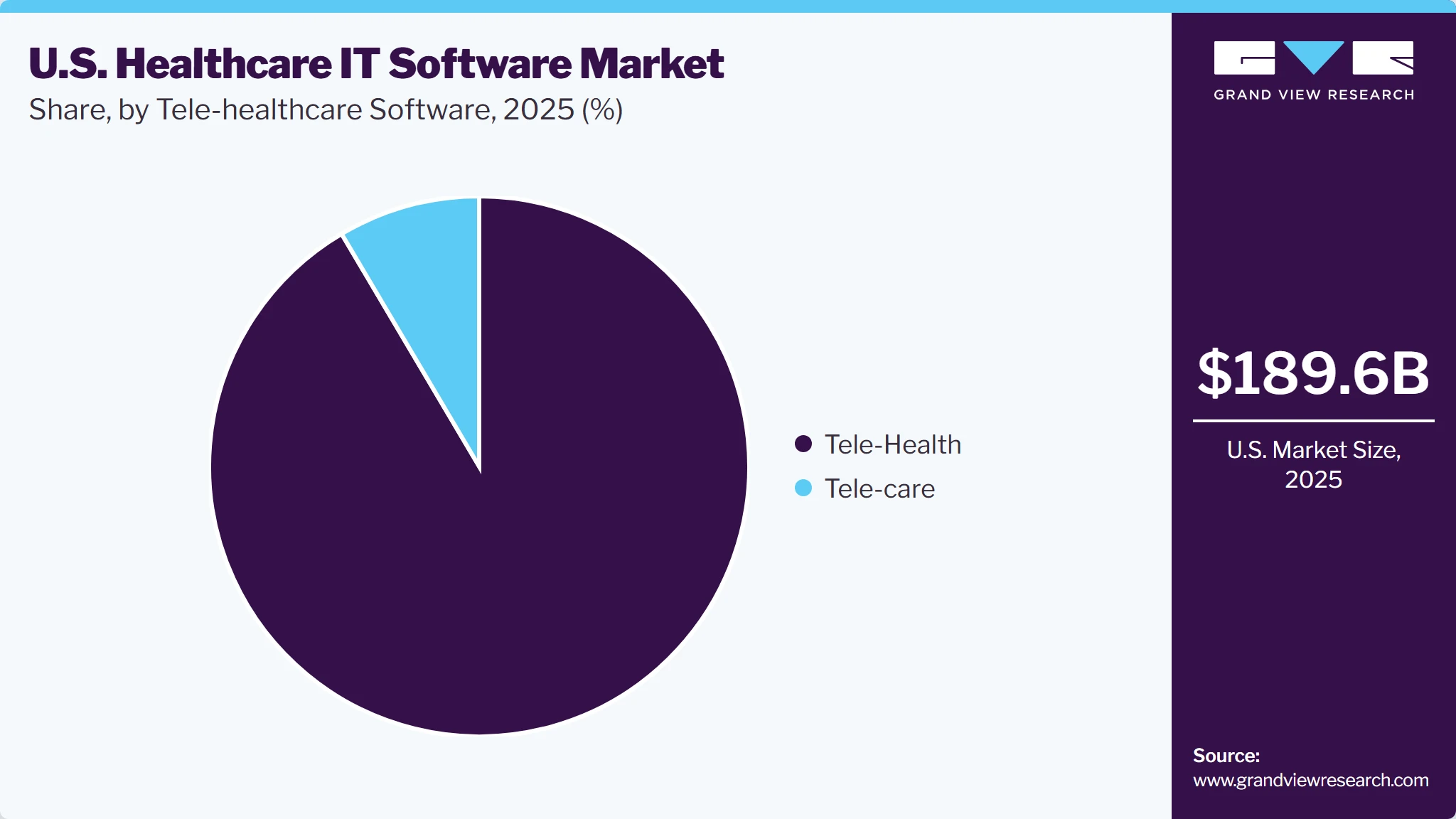
The revenue cycle management software segment led the market, with a revenue share of 32.1% in 2025. The healthcare industry is rapidly moving toward digitalization, creating demand for advanced revenue cycle management solutions. The growth of healthcare organizations is expected to be driven by the increasing demand for workflow optimization through the adoption of synchronized management software systems. The increasing number of data silos and unorganized workflows in healthcare settings is driving market development & growth. RCM involves third-party payers, payment models, guidelines, and codes. Hence, healthcare organizations collaborate with market players to adopt RCM solutions, thereby contributing to market growth. For instance, in January 2024, Tallahassee Memorial HealthCare partnered with an RCM solutions provider, Ensemble Health, to enhance patient care.
 To learn more about this report, Download Free Sample Report
Digital healthcare supply chain management software is expected to grow at the fastest CAGR of 35.6% during the forecast period from 2026 to 2033. This is driven by the increasing need for real-time inventory visibility, procurement optimization, and efficient management of medical supplies and pharmaceuticals across healthcare organizations. Rising adoption of cloud-based supply chain platforms, automation technologies, and predictive demand planning is improving operational efficiency and reducing supply disruptions. In addition, growing investments in healthcare digital transformation and integrated supply chain solutions are further driving the segment growth.
Key U.S. Healthcare IT Software Company Insights
Market players engage in strategic collaborations, acquisitions, partnerships, and product innovations to strengthen their presence in the U.S. healthcare IT software market. These strategic initiatives are expected to create future growth opportunities by accelerating digital transformation, expanding the adoption of cloud-based healthcare IT software, and enhancing AI-enabled healthcare solutions.
Key U.S. Healthcare IT Software Companies
-
Koninklijke Philips N.V.
-
McKesson Corporation
-
eMDs, Inc.
-
Veradigm Inc. (formerly Allscripts Healthcare Solutions, Inc.)
-
Athenahealth, Inc. (Acquired by Hellman & Friedman and Bain Capital)
-
Carestream Health
-
GE Healthcare
-
Agfa- Gevaert Group
-
Hewlett Packard Enterprise Development LP
-
Novarad
-
Optum, Inc.
-
IBM
-
Oracle
-
SAS Institute, Inc.
-
IQVIA
-
Verisk Analytics, Inc.
-
SAP
-
Accenture
Competitive Benchmarking
Category
Operating Strategies
Competitive Edge
Weakness
Established Players (Oracle, Optum, IBM, SAP, Oracle, McKesson Corporation)
Focus on enterprise-wide software platforms, including EHR integration, healthcare analytics, revenue cycle management, cloud computing, AI, and interoperability. Expand through strategic partnerships, acquisitions, and continuous innovation.
Strong brand recognition, extensive U.S. healthcare customer base, comprehensive software portfolios, and advanced AI, cloud, and interoperability capabilities supporting hospitals, payers, and health systems.
High implementation and integration costs, lengthy deployment cycles, and complex customization requirements can limit adoption among smaller healthcare organizations.
Emerging Players (Veradigm Inc., Athenahealth, Inc., eMDs, Inc., Novarad, Carestream Health)
Focus on cloud-native healthcare software, ambulatory EHRs, telehealth, medical imaging, practice management, and AI-enabled workflow automation.
Flexible cloud-based platforms, faster implementation, specialized healthcare software, and lower total cost of ownership for physician practices, imaging centers, and mid-sized healthcare providers.
Limited enterprise-scale deployments, a smaller customer base, narrower product portfolios, and lower global presence compared with established healthcare IT vendors.
Recent Developments:
-
In February 2026, Oracle Health launched the Oracle Health Device Validation Program in the U.S. to standardize and accelerate secure medical device integration across healthcare organizations. The program validates device connectivity, interoperability, and workflow integration, enabling reliable data exchange and improving clinical and operational efficiency.
-
In August 2025, Veeva Systems announced a strategic collaboration with Amgen to advance clinical trial innovation through the Veeva Clinical Platform. The collaboration aims to improve end-to-end clinical trial operations by enhancing process efficiency, accelerating clinical development, and supporting faster delivery of innovative therapies to patients.
-
In January 2024, Hyperfine Inc. introduced a new AI-powered software designed for the Swoop system to enhance the quality and usability of brain imaging. This innovative software aims to improve the diagnostic capabilities of its portable MRI system, making brain imaging more accessible and efficient for healthcare providers.
“Our focus on image quality with this latest software has been on the DWI sequence, which is key in stroke imaging. Since its first FDA clearance in 2020, we’ve been dedicated to continually enhancing image quality and workflow efficiencies to define best-in-class, user-centric, ultra-low field MR brain imaging.”
-Tom Teisseyre, PhD, Chief Operating Officer of Hyperfine, Inc.
-
In November 2024, Suvoda received a patent for its Questionnaire Definition Language (SQDL), part of its electronic Clinical Outcome Assessment (eCOA) software. This innovation allows for rapid questionnaire design and deployment, significantly reducing the time required for clinical trial sponsors to launch studies.
-
In October 2024, Oracle launched the upgraded version of Clinical AI Agent, an advanced AI tool to streamline clinical workflows and enhance decision-making processes within healthcare settings.
-
In September 2024, ContinuumCloud partnered with DrFirst to improve medication management for behavioral health providers. This collaboration integrates DrFirst's medication management solutions into ContinuumCloud's Welligent EHR platform to enhance prescribing workflow with features like comprehensive medication history, clinical alerts, and Electronic Prescribing for Controlled Substances (EPCS).
-
In September 2024, LabWare and Mettler Toledo introduced a new software connector that integrates LabWare’s LIMS and Electronic Lab Notebook (ELN) with Mettler Toledo’s LabX software. This integration aims to enhance laboratory efficiency and connectivity.
-
In April 2024, Atlantic Health System announced the adoption of FeelBetter's Precision Population Health Platform, aimed at optimizing and personalizing medication management for patients. This initiative is part of Atlantic Health's commitment to improving patient care and health outcomes through innovative technology.
U.S. Healthcare IT Software Market Report Scope
Report Attribute
Details
Market size in 2025
USD 189.6 billion
Estimated market size in 2026
USD 216.5 billion
Projected market size by 2033
USD 634.0 billion
Growth rate
CAGR of 16.6% from 2026 to 2033
Historical data
2021 - 2025
Forecast period
2026 - 2033
Quantitative units
Revenue in USD million and CAGR from 2026 to 2033
Report coverage
Revenue forecast, company ranking, competitive landscape, growth factors, and trends
Segments covered
Software type
Key companies profiled
Koninklijke Philips N.V.; McKesson Corporation; eMDs, Inc.; Veradigm Inc. (formerly Allscripts Healthcare Solutions, Inc.); Athenahealth, Inc. (Acquired by Hellman & Friedman and Bain Capital); Carestream Health, GE Healthcare; Agfa-Gevaert Group; Hewlett Packard Enterprise Development LP; Novarad; Optum, Inc.; IBM; Oracle; SAS Institute, Inc.; IQVIA; Verisk Analytics, Inc.; SAP; Accenture
Customization scope
Free report customization (equivalent up to 8 analysts working days) with purchase. Addition or alteration to & segment scope.
Pricing and purchase options
Avail customized purchase options to meet your exact research needs. Explore purchase options
U.S. Healthcare IT Software Market Segmentation
This report forecasts revenue growth at the country levels and provides an analysis of industry trends across each sub-segment from 2021 to 2033. For this study, Grand View Research has segmented the U.S. healthcare IT software market on the basis of software type.
-
Software Type Outlook (Revenue, USD Million, 2021 - 2033)
-
Revenue Cycle Management Software
-
Integrated
-
Standalone
-
-
Tele-healthcare Software
-
Tele-care
-
Activity Monitoring
-
Remote Medication Management
-
-
Tele-Health
-
LTC Monitoring
-
Video Consultation
-
-
-
Population Health Management (PHM) Software
-
Cloud-based EHR & EMR Software
-
Clinical Information Software
-
Technology Solutions in the Healthcare Payers Software
-
Claims Management
-
Enrollment and Member Management
-
Provider Management
-
Revenue Management and Billing
-
Analytics
-
Value based Payments
-
Data management and support
-
Personalize/CRM
-
Clinical Decision Support
-
Others
-
-
Healthcare Customer Relationship Management (CRM) Software
-
Sales
-
Customer Service and Support
-
Marketing
-
Digital Commerce
-
Cross -CRM
-
-
eClinical Software
-
Clinical Trial Management System (CTMS)
-
Electronic Clinical Outcome Assessment (eCOA)
-
Electronic Data Capture (EDC) & CDMS
-
Clinical Data Integration Platforms
-
Clinical Analytics Platforms
-
Safety Solutions
-
Electronic Trial Master File (eTMF)
-
Randomization and Trial Supply Management (RTSM)
-
eConsent
-
-
Healthcare Analytics Software
-
Descriptive Analytics
-
Diagnostic Analytics
-
Predictive Analytics
-
Prescriptive Analytics
-
-
Medical Imaging Information Software
-
Radiology Information Software
-
Monitoring Analysis Software
-
Picture Archiving and Communication Software
-
-
Electronic Prescribing Software (E-Prescribing Solutions)
-
Computerized Provider Order Entry Software
-
Laboratory Information Software
-
Digital Healthcare Supply Chain Management Software
-
Research Methodology
The U.S. healthcare IT software market figures in this report are based on a proven research process that combines executive interviews with secondary research from proprietary databases, company filings, and recognized regulatory and institutional sources. Market size is built through value-chain sizing—reconciling supply-side and demand-side estimates—and triangulated with bottom-up and top-down approaches. Every estimate passes multiple levels of expert validation before publication, with each U.S. healthcare IT software segment quantified using the revenue-capture definitions in the table below.
Segment Definition
Segment - Software Type
Revenue capture definition
Revenue Cycle Management (RCM) Software
Revenue is generated from software that automates medical coding, claims management, billing, payment processing, reimbursement, and revenue optimization. These solutions improve financial performance and reduce claim denials.
Tele-healthcare Software
Revenue is generated from software platforms that enable virtual consultations, remote patient monitoring, telemedicine, and digital patient engagement. These solutions improve healthcare accessibility and continuity of care.
Population Health Management (PHM) Software
Revenue is generated from software that analyzes population health data, manages chronic diseases, identifies at-risk patients, and supports value-based care initiatives. These solutions improve clinical and financial outcomes.
Cloud-based EHR & EMR Software
Revenue is generated from cloud-based electronic health record (EHR) and electronic medical record (EMR) software that stores, manages, and securely exchanges patient health information across healthcare providers.
Clinical Information Software
Revenue is generated from software that manages clinical documentation, patient records, treatment planning, clinical workflows, and clinical decision support. These solutions improve care quality and operational efficiency.
Technology Solutions in the Healthcare Payers Software
Revenue is generated from software used by health insurance providers to manage claims processing, member administration, utilization management, payment integrity, and regulatory compliance.
Healthcare Customer Relationship Management (CRM) Software
Revenue is generated from CRM software that manages patient engagement, appointment scheduling, communication, marketing, and patient relationship management to improve patient experience and retention.
eClinical Software
Revenue is generated from software supporting clinical research, including electronic data capture (EDC), clinical trial management (CTMS), randomization, trial monitoring, and regulatory compliance.
Healthcare Analytics Software
Revenue is generated from software that collects, integrates, and analyzes clinical, financial, and operational healthcare data to support predictive analytics, reporting, and data-driven decision-making.
Medical Imaging Information Software
Revenue is generated from software that manages, stores, retrieves, and shares diagnostic medical images and related information through PACS, RIS, and vendor-neutral archive (VNA) platforms.
Electronic Prescribing Software (E-Prescribing Solutions)
Revenue is generated from software that enables healthcare providers to electronically create, transmit, and manage prescriptions between providers and pharmacies while improving medication safety and regulatory compliance.
Computerized Provider Order Entry (CPOE) Software
Revenue is generated from software that enables healthcare providers to electronically enter medication, laboratory, imaging, and treatment orders, reducing medical errors and improving workflow efficiency.
Laboratory Information Software
Revenue is generated from laboratory information systems (LIS) that manage specimen tracking, laboratory workflows, diagnostic testing, reporting, quality control, and integration with healthcare information systems.
Digital Healthcare Supply Chain Management Software
Revenue is generated from software that manages procurement, inventory, warehousing, logistics, supplier collaboration, and distribution of pharmaceuticals, medical supplies, and healthcare equipment to improve supply chain efficiency.
Estimation Model
Stage
Description
Top-Down
Commodity Flow Analysis: Market size was estimated by analyzing revenues generated by leading healthcare IT software vendors operating in the U.S., supported by company annual reports, SEC filings, investor presentations, product portfolios, and premium industry databases. Revenue contributions from private companies were estimated using industry benchmarks and validated through primary research.
Parent Market
Parent Market & Penetration-Based Analysis: The U.S. healthcare IT software market was estimated by analyzing the broader global healthcare IT market. U.S. market penetration was assessed based on healthcare IT spending, adoption of EHRs, telehealth, healthcare analytics, AI-enabled software, cloud computing, interoperability, and digital health initiatives. These adoption patterns were used to estimate the addressable market and segment-level opportunities within the U.S. healthcare IT software market
Validation
Data Triangulation & Validation Model: Market estimates were validated through triangulation of secondary research, primary interviews, company-level revenue analysis, healthcare IT spending trends, and software adoption patterns to ensure consistency and accuracy across all software segments and end-user categories in the U.S. healthcare IT software market.
Forecasting
Forecasting & CAGR Modeling: Market forecasts were developed using historical healthcare IT spending, cloud migration trends, AI adoption, interoperability initiatives, telehealth expansion, regulatory developments, and healthcare digital transformation investments. Multivariate regression analysis and trend-based forecasting were applied to estimate future market growth and CAGR.
Delivered Customizations
This report has been delivered with the following In-depth customizations
Client Request
Customization Delivered
Value Adds
Competitive landscape, benchmarking & market share analysis of U.S. players
Provided a comprehensive competitive landscape and benchmarking analysis of leading U.S. healthcare IT software vendors. Included market share estimates, competitive positioning, product portfolio benchmarking, deployment models, customer base assessment, and strategic initiatives of key players operating in the U.S. healthcare IT software market.
Enabled identification of market leaders, competitive strengths, whitespace opportunities, and vendor benchmarking to support strategic planning, partner selection, and competitive intelligence.
Pricing analysis
Delivered a detailed pricing analysis of U.S. healthcare IT software solutions across deployment models, organization size, software categories, licensing models, subscription pricing, implementation costs, and annual maintenance and support charges.
Enabled evaluation of pricing strategies, cost benchmarking, budget planning, and procurement decisions for healthcare organizations adopting healthcare IT software solutions.
Market opportunity assessment
Identified emerging growth opportunities across AI-enabled healthcare software, cloud migration, telehealth, healthcare analytics, interoperability, revenue cycle management, population health management, and value-based care initiatives within the U.S. healthcare sector.
Enabled long-term strategic planning, product development, investment prioritization, and identification of high-growth opportunities across the U.S. healthcare IT software market.
Frequently Asked Questions About This Report
Key factors driving market growth include increasing digital transformation, rising demand for interoperability, AI-driven automation, value-based care models, regulatory support, and the need for cost reduction, operational efficiency, and enhanced patient data management.
The U.S. healthcare IT software market is expected to grow at a CAGR of 16.6% from 2026 to 2033 to reach USD 634.0 billion by 2033.
Revenue cycle management software accounted for a 32.1% share of the software type segment in 2025. This growth is driven by increasing healthcare digitization, AI integration, cost reduction needs, and the adoption of cloud-based solutions.
Some key players operating in the U.S. healthcare IT software market include Philips Healthcare, McKesson Corporation, eMDs, Inc., Veradigm Inc. (formerly Allscripts Healthcare Solutions, Inc.), Athenahealth, Inc. (Acquired by Hellman & Friedman and Bain Capital), Carestream Health, GE Healthcare, Agfa- Gevaert Group, Hewlett Packard Enterprise Development LP, Novarad, Optum, Inc., IBM, Oracle, SAS Institute, Inc., IQVIA, Verisk Analytics, Inc., SAP, Accenture.
The U.S. healthcare IT software market size was valued at USD 189.6 billion in 2025 and is expected to reach USD 216.5 billion in 2026.
About the Author(s)
Healthcare IT Research Team
Healthcare · Healthcare ITThis report was authored by the healthcare it research team at Grand View Research - comprising two research analysts, one senior research analyst, and one industry expert - with specialized expertise in the healthcare it segment of the healthcare industry. All findings are based on proprietary healthcare databases, executive interviews, and regulatory analysis, subject to internal peer review prior to publication.
Last Updated:
Speak to Analyst

Customize this report to your needs - add regions, segments, or data points, with 20% free customization.
Or view our licence options:


ISO 9001:2015 & 27001:2022 Certified
We are GDPR and CCPA compliant! Your transaction & personal information is safe and secure. For more details, please read our privacy policy.


