U.S. Medical Tourism Market Size & Trends
The U.S. medical tourism market size was estimated at USD 8.74 billion in 2024 and is projected to grow at a CAGR of 13.20% over the forecast period to reach an estimated value of USD 26.58 billion by 2033. The market has experienced significant growth in recent times, driven by the increasing presence of internationally accredited hospitals and the reputation for providing cutting-edge medical treatments. The growing emphasis on personalized and patient-centric care in U.S. healthcare facilities is significantly driving the medical tourism industry in the country.
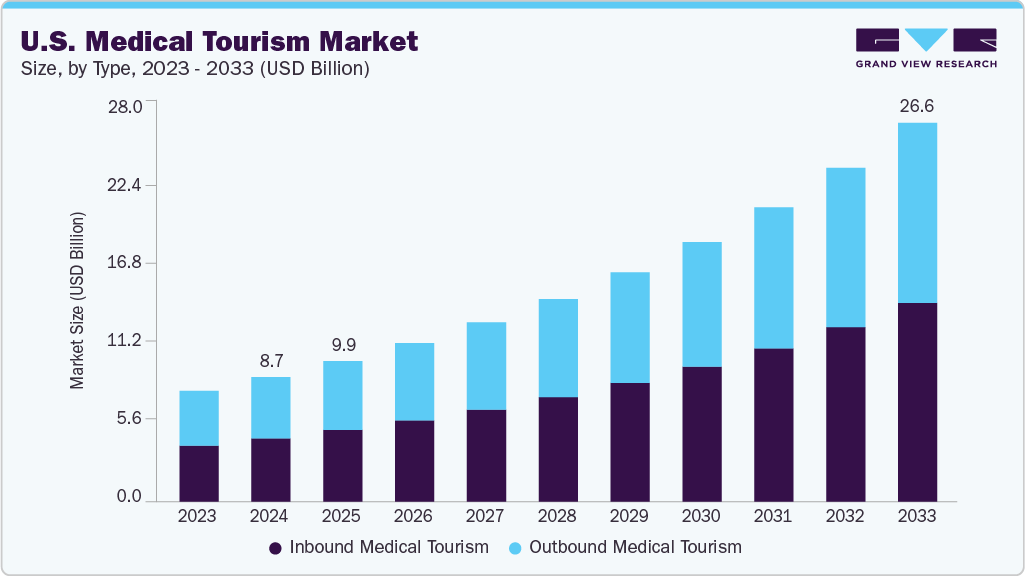
Hospitals and clinics increasingly focus on tailored treatments to individual patient needs, providing personalized care plans, and enhancing the overall patient experience. This high-quality, patient-centered care is expected to witness high demand from international patients seeking an advanced and customized approach to their health.
The presence of internationally accredited hospitals in the U.S. is driving the growth of the inbound medical tourism. As global patients increasingly prioritize safety, quality, and transparency in their healthcare decisions, the U.S. has positioned itself as a preferred destination by offering facilities that meet stringent international standards. As per the 2023 report by The U.S. Cooperative for International Patient Programs (USCIPP), 60 different U.S. organizations assisted 47,002 international patients and reported gross revenue charges totaling USD 2.1 billion in a single fiscal year. Furthermore, hospitals accredited by globally recognized organizations such as Joint Commission International (JCI), Global Healthcare Accreditation (GHA), and DNV-GL stand out in a competitive medical tourism landscape, offering reassurance to patients regarding care quality and procedural integrity.
Moreover, the presence of internationally trained physicians plays a significant role in supporting the growth of the U.S. inbound medical tourism industry. These physicians, commonly referred to as International Medical Graduates (IMGs), comprise a substantial portion of the national medical workforce. According to The Hospitalist, in 2023, nearly 25 percent of active physicians in the U.S. were IMGs. These physicians originate from a wide range of countries, including India, Pakistan, and Nigeria, and bring with them diverse clinical expertise and multilingual capabilities. These qualities strengthen the clinical workforce and foster a culturally sensitive care environment that is especially valuable for international patients seeking personalized and familiar care experiences.
Furthermore, one of the primary drivers of outbound medical tourism from the U.S. is the exceptionally high cost of healthcare domestically. According to the Centers for Medicare & Medicaid Services (CMS), U.S. national health expenditures reached USD 4.5 trillion in 2022, averaging approximately USD 13,493 per person, accounting for about 17.3 percent of GDP. These figures underscore the steep financial burden of healthcare in the U.S.
Meanwhile, the U.S. Census Bureau reports that roughly 8 percent of the U.S. population remained uninsured in 2023, with a similar proportion, 92 percent, insured at some point during the year. Even those who are insured often encounter high deductibles, copayments, or coinsurance, making many vital treatments financially inaccessible.
Average orthopedic treatment price range comparison
|
Orthopedic Treatment
|
U.S.
|
Mexico
|
Costa Rica
|
India
|
Thailand
|
|
Hip Replacement
|
USD 40,000
|
USD 12,500
|
USD 13,600
|
USD 7,200
|
USD 17,000
|
|
Hip Resurfacing
|
USD 28,000
|
USD 12,500
|
USD 13,200
|
USD 9,700
|
USD 13,500
|
|
Knee Replacement
|
USD 35,000
|
USD 10,500
|
USD 12,500
|
USD 9,000
|
USD 14,500
|
|
Spinal Fusion
|
USD 110,000
|
USD 22,500
|
USD 17,000
|
USD 10,300
|
USD 16,000
|
Furthermore, prolonged waiting periods for non-emergency and specialized medical procedures in the U.S. remain a significant driver for outbound medical tourism. According to the American Association of Nurse Practitioners survey 2023, more than 40% of respondents have experienced a longer than reasonable wait for health care. According to the survey, nearly half of those who experienced unreasonable wait times gave up seeking an appointment and did not receive care. Elective surgeries, dental care, and specialty treatments often require patients to wait weeks or even months before receiving care, a delay that can negatively impact quality of life and health outcomes. For instance, among those surveyed, 26% reported waiting more than two months to gain access to a health care provider.
In response, many people are turning to international healthcare providers that offer more efficient access to services. Countries such as Mexico, Costa Rica, India, and Thailand have developed advanced medical infrastructures that cater specifically to the needs of international patients. These destinations are recognized for significantly shorter waiting times, immediate access to specialists, and streamlined administrative processes. Patients benefit from faster appointments and surgeries, as well as comprehensive care packages that are efficiently coordinated and delivered.
Market Concentration & Characteristics
Inbound medical tourism benefits from continuous advancements in medical technologies, including precision medicine, robotic-assisted surgeries, and sophisticated diagnostic tools, which enhance clinical outcomes and serve as a draw for international patients seeking high-quality care. Simultaneously, the outbound segment has witnessed innovation through digital platforms and specialized service providers that facilitate patient access to accredited healthcare facilities abroad, offering comparative cost analyses, treatment planning, and travel coordination.
Several key market players are devising business growth strategies in the form of mergers and acquisitions. Through M&A activity, these companies can expand their business geographies. In August 2024, UCSF Health completed the acquisition of two San Francisco hospitals-Saint Francis Memorial Hospital and St. Mary’s Medical Center-from Dignity Health (CommonSpirit Health). The deal, valued at USD 100 million, includes associated outpatient clinics. UCSF Health is committed to investing at least USD 430 million over 10 years for deferred maintenance, facility improvements, and electronic medical record systems. Both hospitals will operate as acute care facilities with maintained or expanded services and staffing for at least 10 years. The acquisition ends the hospitals’ religious affiliations, allowing broader access to services, including reproductive health. UCSF pledged to retain all employees (approx. 1,800 staff and physicians combined) and preserve open medical staff. Immediate investments include USD 100 million for integration and emergency department upgrades.
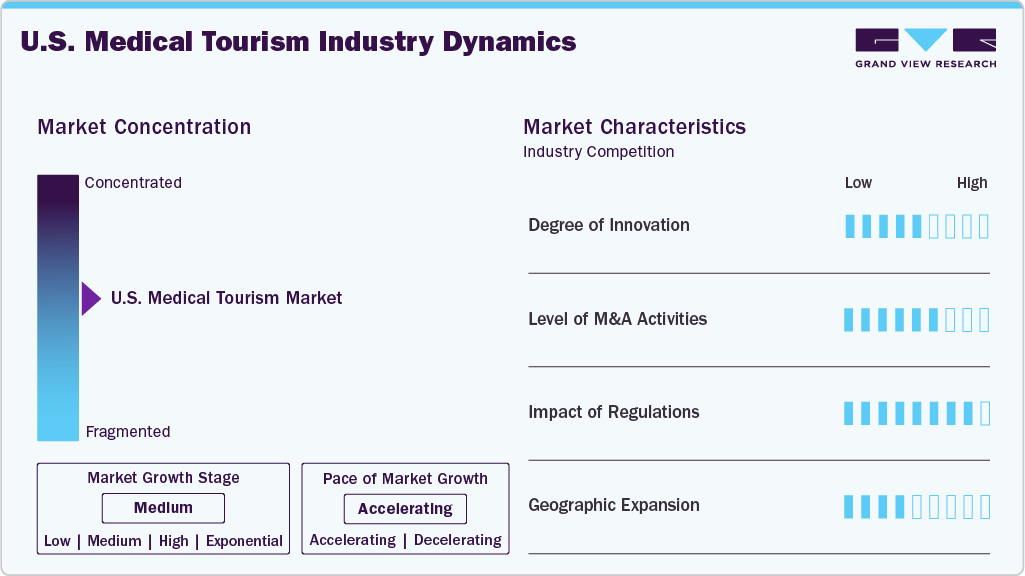
For inbound medical tourism, stringent regulatory standards enforced by bodies such as the FDA, HIPAA, and state medical boards ensure high levels of patient safety, quality of care, and data privacy, which bolster the credibility of U.S. healthcare providers among international patients. However, these same regulations contribute to elevated treatment costs and administrative burdens, potentially deterring cost-sensitive medical tourists. On the outbound side, U.S. regulations influence patients’ ability to seek care abroad, particularly regarding insurance coverage limitations, legal recourse for malpractice, and advisories concerning the safety and accreditation of foreign facilities.
Several market players are expanding their business by entering new geographical regions to strengthen their market position and expand their product portfolio. In January 2025, the Cleveland Clinic announced a major expansion in Palm Beach County, Florida, including a new hospital with approximately 150 beds, emergency department, medical office building, and ambulatory surgery center (ASC). Outpatient services footprint to nearly quadruple, offering specialties such as heart, vascular, thoracic, digestive diseases, neurological, and cancer care.
Type Insights
The inbound medical tourism segment held the largest revenue share of 50.84% in 2024. This leadership is driven by the presence of globally recognized institutions such as the Mayo Clinic, Cleveland Clinic, and Johns Hopkins Hospital, known for their high standards of care and continuous investment in innovation. These facilities offer a comprehensive range of specialized services that make the U.S. a preferred destination for international patients seeking timely, technologically advanced, and outcome-focused medical treatment. As global demand for high-quality healthcare continues to rise, the U.S. is expected to maintain its competitive position through superiority in care delivery and integrated patient services. Furthermore, the U.S. inbound medical tourism industry holds a prominent position globally, supported by the country’s reputation for clinical excellence, technological innovation, and access to highly specialized care.,
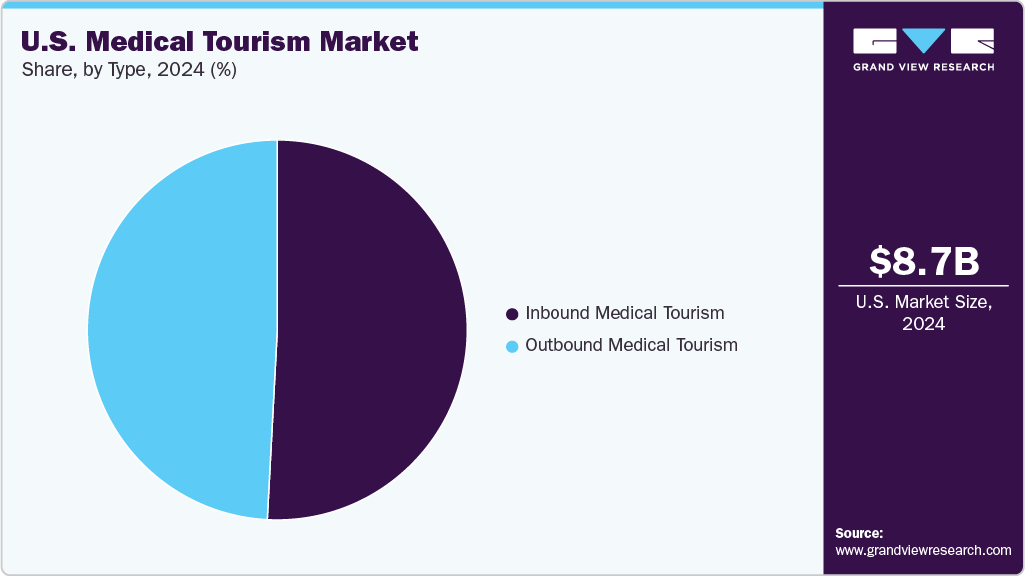
The outbound medical tourism segment is expected to grow at a significant CAGR over the forecast period owing to the persistently high cost of healthcare within the U.S. Although the country is home to some of the most advanced medical technologies and highly trained healthcare professionals, the healthcare system remains financially burdensome for many. High treatment costs, coupled with complex insurance structures and limited coverage for certain procedures, have prompted a growing number of patients to seek care beyond U.S. borders. As a result, medical tourism has emerged as a viable alternative for individuals pursuing affordable, high-quality medical services. Countries such as Mexico, Costa Rica, Thailand, and India have become prominent destinations for U.S. patients, offering a broad range of treatments, including dental procedures, orthopedic surgeries, fertility treatments, and cosmetic enhancements, at substantially lower prices.
Key U.S. Medical Tourism Company Insights
The U.S. medical tourism industry is characterized by fragmentation, with a few dominant players alongside numerous smaller and medium-sized providers.The market players undertake several strategic initiatives, such as partnerships & collaborations, service launches, mergers & acquisitions, and geographical expansion to maintain their position and grow in the market.
Key U.S. Medical Tourism Companies:
- Cleveland Clinic
- Mayo Clinic
- The Johns Hopkins Hospital
- Cedars-Sinai
- Massachusetts General Hospital
- UCSF Health
- NewYork-Presbyterian Hospital
- Ronald Reagan UCLA Medical Center
- Northwestern Memorial Hospital
- Stanford Health Care
Recent Developments
-
In May 2025, Cleveland Clinic formed a joint venture partnership with Regent Surgical to develop ambulatory surgery centers (ASCs) across U.S. markets. Cleveland Clinic will be the majority owner, leveraging Regent's ASC operational expertise to reduce costs and expand outpatient surgical access.
-
In March 2025, Cedars-Sinai entered into a strategic collaboration with Guy's and St Thomas' NHS Foundation Trust to enhance clinical programs and patient care, bringing expertise and knowledge closer to patients globally. This is part of Cedars-Sinai’s broader global collaborations and consulting services aimed at improving clinical excellence and patient-centered care internationally.
-
In February 2025, Canon Healthcare USA acquired a building adjacent to Cleveland Clinic’s main campus in Cleveland Innovation District to establish a comprehensive imaging resource center and headquarters, accelerating medical imaging innovation and supporting Cleveland Clinic’s ecosystem.
-
In November 2023, Mayo Clinic announced a USD 5 billion expansion plan for its Rochester, Minnesota, campus to modernize and unify care neighborhoods, including labs, imaging, consultations, and treatment facilities designed for complex diseases. This initiative, titled “Bold. Forward. Unbound.” involves flexible building designs to adapt rooms for various uses as capacity fluctuates. Financial planning has been rebooted to support this large-scale transformation.
U.S. Medical Tourism Market Report Scope
|
Report Attribute
|
Details
|
|
Revenue forecast in 2025
|
USD 9.86 billion
|
|
Revenue forecast in 2033
|
USD 26.58 billion
|
|
Growth rate
|
CAGR of 13.20% from 2025 to 2033
|
|
Actual data
|
2021 - 2024
|
|
Forecast data
|
2025 - 2033
|
|
Quantitative units
|
Revenue in USD million/billion and CAGR from 2025 to 2033
|
|
Report coverage
|
Revenue forecast, company ranking, competitive landscape, growth factors, and trends
|
|
Segments covered
|
Type
|
|
Country scope
|
U.S.
|
|
Key companies profiled
|
Cleveland Clinic; Mayo Clinic; The Johns Hopkins Hospital; Cedars-Sinai; Massachusetts General Hospital; UCSF Health; NewYork-Presbyterian Hospital; Ronald Reagan UCLA Medical Center; Northwestern Memorial Hospital; Stanford Health Care
|
|
Customization scope
|
Free report customization (equivalent up to 8 analysts working days) with purchase. Addition or alteration to country, regional & segment scope.
|
|
Pricing and purchase options
|
Avail customized purchase options to meet your exact research needs. Explore purchase options
|
U.S. Medical Tourism Market Report Segmentation
This report forecasts revenue growth, country level and provides an analysis of the latest industry trends in each of the sub-segments from 2021 to 2033. For this study, Grand View Research has segmented the U.S. medical tourism market report based on type.
Frequently Asked Questions About This Report
b. The U.S. medical tourism market size was estimated at USD 8.74 billion in 2024 and is expected to reach USD 9.86 billion in 2025.
b. The U.S. medical tourism market is expected to grow at a compound annual growth rate of 13.20% from 2025 to 2033 to reach USD 26.58 billion by 2033.
b. The inbound medical tourism segment dominated the market in 2024 due to the increasing incidence of cancer, cardiovascular disorders, and other chronic conditions.
b. The key industry participants in the U.S. inbound medical tourism market include The Johns Hopkins Hospital; Mayo Clinic; Cleveland Clinic; Cedars-Sinai; Massachusetts General Hospital; UCSF Health; New York-Presbyterian Hospital; Brigham and Women's Hospital; Ronald Regan UCLA Medical Center; Northwestern Memorial Hospital.
b. The availability of additional benefits including better healthcare, latest technologies, innovative medicines, modern devices, better hospitality, and personalized care are some of the drivers of this market.

 Download Sample Report
















