
- Home
- »
- Homecare & Decor
- »
-
U.S. Music Tourism Market Size, Industry Report, 2033GVR Report cover

U.S. Music Tourism Market (2026 - 2033) Size, Share & Trends Analysis Report By Event Type (Concerts, Festivals), By Age Group (18 To 34 Years, 34 To 54 Years), By Expenditure, By Booking Mode, And Segment Forecasts
U.S. Music Tourism Market Summary
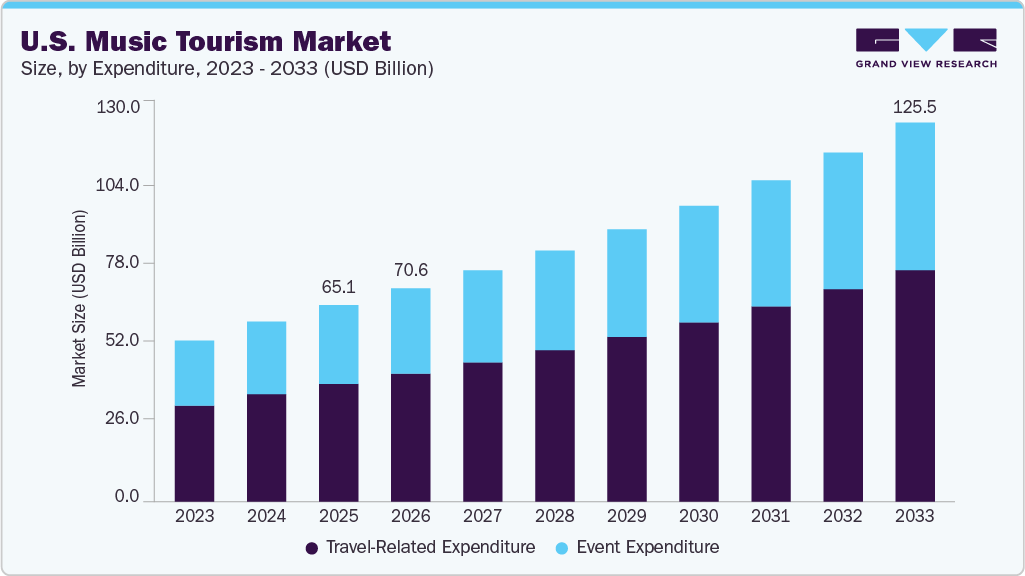
The U.S. music tourism market size was estimated at USD 65.11 billion in 2025 and is projected to reach USD 125.54 billion by 2033, growing at a CAGR of 8.6% from 2026 to 2033. The market is primarily driven by large-scale live events that act as economic anchors for city-level tourism demand.
Key Market Trends & Insights
- By event type, concerts accounted for a market share of 52.5% in 2025.
- By age group, travelers aged between 18 and 34 years accounted for a market share of 64.2% in 2025.
- By expenditure, travel-related expenditure accounted for a market share of 59.8% in 2025.
- By booking mode, bookings through online travel agencies (OTAs) accounted for a market share of 57.4% in 2025.
Market Size & Forecast
- 2025 Market Size: USD 65.11 Billion
- 2033 Projected Market Size: USD 125.54 Billion
- CAGR (2026-2033): 8.6%
Three ways to get this report
Buy it, customize it, or ask a question.Ask an Analyst
Analyst response in 1 business day
- AccessReport author, directly
- Reply timeWithin 1 working day
- No sales callDirect answer only
- FormatEmail reply
- CostFree, no cost
Get the Full Report
What the study covers
- FormatsPDF · Excel · Dashboard
- Timeline2026–2033 annual, 2025 base
- Coverage20+ countries, 5 regions
- Companies10+ key players profiled
Customize the Report
20% free customization
- IncludeCountries, segments, points
- TailorTo your product definition
- ExtendDeeper competitor detail
- OrA fully bespoke study
- Turnaround5–10 working days
Major tours create immediate spikes across hospitality and local spending. For instance, in 2023, Beyoncé’s Renaissance Tour led to 20% increase in hotel and travel activity in Chicago, alongside double-digit growth in restaurants and retail during concert dates. This demonstrates how concerts directly translate into short-term tourism surges, with fans traveling across cities and states. Such event-led demand highlights that music tourism in the U.S. is highly concentrated, where a limited number of blockbuster events generate disproportionate economic impact across the value chain.The U.S. market is heavily driven by blockbuster concerts and multi-city tours that create concentrated, short-term demand shocks across travel and hospitality ecosystems. These events act as primary travel triggers, with fans willing to travel across states, leading to measurable spikes in hotel occupancy and bookings. For instance, according to a 2023 Bloomberg article, during Taylor Swift’s Chicago tour dates, hotel occupancy reached 96.8% with over 44,000 rooms booked per night, marking an all-time high for the city. This demonstrates how a single artist-driven event can temporarily push city infrastructure to near full capacity.
 Source: Grand View Research, IR Documents, Primary Interviews, Paid DatabasesTo learn more about this report,
 Download Free Sample Report
 The impact extends beyond occupancy into broader tourism economics, with concerts driving record-breaking booking volumes and localized demand surges. According to a 2025 Business Times article, Beyoncé’s Chicago concert led to 46,450 hotel rooms booked in a single day, the highest ever recorded in the city, while Airbnb searches for stays surged over 100% during concert periods. Similarly, in Houston, her tour drove hotel occupancy to 81.3% with revenues increasing by 182% compared to the previous year, and more than 50% of attendees traveling from outside the city. These data points highlight how music events generate both inbound tourism and high-intensity spending within short windows.
Another key driver is the strong consumer participation in live music and willingness to spend on experiences, even amid economic pressures. According to a 2026 report by Wi-Fi Talents, 52% of U.S. adults attend at least one live music event annually, indicating broad-based engagement and consistent demand for concerts and festivals. This sustained participation reflects a structural shift where live music is treated as a priority experience rather than discretionary spending. In addition, fans are increasingly willing to travel and spend across categories, including accommodation, dining, and local experiences, making music tourism a high-value contributor to overall travel expenditure.
The U.S. market continues to demonstrate resilient, high-quality growth, underpinned by the structural shift toward streaming-led consumption, robust monetization of intellectual property, and the sustained recovery of live entertainment. Paid subscription streaming remains the primary revenue engine, complemented by expanding income streams from live performances, brand partnerships, and synchronization rights. Notably, the increasing convergence between live music and travel has reinforced the strategic importance of music-led experiences within the U.S. tourism market, as concerts, festivals, and culturally anchored events drive incremental visitor inflows and elevate destination appeal. This intersection is further amplifying the role of the U.S. tourism market as a demand catalyst for large-scale and premium music events.
From a forward-looking perspective, market growth is expected to be driven by continued expansion of experiential consumption, particularly destination-based festivals and exclusive artist residencies, as well as deeper integration of music into travel itineraries, positioning live events as anchor experiences within the U.S. tourism market. Enhanced collaboration between stakeholders, including tourism boards, event organizers, and streaming platforms, is enabling more integrated consumer journeys. In addition, emerging trends such as dynamic pricing for live events, data-driven audience targeting, and the globalization of music content are expected to further reinforce revenue growth. As consumer preferences increasingly shift toward immersive and experience-led spending, the symbiotic relationship between the music industry and the U.S. tourism market is likely to remain a critical driver of long-term value creation.
The market is being accelerated by fan-driven travel behavior and digital amplification, where social media and online communities convert interest into physical mobility. According to CNTraveller, it is seen that major concert weekends can drive over 100,000+ hotel room nights with occupancy rates exceeding 80%, as seen during large-scale events in cities like Chicago. This reflects the growing scale of destination-based concert travel. At the same time, digital platforms amplify demand by creating urgency and visibility around events, encouraging cross-city travel and repeat attendance.
Sustainability is also emerging as an important factor influencing the U.S. market, shaping both consumer preferences and event design. According to YouGov 2024, over 60% of U.S. concertgoers consider it important for tours to implement environmentally friendly practices, indicating growing awareness around the environmental impact of live events and travel.
Brand Market Share Insights
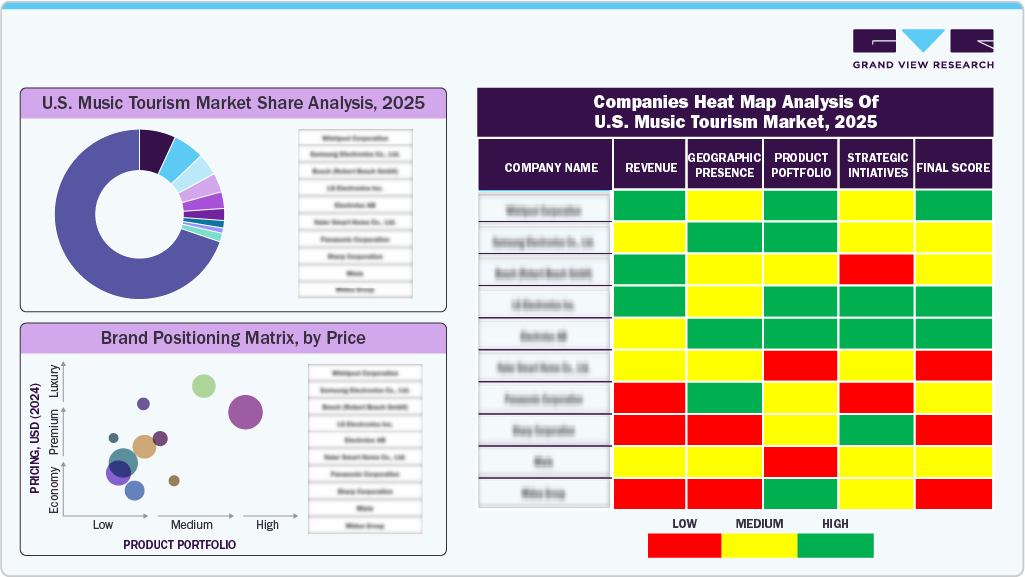
The U.S. market is highly competitive, driven by major concert promoters, festival organizers, and digital ticketing platforms that shape travel demand around live events. Leading players such as Live Nation Entertainment, AEG Presents, and Eventbrite leverage large-scale event portfolios and artist partnerships to attract domestic and international visitors. Major festivals like Coachella Valley Music and Arts Festival and Lollapalooza significantly boost travel, accommodation, and local spending. At the same time, independent organizers are expanding niche, genre-based experiences to appeal to experience-driven travelers. The growth of platforms such as Ticketmaster and Bandsintown is further improving event discovery and travel planning, enabling broader consumer reach and supporting sustained market expansion.
 To learn more about this report, Download Free Sample Report
 Consumer Insights
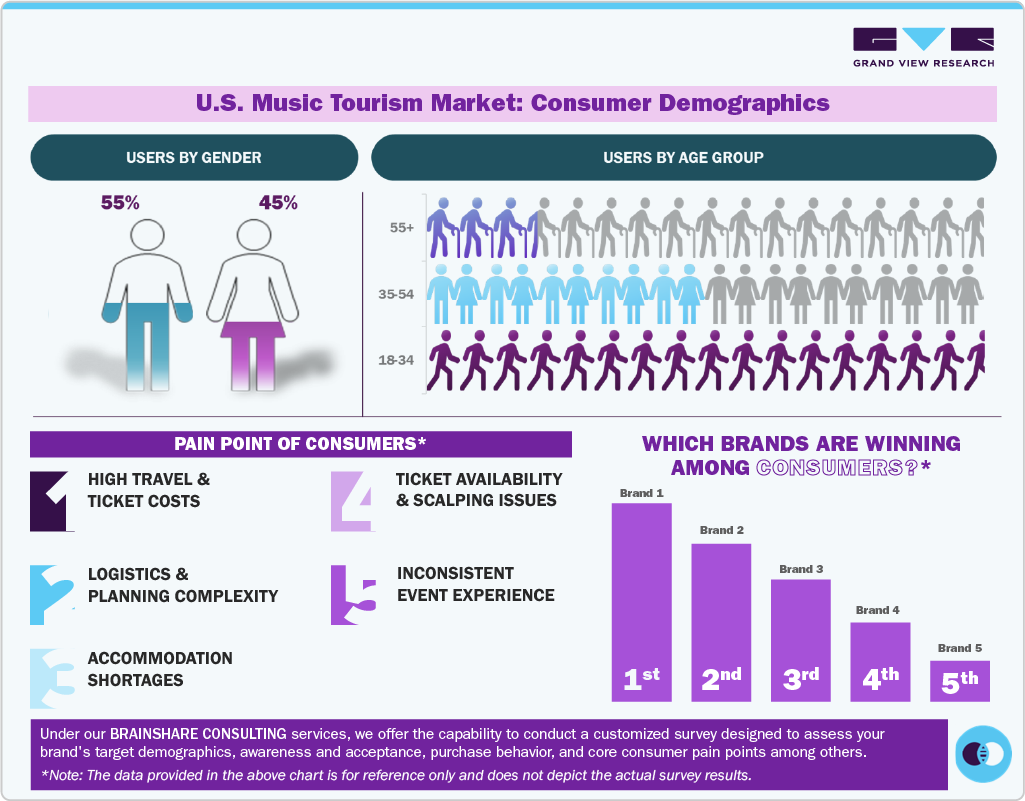
Gen Z emerges as highly enthusiastic travelers, especially when it comes to live events. According to the survey conducted among 1,654 U.S. adults and published in April 2024, as depicted in the above chart, about 48% of Gen Z are willing to travel internationally to find cheaper tickets, highlighting their flexibility and global outlook. They also show strong financial commitment, with 37% ready to dip into savings to fund these experiences. In addition, nearly a third (29%) are even open to taking up side hustles, underscoring their determination to prioritize travel and events.
Millennials also demonstrate strong enthusiasm for travel, particularly when it comes to attending live events. Nearly 42% are willing to dip into their savings to fund these experiences, reflecting a high level of financial commitment. They show a greater tendency to make financial trade-offs, indicating a practical yet committed approach to funding their experiences. Compared to Gen Z, they are slightly more proactive in finding ways to support their travel plans, including additional income streams. Overall, their behavior reflects a balance of passion for experiences and financial responsibility.
 To learn more about this report, Download Free Sample Report
 Generation X and Baby Boomers play a more moderate but still important role in the U.S. market. According to the ILMC (UTA/IQ report) data in a survey conducted among 4,000 U.S. adults and published in October 2023, only about 32% of Gen X and 24% of Boomers attended live music events in the past year, significantly lower than younger cohorts. This indicates comparatively lower travel-driven concert participation, often influenced by lifestyle and budget priorities. However, these groups still contribute steadily to demand, particularly for legacy artists and large-scale tours. Overall, their participation reflects a more selective but consistent engagement with music tourism.
Event Type Insights
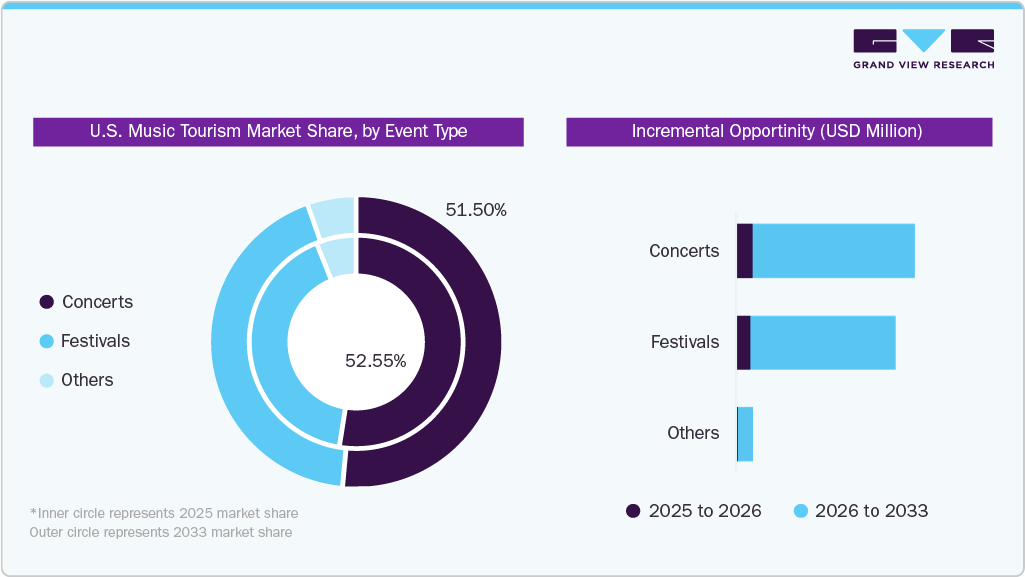
Concerts accounted for the largest market share of 52.55% in 2025, supported by artist-centric loyalty and emotional attachment. Fans often build strong personal connections with performers, and this creates a willingness to travel across cities or even states to experience a live show. For instance, according to the data published in January 2025, Taylor Swift’s ‘Eras Tour’ generated USD 2 billion+ revenue while more than 10 million tickets were sold in total. Unlike other event formats, concerts are highly dependent on the exclusivity of a performer’s tour schedule, making each stop feel like a limited-time opportunity.
 To learn more about this report, Download Free Sample Report
 Music festivals are anticipated to grow at a CAGR of 9.1% from 2026 to 2033, driven by multi-dimensional experiential appeal rather than just music consumption. Attendees are attracted not only by diverse lineups but also by the broader environment, such as themed settings, art installations, food culture, and interactive activities. This layered experience transforms festivals into temporary lifestyle spaces, where music is only one component of a larger cultural immersion. In June 2024, the New York music festival proved a massive success, giving Coachella a strong run for its money with a vibrant mix of headline acts and rising stars that kept the crowd energized throughout. Standout performances, especially the breakout moment from Chappell Roan alongside big names such as The Killers and SZA, showed how the event is quickly becoming one of the most exciting in the music scene.
Age Group Insights
Travelers aged between 18 and 34 years accounted for 64.2% of the market in 2025, driven by a strong preference for experience-based spending over material consumption. Millennials and Gen Z actively prioritize concerts and festivals as core travel motivations, often planning entire trips around major events. A defining driver for this group is emotional and identity-based engagement with music. According to the data published in January 2025, in a survey conducted among 2,000 U.S. adults, about 75% in the age group 25-34 agreed that specific music or genre reminded them of past vacations, invoking nostalgic sentiments, highlighting how music shapes travel intent beyond entertainment. This cohort also shows a high willingness to spend, averaging significant discretionary income on tickets, festivals, and related travel experiences.
Travelers between the age groups 34 to 54 years are expected to grow at a CAGR of 10.5% from 2026 to 2033, driven by a combination of nostalgia and selective experiential spending. Unlike younger audiences, their travel decisions are often tied to revisiting artists, genres, or cultural eras they grew up with, making reunion tours, legacy acts, and genre-specific festivals particularly appealing. Financial stability is a major enabling factor for this segment. With higher disposable incomes compared to younger groups, they are more likely to spend on premium experiences, including better seating, curated travel packages, and comfortable accommodations. However, their participation is more planned and less frequent, often integrating music events into broader leisure or family trips rather than making them the sole purpose of travel.
Expenditure Insights
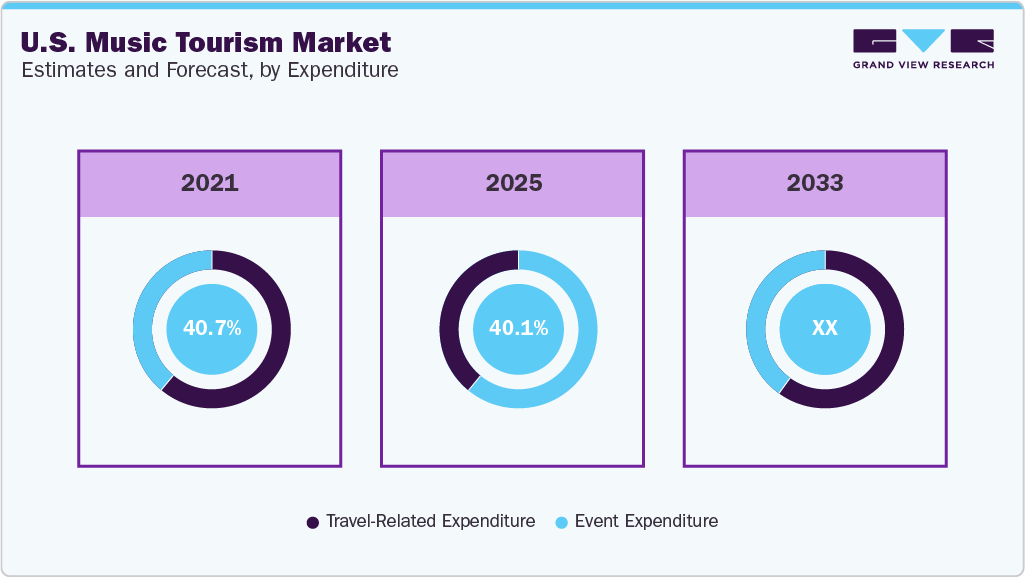
Travel-related expenditure accounted for a market share of 59.8% in 2025, influenced by the distance and mode of transportation required to reach festival destinations. Fans traveling to major music festivals often incur costs for flights, long-distance buses, car rentals, or fuel for personal vehicles. For instance, according to the data published in March 2025, searches for Airbnb stays in U.S. cities hosting Beyoncé’s Cowboy Carter tour surged sharply since tickets went on sale, with Houston up about 620% and other cities, including Atlanta and Washington, D.C., also showing significant increases. This trend reflects growing travel interest around major concert dates and suggests that fans are planning extended stays that can boost local spending on accommodations and services.
 To learn more about this report, Download Free Sample Report
 Event expenditure is expected to grow at a CAGR of 8.2% from 2026 to 2033. Larger events with more participants, complex logistics, or premium venues naturally require higher spending on infrastructure, equipment, and staffing. The type of event, such as conferences, service launches, corporate retreats, or large-scale music festivals, also shapes costs, as some events require specialized services such as audiovisual setups, professional speakers, or interactive experiences.
According to the data published in April 2025, U.S. music festival ticket prices are rising significantly, largely due to increasing artist fees, which can account for 40-45% of a festival’s budget. Events such as Coachella, Bonnaroo, and Breakaway now have general admission tickets starting from USD 69, with premium single-day tickets reaching up to USD 794, highlighting how scale and premium offerings drive expenditure.
Booking Mode Insights
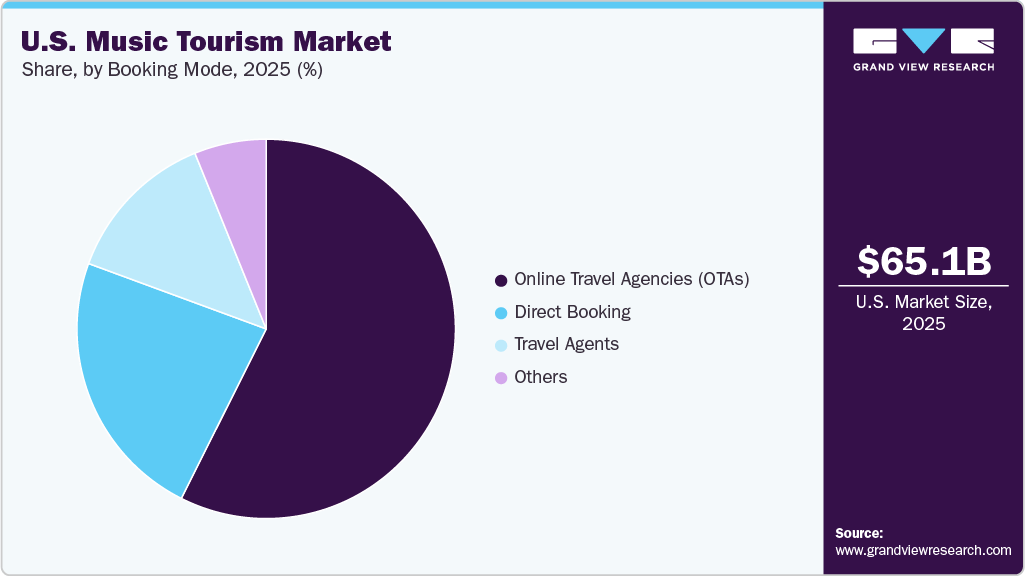
Booking of music tourism through online travel agencies (OTAs) in the U.S. accounted for 57.4% in 2025, due to their convenience and comprehensive offerings. Travelers can browse multiple event tickets, flights, accommodations, and even car rentals in one platform, making planning faster and simpler. For U.S. consumers, the ability to compare prices and read user reviews provides a sense of security and transparency that encourages bookings, especially for high-traffic festivals or popular concert tours. According to the YouGov PLC data published in December 2025, about 70% of U.S. holiday bookers say the booking experience is stress‑inducing, which helps explain why price comparison and vetted reviews on OTA platforms are especially valued.
 To learn more about this report, Download Free Sample Report
 Booking of music tourism through travel agents in the U.S. is expected to grow at a CAGR of 11.7% from 2026 to 2033, supported by the strong presence of established travel service providers and ticketing networks that simplify event-based travel planning. Agencies such as Expedia Group, Booking Holdings, and American Express Travel play a key role by offering bundled packages that combine concert tickets, accommodation, and transportation. These platforms make it easier for consumers to plan trips around major music events while ensuring convenience and cost efficiency. Many travelers prefer booking through such agents to access curated music experiences, exclusive event deals, and organized itineraries centered around festivals, concerts, and live entertainment across the U.S. market.
Key U.S. Music Tourism Companies:
- Coachella Valley Music and Arts Festival
- Lollapalooza
- AEG Presents
- Ticketmaster
- Vivid Seats LLC.
- Insomniac Holdings, LLC.
- Cloud 9 Adventures, LLC.
- Eventbrite, Inc.
- MSG Entertainment Holdings, LLC
- Danny Wimmer Presents
Recent Developments
-
In March 2026, Danny Wimmer Presents launched a strategic partnership with STRUNG Jewelry, appointing the brand as an official partner across its 2026 festival portfolio, including major U.S. rock events. The partnership functions as a fan merchandise and experiential retail service, introducing exclusive, festival-inspired jewelry collections and VIP giveaway activations that extend the live music experience into wearable, community-driven products.
-
In March 2026, Ticketmaster launched a strategic integration with Apple Music, embedding live event discovery and ticket purchasing directly within the streaming platform, including artist pages, a dedicated concerts hub, and personalized notifications. The partnership functions as a distributed commerce and discovery service, enabling seamless conversion from music listening to ticket purchase across Apple’s ecosystem (Music, Shazam, Maps, Spotlight), reaching over 1 billion users and driving real-time demand for live events.
U.S. Music Tourism Market Report Scope
Report Attribute
Details
Market size value in 2026
USD 70.62 billion
Revenue forecast in 2033
USD 125.54 billion
Growth rate
CAGR of 8.6% from 2026 to 2033
Historical data
2021 - 2025
Forecast period
2026 - 2033
Quantitative units
Revenue in USD million/billion and CAGR from 2026 to 2033
Report coverage
Revenue forecast, company ranking, competitive landscape, growth factors, and trends
Segments covered
Event type, age group, expenditure, booking mode
Key companies profiled
Coachella Valley Music and Arts Festival; Lollapalooza; AEG Presents; Ticketmaster (Live Nation); Vivid Seats LLC.; Insomniac Holdings, LLC.; Cloud 9 Adventures, LLC.; Eventbrite, Inc; MSG Entertainment Holdings, LLC; Danny Wimmer Presents
Customization scope
Free report customization (equivalent up to 8 analysts working days) with purchase. Addition or alteration to country, regional & segment scope.
Pricing and purchase options
Avail customized purchase options to meet your exact research needs. Explore purchase options
U.S. Music Tourism Market Report Segmentation
This report forecasts revenue growth at country levels and provides an analysis of the latest trends and opportunities in each of the sub-segments from 2021 to 2033. For this study, Grand View Research has segmented the U.S. music tourism market based on event type, age group, expenditure, and booking mode:
-
Event Type Outlook (Revenue, USD Million, 2021 - 2033)
-
Concerts
-
Festivals
-
Others
-
-
Age Group Outlook (Revenue, USD Million, 2021 - 2033)
-
Below 18 Years
-
18 to 34 Years
-
34 to 54 Years
-
55 Years and Above
-
-
Expenditure Outlook (Revenue, USD Million, 2021 - 2033)
-
Event Expenditure
-
Travel-Related Expenditure
-
-
Booking Mode Outlook (Revenue, USD Million, 2021 - 2033)
-
Direct Booking
-
Travel Agents
-
Online Travel Agencies (OTAs)
-
Others
-
Frequently Asked Questions About This Report
Music tourism in the U.S. is fueled by various factors, including the nation's rich and diverse musical heritage, the rising popularity of music festivals, and a growing demand for immersive travel experiences.
The U.S. music tourism market is expected to grow at a compound annual growth rate of 8.6% from 2026 to 2033 to reach USD 125.54 billion by 2033.
The U.S. music tourism market was estimated at USD 65.11 billion in 2025 and is expected to reach USD 70.62 billion in 2026.
Concerts accounted for the largest share of about 52.55% of the U.S. music tourism market in 2025, due to their powerful emotional impact, strong artist-fan connections, and highly shareable nature on social media. They provide immersive, group-friendly experiences that resonate deeply with attendees, making them more than just entertainment; they’re memorable life events.
Key players include Coachella Valley Music and Arts Festival; Lollapalooza; AEG Presents; Ticketmaster (Live Nation); Vivid Seats LLC.; Insomniac Holdings, LLC.; Cloud 9 Adventures, LLC.; Eventbrite, Inc; MSG Entertainment Holdings, LLC; Danny Wimmer Presents
About the Author(s)
Homecare & Decor Research Team
Consumer Goods · Homecare & DecorThis report was authored by the homecare & decor research team at Grand View Research - comprising two research analysts, one senior research analyst, and one industry expert - with specialized expertise in the homecare & decor segment of the consumer goods industry. All findings are based on proprietary consumer goods databases, executive interviews, and regulatory analysis, subject to internal peer review prior to publication.
Last Updated:
Speak to Analyst

Customize this report to your needs - add regions, segments, or data points, with 20% free customization.
Or view our licence options:


ISO 9001:2015 & 27001:2022 Certified
We are GDPR and CCPA compliant! Your transaction & personal information is safe and secure. For more details, please read our privacy policy.


