
- Home
- »
- Beauty & Personal Care
- »
-
U.S. Organic Personal Care Products Market Report, 2033GVR Report cover

U.S. Organic Personal Care Products Market (2026 - 2033) Size, Share & Trends Analysis Report By Product (Skin Care, Hair Care, Oral Care, Shower & Bath, Perfume/Fragrances), By Gender (Men, Women), By Distribution Channel (Hypermarkets & Supermarkets), And Segment Forecasts
Market Size, 2025
$6.9BMarket Estimate, 2026
$7.5BMarket Forecast, 2033
$14.6BCAGR, 2026–2033
9.9%U.S. Organic Personal Care Products Market Summary
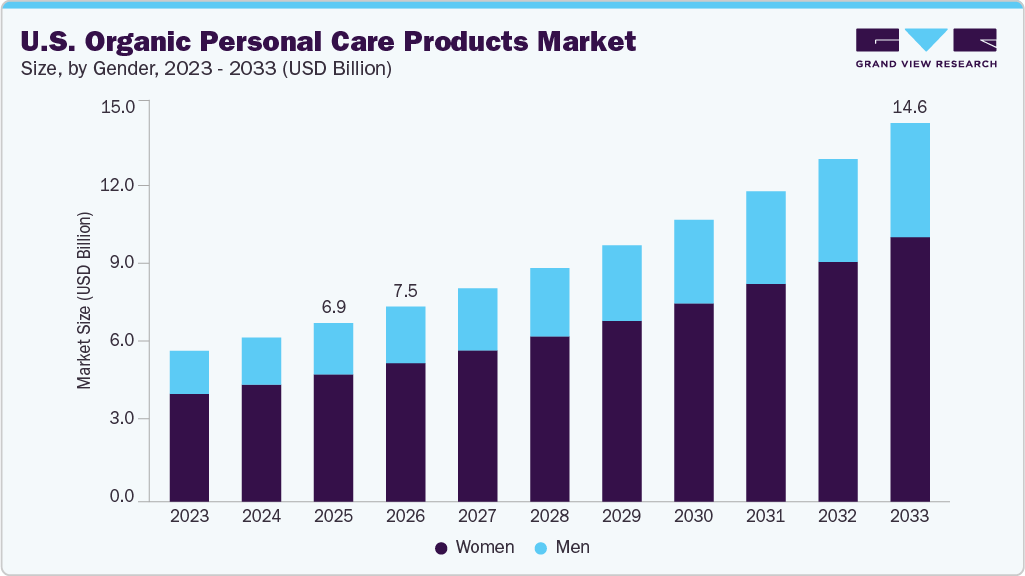
The U.S. organic personal care products market size was estimated at USD 6.88 billion in 2025 and is projected to reach USD 14.58 billion in 2033, growing at a CAGR of 9.9% from 2026 to 2033. The market growth is driven by a clear change in how consumers approach personal care.
Key Market Trends & Insights
- By product: Skin care segment accounted for the largest market share of 42.0% in 2025.
- By gender: Women segment accounted for the dominant share of 71.2% in 2025.
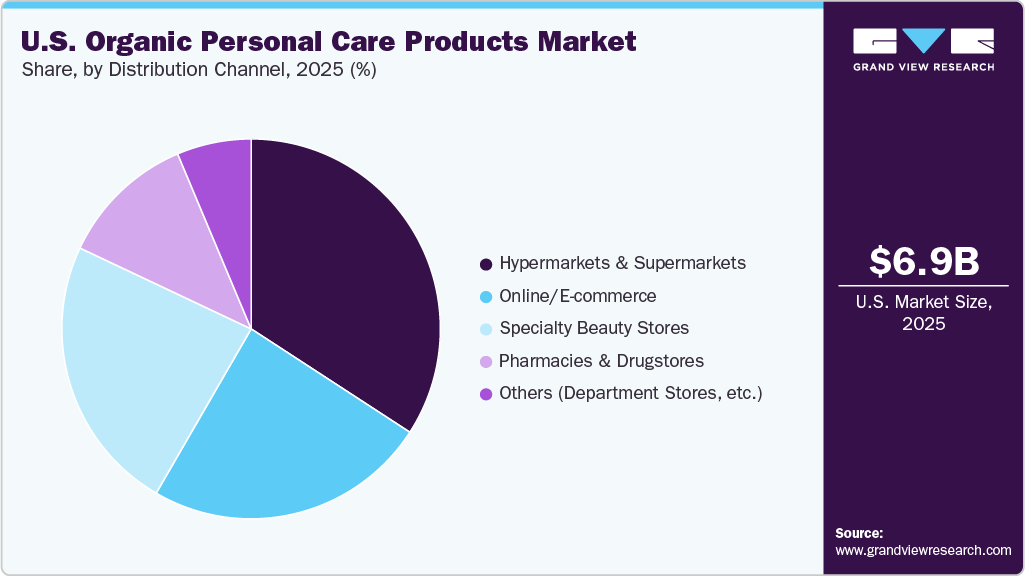
- By distribution channel: Hypermarkets & supermarkets segment accounted for the largest market share of 34.2% in 2025.
Market Size & Forecast
- 2025 Market Size: USD 6.88 Billion
- 2033 Projected Market Size: USD 14.58 Billion
- CAGR (2026-2033): 9.9%
Three ways to get this report
Buy it, customize it, or ask a question.Ask an Analyst
Analyst response in 1 business day
- AccessReport author, directly
- Reply timeWithin 1 working day
- No sales callDirect answer only
- FormatEmail reply
- CostFree, no cost
Get the Full Report
What the study covers
- FormatsPDF · Excel · Dashboard
- Timeline2026–2033 annual, 2025 base
- Coverage20+ countries, 5 regions
- Companies10+ key players profiled
Customize the Report
20% free customization
- IncludeCountries, segments, points
- TailorTo your product definition
- ExtendDeeper competitor detail
- OrA fully bespoke study
- Turnaround5–10 working days
There is increasing scrutiny around product ingredients, with many consumers actively avoiding parabens, sulfates, synthetic chemicals, and artificial fragrances. In their place, products positioned as organic, plant-based, cruelty-free, and sustainably sourced are gaining strong traction. What was once considered a niche preference has become a more mainstream expectation, particularly among younger and health-conscious consumers.Another important factor shaping demand in the U.S. organic personal care products industry is the rising incidence of skin sensitivity and dermatological concerns. Consumers are gravitating toward products perceived as gentler, hypoallergenic, and free of harsh additives. Organic formulations, often supported by dermatological testing and cleaner ingredient profiles, are increasingly viewed as reliable alternatives for daily use.
 Source: Grand View Research, IR Documents, Primary Interviews, Paid DatabasesTo learn more about this report,
 Download Free Sample Report
Companies such as L'Oréal, Unilever, and The Estée Lauder Companies are expanding their presence in the organic segment through new product development, cleaner formulations, and investments in sustainable packaging and green chemistry. These efforts are helping to build consumer trust while also strengthening competitive positioning in a rapidly evolving market.
Organic personal care products are often free from harmful toxins, making them a preferred choice for individuals with sensitive skin, allergies, or concerns about chemical exposure. The rising popularity of "clean beauty," which emphasizes transparency, safety, and sustainability in product formulations, further fuels the demand for organic personal care products.
Consumers are increasingly interested in understanding the ingredients in their skincare and haircare products, driving demand for brands that prioritize natural, organic, and chemical-free formulations. Another major trend is the shift toward eco-friendly and zero-waste packaging. Many companies are introducing biodegradable, refillable, or recyclable packaging to reduce plastic waste and align with consumers' environmental concerns. The demand for cruelty-free and vegan personal care products is also growing as more people seek ethical alternatives that avoid animal testing and animal-derived ingredients.
The U.S. organic personal care products market, by gender, remains strongly skewed toward women, though the men’s segment is gradually gaining traction. In 2025, women accounted for a dominant share. The higher contribution from women is primarily driven by greater product usage frequency and stronger engagement with clean beauty trends. Women consumers are typically more responsive to attributes such as ingredient transparency, sustainability, and product efficacy, which align closely with the value proposition of organic personal care products.
However, the men’s segment is emerging as a key growth area, driven by rising awareness of grooming, skin health, and the benefits of natural formulations. The men's market is projected to grow. This faster growth indicates a gradual shift in consumer behavior, with men increasingly adopting specialized and premium personal care products.
The increasing penetration of e-commerce and direct-to-consumer (DTC) brands has expanded market access, enabling organic personal care companies to engage consumers more effectively. Additionally, major retail chains, specialty organic stores, and premium beauty retailers are expanding their organic product portfolios to cater to this growing demand.
Brand Market Share Insights
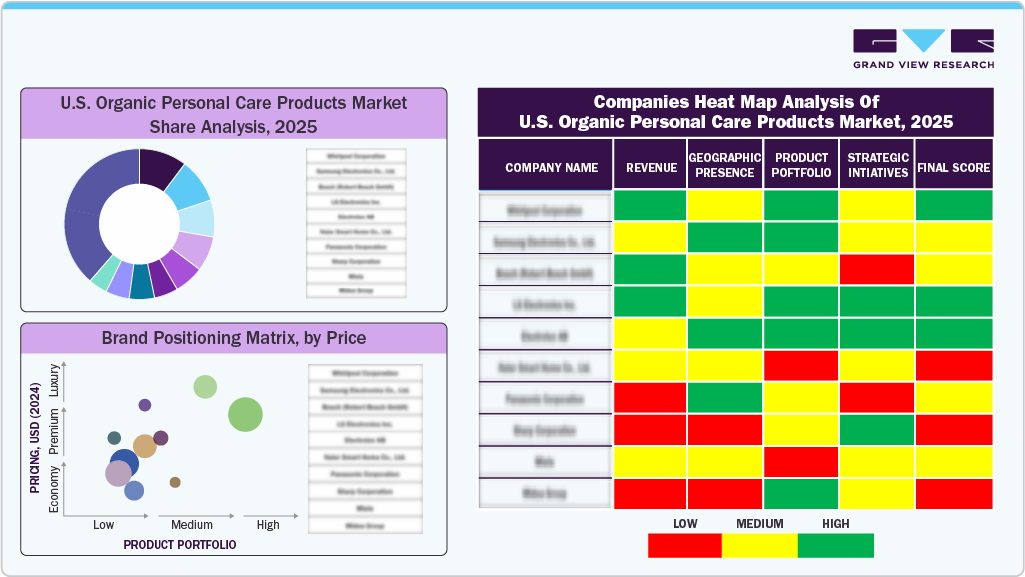
The U.S. organic personal care products market is highly competitive and continues to evolve as both large corporations and smaller niche brands respond to changing consumer expectations. The market is not dominated by a single player; instead, it is fragmented, with companies competing on product quality, ingredient transparency, and brand trust. Global players such as L'Oréal S.A. and The Estée Lauder Companies Inc. maintain a strong presence by leveraging their established brand portfolios and continuous investment in research and development. These companies are increasingly focusing on clean beauty lines, plant-based ingredients, and sustainable packaging, helping them stay relevant as consumer preferences shift toward safer, more environmentally responsible products.
 To learn more about this report, Download Free Sample Report
Competition in the market is no longer just about brand recognition; it is increasingly about earning consumer trust through transparency, delivering effective formulations, and aligning with sustainability values. With the rise of e-commerce and social media, brands now have more direct access to consumers, making the market more dynamic and fast-moving. As a result, while large companies continue to lead in scale, smaller brands are successfully carving out space, making the competitive landscape both diverse and innovation-driven.
Consumer Insights
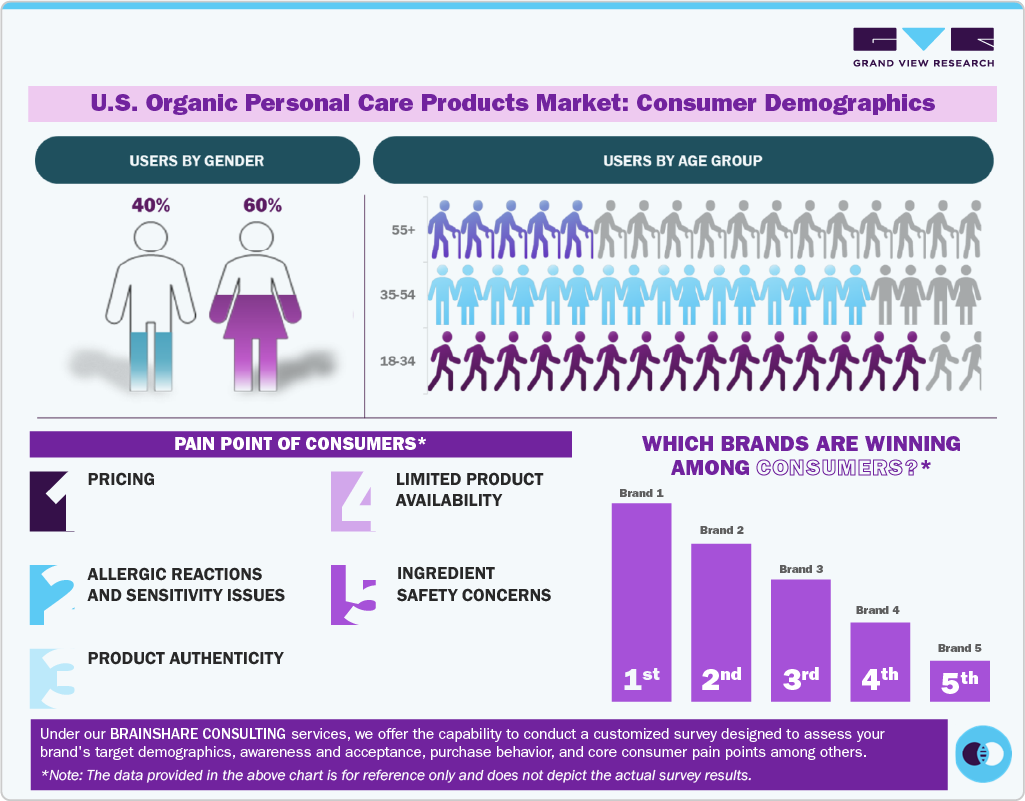
Consumer behavior in the U.S. organic personal care products industry is clearly shifting from basic use to a more results-driven, informed approach. Today’s consumers are not just buying products for routine use; they are looking for solutions that can improve skin and hair health over time. This has increased demand for products that address concerns such as dryness, sensitivity, and barrier repair, with a growing preference for plant-based, gentle, and dermatologically tested formulations. Personal care is increasingly being treated like skincare, where performance and ingredient quality matter just as much as brand appeal.
 To learn more about this report, Download Free Sample Report
Ingredient awareness has become a key decision factor. Consumers are paying closer attention to what goes into their products, often avoiding parabens, sulfates, and synthetic additives, while actively seeking clean, transparent, and sustainably sourced ingredients. Brands that clearly communicate what their products contain and what they avoid are gaining stronger trust and repeat purchases.
Another noticeable shift is in how consumers use these products. Instead of relying on one or two items, many are now following multi-step routines, using different products for different needs, such as daily maintenance, targeted treatment, and repair. This behavior is driving higher product usage, more frequent repurchases, and greater willingness to experiment with new offerings, especially in skincare and hair care.
Seasonal factors also influence buying patterns. For example, colder months tend to drive demand for deeply hydrating and soothing products, while warmer seasons increase the need for lightweight and protective formulations. As a result, consumers often keep multiple products for different situations, which supports consistent usage and category growth.
Product Insights
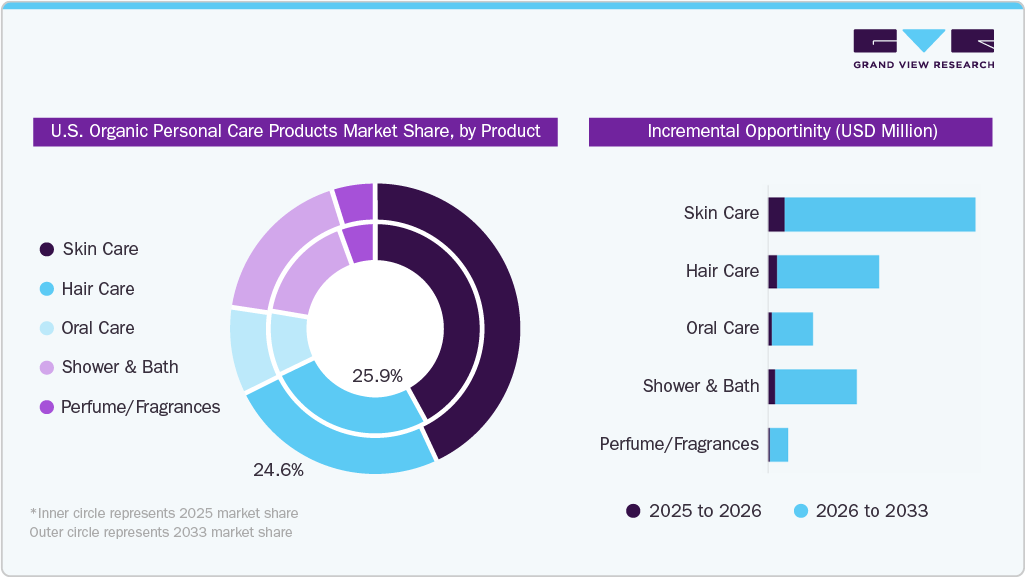
Skin care clearly leads the U.S. organic personal care products market, accounting for 42.0% of revenue in 2025. This dominance is largely due to the fact that skincare products are part of daily routines, and consumers are increasingly focused on long-term skin health rather than quick fixes. There is a strong shift toward products that help with hydration, sensitivity, and aging concerns, especially those made with clean, plant-based ingredients. At the same time, the rise of multistep skincare routines, including serums, creams, and targeted treatments, is encouraging consumers to use multiple products, which is driving higher spending and repeat purchases.
 To learn more about this report, Download Free Sample Report
The shower and bath products segment is expected to grow at the fastest CAGR of 10.8% through 2033. This growth is driven by the increasing importance of everyday hygiene and the benefits of skin care. Consumers are no longer satisfied with basic cleansing; they are seeking gentle, moisturizing, chemical-free body washes and soaps that support overall skin health. Increased exposure to pollution and changing weather conditions are also driving demand for soothing, non-irritating products, making this category more relevant in daily routines.
Gender Insights
The women's segment dominated the U.S. organic personal care products industry, accounting for 71.2% of revenue in 2025. The dominance of this segment is primarily driven by higher product usage frequency, broader adoption of skincare and haircare routines, and stronger consumer engagement with clean beauty and wellness trends. Women consumers also demonstrate greater preference for products featuring natural ingredients, transparency in formulations, and sustainability-focused positioning, which continues to support demand across premium and mass-market organic personal care categories.
The men segment, while comparatively smaller, is expected to grow at the fastest CAGR of 10.6% from 2025 to 2033. The growth is driven by increasing awareness of male grooming and skin health, as well as demand for clean-label grooming products, particularly among younger consumers. The growing acceptance of specialized personal care routines, combined with the expanding availability of organic beard, facial, and haircare products, is further accelerating adoption in the segment.
Distribution Channel Insights
Sales of organic personal care products through hypermarkets and supermarkets accounted for the largest revenue share, at 34.2%, in 2025. These channels continue to play a key role due to the convenience of one-stop shopping, where consumers can easily purchase organic personal care products alongside everyday essentials. The wide availability of multiple brands, combined with strong in-store visibility and established distribution networks, encourages product discovery and impulse purchases. As organic products become more mainstream, large retail chains are expanding shelf space for clean and natural offerings, further supporting growth in this segment.
 To learn more about this report, Download Free Sample Report
The online and e-commerce channels segment is expected to grow at the fastest CAGR of 11.4% over the forecast period. The growth of this segment is driven by rising consumer preference for convenience, competitive pricing, and greater product availability. Online platforms allow consumers to compare products, read reviews, and explore niche or emerging brands that may not be available in physical stores. In addition, the rise of direct-to-consumer (DTC) models, subscription services, and digital promotions is making e-commerce an increasingly attractive option, particularly among younger and digitally engaged consumers.
Key U.S. Organic Personal Care Products Companies:
- L'Oréal S.A.
- Johnson & Johnson Consumer Services Inc. (Neutrogena)
- Amorepacific Corporation
- Thesis Beauty
- Botanic Organic LLC
- Aveda Corporation
- Bare Escentuals Beauty, Inc.
- Burt's Bees, Inc.
- The Estée Lauder Companies Inc.
- Kiehl's LLC
Recent Developments
-
In March 2026, Sky Organics announced the expansion of its 2026 beauty portfolio with the launch of new USDA-certified organic haircare, scalp care, and skincare products in the U.S. market. The newly introduced range includes Organic Castor Glass Skin Serum, botanical hair oils, and scalp treatment formulations developed to address rising consumer demand for clean-label, naturally derived personal care products. The launch reflects the growing shift toward ingredient transparency, sustainable packaging, and multifunctional organic beauty solutions within the premium beauty segment.
-
In March 2026, indē wild officially launched at Sephora US, marking a significant milestone for the expansion of Ayurvedic-inspired organic beauty products in the American prestige beauty market. The brand introduced its “Ayurvedistry”-based skincare and haircare collection across Sephora’s online platform and select U.S. retail stores. The launch highlights growing consumer interest in holistic, wellness-driven beauty products that incorporate botanical ingredients, traditional formulations, and a clean-beauty positioning.
-
In February 2026, Evereden completed its nationwide rollout across Sephora US stores following its initial online debut in late 2025. The company introduced a science-backed portfolio of skincare, haircare, fragrance, and suncare products designed specifically for Gen Alpha consumers, featuring clean, dermatologist-developed formulations. The launch demonstrates the growing demand for safer, transparent, and wellness-oriented beauty products targeting younger consumer demographics in the U.S. market.
-
In February 2026, Unilever expanded its sustainability initiatives by introducing and scaling refillable deodorant formats under its Dove brand, featuring reusable packaging and replaceable refills to reduce plastic waste. This development reflects the company’s broader strategy to transition to circular packaging systems and environmentally responsible product design, aligning with rising consumer demand for sustainable, organic-aligned personal care solutions.
-
In May 2025, Natural Grocers launched a new in-house vegan skincare collection, positioned as “everyday luxury,” featuring body washes, scrubs, butters, and creams. The formulations are developed using small-batch processes and vegan ingredients, and are free from parabens, petroleum products, and synthetic fragrances.
U.S. Organic Personal Care Products Market Report Scope
Report Attribute
Details
Market revenue in 2026
USD 7.51 billion
Revenue forecast in 2033
USD 14.58 billion
Growth rate
CAGR of 9.9% from 2026 to 2033
Base year for estimation
2025
Historical data
2021 - 2025
Forecast period
2026 - 2033
Quantitative units
Revenue in USD million/billion, and CAGR from 2026 to 2033
Report coverage
Revenue forecast, company ranking, competitive landscape, growth factors, and trends
Segments covered
Product, gender, distribution channel
Country scope
U.S.
Key companies profiled
L'Oréal S.A.; Johnson & Johnson Consumer Services Inc. (Neutrogena); Amorepacific Corporation; Thesis Beauty; Botanic Organic LLC; Aveda Corporation; Bare Escentuals Beauty, Inc.; Burt's Bees, Inc.; The Estée Lauder Companies Inc.; Kiehl's LLC
Customization
Free report customization (equivalent up to 8 analysts working days) with purchase. Addition or alteration to country, regional & segment scope.
Pricing and purchase options
Avail customized purchase options to meet your exact research needs. Explore purchase options
U.S. Organic Personal Care Products Market Report Segmentation
This report forecasts revenue growth at the country levels and provides an analysis of the latest industry trends and opportunities in each of the sub-segments from 2021 to 2033. For this study, Grand View Research has segmented the U.S. organic personal care products market report based on product, gender, and distribution channel:
-
Product Outlook (Revenue, USD Million, 2021 - 2033)
-
Skin Care
-
Face Skin Care
-
Lotions, Face Creams, & Moisturizers
-
Cleansers & Face Wash
-
Facial Serums
-
Sunscreen/Sun Care
-
Sheet Face Masks
-
-
Others (Scrub, etc.)
-
Body Skin Care
-
Hair Removal Products
-
Lotions, Creams, & Moisturizers
-
Body Sunscreen/Sun Care
-
Body Scrub
-
Others (Serum, Oils, etc.)
-
-
-
Hair Care
-
Shampoo
-
Conditioner
-
Oils
-
Serums
-
Others (Hair Masks, Peels, Etc.)
-
-
Oral Care
-
Shower and Bath
-
Perfume/Fragrances
-
-
Gender Outlook (Revenue, USD Million, 2021 - 2033)
-
Men
-
Women
-
-
Distribution Channel Outlook (Revenue, USD Million, 2021 - 2033)
-
Hypermarkets & Supermarkets
-
Specialty Beauty Stores
-
Pharmacies & Drugstores
-
Online/E-commerce
-
Others (Department Stores, etc.)
-
Frequently Asked Questions About This Report
Skin care products accounted for the largest revenue share of 42.0% in 2025.
Key players in the U.S. organic personal care products market are L'Oréal S.A., Johnson & Johnson Consumer Services Inc. (Neutrogena), Amorepacific Corporation, Thesis Beauty, Botanic Organic LLC, Aveda Corporation, Bare Escentuals Beauty, Inc., Burt's Bees, Inc., The Estée Lauder Companies Inc., and Kiehl's LLC.
Key factors driving growth in the U.S. organic personal care products market include increasing awareness of the benefits of plant-based, cruelty-free, and sustainably sourced ingredients.
The U.S. organic personal care products market was estimated at USD 6.9 billion in 2025 and is expected to reach USD 7.5 billion in 2026.
The U.S. organic personal care products market is expected to grow at a compound annual growth rate of 9.9% from 2026 to 2033, reaching USD 14.6 billion by 2033.
About the Author(s)
Beauty & Personal Care Research Team
Consumer Goods · Beauty & Personal CareThis report was authored by the beauty & personal care research team at Grand View Research - comprising two research analysts, one senior research analyst, and one industry expert - with specialized expertise in the beauty & personal care segment of the consumer goods industry. All findings are based on proprietary consumer goods databases, executive interviews, and regulatory analysis, subject to internal peer review prior to publication.
Last Updated:
Speak to Analyst

Customize this report to your needs - add regions, segments, or data points, with 20% free customization.
Or view our licence options:


ISO 9001:2015 & 27001:2022 Certified
We are GDPR and CCPA compliant! Your transaction & personal information is safe and secure. For more details, please read our privacy policy.


