
- Home
- »
- Medical Devices
- »
-
U.S. Orthopedic Endoscopy Market Size Report, 2026-2033GVR Report cover

U.S. Orthopedic Endoscopy Market (2026 - 2033)
Size, Share & Trends Analysis Report, By Product Type, By Setting (Hospital, Ambulatory surgery centers (ASCs), Physical Office/Office-Based), By Region, And Segment Forecasts
Market Size, 2025
$223.7MMarket Estimate, 2026
$232.0MMarket Forecast, 2033
$299.9MCAGR, 2026–2033
3.7%U.S. Orthopedic Endoscopy Market Summary
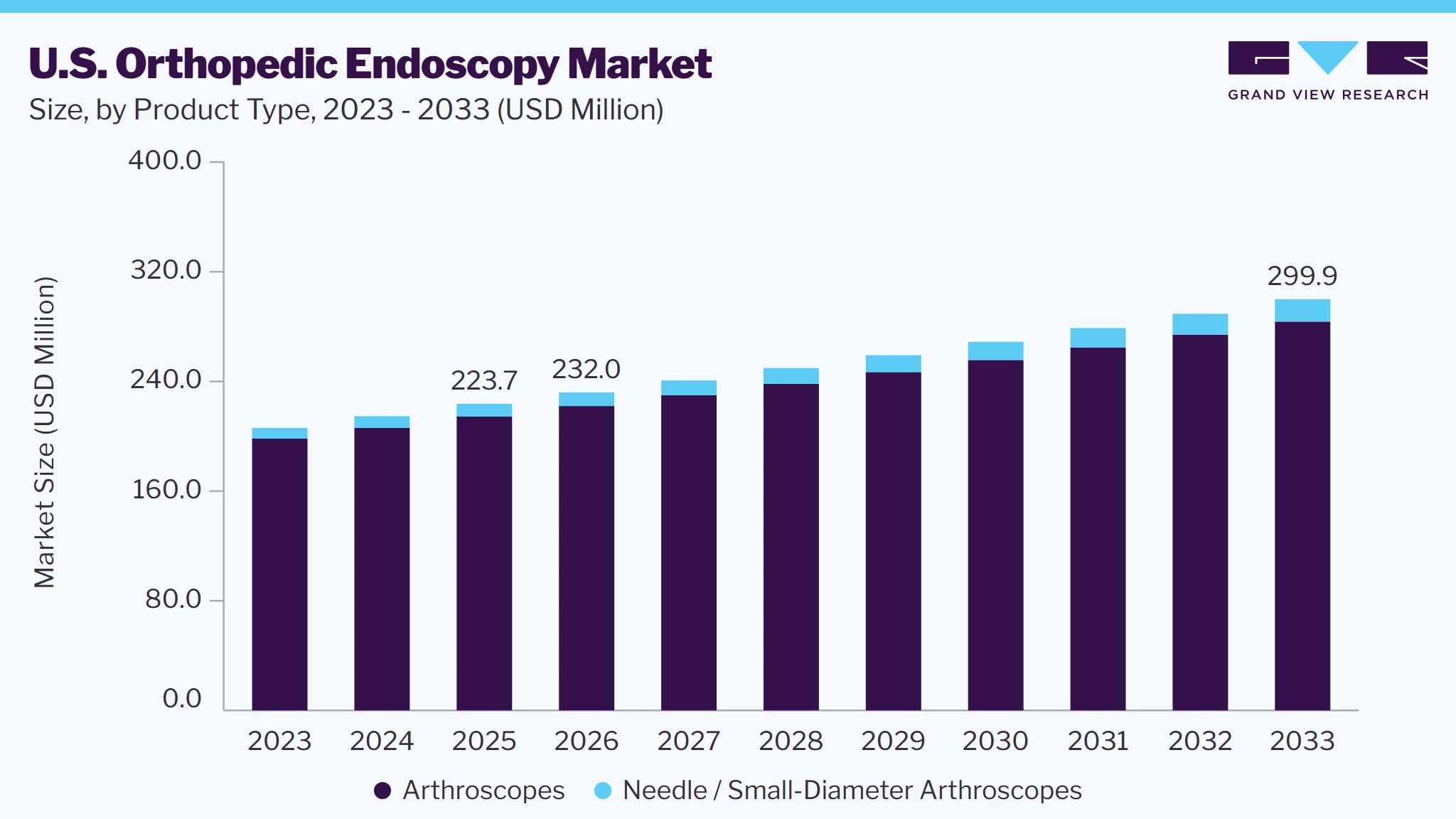
The U.S. orthopedic endoscopy market size was valued at USD 223.7 million in 2025 and is projected to reach USD 232.0 million in 2026 to USD 299.9 million by 2033, at a CAGR of 3.7% from 2026 to 2033. The market growth is driven by the increasing volume of arthroscopic procedures and the growing adoption of outpatient and office-based orthopedic care. In addition, technological advancements in high-definition and small-diameter visualization systems, along with the rising adoption of disposable and needle arthroscopes, are expanding the application of orthopedic endoscopy.
Key Market Trends & Insights
- By product type: Arthroscopes segment held the majority share of 95.9% in 2025.
- By setting: Hospital segment held the majority share of 59.8% in 2025.
Market Size & Forecast
- Market size in 2025: USD 223.7 Million
- Estimated market size in 2026: USD 232.0 Million
- Projected market size by 2033: USD 299.9 Million
- CAGR (2026-2033): 3.7%
Three ways to get this report
Buy it, customize it, or ask a question.Ask an Analyst
Analyst response in 1 business day
- AccessReport author, directly
- Reply timeWithin 1 working day
- No sales callDirect answer only
- FormatEmail reply
- CostFree, no cost
Get the Full Report
What the study covers
- FormatsPDF · Excel · Dashboard
- Timeline2026–2033 annual, 2025 base
- Coverage20+ countries, 5 regions
- Companies10+ key players profiled
Customize the Report
20% free customization
- IncludeCountries, segments, points
- TailorTo your product definition
- ExtendDeeper competitor detail
- OrA fully bespoke study
- Turnaround5–10 working days
 Source: Grand View Research, IR Documents, Primary Interviews, Paid DatabasesTo learn more about this report,
 Download Free Sample Report
Market Dynamics
The U.S. orthopedic endoscopy market is driven by the rising prevalence of musculoskeletal disorders, increasing sports-related injuries, and growing adoption of minimally invasive arthroscopic procedures. Technological advancements in high-definition imaging and surgical visualization systems, along with increasing preference for outpatient orthopedic surgeries and shorter recovery times, are supporting market growth.
The market growth is driven by the shift of orthopedic procedures from hospitals to ambulatory surgery centers (ASCs). Advances in minimally invasive surgical techniques, improved anesthesia and pain-management protocols, payer efforts to reduce procedural costs, and changes in Medicare site-of-service policies are supporting this transition. In February 2026, Becker’s Hospital Review reported that the Centers for Medicare & Medicaid Services (CMS) had removed nearly 300 musculoskeletal procedures from the Inpatient Only (IPO) List for 2026, supporting the expansion of outpatient orthopedic care.
In November 2025, CMS finalized a three-year phaseout of the IPO List, beginning January 1, 2026. The first phase removed 285 procedures, predominantly musculoskeletal services, from the list. For 2026, CMS also added 289 procedures to the ASC Covered Procedures List (ASC CPL), along with 271 codes removed from the IPO List. The full elimination of the IPO List is scheduled for January 1, 2028. These changes expand the range of procedures eligible for Medicare payment in outpatient settings, as advances in medical practice allow more interventions to be performed with shorter recovery periods.
The shift toward outpatient orthopedic care is expected to increase demand for arthroscopy towers, camera systems, light sources, video processors, medical displays, and arthroscopes across ASCs. The transition encompasses sports medicine, joint replacement, and selected spine procedures, creating opportunities for manufacturers to supply compact, cost-efficient visualization systems suited to outpatient surgical workflows. Purchasing decisions are also influenced by equipment utilization, rapid operating-room turnover, ease of use, and total cost of ownership.
For orthopedic endoscopy manufacturers, the expansion of ASC procedure eligibility broadens the potential customer base beyond traditional hospital operating rooms. Market demand will depend on the volume and type of orthopedic procedures performed in ASCs, facility utilization, and replacement requirements for existing visualization systems and scope inventory.
Reusable arthroscopes involve operating requirements beyond the initial equipment purchase. FDA classifies arthroscopes under product code HRX as Class II devices, and applicable reusable devices require validated reprocessing instructions and supporting reprocessing validation data as part of the 510(k) process. At the facility level, each use involves point-of-use treatment, cleaning, inspection, disinfection or sterilization, drying, storage, and documentation. These activities involve recurring labor, consumables, equipment, maintenance, and workflow costs.
The direct cost of reprocessing includes sterile-processing consumables, technician labor, reprocessing-equipment depreciation, and water and energy use. Based on the cost benchmarks used in this analysis, the combined direct reprocessing burden can reach USD 150-300 per procedure, before repair, replacement, or procedure-delay costs.
Cost / operational component
Indicative burden
Cost implication
Sterile-processing consumables
USD 45-95 per procedure
Detergents, HLD/sterilization consumables, packaging, indicators, and inspection supplies
CSSD labor
USD 35-65 per procedure
Cleaning, flushing, leak testing, inspection, assembly, and reprocessing activities
*Note: GVR analysis/analyst benchmarks; actual costs vary by facility, scope design, reprocessing method, labor rates, utilization, and equipment configuration.
The combined expenditure across acquisition, reprocessing, maintenance, repair, and inventory contributes to the total cost of ownership of reusable platforms. Hospitals with established sterile-processing infrastructure and high arthroscopy volumes can distribute these costs across a larger procedure base. Smaller ASCs and physician offices with lower procedure volumes or limited sterile-processing capacity face a different cost structure.
Demand for disposable and single-use arthroscopes is supported by the need to reduce scope reprocessing, maintenance, and repair requirements while maintaining consistent image quality. These systems help orthopedic facilities simplify instrument preparation and improve operating room efficiency, although their economic benefits depend on procedure volumes, device acquisition costs, and the cost of reprocessing reusable scopes. For instance, a study published in Foot and Ankle Surgery in August 2026 compared a disposable 2.0-mm needle arthroscope with a reusable 2.7-mm arthroscope across 60 anterior ankle arthroscopy procedures. Average operating room turnover time was 28.53 minutes with the disposable system, compared with 35.65 minutes with the reusable system, a reduction of approximately 20%. Total arthroscopic time also decreased, from 16.87 minutes with the reusable system to 12.58 minutes with the disposable system. These findings suggest that disposable arthroscopes may improve procedural efficiency in selected orthopedic applications.
Commercial developments also support the expansion of this product category. In November 2023, Pristine Surgical announced the full U.S. market launch of its Summit 4K single-use surgical arthroscope for hospitals and ambulatory surgery centers (ASCs). These developments create opportunities for manufacturers offering single-use arthroscopes to orthopedic hospitals, ASCs, and sports medicine centers. Market adoption will depend on image quality, procedural compatibility, per-case economics, and the balance between disposable device costs and the reprocessing and maintenance expenses associated with reusable scopes.
Market Concentration & Characteristics
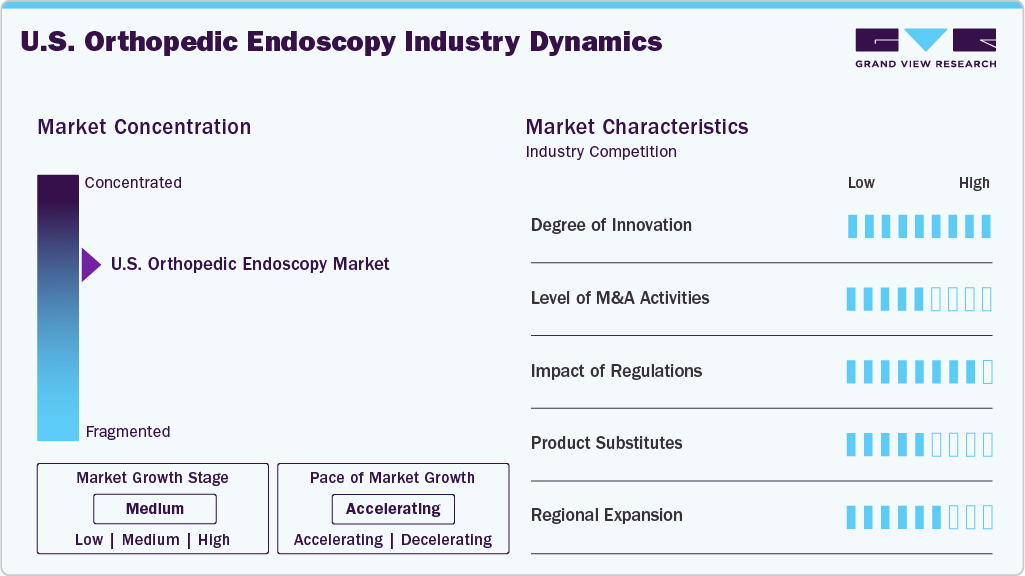
The chart below illustrates the relationship between industry concentration, industry characteristics, and industry participants. The X-axis represents the level of market concentration, ranging from low to high. The Y-axis represents various market characteristics, including industry competition, degree of innovation, level of mergers & acquisition activities, regulatory impact, product substitutes, and regional expansion.
The market is characterized by a high degree of innovation, as participants compete to differentiate through dedicated endoscopes, advanced imaging, and integrated visualization. For instance, in May 2025, Arthrex received FDA 510(k) clearance for its Arthrex Spine Endoscope, classified as an arthroscope under product code HRX, extending its endoscopic offering beyond its sports medicine heritage.
M&A activity is moderate, with leaders favoring targeted acquisitions and distribution partnerships over large mergers. For instance, in January 2026, Smith+Nephew completed its acquisition of Integrity Orthopedics, developer of the Tendon Seam rotator cuff repair system, for an initial USD 225 million plus up to USD225 million in performance-based payments.
 To learn more about this report, Download Free Sample Report
Regulations significantly influence the market, as arthroscopes are Class II medical devices subject to FDA 510(k) clearance, with applicable reprocessing validation requirements for reusable devices. In September 2026, Stryker received FDA De Novo authorization for SportSuite Vision, a surgical application designed for use with Apple Vision Pro during specified hip arthroscopy procedures. This development highlights the expansion of regulatory pathways for digital surgical visualization technologies and encourage innovation in integrated imaging solutions.
The threat of substitutes is moderate, with competition arising from smaller-bore arthroscopes and alternative visualization systems. These technologies offer options for selected procedures that may reduce the need for conventional arthroscopy setups. In January 2025, Arthrex’s NanoScope System received FDA 510(k) clearance, providing a lower-profile visualization option for selected orthopedic procedures.
Regional expansion is moderate, with participants extending reach into ambulatory surgery centers and multispecialty operating rooms through partnerships. For instance, in February 2026, KARL STORZ and Smith+Nephew announced a strategic relationship to align Smith+Nephew's sports medicine portfolio with KARL STORZ's visualization, video management, and OR integration technologies for hospital ORs and ASCs.
Analyst Perspective
The U.S. orthopedic endoscopy market is driven by increasing adoption of minimally invasive arthroscopy and spinal procedures. Rising demand for tissue-sparing techniques and shorter recovery times supports market growth. Conventional arthroscopes remain widely used across joint procedures, while needle and small-diameter scopes are gaining traction in specialized applications. Product selection depends on image quality, scope diameter, maneuverability, and instrument compatibility. Hospitals remain key demand centers due to established surgical infrastructure and specialized expertise. Growing adoption of outpatient orthopedic procedures is supporting demand across ambulatory surgery centers, driven by procedural efficiency and healthcare cost considerations.
Product Type Insights
The arthroscopes segment accounted for the largest share of 95.9% in 2025, supported by its established use across a broad range of orthopedic procedures, including knee, shoulder, hip, ankle, and wrist arthroscopy. Arthroscopes provide direct visualization of joint space and are available in multiple configurations suited to different anatomical sites and procedural requirements. For instance, in August 2026, KARL STORZ received FDA 510(k) clearance for its HOPKINS Telescopes for Arthroscopy, supporting the continued availability of dedicated arthroscopic visualization systems for orthopedic applications.
The needle / small-diameter arthroscopes segment is expected to register the fastest CAGR during the forecast period, supported by their suitability for procedures involving smaller joints and anatomically constrained spaces. Their compact diameter enables access through smaller portals and supports visualization where conventional arthroscopes may have limited maneuverability. For instance, in September 2025, Arthrex announced the launch of its NanoNeedle Scope 2.0 following its first clinical use in a pediatric orthopedic case. This supports the use of small-diameter arthroscopes in pediatric and anatomically constrained orthopedic procedures.
Setting Insight
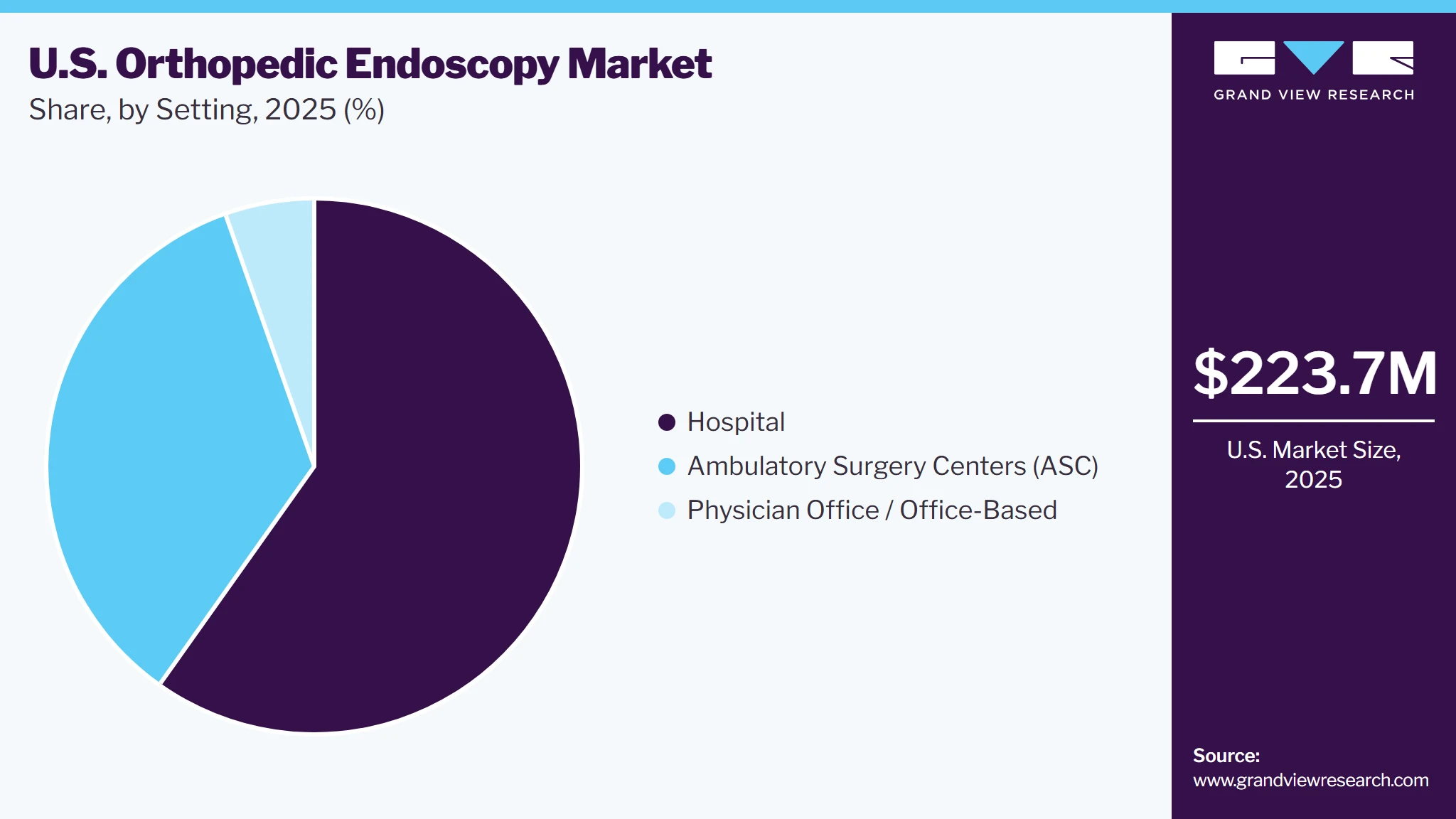
The hospital segment accounted for the largest share of 59.8% in 2025, supported by surgical infrastructure, advanced visualization capabilities, and access to multidisciplinary orthopedic care. Hospitals accommodate a broad range of arthroscopic procedures, including complex interventions requiring specialized equipment and postoperative monitoring. The availability of established operating room infrastructure and trained surgical teams supports continued use of arthroscopes across hospital-based orthopedic procedures. For instance, in June 2025, Northside Hospital reported the first ultra-minimally invasive endoscopic orthopedic surgery at its Gwinnett facility using Arthrex technology. The procedure reflects the use of advanced endoscopic visualization within hospital-based orthopedic services and supports demand for arthroscopic systems and associated instruments.
 To learn more about this report, Download Free Sample Report
The ambulatory surgery centers (ASCs) segment is expected to register the fastest CAGR during the forecast period from 2026 to 2033, owing to the growing use of outpatient orthopedic procedures, shorter recovery requirements, and established same-day surgical pathways. ASCs provide dedicated surgical infrastructure for procedures that do not require prolonged hospitalization, supporting efficient utilization of arthroscopic systems. For instance, a study published in November 2025 analyzed 3,097 endoscopic orthopedic surgery procedures performed in U.S. ASCs and reported an increase in procedure volume, with notable activity in the Western U.S. The findings indicate continued adoption of ASCs for endoscopic orthopedic procedures and support demand for compact, procedure-specific arthroscopic visualization systems suited to outpatient surgical workflows.
Region Insights
The Southeast accounted for the largest share of 29.07% in 2025, supported by a broad orthopedic care network, established surgical infrastructure, and increasing availability of endoscopic procedures across the region. For instance, in May 2025, SGMC Health in Valdosta, Georgia, performed its first endoscopic spine surgery in partnership with Arthrex, adding endoscopic surgical capability to its orthopedic and spine services. The introduction of the procedure reflects the continued adoption of endoscopic techniques within orthopedic care in the Southeast and supports regional demand for endoscopic visualization systems.
The West is expected to register the fastest CAGR during the forecast period from 2026 to 2033. This is supported by the adoption of advanced endoscopic techniques across orthopedic and spine care and the availability of specialized surgical expertise. For instance, in March 2025, Hoag Orthopedic Institute in Irvine, California, performed the first single-portal endoscopic spine surgery in Orange County using Arthrex technology. The procedure used a single incision and was introduced as an ultra-minimally invasive approach for spinal conditions. The introduction of single-portal endoscopic surgery at a major orthopedic institute in Southern California reflects the adoption of advanced endoscopic techniques in the Western U.S. and supports demand for dedicated endoscopic visualization systems.
Key U.S. Orthopedic Endoscopy Company Insights:
Key companies in the U.S. orthopedic endoscopy market are pursuing business growth strategies, including product portfolio expansion, new product development, regulatory clearances, partnerships and collaborations, and acquisitions. These efforts are aimed at strengthening endoscopic visualization capabilities, expanding clinical applications, and increasing market presence.
Key U.S. Orthopedic Endoscopy Companies
-
Arthrex
-
Stryker.
-
Smith+Nephew
-
CONMED Corporation
-
KARL STORZ
-
Zimmer Biomet
-
Richard Wolf GmbH
-
Olympus Corporation
-
Integrated Endoscopy
-
SCHÖLLY FIBEROPTIC GMBH
Market Participant Categorization
Operating Strategies
Competitive Edge
Weaknesses
Mature Players:
- Arthrex
- Stryker
- Smith+Nephew
- CONMED Corporation
- KARL STORZ
- Zimmer Biomet
- Richard Wolf GmbH
- Olympus Corporation
- SCHÖLLY FIBEROPTIC GMBH
- Bundle scopes, cameras, pumps, shavers and implants into integrated OR systems
- Drive adoption through surgeon training and OR-integration partnerships
- Expand into new indications and add capabilities through acquisitions and alliances
- Large installed base and strong surgeon loyalty
- Established FDA clearances and global distribution
- Full-line portfolios and strong R&D funding
- Premium pricing and heavy capital and service costs
- Reprocessing burden for reusable scopes
- Slower to adopt single-use and wireless formats
Emerging Players:
- Integrated Endoscopy
- Enter with low-cost, single-use, cordless arthroscopes
- Stay compatible with existing cannulas and video towers
- Grow through distributor partnerships
- No reprocessing or external light source needed
- 4K imaging at a lower cost
- Agile development and flexibility to serve under-penetrated sites of care
- Limited brand recognition and clinical evidence
- Small sales and training reach, with distributor dependence
- Narrow portfolio and manufacturing scale-up risk
Recent Developments:
-
In July 2026, Smith+Nephew's TESSA Spatial Surgery System received FDA De Novo classification, bringing AI-powered personalized planning, augmented reality, advanced imaging, navigation and real-time tracking to arthroscopic procedures. The system overlays patient-specific 3D anatomical models onto live 4K arthroscopic video and is initially indicated to assist femoral tunnel placement during ACL reconstruction.
“The TESSA System is modernizing ACL surgery by solving an unmet need,” said Dr. Anil Ranawat, Chief of the Hip and Knee Division of Sports Medicine at Hospital for Special Surgery in New York.
-
In February 2026, KARL STORZ and Smith+Nephew announced a strategic relationship combining Smith+Nephew’s Sports Medicine portfolio with KARL STORZ’s visualization, video-management and OR-integration technologies for hospitals and ASCs.
“We’re excited to collaborate with Smith+Nephew to support orthopedic and multispecialty surgical teams,” said Fernando Morales, Vice President of Sales and Marketing, Surgical and OR1
-
In January 2026, Smith+Nephew completed its acquisition of U.S.-based Integrity Orthopaedics, strengthening its Sports Medicine shoulder-repair portfolio with the Tendon Seam rotator-cuff repair system.
-
In July 2025, Integrated Endoscopy’s assets were offered through a secured-party sale under UCC Article 9, with an auction announced for August 2025. The transaction involved the company’s endoscopy-related assets and represented a change in the ownership and commercialization status of its technology portfolio.
-
In July 2025, Arthrex received FDA clearance expanding the NanoScope Operative Arthroscopy System for use in pediatric orthopedic procedures and laparoscopy, broadening the U.S. indications for its minimally invasive visualization platform.
-
In April 2025, Zimmer Biomet completed its acquisition of Paragon 28, expanding its orthopedic portfolio in foot and ankle surgery.
U.S. Orthopedic Endoscopy Market Report Scope
Report Attribute
Details
Market size in 2025
USD 223.7 million
Estimated market size in 2026
USD 232.0 million
Projected market size by 2033
USD 299.9 million
Growth Rate
CAGR of 3.7% from 2026 to 2033
Actual data
2021 - 2025
Forecast data
2026 - 2033
Quantitative units
Revenue in USD million, Unit Volume (Unit, 000’), Install Base (Units, 000’), ASP, 2021–2033 (USD per Unit), and CAGR from 2026 to 2033
Report coverage
Revenue forecast, company ranking, competitive landscape, growth factors, and trends
Segments covered
Product type, setting, and region
Regional scope
Northeast, Southeast, Midwest, Southwest, West
Key companies profiled
Arthrex; Stryker.; Smith+Nephew; CONMED Corporation; KARL STORZ; Zimmer Biomet; Richard Wolf GmbH; Olympus Corporation; Integrated Endoscopy; SCHÖLLY FIBEROPTIC GMBH
Customization scope
Free report customization (equivalent up to 8 analysts working days) with purchase. Addition or alteration to country, regional & segment scope.
Pricing and purchase options
Avail customized purchase options to meet your exact research needs. Explore purchase options
U.S. Orthopedic Endoscopy Market Segmentation
This report forecasts revenue growth at global, regional, and country levels and provides an analysis of the latest industry trends in each of the sub-segments from 2021 to 2033. For this study, Grand View Research has segmented the global U.S. orthopedic endoscopy market report based on product type, setting, and region.
-
Product Type Outlook (Revenue, USD Million, 2021 - 2033), (Unit Volume, 000’ Units, 2021-2033), (Install Base, 000’ Units, 2021-2033), (ASP, Units, 2021-2033)
-
Arthroscopes
-
Disposable Arthroscopes
-
Knee Arthroscopy
-
Shoulder Arthroscopy
-
Hip Arthroscopy
-
Small Joint Arthroscopy
-
Ankle / Foot
-
Elbow
-
Wrist / Hand
-
Other Small Joints
-
-
-
Reusable Arthroscopes
-
Knee Arthroscopy
-
Shoulder Arthroscopy
-
Hip Arthroscopy
-
Small Joint Arthroscopy
-
Ankle / Foot
-
Elbow
-
Wrist / Hand
-
Other Small Joints
-
-
-
-
Needle / Small-Diameter Arthroscopes
-
Disposable Needle Arthroscopes
-
Knee
-
Shoulder
-
Ankle / Foot
-
Wrist / Hand
-
Elbow
-
Other Small Joints
-
-
Reusable Needle / Small-Diameter Arthroscopes
-
Knee
-
Shoulder
-
Ankle / Foot
-
Elbow
-
Wrist / Hand
-
Other Small Joints
-
-
-
-
Setting Outlook (Revenue, USD Million, 2021 - 2033)
-
Hospital
-
Inpatient
-
Outpatient
-
-
Ambulatory Surgery Centers (ASCs)
-
Physician Office / Office-Based
-
-
Region Outlook (Revenue, USD Million, 2021 - 2033), (Unit Volume, 000’ Units, 2021-2033), (Install Base, 000’ Units, 2021-2033), (ASP, Units, 2021-2033)
-
Northeast
-
Southeast
-
Midwest
-
Southwest
-
West
-
Research Methodology
The U.S. orthopedic endoscopy market figures in this report are based on a proven research process that combines executive interviews with secondary research from proprietary databases, company filings, and recognized regulatory and institutional sources. Market size is built through value-chain sizing-reconciling supply-side and demand-side estimates-and triangulated with bottom-up and top-down approaches. Every estimate passes multiple levels of expert validation before publication, with each U.S. Orthopedic endoscopy segment quantified using the revenue-capture definitions in the table below.
Segment Definition
Segment – Product Type
Revenue capture definition
Disposable Arthroscopes
Single-use arthroscopic scopes intended for direct visualization of a joint or joint-related anatomy during minimally invasive orthopedic procedures. These devices are discarded after a procedure and are not intended for reprocessing or reuse. The scope includes disposable arthroscopes with integrated or compatible imaging/illumination components when the scope is used for arthroscopic visualization.
Knee Arthroscopy
Single-use arthroscopes used to visualize the knee joint during diagnostic or therapeutic arthroscopic procedures, including visualization associated with procedures involving the meniscus, cartilage, ligaments, and other intra-articular structures.
Shoulder Arthroscopy
Single-use arthroscopes used for visualization of the shoulder joint and associated structures during minimally invasive procedures, including procedures involving the rotator cuff, labrum, biceps, and glenohumeral or subacromial spaces.
Hip Arthroscopy
Single-use arthroscopes used for visualization of the hip joint and surrounding intra-articular structures during minimally invasive procedures, including procedures addressing the labrum, cartilage, femoroacetabular impingement, and related conditions.
Small Joint Arthroscopy
Single-use arthroscopes used for visualization during arthroscopic procedures involving smaller joints, including the ankle/foot, elbow, wrist/hand, and other small joints.
Reusable Arthroscopes
Arthroscopic scopes designed for repeated clinical use following validated cleaning, disinfection, sterilization, and reprocessing procedures. The scope includes reusable rigid arthroscopes and associated optical configurations used for direct joint visualization during orthopedic procedures.
Knee Arthroscopy
Reusable arthroscopes used for visualization of the knee joint during diagnostic and therapeutic arthroscopic procedures.
Shoulder Arthroscopy
Reusable arthroscopes used for visualization of the shoulder joint and associated anatomical structures during arthroscopic procedures.
Hip Arthroscopy
Reusable arthroscopes used for visualization of the hip joint and associated structures during minimally invasive orthopedic procedures.
Disposable Needle Arthroscopes
Single-use, small-diameter arthroscopic visualization devices designed to access joints through smaller portals or cannulas than conventional arthroscopes. This category includes needle arthroscopes and other disposable arthroscopes characterized by a small outer diameter and intended to support minimally invasive procedures.
Knee
Disposable needle or small-diameter arthroscopes used for visualization of the knee joint.
Shoulder
Disposable needle or small-diameter arthroscopes used for visualization of the shoulder joint and related anatomical structures.
Ankle/Foot
Disposable needle or small-diameter arthroscopes used for visualization during ankle and foot arthroscopic procedures.
Wrist/Hand
Disposable needle or small-diameter arthroscopes used for visualization during wrist and hand arthroscopic procedures.
Elbow
Disposable needle or small-diameter arthroscopes used for visualization during elbow arthroscopic procedures.
Other Small Joints
Disposable needle or small-diameter arthroscopes used in other small-joint applications not separately classified, including less frequently treated small joints.
Reusable Needle / Small-Diameter Arthroscopes
Small-diameter arthroscopic scopes designed for repeated clinical use following validated reprocessing.
Knee
Reusable needle or small-diameter arthroscopes used for visualization of the knee joint.
Shoulder
Reusable needle or small-diameter arthroscopes used for visualization of the shoulder joint and related structures.
Small Joint Arthroscopy
Reusable needle or small-diameter arthroscopes used in ankle/foot, elbow, wrist/hand, and other small-joint procedures.
Segment – Setting
Revenue capture definition
Hospital
Arthroscopic procedures performed on patients admitted to the hospital as inpatients, where the procedure and associated endoscopy equipment are used within an inpatient hospital environment.
Inpatient
Arthroscopic procedures performed in hospital outpatient departments (HOPDs), where the patient is not admitted as an inpatient and is discharged following the procedure or associated observation period.
Outpatient
Freestanding or hospital-affiliated ambulatory surgical facilities where orthopedic arthroscopic procedures are performed without an overnight inpatient admission.
Ambulatory Surgery Centers (ASC)
Arthroscopic or arthroscopy-assisted procedures performed in physician-office or office-based procedural environments, including settings where compact, small-diameter, or disposable visualization systems may be used.
Physician Office / Office-Based
Arthroscopic procedures performed on patients admitted to the hospital as inpatients, where the procedure and associated endoscopy equipment are used within an inpatient hospital environment.
Estimation Model
 To learn more about this report, Download Free Sample Report
Market-specific Research Models:
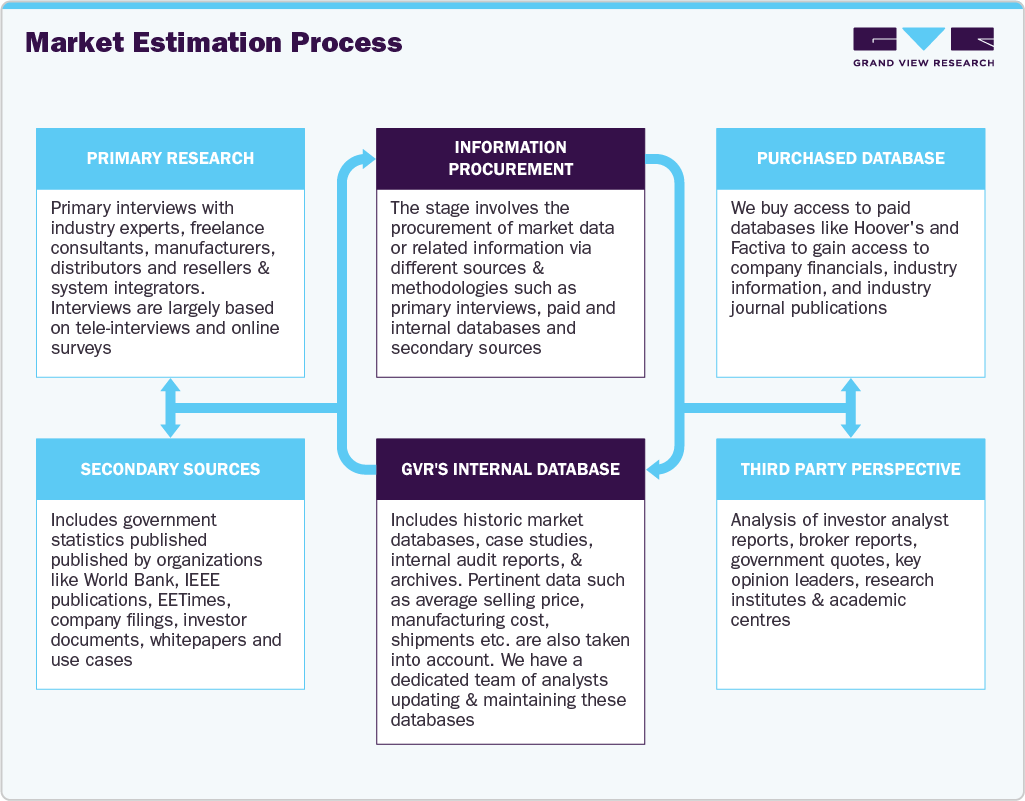
The U.S. orthopedic endoscopy market was estimated using supply-side and demand-side models. Public data, product evidence, existing primary research, and internal databases were used to validate the key assumptions.
The model covers 2021 to 2033. Values for 2021 to 2024 are modeled historical estimates, 2025 is the base year, and 2026 to 2033 are forecasts. All annual estimates were built from the underlying drivers rather than applying one common growth rate to every segment.
-
Model 1: Commodity Flow Analysis - For publicly listed companies, annual reports, 10-K filings, investor presentations, earnings releases, and geographical revenue disclosures were reviewed. For private companies and subsidiaries, revenue information was sourced from company disclosures and premium paid databases, including S&P Global, Crunchbase, ZoomInfo, and RocketReach. Orthopedic endoscope revenue was derived using product portfolio, U.S. availability, FDA clearance, site-of-care suitability, market penetration, and product-level ASP.
-
Model 2: Demand-based Market Sizing Framework
-
Model 3: Primary Market Research Validation
-
Model 4: Internal Database
-
Model 5: U.S. orthopedic Endoscopy Market CAGR Calculations
Market Scope and Product Boundary
In scope: Reusable and single-use standard arthroscopes, as well as reusable and single-use needle/small-diameter arthroscopes used for joint visualization during knee, shoulder, hip, ankle/foot, elbow, wrist/hand, and other small-joint arthroscopic procedures.
Out of scope: Shavers, RF ablation devices, irrigation and fluid-management systems, cannulas and access portals, suture anchors and other fixation devices, cameras and camera heads, processors, monitors, light sources, OR towers, service contracts, and reusable handle assemblies sold separately from the optical scope. General-purpose endoscopes that are not specifically cleared or marketed for joint visualization are also excluded, even when used in arthroscopic procedures.
Model 1: Commodity Flow Analysis
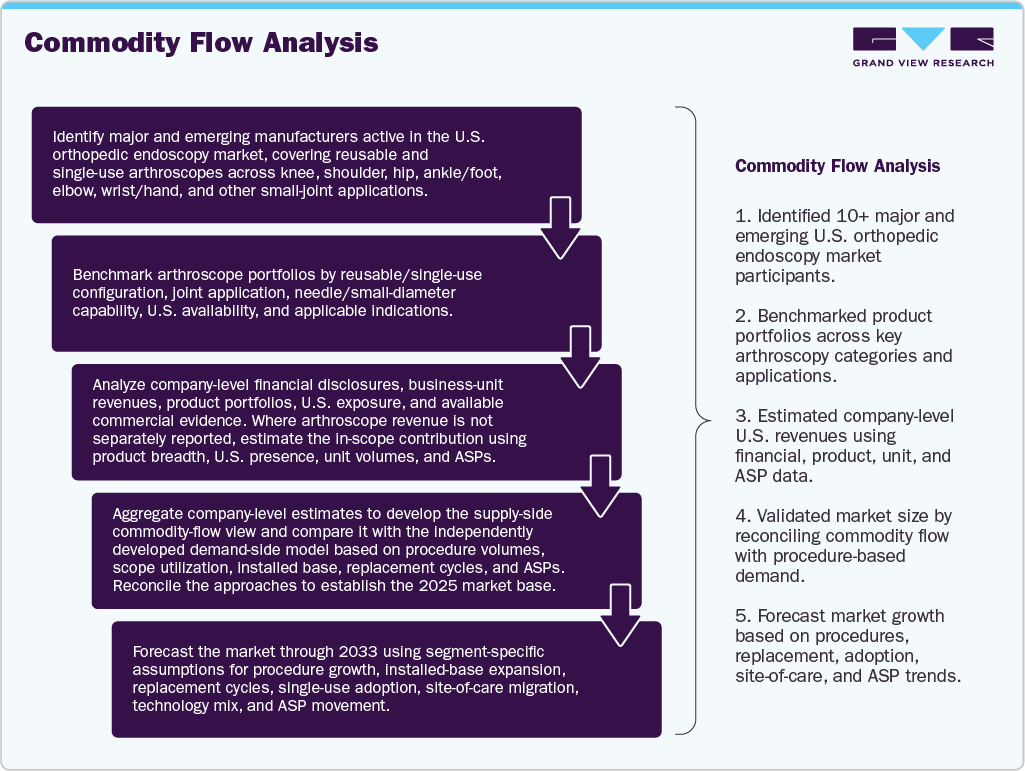
Commodity flow analysis is the principal supply-side methodology used to derive and validate the U.S. Orthopedic Endoscopy market size. The approach reconstructs the market revenue pool from company-level financial information and product-level revenue estimates.
For publicly listed companies, financial data was sourced from annual reports, 10-K filings, investor presentations, earnings releases, and official geographical disclosures. Where companies did not report Orthopedic endoscopy revenue separately, the analysis started with the reported business segment and applied a transparent revenue-allocation framework.
The company-level revenue bridge included:
Step
Calculation
Key control
1. Company revenue
Collect reported company, business-unit, or product-family revenue
Use the closest reported period and currency
2. Orthopedic endoscopy share
Apply the share attributable to verified Orthopedic endoscope products
Exclude broader Orthopedicsurgical equipment
3. U.S. share
Apply reported or supported U.S. geographic exposure
Do not use global revenue as U.S. revenue
4. Product boundary
Retain reusable and single-use visualization scopes only
Exclude systems, tools, accessories, services, and refurbished sales
5. Private companies
Estimate U.S. units multiplied by verified blended-product ASP
Cross-check distributor, procurement, and FDA availability evidence
6. Reconciliation
Sum company estimates and compare with demand-side revenue
For private companies and subsidiaries, the latest available revenue information was sourced from official company disclosures and premium databases, including S&P Global, Crunchbase, ZoomInfo, and RocketReach. The U.S. orthopedic endoscopy contribution was estimated using product breadth, U.S. commercial presence, regulatory availability, distribution coverage, installed-base potential, replacement demand, and product ASP.
Model 1: Commodity Flow Analysis
 To learn more about this report, Download Free Sample Report
Commodity flow analysis was employed to track the movement of U.S. Orthopedic endoscopy through the value chain, from technology providers to end users. This analysis provided insights into demand generation points, intermediary roles, and ultimate consumption patterns.
Customization Table
Client Request
Customization Delivered
Value Adds
Installed Reusable Endoscope Base (2021–2033)
Delivered an analysis of the installed reusable orthopedic endoscope base for 2021–2033 at the overall U.S. level and across each covered region and segment. The analysis captures the existing equipment base and replacement requirements over the forecast period.
Helps manufacturers and distributors assess the installed equipment base, estimate replacement demand, and plan future procurement and servicing requirements.
Number of Units Sold (2021–2033, in 000s)
Delivered unit sales analysis in thousands for 2021–2033 at the overall U.S. level and across each covered region and segment. The analysis covers reusable and disposable/single-use orthopedic endoscopy systems, accounting for new equipment procurement and replacement demand.
Enables stakeholders to quantify unit demand, evaluate procurement patterns, and align production, inventory, distribution, and sales planning with market requirements.
Competitive Differentiation: Price, Technical Capabilities, and Site-of-Care Fit
Delivered a comparative evaluation of competitors based on pricing, technical capabilities, and suitability for hospitals, ambulatory surgery centers (ASCs), and other relevant care settings. The analysis also included Features–Advantages–Benefits (FAB) analysis to translate product specifications into practical advantages and customer benefits.
Supports competitor positioning, value proposition development, pricing strategy, and identification of product attributes that align with facility requirements and purchasing priorities.
Annual Procedure Volume (2021–2033, in 000's)
Provided annual Orthopedic endoscopy procedure volume in 000's for 2021–2033 at the overall U.S. level and at the regional level for each covered segment. The analysis captures procedure activity across relevant Orthopedic endoscopy applications and healthcare settings.
Helps stakeholders connect procedure growth with endoscope demand, estimate utilization levels, and assess the relationship between clinical activity and equipment sales.
About the Author(s)
Medical Devices Research Team
Healthcare · Medical DevicesThis report was authored by the medical devices research team at Grand View Research - comprising two research analysts, one senior research analyst, and one industry expert - with specialized expertise in the medical devices segment of the healthcare industry. All findings are based on proprietary healthcare databases, executive interviews, and regulatory analysis, subject to internal peer review prior to publication.
Last Updated:
Speak to Analyst

Customize this report to your needs - add regions, segments, or data points, with 20% free customization.
Or view our licence options:


ISO 9001:2015 & 27001:2022 Certified
We are GDPR and CCPA compliant! Your transaction & personal information is safe and secure. For more details, please read our privacy policy.


