U.S. Plastic Lidding Films Market Trends
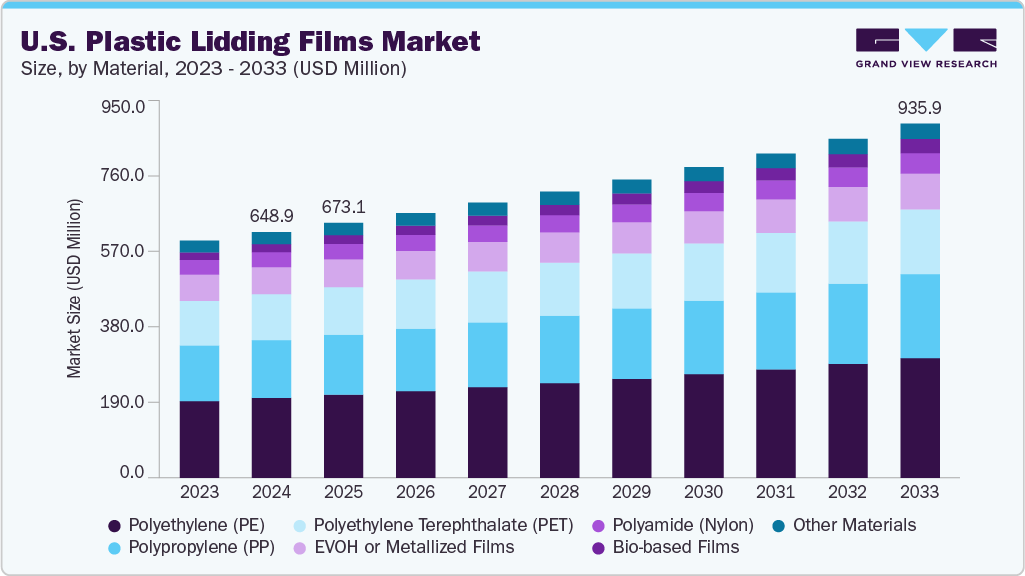
The U.S. plastic lidding films market size was estimated at USD 648.9 million in 2024 and is projected to grow at a CAGR of 4.2% from 2025 to 2033. A growing emphasis on package differentiation is boosting demand for specialty lidding films with custom printing and texture effects.
Key Market Trends & Insights
- By material, the bio-based films segment is expected to grow at a considerable CAGR of 6.2% from 2025 to 2033 in terms of revenue.
- By application, the ready-to-eat meals segment is expected to grow at a considerable CAGR of 5.2% from 2025 to 2033 in terms of revenue.
Market Size & Forecast
- 2024 Market Size: USD 649.0 million
- 2033 Projected Market Size: USD 935.9 million
- CAGR (2025 - 2033): 4.2%
Brands are willing to pay a premium for eye-catching lids that enhance shelf appeal and reinforce product positioning. The U.S. plastic lidding films industry is experiencing a steady shift toward recyclable and mono-material solutions as food manufacturers aim to meet sustainability targets without compromising barrier performance. Multilayer composite structures are gradually being replaced by materials such as recyclable polyethylene (PE) and polypropylene (PP) lidding films. This trend is reinforced by brand owners responding to retailer mandates and changing regulatory frameworks, especially in fresh produce and dairy segments.
Drivers, Opportunities & Restraints
Rising demand for convenience and ready-to-eat meals across urban populations is a primary driver accelerating plastic lidding film consumption. As meal kits, microwavable trays, and single-serve portions grow more popular, there is a corresponding increase in the need for high-performance sealing films with anti-fog, peel able, and heat-resistant properties. This has resulted in expanded product portfolios among major converters catering to temperature-sensitive and extended shelf-life applications.
There is a significant opportunity for innovation in compostable and bio-based lidding films, particularly as U.S. states introduce compostability labeling laws and extended producer responsibility (EPR) frameworks. Startups and established players alike are investing in materials like PLA and cellulose-based substrates that meet ASTM D6400 standards, creating first-mover advantages in institutional foodservice and organic product packaging where sustainable credentials are a differentiator.
Stringent recycling limitations for multilayer and metallized plastic films continue to act as a market restraint, particularly as waste management infrastructure struggles to handle complex film compositions. This creates end-of-life challenges and leads to higher compliance costs for manufacturers under tightening federal and state environmental mandates. The lack of a harmonized national policy on flexible plastic recycling further compounds the difficulty in achieving circularity targets.
Market Concentration & Characteristics
The market growth stage of the U.S. plastic lidding films industry is medium, and the pace is accelerating. The market exhibits slight fragmentation, with key players dominating the industry landscape. Major companies like BOSTIK INC., Winpak Films, Inc., Amcor Flexibles, Sealed Air Corporation, Plastofilm Industries, Inc., Atlantis Plastics, Inc., Tekni-Plex, Inc., Toray Plastics (America), Inc., and others play a significant role in shaping the market dynamics. These leading players often drive innovation within the market, introducing new products, technologies, and end uses to meet evolving industry demands.
In response to growing sustainability concerns, manufacturers are increasingly exploring paper-based lidding films laminated with biodegradable coatings, which offer comparable seal integrity while reducing reliance on virgin plastics. Aluminum foil lids remain popular in high-barrier applications like dairy tubs and frozen entrees, leveraging their superior moisture and oxygen resistance. In addition, compostable PLA and cellulose-based lidding solutions are gaining traction as viable drop-in alternatives that align with industrial and home composting standards.
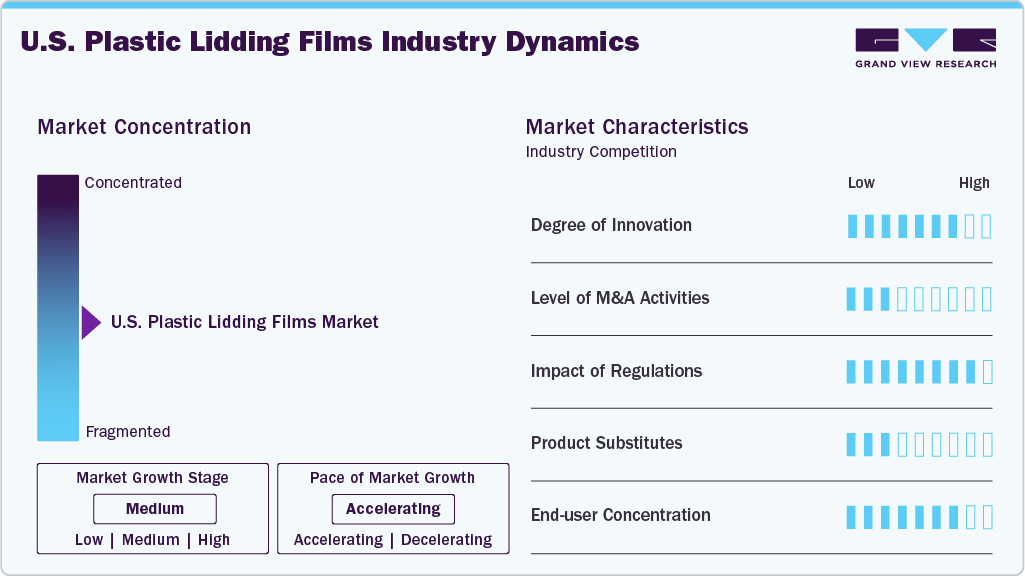
State-level Extended Producer Responsibility (EPR) laws are reshaping supply chains, with five U.S. jurisdictions already enforcing packaging take-back mandates that levy fees based on material complexity and recycled content. Meanwhile, the U.S. EPA’s National Strategy to Prevent Plastic Pollution is prompting calls for a unified federal EPR framework to harmonize diverse state rules and accelerate circularity goals by 2040. The cumulative effect is driving brands to redesign lidding films for recyclability and to integrate post-consumer resins to meet escalating compliance costs.
Material Insights & Trends
The polyethylene (PE) segment led the market with the largest revenue share of 32.78% in 2024. Advances in co-extrusion and additive technologies have significantly enhanced barrier properties and peel performance, making PE lidding films an increasingly preferred choice for moisture-sensitive products. Easy-peel and resealable functionalities now come standard in many formulations, catering to consumer demand for convenience without sacrificing product protection. This technical evolution has spurred adoption across snack, dairy, and fresh produce applications, where cost-effective, high-performance seals are critical.
The bio-based films segment is anticipated to grow at the fastest CAGR of 6.2% through the forecast period. Growing commitments to corporate sustainability targets are driving brand owners to adopt bio-based lidding films derived from renewable polymers like polylactic acid, which consumes significantly less fossil fuel during production compared to conventional plastics. Enhanced ESG disclosures and consumer demand for transparent carbon-reduction claims are prompting film converters to expand PLA capacity and refine formulations for peelable, heat-resistant applications. This strategic pivot helps companies meet evolving extended producer responsibility requirements while differentiating products on both environmental performance and package functionality.
Application Insights & Trends
The dairy products segment led the market with the largest revenue share of 28.88% in 2024. Growing urbanization and higher disposable incomes are driving consumers toward packaged milk, yogurt, and cheese cups, necessitating lidding films with robust moisture and oxygen barriers. Anti-fog coatings and clean-peel features ensure product clarity and ease of use, reinforcing brand trust and reducing food waste. As a result, manufacturers are prioritizing specialized PE and PP formulations tailored to dairy’s rigorous hygiene and shelf-life standards.
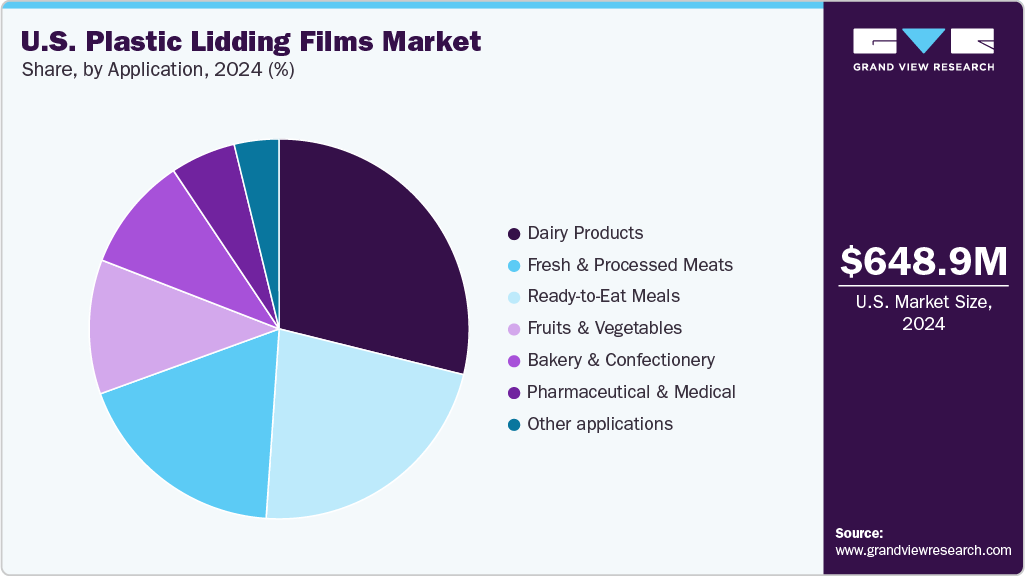
The ready-to-eat meals segment is expected to expand at the fastest CAGR of 5.2% through the forecast period. The surge in grab-and-go consumption has created a premium on lidding films that maintain seal integrity during transport yet allow effortless peel-and-heat convenience. Dual-ovenable PP films capable of withstanding temperatures up to 220 °C support both microwave and conventional heating, while high-barrier variants extend shelf life for chilled and frozen meal kits. This convergence of convenience, performance, and preservation is driving rapid uptake in the RTE segment.
Key U.S. Plastic Lidding Films Company Insights
The U.S. plastic lidding films industry is highly competitive, with several key players dominating the landscape. Major companies include BOSTIK INC., Winpak Films, Inc., Amcor Flexibles, Sealed Air Corporation, Plastofilm Industries, Inc., Atlantis Plastics, Inc., Tekni-Plex, Inc., and Toray Plastics (America), Inc.. The U.S. plastic lidding films industry is characterized by a competitive landscape with several key players driving innovation and market growth. Major companies in this sector are investing heavily in research and development to enhance the performance, cost-effectiveness, and sustainability of their types.
Key U.S. Plastic Lidding Films Companies:
- BOSTIK INC.
- Winpak Films, Inc.
- Amcor Flexibles
- Sealed Air Corporation
- Plastofilm Industries, Inc.
- Atlantis Plastics, Inc.
- Tekni-Plex, Inc.
- Toray Plastics (America), Inc.
Recent Developments
-
In December 2024, BOSTIK INC., the adhesive division of Arkema, and Brückner Maschinenbau, a global cast extrusion line manufacturer, partnered to develop a coextruded, peelable BOPET lidding film aimed at improving production efficiency, consumer convenience, and sustainability.
-
In June 2025, KM Packaging announced the release of K-Peel 4G, a new mono polyethylene terephthalate (PET) lidding film designed for food packaging. This film features a low seal initiation temperature, enabling effective sealing even with contaminants, and can peel cleanly at temperatures as low as 110°C with a short dwell time.
U.S. Plastic Lidding Films Market Report Scope
|
Report Attribute
|
Details
|
|
Market size value in 2025
|
USD 673.1 million
|
|
Revenue forecast in 2033
|
USD 935.9 million
|
|
Growth rate
|
CAGR of 4.2% from 2025 to 2033
|
|
Base year for estimation
|
2024
|
|
Historical data
|
2021 - 2023
|
|
Forecast period
|
2025 - 2033
|
|
Quantitative units
|
Revenue in USD million/billion, Volume in Kilotons, and CAGR from 2025 to 2033
|
|
Report coverage
|
Revenue forecast, competitive landscape, growth factors, and trends
|
|
Segments covered
|
Material, application, region
|
|
Country scope
|
U.S.
|
|
Key companies profiled
|
BOSTIK INC.; Winpak Films, Inc.; Amcor Flexibles; Sealed Air Corporation; Plastofilm Industries, Inc.; Atlantis Plastics, Inc.; Tekni-Plex, Inc.; Toray Plastics (America), Inc.
|
|
Customization scope
|
Free report customization (equivalent up to 8 analyst’s working days) with purchase. Addition or alteration to country, regional & segment scope
|
|
Pricing and purchase options
|
Avail customized purchase options to meet your exact research needs. Explore purchase options
|
U.S. Plastic Lidding Films Market Report Segmentation
This report forecasts revenue growth at the country level and provides an analysis of the latest industry trends in each of the sub-segments from 2021 to 2033. For this study, Grand View Research has segmented the U.S. plastic lidding films market report based on the material, application, and region:
-
Material Outlook (Volume, Kilotons; Revenue, USD Million, 2021 - 2033)
-
Application Outlook (Volume, Kilotons; Revenue, USD Million, 2021 - 2033)
-
Dairy Products
-
Fresh & Processed Meats
-
Ready-to-Eat Meals
-
Fruits & Vegetables
-
Bakery & Confectionery
-
Pharmaceutical & Medical
-
Other applications
Frequently Asked Questions About This Report
b. The U.S. plastic lidding films market size was estimated at USD 648.9 million in 2024 and is expected to reach USD 673.1 million in 2025.
b. The U.S. plastic lidding films market is expected to grow at a compound annual growth rate of 4.2% from 2025 to 2033 to reach USD 935.9 million by 2033.
b. Polyethylene (PE) dominated the U.S. plastic lidding films market across the material segmentation in terms of revenue, accounting for a market share of 32.78% in 2024. Advances in co-extrusion and additive technologies have significantly enhanced barrier properties and peel performance, making PE lidding films an increasingly preferred choice for moisture-sensitive products.
b. Some key players operating in the U.S. plastic lidding films market include BOSTIK INC., Winpak Films, Inc., Amcor Flexibles, Sealed Air Corporation, Plastofilm Industries, Inc., Atlantis Plastics, Inc., Tekni-Plex, Inc., and Toray Plastics (America), Inc..
b. A growing emphasis on package differentiation is boosting demand for specialty lidding films with custom printing and texture effects. Brands are willing to pay a premium for eye-catching lids that enhance shelf appeal and reinforce product positioning.

 Download Sample Report
















