
- Home
- »
- Consumer F&B
- »
-
U.S. Pork Meat Market Size, Industry Report, 2026-2033GVR Report cover
![U.S. Pork Meat Market Size, Share & Trends Report]()
U.S. Pork Meat Market (2026 - 2033) Size, Share & Trends Analysis Report By Product (Chilled Pork Meat, Frozen Pork Meat), By Distribution Channel (Supermarkets & Hypermarkets, Specialty Stores, Online), And Segment Forecasts
Market Size, 2025
$49.1BMarket Estimate, 2026
$49.3BMarket Forecast, 2033
$69.0BCAGR, 2026–2033
4.9%U.S. Pork Meat Market Summary
The U.S. pork meat market size was estimated at USD 49.05 billion in 2025 and is projected to grow from USD 49.26 billion in 2026 to USD 68.97 billion by 2033, at a CAGR of 4.9% from 2026 to 2033. Growth is driven by high consumption levels and strong demand for processed and convenience-oriented pork products.
Key Market Trends & Insights
- By product, frozen pork meat is expected to grow at a CAGR of 6.5% from 2026 to 2033.
- By distribution channel, the sale of pork meat through supermarkets & hypermarkets accounted for a revenue share of 52.2% in 2025.
Market Size & Forecast
- 2025 Market Size: USD 49.05 Billion
- 2033 Projected Market Size: USD 68.97 Billion
- CAGR (2026-2033): 4.9%
Retail expansion across supermarkets, club stores, and foodservice outlets is supporting wider product availability. Increasing consumer inclination toward branded and premium offerings is influencing product positioning strategies. Price sensitivity, along with fluctuations in input costs, continues to affect purchasing behavior. Rising awareness of clean-label, responsibly sourced meat products is further shaping consumer preferences. The market is supported by a highly organized production system with strong integration across farming, processing, and distribution stages. Large-scale operations and advanced slaughtering facilities are enabling efficiency and uniform product quality. Continuous investments in automation technologies have led to measurable efficiency gains, with innovations such as AI-based processing systems improving meat recovery rates by up to 0.5% per animal, reflecting incremental productivity improvements across processing operations. The presence of well-established industry players is contributing to stable supply and competitive dynamics. Regulatory standards related to food safety and quality control are also playing a key role in shaping industry practices.

The U.S. pork meat industry benefits from strong consumption patterns and established production systems, supporting a stable and reliable domestic supply. Strong integration across farming, processing, and distribution stages is enhancing operational efficiency and maintaining product quality standards.
Shifting consumption trends, especially among working professionals and younger demographics, are increasing demand for convenient and ready-to-prepare pork products, with value-added and processed pork accounting for nearly 74% of total U.S. pork consumption. This trend is prompting manufacturers to broaden their portfolios with value-added options such as pre-seasoned, portioned, and packaged formats aligned with modern lifestyle needs.
Premiumization trends are influencing purchasing decisions, with increasing preference for high-quality, branded, and traceable pork products, as 27.1% of all medically important antibiotics in the U.S. are used in pig production, which has intensified consumer focus on “antibiotic-free pork” claims, alongside rising demand for clean-label options as consumers prioritize transparency, safety, and responsible production practices.
A well-developed retail landscape, including supermarkets, warehouse clubs, and foodservice channels, is supporting strong product availability and market penetration. Advanced cold storage and logistics networks are further enhancing distribution efficiency and ensuring consistent product freshness.
Production dynamics in the U.S. pork meat industry are shaped by efficiency-focused farming practices, supported by improved genetics, feed optimization, and modern livestock management systems. These factors are contributing to reliable output levels and reinforcing pork’s position as a key protein source within the market.
Market Dynamics
The growing consumer focus on transparency, safety, and responsible production practices is a key driver of the U.S. pork meat market. According to the Natural Resources Defense Council (NRDC), approximately 27.1% of all medically important antibiotics sold in the U.S. are used in pork production. This significant usage has intensified consumer demand for "antibiotic-free pork" and clean-label options. Buyers are increasingly prioritizing verifiable sourcing claims, certifications, and handling standards. This heightened awareness is prompting manufacturers to expand portfolios with responsibly sourced pork products. Ultimately, production transparency has become a mainstream purchasing criterion that supports long-term brand loyalty. These evolving consumer expectations continue to drive sustained market growth for clean-label pork offerings.
Persistent trade barriers and retaliatory tariffs continue to restrain the U.S. pork meat market growth. According to the U.S. Meat Export Federation (USMEF), U.S. pork exports in 2025 totaled USD 8.4 billion. This fell short of the previous year's record due to tariff-related challenges. The decline forces greater reliance on domestic channels, increasing local price competition. Ongoing tariff uncertainty creates an unpredictable trade environment. These barriers significantly restrain industry growth and profitability. Export markets absorb roughly 25% of U.S. pork production, making trade stability essential for market balance. Without resolution of tariff disputes, U.S. pork producers will continue facing headwinds in maintaining export competitiveness.
Consumer Insights
Consumption patterns are shaped by established dietary habits and widespread acceptance of pork across households, supported by its presence in both home-cooked meals and foodservice menus. Strong demand for specific cuts, such as bacon, ribs, and chops, reflects a preference for flavor-driven, indulgent eating experiences.
Purchasing decisions are increasingly influenced by branding, consistency, and product standardization, with consumers relying on recognized labels and packaged formats for quality assurance. This has strengthened the role of branded and retail-ready pork products in driving repeat purchases.

Busy lifestyles and time constraints are driving demand for portion-controlled, easy-to-prepare meat options, prompting a shift toward streamlined product formats. This trend is reshaping merchandising strategies across retail shelves and refrigerated sections.
Trust in production practices is becoming more important, with buyers paying closer attention to sourcing claims, certifications, and handling standards. Transparency in labeling and production methods is influencing confidence and long-term brand loyalty.
Overall, consumption behavior reflects a balance between convenience, consistency, and assurance of quality, with evolving expectations around reliability and product experience shaping long-term demand trends.
Product Insights
The chilled pork meat segment dominated the U.S. pork meat market, accounting for the largest revenue share of 77.1% in 2025. The market shows strong preference for chilled formats, supported by widespread retail refrigeration infrastructure and frequent purchase cycles among consumers. Chilled pork is extensively distributed through supermarkets, warehouse clubs, and butcher counters, where immediate usability and consistent quality are key purchasing factors. The segment benefits from efficient domestic supply chains that enable rapid processing and distribution, reducing the need for long-term storage. Demand is reinforced by the prominence of fresh pork cuts in everyday meal preparation and foodservice applications, supporting sustained segment performance.

The frozen pork meat segment is projected to grow at the fastest CAGR of 6.5% from 2026 to 2033. The U.S. pork industry is witnessing a gradual shift toward frozen formats, driven by demand from bulk buyers, foodservice operators, and institutional channels. Frozen pork is widely utilized in large-scale meal preparation and processing applications, where portion control and inventory planning are critical. The segment benefits from strong logistics capabilities that enable efficient interstate distribution and long-term storage across diverse geographic regions. Growth is further supported by increasing penetration of e-commerce grocery platforms and evolving retail strategies focused on extended product availability.
Distribution Channel Insights
Sales of pork meat through supermarkets and hypermarkets accounted for the largest revenue share of 52.2% in 2025. The U.S. pork meat market benefits from a highly organized retail structure, with large-format stores playing a central role in product distribution and visibility. These outlets provide standardized packaging, clear labeling, and consistent product grading, supporting informed purchasing decisions. Strong supply agreements with major producers ensure steady inventory flow and product uniformity across locations. The segment is further supported by strategic in-store placement, bulk purchasing options, and integration of loyalty programs that influence repeat buying behavior.
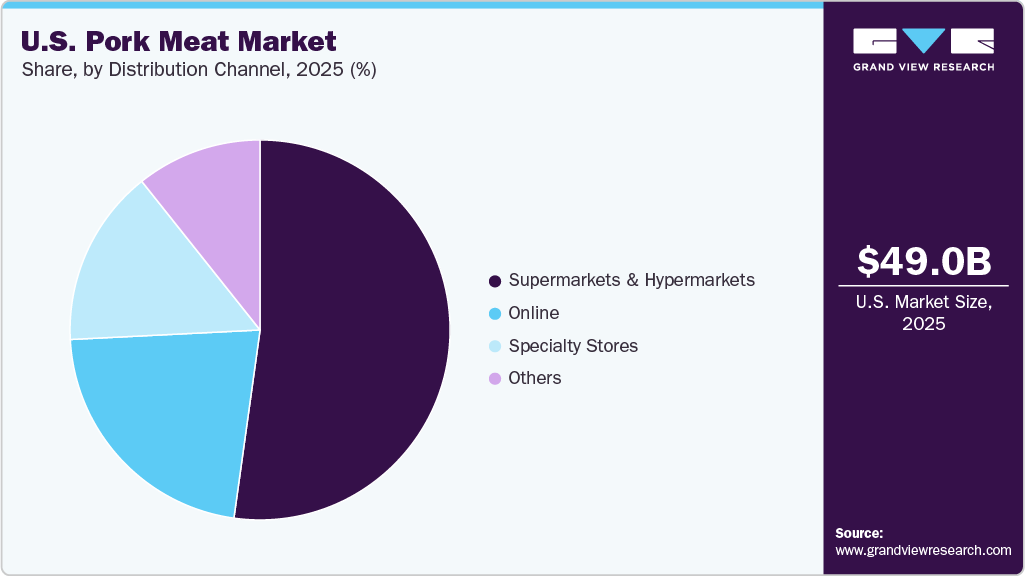
Online sales of pork meat are expected to grow at the fastest CAGR of 5.5% from 2026 to 2033. The U.S. pork meat industry is experiencing steady expansion in digital sales, supported by the growing integration of omnichannel retail strategies among major grocery players. Online platforms are increasingly utilized for scheduled purchasing and subscription-based meat delivery services, enhancing consumer convenience and planning efficiency. Retailers are focusing on digital merchandising, personalized recommendations, and bundled product offerings to improve customer engagement. The segment is further driven by advancements in last-mile delivery systems and temperature-controlled logistics, ensuring product integrity during transit.
U.S Pork Meat Market Trends
The U.S. pork meat market is expected to grow at a CAGR of 4.9% from 2026 to 2033, representing the largest share within the North American region. Growth is supported by strong consumer demand for processed pork products such as bacon, ham, and sausages, as well as high per capita meat consumption. The market benefits from advanced meat processing technologies, efficient cold-chain logistics, and a highly organized retail distribution network. In addition, increasing preference for protein-rich diets and convenient food options continues to drive steady consumption across both household and foodservice channels.

Key U.S. Pork Meat Companies
The following are the leading companies in the U.S. pork meat market.
-
True Story Foods (Fork in the Road Foods LLC)
-
JBS S.A.
-
Prairie Fresh (Seaboard Foods)
-
Cargill, Incorporated
-
Smithfield Foods, Inc.
-
Marfrig Global Foods S.A.
-
Tyson Foods, Inc.
-
Hormel Foods Corporation
-
Clemens Food Group
-
WH Group Limited
Recent Developments
-
In February 2026, Hormel Foods Corporation highlighted its strong presence in the U.S. pork meat market, supported by a wide portfolio of branded and value-added meat products catering to both retail and foodservice channels. The company continues to focus on product innovation and consistent quality standards to strengthen consumer trust and brand positioning. Its diversified protein strategy and established distribution network further support stable performance in a competitive market environment.
-
In July 2025, Clemens Food Group invested approximately $130 million to expand and modernize its Hatfield, Pennsylvania, processing facility, aimed at increasing capacity for value-added pork products such as bacon and sausages.
-
In March 2025, Prairie Fresh launched new ground pork and sausage products in the U.S., including 16-ounce packaged ground pork and fresh sausage offerings in multiple flavor formats. The launch expands the brand’s retail pork portfolio by introducing convenient, versatile products designed for everyday meal preparation.
U.S. Pork Meat Market Report Scope
Report Attribute
Details
Market size value in 2026
USD 49.26 billion
Revenue forecast in 2033
USD 68.97 billion
Growth rate
CAGR of 4.9% from 2026 to 2033
Actuals
2021 - 2025
Forecast period
2026 - 2033
Quantitative units
Revenue in USD billion CAGR from 2026 to 2033
Report coverage
Revenue forecast, company ranking, competitive landscape, growth factors, and trends
Segments covered
Product and distribution channel
Key companies profiled
True Story Foods (Fork in the Road Foods LLC); JBS S.A.; Prairie Fresh (Seaboard Foods); Cargill, Incorporated; Smithfield Foods, Inc.; Marfrig Global Foods S.A.; Tyson Foods, Inc.; Hormel Foods Corporation; Clemens Food Group; WH Group Limited
Customization scope
Free report customization (equivalent up to 8 analysts working days) with purchase. Addition or alteration to country & segment scope.
Pricing and purchase options
Avail customized purchase options to meet your exact research needs. Explore purchase options
U.S. Pork Meat Market Report Segmentation
This report forecasts revenue growth at the country level and provides an analysis of the latest industry trends and opportunities in each of the sub-segments from 2021 to 2033. For this study, Grand View Research has segmented the U.S. pork meat market report based on product and distribution channel:
-
Product Outlook (Revenue: USD Billion, 2021 - 2033)
-
Chilled Pork Meat
-
Frozen Pork Meat
-
-
Distribution Channel Outlook (Revenue: USD Billion, 2021 - 2033)
-
Supermarkets & Hypermarkets
-
Specialty Stores
-
Online
-
Others
-
Frequently Asked Questions About This Report
The U.S. pork meat market size was estimated at USD 49.1 billion in 2025 and is expected to reach USD 49.3 billion in 2026.
The U.S. pork meat market is expected to grow at a compound annual growth rate (CAGR) of 4.9% from 2026 to 2033 to reach USD 68.9 billion by 2033.
By product type, the chilled pork meat accounted for the largest revenue share of 77.1% in overall revenue in 2025 within U.S. pork meat market.
Some key players operating in the U.S. pork meat market include True Story Foods (Fork in the Road Foods LLC); JBS S.A.; Prairie Fresh (Seaboard Foods); Cargill, Incorporated; Smithfield Foods, Inc.; Marfrig Global Foods S.A.; Tyson Foods, Inc.; Hormel Foods Corporation; Clemens Food Group; and WH Group Limited
The market growth is driven by high consumption levels and strong demand for processed and convenience-oriented pork products. Retail expansion across supermarkets, club stores, and foodservice outlets is supporting wider product availability. Increasing consumer inclination toward branded and premium offerings is influencing product positioning strategies.
About the Author(s)
Consumer F&B Research Team
Consumer Goods · Consumer F&BThis report was authored by the consumer f&b research team at Grand View Research - comprising two research analysts, one senior research analyst, and one industry expert - with specialized expertise in the consumer f&b segment of the consumer goods industry. All findings are based on proprietary consumer goods databases, executive interviews, and regulatory analysis, subject to internal peer review prior to publication.
Last Updated:
Speak to Analyst


Customize this report to your needs — add regions, segments, or data points, with 20% free customization.
Or view our licence options:


ISO 9001:2015 & 27001:2022 Certified
We are GDPR and CCPA compliant! Your transaction & personal information is safe and secure. For more details, please read our privacy policy.


