
- Home
- »
- Consumer F&B
- »
-
U.S. Processed Vegetable Market Size Report, 2026-2033GVR Report cover
![U.S. Processed Vegetable Market (2026 - 2033)Report]()
U.S. Processed Vegetable Market (2026 - 2033)
Size, Share & Trends Analysis Report By Product (Frozen, Canned, Dried/Dehydrated), By End-use (Retail, Food Service, Food Processing), Consumer Behavior And Competitive Analysis, And Segment Forecasts
Market Size, 2025
$5.2BMarket Estimate, 2026
$5.4BMarket Forecast, 2033
$7.2BCAGR, 2026–2033
4.2%U.S. Processed Vegetable Market Summary
The U.S. processed vegetable market size was valued at USD 5.2 billion in 2025 and is projected to grow from USD 5.4 billion in 2026 to USD 7.2 billion by 2033, at a CAGR of 4.2% from 2026 to 2033. The market is driven by rising consumer demand for convenient, ready-to-eat, and shelf-stable foods. Increasing health awareness is also boosting demand for frozen and minimally processed vegetables. Besides, growth in the foodservice, retail, and food manufacturing sectors is supporting the overall expansion of the market.
Key Market Trends & Insights
- By product: Frozen segment accounted for the largest share of 45.3% in 2025.
- By end use: Retail channel held the largest share of 47.6% in 2025.
Market Size & Forecast
- Market size in 2025: USD 5.2 Billion
- Estimated market size in 2026: USD 5.4 billion
- Projected market size by 2033: USD 7.2 Billion
- CAGR (2026-2033): 4.2%
The U.S. processed vegetable industry is also supported by innovations in processing and packaging technologies that help improve product quality and extend shelf life. According to the data published in February 2026, packaging innovation is increasingly focused on extending shelf life, maintaining freshness, and improving food safety, with barrier films, active packaging, and ethylene-management technologies helping reduce spoilage and waste. In addition, increasing demand for organic, plant-based, and premium vegetable products is creating new opportunities for manufacturers. In addition, changing lifestyles and higher urbanization are encouraging consumers to choose processed vegetables as practical meal ingredients.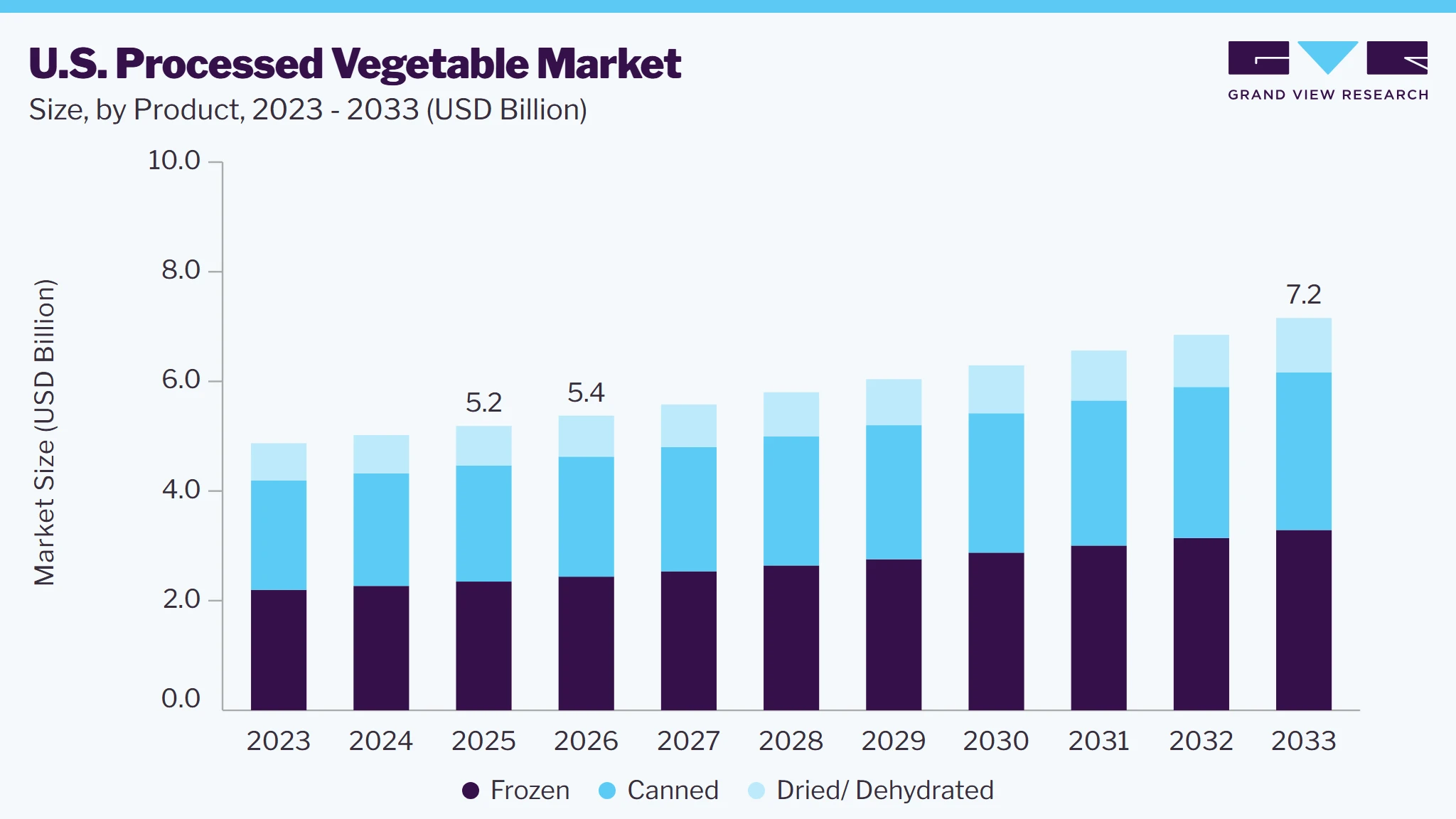
Furthermore, the increasing adoption of processed vegetables across the U.S. hospitality, restaurant, and foodservice sectors is creating new growth opportunities. The expansion of supermarkets, hypermarkets, and online grocery channels is improving product availability and consumer reach across the country. Advancements in processing and preservation technologies are also enhancing product quality, shelf life, and nutritional retention. According to the data published in February 2024, technological innovations such as Cryogenic freezing systems, Individual quick freezing (IQF) innovations, and High-Pressure freezing technologies help in retaining the firmness and texture of the vegetables.
U.S. consumers are increasingly prioritizing convenience, taste, and affordability when purchasing processed vegetables. There is growing interest in frozen and minimally processed formats that offer ease of preparation while retaining nutritional value. Consumers are also paying greater attention to clean-label ingredients, fewer additives, and natural product formulations. At the same time, demand for value, product variety, and better-for-you options is influencing purchasing decisions.
Market Dynamics
The growing preference for time-saving meal solutions is strengthening demand for processed vegetables in the U.S., as consumers increasingly seek products that require minimal preparation and fit into busy lifestyles. This trend is particularly relevant for frozen, canned, and pre-cut vegetable formats, which offer convenience and ease of use. Convenience-focused product offerings are therefore gaining wider acceptance across households, encouraging manufacturers to develop products that simplify everyday meal preparation. In September 2024, Green Giant expanded its frozen vegetable portfolio with 12 new products, including crispy smashed potatoes, corn cob bites, vegetable ramen, and new Restaurant Style vegetable-and-rice varieties.
Variability in the availability and pricing of agricultural inputs can create challenges for processors. Weather conditions can affect crop yields and influence the cost of vegetables used as raw materials, making production planning and cost management more difficult for manufacturers. Companies may also face pressure to maintain stable pricing despite changing input costs, which can affect profit margins and create uncertainty throughout the supply chain. According to USDA data published in December 2024, weather-related disruptions reduced vegetable yields, leading to supply constraints and price volatility, complicating production planning for processors. Unfavorable growing conditions can also increase grower prices for key vegetables, raising input-cost uncertainty and putting pressure on processors’ profit margins.
Demand for organic and clean-label products is creating opportunities for processed vegetable manufacturers. Consumers are paying greater attention to ingredient transparency and simpler product formulations, encouraging companies to reduce artificial additives and highlight recognizable ingredients. Organic certifications and transparent sourcing can also help products differentiate themselves in the market, while expanding these offerings can enable manufacturers to target health- and quality-conscious consumers.
Analyst Perspective
The U.S. processed vegetable market is expected to maintain steady growth, supported by evolving food consumption patterns and expanding product applications. Manufacturers are increasingly focusing on product differentiation, packaging improvements, and value-added offerings to strengthen their market position. Demand from food manufacturers and commercial kitchens is creating a broader range of applications for processed vegetables. The market is also seeing greater emphasis on product quality, sourcing practices, and operational efficiency. Overall, continued innovation and diversification are expected to shape the competitive landscape of the U.S. processed vegetable market.
Product Insights
The frozen segment accounted for the largest share of 45.3% of the revenue in 2025. Frozen vegetables are driven by growing consumer demand for convenient, ready-to-cook meal ingredients that fit busy lifestyles. Frozen vegetables provide year-round availability and consistent quality, making them attractive alternatives to seasonal fresh produce. Increasing interest in healthy eating and plant-based diets is also supporting demand for frozen vegetables across households. In addition, expanding foodservice and prepared-meal applications are increasing the use of standardized frozen vegetable ingredients. Advances in freezing technologies and product innovation are further broadening the range of frozen vegetable offerings.
The dried/ dehydrated segment is projected to grow significantly at a CAGR of 4.2% from 2026 to 2033. Dried/dehydrated vegetables are supported by increasing use of shelf-stable vegetable ingredients in soups, sauces, seasonings, snacks, and convenience foods. Dehydration extends storage life and reduces spoilage, allowing manufacturers to manage inventory more efficiently. The format also lowers dependence on refrigerated storage and cold-chain transportation, improving logistics efficiency. Growing demand for instant meals, seasoning blends, and ready-to-eat products is creating additional applications for dried vegetable flakes, powders, and pieces. Improvements in drying technologies are also enabling manufacturers to offer products with better flavor, color, and nutritional retention.
End Use Insights
The retail segment in the U.S. processed vegetable market accounted for the largest share of 47.6% of the revenue in 2025. The growth is driven by consumers’ increasing preference for convenient, easy-to-prepare vegetable products that reduce meal preparation time. Supermarkets, hypermarkets, warehouse clubs, and convenience stores provide broad access to processed vegetables, while expanding online grocery channels are improving product availability. Retail demand is also supported by interest in healthy, plant-forward meals, encouraging manufacturers to introduce organic, premium, and value-added vegetable options. Longer shelf life and reduced preparation requirements make processed vegetables attractive for household meal planning.
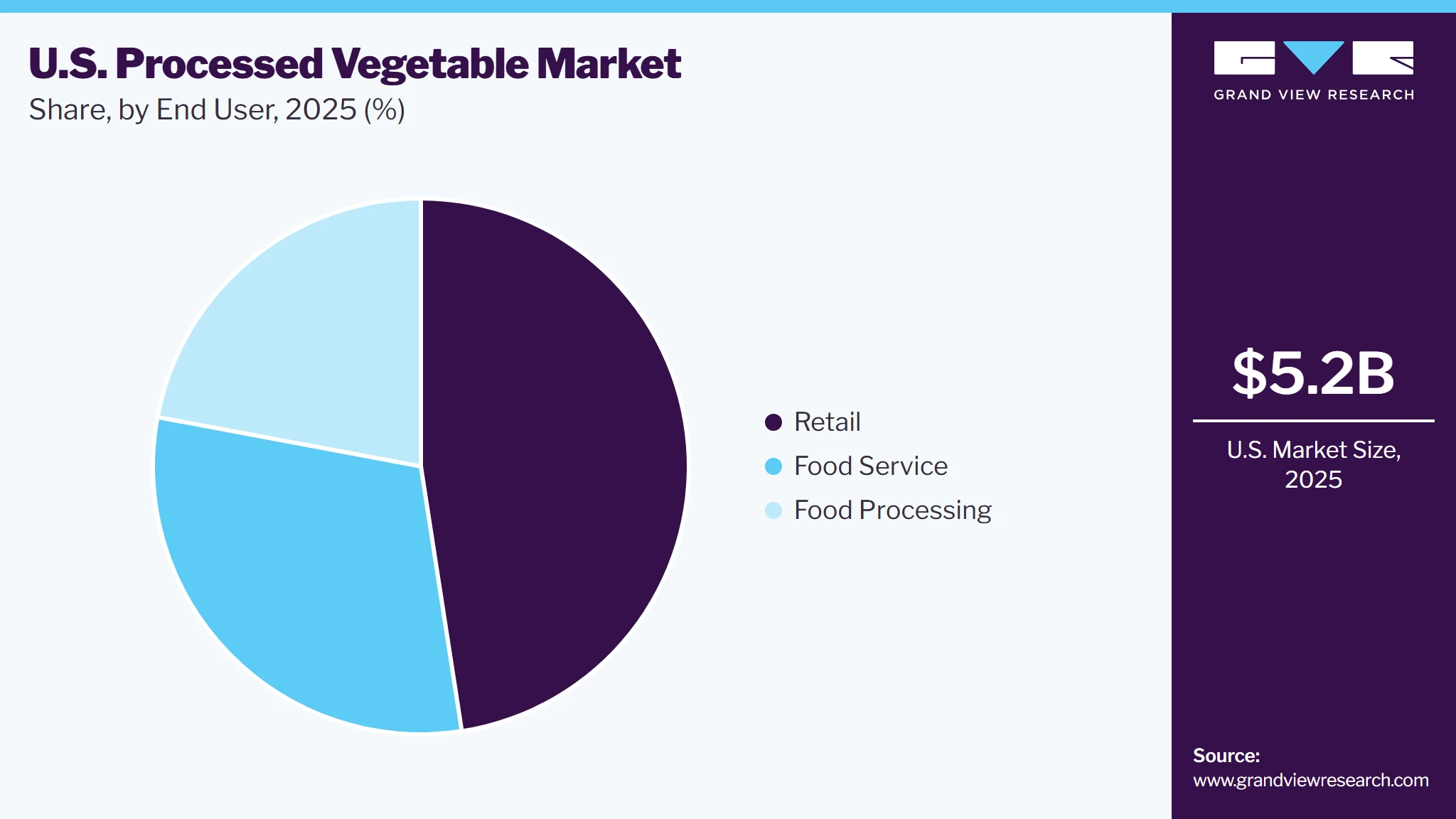
The food service segment is projected to grow at the fastest CAGR of 4.4% from 2026 to 2033. Demand for processed vegetables in the food service is supported by restaurants, quick-service outlets, cafeterias, schools, healthcare facilities, and other institutional operators seeking consistent, ready-to-use vegetable ingredients. Processed vegetables help foodservice businesses reduce preparation requirements, improve kitchen efficiency, and maintain standardized portions and quality across locations. Growing demand for convenient meals and the expansion of limited-service restaurant formats are creating additional opportunities for processed vegetable suppliers.
Key U.S. Processed Vegetable Company Insights
The U.S. processed vegetable industry is characterized by the presence of established food manufacturers and a diverse range of product offerings. Market share is influenced by product quality, brand recognition, distribution reach, and pricing strategies. Leading companies are focusing on product innovation and expanding their retail presence to strengthen their competitive position. Private-label products are also contributing to increased competition across retail channels.
Key U.S. Processed Vegetable Companies
-
B&G Foods, Inc.
-
Conagra Brands, Inc.
-
Del Monte Foods, Inc.
-
Dole Food Company, Inc.
-
Bonduelle Group
-
J.R. Simplot Company
-
Seneca Foods Corporation
-
McCain Foods Limited
-
Goya Foods, Inc.
-
Pacific Coast Producers
Competitive Benchmarking
Category
Operating Strategies
Competitive Edge
Weakness
Established Players (B&G Foods, Inc., Conagra Brands, Inc., Dole Food Company, Inc.)
Strengthen national distribution, expand product portfolios, invest in processing capabilities, and enhance branded and private-label offerings.
Strong brand recognition, extensive distribution networks, established retail relationships, and diversified product portfolios.
High operating costs, intense competition from private labels, and exposure to commodity and supply-chain fluctuations.
Emerging Players (J.R. Simplot Company; Goya Foods, Inc.)
Focus on specialized vegetable categories, expand foodservice and regional distribution, and develop differentiated product offerings.
Flexible product development, specialized processing expertise, strong customer relationships, and responsiveness to specific market segments.
Comparatively smaller brand presence, narrower product portfolios, and lower national market penetration.
Recent Developments
-
In March 2026, Seneca Foods acquired B&G Foods’ Green Giant U.S. frozen business, including the Green Giant brand and intellectual property, frozen inventory, and a frozen vegetable manufacturing facility in Yuma, Arizona. The deal also included a supply agreement covering certain products manufactured in Mexico.
-
In September 2024, Green Giant expanded its frozen vegetable portfolio with 12 new products, including crispy smashed potatoes, corn cob bites, vegetable ramen, and new Restaurant Style vegetable-and-rice varieties.
U.S. Processed Vegetable Market Report Scope
Report Attribute
Details
Market size in 2025
USD 5.2 billion
Estimated market size in 2026
USD 5.4 billion
Projected market size by 2033
USD 7.2 billion
Growth rate (revenue)
CAGR of 4.2% from 2026 to 2033
Actuals
2021 - 2025
Forecast period
2026 - 2033
Quantitative (Revenue) units
Revenue in USD billion and CAGR from 2026 to 2033
Report coverage
Revenue forecast, company ranking, competitive landscape, growth factors, and trends
Segments covered
Product, end use
Country Scope
U.S.
Key companies profiled
B&G Foods, Inc.; Conagra Brands, Inc.; Del Monte Foods, Inc.; Dole Food Company, Inc.; Bonduelle Group; J.R. Simplot Company; Seneca Foods Corporation; McCain Foods Limited; Goya Foods, Inc.; Pacific Coast Producers
Customization scope
Free report customization (equivalent up to 8 analysts’ working days) with purchase. Addition or alteration to country, regional & segment scope.
Pricing and purchase options
Avail customized purchase options to meet your exact research needs. Explore purchase options
U.S. Processed Vegetable Market Report Segmentation
This report forecasts revenue growth at the country level and provides an analysis of the latest industry trends and opportunities in each of the sub-segments from 2021 to 2033. For this study, Grand View Research has segmented the U.S. processed vegetable market report on the basis of product, and end use:
-
Product Outlook (Revenue, USD Billion, 2021 - 2033)
-
Frozen
-
Canned
-
Dried/ Dehydrated
-
-
End Use Outlook (Revenue, USD Billion, 2021 - 2033)
-
Retail
-
Supermarkets/ hypermarkets
-
Convenience stores
-
Online
-
-
Food Service
-
QSR
-
Hotels
-
Catering
-
Others
-
-
Food Processing
-
Segment Definition
Segment - Product
Revenue capture definition
Frozen
In the U.S. market, processed vegetable companies generate revenue from frozen vegetables sold through supermarkets, club stores, food-service distributors, and food manufacturers. Revenue is captured through retail packs, family-size formats, and bulk commercial products. Product variety, portion sizes, and value-added preparations help companies serve different customer groups. Premium and specialty frozen vegetables can also support higher selling prices.
Canned
U.S. processed vegetable manufacturers generate revenue from canned products distributed through grocery retailers, wholesalers, food-service operators, and institutional buyers. Revenue is captured through single cans, multipacks, and large-volume formats. Different vegetable varieties, package sizes, and branded or private-label products allow companies to address diverse consumer requirements. Specialty blends and seasoned formulations can provide additional value opportunities.
Dried/Dehydrated
In the U.S. market, dried and dehydrated vegetables generate revenue through retail products, food ingredients, and bulk supplies for commercial users. Manufacturers sell these products to households, restaurants, food processors, and institutional kitchens. Their lightweight and compact nature supports efficient storage and transportation, making them suitable for various applications. Customized vegetable cuts, powders, flakes, and blends can further expand revenue opportunities.
Estimation Model
Title
Key Question
Description
Consumption Profile Layer
Who consumes processed vegetables in the U.S.?
Captures demand across households, foodservice, and institutional buyers based on meal frequency, convenience, health, and household size.
Market Reach Layer
Where and how do consumers access processed vegetables?
Maps purchasing across retail and foodservice channels, comparing assortment, pack sizes, pricing, private-label penetration, and availability.
Purchase & Retention Layer
What drives trial, repeat purchase, and switching?
Examines key purchase drivers such as price, quality, freshness, taste, nutrition, convenience, shelf life, and availability.
Value Generation Layer
How is value created across the U.S. Processed Vegetable Market?
Assesses value pools across premium, organic, convenient, frozen, shelf-stable, private-label, and foodservice offerings.
Delivered Customizations
This report has been delivered with the following In-depth customizations
Client Request
Customization Delivered
Value Adds
U.S. Processed Vegetable Consumer & Demand Assessment
Segmented demand by household characteristics, dietary preferences, convenience orientation, health priorities, and consumption occasions across key processed vegetable formats.
Identifies the most attractive consumer segments, evolving demand pockets, and unmet needs that can inform portfolio and positioning decisions.
U.S. Processed Vegetable Brand & Innovation Assessment
Reviewed leading brands, private-label propositions, new product activity, packaging developments, clean-label positioning, organic offerings, and convenience-led innovations.
Benchmarks competitive differentiation and identifies innovation themes with potential to strengthen market positioning and capture incremental demand.
U.S. Processed Vegetable Regulatory & Sustainability Assessment
Assessed relevant food-safety, labeling, packaging, sustainability, and waste-reduction considerations influencing processed vegetable products and manufacturers.
Identifies compliance priorities and sustainability-led opportunities that can reduce market-entry friction and strengthen product propositions.
About the Author(s)
Consumer F&B Research Team
Consumer Goods · Consumer F&BThis report was authored by the consumer f&b research team at Grand View Research - comprising two research analysts, one senior research analyst, and one industry expert - with specialized expertise in the consumer f&b segment of the consumer goods industry. All findings are based on proprietary consumer goods databases, executive interviews, and regulatory analysis, subject to internal peer review prior to publication.
Last Updated:
Speak to Analyst


Customize this report to your needs — add regions, segments, or data points, with 20% free customization.
Or view our licence options:


ISO 9001:2015 & 27001:2022 Certified
We are GDPR and CCPA compliant! Your transaction & personal information is safe and secure. For more details, please read our privacy policy.


