
- Home
- »
- Clothing, Footwear & Accessories
- »
-
U.S. Reading Glasses Market Size & Share Report, 2033GVR Report cover
![U.S. Reading Glasses Market (2026 - 2033)Report]()
U.S. Reading Glasses Market (2026 - 2033)
Size, Share & Trends Analysis Report By Product (Prescription, OTC), By Frame Material (Plastic, Metal), By Lens Type (Single Vision, Progressive, Bifocal), By Distribution Channel (Optical Stores, Optometry Clinics), And Segment Forecasts
Market Size, 2025
$3.9BMarket Estimate, 2026
$4.1BMarket Forecast, 2033
$5.5BCAGR, 2026–2033
4.4%U.S. Reading Glasses Market Summary
The U.S. reading glasses market size was valued at USD 3.9 billion in 2025 and is projected to grow from USD 4.1 billion in 2026 to USD 5.5 billion by 2033, at a CAGR of 4.4% from 2026 to 2033. The U.S. market is supported by a large and established consumer base with growing demand for convenient near-vision correction, particularly among adults experiencing presbyopia. The market benefits from the availability of both prescription reading glasses and ready-made/OTC readers, with OTC products widely accessible through pharmacies, drugstores, optical retailers, and online platforms.
Key Market Trends & Insights
- By product: Prescription reading glasses segment held the largest market share of 57.8% in 2025.
- By frame material: Plastic segment held the largest market share of 52.0% in 2025.
- By lens type: Single vision segment held the largest market share of 55.2% in 2025.
- By distribution channel: Optical stores segment held the largest market share of 34.2% in 2025.
Market Size & Forecast
- Market size in 2025: USD 3.9 Billion
- Estimated market size in 2026: USD 4.1 Billion
- Projected market size by 2033: USD 5.5 Billion
- CAGR (2026-2033): 4.4%
The National Eye Institute confirms that reading glasses can be purchased without a prescription through drugstores and convenience stores, supporting broad access to basic near-vision correction. The growing prevalence of vision correction is supporting demand for the U.S. reading glasses market. According to The Vision Council, approximately 75% of Americans require some form of vision correction. In addition, nearly 40% of eyeglass users regularly wear two or more pairs, indicating strong potential for additional-pair and replacement purchases. This multi-pair usage can benefit the market as consumers may keep separate reading glasses at home, at work, or in other locations for convenience. The trend also supports demand for affordable OTC readers alongside prescription reading glasses, particularly as consumers seek convenient solutions for different daily activities and viewing environments.The U.S. reading glasses industry is benefiting from broader access to affordable vision correction through optical retailers, community programs, and partnerships focused on underserved populations. Large U.S. optical companies are increasingly extending access to reading eyewear and prescription glasses beyond conventional commercial purchases by combining eye examinations, eyeglass distribution, and community-based vision services.

National Vision, one of the largest optical companies in the U.S., operates the National Vision Cares program with a goal of providing 30,000 free eye exams and eyeglasses annually across U.S. communities. In partnership with RestoringVision and Americares, the company is also working to provide 500,000 pairs of readers to ultra-low-income Americans. By January 2025, the initiative had distributed reading glasses to 299,600 people through 279 clinics across 46 states, demonstrating the role of established optical networks in expanding access to near-vision correction. National Vision also provided more than 23,000 vouchers for free eye exams and pairs of glasses in 2024, further supporting access to prescription glasses and other vision-correction products among underserved U.S. consumers.
The U.S. reading glasses industry is also developing toward functional and premium products, alongside conventional prescription glasses and OTC readers. Warby Parker, for example, offers readers single-vision and progressive lenses, with options for blue-light filtering, anti-fatigue, and light-responsive lenses. Its anti-blue reading glasses can be added to reader frames, while its anti-fatigue option provides a small near-power boost designed to support the transition from far to near vision. Together, these developments indicate that U.S. consumers have access to reading eyewear across community clinics, OTC retail, prescription glasses, and feature-enhanced products, creating opportunities for both affordable readers and higher-value functional reading solutions.
Growing awareness of eye health, presbyopia, and routine vision examinations is supporting demand for reading glasses in the U.S. Regular eye exams can help identify age-related near-vision changes and other refractive errors, encouraging consumers to seek suitable prescription glasses or OTC reading glasses. The National Eye Institute states that presbyopia commonly affects adults aged 45 and older and can be identified during comprehensive eye examinations. The Vision Council reported that 61% of U.S. adults had an eye exam within the previous year in 2024, indicating strong engagement with vision-care services. Greater awareness and regular eye-care visits can therefore support earlier adoption and replacement of reading eyewear.
Market Dynamics
Growing awareness of eye health, prolonged screen exposure, and age-related changes in near vision are increasing the need for accessible vision-correction solutions in the U.S. As consumers increasingly seek convenient products for reading, computer use, and other close-up activities, demand is shifting toward affordable and easily accessible reading glasses. This trend is also encouraging manufacturers and retailers to offer a wider range of lens powers, lightweight frames, blue-light filtering options, and fashionable designs, supporting the expansion of the U.S. market.
The U.S. has a substantial population experiencing vision difficulty, creating a broad underlying need for vision-correction products. According to the 2024 American Community Survey, approximately 9.0 million Americans have vision difficulty, including 4.6 million adults aged 18-64 (51.1%) and 3.7 million adults aged 65 and older (41.1%). For the reading glasses industry, the large adult and older-adult population represents an important consumer base as age-related changes in near vision increase the need for reading and other near-vision correction products.
Ready-made OTC reading glasses have standardized lens powers and typically provide the same power in both eyes, making them suitable mainly for consumers with similar near-vision requirements in each eye. They generally cannot address conditions such as astigmatism, unequal prescriptions between the eyes, or more complex refractive errors. As a result, consumers requiring individualized correction may prefer prescription reading glasses, bifocals, or progressive lenses. This limits the addressable market for basic OTC readers and can encourage consumers with more complex visual needs to purchase professionally prescribed eyewear instead.
The U.S. reading glasses industry presents opportunities for manufacturers to move beyond basic low-cost glasses toward premium and personalized reading eyewear. Consumers are increasingly exposed to options such as lightweight frames, higher-quality materials, progressive lenses, customized prescriptions, and functional lens treatments. This allows brands to differentiate their products through design, comfort, durability, lens performance, and personalization rather than competing primarily on price. Premium reading glasses can also target consumers who use glasses frequently for work, digital devices, travel, and other daily activities. The shift toward multi-pair ownership further creates opportunities for consumers to maintain different styles or lens configurations for specific activities and environments.
Analyst Perspective
The U.S. reading glasses industry is evolving from a basic vision-correction category toward a more convenient, functional, and lifestyle-oriented segment. The country’s aging population supports demand, widespread awareness of presbyopia, and strong adoption of both OTC reading glasses and prescription glasses. The established availability of readers through pharmacies, optical retailers, convenience stores, and online platforms is making near-vision correction increasingly accessible. At the same time, multi-pair purchasing, functional features such as anti-fatigue and anti-blue reading glasses, and greater interest in stylish frames are broadening consumer expectations beyond basic correction. The market is relatively mature, but continued product innovation, online penetration, premiumization, and replacement demand provide opportunities for sustained growth.
Brand/Company Market Share Insights
The U.S. reading glasses industry is seeing increased innovation as companies move beyond basic magnification toward functional, personalized, and fashion-oriented reading glasses. EssilorLuxottica continues to offer a broad portfolio of non-prescription readers, while Warby Parker combines reading glasses with blue-light filtering, anti-fatigue, and light-responsive lens options. JINS offers OTC readers with features such as blue-light protection, anti-reflective coatings, and high-index lenses, while Zenni Optical provides customizable readers with different lens powers and Blokz blue-light-filtering and FL-41 lens options.
Specialist brands are also focusing on design and lifestyle positioning. Peepers offers anti-blue-light reading glasses alongside fashion-focused and limited-edition frame collections. These developments show that U.S. companies are increasingly differentiating reading eyewear through lens technology, visual comfort, customization, lightweight designs, and fashion appeal, expanding the category beyond basic corrective products and creating opportunities for premium and functional reading glasses.
Consumer Insights
U.S. consumer behavior in the reading glasses industry is increasingly driven by convenience, affordability, multi-pair usage, and functional benefits. Nearly half of consumers purchasing reading glasses buy multiple pairs, indicating that consumers often keep readers in different locations such as home, work, vehicles, and travel bags, supporting recurring and replacement demand.Price remains a key purchase consideration, strong demand for affordable OTC reading glasses, and encouraging consumers to purchase additional pairs rather than rely on a single product.
At the same time, consumer spending is becoming more segmented, with 34% of consumers spending USD 100 or more on non-prescription products, indicating that a portion of buyers is willing to pay more for better designs, materials, and added functionality. Consumers continue to value in-person purchasing because it allows them to assess frame fit, comfort, lens strength, and product appearance before purchase, while online channels are gaining relevance through greater product variety, price comparison, convenience, and easy reordering. Increasing digital-device use is also encouraging interest in anti-blue reading glasses and light-responsive features, shifting reading eyewear from a basic corrective product toward a more functional everyday accessory.
Product Insights
The prescription reading glasses segment accounted for the largest market share of 57.8% in 2025, supported by consumers seeking individualized vision correction rather than standardized lens strengths. Demand is particularly relevant among older adults requiring different correction levels between the two eyes or more precise near-vision support. The segment benefits from the established U.S. eye-care infrastructure, including routine vision examinations and optician-led dispensing. Product differentiation is increasingly centered on thinner lens designs, lightweight frames, customized lens options, and coatings that improve clarity and reduce glare, providing consumers with greater comfort during prolonged reading and digital-device use.
The OTC reading glasses segment is anticipated to grow at a CAGR of 4.8% from 2026 to 2033, and continuing to gain traction in the U.S. due to its convenience and accessibility across drugstores, optical retailers, and online marketplaces. Consumers commonly purchase these products as low-cost supplementary pairs for different locations, increasing replacement and multi-pair demand. Retailers are also expanding the category beyond basic readers through contemporary frame designs, compact formats, flexible materials, and functional lens features. Rising use of smartphones, tablets, and computers is additionally encouraging interest in readers designed for close-up and screen-based activities, particularly among consumers seeking an immediately available solution for mild near-vision difficulties.
Frame Material Insights
The plastic frame material segment accounted for the largest market share of 52.0% in 2025, supported by its lightweight construction, design flexibility, and suitability for affordable and fashion-oriented readers. Plastic enables brands to introduce multiple colors, patterns, and frame shapes while keeping products accessible to a broad consumer base. For example, Peepers offers a range of reading glasses in different shapes and colors, while its premium collections use acetate frames for enhanced durability and finishing. Foster Grant also offers reading glasses across numerous frame shapes and styles, including acetate options, demonstrating the material's relevance across mainstream U.S. reader offerings.
The metal frame material segment is anticipated to grow at a CAGR of 4.8% from 2026 to 2033, due to its slim appearance, structural strength, and suitability for more understated or professional eyewear styles. Metal construction is particularly relevant for consumers seeking durable frames for regular use, with designs often incorporating nose pads and adjustable components for improved fitting. Readers.com, for example, categorizes its reading-glasses portfolio by both metal and plastic materials, while CliC Eyewear offers models such as the Sterling Metal with adjustable nose pads and a metal frame.
Lens Type Insights
The single vision lenses segment accounted for the largest market share of 55.2% in 2025, providing dedicated correction for near-distance activities, and are easy for consumers to understand and select. Their straightforward power structure makes them especially common in ready-made readers sold through mass retail and online channels. Foster Grant and Readers.com are examples of U.S.-focused brands offering readers in multiple diopter strengths, allowing consumers to select products based on their near-vision requirements. The availability of different powers, frame sizes, and styling options also supports use across age groups and everyday activities such as reading, crafting, and smartphone use.
The progressive lens segment is anticipated to grow at the fastest CAGR of 5.1% from 2026 to 2033. The segment is gaining relevance among U.S. consumers who need correction at more than one viewing distance. Unlike conventional readers designed primarily for close-up tasks, progressive designs can combine near, intermediate, and distance correction within one lens, reducing the need to carry separate pairs. Warby Parker provides progressive prescription options, while EssilorLuxottica develops digitally optimized progressive lens designs with customized parameters. Adoption is supported by consumers seeking greater convenience and by improvements in lens personalization that aim to provide smoother transitions between viewing zones and better adaptation.
Distribution Channel Insights
The optical stores segment accounted for the largest market share of 34.2% in 2025, benefiting from the role of eye-care professionals in helping consumers determine suitable lens strength and frame fit. The channel is particularly relevant for prescription reading glasses, where consumers typically require an eye examination and individualized lens specifications. Major optical retailers such as LensCrafters, America’s Best, and Pearle Vision provide access to eye exams, prescription eyewear, and professional fitting services, creating a convenient pathway from vision assessment to purchase. Physical stores also allow consumers to compare frame designs and assess comfort before purchasing.
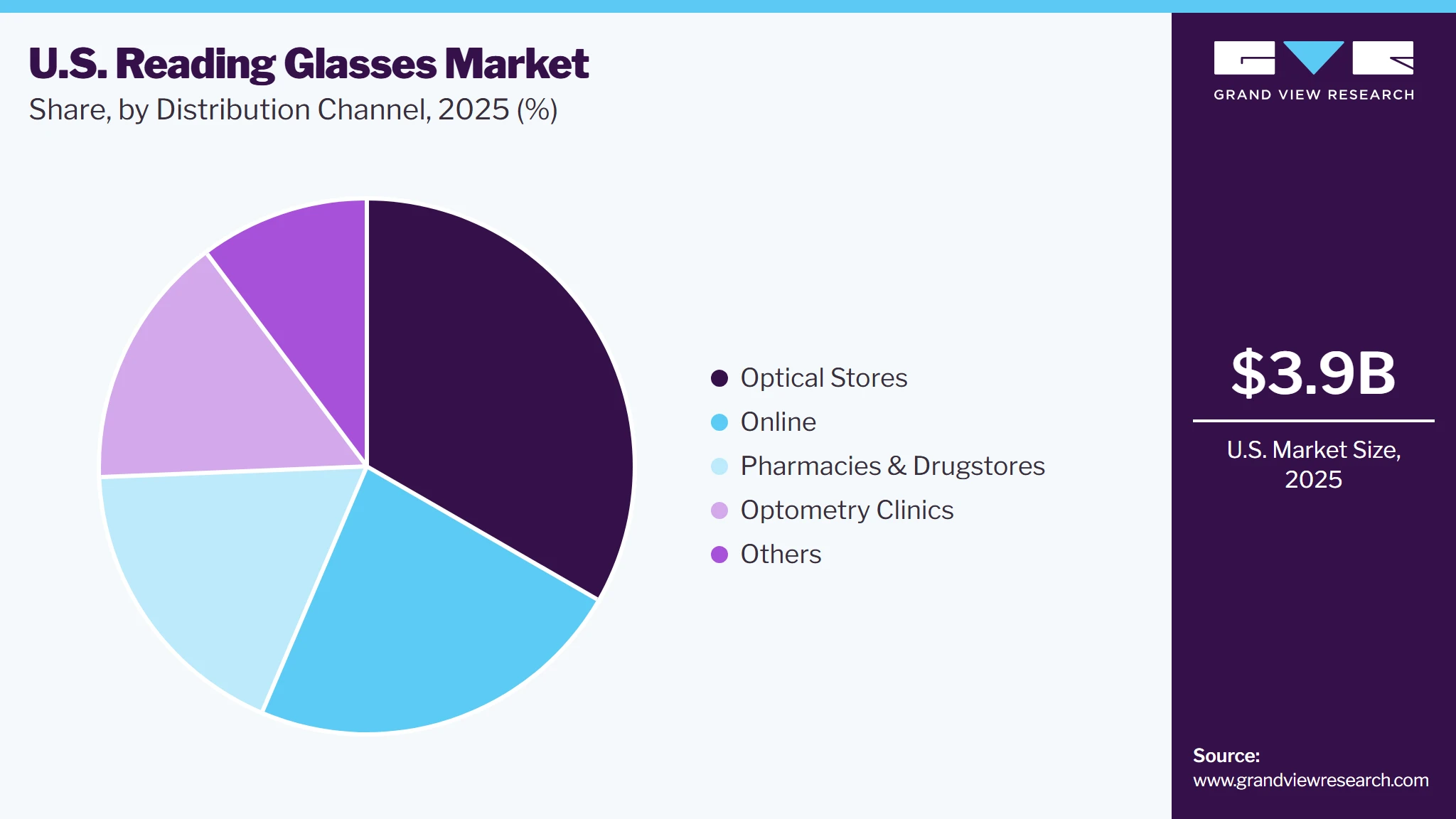
The online channel segment is anticipated to grow at the fastest CAGR of 5.4% from 2026 to 2033. The segment is gaining importance as U.S. consumers increasingly purchase reading glasses directly through brand websites, online optical retailers, and marketplaces. The channel is particularly suitable for OTC readers because consumers can select lens strength without completing a prescription process. Brands such as Zenni Optical, Readers.com, and Peepers provide online catalogs with filters for magnification, frame style, material, and price. Virtual try-on features, customer reviews, multi-pair promotions, and home delivery further improve the online purchasing experience and encourage repeat purchases.
Key U.S. Reading Glasses Companies:
-
EssilorLuxottica S.A.
-
Warby Parker Inc.
-
Bausch + Lomb Corporation
-
HOYA Corporation
-
JINS Holdings Inc.
-
Zenni Optical, Inc.
-
Peepers, Inc.
-
Readers.com
-
Clic Eyewear, Inc.
-
KITS Eyecare Ltd.
Competitive Benchmarking
Category
Operating Strategies
Competitive Edge
Weakness
Established Players (EssilorLuxottica S.A.; Warby Parker Inc.; Bausch + Lomb Corporation; HOYA Corporation; JINS Holdings Inc.; Zenni Optical, Inc.)
- Expand U.S. reading-eyewear portfolios across OTC readers, prescription glasses, bifocals, and progressives while strengthening optical retail, e-commerce, and direct-to-consumer channels and introducing personalized, functional, and technology-enabled lens solutions.
- Strong U.S. brand recognition, extensive optical networks, broad product portfolios, established manufacturing capabilities, and advanced lens technologies enable established players to serve prescription, OTC, progressive, and enhanced reading-eyewear segments.
- Large organizational structures, diversified portfolios, and higher operating costs can reduce flexibility and focus on the specialized U.S. reading glasses segment compared with smaller, specialized competitors targeting specific consumer needs.
Emerging / Niche Players (Peepers Inc.; Readers.com; Clic Eyewear, Inc.; KITS Eyecare Ltd.)
- Focus on specialized U.S. reading-glasses collections, affordable fashion-oriented frames, direct-to-consumer sales, and digital marketing while introducing functional products targeting specific consumer needs and lifestyle applications.
- Specialization in U.S. reading glasses enables niche companies to respond quickly to consumer preferences, introduce distinctive designs, offer competitive pricing, and build targeted product assortments around specific reading and lifestyle needs.
- Smaller scale, limited brand recognition, and narrower distribution networks can restrict physical retail reach, marketing investment, manufacturing capabilities, and access to professional eye-care channels, increasing reliance on online customer acquisition.
Recent Developments
-
In October 2025, ReadingGlasses.com partnered with American Mensa to launch the limited-edition Mensa Collection, featuring reading glasses designed around a more premium and sophisticated aesthetic. The collection combines near-vision functionality with distinctive frame styling, positioning reading glasses as a lifestyle and fashion accessory rather than solely a functional vision-correction product. The development reflects growing efforts among U.S. reading-glasses brands to differentiate through design, brand collaborations, and premium positioning, appealing to consumers who increasingly consider eyewear part of their personal style.
-
In February 2025, Eyesafe Eyewear introduced updated blue-light eyewear requirements alongside a dedicated reader collection, offering reading glasses in powers ranging from +0.50 to +2.50 in half-diopter increments. The development combines near-vision correction with blue-light filtering functionality, targeting consumers who use digital devices for extended periods. The launch reflects growing product differentiation within the U.S. market, as manufacturers increasingly integrate screen-oriented features into conventional readers to address both vision-correction and digital-use needs.
U.S. Reading Glasses Market Report Scope
Report Attribute
Details
Market size in 2025
USD 3.9 billion
Estimated market size in 2026
USD 4.1 billion
Projected market size by 2033
USD 5.5 billion
Growth rate
CAGR of 4.4% from 2026 to 2033
Base year for estimation
2025
Historical data
2021 2025
Forecast period
2026 - 2033
Quantitative units
Revenue in USD billion and CAGR from 2026 to 2033
Report coverage
Revenue forecast, company ranking, competitive landscape, growth factors, and trends
Segments covered
Product, frame material, lens type, distribution channel
Country scope
U.S.
Key companies profiled
EssilorLuxottica S.A.; Warby Parker Inc.; Bausch + Lomb Corporation; HOYA Corporation; JINS Holdings Inc.; Zenni Optical, Inc.; Peepers, Inc.; Readers.com; Clic Eyewear, Inc.; KITS Eyecare Ltd.
Customization scope
Free report customization (equivalent up to 8 analysts working days) with purchase. Addition or alteration to country, regional & segment scope.
Pricing and purchase options
Avail customized purchase options to meet your exact research needs. Explore purchase options
U.S. Reading Glasses Market Report Segmentation
This report forecasts revenue growth at the country level and provides an analysis of the latest trends and opportunities in each of the sub-segments from 2021 to 2033. For this study, Grand View Research has segmented the U.S. reading glasses market based on product, frame material, lens type, distribution channel.
-
Product Outlook (Revenue, USD Billion, 2021 - 2033)
-
Prescription Reading Glasses
-
OTC Reading Glasses
-
-
Frame Material Outlook (Revenue, USD Billion, 2021 - 2033)
-
Plastic
-
Metal
-
Others
-
-
Lens Type Outlook (Revenue, USD Billion, 2021 - 2033)
-
Single Vision
-
Progressive
-
Bifocal
-
-
Distribution Channel Outlook (Revenue, USD Billion, 2021 - 2033)
-
Optical Stores
-
Optometry Clinics
-
Pharmacies & Drugstores
-
Online
-
Others
-
Research Methodology
The U.S. reading glasses market figures in this report are based on a proven research process that combines executive interviews with secondary research from proprietary databases, company filings, and recognized regulatory and institutional sources. Market size is built through value-chain sizing-reconciling supply-side and demand-side estimates-and triangulated with bottom-up and top-down approaches. Every estimate passes multiple levels of expert validation before publication, with each U.S. reading glasses segment quantified using the revenue-capture definitions in the table below.
Segment Definition
Frame Material
Revenue capture definition
Single-Vision
Lenses with one consistent optical power across the entire lens, designed to correct vision at one specific distance, such as near vision for reading.
Progressive
Multifocal lenses provide near, intermediate, and distance vision through a gradual transition in lens power without visible lines between different vision zones.
Bifocal
Multifocal lenses contain two distinct optical powers, typically providing distance vision through the upper lens and near vision through the lower section.
Estimation Model
Layer Name
Key Question
Description
Near-Vision Need & Consumer Base Layer
Who needs reading glasses?
Begin with the U.S. adult population and identify consumers experiencing presbyopia or other near-vision difficulties. Apply age-specific presbyopia prevalence and correction-use rates, with particular focus on adults aged 40+ where near-vision needs become more prevalent. Further refine the population based on consumers requiring OTC or prescription reading correction.
Product Accessibility & Distribution Layer
Who has access to reading glasses?
Filter the potential consumer base based on availability through optical stores, optometry practices, pharmacies, mass retailers, specialty stores, brand websites, and e-commerce platforms. Account for access to both OTC/ready-made readers and prescription reading glasses, including availability of different lens powers, frame designs, and product features.
Purchase & Usage Conversion Layer
Who actively purchases reading glasses?
Apply purchase and adoption rates to consumers with access to reading glasses. Consider awareness of presbyopia, need for near-vision correction, lens-power requirements, purchasing preference for OTC versus prescription readers, replacement frequency, and multi-pair ownership. Account for consumers purchasing additional pairs for home, office, travel, or digital-device use.
Monetisation Layer
How much revenue is generated?
Estimate annual reading-glasses revenue by multiplying units purchased × average selling price (ASP). Segment ASPs across OTC and prescription reading glasses and incorporate differences by lens type, frame material, brand positioning, and distribution channel. Account for repeat purchases and multi-pair ownership to derive total U.S. market revenue.
Delivered Customizations
This report has been delivered with the following In-depth customizations
Client Request
Customization Delivered
Value Adds
U.S. Reading Glasses Market & Product Trend Analysis
Conducted a detailed assessment of the U.S. reading glasses market across prescription and OTC readers, single-vision, bifocal and progressive lenses, and plastic and metal frames, evaluating product positioning, lens functionality, frame design, pricing, and recent product innovations.
Helps stakeholders identify high-potential reading-glasses categories, understand the shift toward multifunctional and fashion-oriented readers, and evaluate opportunities across prescription and OTC product portfolios.
U.S. Consumer & Distribution Channel Analysis
Evaluated U.S. consumer purchasing behavior across optical stores, optometry practices, brand websites, and e-commerce platforms, with assessment of affordability, professional fitting, convenience, repeat purchases, and in-person versus online preferences. Recent U.S. consumer research indicates that readers continue to be predominantly purchased in person, while price sensitivity and selective spending are influencing eyewear purchases
Provides insights into channel-specific growth opportunities, consumer price sensitivity, purchase preferences, and the role of optical professionals in prescription and reading-glasses purchases. Supports channel strategy, pricing decisions, and retail expansion planning.
Technology, Distribution & Competitive Landscape Assessment
Assessed U.S. developments in blue-light-filtering readers, progressive readers, anti-reflective lenses, lightweight and premium frames, multifunctional reading glasses, and digital/online retail. The analysis also evaluated key companies, product launches, brand collaborations, retail positioning, and emerging consumer trends.
Supports product-development and competitive-positioning strategies by identifying functional features, pricing opportunities, emerging product formats, and consumer-driven innovation areas within the U.S. reading-glasses market.
Frequently Asked Questions About This Report
The U.S. reading glasses market size was valued at USD 3.9 billion in 2025 and is estimated at USD 4.1 billion for 2026.
Optical stores accounted for the largest market share of 34.2% in 2025.
The single-vision lens type accounted for the largest market share of 55.2% in 2025.
The online distribution channel is the fastest-growing region over the forecasted period.
The U.S. reading glasses market is expected to grow at a CAGR of 4.4% from 2026 to 2033, reaching USD 5.5 billion by 2033.
Prescription reading glasses accounted for the largest market share of 57.8% in 2025.
Growing awareness of eye health, prolonged screen exposure, and age-related changes in near vision are increasing the need for accessible vision-correction solutions in the U.S. As consumers increasingly seek convenient products for reading, computer use, and other close-up activities, demand is shifting toward affordable and easily accessible reading glasses.
Key players in the U.S. reading glasses market are EssilorLuxottica S.A.; Warby Parker Inc.; Bausch + Lomb Corporation; HOYA Corporation; JINS Holdings Inc.; Zenni Optical, Inc.; Peepers, Inc.; Readers.com; Clic Eyewear, Inc.; and KITS Eyecare Ltd.
Plastic frame material accounted for the largest market share of 52.0% in 2025.
About the Author(s)
Clothing, Footwear & Accessories Research Team
Consumer Goods · Clothing, Footwear & AccessoriesThis report was authored by the clothing, footwear & accessories research team at Grand View Research - comprising two research analysts, one senior research analyst, and one industry expert - with specialized expertise in the clothing, footwear & accessories segment of the consumer goods industry. All findings are based on proprietary consumer goods databases, executive interviews, and regulatory analysis, subject to internal peer review prior to publication.
Last Updated:
Speak to Analyst


Customize this report to your needs — add regions, segments, or data points, with 20% free customization.
Or view our licence options:


ISO 9001:2015 & 27001:2022 Certified
We are GDPR and CCPA compliant! Your transaction & personal information is safe and secure. For more details, please read our privacy policy.


