
- Home
- »
- Clothing, Footwear & Accessories
- »
-
Reading Glasses Market Size & Share Report, 2026-2033GVR Report cover
![Reading Glasses Market (2026 - 2033)Report]()
Reading Glasses Market (2026 - 2033)
Size, Share & Trends Analysis Report By Product (Prescription Reading Glasses, OTC Reading Glasses), By Frame Material (Plastic, Metal), By Lens Type (Single Vision, Progressive), By Distribution Channel, By Region, And Segment Forecasts
Market Size, 2025
$14.4BMarket Estimate, 2026
$15.2BMarket Forecast, 2033
$23.0BCAGR, 2026–2033
6.1%Reading Glasses Market Summary
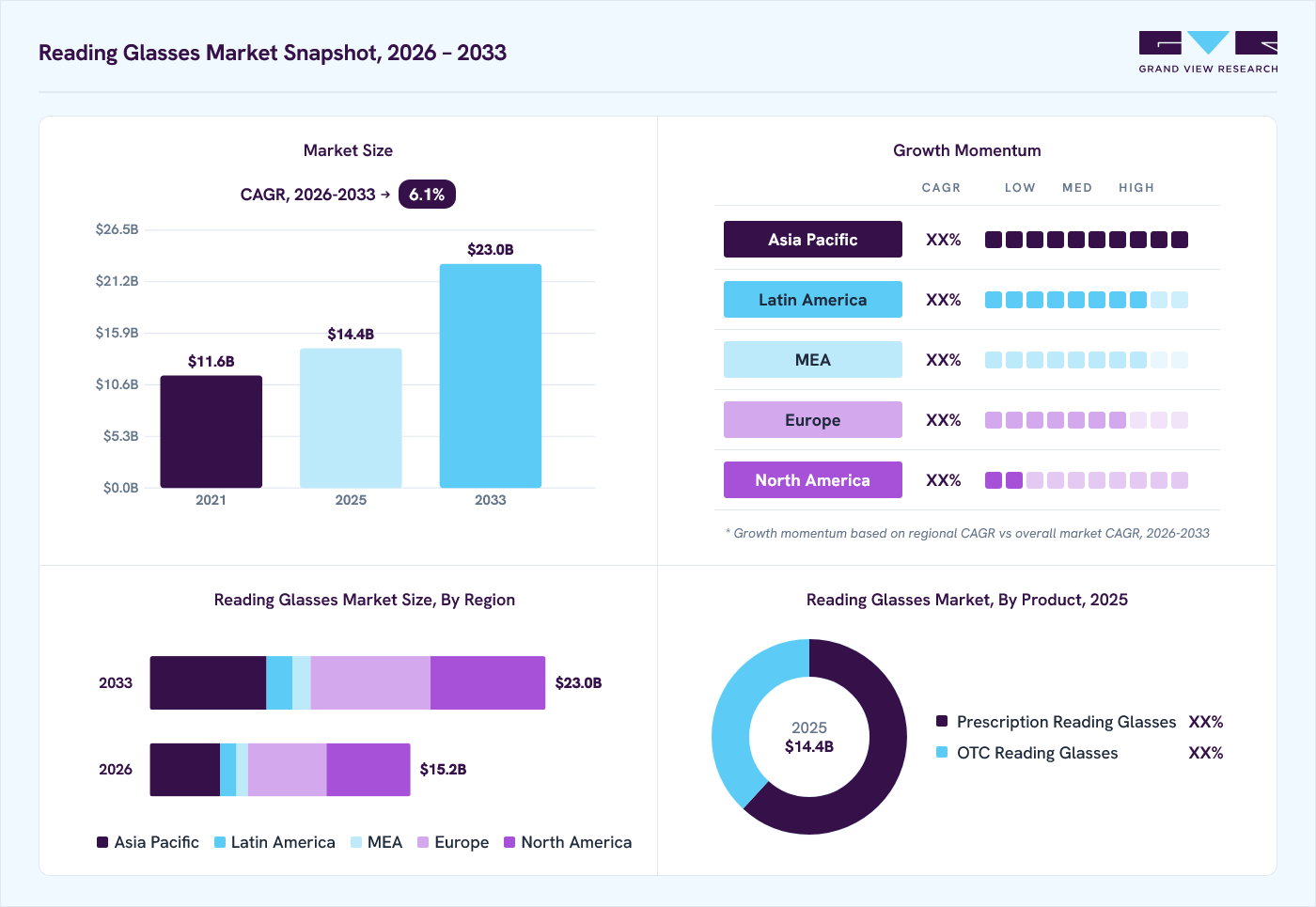
The global reading glasses market size was valued at USD 14.4 billion in 2025 and is projected to grow from USD 15.2 billion in 2026 to USD 23.0 billion by 2033, at a CAGR of 6.1% from 2026 to 2033. The market in North America dominated with a revenue share of 32.7% in 2025. The growth is supported by the expanding population requiring near-vision correction, increasing awareness of presbyopia, rising access to affordable reading eyewear, and the continued development of prescription and ready-made reading-glasses products.
Key Market Trends & Insights
- By frame material: Plastic segment held the largest market share of 63.9% in 2025.
- By product: Prescription reading glasses segment held the largest market share of 62.0% in 2025.
- By lens type: Single vision segment held the largest market share of 54.2% in 2025.
- By distribution channel: Optical stores segment held the largest market share of 35.2% in 2025.
Regional Highlights
- Largest regional market: North America (32.7% revenue share, 2025)
- Fastest-growing regional market: Asia Pacific (highest CAGR, 2026-2033)
- By country: The U.S. held the largest market share in 2025.
Market Size & Forecast
- Market size in 2025: USD 14.4 Billion
- Estimated market size in 2026: USD 15.2 Billion
- Projected market size by 2033: USD 23.0 Billion
- CAGR (2026-2033): 6.1%
For instance, WHO estimates that more than 800 million people globally have near-vision impairment (presbyopia) that could be addressed with reading glasses, while the number of people with presbyopia is projected to reach approximately 2.1 billion by 2030. This expanding addressable population is creating sustained demand for reading eyewear across prescription and OTC formats.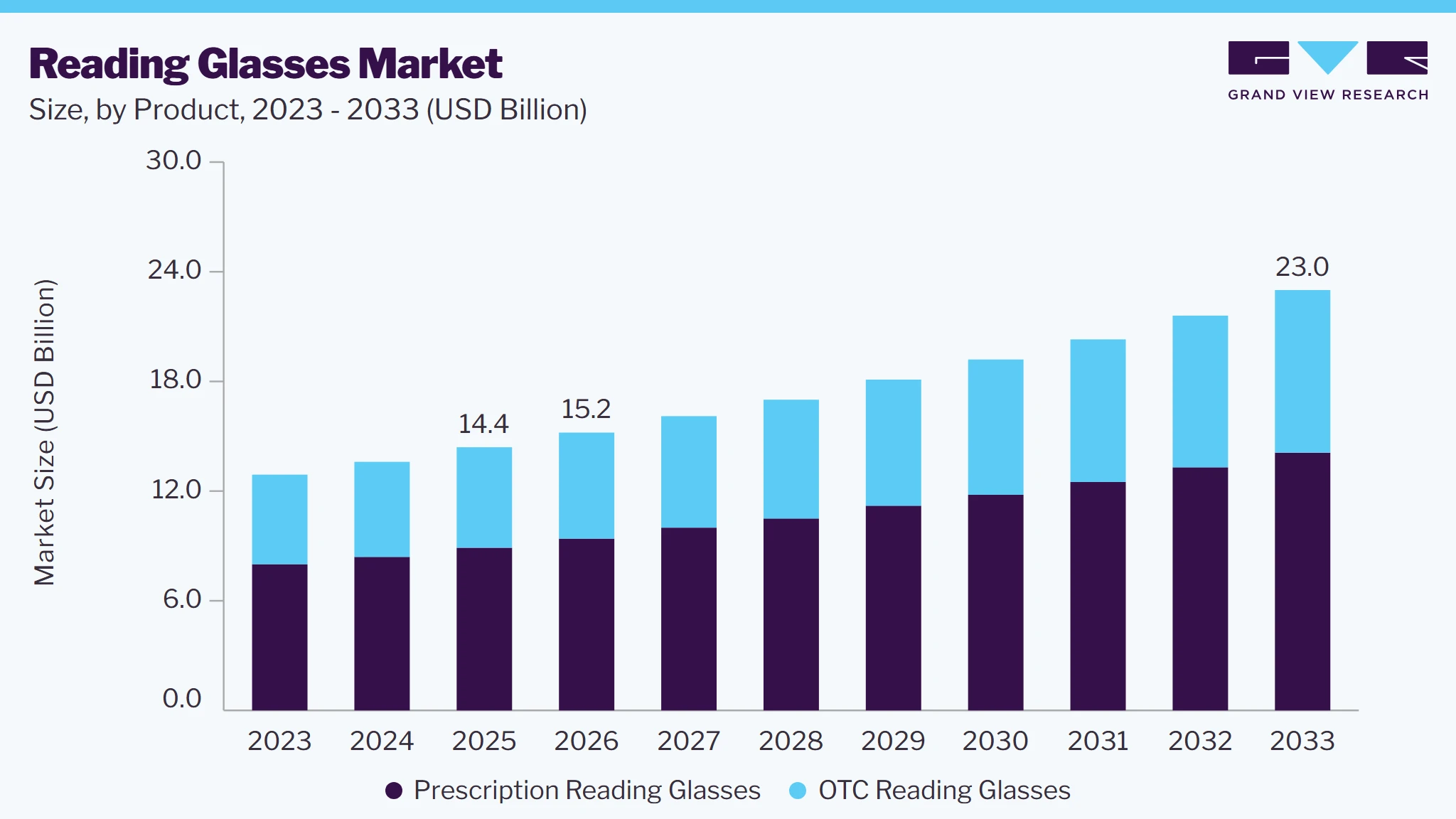
Product innovation and premiumization are also shaping the reading eyewear market. Manufacturers and optical companies are expanding offerings across single-vision, bifocal, and progressive lenses. Product innovation is expanding beyond basic reading correction, with manufacturers introducing lens enhancements such as blue-light filtering, photochromic/light-responsive technology, anti-fatigue designs, and customized lens solutions. These features allow reading eyewear to address additional consumer needs, including digital-device use, changing light conditions, visual comfort, and personalized vision correction. These developments are broadening the range of reading eyewear available to consumers and creating opportunities to move beyond basic readers toward more personalized vision-correction solutions. Lens manufacturers are increasingly adding functional and personalized features to reading and near-vision eyewear. ZEISS offers BlueGuard and DuraVision BlueProtect UV for blue-violet light filtering, while Transitions provides light-adaptive photochromic lenses that automatically adjust from clear indoors to dark outdoors.
Moreover, the global reading glasses market is being supported by the expansion of access to affordable near-vision correction, particularly in underserved populations. WHO has highlighted that only 36% of people globally with distance vision impairment caused by refractive error have access to an appropriate pair of spectacles, while it has established a global target to increase effective refractive-error coverage by 40 percentage points by 2030. Distribution models for reading eyewear are expanding beyond conventional optical retailers and eye-care facilities as organizations seek to improve access to affordable near-vision correction.
For instance, in May 2025, the World Health Organization (WHO) partnered with the Universal Postal Union under a 2025-2027 action plan to use postal networks for distributing affordable near-vision glasses and promoting eye-health awareness. WHO estimates that more than 800 million people worldwide have presbyopia, while in many low-income countries, fewer than one in four people who need eyeglasses can obtain them. As part of the initiative, Assam, India, was selected for the first pilot, where trained postal workers across five postal services are likely to conduct simple vision screenings and provide low-cost, ready-made reading glasses. The initiative demonstrates the potential of community-based and non-traditional distribution networks to expand reading-eyewear accessibility in underserved markets.
Another trend is the expansion of reading eyewear through pharmacies, community agents, and other accessible points of sale. VisionSpring is a social enterprise that expands access to affordable eyeglasses in underserved and low-income communities, with a particular focus on emerging and frontier markets. The organization uses alternative distribution models such as community agents and pharmacies to provide vision screening and ready-made reading glasses, helping address gaps in access to conventional optical services. In 2024, VisionSpring more than doubled its pharmacy network from 297 to 615 locations and helped 39,000 people obtain clear vision through reading glasses. Its demand-generation pilot in Kumasi, Ghana, tripled sales in participating pharmacies, adding approximately 150 pairs per pharmacy. Through its community-agent model, VisionSpring screened 1.16 million people and dispensed glasses to 363,000 people, while reading glasses represented 74% of the 2.13 million eyeglasses distributed across its programs.
Market Dynamics
The expansion of OTC/ready-made reading glasses is supporting growth in the global reading eyewear market by improving the affordability, convenience, and accessibility of near-vision correction. Standardized lens powers allow consumers with straightforward presbyopia to obtain reading eyewear without the need for customized prescriptions, broadening access across multiple retail and digital channels. The availability of low-cost readers also supports repeat purchases and multiple-pair ownership, as consumers can keep glasses in different locations for everyday reading and near-vision activities. Growing awareness of presbyopia and increasing demand for convenient vision-correction solutions are further supporting adoption. In addition, broader retail availability and expanding online access are reducing barriers to purchasing ready-made reading eyewear, particularly among consumers seeking simple, immediate, and affordable near-vision solutions. As accessibility improves across developed and emerging markets, OTC reading glasses are expected to contribute increasingly to overall reading eyewear demand. For instance, Readers.com currently markets selected ready-made readers at prices below US$15, including products priced around US$7-10, while offering discounts of up to 70% on selected styles. Such low-price options can encourage consumers to purchase additional pairs for homes, offices, travel, or other everyday activities, reinforcing the convenience and repeat-purchase characteristics of OTC reading glasses.
The growing availability of low-cost generic and counterfeit reading glasses can restrain market value growth by intensifying price competition and limiting product differentiation. Basic OTC readers are relatively standardized, allowing multiple manufacturers and private-label retailers to offer similar products at lower prices. This can encourage consumers to prioritize affordability over branded or premium reading eyewear, putting pressure on average selling prices and margins. Counterfeit or poor-quality products can further raise concerns regarding lens accuracy, optical quality, durability, and consumer safety, particularly when products are sold through unauthorized online marketplaces and informal retail channels.
Recent enforcement actions highlight the broader counterfeit challenge within the eyewear industry. In February 2026, the Philippine National Bureau of Investigation (NBI) seized 9,571 fake, well-known branded eyewear items and 4,525 other luxury-branded counterfeit eyewear products from five establishments in Cagayan de Oro City. The seized eyewear had an estimated value of ₱242.49 million (US$4.2 million), highlighting the presence of counterfeit products within the broader eyewear market and the potential for low-cost unauthorized products to compete with legitimate eyewear. In another case, Hong Kong Customs seized around 2,500 suspected counterfeit sunglasses and optical glasses in March 2026, with an estimated market value of approximately HK$2.2 million. Although these cases involve broader eyewear categories, they indicate the wider availability of counterfeit optical products and the potential for unauthorized low-priced alternatives to undermine brand differentiation, consumer trust, and pricing power across the reading eyewear market.
Increasing use of smartphones, computers, tablets, and other digital devices is creating opportunities for reading and near-vision eyewear designed for prolonged screen use. Consumers spending extended periods on digital devices may seek improved near and intermediate vision, greater visual comfort, and reduced eye strain. This is encouraging manufacturers to develop specialized lenses incorporating anti-fatigue designs, blue-light-filtering features, and enhanced near-vision support. Such products can be particularly relevant for adults experiencing presbyopia who frequently use digital devices for work, communication, entertainment, and online activities. The growing integration of digital device use into daily routines, therefore, creates opportunities for manufacturers to develop more functional and premium reading eyewear.
Analyst Perspective
The reading glasses market is shifting from a purely functional health category toward a broader wellness and lifestyle purchase, shaped by an aging global population and rising presbyopia awareness. Growth is supported by expanding OTC accessibility, e-commerce distribution, and increased consumer willingness to treat readers as a fashion accessory rather than a medical necessity alone. At the same time, a persistent access gap in lower-income regions where unmet need for corrective eyewear remains high points to long-term structural demand beyond mature markets. WHO-aligned coverage initiatives and vision-care partnerships are gradually narrowing this gap, positioning underserved regions as a longer-horizon growth opportunity alongside near-term demand in developed markets.
Brand/Company Market Share Insights
The global reading glasses market features a mix of vertically integrated eyewear conglomerates, direct-to-consumer digital-first brands, and specialty reader-focused companies. Companies such as EssilorLuxottica S.A., Bausch + Lomb Corporation, and HOYA Corporation compete through broad lens and eyewear portfolios, manufacturing scale, and retail distribution reach spanning both prescription and non-prescription categories. Competition is increasingly centered on expanding online accessibility, virtual try-on tools, and multi-channel retail presence to reach cost-conscious and convenience-driven consumers.
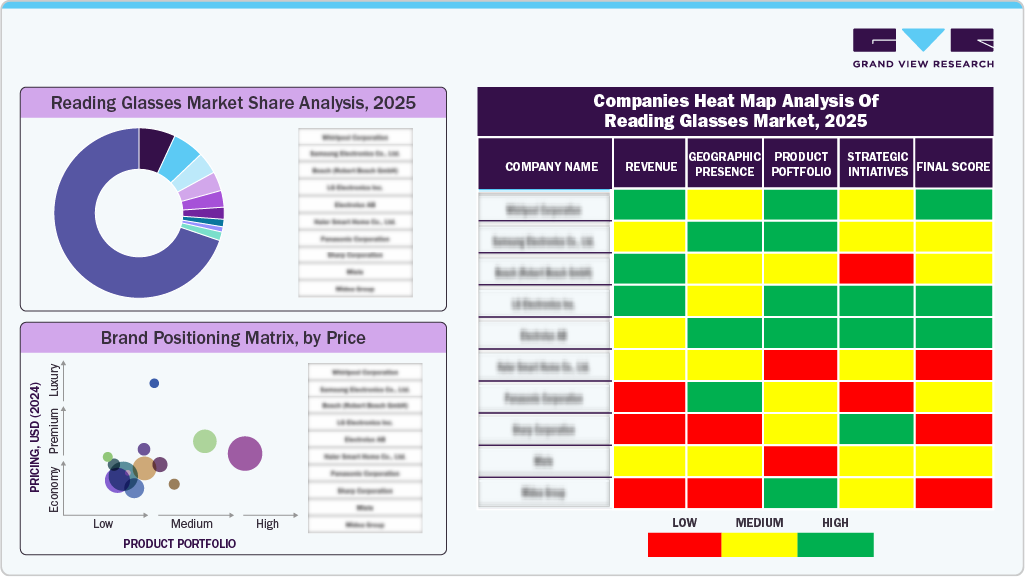
Meanwhile, digital-native and specialty brands are reshaping the category through differentiated positioning. Companies such as Warby Parker Inc., JINS Holdings Inc., and Zenni Optical, Inc. compete on affordability, fast fulfillment, and design-forward branding, while readers-focused specialists, including Peepers, Inc., Readers.com, Clic Eyewear, Inc., and KITS Eyecare Ltd., differentiate through curated style collections, lifestyle-driven marketing, and collaborations targeting style-conscious presbyopic consumers. The expansion of e-commerce platforms, subscription-style repeat-purchase models, and influencer-led content is increasing consumer touchpoints and supporting competitive intensity across both value and premium segments of the market.
Consumer Insights
Consumer behavior in the reading glasses market is shifting from a purely corrective purchase toward one shaped by convenience, price sensitivity, and lifestyle preference. Nearly one in three U.S. adults 36% report using reading glasses, and buyers increasingly treat readers as a low-commitment, replaceable product rather than a single long-term purchase 35% of readers purchased were priced at $10 or less in recent survey data, reflecting strong demand at the budget end of the category.

Consumer behavior in the reading glasses market is shaped less by clinical necessity and more by convenience, affordability, and lifestyle fit. Buyers increasingly treat reading glasses as a low-commitment, easily replaceable purchase rather than a single, considered investment, often keeping multiple pairs on hand for home, work, and travel use. Purchase decisions are influenced by product availability and the ability to try items on, with many consumers still preferring in-person buying for the assurance of correct fit and immediate use, even as online channels grow in relevance for price-conscious shoppers. Growing time spent on digital devices is also nudging consumer interest toward readers with added blue-light-filtering features, reflecting a broader shift toward eyewear that serves both corrective and everyday comfort needs. Overall, purchasing behavior reflects a practical, needs-driven mindset rather than aspirational or brand-loyalty-driven decision-making typical of premium eyewear categories.
Product Insights
The prescription reading glasses segment accounted for the largest market share of 62.0% in 2025, driven by demand for accurate, customized corrective strength suited to individual near-vision needs. Consumers with progressive presbyopia or asymmetric vision requirements favor prescription readers for precision fit, higher-quality lens materials, and reduced risk of visual distortion compared to standardized alternatives. Growth is reinforced by managed vision care coverage, routine eye exam adoption, and continued reliance on optician- and optometrist-guided purchases. Expanding lens technology, including anti-reflective coatings and high-index thin lenses, is further strengthening consumer preference for prescription reading glasses among presbyopic and vision-sensitive populations across developed markets.

The OTC reading glasses segment is anticipated to grow at a CAGR of 6.4% from 2026 to 2033, driven by wide product availability across pharmacies, retail chains, and e-commerce platforms, along with lower price points that support impulse and repeat purchases. Demand is supported by a consumer base skewed toward adults experiencing early-stage presbyopia, many of whom prefer readers as an easily replaceable, multi-pair accessory rather than a single long-term investment. Growing willingness to treat readers as a style-driven purchase, combined with no-prescription-required convenience and rising interest in anti blue reading glasses, continues to expand adoption across price-conscious and style-conscious consumer segments alike.
Frame Material Insights
The plastic frame material segment accounted for the largest market share of 63.9% in 2025, favored for their lightweight construction, affordability, and design flexibility. Manufacturers use plastic to produce a broad range of colors, patterns, and shapes at low cost, making it well-suited to mass-market and OTC reading glasses where frequent replacement and multi-pair ownership are common. Plastic's durability and resistance to bending under everyday wear further support its use in budget and mid-range price tiers. Growing consumer interest in fashion-forward, expressive eyewear styling has reinforced plastic's position, as brands use the material to introduce frequent design updates, seasonal collections, and trend-driven collaborations at accessible price points across both prescription and non-prescription reading glasses.
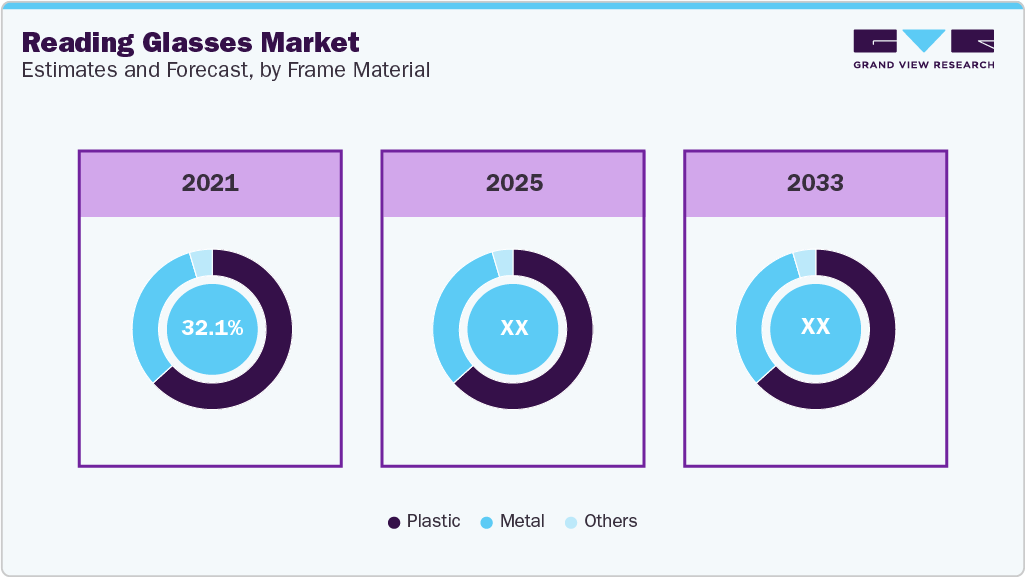
The metal frame material is anticipated to grow at a CAGR of 6.5% from 2026 to 2033, driven by consumer preference for a lightweight, durable, and understated aesthetic often associated with premium or professional styling. Materials such as titanium, stainless steel, and various metal alloys offer strength with minimal bulk, appealing to consumers seeking long-lasting eyewear suited to daily use. Metal frames are commonly favored in prescription reading glasses, where durability and adjustable components such as nose pads support comfort and fit customization. Rising demand for minimalist and classic frame designs, alongside continued innovation in flexible and hypoallergenic metal alloys, is expected to support steady consumer interest in metal-framed readers across both value and premium market segments.
Lens Type Insights
The single vision reading glasses segment accounted for the largest market share of 54.2% in 2025, supported by their affordability and suitability for consumers with a single, uniform near-vision correction need. These lenses are the standard choice across OTC reading glasses, where a single fixed magnification power is applied uniformly across the lens for close-up tasks such as reading, sewing, and screen use. Broad retail availability across pharmacies, optical stores, and e-commerce platforms continues to support consumer access. Ease of manufacturing, lower production cost, and straightforward fitting requirements make single-vision lenses the preferred option for early-stage presbyopes seeking a simple, budget-friendly corrective solution without the complexity of multifocal designs.

The demand for progressive lens reading glasses is anticipated to grow at the fastest CAGR of 7.2% from 2026 to 2033, driven by consumer demand for seamless vision correction across near, intermediate, and distance ranges within a single lens, without the visible line associated with traditional bifocals. This lens type appeals particularly to presbyopic consumers who also require correction for distance or intermediate vision, offering a more versatile, all-in-one alternative to single-purpose readers. Growth is supported by advances in progressive lens design, including wider viewing zones and reduced peripheral distortion, as well as rising consumer preference for multifunctional eyewear that eliminates the need to switch between multiple pairs. Increasing awareness among presbyopic populations and continued innovation in customized progressive lens technology are expected to support steady adoption over the forecast period.
Distribution Channel Insights
The optical stores segment accounted for the largest market share of 35.2% in 2025, supported by consumer preference for in-person try-on, professional fitting assistance, and immediate product availability. These outlets, including independent opticians, optometry practices, and retail optical chains offer the added advantage of on-site eye exams, personalized guidance on lens power and frame fit, and access to both prescription and OTC reading glasses within a single visit. Consumer trust in professional recommendations, combined with the ability to physically assess frame comfort and style before purchase, continues to support strong footfall through this channel. Managed vision care coverage further reinforces optical stores as a preferred channel for the reading eyewear market.
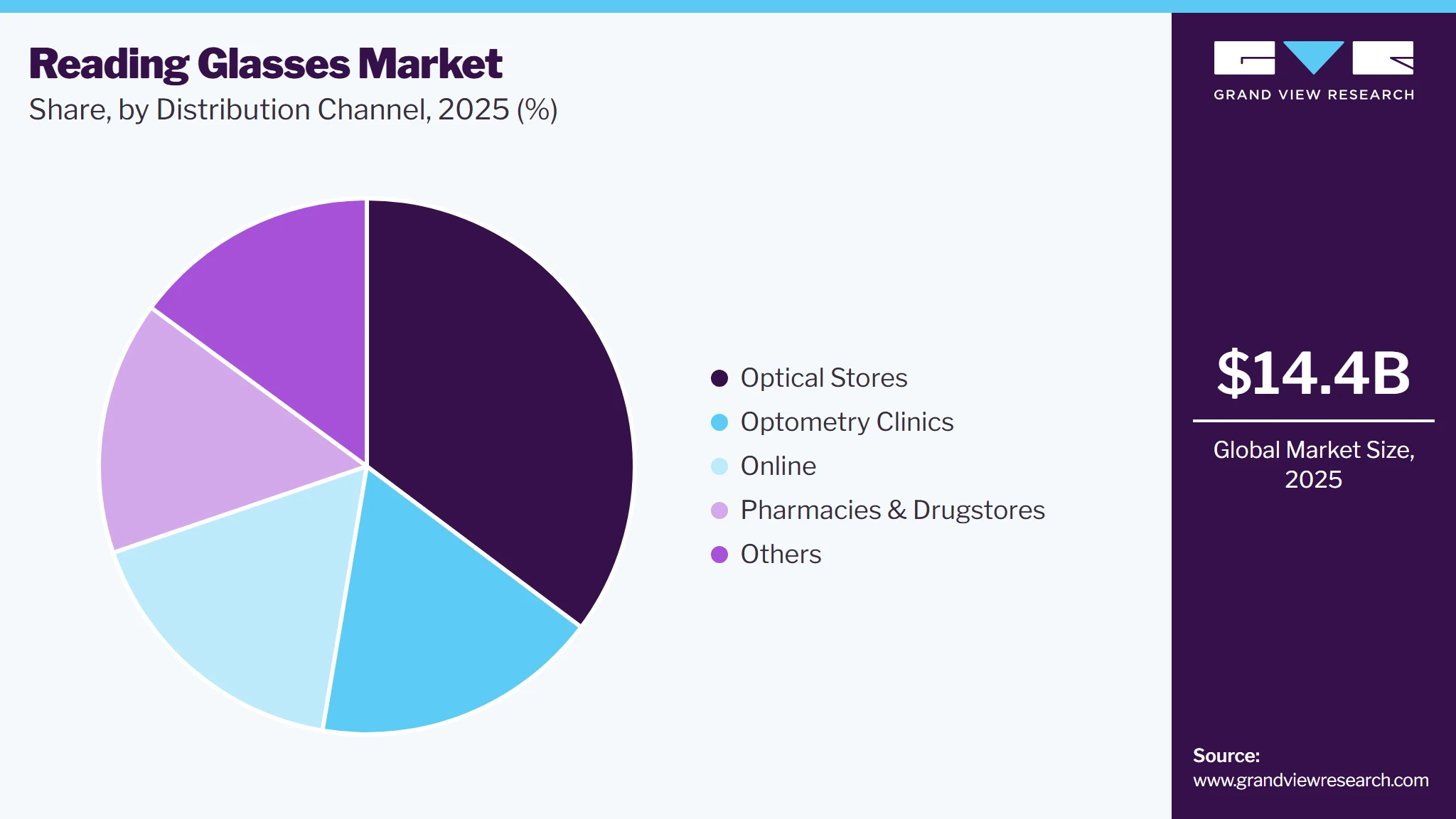
The online channel segment is anticipated to grow at the fastest CAGR of 8.2% from 2026 to 2033, driven by increasing consumer comfort with e-commerce, competitive pricing, and the convenience of doorstep delivery. Growth is supported by expanding digital catalogs, virtual try-on tools, and detailed product filtering by lens power, frame style, and price, which help offset the traditional need for in-person fitting. Online retailers and direct-to-consumer eyewear brands are increasingly targeting price-conscious and repeat-purchase consumers, particularly for OTC readers where prescription verification is not required. Rising consumer familiarity with online shopping for multi-pair, low-cost reading glasses, combined with broader internet and smartphone penetration, is expected to support continued momentum for this channel across both developed and emerging markets.
Regional Insights
The North American reading glasses market accounted for the largest share of 32.7% in 2025, supported by a large aging population and high consumer awareness of vision correction options. Presbyopia, the age-related decline in near-vision focusing ability, typically begins after age 40-45, and according to the National Eye Institute, anyone over the age of 35 is already at risk of developing the condition pointing to a broad and steadily expanding base of potential reading glasses users as the region's population ages. Within the U.S. reading glasses market, demand is anchored by the scale of the country's aging population and the near-universal onset of presbyopia with age. The National Eye Institute notes that approximately half of all American adults don't have the vision physicians consider optimal due to refractive errors, with presbyopia among the most common, reflecting substantial ongoing needs for near-vision correction nationwide. This demographic base, combined with broad retail availability across optical stores, pharmacies, and e-commerce, continues to support sustained consumer demand within the U.S. reading glasses market, distinguishing it as one of the more mature and higher-penetration reading glasses markets globally.Top of Form

U.S. Reading Glasses Market Trends
The U.S. reading glasses market accounted for the largest share of 83.2% in 2025. The U.S. reading glasses market benefits from a large presbyopic population and broad retail accessibility across pharmacies, optical stores, and e-commerce. Presbyopia typically develops after age 40-45, with risk beginning around 35, expanding the addressable consumer base as the population ages. Growing demand for style-forward, multifunctional eyewear, combined with rising smart-eyewear integration and continued innovation from established and digital-first brands, is reshaping consumer expectations beyond basic vision correction.
The Mexico reading glasses industry is expected to grow at a CAGR of 6.1% from 2026 to 2033. The Mexico reading glasses market is shaped by a substantial, clinically documented burden of refractive error. A 2025 peer-reviewed study analyzing 3.8 million outpatients across all 32 Mexican states in 2024 found an overall refractive error prevalence of 74.61%, with a notable inflection point at the 40-49 age group, consistent with presbyopia onset. Separate nationwide research found uncorrected refractive errors affecting 26.5% of outpatients, highest in Baja California Sur. This combination of a large affected population and persistent undercorrection points to sustained structural demand for reading glasses, particularly outside major urban centers where access to corrective eyewear remains limited. Taken together, these findings position Mexico as a market where clinical need consistently outpaces current correction rates, sustaining long-term growth potential for both prescription and OTC reading glasses.
Asia Pacific Reading Glasses Market Trends
The Asia Pacific reading glasses industry is expected to grow at the fastest CAGR of 7.4% from 2026 to 2033, increasing awareness of eye health and the growing adoption of eyewear designed for digital-device use. Age-related presbyopia, prolonged screen exposure, and changing consumer preferences toward lightweight, fashionable, and functional eyewear are encouraging manufacturers to expand their product portfolios across reading glasses, prescription glasses, and anti-blue light reading glasses. Japan, China, South Korea, India, and Australia represent important markets, supported by established optical retail networks, expanding e-commerce channels, and growing access to optometry and vision-care services.
A notable trend in the region is the development of anti-blue light and eyewear designed for digital screen use and eye comfort. Japanese eyewear company JINS offers its JINS SCREEN range with blue light cut lenses designed for consumers who spend extended periods using computers, smartphones, and other digital devices. The range includes lenses with different blue-light filtering levels and is available in both prescription and non-prescription configurations. This product development illustrates the expansion of functional eyewear beyond conventional vision correction and creates opportunities for reading and prescription glasses incorporating additional features such as blue-light filtering and screen-use functionality.
Reading glasses market in India is evolving toward digitally-enabled and multifunctional eyewear, with product development increasingly extending beyond basic prescription correction. The market is expected to showcase a strong CAGR of 8.1% from 2026 to 2033. In particular, Indian eyewear companies are investing in AI-powered smart eyewear, direct-to-consumer digital platforms, and franchise-driven retail expansion, creating opportunities for reading and prescription glasses to incorporate additional lifestyle and technology-driven functionality. A notable development is the increasing integration of AI technology with prescription-compatible eyewear. In June 2026, Lenskart Solutions Limited developed "B by Lenskart," an AI-powered smart eyewear line engineered in-house around a "glasses first" design philosophy, with commercial pricing set at ₹27,000. While this product is not a conventional reading glasses offering, the development demonstrates the broader transformation of corrective eyewear in India into a connected, technology-enabled category, and could support future integration of smart features into mainstream prescription and near-vision eyewear as the domestic market matures.
China reading glasses market accounted for a revenue share of around 37.7% of the Asia Pacific market in 2025. China's reading eyewear market sits at the intersection of two converging demographic forces: the world's largest documented youth myopia burden and a rapidly aging population, both of which point toward substantial long-term corrective eyewear demand. China's 2018 national survey found childhood and adolescent myopia prevalence at 53.6%, rising to 81% by senior secondary school a scale affecting an estimated 280 million children currently in China's school system. In response, the government has treated myopia as a national public health priority rather than a routine clinical issue in December 2025, thirteen government departments led by the National Health Commission issued the Children and Adolescents' Five Health Promotion Action Plan (2026-2030), setting formal prevalence-reduction targets through 2030 and mandating structured vision screening at defined checkpoints nationwide. National monitoring already shows childhood myopia prevalence declined by 3.3% points between 2018 and 2024, reflecting one of the largest coordinated vision-health systems globally a population base that is expected to increasingly require presbyopia correction as it ages into adulthood over the coming decades. China has simultaneously become a global leader in next-generation eyewear, with domestic technology and eyewear brands increasingly embedding AI functionality directly into everyday frames rather than treating smart eyewear as a niche category, reflecting a broader shift toward multifunctional corrective eyewear relevant to the future direction of prescription and reading glasses.
Europe Reading Glasses Market Trends
The reading glasses market in Europe accounted for a revenue share of 30.1% of the global market in 2025. The market is evolving toward multifunctional and technology-enabled eyewear, with product development increasingly extending beyond basic near-vision correction. In particular, European eyewear companies are investing in prescription lens technologies, connected eyewear, AI-enabled features, and digital vision solutions, creating opportunities for reading glasses to incorporate additional functionality. A notable development is the increasing integration of smart technology with prescription-compatible eyewear. In July 2026, EssilorLuxottica showcased its connected-eyewear and AI-powered innovations at VivaTech 2026 in Paris, highlighting the company's focus on combining eyewear with digital technologies and AI capabilities. While these products are not conventional reading glasses, the development demonstrates the broader transformation of corrective eyewear into connected devices and could support future integration of smart features into prescription and near-vision eyewear.
UK reading glasses industry accounted for a revenue share of around 24.5% of the Europe market in 2025. The UK reading glasses market is increasingly moving toward functional and technology-enhanced eyewear, with manufacturers and optical retailers expanding products beyond basic near-vision correction. In July 2025, Boots Opticians introduced Ray-Ban Meta and Nuance Audio smart glasses across selected UK stores. Both products can be fitted with prescription lenses, demonstrating the growing integration of digital functionality with prescription glasses and creating potential opportunities for future reading-focused smart eyewear. The UK reading glasses market is also seeing increasing adoption of smart eyewear with prescription compatibility. In April 2026, new Ray-Ban Meta optical-first models were introduced with support for a wide range of lens designs and became available in the UK. These developments indicate that prescription glasses are increasingly becoming platforms for AI and connected features, while anti blue light reading glasses and other functional lenses provide additional opportunities for differentiation within the reading and near-vision eyewear segment.
Reading glasses industry in Italy benefits from an aging population and strong cultural familiarity with eyewear as both a functional and style-driven product. The market is expected to showcase a CAGR of 5.8% from 2026 to 2033. As presbyopia becomes more common with age, demand continues across both prescription and over-the-counter reading glasses, supported by widespread access through pharmacies, optical stores, and specialty eyewear retailers found throughout the country. Italy's position as one of the global center for eyewear design and manufacturing also shapes the market's character, with a strong emphasis on craftsmanship, frame aesthetics, and fashion-forward styling. This design heritage extends into reading glasses as well, with Italian brands often approaching near-vision eyewear as a lifestyle accessory rather than a purely functional product. Growing interest in premium materials, refined frame shapes, and versatile designs suited to both professional and casual settings continues to influence how reading glasses are positioned within the broader Italian eyewear market.
Central & South America Reading Glasses Market Trends
The Central & South America reading glasses industry is expected to grow at a CAGR of 6.9% from 2026 to 2033. The Central & South America (CSA) reading glasses market is increasingly influenced by the development of prescription glasses, anti blue light reading glasses, and digitally enabled eyewear. Brazil is particularly relevant to regional product development, with optical retailers and international eyewear companies expanding access to prescription and functional lenses. Rising digital-device usage is also creating opportunities for reading glasses that combine near-vision correction with screen-use features.
Reading eyewear market in Brazil operates within one of Central and South America's most developed and competitive optical retail landscapes, led by a mix of international and homegrown players. The market is expected to grow at a CAGR of 7.0% from 2026 to 2033. Óticas Carol, owned by EssilorLuxottica, holds the leading position with roughly 1,400 stores nationally, followed by Óticas Diniz with around 1,200 locations, while Brazilian fashion-eyewear brand Chilli Beans has aggressively expanded its prescription eyewear business. This scale of dedicated optical retail infrastructure spanning both prescription and reading eyewear supports strong consumer access across Brazil's major urban centers, with continued expansion targeting broader national and street-level retail coverage.
Middle East & Africa Reading Glasses Market Trends
Reading glasses industry in Middle East & Africa is expected to grow at a CAGR of 6.7% from 2026 to 2033. The Middle East & Africa reading glasses market is increasingly shaped by premiumization, fashion-led eyewear, and specialized optical retail. In Gulf markets, consumers have greater access to international eyewear brands through premium optical chains, shopping malls, department stores, and luxury retail destinations. This trend is encouraging reading-glasses manufacturers to focus on designer frames, lightweight construction, premium materials, and aesthetically differentiated designs rather than positioning readers solely as functional vision-correction products. In May 2025, Meta and EssilorLuxottica launched the Ray-Ban Meta collection in the UAE, offering multiple frame and lens variations, including prescription lenses. The smart eyewear integrates Meta AI, a camera, open-ear audio, and connected features, demonstrating the growing convergence of prescription eyewear and digital technologies in the Middle East.
South Africa reading glasses industry accounted for a revenue share of around 25.5% of the Middle East and Africa market in 2025. The South Africa reading glasses market is shaped by a distinctive dual-channel structure dedicated optical retailers offering full eye examinations and prescription eyewear, alongside a well-established over-the-counter channel through major pharmacy chains. This OTC pathway plays a particularly important role in South Africa, allowing consumers with mild, uncomplicated presbyopia to access affordable reading glasses without needing a formal optometrist visit a meaningful advantage in a market where access to professional eye care remains uneven, particularly outside major urban centers. This combination of accessible entry-level products and a growing style-conscious retail segment positions South Africa's reading glasses market to serve both essential vision-correction needs and evolving consumer preferences around eyewear as a lifestyle product.
Key Reading Glasses Company Insights
The following key companies have been profiled for this study on the reading glasses market.
-
EssilorLuxottica S.A.
-
Warby Parker Inc.
-
Bausch + Lomb Corporation
-
HOYA Corporation
-
JINS Holdings Inc.
-
Zenni Optical, Inc.
-
Peepers, Inc.
-
Readers.com
-
Clic Eyewear, Inc.
-
KITS Eyecare Ltd.
Competitive Benchmarking
Category
Operating Strategies
Competitive Edge
Weakness
Established Players (EssilorLuxottica S.A.; Warby Parker Inc.; Bausch + Lomb Corporation; HOYA Corporation; JINS Holdings Inc.; Zenni Optical, Inc.)
- Expand reading-glass portfolios across ready-made readers, prescription reading glasses, bifocal and progressive solutions, strengthen omnichannel distribution through optical stores, online platforms, and direct-to-consumer channels, introduce lightweight and digitally oriented products, leverage established optical, lens-manufacturing, and eye-care capabilities, and expand product customization, virtual try-on, and personalized lens solutions.
- Strong brand recognition and extensive optical/eyewear expertise, broad product portfolios covering reading, prescription, bifocal, and progressive solutions, established manufacturing, technology, and retail capabilities, strong online presence and direct-to-consumer models, ability to offer customized reading solutions, and the ability to integrate blue-light, photochromic, and other lens technologies.
- Large organizational structures and broader product portfolios can make it difficult to focus exclusively on the specialized reading-glasses segment higher operating and marketing costs compared with smaller direct-to-consumer specialists. Strong competition from low-cost OTC reader brands. Established companies with diversified businesses may have less flexibility to respond quickly to niche fashion and consumer trends.
Emerging / Niche Players (Peepers Inc.; Readers.com; Clic Eyewear, Inc.; KITS Eyecare Ltd.)
- Focus on specialized reading-glasses collections, fashion-oriented designs, and affordable price points primarily use direct-to-consumer and online distribution to reach consumers, expand product ranges across standard readers, blue-light readers, progressive readers, bifocal readers, and reading sunglasses differentiate through frame design, convenience, lightweight construction, and specialized features build customer loyalty through niche positioning and frequent product launches.
- Strong specialization in reading glasses and close-up vision products, focused product development enables rapid introduction of new styles and niche features. Strong online merchandising and direct consumer engagement. Differentiated designs can create a stronger brand identity within the reader segment.
- Smaller scale and lower brand recognition than global optical groups, more limited physical retail and optometry networks, greater dependence on online/direct-to-consumer sales, narrower product and geographic portfolios, potentially greater exposure to price competition from mass-market and large online eyewear companies, limited resources for large-scale marketing, R&D, and international expansion.
Recent Developments
-
In April 2026, Innovative Eyewear, Inc. announced the launch of its new Reebok Powered by Lucyd smart eyewear collection, introducing six new frame styles built to accommodate the prescription eyeglass market. The collection introduces a new "smart hinge" feature that automatically powers the eyewear on and off as the temples are opened and closed, alongside continued expansion of the company's licensed brand portfolio, which also includes Nautica and Eddie Bauer. The launch reinforces the broader shift among eyewear manufacturers toward blending everyday prescription functionality with smart-device integration, reflecting a move toward multifunctional, tech-enabled reading and prescription eyewear rather than purely corrective, single-purpose designs.
-
In March 2026, Innovative Eyewear, Inc. announced the launch of its Lucyd Armor Vantage smart safety glasses, designed to combine workplace eye protection with smart functionality and prescription-lens compatibility. The glasses support a full range of prescription lenses through the company’s partnership with Ocusafe, highlighting the convergence of traditional vision correction and smart eyewear technologies. The development is relevant to the reading glasses market as an example of the broader shift toward technologically advanced, prescription-compatible eyewear.
-
In August 2025, Eyewa reached 200 retail stores across the GCC, covering Saudi Arabia, the UAE, Kuwait, Bahrain, Oman, and Qatar, following the opening of its 42nd store of the year at Villaggio Mall in Qatar. The company's product portfolio includes reading glasses alongside prescription glasses, sunglasses, and contact lenses. The expansion strengthens the regional retail and omnichannel distribution network for reading glasses and improves consumer access to ready-made and corrective eyewear across major GCC markets.
Reading Glasses Market Report Scope
Report Attribute
Details
Market size in 2025
USD 14.4 billion
Estimated market size in 2026
USD 15.2 billion
Projected market size by 2033
USD 23.0 billion
Growth rate
CAGR of 6.1% from 2026 to 2033
Base year for estimation
2025
Historical data
2021 - 2024
Forecast period
2026 - 2033
Quantitative units
Revenue in USD billion and CAGR from 2026 to 2033
Report coverage
Revenue forecast, company ranking, competitive landscape, growth factors, and trends
Segments covered
Product, frame material, lens type, distribution channel, and region
Regional scope
North America; Europe; Asia Pacific; Central & South America; and Middle East & Africa
Country scope
U.S.; Canada; Mexico; UK; Germany; France; Italy; Spain; China; India; Japan; South Korea; Australia & New Zealand; Brazil; South Africa
Key companies profiled
EssilorLuxottica S.A.; Warby Parker Inc.; Bausch + Lomb Corporation; HOYA Corporation; JINS Holdings Inc.; Zenni Optical, Inc.; Peepers, Inc.; Readers.com; Clic Eyewear, Inc.; KITS Eyecare Ltd.
Customization scope
Free report customization (equivalent up to 8 analysts working days) with purchase. Addition or alteration to country, regional & segment scope.
Pricing and purchase options
Avail customized purchase options to meet your exact research needs. Explore purchase options
Global Reading Glasses Market Report Segmentation
This report forecasts revenue growth at global, regional & country levels and provides an analysis of the latest trends and opportunities in each of the sub-segments from 2021 to 2033. For this study, Grand View Research has segmented the reading glasses market based on market product, frame material, lens type, distribution channel and region.
-
Product Outlook (Revenue, USD Billion, 2021 - 2033)
-
Prescription Reading Glasses
-
OTC Reading Glasses
-
-
Frame Material Outlook (Revenue, USD Billion, 2021 - 2033)
-
Plastic
-
Metal
-
Others
-
-
Lens Type Outlook (Revenue, USD Billion, 2021 - 2033)
-
Single Vision
-
Progressive
-
Bifocal
-
-
Distribution Channel Outlook (Revenue, USD Billion, 2021 - 2033)
-
Optical Stores
-
Optometry Clinics
-
Pharmacies & Drugstores
-
Online
-
Others
-
-
Regional Outlook (Revenue, USD Billion, 2021 - 2033)
-
North America
-
U.S.
-
Canada
-
Mexico
-
-
Europe
-
UK
-
Germany
-
France
-
Italy
-
Spain
-
-
Asia Pacific
-
China
-
India
-
Japan
-
South Korea
-
Australia & New Zealand
-
-
Central & South America
-
Brazil
-
-
Middle East & Africa
-
South Africa
-
-
Research Methodology
The reading glasses market figures in this report are based on a proven research process that combines executive interviews with secondary research from proprietary databases, company filings, and recognized regulatory and institutional sources. Market size is built through value-chain sizing-reconciling supply-side and demand-side estimates-and triangulated with bottom-up and top-down approaches. Every estimate passes multiple levels of expert validation before publication, with each reading glasses segment quantified using the revenue-capture definitions in the table below.
Segment Definition
Frame Material
Revenue capture definition
Prescription Reading Glasses
Prescription reading glasses are customized eyeglasses prescribed based on an individual's eye examination and specific vision requirements. Unlike ready-made/OTC reading glasses, the lenses can have different powers for each eye and can correct additional refractive conditions such as myopia or hyperopia. They can also be designed as single-vision, bifocal, or progressive lenses depending on the user's near- and distance-vision needs.
OTC Reading Glasses
OTC (over-the-counter) reading glasses are ready-made glasses with standardized lens powers that can be purchased without an individual prescription. They are primarily designed to correct age-related near-vision problems such as presbyopia and generally have the same lens power in both eyes. OTC readers are commonly available through pharmacies, drugstores, optical retailers, convenience stores, and online platforms.
Estimation Model
Layer Name
Key Question
Description
Near-Vision Need & Consumer Base Layer
Who needs reading glasses?
Begin with the adult population susceptible to presbyopia and near-vision impairment, particularly consumers aged 40+ as near-vision difficulty becomes increasingly common with age. Apply age, prevalence, and correction-need rates to estimate the total potential reading-glasses consumer base.
Product Accessibility & Distribution Layer
Who has access to reading glasses?
Filter the potential consumer base based on access to optical stores, online optical retailers. Account for availability of both ready-made OTC readers and prescription reading glasses, and availability of appropriate lens powers. Reading glasses can be sold without a prescription through retail channels, while prescription options are typically obtained through eye-care professionals.
Purchase & Usage Conversion Layer
Who actively purchases reading glasses?
Apply purchase and adoption rates to consumers with access to reading glasses. Consider awareness of presbyopia, lens power requirements, frame style, brand preference, replacement frequency, and convenience of purchasing OTC readers. Consumers may purchase multiple pairs for different locations such as home, office, or travel, while prescription users may have lower purchase frequency but higher average spending.
Monetisation Layer
How much revenue is generated?
Multiply annual reading-glasses units purchased by average selling price (ASP) across product types and distribution channels. Incorporate differences in pricing between OTC/ready-made reading glasses and prescription reading glasses, as well as variations by frame material, lens type, brand positioning, and retail channel. Estimate total market revenue from physical reading-glasses sales and replacement purchases.
Delivered Customizations
This report has been delivered with the following In-depth customizations
Client Request
Customization Delivered
Value Adds
Reading Glasses Market & Product Trend Analysis
Conducted a detailed assessment of prescription reading glasses, OTC reading glasses, bifocal and progressive readers, by evaluating product innovation, lens technologies, frame materials, consumer preferences, and emerging formats.
Helps stakeholders identify high-potential product categories, understand evolving consumer needs, evaluate lens and frame innovations, and develop differentiated reading-glasses portfolios.
Consumer & Regional Demand Analysis
Evaluated demand across North America, Europe, Asia Pacific, Central & South America, and Middle East & Africa by assessing ageing demographics, presbyopia prevalence, digital-screen usage, purchasing preferences, and adoption of reading and prescription eyewear across key countries.
Provides insights into regional growth opportunities, identifies country-level demand patterns, supports market-entry strategies, and enables companies to tailor products and pricing to local consumer requirements.
Technology, Distribution & Competitive Landscape Assessment
Assessed emerging developments in anti-blue light lenses, lightweight and sustainable frames, progressive lenses, smart/prescription-compatible eyewear, online optical retail, virtual try-on, and omnichannel distribution. The analysis also evaluated major companies, product launches, retail expansion, partnerships, and digital purchasing trends.
Supports long-term investment and product-development strategies by identifying technology opportunities, distribution expansion areas, competitive positioning, and emerging revenue opportunities across the reading glasses market.
Frequently Asked Questions About This Report
The global reading glasses market size was valued at USD 14.4 billion in 2025 and is estimated at USD 15.2 billion for 2026.
The global reading glasses market is expected to grow at a CAGR of 6.1% from 2026 to 2033, reaching USD 23.0 billion by 2033.
Prescription reading glasses accounted for the largest market share of 62.0% in 2025.
The North America regional market accounted for the largest market share, with a revenue share of 32.7% in 2025
The expansion of OTC/ready-made reading glasses is supporting growth in the global reading glasses market by improving the affordability, convenience, and accessibility of near-vision correction. Standardized lens powers allow consumers with straightforward presbyopia to obtain reading eyewear without the need for customized prescriptions, broadening access across multiple retail and digital channels.
Key players in the reading glasses market are EssilorLuxottica S.A.; Warby Parker Inc.; Bausch + Lomb Corporation; HOYA Corporation; JINS Holdings Inc.; Zenni Optical, Inc.; Peepers, Inc.; Readers.com; Clic Eyewear, Inc.; and KITS Eyecare Ltd.
Plastic frame material accounted for the largest market share of 63.9% in 2025.
Optical stores accounted for the largest market share of 35.2% in 2025.
The single vision lens type accounted for the largest market share of 54.2% in 2025.
About the Author(s)
Clothing, Footwear & Accessories Research Team
Consumer Goods · Clothing, Footwear & AccessoriesThis report was authored by the clothing, footwear & accessories research team at Grand View Research - comprising two research analysts, one senior research analyst, and one industry expert - with specialized expertise in the clothing, footwear & accessories segment of the consumer goods industry. All findings are based on proprietary consumer goods databases, executive interviews, and regulatory analysis, subject to internal peer review prior to publication.
Last Updated:
Speak to Analyst


Customize this report to your needs — add regions, segments, or data points, with 20% free customization.
Or view our licence options:


ISO 9001:2015 & 27001:2022 Certified
We are GDPR and CCPA compliant! Your transaction & personal information is safe and secure. For more details, please read our privacy policy.


