
- Home
- »
- Clothing, Footwear & Accessories
- »
-
U.S. Sapphire Jewelry Market Size, Share Report 2026-2033GVR Report cover

U.S. Sapphire Jewelry Market (2026 - 2033)
Size, Share & Trends Analysis Report By Jewelry Type (Rings, Earrings, Necklaces & Pendants, Bracelets & Bangles), By Sapphire Type (Natural Sapphire), By Sapphire Color, By Price Tier, By Distribution Channel, And Segment Forecasts
Market Size, 2025
$677.2MMarket Estimate, 2026
$717.9MMarket Forecast, 2033
$1,128.2MCAGR, 2026–2033
6.7%U.S. Sapphire Jewelry Market Summary
The U.S. sapphire jewelry market size was valued at USD 677.2 million in 2025 and is expected to grow from USD 717.9 million in 2026 to USD 1,128.2 million by 2033, at a CAGR of 6.7% from 2026 to 2033. The market growth is driven by rising consumer interest in colored gemstone jewelry, increasing demand for distinctive alternatives to traditional diamond jewelry, and growing preference for personalized and meaningful fine jewelry.
Key Market Trends & Insights
- By jewelry type: Rings segment accounted for the largest revenue share of 40.5% in 2025.
- By sapphire type: Natural sapphire segment accounted for the largest revenue share of 87.9% in 2025.
- By sapphire color: Blue category segment accounted for the largest revenue share of 66.5% in 2025.
- By price tier: Mid-range jewelry segment accounted for the largest revenue share of 40.5% in 2025.
- By distribution channel: Specialty jewelry stores accounted for a market share of 45.0% in 2025.
Market Size & Forecast
- Market size in 2025: USD 677.2 Million
- Estimated market size in 2026: USD 717.9 Million
- Projected market size by 2033: USD 1,128.2 Million
- CAGR (2026-2033): 6.7%
Prism AI by Grand View Research Free to tryAsk a question about the U.S. sapphire jewelry marketTry asking✓Every figure cited from GVR research Prefer the report? Download free sample →
The market growth is further supported by the expanding adoption of sapphire engagement and bridal jewelry, strong demand for blue and fancy-colored sapphires, and increasing interest in U.S.-origin gemstones such as Montana sapphires. The market also benefits from growing online accessibility, customization trends, and consumer emphasis on gemstone quality, color, authenticity, and certification. Recent industry data also indicates sapphire's strong position within the colored gemstone category, with blue sapphire accounting for 22.2% of colored gemstone jewelry appraisals in 2025 and 22.1% in the first half of 2026.The U.S. sapphire jewelry market is growing as consumers increasingly view sapphire jewelry as a distinctive expression of individuality, personal style, and emotional value rather than simply as an alternative to traditional diamond jewelry. Rising interest in colored gemstones, unique engagement rings, and fine jewelry with distinctive colors is encouraging consumers to explore sapphires across bridal, fashion, and occasion-based purchases. For instance, according to BriteCo's Jewelry, Diamond & Watch Price Index, blue sapphire accounted for 22.2% of colored gemstone jewelry appraisals in 2025, up from 19.4% in 2021, and represented 22.1% of appraisals during the first half of 2026. This indicates the continued prominence of sapphire within the colored gemstone jewelry category. In addition, according to JCK, colored gemstones are gaining traction among bridal and fashion jewelry consumers seeking to differentiate themselves, with retailers reporting growing consumer interest in sapphires and other colored gemstones.
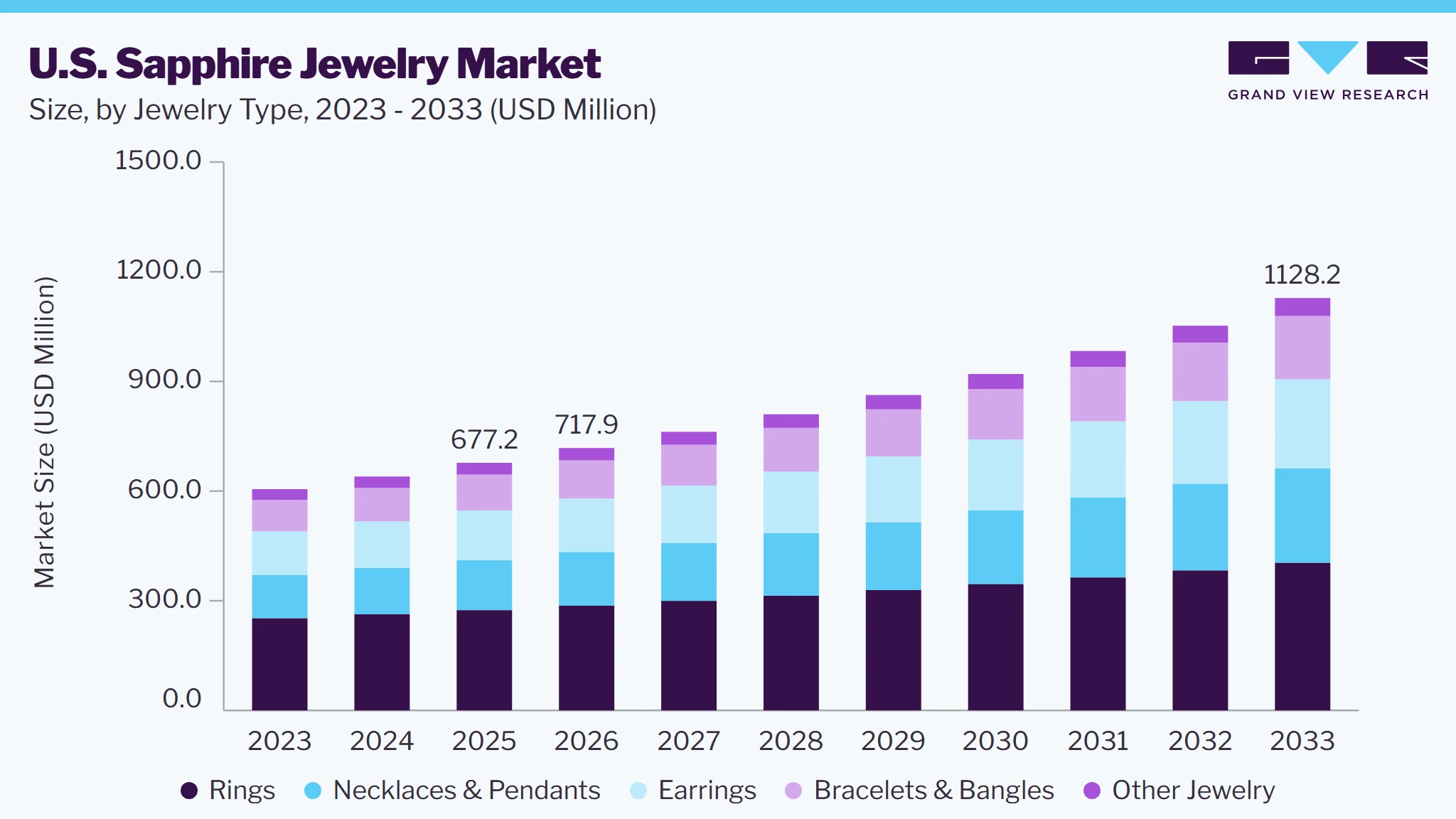 Source: Grand View Research, IR Documents, Primary Interviews, Paid DatabasesTo learn more about this report,
 Download Free Sample Report
The growing preference for personalized and meaningful jewelry is further supporting market expansion. Consumers are increasingly seeking engagement rings and fine jewelry that reflect individual preferences, encouraging the adoption of sapphires in customized settings, bespoke designs, and jewelry featuring a wider range of colors. According to The Plumb Club's February 2025 consumer research, 48% of consumers preferred sapphire when purchasing colored gemstone jewelry, while 45% selected gemstone colors based on personal color preferences, and 42% considered birthstone association. Furthermore, rings were the preferred format for colored gemstone jewelry, selected by 39% of respondents. These trends support the use of sapphires in personalized engagement rings, birthstone jewelry, and customized fine jewelry. Sapphire is particularly suited to this trend due to its availability in blue, pink, yellow, purple, green, and other fancy colors. The Gemological Institute of America also notes that sapphire occurs in most colors and that color is a key factor affecting its value.
The rising interest in gemstone provenance, transparency, and U.S.-origin products is also emerging as an important trend in the U.S. sapphire jewelry market. Montana sapphires are gaining visibility among consumers and jewelry brands due to their traceable origin, diverse color range, and association with domestic gemstone production. GIA reported in 2025 that Rock Creek sapphire has become one of the important American-origin gemstones in the colored gemstone market, with expanded production supporting greater availability for the North American market. This creates opportunities for brands to differentiate sapphire jewelry through origin storytelling, traceability, and the use of domestically sourced gemstones.
Market Dynamics
The growing consumer interest in colorful, meaningful, and occasion-based jewelry is driving demand in the U.S. sapphire jewelry market. Colored gemstones are increasingly being incorporated into fashion, self-purchase, and bridal jewelry as consumers seek products that offer greater visual distinction and personal relevance. According to The Plumb Club's 2025 Industry and Market Insights, 65% of U.S. consumers were seeking jewelry designs containing birthstones, while 39% expressed interest in bright-colored gemstones, representing a 7% increase compared with the previous 2023 survey. As sapphire is the birthstone for September and is available in a broad range of colors, including blue, pink, yellow, and green, this trend is supporting its application across personalized jewelry, gifting, and fashion-oriented collections. The growing shift toward colored gemstones is also evident in the bridal segment, with JCK reporting in June 2026 that retailers and gemstone dealers are seeing increasing consumer interest in sapphires and other colored stones among customers seeking distinctive alternatives to conventional engagement rings.
The wide variation in sapphire quality, origin, color, treatments, and certification can create complexity for consumers and may restrain purchase decisions, particularly among price-sensitive buyers. Natural sapphires can vary significantly in value depending on factors such as color, clarity, cut, carat weight, geographic origin, and whether the stone has undergone treatment. In addition, the presence of natural, treated, and laboratory-grown sapphires across different price points can make product comparisons more difficult for consumers. According to the Gemological Institute of America, treatments are commonly used to improve the appearance of sapphires, making treatment disclosure and independent gemological documentation important considerations during the purchase process. These factors can increase consumer reliance on trusted jewelers and certification while potentially lengthening the purchase decision process for high-value sapphire jewelry.
Growing consumer interest in gemstone provenance, supply-chain transparency, and personalized jewelry presents a significant opportunity for the U.S. sapphire jewelry market. Montana sapphires are gaining greater recognition due to their domestic origin, traceability, and diverse range of natural colors, enabling brands to differentiate their products through origin-based storytelling and locally sourced gemstones. GIA highlighted in 2025 the growing importance of Montana's Rock Creek sapphires and increased production, which is supporting their availability in the North American market. This creates opportunities for jewelry brands to develop collections featuring U.S.-origin sapphires while combining provenance with customization, such as made-to-order engagement rings, personalized birthstone jewelry, and bespoke fine jewelry. The growing availability of online customization tools and direct-to-consumer jewelry platforms could further support consumer access to these differentiated sapphire jewelry offerings.
Analyst Perspective
The U.S. sapphire jewelry market is shifting from traditional blue gemstones to a more diversified segment driven by personalized designs, colored gemstone engagement rings, meaningful gifting, and provenance-led fine jewelry. Consumers seek distinctive alternatives to diamonds, opting for natural, fancy-colored, and lab-grown sapphires. Brands differentiate through customized settings, origin-specific sapphires, traceability, certification, and collections with pink, yellow, green, and other colors. Omnichannel retail, direct-to-consumer, and online tools enable consumers to compare stones, customize, and create made-to-order jewelry. Future trends include increased transparency on origin and treatments, personalization, lab-grown options, and demand for unique colored gemstones.
Consumer Insights
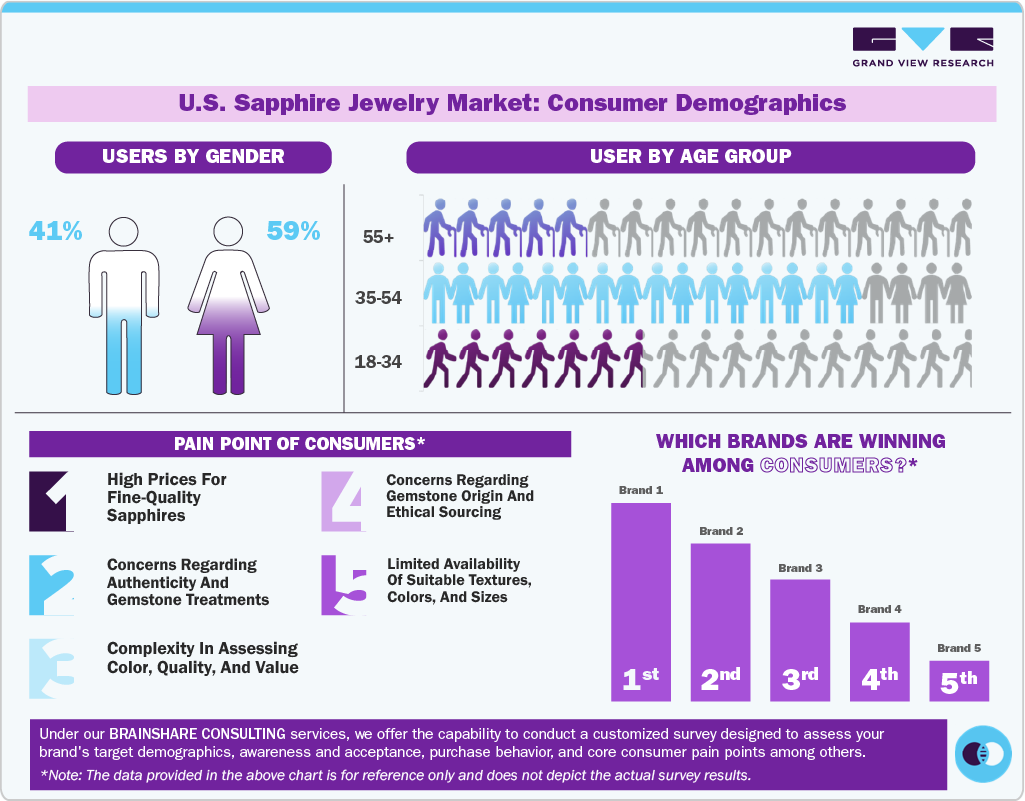
The gender distribution in the U.S. sapphire jewelry market reflects growing consumer interest in colored gemstones, personalized jewelry, bridal pieces, and meaningful gifting across both female and male consumer segments.
 To learn more about this report, Download Free Sample Report
-
Female consumers account for 59% of the market, primarily driven by demand for sapphire rings, earrings, necklaces, bracelets, and fashion-oriented colored gemstone jewelry. Female consumers also represent an important customer base for personalized and occasion-based sapphire jewelry, supported by preferences for distinctive colors, contemporary designs, and birthstone-associated pieces.
-
Male consumers account for 41% of the market, supported by purchases of sapphire engagement rings, anniversary jewelry, gifts, and other occasion-based fine jewelry. Increasing interest in distinctive gemstone designs and alternatives to conventional diamond jewelry is also encouraging male consumers to consider sapphire jewelry for gifting and significant life events.
The gender distribution is based on U.S. colored-stone consumer research reported by National Jeweler and Gemfields, providing relevant consumer insights for the sapphire jewelry segment.
 To learn more about this report, Download Free Sample Report
The U.S. sapphire jewelry market is benefiting from a broader shift toward personalized, distinctive, and meaningful jewelry, particularly among younger consumers. For instance, a May 2025 Jeweller Magazine analysis highlighted that consumers, especially Millennials and Gen Z, are increasingly moving beyond traditional diamond jewelry and considering colored gemstones, including sapphires, as a means of expressing individuality and personal preferences. The growing use of sapphires in engagement rings and personalized designs is therefore creating opportunities for retailers and luxury jewelry brands in the U.S. market.
Consumer preference for sapphire among colored gemstones. According to The Plumb Club’s 2025 Gems and Jewelry Buying Behavior Topline Report, 48% of consumers selected sapphire as a preferred colored gemstone, compared with 45% for emerald and 39% for ruby. Sapphire therefore ranked as the most preferred gemstone among the colored gemstones evaluated in the February 2025 survey.
This represents an increase from the February 2023 survey, when 47% of respondents preferred sapphire, compared with 42% for emerald and 35% for ruby. The data indicates that sapphire has maintained its leading position while its consumer preference increased by 1 percentage point between 2023 and 2025.
A key factor supporting demand for sapphire jewelry is the importance of color and personal relevance in gemstone selection. In the 2025 survey, 42% of respondents selected personal color preference as the main reason for choosing one gemstone color over another, making it the leading purchase consideration. Birthstone preference accounted for 23%, followed by value/rarity at 11%, symbolism at 9%, and matching jewelry with a wardrobe at 15%. These findings indicate that sapphire purchases are driven not only by the gemstone's intrinsic value but also by its visual appeal, personal meaning, and suitability for individual style preferences.
The growing importance of birthstone-based purchasing also creates a specific opportunity for the U.S. sapphire jewelry market. 65% of respondents in the February 2025 survey said they seek jewelry featuring their birthstone, compared with 61% in 2023. As sapphire is the traditional birthstone for September, this trend supports demand for sapphire rings, pendants, earrings, and personalized gifting products.
Product preferences further indicate opportunities across multiple Sapphire Jewelry categories. Rings were the most preferred type of colored gemstone jewelry, selected by 39% of respondents in 2025, up from 35% in 2023. This was followed by earrings at 25%, necklaces at 18%, bracelets at 9%, and pendants at 7%. The strong preference for rings suggests continued opportunities for sapphire engagement rings, anniversary rings, fashion rings, and customized birthstone designs.
The survey also points to changing preferences in gemstone aesthetics. Bright-colored gemstones were preferred by 39% of respondents in 2025, compared with 32% in 2023, while preference for neutral colors declined from 46% to 34% over the same period. This shift toward brighter colors can support demand for vivid blue sapphires as well as fancy sapphires in pink, yellow, green, and other colors, enabling Luxury Jewelry Brands to expand beyond conventional blue sapphire collections.
Jewelry Type Insights
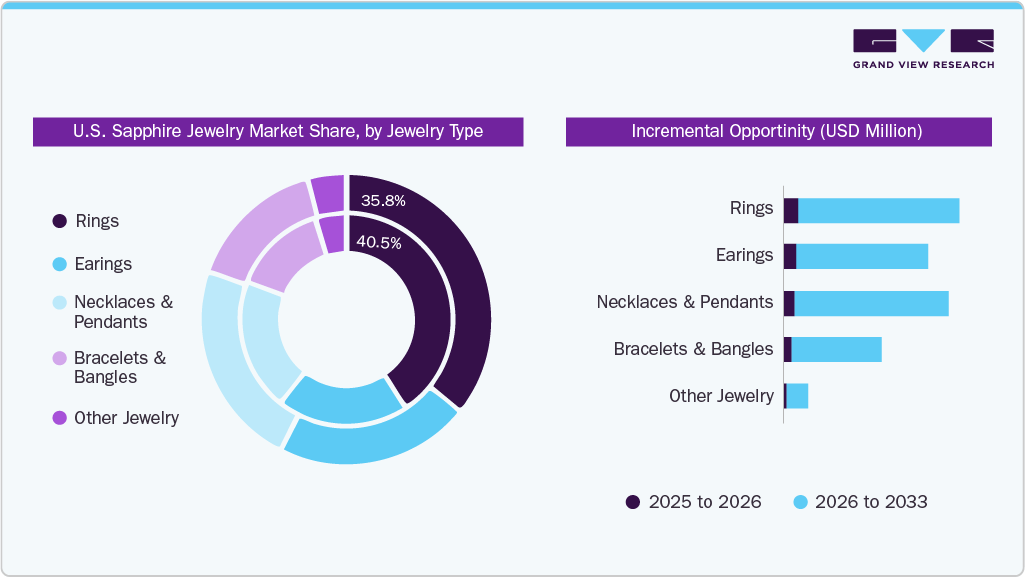
The rings segment accounted for the largest revenue share of 40.5% in 2025, driven by strong consumer preference for sapphire rings as engagement, wedding, anniversary, and statement jewelry. Demand is further supported by the growing popularity of colored gemstone engagement rings, with sapphire increasingly selected as an alternative to traditional diamond-centered designs. According to the Gemological Institute of America (GIA), sapphire’s durability, with a hardness of 9 on the Mohs scale, makes it well-suited for everyday-wear jewelry such as rings. In addition, the rising preference for personalized and distinctive bridal jewelry is encouraging consumers to choose sapphire rings featuring different colors, cuts, and settings. The growing adoption of sapphire in engagement and statement rings is therefore supporting product innovation and strengthening the rings segment within the U.S. sapphire jewelry industry.
 To learn more about this report, Download Free Sample Report
The necklaces & pendants segment is expected to grow at a CAGR of 8.4% from 2026 to 2033, supported by increasing consumer interest in distinctive colored gemstone jewelry and statement pieces. Demand is further supported by the use of high-quality sapphires in luxury necklace designs, particularly pieces combining sapphires with diamonds and precious metals. For instance, in 2025, Sotheby’s featured a sapphire and diamond necklace containing 21.16 carats of sapphires, with the stones identified as Kashmir origin and showing no indications of heating. The piece was offered with an estimated value of CHF 16,000–32,000, highlighting continued interest in sapphire-based necklace designs in the luxury jewelry market.
Sapphire Type Insights
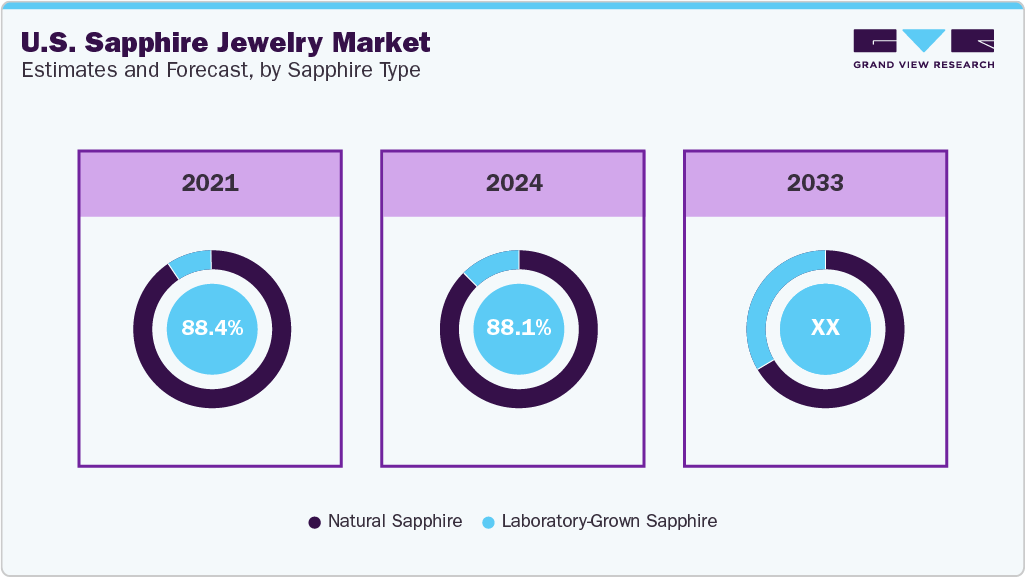
The natural sapphire accounted for the largest revenue share of 87.9% in 2025, supported by strong consumer preference for gemstones valued for their natural origin, unique color characteristics, and rarity. Demand is further reinforced by growing interest in traceable and ethically sourced gemstones, particularly among U.S. consumers seeking distinctive fine jewelry. For instance, in February 2025, Navneet Gems & Minerals introduced a collection of unheated Montana sapphires sourced from the Rock Creek mine, offering calibrated and individual stones in multiple colors. The company highlighted the growing popularity of Montana sapphires in the North American market due to their ethical sourcing, distinctive colors, and quality. The increasing availability of naturally sourced and untreated sapphires is supporting consumer interest in authentic gemstone jewelry and strengthening the natural sapphire segment.
 To learn more about this report, Download Free Sample Report
The laboratory-grown sapphire is expected to grow at a CAGR of 7.7% from 2026 to 2033, driven by technological advancements that enable manufacturers to produce gemstones with consistent quality, color, and clarity. The segment is also gaining traction as jewelry manufacturers expand their use of laboratory-created gemstones across contemporary designs. For instance, in 2025, KYOCERA reported a 25% increase in sales for its lab-grown gemstone business for the fiscal year ended March 2025 and expanded its CRESCENT VERT collection to include 12 types of lab-grown gemstones. KYOCERA 50th Anniversary of Jewelry Business. This expansion demonstrates the growing commercial application of laboratory-grown gemstones and is creating new opportunities for Sapphire Jewelry offerings in the U.S. sapphire jewelry market, particularly among luxury jewelry brands exploring innovative gemstone collections.
Sapphire Color Insights
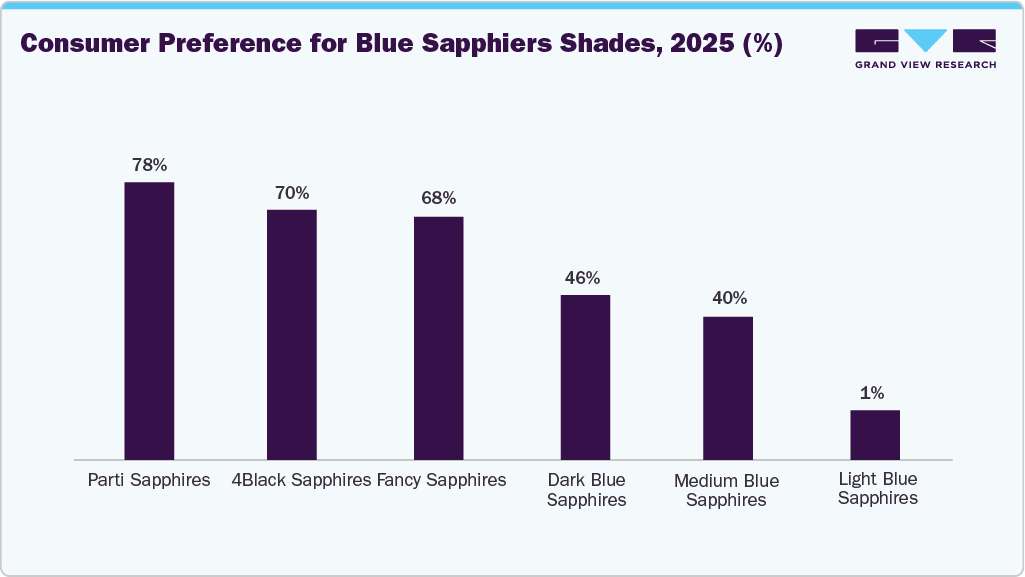
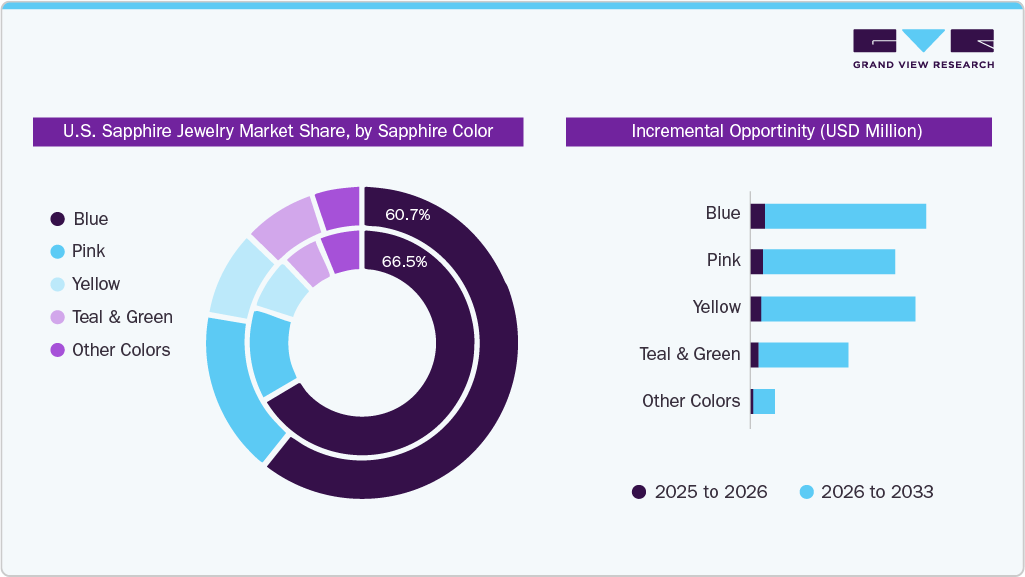
Blue sapphire color accounted for the largest revenue share of 66.5% in 2025, reflecting its established position as the most recognized and commercially significant sapphire color in fine jewelry. The strong appeal of blue sapphires is supported by their association with classic luxury designs, bridal jewelry, and high-value gemstone pieces. For instance, in February 2025, Sophie Ratner expanded its Blue Sapphire Collection with new designs featuring natural blue sapphires in shades ranging from icy tones to deep winter blues, including rings, pendants, and earrings. The continued introduction of blue sapphire collections in varied shades and contemporary settings is expanding design choices for consumers and supporting demand for sapphire jewelry.
 To learn more about this report, Download Free Sample Report
Teal & Green sapphire color is expected to grow at a CAGR of 10.9% from 2026 to 2033, driven by rising interest in distinctive gemstone colors and non-traditional designs, particularly for engagement and statement jewelry. The combination of blue and green tones gives teal sapphires a distinctive visual character, while green sapphires provide an alternative to conventional blue varieties. For instance, in 2025, Anueva Jewelry introduced its “Our Most Green – Holiday 2025” collection featuring deep teal, blue-green, and green sapphires from Madagascar and Montana across several ring designs. The expansion of such collections is broadening color choices for sapphire jewelry and creating opportunities within the U.S. sapphire jewelry market.
Price Tier Insights
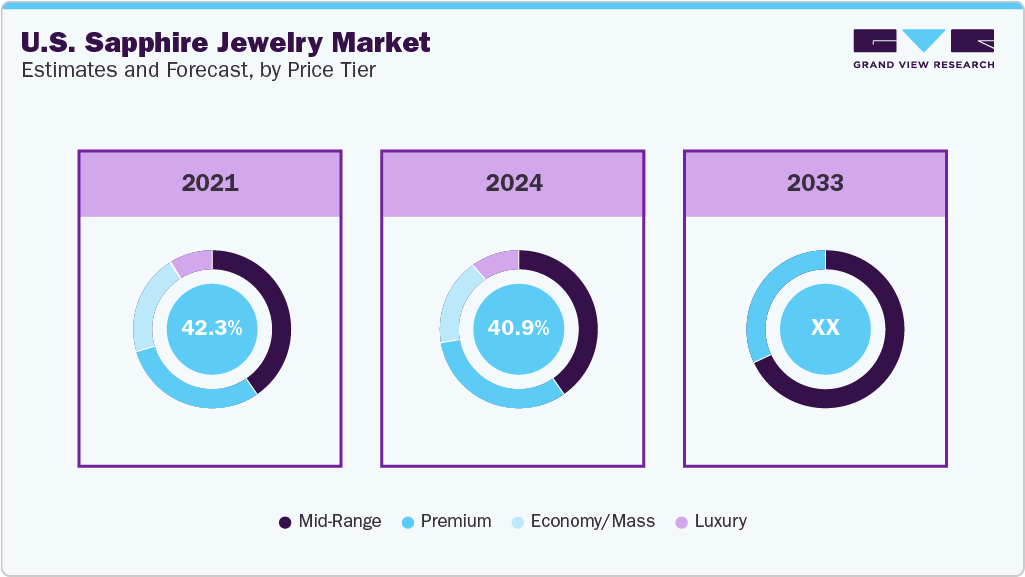
The mid-range segment accounted for the largest revenue share of 40.5% in 2025, reflecting demand for sapphire jewelry that combines gemstone quality, attractive designs, and accessible pricing. This segment benefits consumers seeking fine jewelry for occasions such as engagements, anniversaries, and gifting without moving into the highest-priced luxury category. For instance, Blue Nile offers sapphire jewelry in the mid-price range, including its Riviera Pavé Sapphire Eternity Ring in 18K white gold priced at USD 1,025 and its Shared Prong Sapphire and Diamond Eternity Ring in 14K white gold priced at USD 2,680. The availability of such products demonstrates the expanding range of moderately priced sapphire designs offered by luxury jewelry brands and supports the segment’s growth.
 To learn more about this report, Download Free Sample Report
The luxury segment is expected to grow at a CAGR of 9.3% from 2026 to 2033, is supported by demand for rare, high-quality sapphires, exceptional gemstone origins, and intricate craftsmanship, with high-value pieces appealing to collectors and affluent jewelry buyers. For instance, in 2025, a Kashmir sapphire and diamond ring featuring a 16.58-carat cabochon sapphire sold for USD 1.016 million at Christie’s New York, significantly exceeding its auction estimate. The result highlights the strong value placed on exceptional sapphires with prestigious provenance and rarity. The growing availability of rare gemstone pieces and high-end creations from luxury jewelry brands is supporting demand for luxury sapphire jewelry.
Distribution Channel Insights
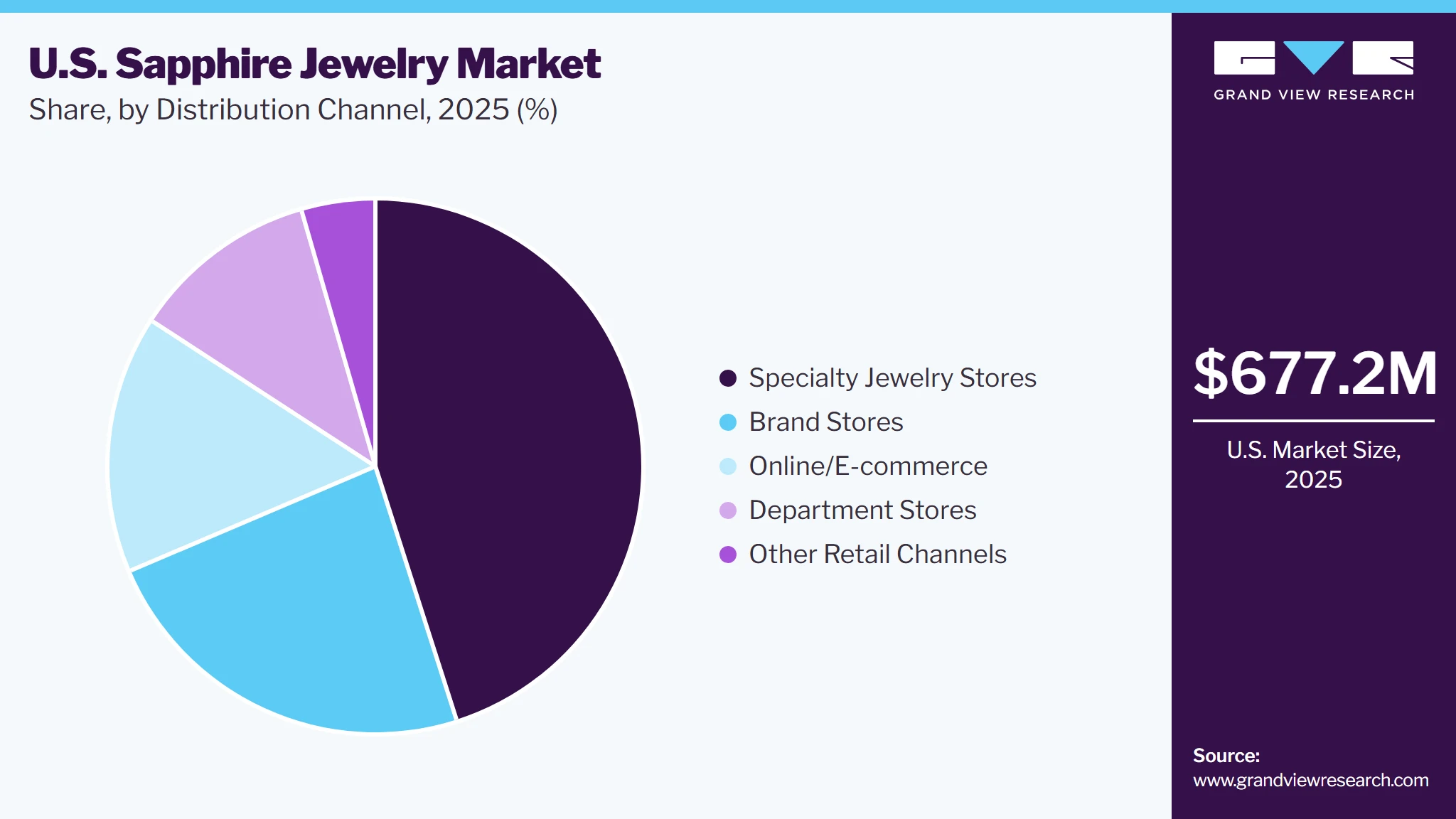
The specialty jewelry stores segment accounted for a revenue share of 45.0% in 2025, benefiting from consumers’ preference for personalized assistance, gemstone expertise, and the ability to evaluate sapphire quality, color, and craftsmanship before purchase. Specialty retailers also provide access to diverse collections across price points and jewelry formats. For instance, Marks Jewelers featured a dedicated 2025 Sapphire Style Guide with new sapphire rings, necklaces, earrings, bracelets, and engagement jewelry, including both natural and lab-created sapphire designs. This broad product assortment demonstrates how specialty retailers are expanding sapphire jewelry offerings and strengthening their role in the U.S. sapphire jewelry market, while providing luxury jewelry brands with an established channel to reach gemstone-focused consumers.
 To learn more about this report, Download Free Sample Report
The online/e-commerce segment is expected to grow at a CAGR of 11.5% from 2026 to 2033, supported by the increasing availability of sapphire products through digital storefronts and the ability of online platforms to present detailed product specifications, gemstone characteristics, pricing, and multiple designs in one place. For instance, in 2025, Stone Fruit launched its debut jewelry collection featuring lab-grown sapphire alongside other gemstones, with products offered in the USD 100–700 range and promoted through its digital-first brand presence. The collection included rings, necklaces, earrings, ear cuffs, and bangles, demonstrating how emerging jewelry brands are using online channels to introduce gemstone collections to a broader consumer base. This expansion of digitally marketed gemstone collections is improving accessibility and product discovery for consumers, creating additional opportunities for sapphire jewelry sales through e-commerce platforms in the U.S. sapphire jewelry market. Luxury jewelry brands are also increasingly able to use online channels to showcase specialized gemstone collections and reach younger, digitally engaged buyers.
Country Insights
The U.S. market is benefiting from the growing value of colored gemstone jewelry, with consumers increasingly gravitating toward distinctive, higher-value pieces. According to Edge Retail Academy data reported by National Jeweler, colored stone jewelry sales at independent U.S. jewelers increased by more than 4% in 2025, while the average retail ticket rose by nearly 12%, even as unit sales declined by close to 8%. This indicates that consumers who purchased colored gemstone jewelry were increasingly selecting more expressive and higher-value pieces.
The market is also benefiting from the broader adoption of colored gemstones in fine jewelry. National Jeweler reported in 2025 that colored gemstones were gaining market share in the U.S. fine-jewelry market, with sapphire remaining one of the leading gemstones. Demand has expanded beyond traditional royal-blue stones toward teal, Montana, Ceylon, and other distinctive sapphire varieties, providing opportunities for designers and luxury jewelry brands to introduce differentiated collections.
In addition, U.S. domestic gemstone production provides a unique advantage through Montana sapphire. The U.S. Geological Survey estimated that the combined value of U.S. natural and synthetic gemstone production was USD 47 million in 2025, with Montana among the six leading states accounting collectively for 68% of U.S. natural gemstone production. Sapphire is among the gemstone materials produced domestically, supporting the availability and visibility of locally sourced stones. Overall, strong sapphire recognition, expanding color preferences, domestic Montana sapphire production, and increasing interest in colored gemstone jewelry are creating favorable conditions for sapphire jewelry demand in the U.S. market.
Key U.S. Sapphire Jewelry Company Insights
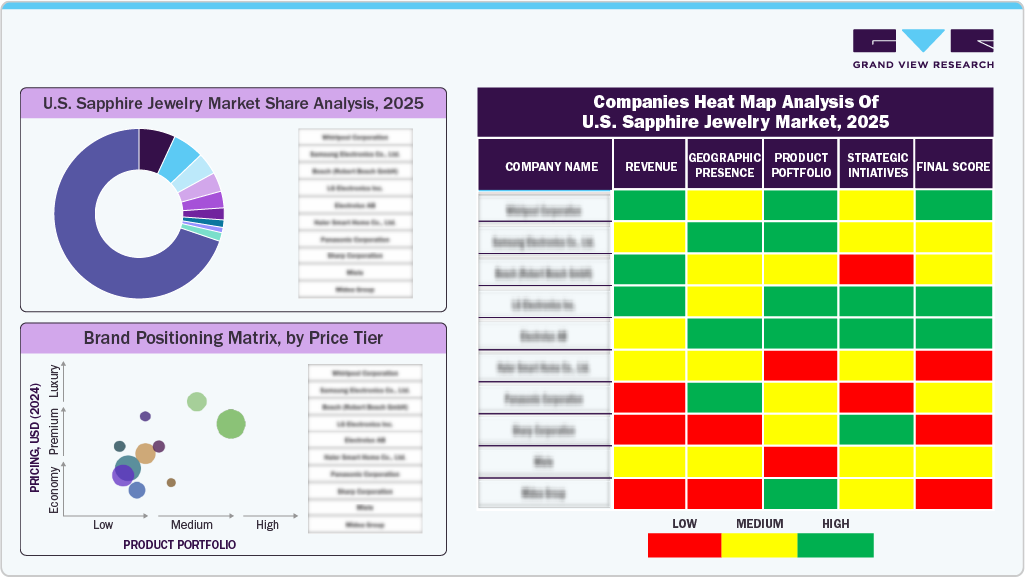
The U.S. sapphire jewelry market is characterized by competition among global luxury jewelry houses with strong heritage, high-jewelry expertise, exclusive gemstone collections, and extensive U.S. retail networks. The selected companies compete primarily through sapphire quality, craftsmanship, design innovation, brand prestige, customization, and exclusivity. Their offerings target affluent consumers, bridal customers, collectors, and buyers seeking distinctive sapphire jewelry.
-
Luxury Heritage & Bridal Jewelry Brands: Tiffany & Co. maintains a strong position in the U.S. market through its heritage, distinctive jewelry designs, and use of colored gemstones across engagement rings, earrings, necklaces, and statement pieces. The brand leverages its extensive U.S. boutique network and strong recognition to attract affluent and bridal consumers seeking high-quality Sapphire Jewelry.
-
Global Luxury Jewelry Houses: Cartier competes through iconic collections, exceptional craftsmanship, and high-jewelry designs incorporating colored gemstones. Its strong brand heritage and established U.S. presence allow it to target affluent consumers seeking exclusive gemstone jewelry with distinctive design aesthetics.
-
High-Jewelry & Artistic Design Specialists: Van Cleef & Arpels differentiates through intricate craftsmanship, artistic motifs, and high-jewelry creations featuring colored gemstones. The brand's emphasis on exceptional materials, refined detailing, and distinctive designs positions it toward collectors and high-net-worth consumers within the luxury segment.
-
Luxury Gemstone & High-Jewelry Players: Bvlgari competes through bold gemstone combinations, vibrant color palettes, and statement-oriented high-jewelry collections. The company frequently incorporates sapphires alongside emeralds, rubies, diamonds, and other gemstones, enabling it to appeal to consumers seeking visually distinctive and collectible jewelry.
-
Competitive Positioning: The selected Luxury Jewelry Brands primarily differentiate through heritage, gemstone quality, craftsmanship, exclusivity, and high-touch retail experiences. Tiffany & Co. and Cartier benefit from strong brand recognition and broad luxury positioning, while Van Cleef & Arpels and Bvlgari emphasize artistic design and high-jewelry craftsmanship. This competitive environment supports product differentiation and expands consumer choices across the U.S. sapphire jewelry market.
 To learn more about this report, Download Free Sample Report
Key U.S. Sapphire Jewelry Companies
-
Tiffany & Co.
-
Cartier
-
Van Cleef & Arpels
-
Bvlgari
-
Harry Winston
-
Chopard
-
Graff
-
Piaget
-
Buccellati
-
Mikimoto
Competitive Benchmarking
Category
Operating Strategies
Competitive Edge
Weakness
Established Players: Tiffany & Co.; Signet Jewelers; H.Stern; Swarovski AG; Harry Winston; CHANEL; Richemont
- Focus on strengthening their position through heritage-driven collections, high jewelry craftsmanship, exclusive gemstone sourcing, and omnichannel retail expansion. These companies leverage established retail networks, flagship stores, designer collections, and personalized client services to address demand across luxury, bridal, gifting, and fine jewelry segments.
- Strong brand recognition, extensive financial resources, established distribution networks, and high consumer trust provide a significant advantage. Companies such as Tiffany & Co. offer dedicated sapphire jewelry across rings, pendants, earrings, and bracelets, while Signet benefits from a broad multi-brand retail network and large-scale market reach.
- Higher pricing can restrict accessibility to affluent consumer groups. Large organizations may also face slower product development cycles and greater dependence on established brand positioning. In addition, strong exposure to diamonds and broader luxury jewelry portfolios can reduce their strategic focus on sapphire-specific collections.
Emerging Players: VRAI & ORO, LLC; Aether Diamonds; Brilliant Earth, LLC
- Focus on digitally driven sales, direct-to-consumer distribution, product customization, transparent sourcing, and contemporary jewelry designs. These players increasingly use online platforms and personalized shopping experiences to target younger consumers seeking distinctive gemstone jewelry. Brilliant Earth, for example, maintains a dedicated sapphire jewelry offering across rings, earrings, necklaces, and bracelets.
- Agile business models, strong e-commerce capabilities, customization options, and appeal among digitally engaged consumers provide competitive advantages. Their ability to introduce modern designs and communicate sourcing and product attributes directly to consumers can support differentiation from traditional luxury jewelers.
- Comparatively lower brand heritage and prestige than established luxury houses may limit appeal among ultra-high-net-worth consumers. Smaller physical retail networks and lower awareness can also constrain market penetration, while intense competition from established jewelers and digitally native brands increases customer acquisition costs.
Recent Developments
-
In 2026, Heritage Auctions achieved a sale of USD 906,250 for a 6.59-carat Kashmir sapphire and diamond ring, exceeding its pre-sale estimate of USD 300,000–600,000. The result highlights continued collector interest in rare sapphires with exceptional color, provenance, and gemstone quality, supporting the high-value segment of the U.S. sapphire jewelry market.
-
In 2025, Bvlgari unveiled its Polychroma high-jewelry collection in Los Angeles, featuring sapphire-centered Tubogas necklaces alongside vivid emeralds, rubies, tourmalines, and other colored gemstones. The collection demonstrates how Luxury Jewelry Brands are incorporating sapphires into elaborate high-jewelry creations that emphasize bold colors, craftsmanship, and distinctive design.
-
In 2025, KYOCERA expanded its laboratory-grown gemstone business, reporting a 25% increase in sales for the business during the fiscal year ending March 2025. Its CRESCENT VERT brand offers 12 types of lab-grown gemstones, reflecting increasing investment in laboratory-created alternatives and expanding opportunities for innovative gemstone jewelry designs.
U.S. Sapphire Jewelry Market Report Scope
Report Attribute
Details
Market size in 2025
USD 677.2 million
Estimated market size in 2026
USD 717.9 million
Projected market size by 2033
USD 1,128.2 million
Growth rate
CAGR of 6.7% from 2026 to 2033
Base Year of Estimation
2025
Historical data
2021 - 2024
Forecast period
2026 - 2033
Quantitative units
Revenue in USD million and CAGR from 2026 to 2033
Report coverage
Revenue forecast, company ranking, competitive landscape, growth factors, and trends
Segments covered
Jewellery type, sapphire type, sapphire color, price tier, distribution channel
Country scope
U.S.
Key companies profiled
Tiffany & Co.; Cartier; Van Cleef & Arpels; Bvlgari; Harry Winston; Chopard; Graff; Piaget; Buccellati; Mikimoto
Customization scope
Free report customization (equivalent up to 8 analysts’ working days) with purchase. Addition or alteration to country, regional & segment scope.
Pricing and purchase options
Avail customized purchase options to meet your exact research needs. Explore purchase options
U.S. Sapphire Jewelry Market Report Segmentation
This report forecasts revenue growth at country levels and provides an analysis of the latest trends and opportunities in each of the sub-segments from 2026 to 2033. For this study, Grand View Research has segmented the U.S. sapphire jewelry market based on jewelry type, sapphire type, sapphire color, price tier, and distribution channel.
-
Jewelry Type Outlook (Revenue, USD Million, 2021 - 2033)
-
Rings
-
Earrings
-
Necklaces & Pendants
-
Bracelets & Bangles
-
Other Jewelry
-
-
Sapphire Type Outlook (Revenue, USD Million, 2021 - 2033)
-
Natural Sapphire
-
Laboratory-Grown Sapphire
-
-
Sapphire Color Outlook (Revenue, USD Million, 2021 - 2033)
-
Blue
-
Pink
-
Yellow
-
Teal & Green
-
Other Colors
-
-
Price Tier Outlook (Revenue, USD Million, 2021 - 2033)
-
Economy/Mass
-
Mid-Range
-
Premium
-
Luxury
-
-
Distribution Channel Outlook (Revenue, USD Million, 2021 - 2033)
-
Specialty Jewelry Stores
-
Brand Stores
-
Department Stores
-
Online/E-commerce
-
Other Retail Channels
-
Research Methodology
The U.S. sapphire jewelry market figures in this report are based on a proven research process that combines executive interviews with secondary research from proprietary databases, company filings, and recognized regulatory and institutional sources. Market size is built through value-chain sizing-reconciling supply-side and demand-side estimates-and triangulated with bottom-up and top-down approaches. Every estimate passes multiple levels of expert validation before publication, with eachU.S. sapphire jewelry segment quantified using the revenue-capture definitions in the table below.
Segment Definition
Jewelry Type
Revenue capture definition
Rings
Covers sapphire-set rings across engagement, wedding, fashion, cocktail, statement, and everyday jewelry categories. Includes rings featuring natural or laboratory-grown sapphires, with sapphire stones incorporated as center stones, side stones, or accent stones. Covers products sold through specialty jewelry stores, brand stores, department stores, online channels, and other retail formats.
Earrings
Covers sapphire earrings, including studs, drop earrings, hoops, huggies, chandeliers, and other decorative formats. Includes earrings using natural or laboratory-grown sapphires as primary or accent gemstones, across different metal settings and designs. Covers products marketed as fine, premium, luxury, or accessible jewelry through both physical and digital retail channels.
Necklaces & Pendants
Covers sapphire necklaces, pendants, chokers, chains with sapphire settings, solitaire pendants, and multi-stone designs. Includes natural and laboratory-grown sapphires incorporated as center or accent stones, across different necklace constructions, precious-metal settings, and design formats. Covers products sold through organized jewelry retailers, brand outlets, department stores, e-commerce platforms, and other channels.
Bracelets & Bangles
Covers sapphire bracelets and bangles, including tennis bracelets, chain bracelets, cuff designs, charm bracelets, and rigid or flexible bangle formats. Includes jewelry incorporating natural or laboratory-grown sapphires as primary or accent stones, across varied metal settings and designs. Covers products distributed through physical jewelry retailers, brand stores, department stores, online platforms, and other retail channels.
Other Jewelry
Covers sapphire jewelry products outside rings, earrings, necklaces, pendants, bracelets, and bangles. Includes brooches, pins, anklets, body jewelry, cufflinks, tie accessories, and other wearable sapphire-adorned pieces. Includes products using natural or laboratory-grown sapphires and covers their sale through specialty stores, brand outlets, department stores, online platforms, and other retail channels.
Sapphire Type
Revenue capture definition
Natural Sapphire
Covers jewelry incorporating naturally occurring sapphires extracted from geological deposits and subsequently cut, polished, treated, graded, and mounted into jewelry. Includes untreated and commercially accepted treated natural sapphires across different colors, qualities, sizes, origins, and gemstone grades. Covers natural sapphire jewelry sold across all specified jewelry types, price tiers, and distribution channels.
Laboratory-Grown Sapphire
Covers jewelry incorporating sapphires produced through controlled laboratory processes, including synthetic or lab-created sapphire gemstones used for jewelry applications. Includes stones manufactured with comparable sapphire chemical and physical characteristics and incorporated into different jewelry designs. Covers laboratory-grown sapphire jewelry across rings, earrings, necklaces, bracelets, other jewelry, price tiers, and specified distribution channels.
Sapphire Color
Revenue capture definition
Blue
Covers jewelry featuring blue sapphires across light, medium, deep, vivid, royal, cornflower, and other commercially recognized blue shades. Includes both natural and laboratory-grown stones used as center or accent gemstones across jewelry categories. Covers blue sapphire products spanning economy, mid-range, premium, and luxury pricing and sold through physical and online retail channels.
Pink
Covers jewelry featuring pink sapphires ranging from pale and pastel pink through vivid, intense, and deeper pink shades. Includes natural and laboratory-grown pink sapphires incorporated into different jewelry forms and settings. Covers products across economy, mid-range, premium, and luxury price tiers, including pieces sold through specialty retailers, brand stores, department stores, e-commerce, and other channels.
Yellow
Covers jewelry incorporating yellow sapphires across pale, bright, golden, intense, and other commercially available yellow shades. Includes natural and laboratory-grown stones used as center or accent gemstones in various jewelry designs. Covers yellow sapphire jewelry across different product categories, price tiers, and distribution channels, including specialty jewelry stores, brand outlets, department stores, online platforms, and other retailers.
Teal & Green
Covers jewelry featuring teal, bluish-green, green, and related commercially recognized sapphire shades. Includes natural and laboratory-grown sapphires used as primary or accent stones across different jewelry designs and metal settings. Covers products across economy, mid-range, premium, and luxury price tiers and their sales through specialty stores, brand stores, department stores, online channels, and other retail formats.
Other Colors
Covers sapphire jewelry featuring colors outside the defined blue, pink, yellow, teal, and green categories. Includes purple, orange, white, colorless, padparadscha, multi-coloured, and other commercially available sapphire shades. Includes natural and laboratory-grown stones across jewelry types, price tiers, and retail channels, covering products sold through specialty stores, brand outlets, department stores, e-commerce, and other retailers.
Price Tier
Revenue capture definition
Economy/Mass
Covers sapphire jewelry positioned for broad consumer accessibility and characterized by comparatively lower retail prices within the sapphire jewelry category. Includes products using smaller, lower-grade, treated, or laboratory-grown sapphires and simpler settings. Covers relevant rings, earrings, necklaces, bracelets, and other jewelry sold through mass-oriented retailers, selected jewelry stores, department stores, online marketplaces, and other channels.
Mid-Range
Covers sapphire jewelry positioned between mass-market and premium offerings, generally combining moderate gemstone quality, design complexity, material quality, and branded or organized retail positioning. Includes natural and laboratory-grown sapphire pieces across jewelry categories and colors. Covers products sold through specialty jewelry stores, department stores, brand stores, e-commerce platforms, and other organized retail channels.
Premium
Covers higher-value sapphire jewelry featuring comparatively better gemstone quality, larger or more distinctive stones, refined craftsmanship, precious-metal settings, recognized brands, or elevated design characteristics. Includes natural and selected laboratory-grown sapphire products across jewelry categories and colors. Covers premium offerings distributed through specialty jewelry stores, brand stores, department stores, e-commerce platforms, and other retail channels.
Luxury
Covers high-value and luxury-positioned sapphire jewelry featuring exceptional gemstone quality, larger or rare sapphires, superior craftsmanship, precious-metal settings, heritage designs, or prestigious brand positioning. Includes high-end natural sapphire jewelry and selected bespoke or limited-edition pieces. Covers products sold through luxury jewelry boutiques, flagship brand stores, selected department stores, private channels, and online luxury platforms.
Distribution Channel
Revenue capture definition
Specialty Jewelry Stores
Covers sapphire jewelry sold through dedicated jewelry retailers and specialty stores primarily focused on jewelry and gemstone products. Includes independent jewelers, organized jewelry chains, multi-brand jewelry retailers, and specialist gemstone retailers. Covers sales of rings, earrings, necklaces, bracelets, and other sapphire jewelry across natural and laboratory-grown stones, colors, and price tiers.
Brand Stores
Covers sapphire jewelry sold directly through branded retail outlets operated by jewelry manufacturers, luxury houses, or dedicated jewelry brands. Includes company-owned stores, flagship boutiques, franchise or authorized brand outlets, and other dedicated branded retail formats. Covers branded sapphire jewelry across product categories, gemstone types, colors, price tiers, and relevant geographic markets.
Department Stores
Covers sapphire jewelry sold through department stores and large multi-category retail establishments that maintain dedicated jewelry sections or counters. Includes branded and multi-brand sapphire jewelry offered within department-store retail environments. Covers natural and laboratory-grown sapphire products across jewelry types, colors, and price tiers, including sales through physical stores and department store-operated digital platforms.
Online/E-commerce
Covers sapphire jewelry purchased through digital retail platforms, including brand websites, jewelry retailer websites, online marketplaces, and other dedicated e-commerce platforms. Includes direct-to-consumer and third-party online sales of rings, earrings, necklaces, bracelets, and other jewelry. Covers natural and laboratory-grown sapphires across colors and price tiers sold through digital channels.
Other Retail Channels
Covers sapphire jewelry distributed through retail channels outside specialty jewelry stores, brand stores, department stores, and dedicated e-commerce platforms. Includes luxury boutiques, duty-free stores, auction-related retail, travel retail, exhibitions, pop-up stores, and other relevant physical or hybrid formats. Covers sapphire jewelry across product types, gemstone categories, colors, and price tiers.
Estimation Model
Layer
Guiding Question
Description
01 Target Consumer Layer
Who purchases sapphire jewelry?
Affluent consumers, bridal buyers, collectors, gift purchasers, and fashion-conscious jewelry buyers.
02 Market Accessibility Layer
Who can access sapphire jewelry?
Consumers with access to jewelry stores, luxury boutiques, brand websites, and online platforms.
03 Purchase Behavior Layer
Who actively purchases sapphire jewelry?
Consumers purchasing for engagements, weddings, gifting, self-purchase, and special occasions.
04 Monetization Layer
How much revenue is generated?
Spending varies based on gemstone quality, jewelry type, design, customization, and purchase frequency.
Delivered Customizations
This report has been delivered with the following In-depth customizations
Client Request
Customization Delivered
Value Adds
U.S. Sapphire Jewelry Consumer Preferences & Buying Behavior Analysis
Conducted a detailed assessment of U.S. consumer demand for sapphire rings, earrings, necklaces, pendants, and bracelets, covering preferences for blue and fancy-color sapphires, natural and lab-created stones, gemstone quality, price points, customization, and purchase occasions.
Helps stakeholders identify high-demand consumer segments, understand evolving preferences for colored gemstone jewelry, and develop targeted product portfolios and marketing strategies. Sapphire remains a leading preference among colored gemstone buyers, while demand for personalized and distinctive designs is also gaining traction.
U.S. Sapphire Jewelry Product Innovation, Customization & Market Trends
Evaluated innovation across sapphire jewelry designs, including personalized engagement rings, alternative cuts, fancy-color sapphires, vintage-inspired settings, heirloom redesigns, and ethically sourced or traceable gemstones, while assessing emerging bridal and fashion jewelry trends.
Provides insights into evolving product innovation and consumer expectations, supporting differentiation through distinctive designs, customization, gemstone transparency, and expanded sapphire color offerings.
U.S. Sapphire Jewelry Distribution & Market Opportunity Assessment
Assessed growth opportunities across specialty jewelry stores, independent jewelers, luxury retailers, brand-owned stores, e-commerce platforms, and omnichannel sales channels, while analyzing regional demand patterns, bridal purchasing, gifting occasions, and emerging consumer segments.
Supports investment and expansion decisions by identifying high-potential distribution channels, consumer touchpoints, and opportunities across bridal, everyday fine jewelry, personalized designs, and high-value sapphire collections.
Frequently Asked Questions About This Report
The global U.S. sapphire jewelry market size was valued at USD 667.2 million in 2025 and is estimated at USD 717.9 billion for 2026.
The global U.S. sapphire jewelry market is expected to grow at a CAGR of 6.7% from 2025 to 2033, reaching USD 1,128.2 million by 2033.
Rings segment accounted for the largest revenue share of 40.5% in 2025, driven by strong consumer preference for sapphire rings as engagement, wedding, anniversary, and statement jewelry.
The U.S. sapphire jewelry market is driven by growing demand for colored gemstones, luxury and personalized jewelry, and sapphire engagement rings.
Key players in the U.S. sapphire jewelry market include Tiffany & Co., Signet Jewelers, VRAI, Aether Diamonds, Brilliant Earth, Swarovski, Harry Winston, CHANEL, and Richemont.
The natural sapphire accounted for the largest revenue share of 87.9% in 2025 while laboratory-grown sapphire segment is second fastest growing market.
Blue sapphire color accounted for the largest revenue share of 66.5% in 2025
The specialty jewelry stores segment accounted for a revenue share of 45.0% in 2025 while online/e-commerce segment is expected to be the fastest-growing market.
About the Author(s)
Clothing, Footwear & Accessories Research Team
Consumer Goods · Clothing, Footwear & AccessoriesThis report was authored by the clothing, footwear & accessories research team at Grand View Research - comprising two research analysts, one senior research analyst, and one industry expert - with specialized expertise in the clothing, footwear & accessories segment of the consumer goods industry. All findings are based on proprietary consumer goods databases, executive interviews, and regulatory analysis, subject to internal peer review prior to publication.
Last Updated:
Speak to Analyst

Customize this report to your needs - add regions, segments, or data points, with 20% free customization.
Or view our licence options:


ISO 9001:2015 & 27001:2022 Certified
We are GDPR and CCPA compliant! Your transaction & personal information is safe and secure. For more details, please read our privacy policy.


