
- Home
- »
- Consumer F&B
- »
-
U.S. Sugar Substitutes Market Size Report, 2026-2033GVR Report cover

U.S. Sugar Substitutes Market (2026 - 2033)
Size, Share & Trends Analysis Report By Type (High Intensity Sweeteners, Low Intensity Sweeteners, High Fructose Syrup), By Application (Food, Beverages, Health & Personal Care), And Segment Forecasts
Market Size, 2025
$2.4BMarket Estimate, 2026
$2.6BMarket Forecast, 2033
$4.1BCAGR, 2026–2033
7.1%U.S. Sugar Substitutes Market Summary
The U.S. sugar substitutes market size was valued at USD 2.4 billion in 2025 and is projected to grow from USD 2.6 billion in 2026 to USD 4.1 billion by 2033, at a CAGR of 7.1% from 2026 to 2033. The market is driven by the growing prevalence of diabetes and obesity, increasing consumer demand for low-calorie and sugar-free food and beverages, rising health awareness, innovation in natural sweeteners, and their expanding use across the food and beverage industry.
Key Market Trends & Insights
- By type: High-intensity sweeteners led the market with a share of 74.3% in 2025.
- By application: Beverages held the largest share of 44.1% in 2025.
Market Size & Forecast
- Market size in 2025: USD 2.4 Billion
- Estimated market size in 2026: USD 2.6 Billion
- Projected market size by 2033: USD 4.1 Billion
- CAGR (2026-2033): 7.1%
Three ways to get this report
Buy it, customize it, or ask a question.Ask an Analyst
A direct answer, usually in 1 working day
- AccessReport author, directly
- Reply timeWithin 1 working day
- No sales callDirect answer only
- FormatEmail reply
- CostFree, no cost
Get the Full Report
What the study covers
- FormatsPDF · Excel · Dashboard
- Timeline2026–2033 annual, 2025 base
- Coverage20+ countries, 5 regions
- Companies10+ key players profiled
Customize the Report
20% free customization
- IncludeCountries, segments, points
- TailorTo your product definition
- ExtendDeeper competitor detail
- OrA fully bespoke study
- Turnaround5–10 working days
The market is also supported by increasing demand for clean-label and plant-based ingredients, as consumers seek healthier alternatives to refined sugar. Favorable regulatory approvals for various sugar substitutes and their growing adoption in pharmaceuticals and personal care products further contribute to market expansion. Rising investment in product innovation is expected to create additional growth opportunities. For instance, in June 2026, Truvia introduced Allulose Plus Stevia Sweetener & Monk Fruit Sweetener, a sweetener blend made with allulose, stevia, and monk fruit that provides a sugar-like taste, zero calories, and can be used as a one-to-one substitute for sugar. The product was initially launched at Target and is being expanded to additional retail stores across the U.S.In addition, the U.S. sugar substitutes market is experiencing growth due to heightened concerns about excessive sugar intake and related health conditions. According to the Centers for Disease Control and Prevention (CDC), Americans consume too much added sugar, with men consuming an average of 19 teaspoons per day and women 15 teaspoons, far exceeding the recommended intake levels. The CDC's guidelines suggest that added sugars should make up less than 10% of daily calories, prompting a shift in consumer behavior toward healthier alternatives. As a result, food and beverage manufacturers are reformulating their products to incorporate sugar substitutes.
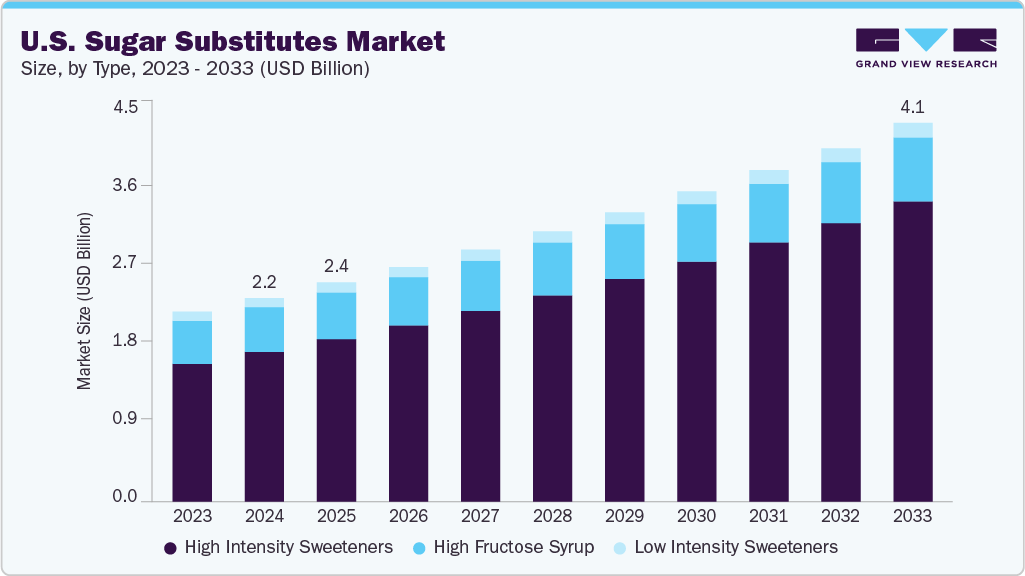 Source: Grand View Research, IR Documents, Primary Interviews, Paid DatabasesTo learn more about this report,
 Download Free Sample Report
 The rising prevalence of obesity and diabetes is another significant factor driving the growth of the sugar substitutes market in the U.S. According to the American Diabetes Association data published in November 2025, nearly 40% Americans suffer from diabetes, while 90% of diabetic individuals are overweight or obese. The rising prevalence of these health conditions, which are associated with excessive sugar intake, is increasing demand for low-calorie and sugar-free sweetening options. As a result, products such as Equal (made with aspartame) and Sweet'N Low (made with saccharin) are witnessing broader consumer adoption.
Furthermore, regulatory actions, such as the FDA’s initiatives to reduce added sugar in food products and their push for manufacturers to voluntarily reduce sugar content, further support the adoption of sugar substitutes in the market. For instance, the Healthy, Hunger-Free Kids Act has encouraged schools to use sugar alternatives in student meals.
Market Dynamics
The U.S. sugar substitutes market is being shaped by evolving consumer preferences, regulatory requirements, and increasing demand for naturally derived ingredients. Rising health consciousness and the growing focus on sugar reduction are encouraging food and beverage manufacturers to adopt alternative sweetening solutions. At the same time, stringent regulatory standards and product approval requirements can increase commercialization timelines and costs.
Increasing health consciousness among consumers is encouraging the adoption of products with reduced sugar content. Food and beverage manufacturers are reformulating products to meet changing dietary preferences and lifestyle needs. The growing focus on weight management and healthier consumption patterns is boosting the use of sugar substitutes. This trend is particularly strong in beverages, snacks, and dairy products. As consumers seek alternatives without compromising taste, demand for sugar substitutes continues to rise. In April 2024, Ingredion launched a new stevia sweetener, PURECIRCLE Clean Taste Solubility Solution, that delivers sugar-like taste with improved solubility and no additives. Consumer testing showed strong taste performance, enabling up to 100% sugar reduction in foods and beverages while reducing stevia aftertaste.
Regulatory authorities impose strict evaluation standards to ensure the safety and quality of sugar substitute ingredients. Manufacturers must undergo extensive testing and compliance procedures before launching new products to the market. These requirements can increase development timelines and operational costs. Differences in regulations across regions may also create challenges for market expansion. In August 2025, NuNaturals recalled certain stevia and monk fruit sweetener products nationwide after a labeling mix-up caused the two products to be swapped. The FDA issued a Class II warning; consumers are advised to check affected bottles and stop using them due to possible temporary health effects. Such regulatory complexities can limit the speed of innovation and product commercialization.
The increasing preference for clean-label, naturally derived, and minimally processed ingredients is creating opportunities for sugar substitute manufacturers in the U.S. market. Consumers are increasingly scrutinizing ingredient lists and seeking sweetening solutions perceived as more natural, transparent, and compatible with healthier lifestyles. According to Splenda data published in June 2026, its U.S.-grown stevia program highlights opportunities for plant-based, transparent, and domestically sourced sugar substitutes, with vertically integrated production supporting quality and traceability. Splenda aims to help Americans cut unwanted sugar consumption by 25% or more by 2030, reinforcing the opportunity for naturally derived sweeteners in the U.S. market.
Analyst Perspective
The U.S. sugar substitutes market is witnessing steady growth, supported by increasing demand for low-calorie, reduced-sugar, and naturally derived alternatives. Growing adoption across food, beverage, health, and personal-care applications is expanding the market’s addressable opportunities. Manufacturers are investing in improved taste, functionality, clean-label formulations, and innovative sweetener technologies to meet evolving preferences. Established players are strengthening broad sweetener portfolios, while emerging players are focusing on novel and plant-based solutions. Overall, increasing sugar-reduction initiatives and demand for healthier formulations are expected to support continued market development.
Type Insights
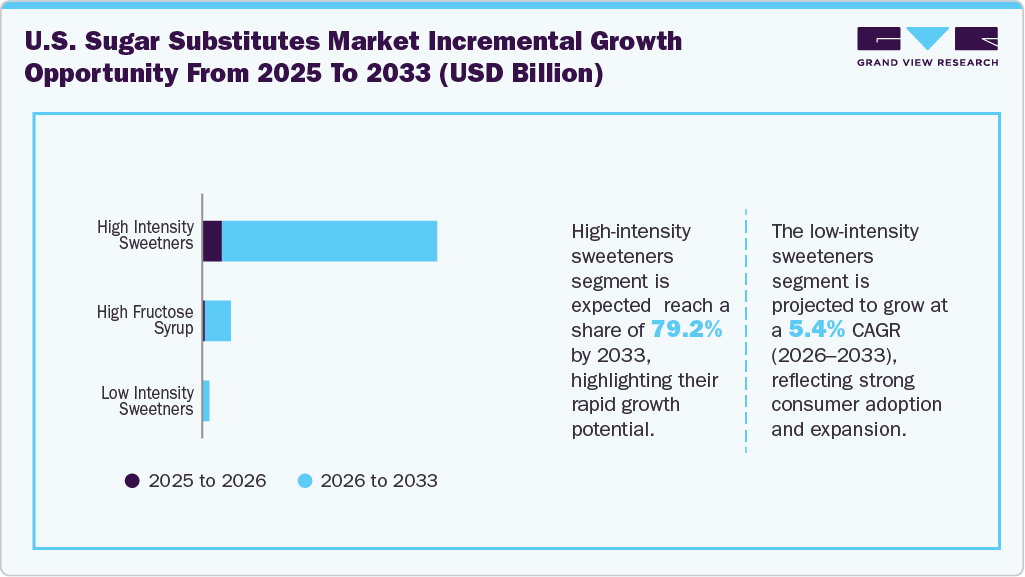
The high-intensity sweeteners accounted for the largest share, accounting for 74.3% share of the U.S. sugar substitutes market revenue in 2025. The demand for high-intensity sweeteners is primarily driven by their high sweetness potency, broad application range, and strong regulatory approval worldwide. Sweeteners such as aspartame, sucralose (Splenda), and stevia-derived ingredients can provide sweetness levels up to 200-600 times greater than sugar, enabling manufacturers to use smaller quantities while lowering calorie content and production expenses. In the U.S., beverage manufacturers including Coca-Cola and PepsiCo widely use high-intensity sweeteners in their diet and zero-sugar product offerings, such as Diet Coke, Coke Zero Sugar, and Pepsi Zero Sugar, which contain blends of aspartame, acesulfame potassium, or sucralose. Additionally, food companies such as General Mills and Chobani use stevia and sucralose in products such as breakfast cereals, flavored yogurts, and snack bars to meet growing consumer demand for reduced-calorie options.
 To learn more about this report, Download Free Sample Report
 The U.S. low-intensity sweeteners segment is projected to grow at the fastest CAGR of 5.4% from 2026 to 2033. The growing preference for mild sweetness in food and beverage products, while preserving the original flavor profile, is driving demand for low-intensity sweeteners. Ingredients such as sorbitol, xylitol, and maltitol are gaining popularity due to their moderate sweetness levels and suitability for products designed to reduce sugar content. In the U.S., sorbitol is commonly used in sugar-free chewing gums, confectionery items, and dental care products as its sweetness lowering the chances of tooth decay. Increasing consumer interest in healthier and naturally sourced ingredients is further supporting the adoption of low-intensity sweeteners, particularly in dairy and bakery applications, where they maintain taste, texture, and product quality while offering a lower glycemic response compared with conventional sugar.
Application Insights
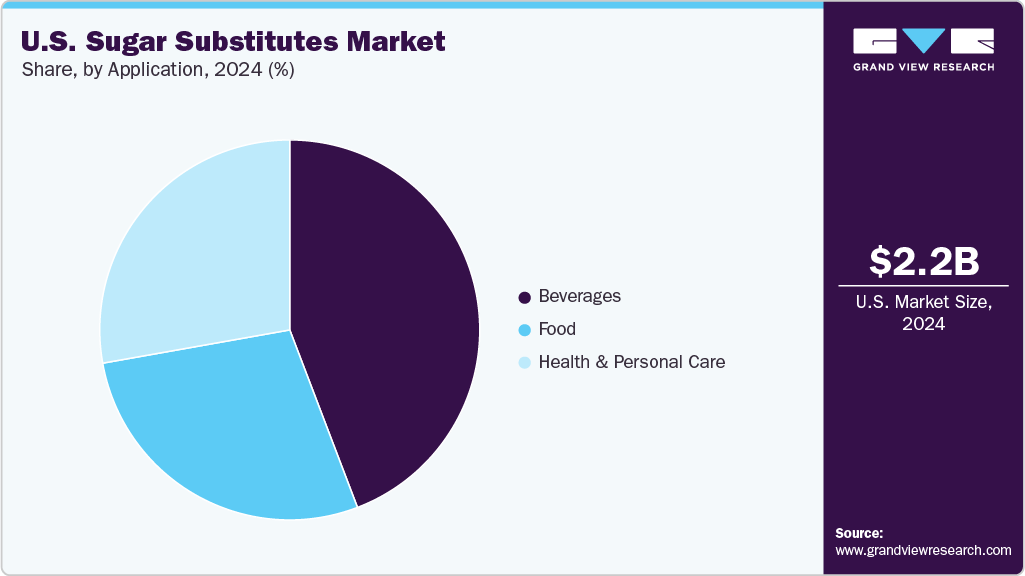
The sugar substitutes for beverages segment accounted for the largest share of 44.1% in 2025. The growing preference for low-calorie and sugar-free beverages among health-conscious consumers is accelerating the adoption of sugar substitutes in the beverage sector. Increased awareness of the adverse effects associated with high sugar consumption, such as obesity and diabetes, is motivating consumers to shift toward healthier beverage choices. Moreover, the rising popularity of reduced-sugar ready-to-drink teas, energy drinks, and sports beverages is further expanding the application of sugar alternatives. For instance, in March 2026, Gatorade introduced Gatorade Lower Sugar, a new hydration beverage containing 75% less sugar than the original Thirst Quencher and made without artificial flavors, sweeteners, or colors. The drink features Gatorade’s electrolyte blend and comes in four varieties: Fruit Punch, Lemonade, Glacier Cherry, and Rain Berry.
 To learn more about this report, Download Free Sample Report
 Sugar substitutes for health & personal care segment is projected to grow at the fastest CAGR of 7.4% from 2026 to 2033. The increasing demand for functional and wellness-oriented products that provide health benefits without adding sugar or excess calories is driving the use of sugar substitutes across various applications. These alternatives are gaining popularity in oral care products, including toothpaste and mouthwash, as they support dental health by providing sweetness, and preventing tooth decay. For instance, brands such as Colgate incorporate ingredients such as xylitol and sorbitol in selected formulations due to their oral health benefits. For instance, in July 2026, Davids Health Sciences introduced a fluoride-free, flavorless nano-hydroxyapatite toothpaste featuring its proprietary Hydroxi technology and xylitol as a sweetening ingredient to promote enamel protection and oral health. The formulation supports enamel remineralization, whitening, and plaque removal while being free from added flavors, fluoride, artificial colors, and preservatives.
Regional Insights
U.S. Sugar Substitutes Market Trends
The U.S. sugar substitutes market is driven by increasing product innovation and the development of advanced sweetening solutions that improve taste, texture, and functionality. The expanding application of sugar substitutes in processed foods, dietary supplements, and specialty nutrition products is supporting market growth. Additionally, manufacturers are investing in research and development to introduce improved formulations that cater to evolving consumer preferences. The growing availability of diverse sweetener options is further strengthening market adoption across various industries.
Key U.S. Sugar Substitutes Company Insights
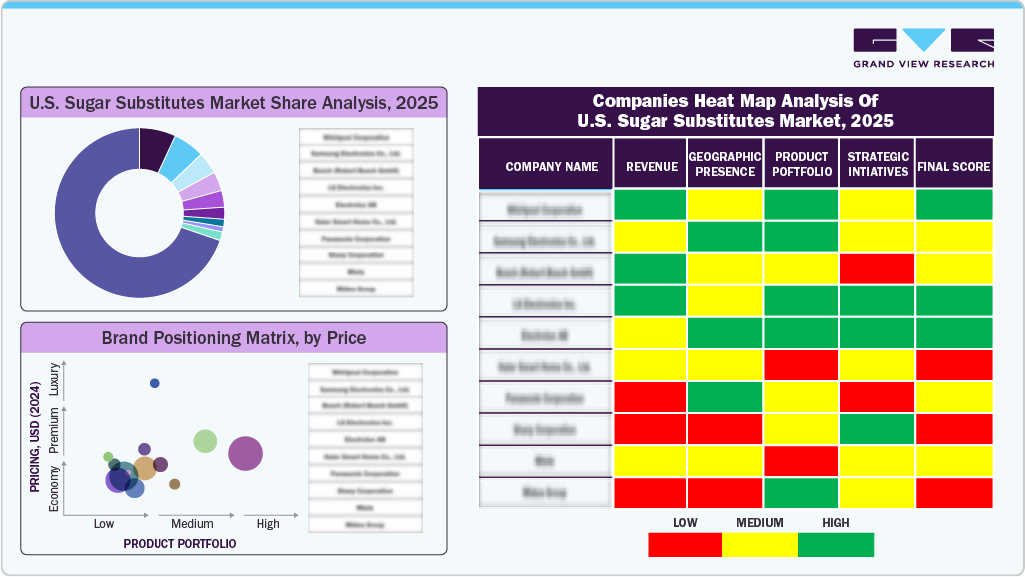
The U.S. sugar substitutes industry is characterized by the presence of several established players offering a wide range of artificial and natural sweeteners. Leading companies are focusing on product diversification, strategic partnerships, and technological advancements to strengthen their market position. Natural sweeteners are gaining traction due to increasing preference for clean-label ingredients. The competitive landscape is shaped by continuous innovation, pricing strategies, and expanding applications across food, beverage, and other end-use sectors. Growth opportunities are also emerging through the introduction of novel sweetener formulations.
Market participants are increasingly investing in sustainable sourcing and improved production processes to meet evolving consumer expectations. The market is witnessing greater competition as companies expand their product portfolios and target diverse consumer segments. In addition, mergers, acquisitions, and collaborations are contributing to the consolidation and growth of the industry.
 To learn more about this report, Download Free Sample Report
 Key U.S. Sugar Substitutes Companies
-
Tate & Lyle
-
Cargill, Incorporated
-
Archer Daniels Midland Company (ADM)
-
Ingredion Incorporated
-
Roquette Frères
-
Ajinomoto Co.
-
JK Sucralose Inc.
-
The NutraSweet Company
-
International Flavors & Fragrances Inc.
-
PureCircle Limited
Competitive Benchmarking
Category
Operating Strategies
Competitive Edge
Weakness
Established Players (Tate & Lyle, Cargill, Incorporated)
- Expand sweetener portfolios, invest in formulation solutions, and strengthen manufacturer partnerships.
- Broad product portfolios, strong R&D capabilities, and established customer relationships.
- Higher operating costs and complex product portfolios can slow innovation.
Emerging Players (JK Sucralose Inc.)
- Focus on novel sweeteners, fermentation-based production, and clean-label solutions.
- Faster innovation, specialized technologies, and strong appeal in next-generation sweeteners.
- Limited production scale, lower brand recognition, and smaller distribution networks.
Recent Developments
-
In July 2026, Davids Health Sciences introduced a fluoride-free, flavorless nano-hydroxyapatite toothpaste featuring its proprietary Hydroxi technology and xylitol as a sweetening ingredient to promote enamel protection and oral health. The formulation supports enamel remineralization, whitening, and plaque removal while being free from added flavors, fluoride, artificial colors, and preservatives.
-
In June 2026, Truvia introduced Allulose Plus Stevia Sweetener & Monk Fruit Sweetener, a sweetener blend made with allulose, stevia, and monk fruit that provides a sugar-like taste, zero calories, and can be used as a one-to-one substitute for sugar. The product was initially launched at Target and is being expanded to additional retail stores across the U.S.
U.S. Sugar Substitutes Market Report Scope
Report Attribute
Details
Market size in 2025
USD 2.4 billion
Estimated market size in 2026
USD 2.6 billion
Projected market size by 2033
USD 4.1 billion
Growth rate (Revenue)
CAGR of 7.1% from 2025 to 2033
Actual data
2021 - 2025
Forecast period
2026 - 2033
Quantitative units
Revenue in USD Billion, volume in Thousand Tons, and CAGR from 2025 to 2033
Report coverage
Revenue forecast, company ranking, competitive landscape, growth factors, and trends
Segments covered
Type, and application
Key companies profiled
Tate & Lyle; Cargill; Incorporated; Archer Daniels Midland Company (ADM); Ingredion; Roquette Freres; Ajinomoto Co.; JK Sucralose Inc.; The NutraSweet Company; International Flavors & Fragrances Inc.; PureCircle Limited
Customization scope
Free report customization (equivalent up to 8 analysts’ working days) with purchase. Addition or alteration to country, regional & segment scope.
Pricing and purchase options
Avail customized purchase options to meet your exact research needs. Explore purchase options
U.S. Sugar Substitutes Market Report Segmentation
This report forecasts revenue growth at the country level and provides an analysis of the latest industry trends and opportunities in each of the sub-segments from 2021-2033. For this study, Grand View Research has segmented the U.S. sugar substitutes market report based on type and application.
-
Type Outlook (Revenue, USD Billion; Volume, Thousand Tons, 2021 - 2033)
-
High Intensity Sweeteners
-
Natural
-
Stevia Extracts
-
Licorice Root Extracts
-
Monk Fruit Extracts
-
-
Artificial
-
Aspartame
-
Cyclamate
-
Saccharin
-
Sucralose
-
Others
-
-
-
Low Intensity Sweeteners
-
Xylitol
-
Sorbitol
-
Maltitol
-
Mannitol
-
Trehalose
-
Isomaltulose
-
Others
-
-
High Fructose Syrup
-
-
Application Outlook (Revenue, USD Billion; Volume, Thousand Tons, 2021 - 2033)
-
Food
-
Bakery
-
Confectionery
-
Dairy
-
Others
-
-
Beverages
-
Juices
-
Functional Drinks
-
Carbonated Drinks
-
Non-Dairy
-
Milk and Dairy
-
Others
-
-
Health & Personal Care
-
Research Methodology
The U.S. sugar substitutes market figures in this report are based on a proven research process that combines executive interviews with secondary research from proprietary databases, company filings, and recognized regulatory and institutional sources. Market size is built through value-chain sizing-reconciling supply-side and demand-side estimates-and triangulated with bottom-up and top-down approaches. Every estimate passes multiple levels of expert validation before publication, with eachU.S. sugar substitutes segment quantified using the revenue-capture definitions in the table below.
Segment Definition
Segment - Application
Revenue capture definition
Food
Sugar substitutes generate revenue through their incorporation into food products such as bakery and confectionery products, snacks, desserts, sauces, and processed foods. Revenue is captured through ingredient sales to food manufacturers and, in some cases, direct-to-consumer retail sales. Different sweetener types, functional properties, and formulation requirements allow suppliers to serve diverse food applications and support value-added product positioning.
Beverages
Sugar substitutes generate revenue through their use in carbonated soft drinks, juices, flavored waters, sports and energy drinks, ready-to-drink beverages, and other reduced-sugar formulations. Revenue is captured primarily through sales to beverage manufacturers, as well as through retail products containing sugar substitutes. High-volume beverage applications, customized sweetener blends, and formulations designed to maintain taste and mouthfeel create opportunities for suppliers to capture greater value.
Health & Personal Care
Sugar substitutes generate revenue through their use in health-oriented products, nutritional formulations, oral-care products, and personal-care applications where sweetness, flavor enhancement, or sugar reduction is required. Revenue is captured through ingredient supply to manufacturers and finished-product sales across health, wellness, and personal-care channels. Specialty formulations, functional ingredients, and applications requiring specific sensory or formulation characteristics can support premium-value opportunities.
Estimation Model
Layer Name
Question
Description
Consumption Profile Layer
Who uses sugar substitutes?
Targets consumers and manufacturers seeking reduced-sugar, low-calorie, and healthier food and beverage options.
Market Reach Layer
Where are sugar substitutes used?
Covers food, beverage, health, and personal-care applications across retail, food service, and e-commerce channels.
Purchase & Retention Layer
What drives repeat purchases?
Driven by taste performance, functionality, affordability, ingredient quality, and formulation consistency.
Value Generation Layer
How is revenue generated?
Revenue is created through bulk ingredient sales, specialty sweetener blends, premium formulations, and high-value applications.
Delivered Customizations
This report has been delivered with the following In-depth customizations
Client Request
Customization Delivered
Value Adds
U.S. Sugar Substitute Consumer & Usage Assessment
Examined sweetening needs across beverages, bakery, dairy, confectionery, and household applications, including preferences for taste, calories, naturality, and clean-label attributes.
Pinpoints attractive consumer needs, emerging demand spaces, and usage occasions for sugar-reduction solutions.
U.S. Sugar Substitute Market & Distribution Assessment
Assessed market dynamics across foodservice, retail, ingredient suppliers, and digital channels, with a focus on supplier structures, pricing movements, regulatory considerations, and adoption barriers.
Reveals priority application channels, whitespace opportunities, and routes to improve market access and commercial reach.
U.S. Sugar Substitute Product & Competitive Assessment
Compared sweetener types, formulation performance, taste profiles, source positioning, functional benefits, cost economics, and leading market offerings.
Enables portfolio prioritization, competitive differentiation, and sharper positioning across target food and beverage applications.
Frequently Asked Questions About This Report
The use of sugar substitutes in beverages led the market with a 44.1% revenue share in 2025.
The use of sugar substitutes in health & personal care is projected to grow at a CAGR of 7.4% from 2026 to 2033.
Key players include Tate & Lyle, Cargill, Incorporated, Archer Daniels Midland Company (ADM), Ingredion, Roquette Freres, Ajinomoto Co., JK Sucralose Inc., The NutraSweet Company, International Flavors & Fragrances Inc., and PureCircle Limited.
The U.S. sugar substitutes market size was valued at USD 2.4 billion in 2025 and is estimated at USD 2.6 billion for 2026.
The U.S. sugar substitutes market is expected to grow at a CAGR of 7.1% from 2026 to 2033, reaching USD 4.1 billion.
Key factors driving the U.S. sugar substitutes market include growing consumer demand for low-calorie and reduced-sugar products, rising obesity and diabetes concerns, and increasing health awareness.
The high-intensity sweeteners market led with a 74.3% revenue share in 2025.
The low-intensity sweeteners market is projected to grow at the fastest CAGR of 5.4% from 2026 to 2033.
About the Author(s)
Consumer F&B Research Team
Consumer Goods · Consumer F&BThis report was authored by the consumer f&b research team at Grand View Research - comprising two research analysts, one senior research analyst, and one industry expert - with specialized expertise in the consumer f&b segment of the consumer goods industry. All findings are based on proprietary consumer goods databases, executive interviews, and regulatory analysis, subject to internal peer review prior to publication.
Last Updated:
Speak to Analyst

Customize this report to your needs - add regions, segments, or data points, with 20% free customization.
Or view our licence options:


ISO 9001:2015 & 27001:2022 Certified
We are GDPR and CCPA compliant! Your transaction & personal information is safe and secure. For more details, please read our privacy policy.


