
- Home
- »
- Power Generation & Storage
- »
-
U.S. Diesel Generator Market Size Report, 2026-2033GVR Report cover

U.S. Diesel Generator Market (2026 - 2033)
Size, Share & Trends Analysis Report By Power Rating (Low Power Gensets, Medium Power Gensets, High Power Gensets), By Application (Industrial, Commercial, Residential), And Segment Forecasts
Market Size, 2025
$3.3BMarket Estimate, 2026
$3.6BMarket Forecast, 2033
$6.8BCAGR, 2026–2033
9.5%U.S. Diesel Generator Market Summary
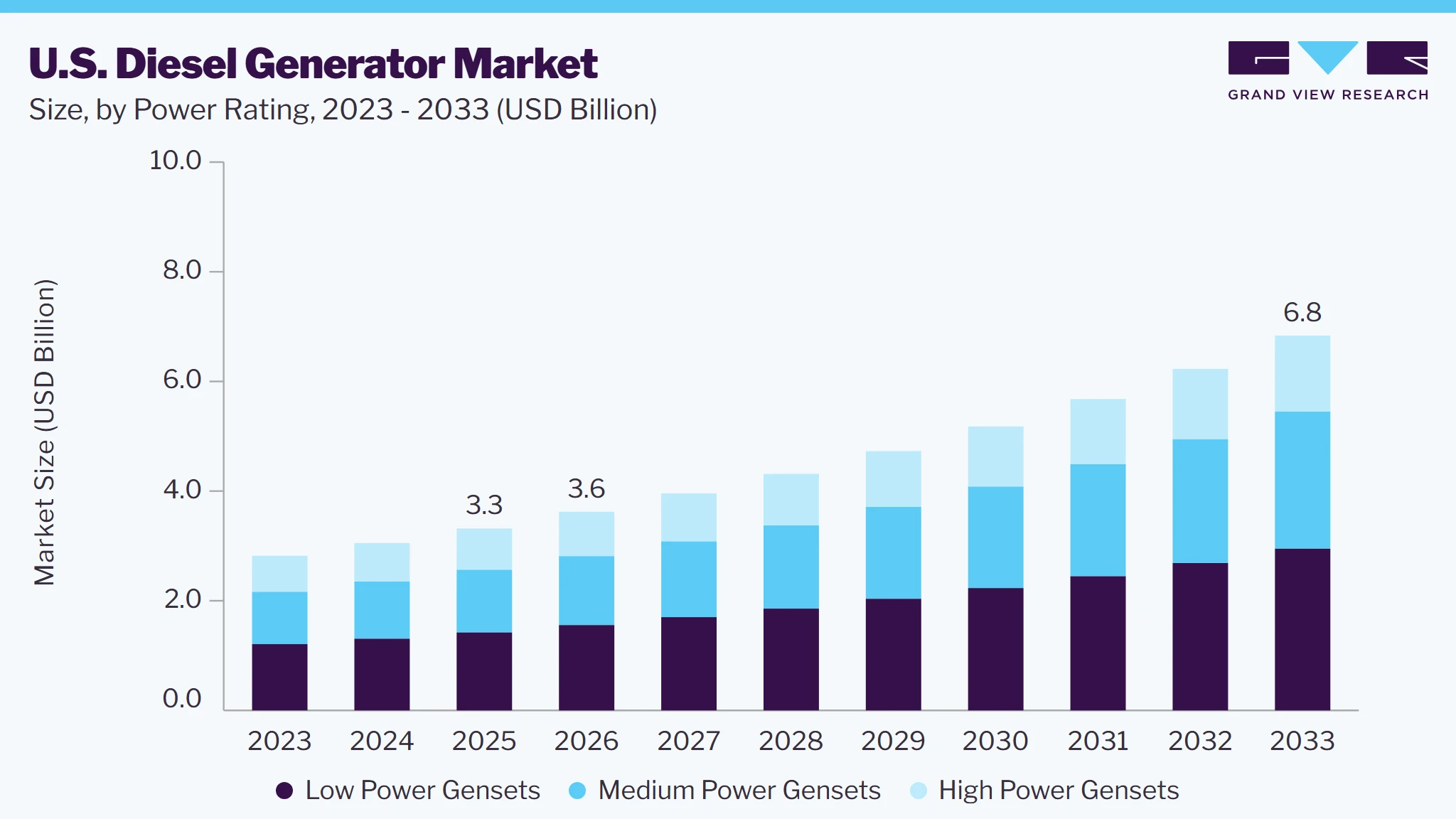
The U.S. diesel generator market size was valued at USD 3.3 billion in 2025 and is projected to grow from USD 3.6 billion in 2026 to USD 6.8 billion by 2033, at a CAGR of 9.5% from 2026 to 2033. The market growth is driven by expanding data center capacity, rising concerns about power reliability, and increasing demand for dependable backup power across critical infrastructure.
Key Market Trends & Insights
- By power rating: Low power gensets segment held the largest revenue share of 42.9% in 2025.
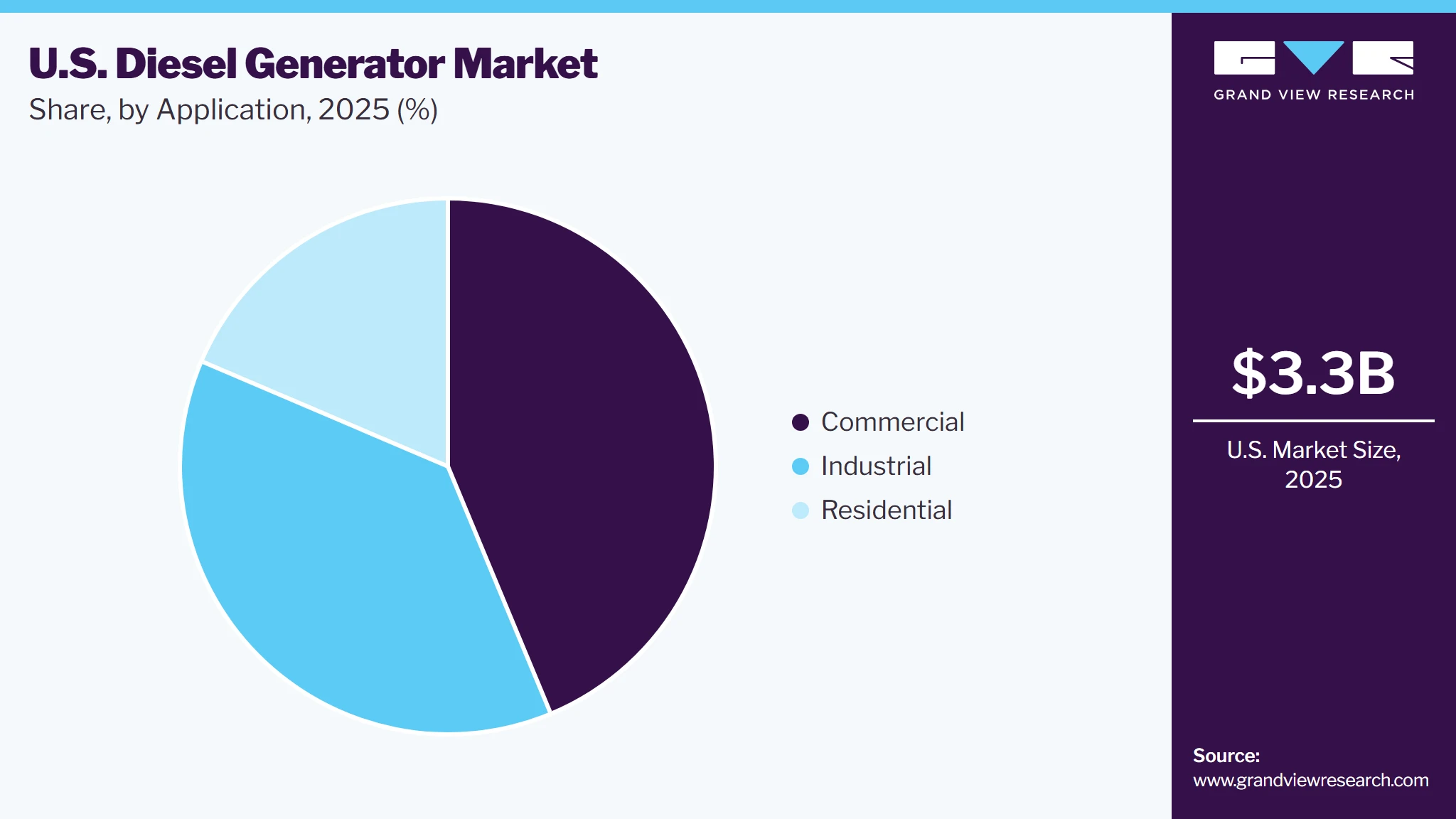
- By application: Commercial segment held the largest revenue share of 43.7% in 2025.
Market Size & Forecast
- Market Size in 2025: USD 3.3 Billion
- Estimated Market Size in 2026: USD 3.6 Billion
- Projected Market Size by 2033: USD 6.8 Billion
- CAGR (2026-2033): 9.5%
Three ways to get this report
Buy it, customize it, or ask a question.Ask an Analyst
Analyst response in 1 business day
- AccessReport author, directly
- Reply timeWithin 1 working day
- No sales callDirect answer only
- FormatEmail reply
- CostFree, no cost
Get the Full Report
What the study covers
- FormatsPDF · Excel · Dashboard
- Timeline2026–2033 annual, 2025 base
- Coverage20+ countries, 5 regions
- Companies10+ key players profiled
Customize the Report
20% free customization
- IncludeCountries, segments, points
- TailorTo your product definition
- ExtendDeeper competitor detail
- OrA fully bespoke study
- Turnaround5–10 working days
 Source: Grand View Research, IR Documents, Primary Interviews, Paid DatabasesTo learn more about this report,
 Download Free Sample Report
Extreme weather events, grid disruptions, and continued infrastructure investment are further supporting demand for diesel generators.
Market Dynamics
The U.S. diesel generator market is shaped by the growing need for reliable backup and standby power across data centers, healthcare facilities, commercial buildings, manufacturing, and critical infrastructure. Increasing electricity demand, aging grid infrastructure, and frequent weather-related power disruptions are encouraging end users to invest in higher-capacity generation systems. Stricter emissions requirements and pressure to reduce operating costs are driving demand for fuel-efficient, low-emission generators and advanced monitoring systems. Rising data center construction and infrastructure investment are expected to sustain demand, while competition from natural gas generators, battery energy storage systems, and other distributed power technologies remains a key constraint.
Rapid growth in hyperscale and AI-driven data centers is increasing demand for reliable backup power across the U.S. As these facilities operate continuously and support mission-critical workloads, even short power interruptions can result in significant operational and financial losses. Diesel generators provide high-capacity, fast-start backup power during grid outages and support stringent uptime requirements. This makes them an important component of data center power infrastructure, particularly for large campuses with high-density computing loads. The continued expansion of AI infrastructure is therefore expected to sustain demand for high-capacity diesel generator sets.
In August 2026, NVIDIA announced a partnership with SB Energy to develop the PORTS-Pike Technology Campus in Ohio as an AI computing hub. The project is planned with an initial 4.25 GW of IT capacity, with an option to expand to 8 GW, with OpenAI as the customer. The scale of the project highlights the rapidly increasing power requirements of U.S. AI data centers and the need for dependable power infrastructure to support continuous, high-density computing operations.
High-capacity diesel generators involve substantial initial investments in equipment, transportation, installation, fuel storage, switchgear, control systems, and site preparation. Operating expenses also remain significant due to diesel consumption, periodic maintenance, replacement of critical components, and emissions-compliance requirements. These cost pressures can discourage smaller commercial and industrial users from adopting large diesel generator systems. The relatively high lifecycle cost also makes alternative backup technologies, including natural gas generators and battery energy storage, more attractive in some applications.
Hybrid microgrids combining diesel generators with solar PV and BESS are emerging as an opportunity in the U.S. diesel generator market. These systems allow renewable generation and stored electricity to meet a larger share of routine power demand, while diesel generators provide dependable backup during periods of low renewable output, peak loads, or grid outages. This operating model can reduce diesel fuel consumption, operating costs, and emissions while maintaining the reliability associated with conventional generator-based systems. The opportunity is particularly relevant for remote facilities, critical infrastructure, commercial sites, and locations facing grid reliability constraints.
Analyst Perspective
The U.S. diesel generator market is evolving toward more flexible and application-specific power solutions rather than relying solely on conventional standby use. Demand is expanding across data centers, construction, utilities, healthcare, and other facilities where power continuity is critical. Larger projects are increasingly favoring higher-capacity and digitally monitored generator systems. Hybrid configurations with BESS and renewable generation are also gaining relevance as users seek to reduce fuel consumption and emissions. Growing emphasis on lifecycle costs is encouraging buyers to evaluate fuel efficiency, maintenance requirements, and remote monitoring capabilities alongside initial equipment costs. This is increasing the importance of integrated service and aftermarket support in supplier selection.
Power Rating Insights
Low-power gensets dominated the U.S. diesel generator industry, accounting for a revenue share of 42.9% in 2025. This is driven by their widespread use across small commercial facilities, retail establishments, residential buildings, construction sites, and light industrial applications. Their relatively lower purchase and installation costs make them suitable for users requiring dependable backup power without investing in large-capacity systems. Demand is also supported by frequent short-duration power interruptions and the need for temporary power at construction and infrastructure projects. In addition, compact designs, improved fuel efficiency, and simplified maintenance are supporting adoption across decentralized applications.
The medium power gensets segment is expected to grow at the fastest CAGR of 10.3% from 2026 to 2033. This growth is supported by increasing demand for reliable backup and prime power across commercial, industrial, healthcare, and construction applications. Medium-capacity systems offer greater load-handling capability than low-power units while remaining more flexible and cost-effective than large utility-scale generators. Rising data center development is also driving demand for medium-capacity units to meet auxiliary and distributed power requirements. In addition, grid reliability concerns and weather-related outages are encouraging businesses to strengthen onsite generation capacity.
Application Insights
The commercial application segment dominated the U.S. diesel generator market, accounting for a revenue share of 43.7% in 2025. This is driven by the growing need for reliable backup power across offices, retail facilities, hotels, data centers, and other commercial establishments. Increasing dependence on uninterrupted electricity for IT systems, security infrastructure, HVAC, and critical operations is encouraging businesses to deploy diesel gensets. Frequent weather-related outages and grid reliability concerns are further strengthening demand for onsite backup generation. In addition, continued commercial construction and expansion of data center facilities are creating new opportunities for generator installations.
 To learn more about this report, Download Free Sample Report
The industrial application segment is expected to grow at the second-fastest CAGR of 9.7% from 2026 to 2033. This growth is driven by rising industrial production, the expansion of manufacturing facilities, and the need for reliable power to sustain continuous operations. Power interruptions can disrupt production processes, damage equipment, and increase downtime costs, encouraging industries to maintain onsite generation capacity. Demand is also supported by investments in construction, mining, oil & gas, and other energy-intensive activities. In addition, aging grid infrastructure and weather-related disruptions are encouraging industrial users to strengthen backup and standby power capabilities.
Key U.S. Diesel Generator Company Insights
Some of the key players operating in the U.S. diesel generator market include Caterpillar and Cummins Inc.
-
Caterpillar is an established player in the market, offering a broad range of diesel generator sets for standby, prime, and continuous power applications. Its portfolio spans compact units for commercial facilities to high-capacity systems for data centers, healthcare, industrial facilities, and other mission-critical applications. The company also provides integrated power solutions, including automatic transfer switches, paralleling controls, and monitoring systems, supported by an extensive U.S. dealer and service network. Its broad product range, strong brand presence, and established aftermarket support position Caterpillar as a key participant in the U.S. diesel generator market.
-
Cummins Inc. is a prominent participant in the market, supplying diesel generator sets across residential, commercial, industrial, data center, healthcare, and other critical power applications. Its portfolio includes standby and prime power systems spanning a wide range of capacities, complemented by transfer switches, paralleling equipment, controls, and remote monitoring solutions. Cummins supports customers through an extensive network of distributors, dealers, and service locations across the U.S., enabling equipment sales, maintenance, parts, and technical support. Its vertically integrated powertrain capabilities, broad generator portfolio, and strong service infrastructure position Cummins as a significant competitor in the U.S. diesel generator industry.
Key U.S. Diesel Generator Companies
-
Atlas Copco
-
Briggs & Stratton, LLC
-
Caterpillar
-
Cummins Inc.
-
Discovery Energy, LLC
-
Doosan Bobcat
-
Generac Power Systems, Inc.
-
Kubota Engine America Corporation
-
Multiquip Inc.
-
Rolls-Royce plc (mtu)
Competitive Benchmarking
Category
Operating Strategies
Competitive Edge
Weakness
Established Players (Atlas Copco, Briggs & Stratton, LLC, Caterpillar, Cummins Inc., Doosan Bobcat, Generac Power Systems, Inc., Kubota Engine America Corporation, Multiquip Inc., Rolls-Royce plc (mtu))
- Maintain broad generator portfolios across standby, prime, and continuous power applications.
- Strengthen direct sales, dealer networks, and aftermarket service coverage across the U.S.
- Target high-growth applications such as data centers, healthcare, manufacturing, and critical infrastructure.
- Integrate generators with controls, transfer switches, monitoring systems, and hybrid power solutions.
- Strong brand recognition and long-standing customer relationships.
- Extensive distribution, parts, and service networks.
- Broad product portfolios covering multiple power ratings and applications.
- Strong engineering capabilities and ability to provide integrated power solutions.
- Higher equipment and service costs compared with smaller suppliers.
- Large organizational structures can limit flexibility for highly customized requirements.
- Strong dependence on diesel-based systems exposes them to fuel-cost and emissions-related pressures.
- Competition among major OEMs can create pricing pressure in standardized generator categories.
Emerging Players (Discovery Energy, LLC)
- Focus on specialized applications, regional markets, and customized generator solutions.
- Compete through flexible customer support and shorter decision-making cycles.
- Target underserved industrial, commercial, rental, and temporary power requirements.
- Build partnerships with distributors, equipment dealers, and service providers to expand market reach.
- Greater flexibility in product customization and customer requirements.
- Ability to compete aggressively on pricing in selected applications.
- Faster adaptation to niche market requirements and emerging power technologies.
- More focused operating structures can enable responsive customer service.
- Smaller geographic and aftermarket service networks.
- Lower brand recognition compared with major generator OEMs.
- Limited manufacturing scale and product breadth.
- Fewer resources for large-scale R&D, digital technologies, and emissions-compliance investments.
Recent Developments
-
In August 2025, Caterpillar introduced the Cat D1500 1.5 MW diesel generator set, powered by a 32.1-liter Cat C32B engine and designed for standby power applications. The generator occupies up to 13% less floor space and is up to 32% lighter than the previous model at the same power rating, reducing shipping, installation, and structural support requirements. The unit complies with NFPA 110 Level 1 Type 10 and U.S. EPA Tier 2 standards and supports remote monitoring through Cat’s digital platforms. The launch strengthens Caterpillar’s offering for space-constrained applications requiring reliable backup power.
U.S. Diesel Generator Report Scope
Report Attribute
Details
Market Definition
The U.S. diesel generator market represents the annual sales revenue generated from diesel-powered generator sets across low, medium, and high power ratings for industrial, commercial, and residential applications.
Market size in 2025
USD 3.3 billion
Estimated market size in 2026
USD 3.6 billion
Projected market size by 2033
USD 6.8 billion
Growth rate
CAGR of 9.5% from 2026 to 2033
Base year for estimation
2025
Historical data
2021 - 2024
Forecast period
2026 - 2033
Quantitative units
Revenue in USD million/billion and CAGR from 2026 to 2033
Report coverage
Revenue forecast, competitive landscape, growth factors, and trends
Segments covered
Power rating and application
Country scope
U.S.
Key companies profiled
Atlas Copco; Briggs & Stratton, LLC; Caterpillar; Cummins Inc.; Discovery Energy, LLC; Doosan Bobcat; Generac Power Systems, Inc.; Kubota Engine America Corporation; Multiquip Inc.; Rolls-Royce plc (mtu)
Customization scope
Free report customization (equivalent up to 8 analysts working days) with purchase. Addition or alteration to country, regional & segment scope.
Pricing and purchase options
Avail customized purchase options to meet your exact research needs. Explore purchase options
U.S. Diesel Generator Market Report Segmentation
This report forecasts revenue growth at the country level and provides an analysis of the latest industry trends in each of the sub-segments from 2021 to 2033. For this study, Grand View Research has segmented the U.S. diesel generator market report based on power rating and application:
-
Power Rating Outlook (Revenue, USD Million/Billion, 2021 - 2033)
-
Low Power Gensets
-
Medium Power Gensets
-
High Power Gensets
-
-
Application Outlook (Revenue, USD Million/Billion, 2021 - 2033)
-
Industrial
-
Commercial
-
Residential
-
Research Methodology
The U.S. diesel generator market figures in this report are based on a proven research process that combines executive interviews with secondary research from proprietary databases, company filings, and recognized regulatory and institutional sources. Market size is built through value-chain sizing-reconciling supply-side and demand-side estimates-and triangulated with bottom-up and top-down approaches. Every estimate passes multiple levels of expert validation before publication, with each U.S. diesel generator segment quantified using the revenue-capture definitions in the table below.
Segment Definition
Segment - Power Rating
Revenue capture definition
Low Power Gensets
Revenue generated from the sale of diesel generator sets in the low power rating range, typically used for residential, small commercial, and light-duty applications.
Medium Power Gensets
Revenue generated from diesel generator sets in the medium power rating range, primarily serving commercial facilities, construction sites, and industrial applications.
High Power Gensets
Revenue generated from high-capacity diesel generator sets designed for large industrial facilities, data centers, utilities, and other high-load applications.
Segment - Application
Revenue capture definition
Industrial
Revenue generated from diesel generator sets sold for manufacturing, construction, mining, oil & gas, utilities, and other industrial operations requiring standby, prime, or continuous power.
Commercial
Revenue generated from diesel generator sets sold to offices, retail facilities, data centers, healthcare facilities, hotels, and other commercial establishments for backup or primary power needs.
Residential
Revenue generated from diesel generator sets sold for homes and residential properties to provide backup power during grid outages and other power interruptions.
Estimation Model
Layer Name
Key Question
Description
Demand Layer
Which factors generate demand for diesel generators in the U.S.?
Assess demand from new installations and replacement of existing diesel generator sets across industrial, commercial, and residential applications, considering data center expansion, infrastructure development, grid reliability concerns, and generator replacement cycles.
Power Rating Layer
How does market revenue vary by generator power rating?
Estimate revenue across Low Power Gensets, Medium Power Gensets, and High Power Gensets based on the number of diesel generator sets sold within each power-rating category and their respective average selling prices.
Application Layer
Where are diesel generators used?
Estimate revenue across Industrial, Commercial, and Residential applications, based on demand for standby, prime, and continuous power across manufacturing, construction, data centers, healthcare, commercial facilities, homes, and other end users.
Revenue Layer
How is market revenue generated?
Market revenue represents the sales value of new diesel generator sets sold in the U.S. Revenue is calculated based on the number of generator sets sold and their average selling price, covering sales across the defined power-rating and application segments.
Delivered Customizations
We have successfully delivered the following deep-dive customizations:
Client Request
Customization Delivered
Value Adds
Data Center Opportunity Assessment
Analyzed diesel generator demand from major U.S. data center developments, focusing on new capacity additions, backup power requirements, and the increasing power intensity of AI and hyperscale facilities.
Helps the client quantify data center-driven demand and identify opportunities for high-capacity generator solutions.
State-Level Market Assessment
Assessed diesel generator demand across key U.S. states based on data center development, industrial activity, infrastructure investment, and power reliability requirements.
Enables identification of high-potential states and supports regional market expansion and sales prioritization.
Replacement Demand Assessment
Evaluated replacement demand from the existing U.S. diesel generator base based on equipment age, replacement cycles, and continued requirements for reliable standby and prime power.
Helps the client estimate recurring replacement opportunities and assess the long-term aftermarket potential of the market.
About the Author(s)
Power Generation & Storage Research Team
Energy & Power · Power Generation & StorageThis report was authored by the power generation & storage research team at Grand View Research - comprising two research analysts, one senior research analyst, and one industry expert - with specialized expertise in the power generation & storage segment of the energy & power industry. All findings are based on proprietary energy & power databases, executive interviews, and regulatory analysis, subject to internal peer review prior to publication.
Last Updated:
Speak to Analyst

Customize this report to your needs - add regions, segments, or data points, with 20% free customization.
Or view our licence options:


ISO 9001:2015 & 27001:2022 Certified
We are GDPR and CCPA compliant! Your transaction & personal information is safe and secure. For more details, please read our privacy policy.


