
- Home
- »
- Distribution & Utilities
- »
-
Natural Gas Generator Market Size, Share Report 2026-2033GVR Report cover

Natural Gas Generator Market (2026 - 2033)
Size, Share & Trends Analysis Report By Type (Low Power Genset, Medium Power Genset), By Application (Industrial, Residential, Commercial), By Region (North America, Asia Pacific, Europe, Latin America, Middle East & Africa), And Segment Forecasts
Market Size, 2025
$10.9BMarket Estimate, 2026
$12.1BMarket Forecast, 2033
$23.0BCAGR, 2026–2033
9.6%Natural Gas Generator Market Summary
The global natural gas generator market size was valued at USD 10.9 billion in 2025 and is projected to grow from USD 12.1 billion in 2026 to USD 23.0 billion by 2033, at a CAGR of 9.6% from 2026 to 2033. The market in North America dominated with a revenue share of 29.8% in 2025. This growth can be attributed to the Increasing demand for reliable power supply amidst frequent outages, alongside stringent environmental regulations favoring cleaner energy sources, propelling market expansion.
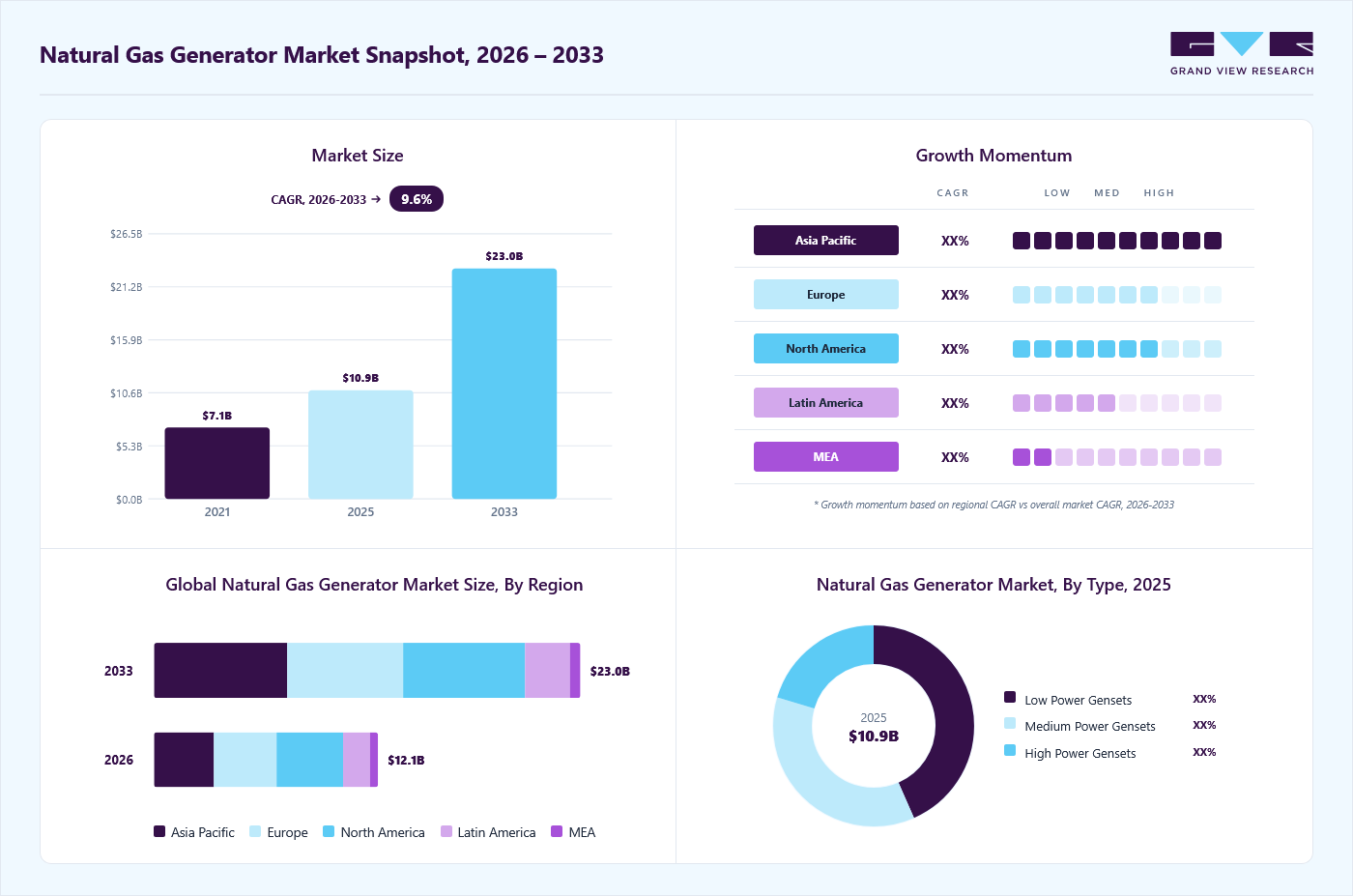 Source: Grand View Research, IR Documents, Primary Interviews, Paid DatabasesTo learn more about this report,
 Download Free Sample Report
Key Market Trends & Insights
- By type: Low power gensets segment dominated the market, with a revenue share of 43.4% in 2025.
- By application: Commercial segment held the largest market share of 46.1% in 2025.
Regional Highlights
- Largest regional market: North America (29.8% revenue share, 2025)
- By country: The U.S. held the largest market share in 2025.
Market Size & Forecast
- Market size in 2025: USD 10.9 Billion
- Estimated market size in 2026: USD 12.1 Billion
- Projected market size by 2033: USD 23.0 Billion
- CAGR (2026-2033): 9.6%
Three ways to get this report
Buy it, customize it, or ask a question.Ask an Analyst
Analyst response in 1 business day
- AccessReport author, directly
- Reply timeWithin 1 working day
- No sales callDirect answer only
- FormatEmail reply
- CostFree, no cost
Get the Full Report
What the study covers
- FormatsPDF · Excel · Dashboard
- Timeline2026–2033 annual, 2025 base
- Coverage20+ countries, 5 regions
- Companies10+ key players profiled
Customize the Report
20% free customization
- IncludeCountries, segments, points
- TailorTo your product definition
- ExtendDeeper competitor detail
- OrA fully bespoke study
- Turnaround5–10 working days
In addition, the rising occurrence of power outages and power supply deficits globally, combined with regulations imposed on diesel gensets due to high levels of carbon emissions, is driving the global demand for natural gas generators. Furthermore, technological advancements enhancing efficiency and performance, combined with rising industrial and commercial activities, are crucial in meeting the escalating energy needs globally.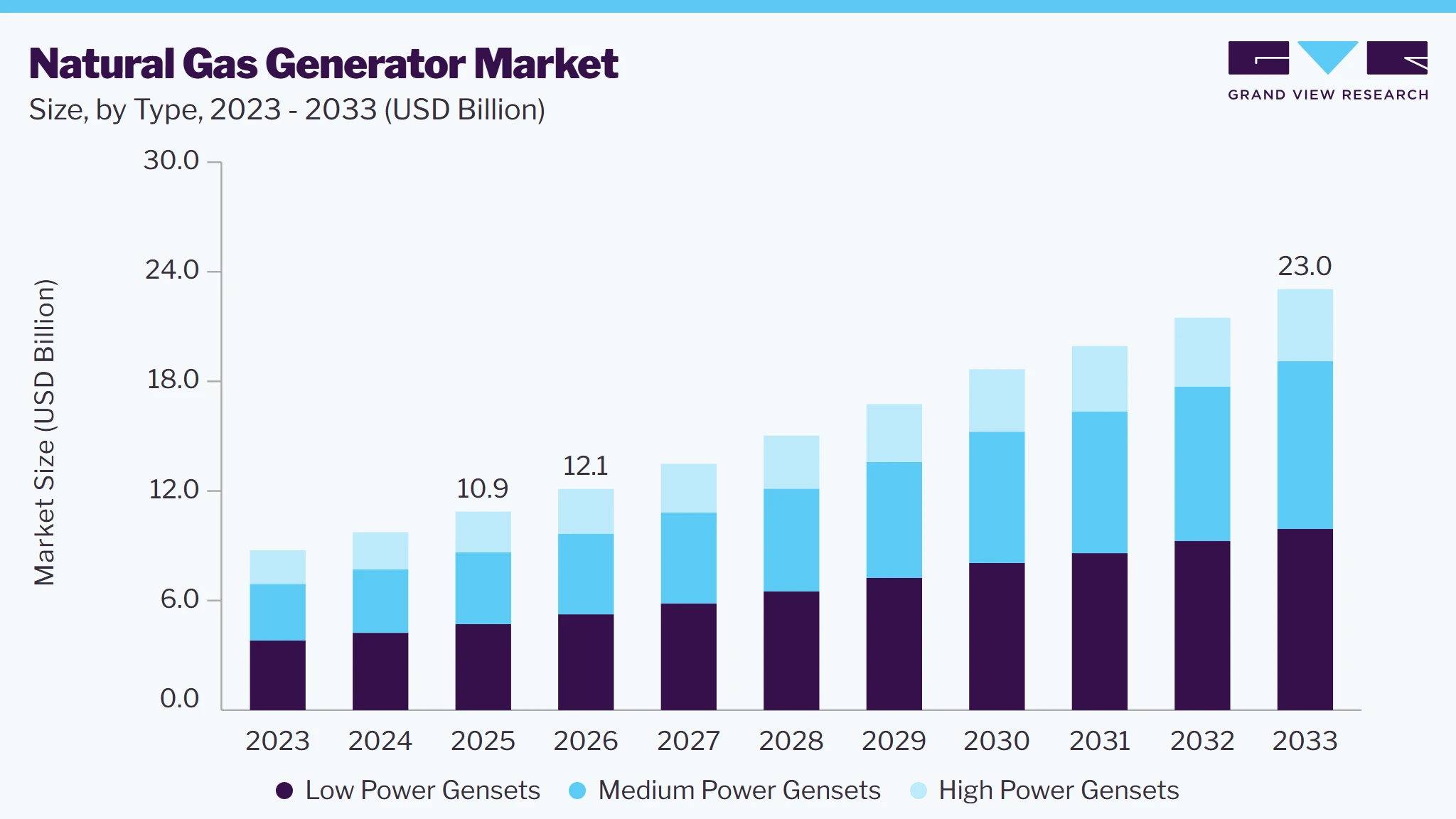 To learn more about this report, Download Free Sample Report
Natural gas generators convert natural gas into electricity and are increasingly significant in the global energy landscape. The surge in natural gas production is largely attributed to supportive policies that promote sustainable development and reduce greenhouse gas emissions, as natural gas is a cleaner-burning alternative to traditional fuels. In addition, growing industrial and commercial facilities, such as shopping malls, high rises, universities, restaurants, district heating and cooling plants, refineries, office buildings, and others in the U.S., are driving the demand for uninterrupted electricity supply to expand businesses and perform operations efficiently, which propels the demand for natural gas gensets.
Natural disasters and severe weather conditions due to climate change have resulted in extended power outages, driving demand for backup power as a necessary amenity in commercial, residential, and industrial buildings. The abundance of natural gas in the U.S., combined with the well-developed infrastructure for transporting it within the country, has fueled the demand for generator sets in the U.S. Gas generator sets are becoming more popular than diesel generator sets due to the country's shale gas revolution, and this trend is expected to continue in the coming years.
Moreover, another crucial factor is the need for a consistent power supply amid rapid economic growth. As industrial sectors expand and populations grow, the reliance on uninterrupted power has intensified. The information and communication technology sector, particularly data centers, significantly contributes to this demand, necessitating dependable generators.
Market Dynamics
The natural gas generator market is growing steadily due to increasing demand for reliable and continuous power across industrial, commercial, and residential sectors. Rising concerns about power outages and the need for backup power solutions are supporting market demand. Natural gas generators are also gaining preference because they produce lower emissions compared to diesel generators and offer stable fuel availability in many regions. In addition, expanding natural gas infrastructure and growing investments in data centers, healthcare facilities, and manufacturing plants are creating new growth opportunities for the market.
Governments are tightening air quality and emission regulations to reduce pollution from conventional diesel-based power generation. As a result, industries and commercial facilities are increasingly shifting toward natural gas generators, which produce lower levels of carbon dioxide, particulate matter, and nitrogen oxides (NOx). Natural gas is widely viewed as a transition fuel that helps organizations meet environmental compliance requirements while maintaining reliable power supply. This regulatory pressure is expected to remain a key factor supporting long-term demand for natural gas generators.
For instance, the growing regulatory scrutiny of backup power systems used in data centers across the United States. In 2026, the EPA introduced updated NOx emission standards for new stationary combustion turbines, with the agency estimating annual NOx emission reductions of up to 296 tons by 2032. Several states tightened permitting requirements for diesel generator installations, encouraging operators to evaluate lower-emission alternatives such as natural gas generators. The rapid expansion of data centers and AI infrastructure is further accelerating this shift toward cleaner backup power solutions.
High upfront investment requirements remain a key challenge for the natural gas generator market. Installing a natural gas generator often involves additional expenses such as gas pipeline connections, fuel infrastructure, site modifications, and regulatory approvals, making the overall project more complex than diesel generator installations. These higher initial costs can discourage adoption, particularly among small and medium-sized businesses with limited capital budgets. Many end users continue to prefer diesel generators due to their lower installation costs and easier deployment. For industrial and commercial facilities located in areas without existing natural gas pipeline networks, the cost of extending gas infrastructure can significantly increase total project expenses.
The rapid expansion of data centers and digital infrastructure is creating strong growth opportunities for the natural gas generator market. Data center operators require reliable, continuous power to support cloud computing, artificial intelligence, and mission-critical applications where even short outages can result in significant financial losses. Natural gas generators are increasingly being adopted as both backup and prime power solutions due to their reliability, scalability, and lower emissions compared to diesel generators. As power demand from AI-driven facilities rises, investments in natural gas-based power systems are expected to increase. In March 2026, Meta partnered with Entergy to support its Hyperion AI data center campus in Louisiana through the development of seven new natural gas power plants, adding 5.2 GW of generating capacity. Combined with three previously approved facilities, the project will provide more than 7 GW of power across ten natural gas plants dedicated to supporting Meta’s expanding AI and data center operations.
Analyst Perspective
The natural gas generator market is benefiting from the growing need for reliable power across industries, commercial facilities, and data centers. Rising concerns over grid instability and power outages are encouraging businesses to invest in dependable backup power solutions. Natural gas generators are also gaining attention as a cleaner alternative to diesel generators, helping users meet emission regulations while maintaining operational reliability. Strong growth in data centers and digital infrastructure is creating new demand for high-capacity generator systems. However, competition from renewable energy and battery storage technologies may limit growth in some regions. Overall, the market is expected to remain resilient as organizations continue to prioritize energy security and uninterrupted power supply.
Type Insights
Based on type, the low power gensets segment led the market with the largest revenue share of 43.4% in 2025. Low power gensets are popular for residential and commercial power backup applications. Nowadays, people use various electrical appliances in their homes, such as geysers, water pumps, AC units, water purifiers, and others. These appliances require more power to function, as in the case of washing machines, which might consume 750 watts but need about 2500 watts to start. As a result, many households choose to have only an 80 KW generator set as a standby power source.
Medium power gensets are expected to grow at a CAGR of 12.9% over the forecast period, owing to the rising energy demands in the industrial and commercial sectors. As economies expand, there is a heightened need for dependable power systems to support operations, particularly in emerging markets. In addition, the shift towards cleaner fuel options has led many businesses to adopt natural gas generators for their efficiency and lower emissions than diesel alternatives. Furthermore, government initiatives promoting clean energy use are propelling investments in medium power gensets, making them a preferred choice for various applications requiring substantial power output.
Application Insights
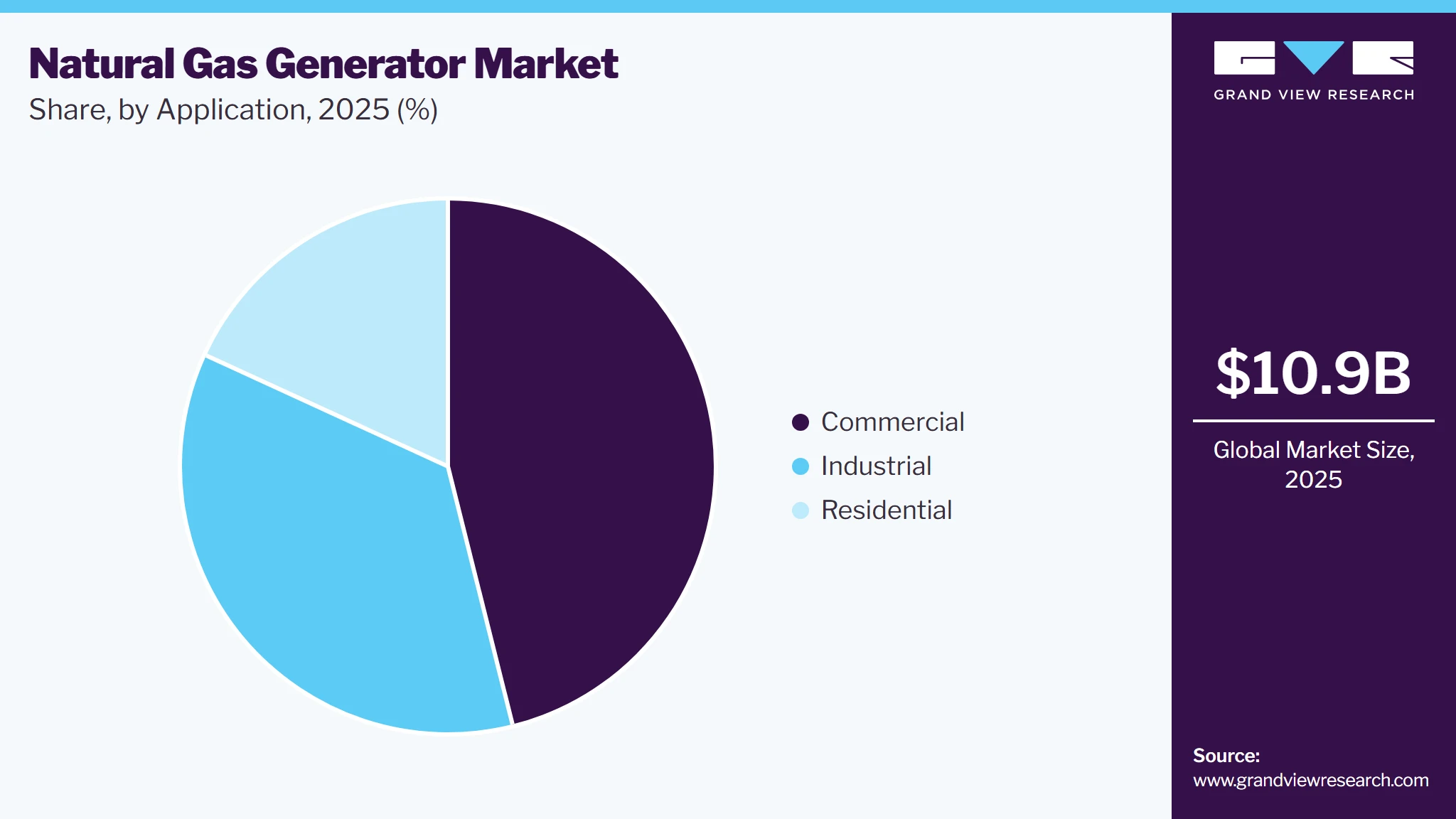
Based on application, the commercial segment led the market with the largest revenue share of 46.1% in 2025, primarily driven by the increasing demand for reliable and clean energy solutions. Businesses are increasingly adopting natural gas generators to ensure uninterrupted power supply, especially in retail, healthcare, and telecommunications sectors. In addition, the shift towards environmentally friendly practices is prompting companies to choose natural gas over diesel, as it produces fewer emissions.
 To learn more about this report, Download Free Sample Report
The industrial sector is expected to grow at a CAGR of 11.5%, owing to the need for consistent and efficient power supply to support various operations. As industries expand and modernize, reliable energy sources are essential for maintaining productivity and minimizing downtime. Furthermore, natural gas generators are favored for their ability to provide a cleaner alternative to traditional diesel generators, aligning with sustainability goals. Moreover, technological advancements and government initiatives promoting clean energy adoption are encouraging industries to invest in natural gas generators for their operational needs.
Regional Insights
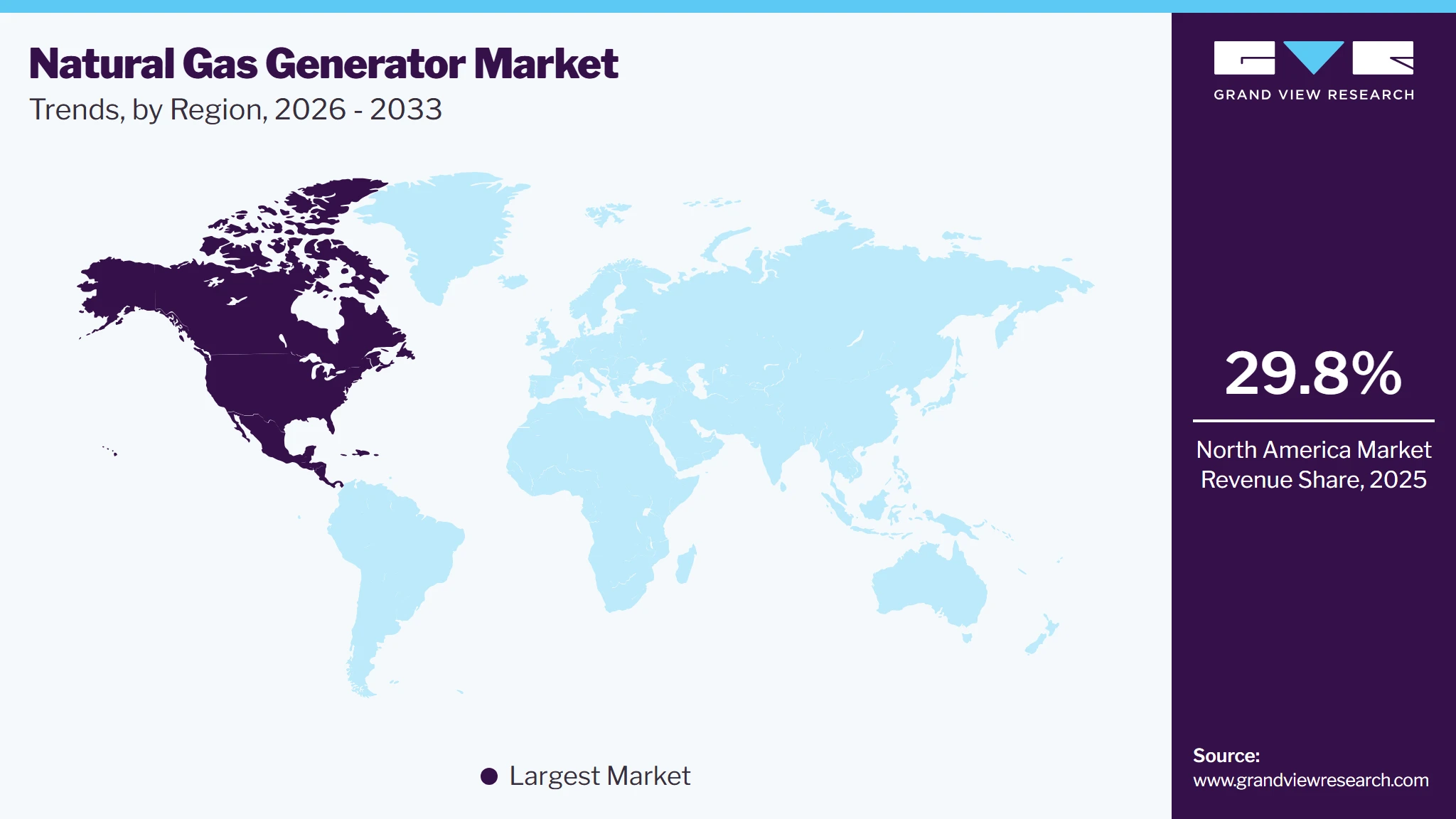
North America dominated the natural gas generator market with the largest revenue share of 29.8% in 2025. This growth can be attributed to the abundance of shale gas reserves and a robust infrastructure for natural gas transportation. In addition, the region's commitment to clean energy initiatives has led to increased adoption of natural gas generators, which are favored for their lower emissions compared to diesel. Furthermore, the presence of prominent gas genset OEMs and EPC players, large shale gas reserves, and developed infrastructure for the transportation of natural gas has emerged as the primary driving factors for the North America natural gas generator set market.
 To learn more about this report, Download Free Sample Report
U.S. Natural Gas Generator Market Trends
The natural gas generator market in U.S. held the largest share in the North America region in 2025, primarily driven by significant investments in natural gas infrastructure and favorable government policies promoting cleaner energy sources. In addition, the shift from coal to natural gas for electricity generation is accelerating, supported by technological advancements that enhance efficiency. Furthermore, the increasing reliance on off-grid power systems during peak demand periods is driving businesses and consumers to adopt natural gas generators as a cost-effective solution for uninterrupted power supply.
Asia Pacific Natural Gas Generator Market Trends
The APAC natural gas generator market is expected to grow at a CAGR of 14.0% over the forecast period, driven by the escalating demand for efficient backup power systems amid rapid industrialization. The high growth of the industrial sector in China, India, Japan, and South Korea has triggered the demand for industrial generator sets in the region.
The natural gas generator market in China dominated the Asia Pacific and accounted for the highest share in 2024, driven by the government's commitment to reducing carbon emissions, which has led to increased adoption of natural gas as a primary fuel source. Furthermore, the growing industrial sector requires reliable power solutions, driving demand for natural gas generators that provide efficient and environmentally friendly energy.
Europe Natural Gas Generator Market Trends
The Europe natural gas generator market is expected to grow significantly over the forecast period as countries seek to meet stringent environmental regulations and reduce greenhouse gas emissions. In addition, the transition from coal-fired power plants to natural gas facilities is a key trend supported by government initiatives promoting cleaner energy sources. Furthermore, the increasing frequency of extreme weather events has underscored the need for reliable backup power solutions, further boosting the demand for natural gas generators across various applications.
The growth of the natural gas generator market in Germany is expected to be driven by strong government policies promoting renewable energy and reducing carbon footprints. The country’s commitment to transitioning from coal and nuclear power has led to greater reliance on natural gas as a cleaner alternative. Furthermore, advancements in technology have improved the efficiency of natural gas generators, making them an attractive option for both commercial and industrial applications seeking sustainable energy solutions.
Key Natural Gas Generator Company Insights
Key players in the global natural gas generator industry include Kohler Co. Inc., MTU Onsite Energy, Cooper Corp., and others. These players adopt several strategies to improve their competitive edge. These include investing in research and development to innovate and improve generator efficiency, performance, and emissions reduction technologies. Furthermore, strategic partnerships and collaborations with other companies and stakeholders are common and aimed at expanding market reach and sharing expertise.
-
Caterpillar Inc. manufactures natural gas generators and provides various gas-fueled generator sets for various applications. The company operates in the power generation segment, focusing on solutions that deliver dependable and efficient energy. Caterpillar's product portfolio includes gas engines and generator sets designed for cogeneration power plants, with outputs ranging from 400 kW to 4,500 kW.
-
Kohler Co. Inc. specializes in manufacturing natural gas generators for commercial and residential markets. The company focuses on providing consistent backup and prime power solutions within the power systems segment. Its natural gas generators are engineered for efficiency and low emissions, making them an attractive choice for environmentally conscious consumers. The company's offerings include a variety of generator sizes and configurations.
Key Natural Gas Generator Companies
The following key companies have been profiled for this study on the natural gas generator market.
-
Cummins Inc.
-
Caterpillar Inc.
-
Kohler Co. Inc.
-
Mitsubishi Heavy Industries, Ltd
-
MTU Onsite Energy
-
Generac Power Systems, Inc.
-
Cooper Corp.
-
General Electric
-
Yanmar Co., Ltd
-
Mahindra Powerol
Competitive Benchmarking
Category
Operating Strategies
Competitive Edge
Weakness
Established Players (Cummins Inc.; Caterpillar Inc.; Kohler co. Inc.; Mitsubishi Heavy Industries, Ltd; MTU Onsite Energy; Generac Power Systems, Inc.; General Electric)
- Expand product portfolios across standby, prime, and continuous power applications.
- Invest in low-emission and high-efficiency natural gas generator technologies.
- Strengthen service networks, digital monitoring platforms, and long-term maintenance contracts.
- Strong brand recognition and established customer relationships.
- Extensive global distribution and after-sales service networks.
- Broad product portfolios covering multiple power ranges.
- Higher operating and manufacturing costs compared to regional competitors.
- Exposure to fluctuations in natural gas prices and global economic cycles.
- Large organizational structures can slow product development and market responsiveness.
Emerging Players (Cooper Corp.; Yanmar Co., Ltd; Mahindra Powerol)
- Focus on cost-competitive generator solutions for regional markets.
- Expand dealer networks and local manufacturing capabilities.
- Develop customized products tailored to local regulatory and customer requirements.
- Competitive pricing and strong understanding of local market requirements.
- Faster decision-making and product customization capabilities.
- Strong presence in selected regional markets and distribution channels.
- Limited global footprint and brand recognition.
- Smaller product portfolios compared to multinational competitors.
- Lower R&D budgets and technological capabilities.
Recent Developments
-
In October, 2024, HIMOINSA launched its HGY Series of natural gas generators in Madrid, Spain, showcasing a new power solution for critical applications. Developed in collaboration with Yanmar Power Technology, these generators range from 1250kVA to 3500kVA and are designed for efficiency and low emissions. The HGY Series supports alternative fuels such as natural gas and hydrogen, aligning with sustainability goals. Equipped with advanced features for optimal performance, these generators are set to enhance HIMOINSA's global market presence in power generation.
-
In February 2023, Cummins Inc. announced the launch of its new 175 kW and 200 kW natural gas generator sets, designed to meet the growing demand for reliable and efficient power solutions in North America. These generator sets are engineered for performance and sustainability, offering lower emissions and reduced operating costs. The introduction of these natural gas generators reflects Cummins' commitment to providing innovative energy solutions that support various applications, from commercial to industrial sectors.
Natural Gas Generator Market Report Scope
Report Attribute
Details
Market Definition
The natural gas generator market comprises power generation systems that use natural gas as a primary fuel source to produce electricity for standby, prime, and continuous power applications. The market size represents the revenue generated from the sale of natural gas generators utilized across residential, commercial and industrial sectors.
Market size in 2025
USD 10.9 billion
Estimated market size in 2026
USD 12.1 billion
Projected market size by 2033
USD 23.0 billion
Growth rate
CAGR of 9.6% from 2026 to 2033
Base year for estimation
2025
Historical data
2021 - 2024
Forecast period
2026 - 2033
Quantitative units
Revenue in USD Million and CAGR from 2026 to 2033
Report coverage
Revenue forecast, company ranking, competitive landscape, growth factors, and trends
Segments covered
Type, application, region
Regional scope
North America; Europe; Asia Pacific; Latin America; Middle East & Africa
Country scope
U.S., Canada, Mexico, Germany, UK, France, Russia, China, India, Japan, South Korea, Brazil, Argentina, UAE, Saudi Arabia
Key companies profiled
Cummins Inc.; Caterpillar Inc.; Kohler co. Inc.; Mitsubishi Heavy Industries, Ltd; MTU Onsite Energy; Generac Power Systems, Inc.; Cooper Corp.; General Electric; Yanmar Co., Ltd; Mahindra Powerol.
Customization scope
Free report customization (equivalent up to 8 analysts' working days) with purchase. Addition or alteration to country, regional & segment scope.
Pricing and purchase options
Avail customized purchase options to meet your exact research needs. Explore purchase options
Global Natural Gas Generator Market Report Segmentation
This report forecasts revenue growth at global, regional, and country levels and analyzes the latest industry trends in each sub-segment from 2021 to 2033. For this study, Grand View Research has segmented the global natural gas generator market report based on type, application, and region.
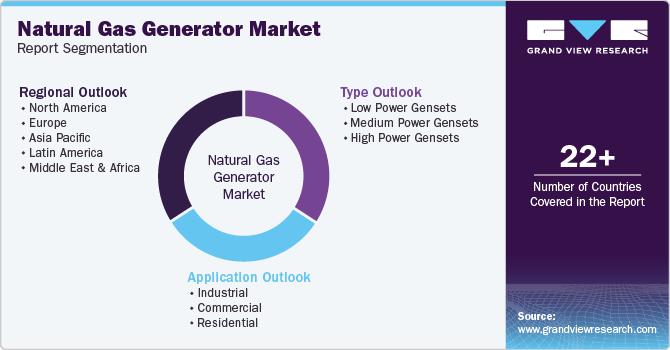 To learn more about this report, Download Free Sample Report
-
Type Outlook (Revenue, USD Million, 2021 - 2033)
-
Low Power Gensets
-
Medium Power Gensets
-
High Power Gensets
-
-
Application Outlook (Revenue, USD Million, 2021 - 2033)
-
Industrial
-
Commercial
-
Residential
-
-
Regional Outlook (Revenue, USD Million, 2021 - 2033)
-
North America
-
U.S.
-
Canada
-
Mexico
-
-
Europe
-
Germany
-
Russia
-
UK
-
France
-
-
Asia Pacific
-
China
-
India
-
Japan
-
South Korea
-
-
Latin America
-
Brazil
-
Argentina
-
-
Middle East and Africa
-
UAE
-
Saudi Arabia
-
-
Research Methodology
The natural gas generator market figures in this report are based on a proven research process that combines executive interviews with secondary research from proprietary databases, company filings, and recognized regulatory and institutional sources. Market size is built through value-chain sizing - reconciling supply-side and demand-side estimates - and triangulated with bottom-up and top-down approaches. Every estimate passes multiple levels of expert validation before publication, with each natural gas generator segment quantified using the revenue-capture definitions in the table below.
Segment Definition
Segment - Type
Revenue capture definition
Low Power Gensets
Revenue is generated from the sale of natural gas generators with lower power output capacities, primarily used for residential backup power, small commercial establishments, telecommunications sites, and light-duty applications requiring reliable and cost-effective electricity supply.
Medium Power Gensets
Market revenue is derived from natural gas generators designed for medium-scale power requirements across commercial buildings, healthcare facilities, educational institutions, small industrial operations, and distributed energy applications requiring continuous or standby power.
High Power Gensets
Revenue is generated from high-capacity natural gas generators used in large industrial facilities, utilities, data centers, oil & gas operations, manufacturing plants, and critical infrastructure projects where uninterrupted and large-scale power generation is essential.
Segment - Application
Revenue capture definition
Industrial
Revenue potential is assessed through the demand for natural gas generators used in manufacturing facilities, processing plants, mining operations, oil & gas sites, and other industrial environments requiring dependable prime or backup power solutions.
Commercial
Market value is generated from the adoption of natural gas generators across commercial buildings, data centers, hospitals, hotels, retail facilities, educational institutions, and office complexes to ensure uninterrupted operations during grid outages and peak demand periods.
Residential
Revenue is associated with the sale of natural gas generators for residential applications, providing backup and emergency power for homes, residential communities, and multi-family housing units to maintain essential electrical services during power disruptions.
Estimation Model
Layer Name
Key Question
Description
Power Demand Base Layer
What forms the demand base?
Identify demand for reliable and uninterrupted power across industrial, commercial, and residential sectors. Assess electricity consumption patterns, grid reliability challenges, power outage frequency, industrial activity, commercial infrastructure growth, and residential backup power requirements. This layer establishes the addressable market opportunity by evaluating sectors that require standby, prime, or continuous power generation solutions.
Natural Gas Infrastructure & Accessibility Layer
Where can natural gas generators be deployed?
Estimate the availability of natural gas transmission pipelines, distribution networks, gas supply infrastructure, and fueling accessibility across major regions. Analyze natural gas availability, energy policies, utility connectivity, and regional fuel supply reliability. Infrastructure readiness plays a critical role in determining the feasibility and adoption potential of natural gas generators across end-use sectors.
Generator Adoption & Capacity Layer
How extensively are natural gas generators utilized?
Analyze the adoption of low-power, medium-power, and high-power natural gas generators across industrial, commercial, and residential applications. Evaluate factors such as power reliability requirements, operating costs, emission regulations, fuel availability, and investments in critical infrastructure including data centers, healthcare facilities, manufacturing plants, and residential communities. Adoption levels vary by application, power demand, and regional energy policies.
Revenue Layer
How is market revenue generated?
Market revenue is generated through the sale and installation of low-power, medium-power, and high-power natural gas generators across industrial, commercial, and residential sectors. Revenue is influenced by generator capacity, unit sales volumes, technology specifications, installation requirements, maintenance contracts, and regional demand patterns. Growth in backup power needs, distributed energy systems, and critical infrastructure investments drives overall market value.
Delivered Customizations
This report has been delivered with the following In-depth customizations
Client Request
Customization Delivered
Value Adds
Power Capacity Demand Analysis
Conducted a detailed assessment of demand trends across low-power, medium-power, and high-power natural gas generators, analyzing adoption patterns, application requirements, and growth opportunities across key end-use sectors and regions.
Helps stakeholders identify high-growth capacity segments, optimize product portfolios, and align investments with evolving customer requirements.
Competitive Benchmarking
Compared leading generator manufacturers based on product portfolio, power range coverage, geographic presence, technological capabilities, pricing strategy, service network, and recent strategic developments.
Supports competitive intelligence, product positioning, and strategic decision-making.
Opportunity Assessment
Analyzed the growing role of natural gas generators in distributed energy systems, microgrids, and hybrid power solutions integrated with renewable energy sources.
Helps stakeholders identify future growth areas and develop long-term expansion strategies in evolving energy markets.
Frequently Asked Questions About This Report
The natural gas generator market size was estimated at USD 10.9 billion in 2025 and is expected to reach USD 12.1 billion in 2026.
The natural gas generator market is expected to grow at a CAGR of 9.6% from 2026 to 2033 to reach USD 23.0 billion by 2033.
Low power gensets accounted for largest revenue share of 43.4% in 2025 while medium power gensets segment is second fastest growing market.
The natural gas generator market is primarily driven by the growing demand for reliable backup and continuous power, particularly from industrial facilities, commercial buildings, and data centers. Increasing emission regulations and the shift toward cleaner alternatives to diesel generators are further supporting market growth.
The commercial segment led the market with the largest revenue share of 46.1% in 2025,primarily driven by the increasing demand for reliable and clean energy solutions.
North America dominated the natural gas generator market with revenue share of 29.8% in 2025.
The key players operating in the natural gas generator market are Cummins Inc.; Caterpillar Inc.; Kohler co. Inc.; Mitsubishi Heavy Industries, Ltd; MTU Onsite Energy; Generac Power Systems, Inc.; Cooper Corp.; General Electric; Yanmar Co., Ltd; Mahindra Powerol; and others.
About the Author(s)
Distribution & Utilities Research Team
Energy & Power · Distribution & UtilitiesThis report was authored by the distribution & utilities research team at Grand View Research - comprising two research analysts, one senior research analyst, and one industry expert - with specialized expertise in the distribution & utilities segment of the energy & power industry. All findings are based on proprietary energy & power databases, executive interviews, and regulatory analysis, subject to internal peer review prior to publication.
Last Updated:
Speak to Analyst

Customize this report to your needs - add regions, segments, or data points, with 20% free customization.
Or view our licence options:


ISO 9001:2015 & 27001:2022 Certified
We are GDPR and CCPA compliant! Your transaction & personal information is safe and secure. For more details, please read our privacy policy.


