
- Home
- »
- Next Generation Technologies
- »
-
Used Car Market Size, Share & Growth Report, 2026-2033GVR Report cover

Used Car Market (2026 - 2033)
Size, Share & Trends Analysis Report By Vehicle Type (Conventional, Electric Vehicle), By Vendor Type (Organized, Unorganized), By Fuel Type (Diesel, Petrol), By Size (Mid-Sized, SUV), By Sales Channel, By Region, And Segment Forecasts
Market Size, 2025
$2.0TMarket Estimate, 2026
$2.2TMarket Forecast, 2033
$3.1TCAGR, 2026–2033
5.4%Used Car Market Summary
The global used car market size was valued at USD 2.0 trillion in 2025 and is projected to grow from USD 2.2 trillion in 2026 to USD 3.1 trillion by 2033, at a CAGR of 5.4% from 2026 to 2033. North America dominated the global market, accounting for a revenue share of 34.2% in 2025. The global industry is expanding as consumers increasingly prioritize affordability, vehicle availability, and value retention amid higher new-vehicle prices and changing ownership preferences.
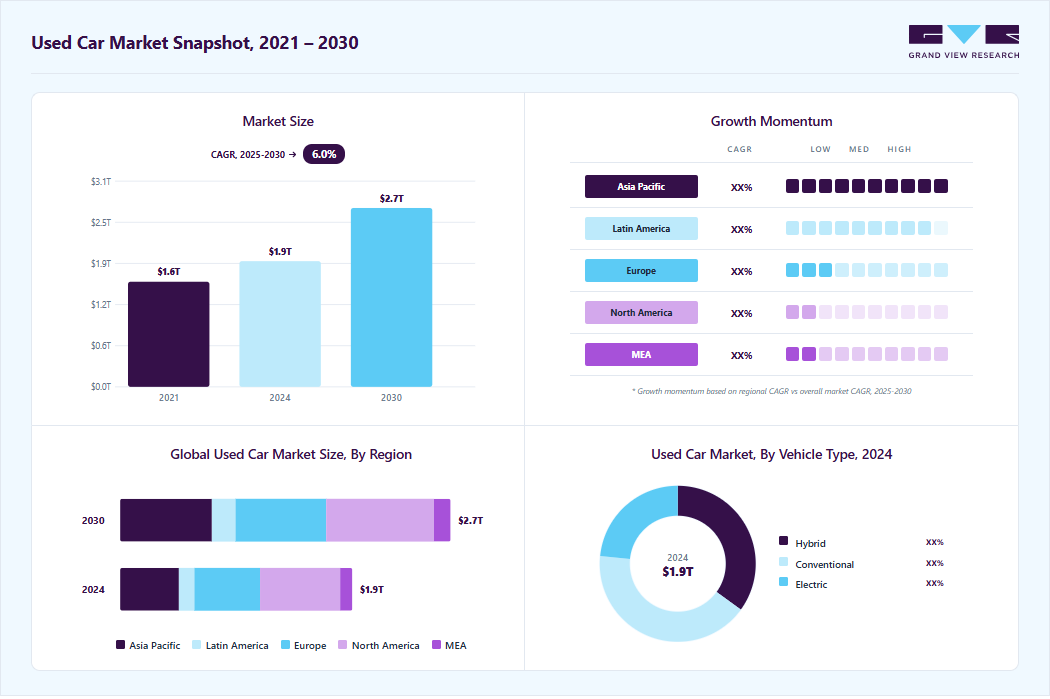 Source: Grand View Research, IR Documents, Primary Interviews, Paid DatabasesTo learn more about this report,
 Download Free Sample Report
 Key Market Trends & Insights
- By vehicle type: Conventional segment held the largest market share of 41.0% in 2025.
- By vendor type: Organized segment dominated the market, with a revenue share of 75.5% in 2025.
- By fuel type: Petrol segment held the largest revenue share of approximately 41.8% in 2025.
- By size: Mid-sized segment held the largest revenue share of approximately 36.0% in 2025.
- By sales channel: Offline segment accounted for the largest revenue share of 71.4% in 2025.
Regional Highlights
- Largest regional market: North America (34.2% revenue share, 2025)
- Fastest-growing regional market: Asia Pacific (highest CAGR approximately 6.8%, 2026-2033)
- By country: The U.S. held the largest market share in 2025.
Market Size & Forecast
- Market size in 2025: USD 2.0 Trillion
- Estimated market size in 2026: USD 2.2 Trillion
- Projected market size by 2033: USD 3.1 Trillion
- CAGR (2026-2033): 5.4%
Three ways to get this report
Buy it, customize it, or ask a question.Ask an Analyst
A direct answer, usually in 1 working day
- AccessReport author, directly
- Reply timeWithin 1 working day
- No sales callDirect answer only
- FormatEmail reply
- CostFree, no cost
Get the Full Report
What the study covers
- FormatsPDF · Excel · Dashboard
- Timeline2026–2033 annual, 2025 base
- Coverage20+ countries, 5 regions
- Companies10+ key players profiled
Customize the Report
20% free customization
- IncludeCountries, segments, points
- TailorTo your product definition
- ExtendDeeper competitor detail
- OrA fully bespoke study
- Turnaround5–10 working days
The global market is expanding as consumers increasingly prioritize affordability, vehicle availability, and value retention amid higher new-vehicle prices and changing ownership preferences. The market growth is driven by a sharp consumer shift toward organized digital platforms and certified pre-owned networks that offer transparency, safety warranties, and fair AI-driven pricing. Moreover, used vehicles provide a lower upfront cost than new cars, making them attractive to budget-conscious buyers and households seeking access to personal mobility without the higher depreciation associated with new vehicles. The growing availability of certified pre-owned programs, warranties, vehicle inspections, and financing options is also improving consumer confidence in pre-owned purchases.A growing supply of old vehicles from leasing, fleet, and trade-in channels is supporting market growth. These factors are contributing to the continued shift toward organized and transparent used-vehicle transactions across major markets. Digitalization is further reshaping how used vehicles are discovered, evaluated, and purchased. Online marketplaces and dealer platforms enable consumers to compare vehicle prices, specifications, histories, and financing options across larger inventories without visiting multiple dealerships. Digital retailing is increasingly complemented by virtual vehicle tours, online appraisals, digital documentation, and AI-enabled pricing and customer-service tools. These technologies are helping dealers improve inventory management, pricing accuracy, lead conversion, and customer engagement. The online sales channel is consequently expanding, although offline dealerships and organized dealer networks continue to account for a substantial share of transactions.
 To learn more about this report, Download Free Sample Report
 The used car market is also becoming increasingly connected to the transition toward electric mobility. As electric vehicles enter the second-hand market following initial ownership, leasing, and fleet cycles, consumers are gaining access to more affordable pre-owned EV options. The IEA reports that sales of used electric cars across China, five major European markets, and the U.S. exceeded 3 million units in 2025, representing an increase of about 35% from 2024. In Europe, electric vehicles accounted for approximately 4% of used-car transactions across France, Germany, Italy, Spain, and the UK in 2025, up from about 1% in 2021.
Market Dynamics
Rising prices of new vehicles are fueling the used car market, leading budget-conscious consumers to favor pre-owned alternatives that deliver greater value. Increasing availability of certified pre-owned vehicles, along with improved vehicle inspection and warranty programs, has strengthened buyer confidence and reduced perceived purchasing risks. Additionally, ongoing supply constraints in new vehicle production and longer vehicle ownership cycles continue to sustain strong demand for quality used cars across both developed and emerging markets.
The widening price gap between new and pre-owned vehicles is encouraging consumers to consider used cars as a practical alternative, particularly as higher new-vehicle prices increase the upfront cost of ownership. Pre-owned vehicles can also provide access to higher-end models, advanced features, and larger vehicle categories at comparatively lower purchase prices. In addition, slower depreciation after the initial ownership period can improve value retention for buyers, while competitive financing options are making used vehicles more accessible across different income groups.
The market is also benefiting from the increasing professionalization of used-vehicle transactions. Certified pre-owned programs, standardized inspections, vehicle-history reports, limited warranties, and financing packages are reducing concerns about vehicle condition and unexpected ownership costs. Organized dealers and digital platforms are increasingly combining these services with transparent pricing and online vehicle discovery, making the purchasing process more predictable. As consumers place greater emphasis on value for money and total ownership costs, the affordability advantage of used vehicles is supporting sustained adoption across both mature and emerging automotive markets.
Higher maintenance and repair expenses associated with older used vehicles can limit market adoption, particularly among price-sensitive buyers. Although aging vehicles generally offer lower purchase prices, accumulated wear and tear can increase the likelihood of repairs involving brakes, suspension, transmissions, electrical systems, and other components. The growing complexity of modern vehicles, including advanced electronics, sensors, driver-assistance systems, and software-enabled components, can further increase diagnostic and repair costs. As a result, the initial affordability advantage of an older vehicle may diminish when unexpected maintenance expenses are included in the total cost of ownership.
Concerns about vehicle condition, maintenance history, mileage, and the availability of replacement parts can also influence purchasing decisions. These concerns are particularly relevant when buyers purchase vehicles through informal channels without standardized inspections or warranty protection. Consequently, consumers may increasingly favor newer used vehicles, certified pre-owned models, and organized dealerships that provide inspections, service records, and warranty coverage. While these offerings improve confidence in pre-owned purchases, they can also increase the price premium of higher-quality vehicles, limiting demand among buyers seeking the lowest-cost options. The resulting uncertainty about future repair costs remains a restraint on the adoption of older, high-mileage vehicles.
The increasing number of electric vehicles entering secondary markets is creating opportunities for used-car dealers, digital marketplaces, and automotive service providers. As EV adoption expands, more vehicles are completing initial ownership and leasing cycles, increasing the availability of pre-owned models at lower prices than new EVs.
The opportunity is also expanding around battery-health assessments, digital diagnostics, vehicle-history reports, warranties, and specialized financing that can address concerns about used EV condition and resale value. Fleet and leasing companies can further increase secondary-market supply as electrified vehicles complete their first ownership cycles.
Market Concentration & Characteristics
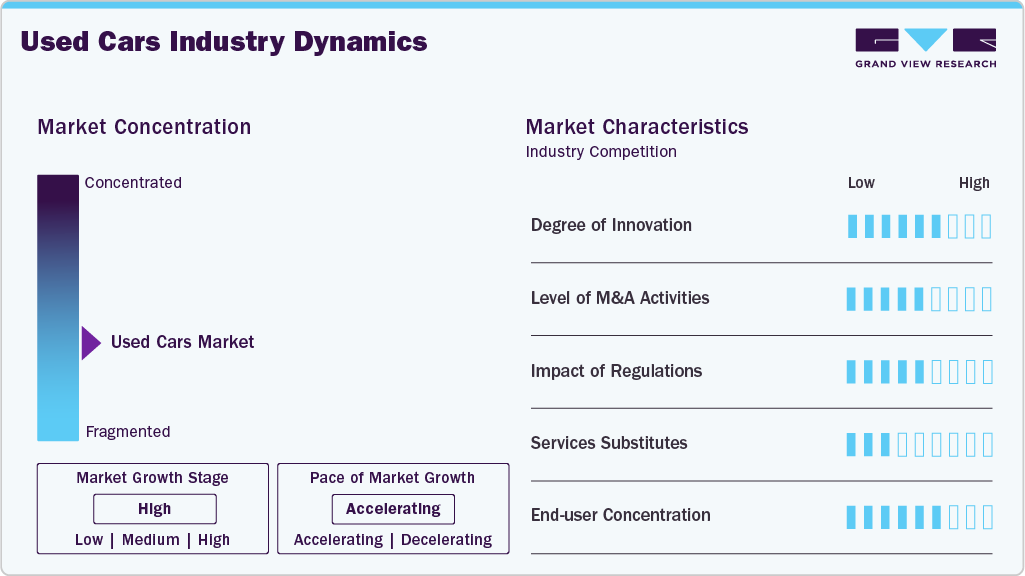
The threat of service substitutes in the used car market is moderate as consumers increasingly explore alternative mobility solutions such as ride-sharing, vehicle subscriptions, car leasing, and public transportation. Urban consumers, particularly younger demographics, are showing a rising preference for flexible transportation services over vehicle ownership. However, used vehicles continue to maintain a strong demand due to affordability advantages, ownership flexibility, and expanding financing accessibility. In developing economies, personal vehicle ownership remains highly preferred, limiting the overall substitution impact.
 To learn more about this report, Download Free Sample Report
 End-user concentration in the used car market is relatively high due to broad participation from individual consumers, small businesses, ride-hailing operators, and commercial fleet buyers. Demand is widely distributed across income groups because used vehicles offer more cost-effective mobility options than new vehicles. Urbanization, rising middle-class populations, and growing first-time vehicle ownership are significantly increasing consumer demand across emerging economies. Additionally, increasing online accessibility and the availability of financing are expanding the customer base globally.
Analyst Perspective
The used car market is evolving from a price-driven segment to a more organized, technology-enabled part of the automotive ecosystem. Affordability remains a key demand driver as higher new-vehicle prices and longer replacement cycles encourage consumers to choose pre-owned vehicles. Certified pre-owned programs, inspections, vehicle history reports, warranties, and financing are improving transparency and buyer confidence, thereby supporting organized dealerships and formal resale channels. Digitalization is further transforming the market through online inventory, AI-enabled pricing, digital appraisals, virtual vehicle experiences, and digital financing. Meanwhile, growing volumes of leased and fleet-operated EVs entering secondary markets are creating demand for battery-health assessments, EV certification, specialized financing, and residual-value management. Future competition will increasingly depend on integrated sourcing, inspection, certification, financing, warranty, and digital transaction capabilities.
Vehicle Type Insights
The conventional segment led the used car industry with a revenue share of 41.0% in 2025, supported by the broad availability of gasoline and diesel vehicles, established refueling infrastructure, and strong consumer familiarity with internal combustion engine (ICE) technology. Conventional vehicles continue to benefit from extensive model availability, established servicing networks, and relatively accessible purchase prices in the pre-owned market. Their presence across multiple price points and vehicle categories also makes them widely accessible to first-time buyers and cost-conscious consumers. In addition, the large existing vehicle parc and established resale ecosystem for ICE vehicles continue to support transaction volumes in the conventional used-car segment.
The electric vehicle (EV) segment is expected to grow at the fastest CAGR over the forecast period, as declining battery costs, expanding model availability, and improvements in charging infrastructure support wider adoption of electric vehicles in secondary markets. As more EVs complete their initial ownership and leasing cycles, their availability in the pre-owned market is increasing, providing consumers with more affordable access to electric mobility. Growing interest in lower-emission transportation and improvements in battery performance are also strengthening consumer acceptance. In addition, battery health diagnostics, vehicle history information, and specialized financing are helping to address concerns surrounding used EV ownership. These developments are supporting the expansion of electric vehicles within the used-car market and positioning the segment for faster growth over the forecast period.
Vendor Type Insights
The organized segment dominated the used car market, with a revenue share of 75.5% in 2025. These dealerships enhance consumer confidence through various benefits, such as warranties, comprehensive vehicle history reports, and accessible financing options. By adhering to higher standards of vehicle quality and customer service, organized players offer a more reliable buying experience that attracts cautious consumers. Organized players have a streamlined process of buying and selling used cars that enhances the reliability and eases the overall process. Moreover, their compliance with regulatory requirements and safety standards fosters trust among buyers, which is crucial in the market.
The unorganized segment is characterized by individual sellers, small dealerships, and online classifieds, providing a wide variety of options at potentially lower prices. This segment offers several benefits that attract price-sensitive consumers. Consumers in this market have the flexibility to negotiate directly with sellers, often resulting in better deals and personalized service. Furthermore, the unorganized market typically features a diverse range of vehicles, including older models and unique finds that may not be available at organized dealerships. However, buyers in this segment should be cautious, as the lack of standardized quality assurance can pose risks to vehicle reliability and transparency in vehicle history.
Fuel Type Insights
The petrol segment dominated the market with a revenue share of approximately 41.8% in 2025, supported by its widespread availability, extensive refueling infrastructure, and large installed base of petrol-powered vehicles. Petrol vehicles remain widely preferred in the pre-owned market because of their broad model availability, comparatively accessible purchase prices, and established servicing networks. The extensive presence of petrol vehicles across passenger-car segments also provides buyers with greater choice across price ranges and vehicle categories. In addition, improvements in engine efficiency and emissions performance have supported the continued relevance of petrol-powered vehicles, particularly in markets where gasoline infrastructure remains well established.
The diesel segment is witnessing significant growth, particularly driven by consumers seeking better fuel economy and higher torque for long-distance driving, commercial applications, and utility-oriented vehicles. Diesel vehicles can offer favorable operating economics for high-mileage users, supporting continued demand in markets with established diesel fleets. However, tighter emissions standards and the increasing adoption of hybrid and electric powertrains are influencing the long-term composition of the segment. As a result, demand is increasingly concentrated around relatively newer, fuel-efficient diesel models that comply with prevailing emissions requirements. The availability of used diesel vehicles from existing fleets and ownership cycles continues to provide consumers with a broad range of options.
Size Insights
The mid-sized segment held the largest revenue share of approximately 36.0% in 2025, supported by demand for vehicles offering a balance of affordability, interior space, comfort, and fuel efficiency. Mid-sized vehicles appeal to a broad range of buyers, including families, professionals, and urban commuters seeking more cabin and cargo space without the higher purchase and operating costs often associated with larger vehicles. Their wide availability across sedans, crossovers, and other body styles also provides consumers with diverse options across price ranges. In addition, improvements in safety features, connectivity, fuel efficiency, and overall vehicle performance have strengthened the appeal of mid-sized vehicles in the pre-owned market.
The SUV segment continues to represent an important part of the used car market, supported by demand for spacious interiors, higher driving positions, cargo capacity, and versatile usage. The availability of SUVs across different sizes and price points has broadened their appeal among families, utility-focused buyers, and consumers seeking multipurpose vehicles. Improvements in fuel efficiency and the growing availability of compact and crossover SUVs have further expanded consumer choice. In the used-car market, these factors, combined with strong availability from previous ownership and fleet cycles, continue to support demand for SUVs across both mature and emerging markets.
Sales Channel Insights
The offline sales channel segment led the used car industry with a revenue share of 71.4% in 2025. These traditional outlets offer a tangible experience, allowing customers to inspect vehicles, test drive them, and negotiate face-to-face with sellers. The personalized service and sense of security that come with buying from a reputable dealer have contributed to the offline segment's stronghold in the market. Traditional dealerships and used-car outlets also provide access to financing, warranties, vehicle inspections, and after-sales services, which can strengthen buyer confidence. The established dealer network and familiarity of offline transactions continue to support the segment's leading position, particularly for higher-value vehicle purchases where consumers may prefer in-person evaluation.
 To learn more about this report, Download Free Sample Report
 The online segment is expected to grow at the fastest CAGR from 2026 to 2033, as consumers increasingly seek convenient and transparent ways to research and purchase used vehicles. Digital platforms offer broader access to inventory, price comparisons, vehicle history information, digital inspections, virtual vehicle tours, and online financing options, reducing the need for multiple physical visits. The expansion of AI-enabled pricing, digital appraisals, remote documentation, and omnichannel retailing is further improving the online buying experience. While offline channels are expected to retain their leading revenue position, the rapid adoption of digital tools is increasing the role of online platforms in used-car discovery, evaluation, and transactions.
Regional Insights
North America dominated the used car market with a revenue share of 34.2% in 2025. The regional market is being supported by sustained demand for value-oriented mobility as high new-vehicle prices and financing costs encourage consumers to consider pre-owned vehicles. Greater availability of certified pre-owned inventory and improved vehicle-history information are also strengthening buyer confidence. Digital retailing is becoming an increasingly important channel, with online inventory search, vehicle valuation, financing, and remote purchasing simplifying transactions. Retailers are also using AI to improve customer engagement and vehicle-shopping experiences. For example, CarMax launched a car-shopping and selling experience in ChatGPT in February 2026, allowing consumers to search its nationwide used-vehicle inventory and obtain vehicle value information through the platform. These developments, combined with established dealership networks and financing infrastructure, are supporting the continued expansion of the regional used-car market.
 To learn more about this report, Download Free Sample Report
 The U.S. used car market held the largest revenue share of North America in 2025, supported by a mature dealership ecosystem, extensive financing availability, and strong consumer demand for affordable transportation. Used vehicles continue to provide an alternative for buyers facing elevated new-car prices, while certified pre-owned programs and digital vehicle-history tools help address concerns regarding vehicle condition and reliability. The market is also becoming increasingly digital, with retailers expanding online valuation, purchasing, financing, and delivery capabilities. CarMax, for instance, reported approximately 780,700 used-vehicle unit sales in fiscal 2026, demonstrating the scale of the organized used-car retail channel.
Europe Used Car Market Trends
The Europe used car industry accounted for a share of approximately 28.0% in 2025, and is increasingly characterized by greater inventory availability, changing leasing cycles, and the gradual expansion of used electric vehicles. AutoScout24 reported that the European used-car market remained broadly stable in 2025, while shorter leasing cycles contributed to a younger vehicle supply in Germany. The growing flow of electric vehicles into the secondary market is another important development. Across five major European markets, EVs accounted for around 4% of used-car transactions in 2025, compared with approximately 1% in 2021. Germany is emerging as an important market for used EVs, with used BEV registrations increasing sharply during the first four months of 2026. Digital marketplaces such as AutoScout24 are supporting market transparency by providing consumers with broader inventory access, pricing information, and vehicle comparisons across multiple European markets.
Asia Pacific Used Car Market Trends
The Asia Pacific used car industry is expected to grow at the fastest CAGR of approximately 6.8% over the forecast period, supported by expanding vehicle ownership, rising consumer awareness of pre-owned vehicles, and the rapid digitalization of buying and selling processes. India is an important market in the region, where online platforms are helping formalize the transactions of used cars through vehicle inspections, digital valuation, financing, and ownership-transfer services. Spinny reported that 77% of its customers purchased vehicles online during the first quarter of 2025, highlighting the growing role of digital channels in India's pre-owned vehicle market. The partnership between Nissan Motor India and Spinny, announced in September 2025, further strengthened the organized exchange ecosystem by making Spinny a preferred vehicle-exchange platform across Nissan dealerships in India. In March 2026, both players expanded the initiative through a 55-minute vehicle-exchange program across 30 cities. Meanwhile, the increasing availability of used EVs is creating another avenue for market development across major Asian economies.
Key Used Car Company Insights
Key companies operating in the used-car market include CarMax, Inc.; Asbury Automotive Group, Inc.; TrueCar, Inc.; Scout24 SE; Lithia Motors, Inc.; Group 1 Automotive, Inc.; eBay Inc.; Hendrick Automotive Group; and AutoNation, Inc. These companies participate in the market through used-vehicle retailing, dealership networks, and digital automotive marketplaces. To strengthen their market presence and respond to changing consumer purchasing behavior, companies are focusing on expanding dealership networks, enhancing digital vehicle-shopping capabilities, improving customer experience, and pursuing strategic acquisitions and partnerships.
-
CarMax, Inc. is a major used-vehicle retailer in the U.S., operating an extensive network of locations and digital channels for purchasing and selling pre-owned vehicles. The company continues to expand its digital capabilities, including online vehicle discovery, valuation, financing, and remote purchasing and selling processes. Its investments in AI-enabled customer engagement and digital retailing are supporting a more integrated used-car buying and selling experience.
-
Asbury Automotive Group, Inc. operates a large dealership network offering new and used vehicles across the U.S. The company has continued to strengthen its retail operations through dealership acquisitions, network expansion, and digital tools that support vehicle discovery and customer engagement. Its used-vehicle operations form an important component of its broader automotive retail business, with pre-owned inventory offered across its dealership network.
Key Used Car Companies
The following key companies have been profiled for this study on the used car market.
-
Alibaba.com.
-
CarMax Enterprise Services, LLC
-
Asbury Automotive Group
-
TrueCar, Inc.
-
Scout24 SE
-
Lithia Motor Inc.
-
Group 1 Automotive, Inc.
-
eBay.com
-
Hendrick Automotive Group
-
AutoNation, Inc.
Competitive Benchmarking
Operating Strategies
Competitive Edge
Weaknesses
Mature Players: CarMax Enterprise Services, LLC; Asbury Automotive Group; Hendrick Automotive Group; Lithia Motor Inc.
- Expanding dealership networks and certified programs strengthen long-term customer retention.
- Integrating digital retailing with financing improves operational efficiency and convenience.
- Strong brand recognition and inventory scale increase customer trust significantly.
- Advanced pricing analytics and warranty services enhance competitive market positioning.
- High dealership operational costs reduce profitability during economic market slowdowns.
- Slower digital transformation limits adaptability against rapidly growing online competitors.
Emerging Players: Alibaba.com; TrueCar, Inc.; Scout24 SE; eBay.com
- Digital-first platforms and AI pricing attract technology-driven used vehicle consumers.
- Asset-light partnerships support scalable expansion with lower operational infrastructure costs.
- Strong digital capabilities simplify vehicle discovery and purchasing experiences efficiently.
- Flexible business models rapidly adapt to changing consumer market preferences.
- Limited inspection services reduce customer trust in vehicle quality assurance.
- Third-party inventory dependence affects profitability and fulfillment consistency significantly.
Recent Developments
-
In February 2026, CarMax, Inc. launched a car shopping and selling experience within the ChatGPT app, providing consumers with access to over 45,000 vehicles and online vehicle-value information. The initiative extends CarMax’s digital used-car retailing capabilities and enables customers to search inventory and begin vehicle-buying or selling journeys through an AI-powered interface.
-
In July 2026, Hendrick Automotive Group acquired Foreign Cars Italia, adding eight franchises across Charlotte and Greensboro, North Carolina, to its retail network. The transaction expanded Hendrick’s dealership footprint and increased its vehicle retailing capacity, including pre-owned vehicle sales across its expanded network.
-
In June 2026, AutoNation, Inc. acquired Toyota of Newnan in Georgia, adding approximately 4,900 annual retail new and used vehicle unit sales to its operations. The dealership was renamed AutoNation Toyota Newnan, expanding AutoNation’s retail footprint and its used-vehicle sales capacity in the U.S. market.
-
In August 2024, MOTORS collaborated with Parkers, a UK platform for used car buyers, to expand the reach of its multisite advertising service. This collaboration aims to give dealers more visibility and offer consumers a broader selection of used cars on one of the UK's most trusted automotive platforms.
Used Car Market Report Scope
Report Attribute
Details
Market size in 2025
USD 2.0 trillion
Estimated market size in 2026
USD 2.2 trillion
Projected market size by 2033
USD 3.1 trillion
Growth rate
CAGR of 5.4% from 2026 to 2033
Base year for estimation
2025
Historical data
2021 - 2024
Forecast period
2026 - 2033
Quantitative units
Revenue in USD billion/trillion, shipment in billion units, and CAGR from 2026 to 2033
Report coverage
Revenue forecast, volume forecast, company ranking, competitive landscape, growth factors, and trends
Segments covered
Vehicle type, vendor type, fuel type, size, sales channel, region
Regional scope
North America; Europe; Asia Pacific; Latin America; MEA
Country scope
U.S.; Canada; Mexico; Germany; UK; France; China; Japan; India; South Korea; Australia; Brazil; KSA; South Africa; UAE
Key companies profiled
Alibaba.com, CarMax Enterprise Services, LLC, Asbury Automotive Group, TrueCar, Inc., Scout24 SE, Lithia Motor Inc., Group 1 Automotive, Inc., eBay.com, Hendrick Automotive Group, AutoNation, Inc.
Customization scope
Free report customization (equivalent up to 8 analysts' working days) with purchase. Addition or alteration to country, regional & segment scope.
Pricing and purchase options
Avail customized purchase options to meet your exact research needs. Explore purchase options
Global Used Car Market Report Segmentation
This report forecasts volume & revenue growth at the global, regional & country levels and provides an analysis of the latest industry trends in each of the sub-segments from 2021 to 2033. For this study, Grand View Research has segmented the global used car market report based on vehicle type, vendor type, fuel type, size, sales channel, and region:
-
Vehicle Type Outlook (Shipment, Billion Units; Revenue, USD Billion/Trillion, 2021 - 2033)
-
Hybrid
-
Conventional
-
Electric
-
-
Vendor Type Outlook (Shipment, Billion Units; Revenue, USD Billion/Trillion, 2021 - 2033)
-
Organized
-
Unorganized
-
-
Fuel Type Outlook (Shipment, Billion Units; Revenue, USD Billion/Trillion, 2021 - 2033)
-
Diesel
-
Petrol
-
Others
-
-
Size Outlook (Shipment, Billion Units; Revenue, USD Billion/Trillion, 2021 - 2033)
-
Compact Car
-
Mid-Sized
-
SUV
-
-
Sales Channel Outlook (Shipment, Billion Units; Revenue, USD Billion/Trillion, 2021 - 2033)
-
Offline
-
Online
-
-
Regional Outlook (Shipment, Billion Units; Revenue, USD Billion/Trillion, 2021 - 2033)
-
North America
-
U.S.
-
Canada
-
Mexico
-
-
Europe
-
UK
-
Germany
-
France
-
-
Asia Pacific
-
China
-
Japan
-
India
-
Australia
-
South Korea
-
-
Latin America
-
Brazil
-
-
Middle East & Africa (MEA)
-
KSA
-
UAE
-
South Africa
-
-
Research Methodology
The used car market figures in this report are based on a proven research process that combines executive interviews with secondary research from proprietary databases, company filings, and recognized regulatory and institutional sources. Market size is built through value-chain sizing - reconciling supply-side and demand-side estimates - and triangulated with bottom-up and top-down approaches. Every estimate passes multiple levels of expert validation before publication, with each used car segment quantified using the revenue-capture definitions in the table below.
Segment Definition
Segment - Vehicle Type
Revenue capture definition
Hybrid
Revenue in this segment is generated by the resale of vehicles that combine internal combustion engines with electric propulsion systems. This segment captures demand from buyers seeking improved fuel efficiency and lower operating costs.
Conventional
The conventional used car segment derives revenue from the sale of pre-owned gasoline and diesel-powered vehicles. Its revenue contribution remains significant due to the lower acquisition costs relative to alternative powertrain technologies.
Electric
Revenue in the electric used car segment is generated from battery electric vehicles (BEVs) and other fully electric pre-owned models. Market expansion is supported by increasing EV adoption, improving battery performance, and growing charging infrastructure coverage.
Segment - Vendor Type
Revenue capture definition
Organized
Organized vendors operate through standardized sales, inspection, financing, and after-sales processes. Revenue is captured from used vehicle transactions conducted through formally registered businesses, including associated services.
Unorganized
The unorganized segment functions with limited operational standardization. Revenue capture includes the value of pre-owned vehicle sales facilitated through these informal channels, excluding revenues generated by organized dealership networks and certified retail platforms.
Segment - Fuel Type
Revenue capture definition
Diesel
Revenue in the diesel segment is from the resale and trade of pre-owned diesel-powered passenger and commercial vehicles. Demand is primarily concentrated among high-mileage users and buyers seeking lower fuel costs per kilometer, particularly in long-distance travel applications.
Petrol
The petrol segment captures revenue from used gasoline-powered vehicles across hatchbacks, sedans, SUVs, and crossovers. Its contribution is supported by broad vehicle availability, lower maintenance complexity, and strong adoption in urban and suburban markets.
Others
The others segment includes used vehicles powered by alternative fuels such as CNG, LPG, hybrid, and electric powertrains. Revenue is derived from growing consumer interest in fuel efficiency, emissions reduction, and access to government-supported mobility ecosystems.
Segment - Size
Revenue capture definition
Compact
It captures revenue through high transaction volumes driven by affordability, fuel efficiency, and lower maintenance costs. Demand is among first-time buyers, urban commuters, and budget-conscious households seeking practical mobility solutions.
Mid-Sized
Revenue in this segment is generated from consumers seeking a balance between purchase cost, cabin space, comfort, and vehicle features. Its market contribution is by family buyers and professionals upgrading from entry-level vehicles.
SUV
The SUV segment accounts for a significant share due to higher ASP and sustained consumer preference for larger vehicles. Growth in this category is supported by demand for enhanced seating capacity, cargo space, driving visibility, and multi-purpose usability.
Segment - Sales Channel
Revenue capture definition
Offline
This captures revenue through franchised dealerships, independent used-car dealers, and local automotive retailers. Revenue is generated from vehicle sales, dealer margins, financing commissions, warranties, and value-added services offered at physical locations.
Online
Captures revenue from digital platforms through websites and mobile applications. Revenue is derived from vehicle transactions, platform commissions, listing fees, subscription services, advertising, and associated financing or protection products sold through digital channels.
Estimation Model
Layer Name
Key Questions
Description
Ownership Layer
Who Owns Vehicles for Resale?
Identify vehicles reaching resale age and estimate the addressable stock of vehicles - establishes the addressable base of vehicles available for used-car transactions.
Transaction Layer
How Many Vehicles Are Traded?
Apply vehicle turnover and resale rates to estimate the number of used vehicles exchanged annually through dealer, online, and private-party channels. This converts the vehicle base into active market transactions.
Channel Layer
Where Are Used Cars Sold?
Measure the distribution of transactions across organized dealerships, certified programs, online, and independent sellers. This reflects the penetration and utilization of various sales channels within the market.
Monetisation Layer
How Much Revenue Is Generated?
Apply the average transaction value per vehicle and aggregate revenues from vehicle sales, dealer margins, financing, warranties, and ancillary services to estimate total market revenue.
Delivered Customizations
This report has been delivered with the following In-depth customizations
Client request
Customization Delivered
Value Adds
Market Entry & Expansion Assessment
Regional demand sizing and forecasting
Customer segmentation and buying behavior analysis
Competitive landscape benchmarking
Regulatory and distribution channel assessment
Identified high-growth market opportunities.
Supported go-to-market strategy development
Highlighted investment priorities and risks
Enabled data-driven expansion planning
Customer & End-User Insights Study
Consumer awareness and adoption analysis
Purchase decision journey mapping
Satisfaction and loyalty assessment
Usage pattern and pain-point evaluation
Revealed key adoption drivers and barriers
Supported customer-centric product development
Improved targeting and engagement strategy
Identified opportunities for retention and upselling
Channel Partner & Distribution Study
Dealer/distributor network analysis
Channel performance benchmarking
Margin and profitability assessment
Route-to-market evaluation
Optimized channel strategy
Identified distribution gaps
Improved partner engagement approach
Enhanced market penetration planning
Frequently Asked Questions About This Report
The global used car market size was estimated at USD 2.0 trillion in 2025 and is expected to reach USD 2.2 trillion in 2026.
Asia Pacific is the fastest-growing region over the forecast period.
The global used car market is expected to grow at a compound annual growth rate of 5.4% from 2026 to 2033 to reach USD 3.1 trillion by 2033.
The Conventional segment led with a 41.0% revenue share in 2025, while Electric is the fastest growing segment.
Offline held the largest revenue share in 2025, while online is the fastest growing segment.
The Petrol segment led with a 41.8% revenue share in 2025, while Diesel is the prominent growing segment.
North America dominated the used car market with a share of 34.2% in 2025. In North America, the used car market is expanding due to a shift in consumer preferences towards more affordable vehicle options.
Some key players operating in the used car market include Alibaba.com, CarMax Enterprise Services, LLC, Asbury Automotive Group, TrueCar, Inc., Scout24 SE, Lithia Motor Inc., Group 1 Automotive, Inc., eBay.com, Hendrick Automotive Group, AutoNation.com
Key factors driving the growth of the used car market include various factors including economic shifts, changing consumer preferences, and advancements in technology. As new car prices rise, many buyers are turning to the used car market as a more affordable alternative.
Used Car Market By Country
- Saudi Arabia Used Car Market
- Brazil Used Car Market
- U.S. Used Car Market
- Spain Used Car Market
- Uae Used Car Market
- Germany Used Car Market
- France Used Car Market
- India Used Car Market
- Australia Used Car Market
- South Africa Used Car Market
- Japan Used Car Market
- China Used Car Market
- Mexico - North America Used Car Market
- South Korea Used Car Market
- Canada Used Car Market
- U.K. Used Car Market
About the Author(s)
Next Generation Technologies Research Team
Technology · Next Generation TechnologiesThis report was authored by the next generation technologies research team at Grand View Research - comprising two research analysts, one senior research analyst, and one industry expert - with specialized expertise in the next generation technologies segment of the technology industry. All findings are based on proprietary technology databases, executive interviews, and regulatory analysis, subject to internal peer review prior to publication.
Last Updated:
Speak to Analyst

Customize this report to your needs - add regions, segments, or data points, with 20% free customization.
Or view our licence options:


ISO 9001:2015 & 27001:2022 Certified
We are GDPR and CCPA compliant! Your transaction & personal information is safe and secure. For more details, please read our privacy policy.


