
- Home
- »
- Animal Health
- »
-
Veterinary Medical Data Monetization Market Report, 2033GVR Report cover

Veterinary Medical Data Monetization Market (2026 - 2033)
Size, Share & Trends Analysis Report By Solution (PIMS Operational & Commercial Data, EHR Data, Diagnostic & Imaging Data), By Animal (Companion Animals, Livestock Animals), By Business Model, By Customer, By Region, And Segment Forecasts
Market Size, 2025
$98.7MMarket Estimate, 2026
$105.0MMarket Forecast, 2033
$186.4MCAGR, 2026–2033
8.6%Veterinary Medical Data Monetization Market Summary
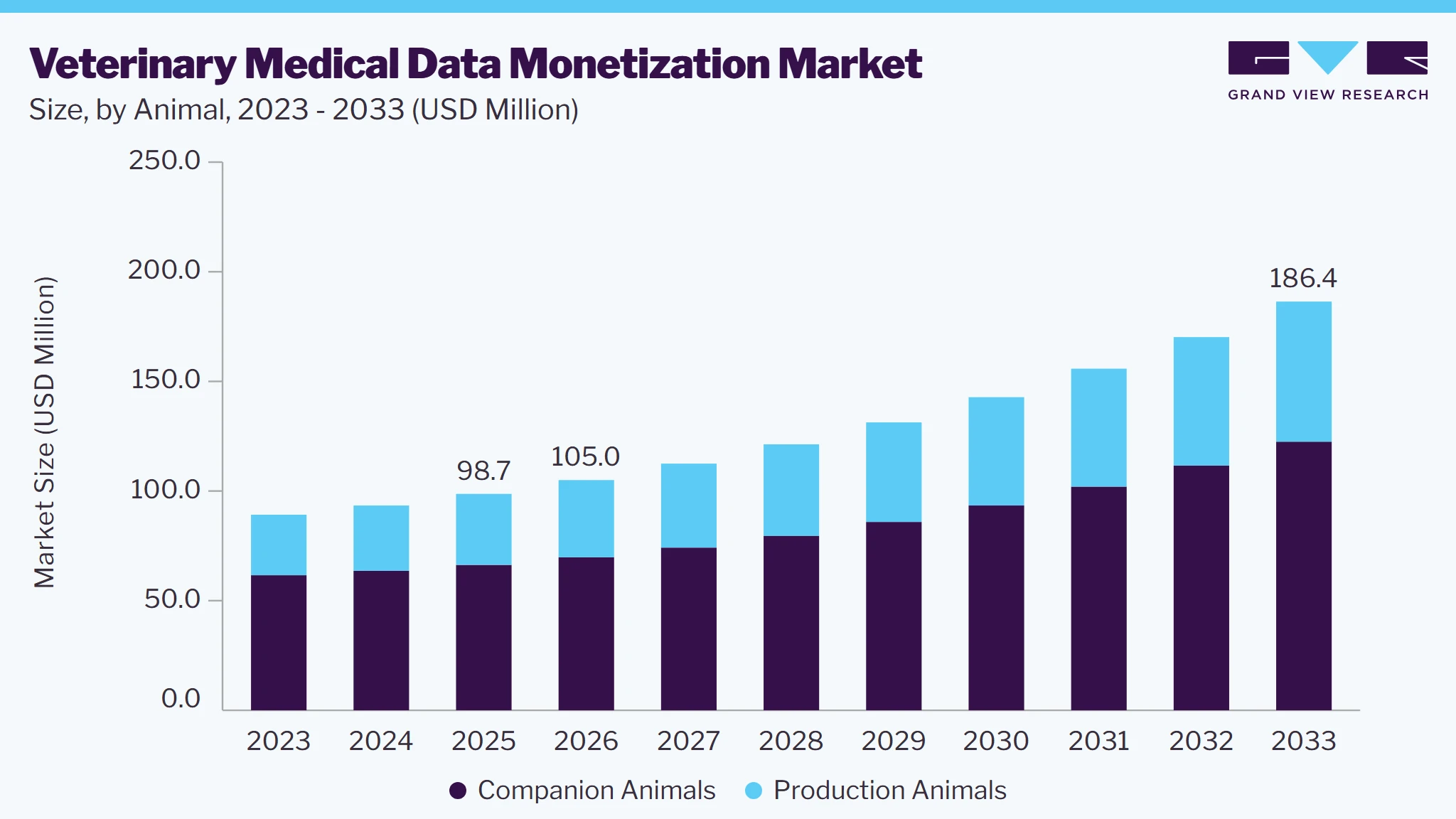
The global veterinary medical data monetization market size was valued at USD 98.7 million in 2025 and is projected to grow from USD 105.0 million in 2026 to USD 186.4 million by 2033, at a CAGR of 8.6% from 2026 to 2033. North America dominated the market, accounting for a revenue share of 53.4% in 2025. The market is driven by factors such as increasing digitization of veterinary clinical and diagnostic records, rising demand for veterinary real-world evidence in animal health R&D, expansion of AI-enabled veterinary analytics and diagnostic applications, and growing commercialization of veterinary medical data assets.
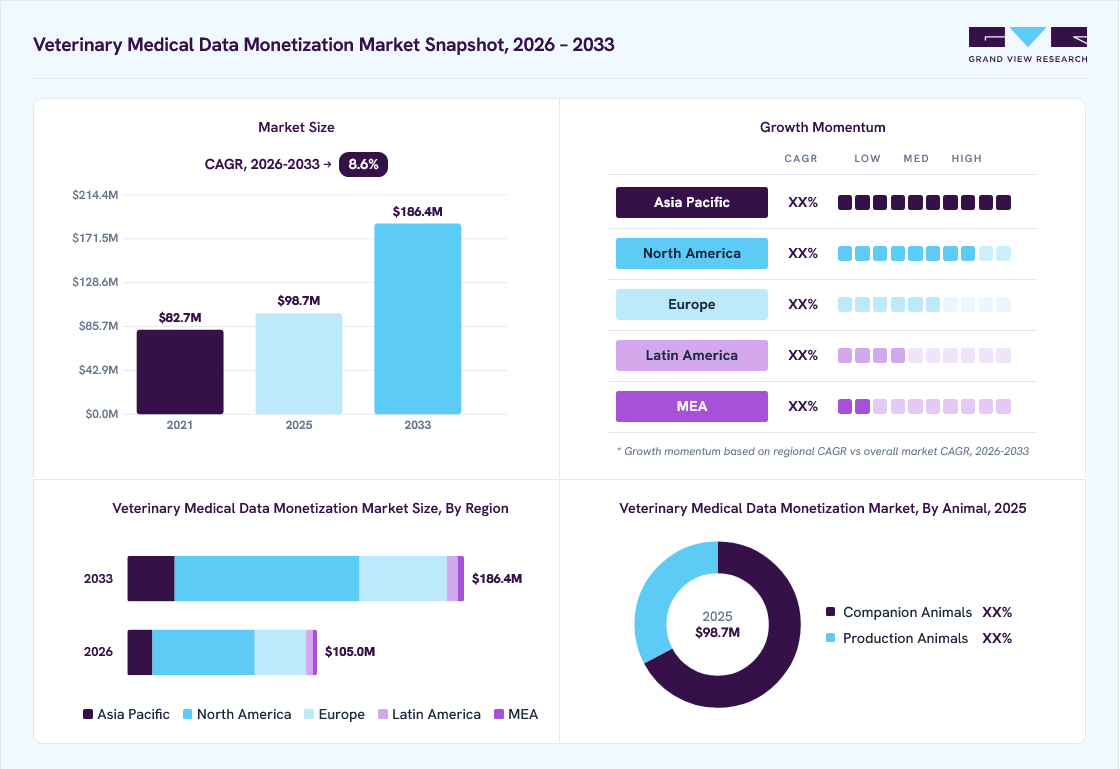 Source: Grand View Research, IR Documents, Primary Interviews, Paid DatabasesTo learn more about this report,
 Download Free Sample Report
Key Market Trends & Insights
- By solution: EHR data led the market with the largest revenue share of 34.6% in 2025.
- Based on animal: Companion animals segment led the market with the largest revenue share of 67.2% in 2025.
- Based on business model: Embedded AI & analytics subscriptions segment is expected to grow at the fastest rate of 9.4% over the forecast period.
- Based on customer: Research institutions & universities segment is expected to grow at the fastest rate of 9.2% over the forecast period.
Regional Highlights
- Largest regional market: North America (53.4% revenue share, 2025)
- Fastest-growing regional market: Asia Pacific (highest CAGR, 2026-2033)
Market Size & Forecast
- Market Size in 2025: USD 98.7 Million
- Estimated market size in 2026: USD 105.0 Million
- Projected Market Size by 2033: USD 186.4 Million
- CAGR (2026-2033): 8.6%
Three ways to get this report
Buy it, customize it, or ask a question.Ask an Analyst
Analyst response in 1 business day
- AccessReport author, directly
- Reply timeWithin 1 working day
- No sales callDirect answer only
- FormatEmail reply
- CostFree, no cost
Get the Full Report
What the study covers
- FormatsPDF · Excel · Dashboard
- Timeline2026–2033 annual, 2025 base
- Coverage20+ countries, 5 regions
- Companies10+ key players profiled
Customize the Report
20% free customization
- IncludeCountries, segments, points
- TailorTo your product definition
- ExtendDeeper competitor detail
- OrA fully bespoke study
- Turnaround5–10 working days
 To learn more about this report, Download Free Sample Report
Market Dynamics
The veterinary medical data monetization market is developing around the commercialization of animal-health information generated across clinical, operational, diagnostic, and research environments. Veterinary practices, diagnostic laboratories, research institutions, and livestock systems produce datasets that acquire economic value when transformed into licensed databases, syndicated intelligence, API feeds, analytics, and research services. Demand is driven by animal-health companies seeking real-world evidence, diagnostic providers developing data-driven applications, and research organizations requiring longitudinal clinical information. The European Medicines Agency's (EMA) veterinary big data strategy identifies data quality, interoperability, and reuse as priorities for improving data-driven decision-making in veterinary medicine. The inclusion of veterinary datasets in the HMA-EMA Real-World Data Catalogue also improves their discoverability for research and regulatory applications. However, fragmented records and inconsistent data structures constrain commercial accessibility. Competitive advantage therefore accrues to providers that secure data access, standardize disparate records, and convert raw information into commercially valuable products. Market revenue depends on the use of paid external data rather than on data generation alone.
The expansion of AI-enabled veterinary analytics is increasing the commercial value of clinical records, diagnostic images, pathology datasets, and longitudinal treatment information. AI applications convert these data assets into diagnostic classifications, quantified pathology findings, treatment insights, and structured clinical intelligence that can support paid analytics and research services. Veterinary diagnostic platforms already offer AI-assisted image analysis, automated scoring, and case-level information sharing, creating opportunities to commercialize specialized analytical capabilities. In parallel, data-intelligence platforms extract diagnoses, treatments, medications, and outcomes from unstructured clinical notes, making previously difficult-to-use information accessible for research cohorts, pharmacovigilance, and treatment evaluation. These capabilities expand monetization beyond the sale of raw datasets by enabling providers to package data-derived outputs for pharmaceutical companies, diagnostic laboratories, and veterinary research organizations. As AI applications become more closely connected to clinical and diagnostic datasets, monetizers gain additional avenues for revenue through analytics subscriptions, APIs, and customized research products, provided the underlying data can be accessed and used commercially.
Fragmented veterinary data infrastructure constrains the commercialization of animal medical information because clinical records, laboratory results, imaging files, and research datasets frequently use different formats, terminologies, and collection practices. The EMA's veterinary big-data strategy identifies inconsistent data standards, variable completeness, and limited interoperability across private veterinary data sources as barriers to data integration and reuse. Research on veterinary patient-record extraction similarly identifies compatibility issues across practice-management systems as an obstacle to combining records for research. These limitations increase the cost of extracting, cleaning, mapping, validating, and linking datasets before they can support commercial analytics or licensing. Data providers must also establish appropriate access permissions and demonstrate that datasets meet the quality requirements of intended users. These costs limit the economic viability of smaller or isolated datasets and create barriers for independent practices and laboratories seeking to monetize their data. Consequently, commercial revenue tends to favor providers with established data-access agreements, integration capabilities, and standardized processing systems, while fragmented data ownership limits the scalability of the broader market.
Commercial licensing of longitudinal veterinary clinical datasets creates an opportunity to generate recurring revenue from patient histories, diagnoses, treatment pathways, medication utilization, diagnostic results, and clinical outcomes collected over time. When records from multiple practices or hospital networks are standardized and linked, they support analysis of disease progression, treatment effectiveness, product utilization, and real-world safety outcomes. These applications are relevant to animal-health companies conducting research, planning clinical trials, and evaluating veterinary medicines, as well as research organizations developing epidemiological and clinical evidence. The EMA identifies real-world data from veterinary practices and farm-management systems as potential inputs for improving evidence generation and regulatory assessment. Commercial data platforms are also establishing models in which veterinary practices receive a share of revenue generated from insights derived from their clinical records, creating an economic incentive for data contribution. This creates opportunities for data owners and aggregators to monetize curated datasets through annual licensing agreements, syndicated research feeds, paid APIs, and customized analytical services, subject to appropriate data governance and commercial-use permissions.
Evolution of Veterinary Medical Data Monetization: From Traditional Data Sales to AI-Driven Intelligence
Dimension
Previously: Traditional Data Monetization
AI Onset: Early Transformation
Current Landscape: 2025-2026
Near Future: 2027-2033
Data Collection & Processing
Veterinary medical data was collected through practice-management systems, clinical records, diagnostic laboratories, and research studies. Extraction and standardization frequently required manual processing.
Machine learning and natural language processing began converting unstructured clinical notes, diagnostic reports, and medical records into usable datasets.
AI accelerates data extraction, classification, normalization, and linkage across clinical, diagnostic, and research systems. Veterinary research initiatives are exploring large language models for antimicrobial-use monitoring.
Automated processing is expected to support larger, continuously updated datasets, reducing the cost of preparing fragmented veterinary information for commercial use.
Primary Monetization Model
Revenue came primarily from customized research, static reports, dataset licensing, and traditional benchmarking services.
Data providers began developing API-based access and analytics products alongside conventional licensing agreements.
Monetization increasingly encompasses DaaS, APIs, syndicated datasets, AI-enabled analytics, and specialized research services. Veterinary practices can also participate in revenue-sharing arrangements for insights derived from their records.
Recurring subscriptions to continuously updated data products, predictive analytics, and specialized research intelligence are expected to gain importance relative to one-time dataset sales.
Value Proposition
Customers purchased access to historical clinical, diagnostic, operational, or research information for specific analytical purposes.
AI increased the usability of existing datasets by extracting insights from information that was difficult to structure or analyze manually.
Buyers can purchase data-derived intelligence for clinical benchmarking, diagnostic model development, real-world evidence, pharmacovigilance, and research. AI therefore expands monetization beyond the underlying dataset.
Commercial value is expected to shift further toward longitudinal insights, predictive intelligence, and integrated clinical-diagnostic datasets that support recurring customer decisions.
Data Integration & Accessibility
Data remained distributed across individual veterinary practices, laboratories, and research institutions, limiting cross-source commercialization.
AI-assisted mapping and extraction began improving compatibility between different data formats, although system interoperability remained a constraint.
Industry initiatives increasingly address data quality, interoperability, governance, and reuse. The European veterinary big-data programme explicitly includes these priorities.
Greater interoperability and secure data-access infrastructure are expected to facilitate cross-institutional datasets, multi-source analytics, and broader commercial distribution, subject to data-access rights.
Competitive Landscape
Monetization favored organizations with proprietary datasets, established institutional relationships, and the resources to produce specialized research outputs.
Technology providers gained opportunities to convert previously underutilized veterinary data into structured commercial products.
Competition increasingly spans data owners, aggregators, API providers, diagnostic-data platforms, and AI analytics companies. Veterinary practices can also participate directly as data suppliers.
Competitive advantage is expected to favor organizations combining differentiated datasets, data rights, scalable AI capabilities, established distribution channels, and trusted customer relationships.
Revenue Potential
Revenue depended heavily on access to proprietary datasets and the ability to fulfil individual licensing or research contracts.
AI created opportunities to commercialize more data from existing records without proportionate increases in manual processing.
Providers can monetize the same underlying data through multiple qualifying products, including licensing, APIs, analytics, and research services, provided contractual rights permit such use.
Revenue opportunities are expected to expand through recurring data products, AI-derived insights, and multi-source intelligence. Actual monetization will depend on customer adoption, data quality, governance, and willingness to pay.
Market Concentration & Characteristics
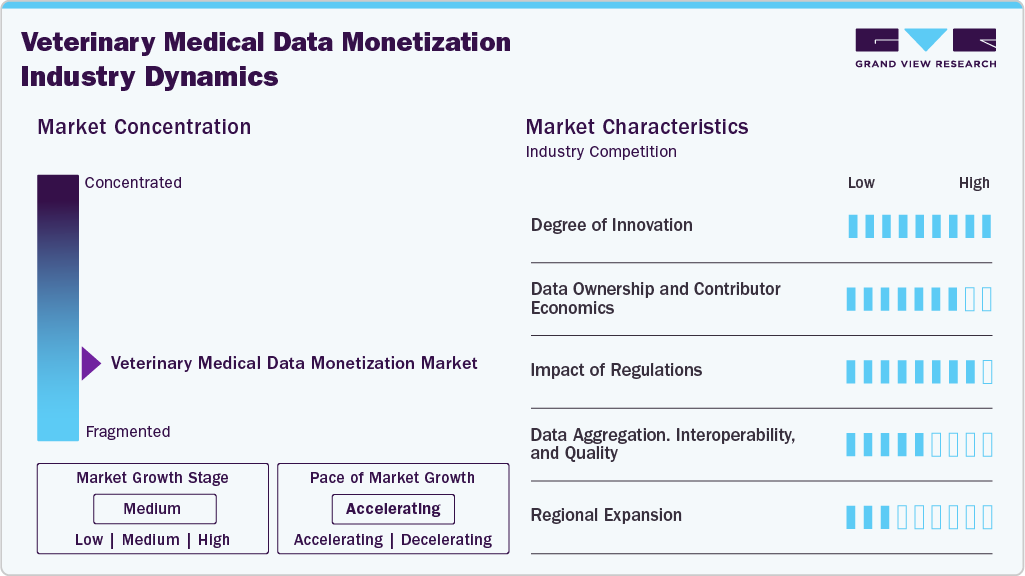
The veterinary medical data monetization market remains fragmented rather than fully consolidated. Participants span specialist data businesses such as Animalytix and iVET360, technology and diagnostic providers such as IDEXX and Aiforia, PIMS/API platforms, research service firms, and veterinary hospitals, laboratories, universities, and livestock data owners. No single participant controls the full chain from data generation to commercial licensing. Consolidation is likely to increase around proprietary datasets, AI capabilities, interoperability, and customer access.
Innovation is shifting the value proposition from static datasets and manual research services toward continuously updated data products, API access, and AI-derived analytics. Natural language processing can structure clinical notes, while computer vision extracts measurable features from diagnostic images. The commercial differentiator is the ability to deliver validated, reusable insights rather than simply apply AI to existing workflows. Providers with differentiated datasets, analytical capabilities, and clear commercial data rights are better positioned to generate recurring revenue.
 To learn more about this report, Download Free Sample Report
Veterinary institutions, diagnostic laboratories, universities, and livestock producers generate much of the underlying medical data, while technology providers and aggregators frequently manage access, processing, and distribution. This creates a multi-party value chain in which ownership, consent, revenue sharing, and data portability determine participation. Commercial models that compensate data contributors and define permitted reuse can expand dataset availability. Restrictive contracts or unclear rights, however, can limit participation and prevent data owners from capturing economic value from their records.
Regulation affects the market through data permissions, confidentiality, consent, anonymization, retention, cross-border transfers, and rules governing secondary use. Veterinary records can contain sensitive animal-owner information, while contractual terms can restrict access through practice-management vendors. These requirements increase the cost of preparing datasets for commercial reuse, but effective governance improves buyer confidence and licensing viability. Requirements vary by jurisdiction, making lawful data access, permitted-use conditions, and transparent commercial agreements essential to scaling veterinary medical data monetization.
Commercial value increases when records from veterinary practices, laboratories, imaging systems, and research studies can be linked and standardized. Inconsistent coding, proprietary formats, incomplete outcomes, and differing governance requirements increase curation costs and weaken cross-dataset comparability. Centralized and federated data-access models offer different trade-offs between integration, data control, and scalability. Providers that establish reliable data provenance, consistent quality standards, and clear permitted-use conditions are better positioned to commercialize reusable datasets and analytical products across multiple customer groups.
North America provides an established commercial base through veterinary software providers, diagnostic networks, and specialist data businesses. Europe offers organized veterinary research and surveillance infrastructure, although differences in national systems and data-governance requirements complicate cross-border aggregation. Asia Pacific presents expansion opportunities as veterinary digitization and livestock traceability programs develop. Latin America, the Middle East, and Africa offer selective opportunities linked to disease surveillance and livestock health systems, but commercial growth depends on accessible datasets, licensing rights, and paying demand rather than on digitization alone.
Analyst Perspective
The veterinary medical data monetization market is expected to expand as animal health companies, research institutions, diagnostic laboratories, and veterinary networks seek commercially usable evidence for product development, safety monitoring, disease surveillance, and clinical decision-making. Growth will depend on the ability to convert fragmented clinical records, diagnostic outputs, practice management information, and research datasets into standardized, decision-ready assets with identifiable commercial value. The market is likely to become more structured gradually as data-sharing partnerships, interoperability initiatives, licensing frameworks, and AI-driven analytical capabilities mature.
Solution Insights
The EHR data segment dominated the market in 2025 with a share of 34.6% because longitudinal clinical records capture diagnoses, treatments, medication use, and outcomes that serve multiple paying use cases, including benchmarking, real-world evidence (RWE), pharmacovigilance, and research. Their value increases when records are standardized across practice systems and linked with laboratory results. For instance, in October 2026, the HMA-EMA real-world data catalogue listed VetCompass, which compiles demographic information, clinical notes, and treatment data from participating veterinary practices.
The R&D & biostatistical data segment is anticipated to grow at the fastest CAGR over the forecast period. The segment is growing as veterinary medicine developers and research teams seek structured clinical-trial, epidemiological, genomic, and treatment-outcome datasets to support product development and evidence generation. Revenue can arise from licensed research cohorts, trial data management, statistical analysis, and customized study-data services. For instance, in 2026, the HMA-EMA real-world data catalogue introduced a veterinary data-source section to help study sponsors, researchers, and regulators identify datasets relevant to veterinary RWE. Improved discoverability supports commercial research demand.
Animal Insights
The companion animals segment accounted for the largest share of 67.2% in 2025. Companion-animal care generates longitudinal clinical records across routine consultations, vaccinations, chronic disease management, diagnostic testing, prescriptions, and treatment outcomes. These records become more commercially valuable when standardized across practices, enabling product evaluation, epidemiological analysis, and treatment-outcome research. For instance, an April 2025 study published in Frontiers examined veterinary electronic health records as a source of real-world data for pharmacoepidemiology, including methods to identify medication exposure and potential adverse events.
The production animals segment is anticipated to register the significant CAGR during the forecast period, driven by expanding volume of livestock health, disease surveillance, animal identification, treatment, and production-performance data generated across farms and veterinary networks. When standardized and made accessible, these datasets can support herd-health monitoring, disease prevention, productivity analysis, and evaluation of veterinary products. For instance, a March 2025 assessment of European livestock datasets published in PubMed Central, identified inconsistencies in metadata, terminology, and data-management practices as barriers to reuse. Improvements in data quality and interoperability could therefore increase the commercial usability of production-animal information over the forecast period.
Business Model Insights
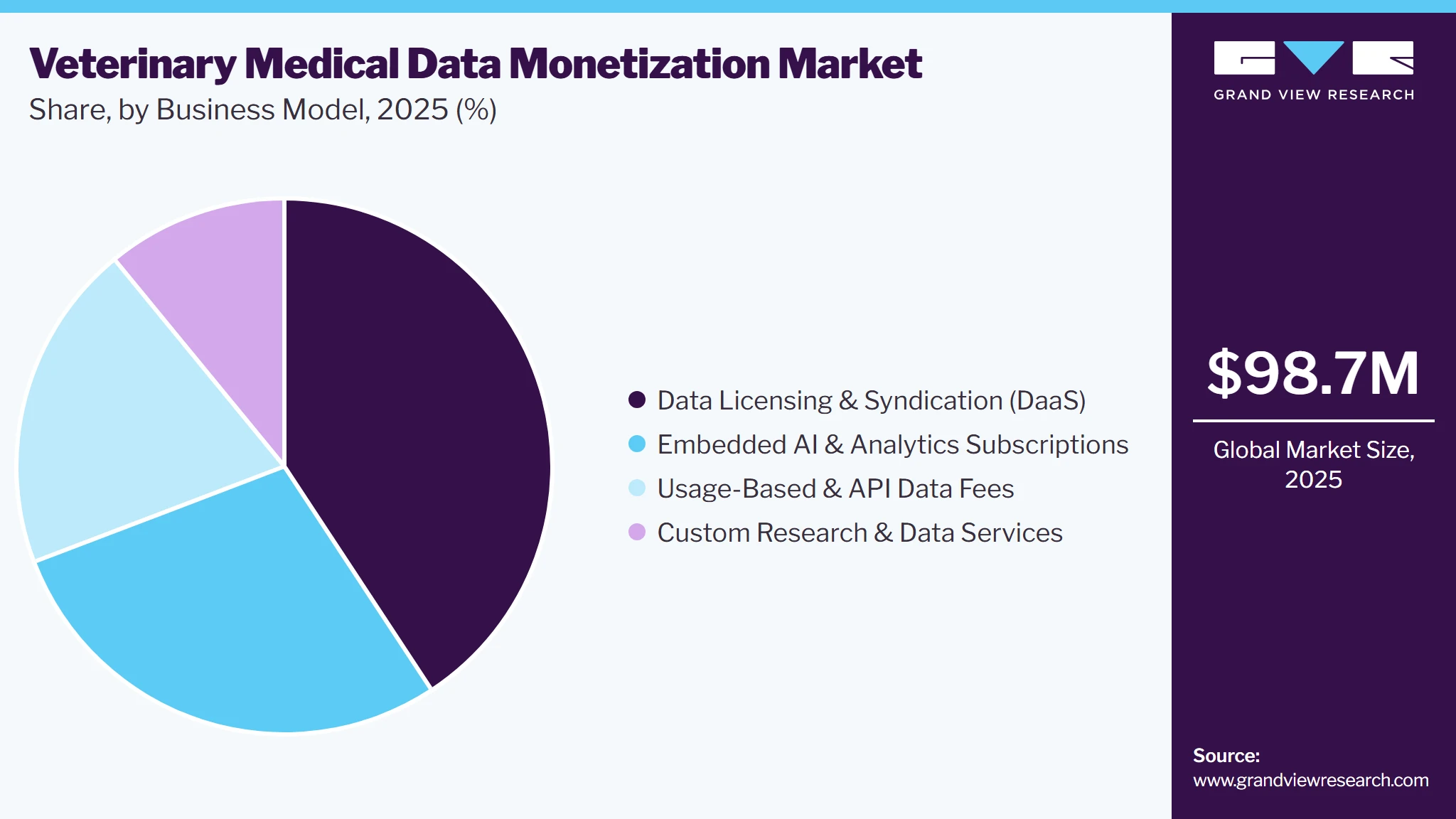
The data licensing & syndication (DaaS) segment dominated the market with share of 40.7% in 2025. The segment is driven by the capacity to commercialize curated datasets across multiple customers and applications without rebuilding the underlying data asset for every transaction. Veterinary clinical records, diagnostic results, and treatment information can serve different research, product-development, and analytical needs when access rights, data quality, and permitted uses are clearly defined. This model offers data holders a scalable monetization route, while customers gain access to relevant datasets without developing comparable collection infrastructure independently.
 To learn more about this report, Download Free Sample Report
The embedded AI & analytics subscriptions segment is expected to grow at the fastest CAGR over the forecast period. Veterinary data are becoming more useful when analytical tools convert diagnostic images, clinical records, and laboratory outputs into structured findings, quantified measurements, and decision-support insights. Subscription models can generate recurring revenue when customers require continuing access to analytical capabilities, workflow updates, and ongoing data processing. For instance, Aiforia’s veterinary diagnostics platform demonstrates the application of AI-supported image analysis, quantification, scoring, and case collaboration in veterinary diagnostic workflows. The growth rests on expanding demand for repeatable, data-driven insights.
Customer Insights
The animal health companies segment dominated the market with share of 38.7% in 2025. These companies have multiple commercial uses for veterinary medical data, including product development, clinical research, treatment evaluation, safety monitoring, and post-market surveillance. Access to structured clinical, diagnostic, and outcomes data can help companies assess product performance and identify relevant patient or animal populations. The European Medicines Agency’s EudraVigilance Veterinary system supports the recording of suspected adverse-event reports and the analysis of safety signals. This demonstrates the importance of structured safety information in veterinary medicines management.
The research Institutions & universities segment is projected to register the highest CAGR over the forecast period. Growth potential comes from increasing analytical requirements across veterinary epidemiology, antimicrobial resistance, disease surveillance, treatment effectiveness, and animal health research. Acquiring licensed datasets or specialist analytical services can give researchers access to broader evidence pools than individual institutions may assemble independently. A December 2025 Frontiers published study described an antimicrobial-resistance dashboard for veterinary practices in Texas, using historical laboratory data and machine-learning methods to support treatment decisions and resistance monitoring.
Regional Insights
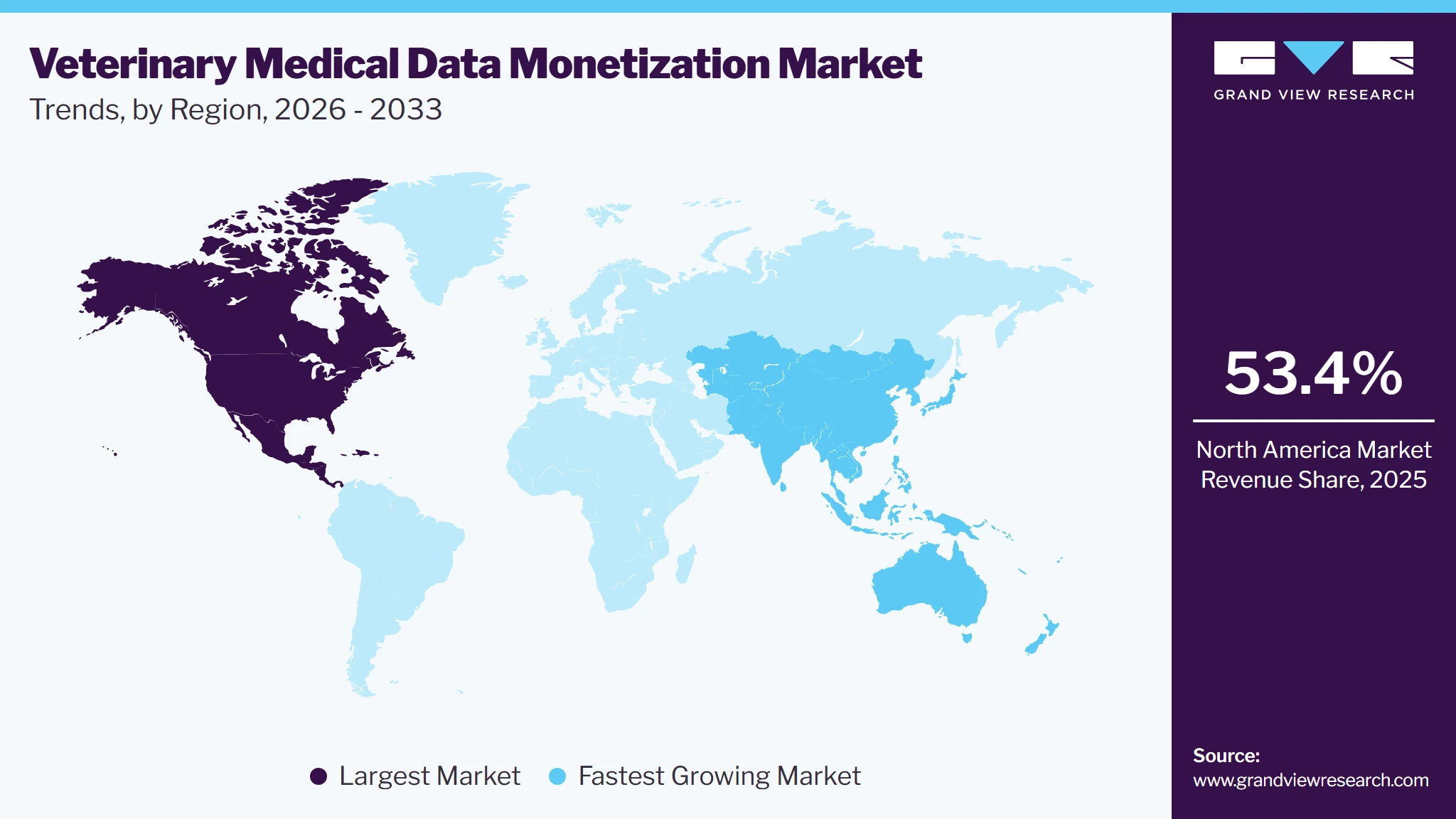
North America held the largest revenue share of 53.4% in theveterinary medical data monetization market in 2025. The region’s leading position is supported by mature veterinary practice software adoption, a large animal-health industry, extensive diagnostic networks, and established research collaborations. Digitized clinical records and laboratory outputs are easier to standardize and package for licensing, benchmarking, product evaluation, and real-world evidence studies. In the U.S., AVMA’s 2025 practice technology survey reported practice management software use at 76.5% and electronic medical record use at 66.8%, indicating a substantial pool of structured clinical data. Canada also maintains connected animal-health laboratory and surveillance networks. These conditions support a deeper buyer base and more advanced commercialization than in regions where records remain fragmented.
 To learn more about this report, Download Free Sample Report
U.S. Veterinary Medical Data Monetization Market Trends
Theveterinary medical data monetization market in the U.S. held the largest share in North America in 2025.The U.S. benefits from broad clinical digitization, a concentrated base of animal-health companies, diagnostic laboratories, veterinary technology providers, and research organizations. Electronic patient records, prescriptions, imaging, laboratory results, and treatment outcomes can serve pharmaceutical development, safety monitoring, clinical benchmarking, and disease research. Federal livestock health studies and diagnostic surveillance further increase demand for structured evidence. The market benefits from established research institutions and large commercial animal-health buyers that can purchase curated datasets or custom analyses. The country’s established infrastructure gives it an advantage in generating recurring revenue from commercial data services.
The Mexicoveterinary medical data monetization market is expected to grow at the fastest rate in the region over the forecast period. Growth is supported by expanding livestock traceability infrastructure and opportunities to connect animal identification with health and production records. Mexico’s government has developed a traceability framework that tracks cattle through the supply chain and records information on animal origin, movement, feed, medicines, fattening, slaughter, and processing. These records create a potential foundation for paid traceability analytics, herd-health intelligence, veterinary product evaluation, and export-related data services. As data integration improves, animal-health companies, diagnostic providers, and commercial producers may gain more value from linked datasets than from isolated records. Companion-animal clinics also present a developing source of clinical information.
Europe Veterinary Medical Data Monetization Market Trends
The veterinary medical data monetization market in Europe is witnessing significant growth. Regulation, pharmacovigilance, antimicrobial-resistance monitoring, and clinical research are increasing demand for reliable real-world veterinary evidence. The European Medicines Agency and Heads of Medicines Agencies adopted a 2022-2027 veterinary big-data strategy to improve access to relevant datasets, develop analytical capabilities, and connect information from regulatory systems, veterinary practices, laboratories, and farm-management platforms. This creates clearer opportunities to license clinical, diagnostic, and production-animal data to animal-health companies and research organizations. However, commercial readiness varies by country because private records often differ in format, completeness, and access rights.
The Germanyveterinary medical data monetization market dominated the region in terms of revenue share in 2025. Its position is supported by an established veterinary medicines and animal-health ecosystem, substantial livestock production, research capacity, and traceability infrastructure. National and EU animal-identification requirements generate structured information on animal identity and movement, while veterinary practices, laboratories, and farm-management systems produce clinical, diagnostic, and operational records. Together, these data sources can support disease surveillance, medicine safety evaluation, herd-health analytics, and product research. Germany’s role within European regulatory and life-science networks also broadens the pool of potential institutional and commercial data buyers. Its advantage comes from the ability to aggregate multiple data types across mature veterinary and livestock systems.
Theveterinary medical data monetization market in France is expected to grow at the fastest rate in the region over the forecast period. Growth is supported by digital agriculture and connected livestock-management tools that increase animal-health data volume and granularity. French agriculture authorities describe the use of sensors, connected collars, electronic identification, smartphones, and farm platforms to capture animal movement, weight, physiological signals, and barn conditions, then convert these inputs into dashboards and decision-support services. As these systems mature, linked data can support precision livestock management, disease-risk analysis, treatment evaluation, and veterinary product research. The opportunity extends from livestock operators to diagnostic providers and animal-health companies seeking better evidence on performance and outcomes. France’s projected growth is consistent with expanding data availability and new analytical use cases, although conversion into paid medical-data products depends on interoperability, governance, and willingness to pay.
Asia Pacific Veterinary Medical Data Monetization Market Trends
The veterinary medical data monetization market in the Asia Pacific is expected to grow at the significant CAGR over the forecast period. Large companion-animal and livestock populations intersect with expanding veterinary services, mobile connectivity, digital farm management, and national animal-health information initiatives. Growth in poultry, dairy, and other intensive production systems raises the value of connected disease, vaccination, treatment, and productivity records, while urban pet-care spending generates more clinical and diagnostic data. The region also spans a wide range of digital maturity, allowing markets at earlier stages to adopt cloud-based records, API access, and AI-supported analytics without replicating legacy infrastructure. Government investment in animal identification and surveillance adds potential data sources. The market opportunity depends on lawful access, data standardization, and buyers’ willingness to pay for decision-ready datasets rather than basic record storage.
The Chinaveterinary medical data monetization market held the largest share in Asia Pacific in 2025.Its position is supported by the scale of its livestock production, veterinary medicine demand, animal-health research, and organized companion-animal care. Large commercial farms and integrated production chains generate data on disease events, vaccination, medication, productivity, and animal movement, while veterinary clinics and laboratories create clinical and diagnostic records. These datasets have potential value for pharmaceutical development, safety monitoring, disease forecasting, and production optimization. Domestic animal-health and technology firms offer a potential buyer base for analytics and data services. Commercialization, however, depends on data governance, interoperability between organizations, and permissions for secondary use. China’s leadership is driven by the scale of its data-generating economy and the number of potential applications.
Theveterinary medical data monetization market in India is estimated to grow at the fastest growth rate globally over the forecast period. Growth is supported by livestock digitization, expanding veterinary service requirements, and a comparatively early-stage commercial data market. The National Digital Livestock Mission and Bharat Pashudhan assign unique identities to animals and capture field activities such as vaccination, breeding, treatment, and health services. This infrastructure can improve the availability of linked animal-health data for disease surveillance, productivity analysis, diagnostics, and veterinary product evaluation. Growth in organized pet clinics and demand for affordable digital services add another source of clinical data. The commercial opportunity will emerge when authorized data holders and service providers convert these records into paid analytics, APIs, or research datasets. Government databases themselves are not counted as market revenue, and commercialization will depend on interoperability, privacy, consent, and access rules.
Latin America Veterinary Medical Data Monetization Market Trends
Theveterinary medical data monetization market in Latin America is expected to grow lucratively during the forecast period. Export-oriented livestock industries, disease-control requirements, and the need to document animal health increase the value of traceability and veterinary datasets. Brazil and Argentina generate extensive production-animal information, while animal-health companies and diagnostic providers need evidence on disease patterns, treatment outcomes, and product performance across farming conditions. Linking animal identification, movement, laboratory, and health records can support trade compliance, surveillance, herd management, and targeted veterinary interventions. As digital systems become connected, data holders may develop commercial services around analytics and standardized data access. Growth will remain uneven because record quality, infrastructure, and purchasing capacity differ across countries. Revenue potential lies in paid access to curated or analyzed information.
The Brazilveterinary medical data monetization market held the largest share in Latin America in 2025. Its position is supported by the scale and international orientation of its livestock sector alongside established animal-health surveillance and traceability systems. The Ministry of Agriculture’s national animal-health information system collects, consolidates, and analyzes notified disease information, while e-SISBRAVET supports digital disease notifications and investigation workflows. These sources sit alongside cattle traceability infrastructure that records animal origin and movement. When appropriately licensed and linked with laboratory, treatment, and production data, such information can support epidemiological analysis, veterinary pharmaceutical research, risk assessment, and herd-health services. Brazil’s large producer base and export requirements increase incentives for verifiable animal-health information. The monetization opportunity depends on private firms and service providers creating paid datasets or analytics from usable information
Theveterinary medical data monetization market in Argentina is expected to grow at the fastest rate in the region over the forecast period. Growth is supported by expanding electronic animal identification and the resulting increase in the quantity and granularity of livestock data available for analysis. SENASA requirements for 2026 call for electronic identification of specified bovine, buffalo, and cervid categories, enabling more consistent links between animal identity and movement records. For an export-oriented livestock economy, better traceability can improve disease response, veterinary treatment histories, herd management, and compliance evidence. Data from identification systems can be connected with diagnostic, breeding, and production records to support paid analytics for producers, veterinary service providers, research bodies, and animal-health companies. The growth outlook is supported by digital infrastructure development from a lower commercial monetization base.
Middle East & Africa Veterinary Medical Data Monetization Market Trends
Theveterinary medical data monetization market in the Middle East & Africa is witnessing steady growth. Governments and livestock industries are improving animal identification, disease surveillance, laboratory information, and digital public services. In livestock-intensive markets, traceability and health records support disease control, movement monitoring, food security, and trade compliance. Urban markets are also generating more clinical and diagnostic information as veterinary practices modernize. However, adoption and commercial data use remain uneven across the region, and fragmented systems can limit the ability to combine records across providers or borders. This supports a gradual rather than uniform growth path. Opportunities center on curated disease and diagnostic datasets, livestock analytics, and clinical benchmarking, with commercial revenue arising where data holders license information or sell analytical services rather than from public databases alone.
The South Africaveterinary medical data monetization market held the largest share in Middle East & Africa in 2025.The market is driven by a developed veterinary research base, livestock recording infrastructure, and organized animal-health surveillance. The Agricultural Research Council’s INTERGIS platform manages pedigree, production, performance, and genetic information across livestock industries, while national identification and traceability initiatives connect animal identity, movement, and health-related practices. These systems enable analysis of herd performance, disease risk, breeding outcomes, and veterinary product effectiveness. Research institutions, diagnostic providers, animal-health companies, and large producers represent potential buyers of these insights. Revenue growth depends on linking fragmented sources and establishing clear access rights, rather than merely expanding data collection. The country’s regional position is consistent with established livestock information infrastructure.
The veterinary medical data monetization market in the UAE is expected to grow at the fastest rate in the region over the forecast period. Growth is driven by digital-government investment, AI adoption, and demand for connected veterinary and livestock services. National AI and data initiatives signal a policy environment receptive to data-led services. In veterinary markets, modernization of clinic records, diagnostic workflows, and animal-health monitoring could create opportunities for paid analytics, API-based access, and research services. The UAE’s compact market may enable providers to build integrated digital workflows faster than in fragmented countries. However, its high growth rate is from a smaller base, not the region’s largest revenue pool. Commercial expansion depends on data access, operator participation, and conversion of records into paid medical-data products.
Key Veterinary Medical Data Monetization Company Insights
The veterinary medical data monetization market features competition among healthcare data and analytics providers, veterinary data aggregators, diagnostic companies, and specialized technology platforms. Market positioning is shaped by access to veterinary clinical records, diagnostic outputs, practice management data, and research datasets, alongside capabilities in data standardization, advanced analytics, data licensing, and commercial partnerships.
Competition is further intensified by specialized providers targeting veterinary practice benchmarking, animal health market intelligence, diagnostic analytics, and research-oriented data services. Market share is distributed across companies with different commercialization models, and competitive concentration is difficult to assess because several participants generate revenue from broader software, diagnostic, or healthcare services rather than direct medical data monetization.
Key Veterinary Medical Data Monetization Companies
The following key companies have been profiled for this study on the veterinary medical data monetization market.
-
Optum
-
IQVIA
-
VetSuccess Limited
-
Kynetec
-
Animalytix
-
iVET360
-
Kreavet
-
BioVenic
-
Vetspire, LLC
-
Aiforia
-
CoVet
-
Idexx Laboratories
-
Covetrus Inc. (Henry Schein)
-
DaySmart Software
-
Digitail
-
ProVet (NordHealth)
-
OnwardVet
-
VetStoria
-
Instinct Science, LLC
-
EvidentVet
Competitive Benchmarking
Operating Strategies
Competitive Edge
Weaknesses
Mature Players: Optum; IQVIA; VetSuccess Limited; Kynetec; Animalytix; iVET360; IDEXX Laboratories; Covetrus Inc. (Henry Schein)
- Focus on commercializing structured veterinary market data, practice-level operational information, diagnostic outputs, and performance analytics through data licensing, benchmarking subscriptions, market intelligence, and customized analytical services.
- Kynetec and Animalytix focus on animal-health market intelligence and sales data, while VetSuccess translates practice management information into benchmarking reports and performance dashboards.
- IDEXX combines diagnostic results, longitudinal patient information, and clinical decision-support capabilities.
- Covetrus and iVET360 generate practice-level operational and financial insights. Optum and IQVIA offer transferable capabilities in real-world data management, analytics, and research services, although their publicly documented data portfolios primarily address human healthcare.
- Established data aggregation capabilities, established customer relationships, specialized animal-health knowledge, and access to substantial clinical, diagnostic, transactional, or operational datasets create opportunities for recurring data and analytics revenue.
- Veterinary-focused companies benefit from domain-specific data normalization and established commercial applications, particularly pharmaceutical market intelligence, clinical benchmarking, and diagnostic interpretation.
- IDEXX has direct access to diagnostic information through its laboratory ecosystem, while VetSuccess specializes in converting practice transactions into comparable operating metrics.
- Broader healthcare analytics capabilities provide potential strategic advantages in data engineering, research analytics, and evidence generation, subject to veterinary-specific applicability.
- Data availability and commercial access differ across providers, while inconsistent coding, fragmented practice systems, and restrictions on secondary data use can limit dataset integration.
- Companies focused primarily on veterinary product sales, practice performance, or diagnostics may have narrower exposure to clinical data licensing and research monetization.
- Optum and IQVIA’s cross-sector presence requires veterinary-specific commercial applicability to be established.
- Furthermore, practice software, diagnostic testing, and conventional consulting revenue do not qualify as veterinary medical data monetization unless the revenue arises directly from commercialized medical data or data-derived intelligence.
Emerging / Specialized and Technology-Focused Players: Kreavet; BioVenic; Vetspire, LLC; Aiforia; CoVet; DaySmart Software; Digitail; ProVet (NordHealth); OnwardVet; VetStoria; Instinct Science, LLC; EvidentVet
- Concentrate on specialized clinical data processing, AI-supported analysis, veterinary workflow digitization, research services, and data-enabled decision support.
- EvidentVet focuses on extracting structured clinical intelligence from veterinary records, supporting longitudinal patient analysis, pharmacovigilance, research, and practice benchmarking.
- Aiforia applies AI to veterinary pathology images, while BioVenic and Kreavet provide animal-health research, data analysis, epidemiological, and statistical services.
- Vetspire, DaySmart, Digitail, ProVet, and Instinct Science provide veterinary practice platforms or clinical software; CoVet and OnwardVet offer AI-supported clinical documentation capabilities. VetStoria focuses on digital booking and practice access.
- Specialized providers can address data gaps that broad platforms may not resolve efficiently, particularly unstructured clinical notes, pathology images, disease-specific datasets, and research-oriented information.
- AI-assisted extraction and classification can convert otherwise difficult-to-analyze records into commercially useful clinical intelligence.
- Direct integration with veterinary workflows can improve access to information at its source, while research-focused businesses can generate value from specialized datasets and analytical expertise.
- EvidentVet has a particularly close fit through its stated model of generating clinical intelligence and sharing revenue with participating practices.
- Specialized technology providers can also develop targeted analytical products for animal-health companies, diagnostic laboratories, and research institutions.
- Many companies primarily monetize software subscriptions, clinical workflow tools, diagnostic capabilities, or research services rather than the direct licensing or syndication of medical data.
- Commercial expansion may be constrained by limited cross-platform interoperability, fragmented customer datasets, data ownership requirements, and restrictions on secondary use. Specialized research services can also be project-dependent rather than recurring.
- For PIMS, AI documentation, and booking providers, the principal challenge is converting data-generation capabilities into distinct paid data products or analytics revenue without compromising customer control over clinical records.
Recent Developments
-
In October 2026, the HMA-EMA Real-World Data Catalogue expanded veterinary data visibility through dedicated listings of animal-health datasets, including clinical and disease-surveillance information, improving dataset discovery for researchers, regulators, and potential commercial data users.
-
In June 2026, CompanAIn launched its Veterinary Portal, integrating longitudinal pet health records, diagnostic results, medications, owner observations, and AI-generated insights into a unified platform for veterinary teams. The launch advances clinical data integration and AI-driven analytics, creating potential opportunities for veterinary medical data utilization and insights generation.
Veterinary Medical Data Monetization Market Report Scope
Report Attribute
Details
Market size in 2025
USD 98.7 million
Estimated market size in 2026
USD 105.0 million
Projected market size by 2033
USD 186.4 million
Growth rate
CAGR of 8.6% from 2026 to 2033
Actual Data
2021 - 2025
Forecast period
2026 - 2033
Quantitative units
Revenue in USD million and CAGR from 2026 to 2033
Report coverage
Revenue forecast, company ranking, competitive landscape, growth factors, and trends
Segments covered
Solution, animal, business model, customer, region
Regional scope
North America; Europe; Asia Pacific; Latin America; MEA
Country scope
U.S.; Canada; Mexico; UK; Germany; France; Italy; Spain; Denmark; Sweden; Norway; Japan; China; India; Thailand; South Korea; Australia; Brazil; Argentina; South Africa; UAE; Saudi Arabia; Kuwait; Oman; Qatar
Key companies profiled
Optum; IQVIA; VetSuccess Limited; Kynetec; Animalytix; iVET360; Kreavet; BioVenic; Vetspire, LLC; Aiforia; CoVet; IDEXX Laboratories; Covetrus Inc. (Henry Schein); DaySmart Software; Digitail; ProVet (NordHealth); OnwardVet; VetStoria; Instinct Science, LLC; and EvidentVet
Customization scope
Free report customization (equivalent up to 8 analysts working days) with purchase. Addition or alteration to country, regional & segment scope.
Pricing and purchase options
Avail customized purchase options to meet your exact research needs. Explore purchase options
Global Veterinary Medical Data Monetization Market Report Segmentation
This report forecasts revenue growth at global, regional, and country levels and provides an analysis of the latest industry trends in each of the sub-segments from 2021 to 2033. For this study, Grand View Research has segmented the global veterinary medical data monetization market report based on solution, animal, business model, customer, and region.
-
Solution Outlook (Revenue, USD Million, 2021 - 2033)
-
PIMS Operational & Commercial Data
-
EHR Data
-
R&D & Biostatistical Data
-
Diagnostic & Imaging Data
-
-
Animal Outlook (Revenue, USD Million, 2021 - 2033)
-
Companion Animals
-
Livestock Animals
-
-
Business Model Outlook (Revenue, USD Million, 2021 - 2033)
-
Data Licensing & Syndication (DaaS)
-
Usage-Based & API Data Fees
-
Embedded AI & Analytics Subscriptions
-
Custom Research & Data Services
-
-
Customer Outlook (Revenue, USD Million, 2021 - 2033)
-
Veterinary Clinical Institutions
-
Animal Health Companies
-
Veterinary Diagnostic Laboratories
-
Research Institutions & Universities
-
Veterinary Organizations
-
Commercial Livestock Producers
-
-
Regional Outlook (Revenue, USD Million, 2021 - 2033)
-
North America
-
U.S.
-
Canada
-
Mexico
-
-
Europe
-
UK
-
Germany
-
France
-
Italy
-
Spain
-
Denmark
-
Sweden
-
Norway
-
-
Asia Pacific
-
Japan
-
China
-
India
-
Australia
-
Thailand
-
South Korea
-
-
Latin America
-
Brazil
-
Argentina
-
-
Middle East & Africa
-
South Africa
-
UAE
-
Saudi Arabia
-
Kuwait
-
Qatar
-
Oman
-
-
Research Methodology
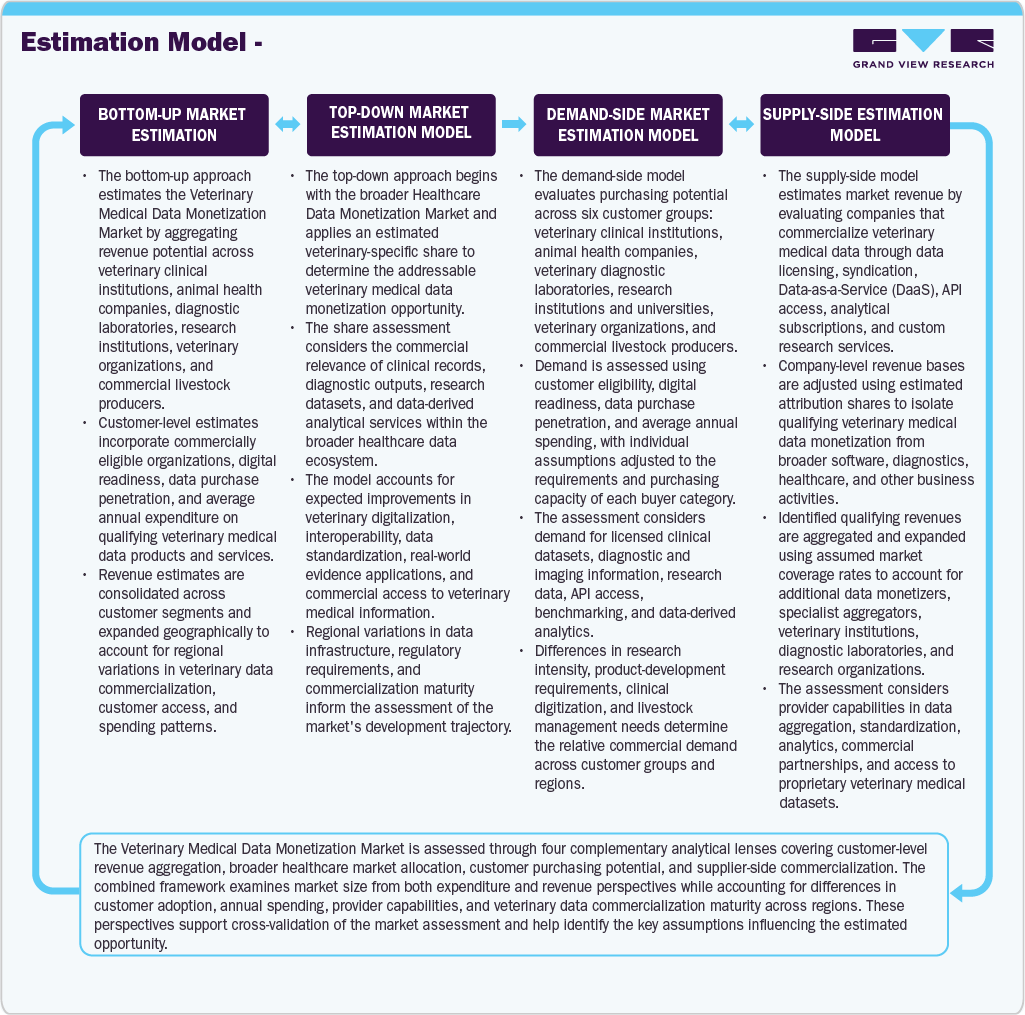
The veterinary medical data monetization marketfigures in this report are based on a proven research process that combines executive interviews with secondary research from proprietary databases, company filings, and recognized regulatory and institutional sources. Market size is built through value-chain sizing—reconciling supply-side and demand-side estimates—and triangulated with bottom-up and top-down approaches. Every estimate passes multiple levels of expert validation before publication, with eachveterinary medical data monetization segment quantified using the revenue-capture definitions in the table below.
Segment Definition
Market
Definition
Inclusions
Exclusion
Veterinary Medical Data Monetization Market
Captures revenue generated by companies through the commercialization, licensing, syndication, exchange, and monetization of animal medical data across clinical, operational, diagnostic, and research applications. It measures the direct economic value derived from transforming raw practice management records, patient electronic health files, diagnostic outputs, and trial data into commercial Data-as-a-Service (DaaS), API feeds, analytics, and research streams.
Data licensing fees, subscription-based DaaS platforms, pay-per-use API data exchange fees, embedded AI analytics subscriptions, syndicated market intelligence feeds, and project-based custom research/data services.
Standalone practice management software licenses without data monetization rights, physical diagnostic instruments, laboratory consumables, animal therapeutics/vaccines, generic CRM/HR software, and IT hardware.
Solution
Definition
Inclusions
Exclusion
PIMS Operational & Commercial Data
Captures revenue from monetizing practice operational, workflow, supply chain, and financial transactional data generated by veterinary practice management systems.
Practice performance benchmarks, inventory turnover analytics, appointment volume tracking, billing data feeds, and syndicated commercial intelligence.
General PIMS software license fees, hardware installation, accounting modules, and clinical/EHR patient notes.
EHR Data
Captures revenue from commercializing longitudinal electronic health records, treatment patterns, prescription histories, and patient outcomes.
Real-World Evidence (RWE) data feeds, anonymized patient registries, clinical outcome benchmarks, and longitudinal treatment datasets.
Unmonetized electronic chart storage, paper medical records, and administrative practice management records.
R&D & Biostatistical Data
Captures revenue generated from specialized research datasets, biostatistical analysis, and clinical trial data services supporting animal health drug and vaccine development.
Clinical trial data management, biostatistical research feeds, genomic/biomarker datasets, epidemiological study data, and CRO data services.
General contract laboratory testing without a data licensing component, internal university research, and drug manufacturing revenue.
Diagnostic & Imaging Data
Captures revenue from monetizing digital diagnostic results, pathology scans, teleradiology datasets, and imaging files generated across laboratories and clinical point-of-care.
Digital pathology scan feeds, raw laboratory result data lakes, DICOM imaging archives, AI model training datasets, and teleradiology data streams.
Physical diagnostic testing kits, point-of-care analyzers, laboratory reagents, and hardware maintenance.
Animal
Definition
Inclusions
Exclusion
Companion Animals
Captures monetized data revenue generated from veterinary care provided to household pets and companion species.
Canine (dog), feline (cat), avian, exotic, and small mammal clinical records, diagnostic files, and companion practice metrics.
Commercial livestock, poultry, swine, equine, and aquaculture data feeds.
Livestock Animals
Captures monetized data revenue generated from production animals, commercial livestock operations, and equine herds.
Bovine (cattle), equine (horses), swine (pigs), poultry, ovine/caprine (sheep/goats), and commercial farm herd-health metrics.
Domestic household pet data (dogs, cats) and small animal clinic metrics.
Business Model
Definition
Inclusions
Exclusion
Data Licensing & Syndication (DaaS)
Captures recurring revenue from granting enterprise access to structured, anonymized, or aggregated veterinary datasets and market intelligence products.
Fixed DaaS subscriptions, syndicated market feeds, annual enterprise dataset access licenses, and recurring market intelligence reports.
One-off custom research projects, pay-per-call API access, and generic SaaS software seats.
Usage-Based & API Data Fees
Captures transaction-based revenue generated from real-time medical data exchanges, volume-based queries, and integration endpoints.
Pay-per-query data lookups, volume-based API call fees, transaction-based medical record exchange fees, and integration usage billing.
Fixed monthly software seat licenses and flat-rate annual data contracts.
Embedded AI & Analytics Subscriptions
Captures recurring revenue from decision-support algorithms, predictive models, and ambient AI tools operating directly on top of medical datasets.
AI scribing subscriptions, clinical decision-support modules, automated diagnostic image interpretation software, and predictive analytics dashboards.
Raw data licensing without analytical/AI models, basic static reporting tools, and non-monetized software features.
Custom Research & Data Services
Captures project-based revenue for tailored biostatistical analysis, trial data curation, biosecurity mapping, and specialized research deliverables.
Bespoke RWE data extractions, clinical trial data management contracts, epidemiological modeling services, and CRO research data projects.
General practice management consulting, IT hardware support, and unmonetized internal R&D activities.
Customer
Definition
Inclusions
Exclusion
Veterinary Clinical Institutions
Captures revenue from veterinary practices, specialty hospitals, and corporate hospital groups purchasing operational benchmarking and decision-support data.
Independent clinics, specialty animal hospitals, corporate practice networks, and academic teaching hospitals.
Pharmaceutical companies, commercial livestock farms, and standalone diagnostic laboratories.
Animal Health Companies
Captures revenue from commercial animal health, pharmaceutical, vaccine, and nutrition companies purchasing clinical and market data.
Veterinary pharmaceutical manufacturers, animal biotech firms, therapeutics developers, and pet nutrition/feed enterprises.
Human pharmaceutical operations, general consumer goods companies, and retail pet stores.
Veterinary Diagnostic Laboratories
Captures revenue from independent reference laboratories and diagnostic networks purchasing data integration and diagnostic AI solutions.
Commercial reference laboratories, digital pathology centers, teleradiology networks, and diagnostic software integrations.
General human pathology labs, hardware distributors, and reagent manufacturers.
Research Institutions & Universities
Captures revenue from academic organizations, veterinary colleges, and clinical research organizations (CROs) acquiring research datasets.
Veterinary universities, public/private research institutes, clinical research organizations, and academic trial sponsors.
Commercial veterinary practices and private corporate pharmaceutical companies.
Veterinary Organizations
Captures revenue from government bodies, public health ministries, and regulatory associations procuring disease surveillance and epidemiological data.
Government departments of agriculture, public veterinary authorities, regulatory agencies, disease monitoring networks, and industry associations.
Private commercial farms, corporate veterinary clinic groups, and pharmaceutical companies.
Commercial Livestock Producers
Captures revenue from commercial agricultural operations, integrators, and equine enterprises utilizing production and herd health data.
Dairy/beef cattle producers, swine integrators, commercial poultry operations, equine breeding facilities, and aquaculture enterprises.
Companion animal clinics, household pet owners, and urban small-animal practices.
Estimation Model
 To learn more about this report, Download Free Sample Report
Delivered Customizations
This report has been delivered with the following In-depth customizations
Client Request
Customization Delivered
Value Adds
Global Market Intelligence & Commercialization Strategy: Veterinary Medical Data Monetization
Comprehensive assessment of global and regional monetization opportunities across veterinary clinical records, practice management information, diagnostic and imaging outputs, and R&D datasets.
Evaluates data licensing and syndication, usage-based API fees, AI-supported analytics subscriptions, and custom research services.
Maps data suppliers, commercial buyers, purchasing priorities, and monetization pathways across companion and production animals.
Includes regional opportunity assessment, demand-side customer profiling, commercial readiness indicators, and prioritization of customer groups such as animal health companies, veterinary clinical institutions, diagnostic laboratories, and research organizations.
Supports market-entry planning by identifying the most commercially attractive data assets, buyer categories, and revenue models.
Helps prioritize opportunities based on data availability, customer demand, and the potential to generate recurring revenue from licensed datasets and analytical services.
Enables companies to distinguish high-value clinical and diagnostic information from operational data with limited independent monetization potential.
Provides a structured basis for identifying regional expansion opportunities, developing partnerships with veterinary data holders, and designing differentiated commercialization strategies aligned with customer requirements.
Data Governance, Access & Commercialization Assessment: Veterinary Medical Data
Detailed assessment of the conditions governing the collection, processing, sharing, licensing, and commercial use of veterinary medical data across priority countries.
Evaluates data ownership, contractual access rights, consent requirements where applicable, anonymization and de-identification practices, cybersecurity, cross-border data transfers, and intellectual property considerations.
Examines differences between clinical records, diagnostic outputs, livestock health information, and research datasets.
Assesses how data access restrictions and interoperability limitations affect commercial feasibility across the United States, Europe, China, India, and other priority markets.
Identifies potential challenges associated with converting fragmented veterinary records into standardized, commercially usable datasets.
Helps organizations assess whether veterinary medical data can be lawfully accessed, standardized, and commercialized within target markets.
Supports the development of appropriate data-sharing agreements, licensing structures, and commercial partnerships with clinics, diagnostic laboratories, research institutions, and animal health companies.
Enables early identification of regulatory and operational barriers that could delay commercialization or restrict cross-border data access.
Provides a framework for evaluating data quality, provenance, permitted uses, and commercial feasibility before investment in data aggregation, analytics infrastructure, or research-oriented data products..
Competitive Intelligence & Strategic Benchmarking: Veterinary Medical Data Monetization Providers
Comparative assessment of established data and analytics providers, veterinary data aggregators, diagnostic companies, practice management platforms, and specialized AI analytics businesses.
Covers Optum, IQVIA, VetSuccess Limited, Kynetec, Animalytix, iVET360, Kreavet, BioVenic, Vetspire, Aiforia, CoVet, IDEXX Laboratories, Covetrus, DaySmart Software, Digitail, ProVet, OnwardVet, VetStoria, Instinct Science, and EvidentVet.
Benchmarks their veterinary data relevance, available data assets, commercialization models, customer focus, analytical capabilities, partnership networks, and strategic positioning.
Distinguishes direct medical data monetization from adjacent software, diagnostics, and research services to identify companies with demonstrable exposure to the defined market.
Enables clients to identify competitive gaps across veterinary data licensing, clinical benchmarking, diagnostic intelligence, and research data services.
Supports the evaluation of potential acquisition targets, technology partners, and data-sourcing relationships based on the commercial relevance of their capabilities.
Helps distinguish established revenue-generating data businesses from platforms with potential but unproven direct monetization.
Identifies opportunities in underdeveloped data categories, underserved customer segments, and fragmented regional markets. Provides a practical foundation for differentiation through proprietary datasets, improved interoperability, specialized analytics, and customer-specific data products.
About the Author(s)
Animal Health Research Team
Healthcare · Animal HealthThis report was authored by the animal health research team at Grand View Research - comprising two research analysts, one senior research analyst, and one industry expert - with specialized expertise in the animal health segment of the healthcare industry. All findings are based on proprietary healthcare databases, executive interviews, and regulatory analysis, subject to internal peer review prior to publication.
Last Updated:
Speak to Analyst

Customize this report to your needs - add regions, segments, or data points, with 20% free customization.
Or view our licence options:


ISO 9001:2015 & 27001:2022 Certified
We are GDPR and CCPA compliant! Your transaction & personal information is safe and secure. For more details, please read our privacy policy.


