
- Home
- »
- Semiconductors & Electronics
- »
-
Vetronics Market Size, Share And Trends Report, 2026-2035GVR Report cover

Vetronics Market (2026 - 2035)
Size, Share & Trends Analysis Report By Product (Communication, Navigation, Power, Protection, Weapon), By Technology (AI, IoT, Cloud, Automation), By Application (Military Vehicles, Others), By Region, And Segment Forecasts
Market Size, 2025
$6.2BMarket Estimate, 2026
$6.6BMarket Forecast, 2035
$11.2BCAGR, 2026–2035
6.1%Vetronics Market Summary
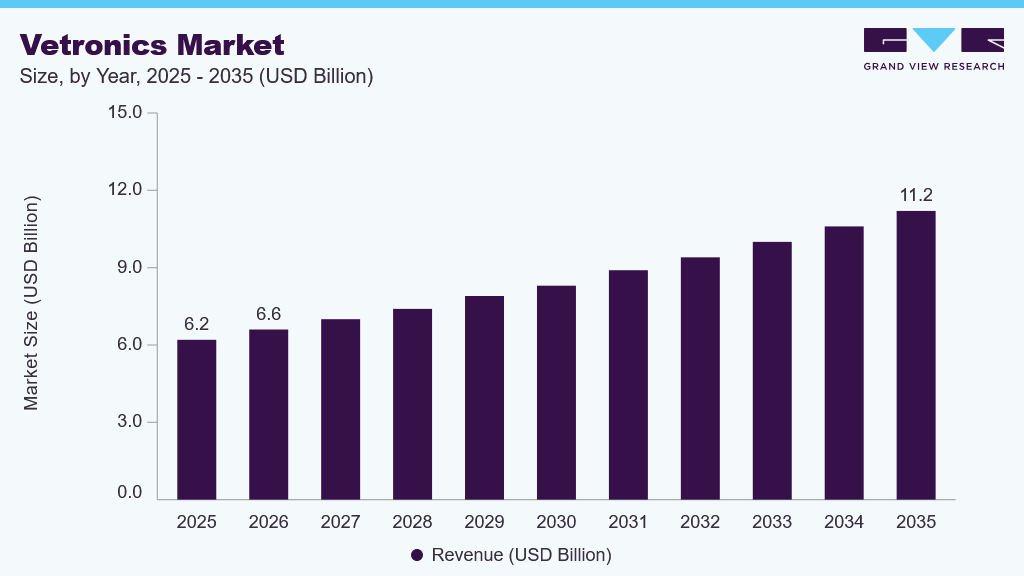
The global vetronics market size was valued at USD 6.2 billion in 2025 and is projected to grow from USD 6.6 billion in 2026 to USD 11.2 billion by 2035, at a CAGR of 6.1% from 2026 to 2035. North America dominated the market, accounting for the largest revenue share of approximately 43.0% in 2025. The market is driven by increasing defense modernization programs, rising demand for advanced vehicle electronics, and the integration of artificial intelligence, autonomous technologies, and network-centric communication systems to enhance battlefield awareness, operational efficiency, and mission effectiveness.
Key Market Trends & Insights
- By product: The communication systems segment held the largest market share of approximately 30.0% in 2025.
- By technology: The automation segment held the largest market share of around 35.0% in 2025.
- By application: The military vehicles segment held the largest market share of around 55.0% in 2025.
Regional Highlights
- Largest regional market: North America (43.0% revenue share, 2025)
- Fastest-growing regional market: Asia Pacific (highest CAGR, 2026-2035)
Market Size & Forecast
- Market size in 2025: USD 6.2 Billion
- Estimated market size in 2026: USD 6.6 Billion
- Projected market size by 2035: USD 11.2 Billion
- CAGR (2026-2035): 6.1%
Prism AI by Grand View Research Free to tryAsk a question about the vetronics marketTry asking✓Every figure cited from GVR research Prefer the report? Download free sample →The vetronics market is primarily driven by increasing defense modernization programs, rising military expenditure, and growing demand for advanced electronic systems that enhance battlefield communication, situational awareness, navigation, and vehicle survivability. The integration of artificial intelligence, automation, sensor fusion, and network-centric warfare capabilities into military vehicles is accelerating market growth. In addition, the increasing procurement of armored vehicles, main battle tanks, and unmanned ground vehicles (UGVs), coupled with the need for real-time data exchange and improved mission effectiveness, is further supporting the adoption of advanced vetronics solutions across defense forces worldwide.
 Source: Grand View Research, IR Documents, Primary Interviews, Paid DatabasesTo learn more about this report,
 Download Free Sample Report
The market faces challenges such as high development and integration costs, lengthy procurement cycles, and stringent military certification requirements, which can delay deployment and increase project complexity. Furthermore, cybersecurity concerns associated with connected military platforms and interoperability issues with legacy vehicle systems also pose significant restraints. Despite these challenges, increasing investments in autonomous combat vehicles, artificial intelligence-enabled battlefield management systems, and next-generation military vehicle modernization programs present substantial growth opportunities. The growing adoption of modular, open-architecture vetronics systems is further expected to create new avenues for innovation and long-term market expansion.
Analyst Perspective
The vetronics market is expected to grow strongly, driven by increasing defense modernization initiatives and the growing adoption of advanced electronic systems in military vehicles. Defense organizations are investing in communication systems, artificial intelligence, automation, and integrated battlefield management solutions to improve situational awareness, mission effectiveness, and vehicle survivability. The shift toward network-centric warfare and connected defense platforms is further accelerating the demand for next-generation vetronics technologies. In addition, the adoption of open-architecture and modular system designs enables easier integration, scalability, and future upgrades across combat platforms. Investments in autonomous and unmanned ground vehicles, coupled with rising defense budgets in emerging economies, are expected to create significant opportunities for market participants.
Product Insights
The communication systems segment dominated the vetronics market with the largest revenue share of approximately 30.0% in 2025. The segment's growth is driven by the increasing adoption of secure, real-time communication networks that enable seamless coordination among military vehicles, command centers, and battlefield personnel. Modern defense operations increasingly rely on network-centric warfare, in which uninterrupted data transmission is critical to mission success. The integration of advanced tactical radios, software-defined communication systems, and battlefield management solutions is further strengthening demand for communication systems across armored vehicles and combat platforms.
The protection systems segment is expected to register the fastest CAGR during the forecast period, owing to the growing emphasis on enhancing vehicle survivability against evolving battlefield threats, including anti-tank guided missiles, drones, and electronic warfare attacks. Increasing investments in active protection systems (APS), threat detection sensors, electronic countermeasures, and integrated defensive technologies are driving segment growth. These solutions enable combat vehicles to detect, assess, and neutralize threats in real time, improving operational safety. For instance, in March 2025, Curtiss-Wright Corporation was awarded multiple contracts by Rheinmetall to provide its modular Turret Drive Stabilization System (TDSS) for the German Army’s Boxer Heavy Weapon Carrier and the Hungarian Ministry of Defense’s Lynx Infantry Fighting Vehicle. The system is designed to provide accurate turret stabilization and maintain target location while the vehicles are moving, supporting enhanced weapon-aiming and engagement capabilities .
Technology Insights
The automation segment dominated the vetronics market in 2025, accounting for the largest revenue share of 35.0% in 2025. The segment growth is attributed to the widespread integration of automated vehicle management, fire control, power distribution, diagnostics, and mission-critical control systems across modern military platforms. Automation enhances operational efficiency by reducing manual intervention, improving system reliability, and enabling faster decision-making during combat operations. Increasing defense modernization programs and the adoption of digitally connected combat vehicles are further driving the deployment of automation technologies. Continuous advancements in embedded electronics and integrated control systems are expected to sustain the segment's leading position throughout the forecast period.
The artificial intelligence (AI) segment is expected to register the fastest CAGR during the forecast period, owing to the increasing demand for autonomous decision-making, predictive maintenance, sensor fusion, and real-time battlefield intelligence. AI-enabled vetronics systems improve target recognition, navigation, route planning, threat detection, and mission execution, enhancing the operational effectiveness and survivability of military vehicles. Growing investments in autonomous combat platforms, unmanned ground vehicles (UGVs), and intelligent command-and-control systems are further accelerating AI adoption. Furthermore, advancements in machine learning, edge computing, and data analytics are enabling defense organizations to develop next-generation vetronics solutions that operate effectively in complex, dynamic battlefield environments.
Application Insights
The military vehicles segment dominated the vetronics market in 2025, accounting for the largest revenue share of approximately 55.0%. Segment growth is driven by increased procurement and modernization of main battle tanks, infantry fighting vehicles, armored personnel carriers, and tactical combat vehicles equipped with advanced electronic systems. Rising investments in communication, navigation, protection, weapon control, and power management technologies are enhancing vehicle survivability, situational awareness, and mission effectiveness. Governments across major defense-spending nations continue to prioritize fleet modernization to address evolving security challenges. Defense manufacturers are integrating advanced vetronics technologies into next-generation combat vehicles to improve operational capabilities. For instance, in January 2026, Leonardo Rheinmetall Military Vehicles (LRMV) delivered the first four Lynx KF41 Infantry Fighting Vehicles to the Italian Army under the A2CS program, featuring advanced digital architecture and integrated mission systems that support modern battlefield operations.
The unmanned ground vehicles (UGVs) segment is expected to register the fastest CAGR during the forecast period, owing to the increasing adoption of autonomous and remotely operated platforms for reconnaissance, surveillance, logistics, explosive ordnance disposal, and combat support missions. Growing defense investments in autonomous technologies, artificial intelligence, and advanced sensor integration are accelerating the deployment of UGVs across military operations. These platforms help reduce risks to personnel while improving operational efficiency in complex and hazardous environments. Furthermore, ongoing advancements in autonomous navigation, communication systems, and real-time data processing are expected to drive significant growth in the UGV segment throughout the forecast period.
Regional Insights
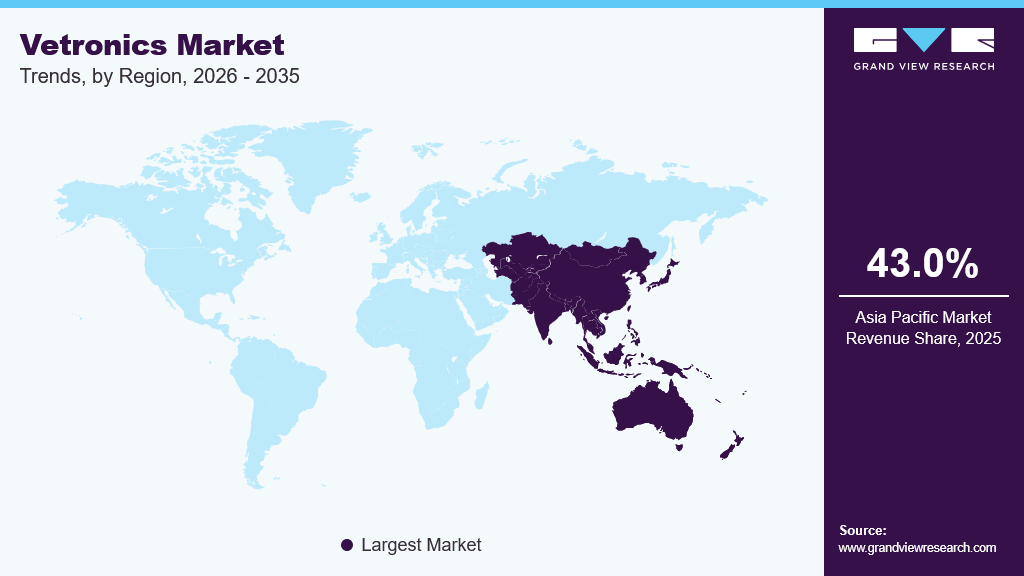
North America dominated the vetronics market, accounting for the largest revenue share of approximately 43.0% in 2025. Regional growth is driven by high defense spending, ongoing military vehicle modernization programs, and early adoption of advanced digital battlefield technologies. Strong investments in communication systems, artificial intelligence, automation, and integrated mission systems, coupled with the presence of leading defense contractors, continue to support market growth. The U.S. Department of Defense's focus on enhancing the survivability, connectivity, and operational capabilities of combat vehicles is further accelerating the adoption of advanced vetronics solutions. Leading defense companies are also introducing next-generation technologies to strengthen military vehicle capabilities across the region. For instance, in October 2025, Leonardo DRS was awarded a contract by the U.S. Army to develop prototype Vehicle Integrated Power Kits (VIPKs), supporting on-demand power generation for next-generation combat vehicles and advance technologies. The development supports the integration of advanced electrical power capabilities into military vehicles and further contributes to segment growth.
 To learn more about this report, Download Free Sample Report
Asia Pacific Vetronics Market
The vetronics market in the Asia Pacific is expected to register the fastest CAGR during the forecast period, owing to increasing defense budgets, rising geopolitical tensions, and ongoing military modernization initiatives across countries such as China, India, South Korea, Japan, and Australia. Governments are investing significantly in advanced armored vehicles, unmanned ground vehicles, and indigenous defense manufacturing to strengthen national security and operational readiness. The growing adoption of digital battlefield technologies, network-centric warfare capabilities, and advanced electronic systems is further driving demand for vetronics across the region. In addition, regional governments are emphasizing self-reliance in defense production through strategic procurement programs and investments in the development of indigenous military vehicles. The increasing integration of artificial intelligence, advanced sensors, and secure communication technologies into next-generation combat platforms is expected to further accelerate the deployment of vetronics systems. These factors, coupled with expanding defense research and development activities, are expected to sustain strong market growth across the region throughout the forecast period.
Key Vetronics Company Insights
The vetronics market is highly competitive, with leading defense companies focusing on the development of advanced vehicle electronics, integrated mission systems, and next-generation digital battlefield technologies to strengthen their market position. Market participants are investing in artificial intelligence, automation, secure communication systems, power management solutions, navigation technologies, and active protection systems to enhance the operational capabilities and survivability of military vehicles. Companies are also prioritizing open-architecture and modular system designs to improve interoperability, simplify upgrades, and support evolving defense requirements. In addition, strategic collaborations, defense contracts, research and development investments, and military modernization programs are enabling manufacturers to expand their technological capabilities and reinforce their presence in the global vetronics market.
Key Vetronics Companies
The following key companies have been profiled for this study on the vetronics market:
-
Thales Group
-
Saab Group
-
Lockheed Martin Corporation
-
General Dynamics Corporation
-
Raytheon Company (RTX)
-
Curtiss-Wright Corporation
-
Leonardo S.p.A.
-
Rheinmetall AG
-
BAE Systems plc
-
L3Harris Technologies, Inc.
Recent Developments
-
In February 2026, BAE Systems Hägglunds rolled out the first CV9035 MkIV Infantry Fighting Vehicle for the Slovak Armed Forces as part of the country's CV90 modernization program. The vehicle features modern digital architecture, an integrated fire control system, an active protection system, and the ability to integrate new sensors and weapon systems, highlighting the growing adoption of integrated vetronics solutions in next-generation military vehicles.
-
In April 2024, BAE Systems received an additional USD 25 million contract modification from the U.S. Marine Corps for the production of additional Amphibious Combat Vehicles (ACVs) under the fourth full-rate production order. The continued procurement of advanced combat vehicles highlights the increasing demand for integrated vetronics systems that enhance mobility, survivability, communication, and mission capabilities in modern military platforms.
Vetronics Market Report Scope
Report Attribute
Details
Market size in 2025
USD 6.2 billion
Estimated market size in 2026
USD 6.6 billion
Projected market size by 2035
USD 11.2 billion
Growth rate
CAGR of 6.1% from 2026 to 2035
Base year for estimation
2025
Actual data
2021 – 2024
Forecast period
2026 – 2035
Quantitative units
Revenue in USD billion and CAGR from 2026 to 2035
Report coverage
Revenue forecast, company ranking, competitive landscape, growth factors, and trends
Segments covered
Product, technology, application, region
Regional Scope
North America; Europe; Asia Pacific; Latin America; Middle East & Africa
Country Scope
U.S.; Canada; Mexico; UK; Germany; France; Italy; Spain; China; Japan; India; Australia; South Korea; Brazil; Argentina; South Africa; Saudi Arabia; UAE.
Key companies profiled
Thales Group; Saab Group; Lockheed Martin Corporation; General Dynamics Corporation ; Raytheon Company (RTX); Curtiss-Wright Corporation; Leonardo S.p.A.; Rheinmetall AG ; BAE Systems plc; L3Harris Technologies , Inc.
Customization scope
Free report customization (equivalent to 8 analyst working days) with purchase. Addition or alteration to country, regional & segment scope.
Pricing and purchase options
Avail of customized purchase options to meet your exact research needs. Explore purchase options
Global Vetronics Market Report Segmentation
This report forecasts revenue growth at the global, regional, and country levels and provides an analysis of the latest industry trends and opportunities across each sub-segment from 2021 to 2035. For this study, Grand View Research has segmented the global vetronics market report based on product, technology, application, and region:
-
Product Outlook (Revenue, USD Billion, 2021 - 2035)
-
Communication Systems
-
Navigation Systems
-
Power Systems
-
Protection Systems
-
Weapon Systems
-
Others
-
-
Technology Outlook (Revenue, USD Billion, 2021 - 2035)
-
Artificial Intelligence (AI)
-
Internet of Things (IoT)
-
Cloud
-
Automation
-
Others
-
-
Application Outlook (Revenue, USD Billion, 2021 - 2035)
-
Military Vehicles
-
Unmanned Ground Vehicles (UGVs)
-
Homeland Security
-
Others
-
-
Regional Outlook (Revenue, USD Billion, 2021 - 2035)
-
North America
-
U.S.
-
Canada
-
Mexico
-
-
Europe
-
UK
-
Germany
-
France
-
Italy
-
Spain
-
-
Asia Pacific
-
China
-
Japan
-
India
-
Australia
-
South Korea
-
-
Latin America
-
Brazil
-
Argentina
-
-
Middle East and Africa
-
South Africa
-
Saudi Arabia
-
UAE
-
-
Frequently Asked Questions About This Report
The global vetronics market size was valued at USD 6.2 billion in 2025 and is estimated at USD 6.6 billion for 2026.
The global vetronics market is expected to grow at a CAGR of 6.1% from 2026 to 2035, reaching USD 11.2 billion.
North America dominated with approximately 43.0% revenue share in 2025.
The communication systems segment accounted for the largest revenue share of approximately 30.0% in 2025.
Key players in the market include Thales Group, Saab Group, Lockheed Martin Corporation, General Dynamics Corporation, Raytheon Company (RTX), Curtiss-Wright Corporation, Leonardo S.p.A., Rheinmetall AG, BAE Systems plc, L3Harris Technologies, Inc., and others.
About the Author(s)
Semiconductors & Electronics Research Team
Research · Semiconductors & ElectronicsThis report was authored by the semiconductors & electronics research team at Grand View Research - comprising two research analysts, one senior research analyst, and one industry expert - with specialized expertise in the semiconductors & electronics segment of the research industry. All findings are based on proprietary research databases, executive interviews, and regulatory analysis, subject to internal peer review prior to publication.
Last Updated:
Speak to Analyst

Customize this report to your needs - add regions, segments, or data points, with 20% free customization.
Or view our licence options:


ISO 9001:2015 & 27001:2022 Certified
We are GDPR and CCPA compliant! Your transaction & personal information is safe and secure. For more details, please read our privacy policy.


