
- Home
- »
- Sensors & Controls
- »
-
Vibration Control System Market Size & Share Report, 2033GVR Report cover

Vibration Control System Market (2026 - 2033)
Size, Share & Trends Analysis Report By System Type (Vibration Control, Motion Control), By Application (Automotive, Aerospace & Defense, Manufacturing, Electrical & Electronics, Oil & Gas), By Region, And Segment Forecasts
Market Size, 2025
$5.8BMarket Estimate, 2026
$6.2BMarket Forecast, 2033
$9.9BCAGR, 2026–2033
7.1%Vibration Control System Market Summary
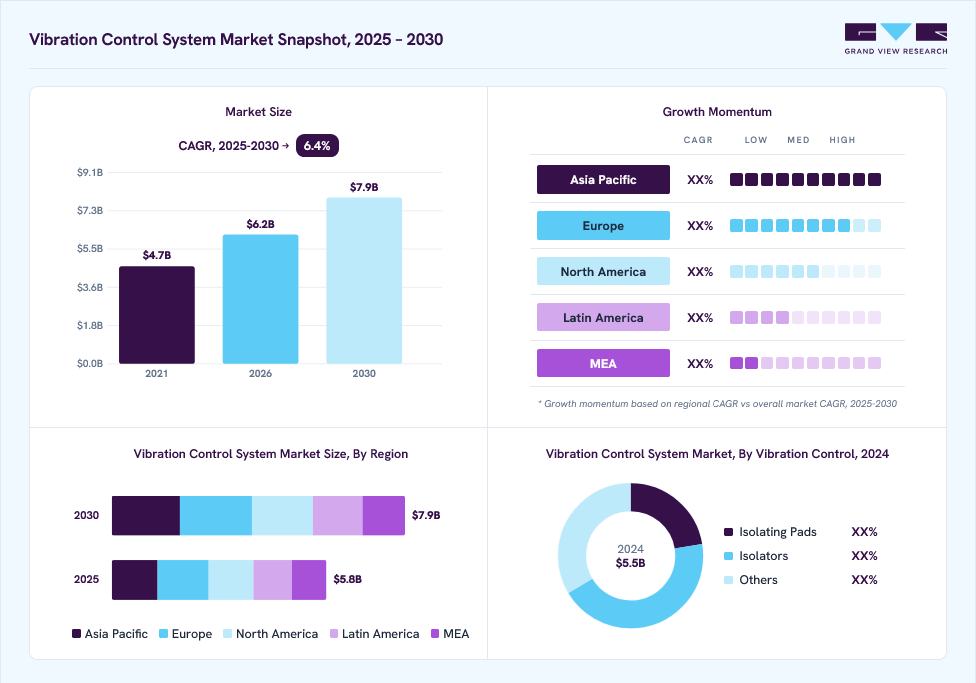
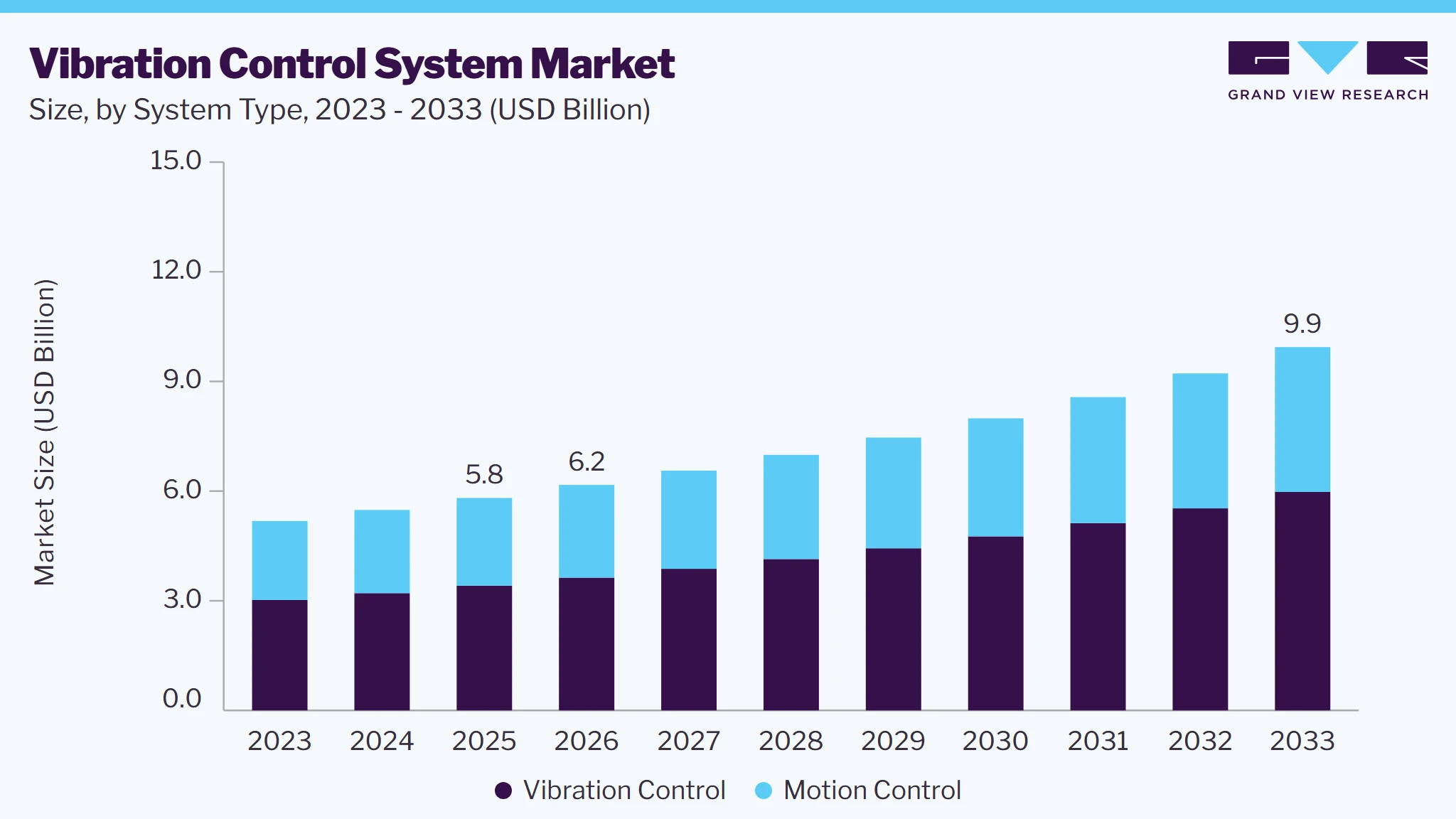
The global vibration control system market size was valued at USD 5.8 billion in 2025 and is projected to grow from USD 6.2 billion in 2026 to USD 9.9 billion by 2033, growing at a CAGR of 7.1% from 2026 to 2033. North America dominated the global market with the largest revenue share of 35.1% in 2025. The market is experiencing significant growth, driven by accelerating demand across multiple high-growth industries, including automotive, aerospace, healthcare, and manufacturing.
 Source: Grand View Research, IR Documents, Primary Interviews, Paid DatabasesTo learn more about this report,
 Download Free Sample Report
 Key Market Trends & Insights
- By system type: Vibration control segment dominated the market, with a share of 58.7% in 2025.
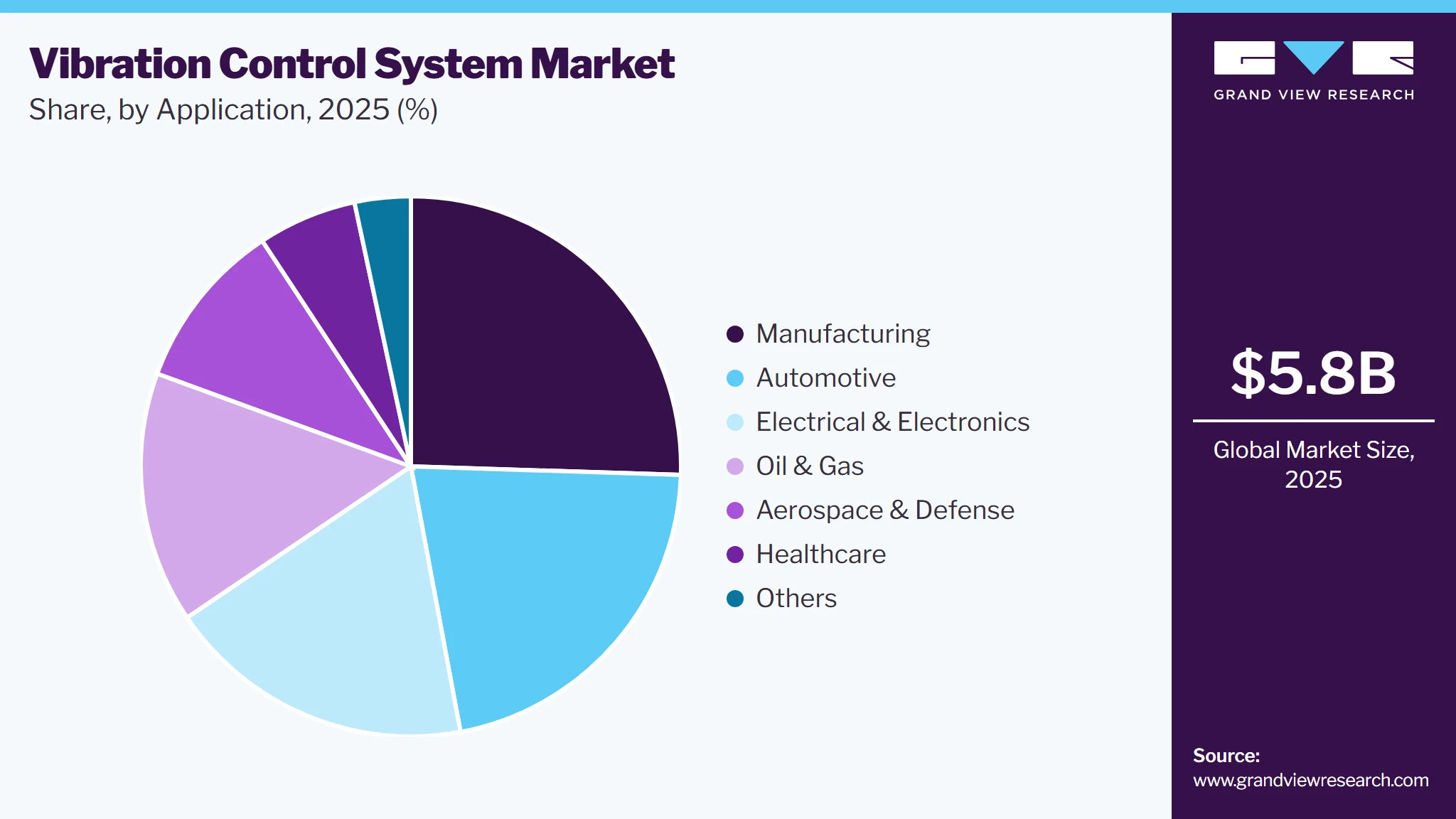
- By application: Manufacturing segment accounted for the largest market share of 25.5% in 2025.
Regional Highlights
- Largest regional market: North America (35.1% revenue share in 2025)
- Fastest growing regional market: Asia Pacific (highest CAGR 8.5%, 2026-2033)
- By Country: The U.S. held the largest share of North America in 2025
Market Size & Forecast
- Market size in 2025: USD 5.8 Billion
- Estimated market size in 2026: USD 6.2 Billion
- Projected market size by 2033: USD 9.9 Billion
- CAGR (2026-2033): 7.1%
Three ways to get this report
Buy it, customize it, or ask a question.Ask an Analyst
Analyst response in 1 business day
- AccessReport author, directly
- Reply timeWithin 1 working day
- No sales callDirect answer only
- FormatEmail reply
- CostFree, no cost
Get the Full Report
What the study covers
- FormatsPDF · Excel · Dashboard
- Timeline2026–2033 annual, 2025 base
- Coverage20+ countries, 5 regions
- Companies10+ key players profiled
Customize the Report
20% free customization
- IncludeCountries, segments, points
- TailorTo your product definition
- ExtendDeeper competitor detail
- OrA fully bespoke study
- Turnaround5–10 working days
The vibration control system market is driven by the increasing adoption of industrial automation and smart manufacturing technologies across sectors such as automotive, aerospace, energy, and electronics. Growing investments in advanced machinery, predictive maintenance solutions, and condition monitoring systems are accelerating market expansion by enhancing equipment reliability, reducing operational downtime, and improving overall production efficiency.
Increasing industrialization worldwide and stringent government regulations concerning noise, vibration, and harshness (NVH) reduction are major market drivers. These regulations are compelling manufacturers to adopt advanced, efficient vibration control solutions to improve machinery longevity, operational safety, and environmental sustainability.
Additionally, technological advancements significantly support the vibration control system industry growth, with innovations in active vibration control systems integrating smart sensors, IoT, and AI for real-time monitoring and adaptive vibration mitigation. This fostered improved performance and predictive maintenance capabilities, particularly in precision-dependent sectors such as semiconductor manufacturing, automotive safety systems, and aerospace. Moreover, the rise of electric vehicles, with quieter engines that demand enhanced vibration control, further stimulates adoption and innovation in the vibration control systems industry.
 To learn more about this report, Download Free Sample Report
 Additionally, companies are investing heavily in research and development to innovate advanced active vibration control solutions integrated with smart sensors, IoT, and AI technologies. These initiatives aim to offer real-time monitoring, adaptive control, and predictive maintenance capabilities tailored for high-growth sectors, including automotive, aerospace, and healthcare. Furthermore, these players are expanding their global footprint with focused activities in emerging markets where rapid industrialization and urbanization fuel demand, thereby driving the vibration control system industry growth.
Furthermore, the escalating global production demand for electric vehicle (EV) fleets is transforming the strategic landscape of the vibration control system industry. As governments and automakers worldwide commit to ambitious electrification targets, EV manufacturing volumes are surging, driven by policies promoting zero-emission transportation and sustainability goals. This rapid expansion necessitates advanced vibration control solutions optimized for EV architectures, which face unique vibration and noise challenges due to electric motors, high-voltage batteries, and lightweight chassis materials.
Moreover, the growing adoption of wireless communication in vibration control systems is a pivotal driver of market growth, fueled by rapid advancements in sensors and communication technologies. Wireless vibration sensors eliminate the constraints associated with traditional wired systems, offering greater flexibility, lower installation and maintenance costs, and enhanced scalability. Key industry players are leveraging wireless sensor networks that use protocols such as BLE and LoRaWAN to enable real-time remote monitoring of vibration parameters, even in challenging or inaccessible environments. These innovations enable more comprehensive and frequent data collection, bolstering predictive maintenance and fault detection capabilities.
Market Dynamics
The vibration control system market is witnessing steady growth driven by advancements in sensor technologies, smart monitoring systems, and industrial automation. The growing emphasis on equipment reliability, workplace safety, operational efficiency, and asset lifecycle management across manufacturing, automotive, aerospace, energy, construction, and healthcare industries is accelerating market expansion. The rising investments in smart factories, renewable energy infrastructure, transportation modernization, and high-precision industrial equipment are creating significant growth opportunities in the market. Strategic collaborations among vibration control system manufacturers, industrial automation providers, engineering firms, and infrastructure developers are expected to continue driving strong growth in the vibration control system market.
The increasing adoption of active vibration control technologies in precision equipment is a key driver for the vibration control system market. Manufacturers are implementing advanced vibration mitigation solutions to maintain operational accuracy, reduce performance deviations, and protect sensitive components from vibration-induced disturbances. As production environments become more automated and technologically sophisticated, the need for highly effective vibration suppression systems continues to strengthen.
Advancements in sensors, actuators, control algorithms, and real-time monitoring capabilities are enhancing the effectiveness of active vibration control systems. These technologies enable rapid detection and correction of vibration anomalies, helping improve equipment performance and operational consistency. The growing reliance on high-precision machinery and mission-critical systems is driving greater investment in advanced vibration control solutions across diverse applications.
The vibration control system market faces challenges due to the technical complexity of designing customized solutions for diverse operational environments. Different equipment configurations, structural characteristics, vibration frequencies, and performance requirements often necessitate tailored engineering approaches. This complexity can lengthen project timelines, increase implementation efforts, and raise design costs, creating barriers for organizations seeking standardized vibration-control deployments.
The successful system integration requires detailed vibration analysis, specialized expertise, and extensive performance validation. Many end users struggle to select the most suitable vibration control technologies for specific applications, particularly for highly sensitive equipment. These technical challenges can slow down adoption rates and limit the widespread deployment of advanced vibration control systems in certain operating environments.
The increasing focus on smart infrastructure modernization is creating significant opportunities for vibration control system providers. Large-scale investments in transportation networks, energy facilities, commercial buildings, and high-performance structures are generating demand for technologies that enhance structural stability and operational reliability. Vibration control solutions play a critical role in protecting sensitive equipment, reducing mechanical stress, and supporting long-term infrastructure performance objectives.
Moreover, advancements in intelligent building management systems, digital twins, and connected monitoring platforms are encouraging wider implementation of vibration control technologies. Infrastructure operators are seeking solutions that deliver real-time performance insights while maintaining safety and efficiency standards. This evolving landscape is opening new avenues for manufacturers to develop innovative products tailored to increasingly sophisticated infrastructure requirements.
Market Concentration & Characteristics:
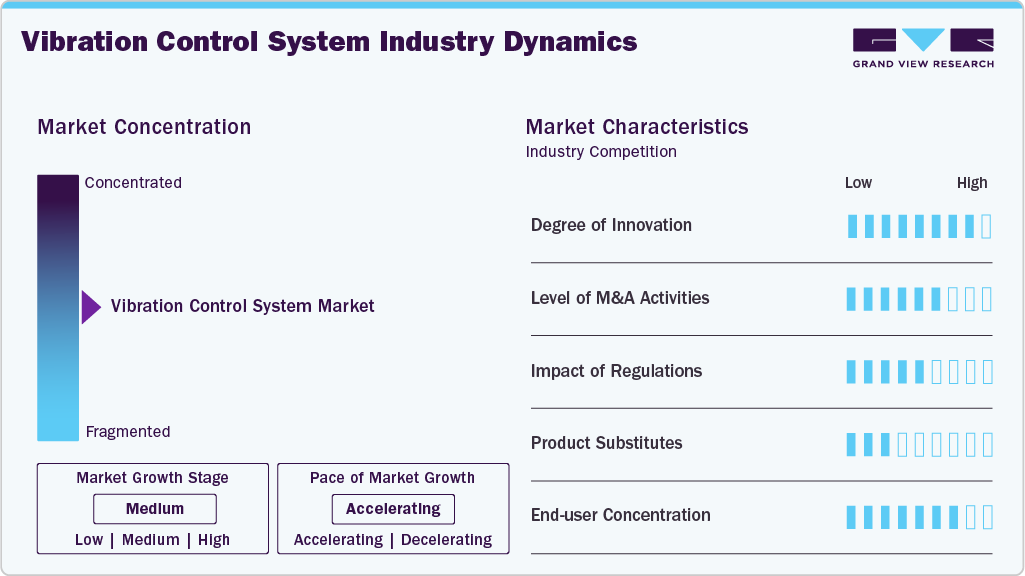
The vibration control system market is moderately concentrated, comprising global vibration control solution manufacturers, industrial equipment component suppliers, structural engineering firms, and specialized vibration isolation system developers. The market is expanding due to increasing emphasis on equipment reliability, asset protection, and structural stability. Organizations are increasingly adopting vibration mitigation technologies to reduce equipment wear, minimize unplanned downtime, and improve long-term operational performance. Strategic collaborations among technology providers, engineering companies, automation vendors, and infrastructure developers are becoming more common as participants seek to enhance system capabilities and expand application coverage. Continuous advancements in vibration isolation technologies, intelligent monitoring systems, active control mechanisms, and predictive maintenance platforms are emerging as key competitive differentiators across the market.
 To learn more about this report, Download Free Sample Report
 The market is characterized by a high level of innovation, driven by ongoing developments in smart sensors, AI-enabled diagnostics, digital twin integration, adaptive damping technologies, real-time condition-monitoring platforms, and active vibration-control systems. The industry is witnessing moderate merger and acquisition activity as companies seek to strengthen engineering expertise, broaden product portfolios, and enhance technological capabilities. Competition from alternative vibration mitigation approaches, including equipment balancing, structural reinforcement, foundation modifications, and machine redesign, persists in certain applications where dedicated vibration control systems may not be the primary choice. Increasing investments in industrial automation, smart infrastructure modernization, advanced manufacturing facilities, transportation networks, renewable energy assets, and intelligent asset management systems are expected to further strengthen the competitive landscape of the vibration control system market.
Analyst Perspective
The vibration control system market is experiencing significant advancement driven by the increasing adoption of industrial automation, smart monitoring technologies, and advanced vibration mitigation systems. The industry is benefiting from the growing need for equipment reliability, structural stability, operational efficiency, and asset protection, all of which enable organizations to reduce downtime and extend equipment lifespans. Strategic collaborations among vibration control manufacturers, automation providers, engineering firms, and condition monitoring specialists are expanding technological capabilities while improving solution effectiveness across diverse applications. As organizations continue prioritizing operational resilience, equipment performance optimization, and data-driven maintenance strategies, vibration control systems are becoming increasingly critical for maintaining reliability and performance across modern industrial and infrastructure environments.
System Type Insights
Based on system type, the vibration control segment led the market with the largest revenue share of 58.7% in 2025 and is expected to grow at the highest CAGR over the forecast period., driven by the growing demand for enhanced mechanical stability and vibration isolation across key industries such as manufacturing, automotive, aerospace, and infrastructure. This demand is fueled by the increasing adoption of advanced vibration control technologies to improve equipment performance, reduce noise and wear, and meet stringent regulatory and safety standards.
The motion control segment is expected to register a significant CAGR of 6.6% over the forecast period. The segmental growth is driven by increasing automation and precision requirements in manufacturing and robotics. Advanced vibration damping in motion control systems improves equipment longevity and operational accuracy while minimizing downtime caused by mechanical wear. The rise of Industry 4.0 and demand for smart motion solutions incorporating sensors for real-time vibration monitoring are expanding, enhancing predictive maintenance capabilities.
Application Insights
Based on device, the manufacturing segment led the market with the largest revenue share of 25.5% in 2025, driven by the critical reliance of manufacturing industries on machinery and equipment that generate vibrations during operation. This created a high demand for vibration control systems to ensure operational stability, safety, and machinery longevity. Additionally, the need to meet stringent quality standards, optimize operational efficiency, and reduce risks related to equipment breakdowns and production delays contributed to this dominance. Technological advancements offering innovative, tailored vibration control solutions further propelled adoption in manufacturing facilities worldwide, thereby driving the segment growth.
 To learn more about this report, Download Free Sample Report
 The automotive segment is expected to register the fastest growth at a CAGR of 8.8% over the forecast period, driven by the stricter government regulations on vehicle vibration and noise, rising adoption of electric and hybrid vehicles, which require advanced vibration control to compensate for quieter engines, and technological advancements such as active vibration control systems that provide real-time adaptation to vibrations. Additionally, manufacturers are focusing on lightweight vibration control components to improve fuel efficiency. At the same time, ongoing investments in intelligent damping systems and smart sensor technologies help reduce noise, vibration, and harshness (NVH) in vehicles.
Regional Insights
North America dominated the vibration control system market with the largest revenue share of 35.1% in 2025, driven by the growing demand for advanced noise, vibration, and harshness (NVH) solutions in the automotive and aerospace sectors. The shift towards electric vehicles (EVs) and autonomous driving technologies necessitates sophisticated vibration management to enhance performance and comfort.
 To learn more about this report, Download Free Sample Report
 U.S. Vibration Control System Market Trends
The vibration control system market in the U.S. held the largest share in the North America region in 2025, driven by the expansion of manufacturing activities and the increasing emphasis on infrastructure modernization. The rise in construction projects, particularly in urban areas, necessitates the use of vibration control solutions to mitigate the impact of machinery on surrounding structures.
Europe Vibration Control System Market Trends
Europe dominated the market with a share of over 27.9% in 2025, driven by stringent environmental regulations and the automotive industry's push towards electrification. The transition to electric vehicles requires the development of components that can effectively manage vibrations to ensure vehicle performance and passenger comfort. The increasing adoption of automation in manufacturing processes necessitates the integration of vibration control systems to maintain precision and reduce wear on machinery.
The Germany vibration control system market is expected to grow at the fastest rate in the coming years, driven by the country's strong automotive industry and its emphasis on precision engineering. The development of high-performance vehicles, including electric and hybrid models, requires advanced vibration control solutions to meet stringent quality standards.
The UK vibration control system market is rapidly expanding, driven by renewable energy projects, particularly offshore wind farms, which demand robust vibration management solutions to protect equipment and ensure operational efficiency. The construction sector's recovery post-pandemic also contributes to the increased need for vibration control in building foundations and heavy machinery.
Asia Pacific Vibration Control System Market Trends
The Asia Pacific market is expected to grow at the fastest CAGR of 8.5% from 2026 to 2033, driven by the booming automotive and manufacturing industries. The shift towards electric vehicles and the expansion of industrial automation require advanced vibration management solutions to ensure product quality and operational efficiency. The region's focus on infrastructure development and urbanization fosters the demand for vibration control systems in construction and transportation projects.
The China vibration control system market is driven by the country's rapid industrialization and the government's emphasis on technological innovation. The automotive industry's transition to electric vehicles necessitates the development of components that effectively manage vibrations to enhance vehicle performance and comfort. The expansion of the aerospace sector and the need for high-precision manufacturing processes drive the demand for advanced vibration control solutions. This factor highlights the integration of vibration control in China's electric mobility sector.
The Japan vibration control system market is rapidly expanding, driven by the country's advanced technological landscape and the demand for high-precision equipment in industries such as robotics, electronics, and automotive. The development of autonomous vehicles and the integration of automation in manufacturing processes necessitate sophisticated vibration management solutions to maintain performance and reliability.
Key Vibration Control System Company Insights
Some of the key players operating in the market include ContiTech Deutschland GmbH and Fabreeka (Stabilus), among others.
-
ContiTech Deutschland GmbH, a subsidiary of Continental AG, is a global player specializing in advanced suspension and anti-vibration solutions for diverse sectors including automotive, rail, industry, and energy. Their vibration control technology focuses on reducing noise, vibration, and harshness (NVH) for enhanced safety and comfort, and the company has recently expanded its worldwide footprint through acquisitions in the anti-vibration segment. The company’s portfolio includes active and passive vibration-optimized mounting components and lightweight systems for engines, transmissions, and structural applications, supported by dedicated R&D and manufacturing across several continents.
-
Fabreeka specializes in shock control and vibration isolation for industrial, infrastructure, aerospace, automotive, mining, and high-precision laboratory markets. The company is a globally recognized supplier of custom and innovative products, notably the Fabreeka pad an early fabric-reinforced elastomer developed with MIT and Goodyear which remains a benchmark for impact and vibration absorption across a diverse portfolio. Fabreeka is driven by a customer-oriented approach, providing turnkey solutions for vibration analysis, product integration, and technical support that meet the evolving demands of Industry 4.0 and complex engineering applications.
ELESA S.p.A. and VICODA GmbH. are some of the emerging market participants in the vibration control system market.
-
ELESA S.p.A. develops high-performance vibration damping elements, mounts, buffers, pads, springs, and wire rope isolators, crafted primarily from rubber and composites for industrial machinery and equipment. Their DVA range addresses vibration, shock, and noise for conveyors, motors, presses, and sensitive instrumentation, improving operational accuracy, comfort, and the longevity of machines.
-
VICODA GmbH is a member of the LISEGA group, specializing in vibration isolation and elastic bearings for industrial applications. The company delivers turnkey services from vibration measurement and analysis to customized product design, manufacturing, installation, and system monitoring. Their product range includes pre relaxed spring mounts and viscoelastic dampers, engineered for continual performance and low-frequency vibration isolation in heavy machinery and buildings.
Key Vibration Control System Companies:
The following key companies have been profiled for this study on the vibration control system market.
- Resistoflex
- HUTCHINSON (CK Hutchison Holdings Ltd)
- Fabreeka (Stabilus)
- ELESA S.p.A.
- Sentek Dynamics Inc.
- VICODA GmbH
- Isolation Technology Inc.
- Trelleborg AB
- Kinetics Noise Control, Inc
Competitive Benchmarking
Category
Operating Strategies
Competitive Edge
Weakness
Established Players (Trelleborg AB, HUTCHINSON, ContiTech Deutschland GmbH)
- Focus on expanding integrated vibration-control portfolios through partnerships in engineering, monitoring, and automation.
- Invest heavily in R&D to develop intelligent vibration mitigation solutions for critical applications.
- Strong global presence, diversified customer base, and extensive vibration control expertise support leadership.
- Ability to provide customized, high-performance vibration solutions for complex operational environments.
- Dependence on established product portfolios can slow the adoption of emerging technologies.
- Large organizational structures may reduce responsiveness to specialized customer requirements.
Emerging Players (ELESA S.p.A., VICODA GmbH., Sentek Dynamics Inc.)
- Emerging players focus on developing innovative vibration-monitoring technologies leveraging specialized engineering capabilities.
- Invest in smart sensing solutions to address evolving vibration management requirements.
- A strong focus on innovation enables the rapid development of advanced vibration control technologies.
- Ability to deliver flexible, application-specific solutions for specialized operational requirements.
- Limited geographic presence restricts access to large-scale international project opportunities.
- Smaller financial resources may constrain product development and market expansion initiatives.
Recent Developments
-
In October 2025, Fabreeka launched Fabreeka-TIM RF an advanced shock control and vibration isolation product line featuring high-performance materials that improve vibration-damping efficiency in heavy industrial equipment and construction machinery. These products are engineered for enhanced durability and reduced maintenance costs in demanding environments.
-
In September 2025, Sentek Dynamics Incorporated, a U.S.-based provider of vibration testing solutions, unveiled a new 200 kN vibration testing system at its laboratory in Charlotte, North Carolina.
-
In November 2024, Elesa S.p.A. acquired a 60% majority stake in Tellure Rôta S.p.A., an Italian company specializing in the design and production of wheels and castors for industrial applications.
Vibration Control System Market Report Scope
Report Attribute
Details
Market size value in 2025
USD 5.8 billion
Market size value in 2026
USD 6.2 billion
Revenue forecast in 2033
USD 9.9 billion
Growth rate
CAGR of 7.1% from 2026 to 2033
Base year for estimation
2025
Historical data
2021 - 2024
Forecast period
2026 - 2033
Quantitative units
Revenue in USD million/billion, and CAGR from 2026 to 2033
Report coverage
Revenue forecast, company ranking, competitive landscape, growth factors, and trends
Segments covered
System type, application, region
Regional scope
North America; Europe; Asia Pacific; Latin America; MEA
Country scope
U.S.; Canada; U.K.; Germany; France; Russia; China; Japan; India; South Korea; Australia; Brazil; Mexico; Saudi Arabia; UAE; South Africa
Key companies profiled
ContiTech Deutschland GmbH; Resistoflex; HUTCHINSON (CK Hutchison Holdings Ltd); Fabreeka (Stabilus); ELESA S.p.A.; Sentek Dynamics Inc.; VICODA GmbH.; Isolation Technology Inc.; Trelleborg AB; Kinetics Noise Control, Inc.
Customization scope
Free report customization (equivalent up to 8 analysts' working days) with purchase. Addition or alteration to country, regional & segment scope.
Pricing and purchase options
Avail customized purchase options to meet your exact research needs. Explore purchase options
Global Vibration Control System Market Report Segmentation
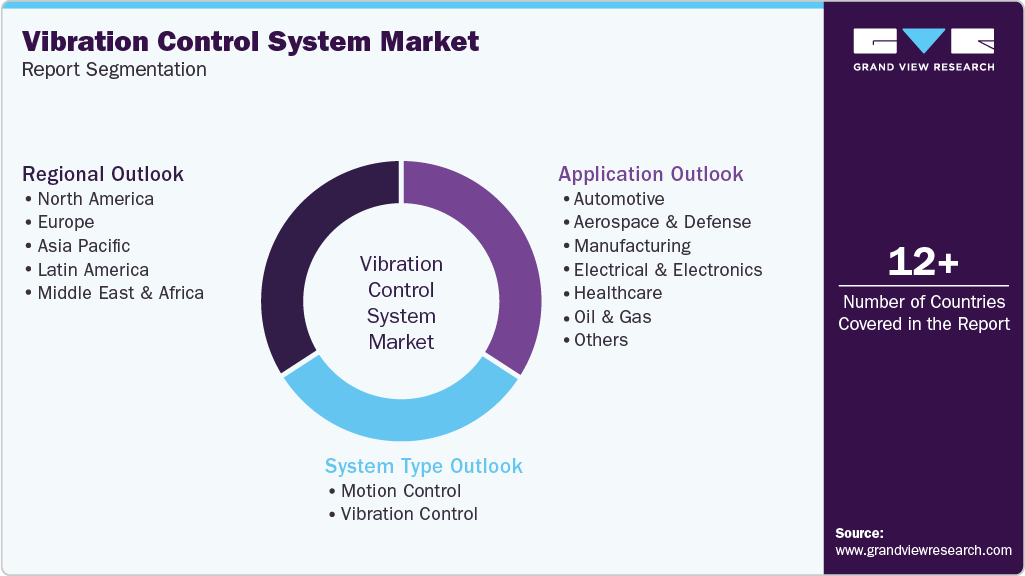
This report forecasts revenue growth at global, regional, and country levels and provides an analysis of the latest industry trends in each of the sub-segments from 2021 to 2033. For this study, Grand View Research has segmented the global vibration control system market report based on system type, application, and region.
 To learn more about this report, Download Free Sample Report
 -
System Type Outlook (Revenue, USD Billion, 2021 - 2033)
-
Motion Control
-
Springs
-
Hangers
-
Washers & Bushes
-
Mounts
-
-
Vibration Control
-
Isolating Pads
-
Isolators
-
Others
-
-
-
Application Outlook (Revenue, USD Billion, 2021 - 2033)
-
Automotive
-
Aerospace & Defense
-
Manufacturing
-
Electrical & Electronics
-
Healthcare
-
Oil & Gas
-
Others
-
-
Regional Outlook (Revenue, USD Billion, 2021 - 2033)
-
North America
-
U.S.
-
Canada
-
-
Europe
-
U.K.
-
Germany
-
France
-
Russia
-
-
Asia Pacific
-
China
-
Japan
-
India
-
South Korea
-
Australia
-
-
Latin America
-
Brazil
-
Mexico
-
-
Middle East and Africa (MEA)
-
Saudi Arabia
-
UAE
-
South Africa
-
-
Research Methodology
The vibration control system market figures in this report are based on a proven research process that combines executive interviews with secondary research from proprietary databases, company filings, and recognized regulatory and institutional sources. Market size is built through value-chain sizing - reconciling supply-side and demand-side estimates - and triangulated with bottom-up and top-down approaches. Every estimate passes multiple levels of expert validation before publication, with each vibration control system segment quantified using the revenue-capture definitions in the table below.
Segment Definition
Segment - System Type
Revenue capture definition
Motion Control
Revenue is generated through motion control systems designed to regulate, stabilize, and optimize the movement of machinery, equipment, and structures by minimizing unwanted motion disturbances. This segment is driven by increasing adoption of automation technologies, equipment performance optimization initiatives, and growing demand for operational accuracy across complex mechanical systems.
Vibration Control
Revenue is captured through vibration control systems that isolate, dampen, or suppress unwanted vibrations in machinery, equipment, vehicles, and structures to enhance reliability and performance. This segment is propelled by increasing focus on asset protection, predictive maintenance strategies, structural stability requirements, and the need to reduce downtime associated with vibration-induced failures.
Segment - Application
Revenue capture definition
Automotive
Revenue is generated through vibration control systems deployed in vehicles to improve ride comfort, reduce noise and vibration levels, protect critical components, and enhance overall vehicle performance. This segment is driven by increasing vehicle production, growing demand for passenger comfort, and advancements in electric and autonomous vehicle technologies.
Aerospace & Defense
Revenue is captured through vibration control solutions utilized in aircraft, military vehicles, defense equipment, and aerospace structures to maintain operational stability and protect sensitive systems. This segment is driven by stringent performance requirements and the need for enhanced equipment durability under demanding operating conditions.
Manufacturing
Revenue is generated through vibration control systems integrated into industrial machinery, production equipment, and automated manufacturing facilities to improve operational efficiency and reduce mechanical wear. This segment is fueled by increasing adoption of automation, implementation of predictive maintenance, and the growing need to maximize equipment uptime.
Electrical & Electronics
Revenue is generated through vibration control solutions that protect sensitive electronic equipment, semiconductor manufacturing systems, test instruments, and precision devices from vibration-induced disturbances. This segment is driven by increasing demand for high-precision production environments, equipment accuracy, and reliable performance of advanced electronic systems.
Healthcare
Revenue is generated through vibration control systems incorporated into medical imaging equipment, laboratory instruments, diagnostic devices, and healthcare infrastructure to ensure precision and operational stability. This segment is driven by the rising deployment of medical technologies, increasing investments in healthcare infrastructure, and the need for accurate diagnostic performance.
Oil & Gas
Revenue is captured through vibration control solutions deployed in drilling systems, compressors, pumps, turbines, pipelines, and processing facilities to enhance equipment reliability and operational safety. This segment is driven by growing emphasis on asset integrity management, maintenance cost reduction, and uninterrupted operation of critical energy infrastructure.
Others
Revenue is generated through vibration control systems utilized across construction, transportation, power generation, marine, renewable energy, commercial infrastructure, and research applications. This segment is driven by increasing demand for structural protection, operational stability, equipment longevity, and enhanced performance across a broad range of specialized environments.
Estimation Model
Layer Name
Key Question
Description
Vibration Management Demand Layer
Who are the potential adopters?
Identifies the total addressable customer base requiring vibration mitigation solutions, including operators of industrial machinery, infrastructure assets, transportation systems, energy facilities, commercial buildings, healthcare installations, and organizations seeking improved equipment reliability, structural stability, operational safety, and asset longevity.
Infrastructure Compatibility Layer
Who can deploy vibration control systems?
Adoption is determined by factors such as equipment criticality, vibration severity levels, infrastructure modernization investments, availability of monitoring technologies, maintenance budgets, engineering capabilities, regulatory compliance requirements, and the ability to integrate vibration control solutions into existing operational environments.
System Deployment Layer
Where are vibration control systems actively utilized?
Applies adoption levels across environments where vibration control technologies are deployed, including manufacturing facilities, transportation infrastructure, aerospace platforms, semiconductor production facilities, commercial structures, industrial processing plants, and other vibration-sensitive operating environments.
Revenue Generation Layer
How is revenue generated?
Revenue is generated through sales of vibration isolation systems, active vibration control solutions, damping technologies, vibration monitoring equipment, condition monitoring platforms, engineering design services, installation and integration services, system upgrades, and recurring service agreements associated with asset performance optimization and vibration management programs.
Delivered Customizations
This report has been delivered with the following In-depth customizations
Client Request
Customization Delivered
Value Adds
Vibration Control System Deployment Assessment & Infrastructure Reliability Evaluation
Conducted detailed evaluation of vibration control systems across industrial machinery, transportation equipment, healthcare equipment, and precision manufacturing environments, integrating vibration isolation technologies and condition monitoring platforms to optimize operational stability and equipment performance.
Enables enhanced equipment reliability, reduces vibration-induced failures, improves operational efficiency, and extends asset service life across critical applications.
Integrated Vibration Monitoring Ecosystem Optimization Strategy
Assessed deployment of vibration control solutions across manufacturing facilities, transportation infrastructure, power generation assets, healthcare installations, and commercial buildings, integrating smart sensors, monitoring platforms, asset management systems, automation technologies, and real-time diagnostics capabilities.
Enhances maintenance effectiveness, improves system visibility, and enables proactive vibration management across diverse operating environments.
AI-Enabled Condition Monitoring & Vibration Mitigation Planning
Evaluated implementation of advanced vibration monitoring platforms, AI-powered diagnostics systems, predictive maintenance technologies, digital twin frameworks, adaptive vibration control solutions, and centralized asset performance management systems to optimize equipment health monitoring and vibration mitigation effectiveness.
Enables data-driven maintenance decisions, reduces unplanned downtime, increases monitoring accuracy, and supports intelligent asset management strategies.
Frequently Asked Questions About This Report
The global vibration control system market size was valued at USD 5.8 billion in 2025 and is estimated at USD 6.2 billion for 2026.
The global vibration control system market is expected to grow at a CAGR of 7.1% from 2026 to 2033, reaching USD 9.9 billion by 2033.
Some key players operating in the vibration control system market include ContiTech AG; Lord Corporation; Resistoflex (P) Ltd.; HUTCHINSON; Fabreeka; Sentek Dynamics Inc.; VICODA GmbH; Isolation Technology Inc.; Trelleborg AB; and Kinetics Noise Control, Inc.
Key factors that are driving the vibration control system market growth include growing emphasis on the mechanical stability and balancing of industrial machinery and automobiles, growing automotive as well as the aviation industry, rising demand for self-controlling smart & adaptive VCS, along with technological developments, such as web-based continuous machine condition monitoring and Active Noise and Vibration Control (ANVC) systems in aircraft.
The manufacturing segment led with a 25.5% revenue share in 2025.
The U.S. dominated the gaming market with a share of 81.8% in 2025.
North America dominated the computer-aided dispatch market with a share of 35.1% in 2025.
About the Author(s)
Sensors & Controls Research Team
Semiconductors & Electronics · Sensors & ControlsThis report was authored by the sensors & controls research team at Grand View Research - comprising two research analysts, one senior research analyst, and one industry expert - with specialized expertise in the sensors & controls segment of the semiconductors & electronics industry. All findings are based on proprietary semiconductors & electronics databases, executive interviews, and regulatory analysis, subject to internal peer review prior to publication.
Last Updated:
Speak to Analyst

Customize this report to your needs - add regions, segments, or data points, with 20% free customization.
Or view our licence options:


ISO 9001:2015 & 27001:2022 Certified
We are GDPR and CCPA compliant! Your transaction & personal information is safe and secure. For more details, please read our privacy policy.


