
- Home
- »
- Next Generation Technologies
- »
-
Virtual Reality Glove Market Size & Share Report, 2026-2033GVR Report cover
![Virtual Reality Glove Market (2026 - 2033)Report]()
Virtual Reality Glove Market (2026 - 2033)
Size, Share & Trends Analysis Report By Product (Hepatic Glove, Gaming Glove), By Technology (Wired, Wireless), By Application (Gaming, Healthcare, Education & Training, Industrial), By Region, And Segment Forecasts
Market Size, 2025
$1.9BMarket Estimate, 2026
$2.2BMarket Forecast, 2033
$6.7BCAGR, 2026–2033
17.5%Virtual Reality Glove Market Summary
The global virtual reality glove market size was valued at USD 1.9 billion in 2025 and is projected to grow from USD 2.2 billion in 2026 to USD 6.7 billion by 2033, at a CAGR of 17.5% from 2026 to 2033. North America dominated the global market with the largest revenue share of 40.6% in 2025. The market growth is driven by increasing adoption of immersive virtual reality, rising demand for natural hand-based interaction within virtual environments, and growing need for realistic tactile and force feedback.

Key Market Trends & Insights
- By technology: Wireless segment held the largest market share of 51.0% in 2025.
- By product: Haptic gloves segment held the largest market share of 42.8% in 2025.
- By application: Gaming segment held the largest market share of 39.0% in 2025.
Regional Highlights
- Largest regional market: North America (40.6% revenue share, 2025)
- Fastest-growing regional market: Asia Pacific (highest CAGR, 2026-2033)
- By country: The U.S. held the largest market share in 2025
Market Size & Forecast
- Market size in 2025: USD 1.9 Billion
- Estimated market size in 2026: USD 2.2 Billion
- Projected market size by 2033: USD 6.7 Billion
- CAGR (2026-2033): 17.5%
Virtual reality (VR) gloves enable users to track finger and hand movements while simulating touch, pressure, resistance, and object manipulation, improving immersion and interaction accuracy. The market growth is driven by the expanding use of spatial computing and mixed reality platforms, increasing deployment of digital twins for product design and operational visualization, and rising demand for remote collaboration and teleoperation capabilities across geographically distributed work environments. The integration of VR gloves with robotic systems, virtual prototyping platforms, defense mission simulations, and collaborative 3D environments is enabling users to manipulate digital assets and remotely operated systems. The transition toward multisensory extended reality experiences are encouraging enterprises, research institutions, and technology developers to adopt wearable interfaces that combine hand movement, touch, and physical feedback within shared virtual environments.
The increasing deployment of virtual reality across education, vocational training, and academic research is accelerating demand for advanced wearable interfaces such as VR gloves. Educational institutions and training organizations are increasingly adopting immersive learning environments to provide students with interactive demonstrations, practical exercises, and simulated laboratory experiences without requiring extensive physical infrastructure. The growing use of VR-based programs for engineering education, technical skills development, aviation training, and scientific visualization is encouraging institutions to incorporate hand-tracking and tactile interfaces that enable users to interact more naturally with virtual tools, components, and learning objects.
In addition, the expansion of virtual product development, 3D design, and immersive visualization is creating new demand for VR gloves across architecture, engineering, automotive, aerospace, and creative industries. Designers and engineers are increasingly using immersive environments to examine three-dimensional models, evaluate product concepts, and conduct design reviews before physical prototypes are developed. VR gloves enable users to select, reposition, and inspect virtual components using hand movements, thereby accelerating design iteration and reducing reliance on conventional input devices.
Moreover, the growing emphasis on workplace safety, operational efficiency, and cost reduction is encouraging organizations to shift selected activities from physical environments to immersive virtual platforms. Enterprises are increasingly using virtual environments to conduct equipment familiarization, emergency-response exercises, and scenario-based assessments without exposing physical assets. The ability to reduce material consumption, minimize equipment downtime, and support repeatable training experiences is encouraging broader adoption of wearable VR interfaces across enterprise applications.
Market Dynamics
The market is experiencing significant growth, driven by the increasing integration of immersive technologies into enterprise workflows, rising demand for interoperable wearable interfaces, and expanding adoption of three-dimensional digital environments for collaborative work. Organizations are increasingly exploring VR-based solutions for remote design reviews, virtual meetings, technical visualization, and interactive workforce development, creating demand for intuitive hand-operated interfaces. The development of standardized immersive technology ecosystems and greater compatibility between VR hardware, software platforms, and digital environments is further supporting the broader deployment of virtual reality gloves across commercial and institutional settings.
The increasing demand for intuitive human-computer interaction is accelerating the adoption of virtual reality gloves across immersive environments. Users increasingly seek direct, hand-based control rather than relying solely on conventional handheld controllers, creating demand for wearable interfaces that translate finger movements into digital actions. Improvements in lightweight glove architectures, wireless operation, and tactile feedback are making these devices more practical for extended use while improving interaction precision, responsiveness, and overall immersion.
The emergence of lightweight, untethered designs is enhancing the appeal of VR gloves for users seeking greater freedom of movement. Recent developments demonstrate reductions in device weight, power consumption, and physical constraints while maintaining responsive tactile feedback. These improvements address longstanding usability concerns associated with bulky or tethered systems, support broader acceptance of wearable interaction technologies, and encourage manufacturers to focus on more comfortable, portable, and user-oriented glove designs.
High acquisition costs remain a significant restraint for the market, particularly for advanced systems incorporating force feedback, precision tracking, multiple actuators, specialized sensors, and wireless components. Compared with conventional VR controllers, sophisticated gloves require more complex hardware architectures and calibration, increasing manufacturing and deployment expenses. The resulting price differential can discourage cost-sensitive users from adopting VR gloves, particularly when the perceived benefits do not clearly justify the purchase of an additional wearable interface.
The cost pressures are compounded by challenges associated with maintaining performance, durability, comfort, and tactile accuracy within a compact wearable form factor. Advanced gloves may require specialized components and sophisticated actuation mechanisms, increasing development and maintenance requirements. Bulky construction, limited operating duration, and calibration needs can further reduce perceived value, particularly when users compare these devices with established controllers that offer simpler operation and substantially lower acquisition costs.
The increasing focus on inclusive digital interaction presents an important opportunity for virtual reality glove manufacturers to develop adaptable interfaces for users with diverse physical capabilities. Hand-based wearable systems can provide alternative interaction methods where conventional interfaces may create accessibility barriers. Lightweight designs, customizable fitting, adjustable feedback intensity, and multimodal interaction could enable manufacturers to address broader user requirements while supporting more inclusive virtual experiences.
Advances in compact actuators, wireless architectures, and low-power components are creating opportunities to develop more affordable and portable glove systems. Recent research demonstrates lightweight, untethered designs capable of delivering tactile cues with very low power consumption, indicating scope to improve portability without sacrificing responsiveness. Greater affordability, simplified setup, and improved comfort could help transition VR gloves from specialized equipment toward more accessible wearable interfaces for a broader range of users.
Market Concentration & Characteristics
The virtual reality glove industry is fragmented, comprising specialized haptic technology providers, motion-capture companies, wearable interface developers, robotics technology firms, and emerging VR hardware manufacturers competing across consumer, commercial, research, and professional applications. The market is supported by increasing adoption of immersive technologies, expanding demand for intuitive human-machine interfaces, and rising deployment of VR-based simulation and training solutions. Strategic collaborations with VR platform developers, investments in proprietary haptic technologies, and partnerships with application providers are enabling companies to strengthen technology capabilities and expand their market reach.
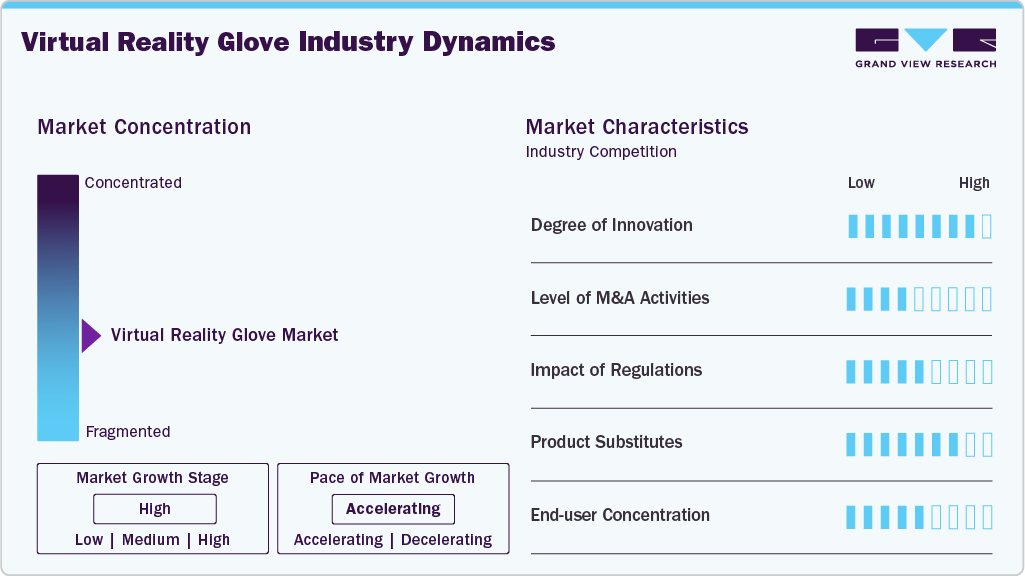
The market is characterized by a high degree of innovation, supported by continuous advancements in force-feedback mechanisms, tactile actuators, finger-tracking systems, wireless architectures, lightweight glove designs, and multimodal feedback technologies. The market is witnessing low-to-moderate merger and acquisition activity, as specialized technology companies remain focused on internal product development, strategic partnerships, licensing arrangements, and technology commercialization. Competition from conventional VR controllers, optical hand-tracking systems, motion-capture devices, and other wearable interfaces remains high, while increasing investments in advanced haptics, ergonomic designs, interoperability, and application-specific solutions continue to strengthen product differentiation and competitive positioning.
Analyst Perspective
The virtual reality glove market is gaining momentum, driven by increasing adoption of immersive technologies, rising demand for intuitive hand-based interaction, and expanding use of haptic interfaces across gaming, simulation, training, robotics, education, and research applications. Manufacturers are introducing advanced force feedback, precise finger tracking, lightweight ergonomic designs, wireless connectivity, and customizable tactile feedback. Growing demand for realistic virtual interaction and more natural human-machine interfaces is encouraging product innovation. These developments are helping companies improve immersion, expand application coverage, differentiate technologies, and strengthen adoption across consumer, professional, institutional, and specialized applications.
Product Insights
The haptic gloves segment accounted for the largest market share of 42.8% in 2025, propelled by increasing demand for realistic tactile interaction, growing adoption of immersive gaming, expanding use of VR simulation, and rising preference for enhanced hand-based interaction in virtual environments. Users are increasingly adopting haptic gloves that provide touch sensations, vibration feedback, pressure simulation, and force feedback to improve interaction with digital objects. Advancements in tactile actuators, sensor integration, hand tracking, and ergonomic glove designs continue to strengthen demand across gaming, training, simulation, and professional applications.
The gaming gloves segment is expected to witness the highest CAGR of over 18.0% from 2026 to 2033. The segment is driven by the expanding VR gaming ecosystem, the increasing availability of immersive game content, and the growing demand for interactive gameplay. Gaming gloves enable gesture recognition, finger tracking, tactile feedback, and natural object manipulation, allowing players to interact more intuitively within virtual environments. Increasing investments in VR game development, multiplayer immersive experiences, improved hardware compatibility, and declining technology costs are expected to accelerate the adoption of gaming-focused virtual reality gloves.
Application Insights
The gaming segment accounted for the largest market share, at 39.0% in 2025, driven by the growing adoption of immersive gaming, rising demand for realistic tactile feedback, the increasing popularity of VR gaming platforms, and growing consumer interest in interactive gameplay. Gamers are increasingly adopting virtual reality gloves to enable hand tracking, gesture recognition, force feedback, and haptic sensations, thereby enhancing interaction with virtual environments. Increasing investments in immersive game development, expanding VR content libraries, and improved compatibility with head-mounted displays continue to strengthen adoption across gaming applications.
The healthcare segment is expected to witness the highest CAGR from 2026 to 2033, driven by increasing adoption of immersive medical training, rehabilitation applications, surgical simulation, and remote patient interaction technologies. Healthcare institutions are increasingly deploying virtual reality gloves to provide tactile feedback during clinical simulations, support motor rehabilitation, improve hand-movement assessment, and enable more realistic training environments for medical professionals. Advancements in precision haptics, sensor miniaturization, motion tracking, and therapeutic VR applications are further accelerating adoption across hospitals, rehabilitation centers, medical universities, and specialized healthcare facilities.
Technology Insights
The wireless segment accounted for the largest market share of 51.0% in 2025, fueled by increasing demand for unrestricted movement, improved compatibility with standalone VR headsets, growing preference for cable-free immersive experiences, and advancements in low-latency wireless connectivity. Wireless virtual reality gloves enable users to perform natural hand movements without cable limitations, making them suitable for gaming, training, simulation, and interactive applications. Improvements in battery efficiency, Bluetooth and other wireless communication technologies, compact sensor integration, and ergonomic designs continue to strengthen the adoption of wireless gloves.

The wired segment is expected to witness a significant CAGR from 2026 to 2033, driven by demand for high-precision haptic feedback, reliable data transmission, low-latency motion tracking, and extended operating sessions in professional applications. Wired gloves can provide stable connections for applications requiring continuous, high-bandwidth sensor data, including industrial simulation, medical training, research, and advanced motion capture. Increasing requirements for precise hand tracking, force-feedback responsiveness, and consistent performance in controlled environments are supporting continued adoption of virtual reality gloves.
Regional Insights
North America virtual reality glove market held the largest share of 40.6% in 2025, driven by strong adoption of immersive technologies across enterprise simulation, research, design visualization, and advanced training environments. The region benefits from a mature VR ecosystem, substantial investments in extended reality development, and specialized haptic technology providers. The increasing deployment of immersive solutions for remote collaboration, virtual prototyping, robotic interaction, and workforce development is prompting organizations to evaluate glove-based interfaces for more intuitive three-dimensional interaction.

U.S. Virtual Reality Glove Market Trends
The virtual reality glove market in the U.S. dominated with a share of 78.8% in 2025, driven by extensive investment in immersive technology research, strong venture funding for haptic startups, and early adoption of advanced wearable interfaces by technology developers and large enterprises. Universities, research laboratories, and technology companies are actively developing applications involving tactile interaction, human-robot collaboration, and virtual prototyping. The country's strong ecosystem of VR hardware developers, software companies, and research institutions is facilitating the commercialization of specialized glove technologies across diverse professional applications.
Europe Virtual Reality Glove Market Trends
The virtual reality glove market in Europe is expected to grow at a significant CAGR of 16.4% from 2026 to 2033. The market growth is driven by the increasing adoption of immersive technologies for engineering visualization, vocational education, product development, and workplace simulation. Strong emphasis on digital transformation, human-centric technology development, and data protection is influencing the design of wearable VR interfaces across the region. European technology developers are increasingly focusing on ergonomic glove architectures, energy-efficient components, and user safety, supporting broader integration of virtual reality gloves into professional environments.
The UK virtual reality glove market is gaining traction through expanding adoption of immersive learning, creative visualization, virtual collaboration, and simulation-based professional development. Organizations, technology developers, and creative studios are increasingly exploring glove-based interaction for three-dimensional environments and digital content creation. Government-backed digital innovation programs and the country's established technology ecosystem are supporting experimentation with extended reality applications, while demand for more natural interaction methods is encouraging development of lightweight and adaptable VR glove solutions.
The virtual reality glove market in Germany is supported by strong engineering capabilities, the increasing use of virtual prototyping, and the expanding adoption of immersive technologies in advanced manufacturing environments. Automotive, machinery, engineering, and research organizations are increasingly evaluating VR interfaces for design validation, equipment visualization, and human-machine interaction. Germany's emphasis on precision engineering and industrial digitalization is encouraging the development of highly accurate motion tracking, while collaboration among technology companies, research institutes, and manufacturers is strengthening the regional ecosystem.
Asia Pacific Virtual Reality Glove Market Trends
The virtual reality glove market in the Asia Pacific is expected to grow at the highest CAGR of 21.1% from 2026 to 2033, driven by the rapid development of VR hardware ecosystems, investments in immersive technology research, and expanding adoption of simulation-based solutions. China, Japan, South Korea, and other technology-oriented economies are strengthening their capabilities in wearable electronics, robotics, gaming technology, and advanced manufacturing. Growing investment in domestic VR development, expanding technology incubators, and increasing integration of immersive interfaces into education, design, and robotics applications are supporting regional demand for VR gloves.
Japan virtual reality glove market is supported by the country's advanced robotics ecosystem, strong research capabilities in human-machine interaction, and increasing integration of immersive technologies into specialized applications. Robotics developers and research institutions are exploring wearable interfaces for remote manipulation, robot control, rehabilitation research, and virtual simulation. Japan's focus on precision technology, compact electronics, and human-centric robotics is encouraging the development of lightweight VR gloves with accurate finger tracking and responsive tactile feedback, strengthening demand for specialized wearable interaction solutions.
The virtual reality glove market in China is expanding rapidly, driven by increasing domestic development of VR hardware, government support for immersive technology ecosystems, and rapid expansion of the country's robotics capabilities. Technology companies are increasingly investing in haptic interfaces, motion capture, virtual simulation, and immersive content platforms. Expanding domestic manufacturing capabilities are also enabling companies to improve component availability and production scalability, while the development of VR applications across education, entertainment, product design, and robotics is broadening demand for glove-based interfaces.
Key Virtual Reality Glove Company Insights
Some of the key players operating in the market are HaptX Inc. and Meta Platforms, Inc., among others.
-
HaptX Inc. is a leading player in the virtual reality glove industry, specializing in advanced haptic gloves that provide tactile sensations and force feedback for immersive virtual interaction. The company focuses on highly realistic touch simulation, precision hand tracking, and integration of haptic technologies into professional simulation and training environments. Its emphasis on realistic physical feedback, sophisticated glove architecture, and high-fidelity virtual interaction strengthens its position in the premium market segment.
-
Meta Platforms, Inc. is a major technology player in the market through its Reality Labs research and development activities, particularly in advanced haptic interaction and wearable interfaces. The company has explored soft robotic actuators, tactile feedback, hand tracking, and haptic rendering to create more natural interaction within virtual environments. Its extensive VR ecosystem, hardware capabilities, software platforms, and research resources position it as an influential technology developer in the virtual reality glove industry.
CyberGlove Systems Inc. and Ultraleap are some of the emerging market participants.
-
CyberGlove Systems Inc. is an emerging player in the market, specializing in data gloves and wearable hand-motion capture systems that translate detailed finger and hand movements into digital environments. The company's technology is suited to applications requiring precise hand measurement, virtual interaction, simulation, and ergonomic analysis. Its long-standing expertise in instrumented gloves and emphasis on accurate motion capture provide a specialized foundation for serving professional and research-oriented virtual reality applications.
-
Ultraleap is an emerging player in the virtual reality glove industry, offering advanced hand-tracking and mid-air haptic technologies that provide alternatives to conventional wearable interfaces. The company's hand-tracking systems use infrared cameras and software to capture detailed finger and hand movements, while its mid-air haptics use focused ultrasound to create tactile sensations directly on the hands. Its combination of touchless interaction, precision tracking, and haptic feedback positions the company strongly within next-generation virtual interaction technologies.
Key Virtual Reality Glove Companies
The following key companies have been profiled for this study on the virtual reality glove market.
-
HaptX Inc.
-
SenseGlove
-
MANUS Technology Group
-
Noitom Ltd.
-
Sony Group Corporation
-
Meta Platforms, Inc.
-
bHaptics Inc.
-
CyberGlove Systems Inc.
-
Dexta Robotics
-
Ultraleap
Competitive Benchmarking
Category
Operating Strategies
Competitive Edge
Weakness
Established Players (HaptX Inc., SenseGlove, Meta Platforms, Inc.)
- Focus on expanding haptic glove portfolios through advanced tracking, tactile feedback, and force-feedback technologies.
- Invest heavily in R&D, strategic partnerships, and software integration to strengthen immersive interaction capabilities.
- Established technology expertise, strong customer relationships, and proven haptic capabilities support market leadership.
- Broad application portfolios enable customized VR glove solutions across simulation, training, design, robotics, and research.
- High development costs for sophisticated haptic systems can constrain pricing flexibility and broader adoption.
- Complex hardware architectures and calibration requirements may limit usability compared with simpler VR interaction technologies.
Emerging Players (bHaptics Inc., Ultraleap, CyberGlove Systems Inc.)
- Emerging players are focusing on developing specialized haptic gloves with lightweight designs, precise tracking, and responsive tactile feedback.
- Invest in strategic partnerships, application development, and technology integration to drive adoption of immersive gloves.
- Agile product development enables rapid adaptation to emerging haptic technologies and evolving user requirements.
- Specialized expertise in force feedback and wearable interaction supports differentiated solutions for niche applications.
- Limited financial resources and smaller customer bases can restrict large-scale product development and commercialization.
- Lower brand recognition and limited distribution networks can constrain access to established enterprise customers.
Recent Developments
-
In June 2026, bHaptics Inc. introduced the updated TactGlove DK3 at AWE 2026, featuring an upgraded eight-motor configuration, additional palm motors, and a larger wrist vibration motor. The improvements are designed to deliver stronger and more precise tactile sensations across the hand and wrist. The launch demonstrates bHaptics' continued focus on improving wearable haptic feedback and strengthening its position in consumer-oriented immersive interaction solutions.
-
In April 2026, MANUS Technology Group demonstrated its MetaGlove in real-time wireless teleoperation of a bionic hand, enabling precise finger-level motion capture and low-latency transmission to mirror the operator’s hand movements. The demonstration highlights the integration of high-precision wearable tracking with robotic manipulation, supporting applications in remote control, robotics, prosthetics, and immersive interaction. The development strengthens MANUS’s positioning in advanced hand-tracking gloves and demonstrates the expanding role of the virtual reality glove industry.
-
In December 2025, SenseGlove introduced the R1 exoskeleton glove, designed to provide force-aware precision for dexterous robotic systems. The product, previously developed under the codename Project Rembrandt, expands SenseGlove's technology beyond conventional VR interaction toward robotic control and imitation learning. The development strengthens the company's focus on combining precise hand tracking with force feedback for advanced virtual and physical interaction applications.
Virtual Reality Glove Market Report Scope
Report Attribute
Details
Market size in 2025
USD 1.9 billion
Estimated market size in 2026
USD 2.2 billion
Projected market size by 2033
USD 6.7 billion
Growth rate
CAGR of 17.5% from 2026 to 2033
Historical data
2021 - 2025
Forecast period
2026 - 2033
Quantitative units
Revenue in USD billion and CAGR from 2026 to 2033
Report Product
Revenue forecast, company ranking, competitive landscape, growth factors, and trends
Segments covered
Product, technology, application, region
Region scope
North America; Europe; Asia Pacific; Latin America; MEA
Country scope
U.S.; Canada; Mexico; UK; Germany; France; China; Japan; India; South Korea; Australia; Brazil; Saudi Arabia; UAE; South Africa
Key companies profiled
HaptX Inc.; SenseGlove; MANUS Technology Group; Noitom Ltd.; Sony Group Corporation; Meta Platforms, Inc.; bHaptics Inc.; CyberGlove Systems Inc.; Dexta Robotics; Ultraleap
Customization scope
Free report customization (equivalent to up to 8 analyst’s working days) with purchase. Addition or alteration to country, regional & segment scope.
Pricing and purchase options
Avail customized purchase options to meet your exact research needs. Explore purchase options
Global Virtual Reality Glove Market Report Segmentation
This report forecasts revenue growth at global, regional, and country levels and provides an analysis of the latest technological trends in each of the sub-segments from 2021 to 2033. For this study, Grand View Research has segmented the global virtual reality glove market report based on product, technology, application, and region:

-
Product Outlook (Revenue, USD Billion, 2021 - 2033)
-
Haptic Gloves
-
Motion Capture Gloves
-
Gaming Gloves
-
Other
-
-
Technology Outlook (Revenue, USD Billion, 2021 - 2033)
-
Wired
-
Wireless
-
-
Application Outlook (Revenue, USD Billion, 2021 - 2033)
-
Gaming
-
Healthcare
-
Education & Training
-
Industrial
-
Other
-
-
Regional Outlook (Revenue, USD Billion, 2021 - 2033)
-
North America
-
U.S.
-
Canada
-
Mexico
-
-
Europe
-
UK
-
Germany
-
France
-
-
Asia Pacific
-
China
-
Japan
-
India
-
South Korea
-
Australia
-
-
Latin America
-
Brazil
-
-
Middle East and Africa (MEA)
-
Saudi Arabia
-
UAE
-
South Africa
-
-
Research Methodology
The virtual reality glove market figures in this report are based on a proven research process that combines executive interviews with secondary research from proprietary databases, company filings, and recognized regulatory and institutional sources. Market size is built through value-chain sizing-reconciling supply-side and demand-side estimates-and triangulated with bottom-up and top-down approaches. Every estimate passes multiple levels of expert validation before publication, with each virtual reality glove segment quantified using the revenue-capture definitions in the table below.
Segment Definition
Product
Revenue capture definition
Haptic Gloves
Revenue is generated from gloves designed to provide tactile, vibration, pressure, or force feedback during virtual interactions. This segment includes wearable systems that allow users to feel virtual objects, surface characteristics, resistance, contact, and other physical sensations while interacting within immersive environments.
Motion Capture Gloves
Revenue is generated from gloves designed to capture and translate hand, finger, and wrist movements into digital environments. These products use sensors or tracking technologies to record precise hand movements for virtual interaction, animation, simulation, motion analysis, and immersive content development.
Gaming Gloves
Revenue is generated from gloves specifically designed to enhance interactive gaming experiences through hand tracking, gesture recognition, vibration, tactile feedback, or force feedback. These products enable players to interact with virtual objects and game environments using natural hand movements and immersive sensory responses.
Other
Revenue is generated from specialized virtual reality gloves that do not fall under haptic, motion capture, or gaming categories. This segment includes gloves developed for professional simulation, research, robotics interaction, virtual prototyping, rehabilitation, specialized training, and other emerging immersive applications.
Technology
Revenue capture definition
Wired
Revenue is generated from virtual reality gloves connected to computers, VR systems, or other devices through physical cables. Wired gloves provide continuous power and stable data transmission, making them suitable for applications requiring reliable connectivity, high-precision tracking, consistent latency, and extended operational sessions.
Wireless
Revenue is generated from virtual reality gloves that communicate with VR systems, computers, or other devices through wireless technologies. Wireless gloves provide greater freedom of movement and reduced cable constraints, supporting immersive applications where portability, flexibility, mobility, and user comfort are important.
Application
Revenue capture definition
Gaming
Revenue is generated from virtual reality gloves used to enhance interactive gaming experiences through hand tracking, gesture recognition, tactile feedback, and force feedback. These gloves enable players to manipulate virtual objects, perform hand-based actions, and interact with immersive game environments more naturally.
Healthcare
Revenue is generated from virtual reality gloves used for clinical simulation, rehabilitation, therapy, medical education, motor-skill assessment, and other healthcare-related applications. These gloves provide hand tracking and tactile interaction capabilities that support simulated procedures, movement exercises, therapeutic activities, and skill development.
Education & Training
Revenue is generated from virtual reality gloves used for immersive learning, technical instruction, professional training, simulation exercises, and practical skills development. These solutions allow users to manipulate virtual tools, equipment, and objects, providing interactive training experiences without requiring physical training environments or equipment.
Industrial
Revenue is generated from virtual reality gloves used for equipment simulation, virtual prototyping, assembly training, maintenance procedures, robotics control, design visualization, and operational simulations. These gloves enable precise hand interaction with virtual components and systems, supporting realistic task practice and digital workflow development.
Other
Revenue is generated from virtual reality gloves used across research, entertainment, virtual collaboration, motion analysis, robotics experimentation, architecture, design, and specialized simulation applications. These solutions support applications requiring accurate hand tracking, gesture control, tactile feedback, or immersive interaction beyond the primary application categories.
Estimation Model
Layer Name
Key Question
Description
End-User Adoption Layer
Who are the potential adopters?
Identifies gamers, VR enthusiasts, training organizations, educational institutions, research centers, healthcare facilities, robotics developers, simulation providers, designers, and enterprises seeking immersive hand-tracking and haptic interaction solutions.
Product Enablement Layer
Who can provide virtual reality gloves?
Deployment depends on VR glove manufacturers, haptic technology providers, motion-capture companies, wearable technology developers, VR hardware companies, robotics technology providers, software developers, distributors, and specialized immersive technology suppliers supporting advanced hand interaction.
Application Deployment Layer
Where are virtual reality gloves currently used?
Virtual reality gloves are used across gaming, simulation, training, virtual prototyping, robotics control, research, education, healthcare applications, virtual collaboration, motion capture, and other immersive environments requiring precise hand tracking or tactile feedback.
Revenue Generation Layer
How is revenue generated?
Revenue is generated through VR glove sales, premium haptic systems, motion-capture solutions, force-feedback devices, software and SDK licensing, accessories, replacement components, maintenance services, customization, enterprise deployments, and technology integration services.
Delivered Customizations
This report has been delivered with the following In-depth customizations
Client Request
Customization Delivered
Value Adds
Haptic Glove Technology Assessment & Product Benchmarking
Conducted detailed evaluation of haptic glove technologies across force feedback, tactile feedback, motion capture, and finger-tracking solutions, assessing actuator systems, tracking accuracy, ergonomics, software compatibility, and application-specific performance requirements.
Improves technology selection, enhances product differentiation, supports investment decisions, and strengthens competitive positioning.
Enterprise VR Deployment & Integration Strategy
Assessed deployment of virtual reality gloves across simulation, training, robotics, design, and collaborative environments, integrating software platforms, hand-tracking systems, haptic technologies, and interoperability frameworks to improve immersive interaction capabilities.
Enhances operational efficiency, improves user experience, supports integration planning, and enables scalable immersive deployments.
Robotics Teleoperation & Human-Machine Interaction Analysis
Evaluated implementation of VR gloves for robotic control, remote manipulation, and dexterous interaction, analyzing force feedback, motion capture, latency performance, and wearable interface technologies to improve precision and responsiveness.
Enables advanced teleoperation, improves control accuracy, supports innovation initiatives, and strengthens technology adoption strategies.
Frequently Asked Questions About This Report
The global virtual reality glove market size was valued at USD 1.9 billion in 2025 and is estimated at USD 2.2 billion for 2026.
The haptic gloves segment accounted for the largest share, with 42.8% of revenue in 2025.
The wireless segment dominated the market with a share of 51.0% in 2025.
The gaming segment accounted for the largest share, with 39.0% of revenue in 2025.
The global virtual reality glove market is expected to grow at a CAGR of 17.5% from 2026 to 2033, reaching USD 6.7 billion by 2033.
North America dominated the virtual reality glove market with a share of 40.6% in 2025.
Key factors that are driving the market growth include increasing adoption of immersive virtual reality, rising demand for natural hand-based interaction within virtual environments, and growing need for realistic tactile and force feedback. Virtual reality gloves enable users to track finger and hand movements while simulating touch, pressure, resistance, and object manipulation, improving immersion and interaction accuracy.
Some key players operating in the virtual reality glove market include HaptX Inc., SenseGlove, MANUS Technology Group, Noitom Ltd., Sony Group Corporation, Meta Platforms, Inc., bHaptics Inc., CyberGlove Systems Inc., Dexta Robotics, Ultraleap
The Asia Pacific is the fastest-growing region with a CAGR of over 21.1% from 2026 to 2033.
About the Author(s)
Next Generation Technologies Research Team
Technology · Next Generation TechnologiesThis report was authored by the next generation technologies research team at Grand View Research - comprising two research analysts, one senior research analyst, and one industry expert - with specialized expertise in the next generation technologies segment of the technology industry. All findings are based on proprietary technology databases, executive interviews, and regulatory analysis, subject to internal peer review prior to publication.
Last Updated:
Speak to Analyst


Customize this report to your needs — add regions, segments, or data points, with 20% free customization.
Or view our licence options:


ISO 9001:2015 & 27001:2022 Certified
We are GDPR and CCPA compliant! Your transaction & personal information is safe and secure. For more details, please read our privacy policy.


