
- Home
- »
- Homecare & Decor
- »
-
Wallpaper Market Size, Share And Trends Report, 2026-2033GVR Report cover

Wallpaper Market (2026 - 2033)
Size, Share & Trends Analysis Report By Product (Vinyl, Nonwoven, Paper, Fabric), By End Use (Residential, Commercial), By Region (North America, Asia Pacific), And Segment Forecasts
Market Size, 2025
$2.0BMarket Estimate, 2026
$2.1BMarket Forecast, 2033
$2.9BCAGR, 2026–2033
5.0%Wallpaper Market Summary
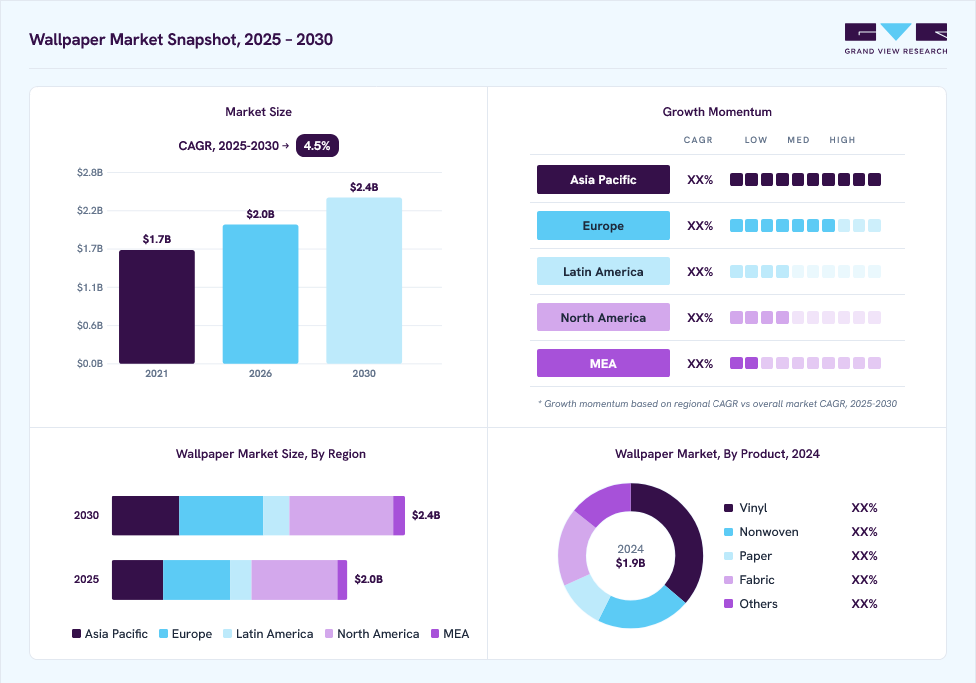
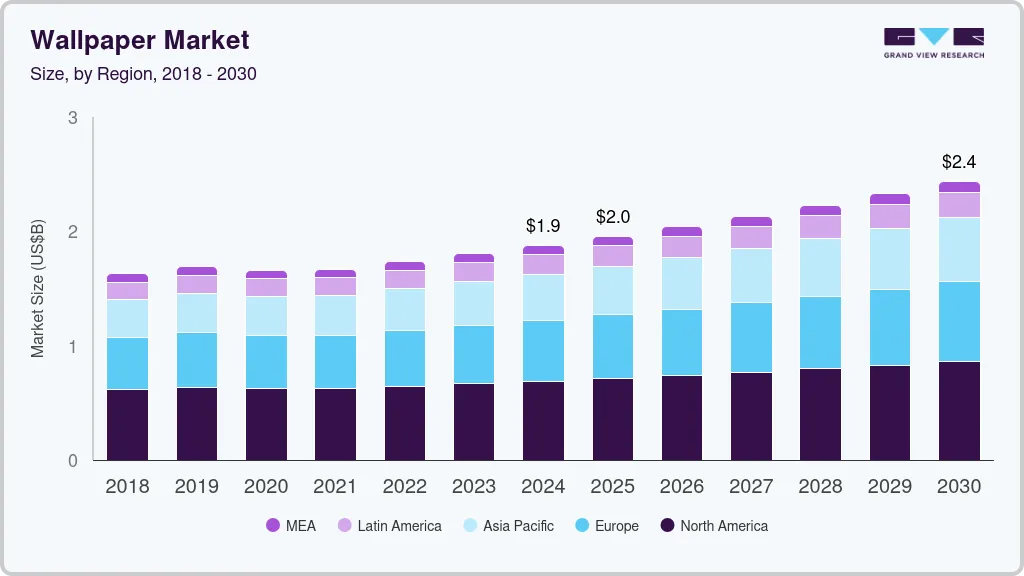
The global wallpaper market size was valued at USD 2.0 billion in 2025 and is projected to grow from USD 2.1 billion in 2026 to USD 2.9 billion by 2033, at a CAGR of 5.0% from 2026 to 2033. North America dominated the market, accounting for 36.4% of revenue in 2025. The rising adoption of home renovation activities, coupled with advancements in printing techniques, has significantly driven the demand for wallpapers.
 Source: Grand View Research, IR Documents, Primary Interviews, Paid DatabasesTo learn more about this report,
 Download Free Sample Report
 Key Market Trends & Insights
- By product: Vinyl segment dominated the market, with a revenue share of 36.2% in 2025.
- By end use: Commercial segment accounted for the largest revenue share of 52.2% in 2025.
Regional Highlights
- Largest regional market: North America (36.4% revenue share, 2025)
- Fastest-growing regional market: Asia Pacific (highest CAGR, 2026-2033)
- By country: The U.S. held the largest market share in 2025.
Market Size & Forecast
- Market size in 2025: USD 2.0 billion
- Estimated market size in 2026: USD 2.1 billion
- Projected market size by 2033: USD 2.9 billion
- CAGR (2026-2033): 5.0%
Three ways to get this report
Buy it, customize it, or ask a question.Ask an Analyst
Analyst response in 1 business day
- AccessReport author, directly
- Reply timeWithin 1 working day
- No sales callDirect answer only
- FormatEmail reply
- CostFree, no cost
Get the Full Report
What the study covers
- FormatsPDF · Excel · Dashboard
- Timeline2026–2033 annual, 2025 base
- Coverage20+ countries, 5 regions
- Companies10+ key players profiled
Customize the Report
20% free customization
- IncludeCountries, segments, points
- TailorTo your product definition
- ExtendDeeper competitor detail
- OrA fully bespoke study
- Turnaround5–10 working days
Furthermore, rising disposable income, a shift in consumer preferences, and an increase in DIY projects involving the use of wallpapers are expected to drive demand for them in the coming years. Manufacturers in the wallpaper industry segregate the products based on residential and commercial usage, as both types require different types of paper, varying in thickness and weight. Wallpapers used for residential purposes are usually available in pre-pasted or unpasted styles. On the other hand, commercial wallpapers come in several types based on thickness and use. These wallpapers have passed several tests and measures, as they are used in high-traffic areas.The increasing demand for stain-resistant and eco-friendly wallpapers is creating a huge demand among consumers. Several manufacturers are testing the humidity levels to provide products and solutions to combat issues regarding bacterial growth. Additionally, in recent years, companies like Sangetsu Corporation and York Wallcoverings have launched several products that are stain-and damage-resistant. For instance, in June 2022, Asian Paints expanded its home décor portfolio by introducing an extensive collection across categories such as fabrics, wallpapers, rugs, furniture, lighting, and a new bedding line under its Royale umbrella.
 To learn more about this report, Download Free Sample Report
 Manufacturers in the industry are increasingly investing in marketing, sponsorships, and partnerships to broaden their customer base. The direct-to-customer channel is highly profitable for brands with consumer loyalty and that have already invested in promotional activities to build a strong brand image and a loyal consumer base. Companies are also actively focusing on this sales strategy to increase consumer brand loyalty. For instance, in May 2022, Sanderson Design Group PLC announced a sponsorship deal with the Emery Walker Trust. This partnership led to the curation of a collection of fabrics, wallpapers, bedding, and homewares inspired by artifacts at Emery Walker's House, reflecting the company's dedication to heritage and design.
The industry is highly competitive due to the presence of numerous companies with strong brand images, geographic presence, and wide distribution networks. As key players across the globe focus on expanding their geographical presence, mergers & acquisitions are expected to rise in the near future and contribute to the industry’s growth. For instance, in May 2022, the largest and oldest wallcoverings producer in North America, York Wallcoverings, was acquired by Industrial Opportunities Partners (IOP) and will join Brewster Home Fashions LLC and Fine Decor LTD under the umbrella of a new entity, The Bersham Group. Such initiatives are expected to enable companies to enter the untapped market and widen their consumer outreach while contributing to growth.
Market Dynamics
The wallpaper market is experiencing renewed growth as consumers, commercial property owners, and interior designers increasingly seek aesthetically appealing and cost-effective wall décor solutions. Wallpaper has evolved beyond traditional decorative applications, with advancements in digital printing, customizable designs, textured finishes, and eco-friendly materials expanding its appeal across residential, hospitality, retail, and corporate spaces. Growing urbanization, rising spending on home improvement projects, increasing renovation activities, and the influence of social media-driven interior design trends are further contributing to market expansion. In addition, the demand for personalized and premium interior spaces is encouraging wider adoption of designer and specialty wallpapers globally.
The growing expenditure on home renovation, remodeling, and interior decoration is a key driver of the wallpaper market. Consumers are increasingly investing in home aesthetics, particularly in living rooms, bedrooms, kitchens, and home offices, creating strong demand for decorative wall coverings. The shift toward personalized living spaces has accelerated the adoption of wallpapers featuring customized patterns, textures, murals, and luxury finishes.
Furthermore, rapid urbanization and increasing residential construction activities are expanding the potential customer base for wallpaper products. The influence of social media platforms, interior design influencers, and home décor television programs has further increased consumer awareness regarding modern wallpaper applications. As homeowners seek affordable alternatives to extensive wall remodeling while achieving premium visual appeal, wallpaper adoption continues to gain momentum across both developed and emerging markets.
Competition from alternative wall finishing products remains a significant challenge for the wallpaper market. Paints, decorative coatings, wall panels, textured finishes, and other wall treatment solutions often offer lower installation complexity and greater familiarity among consumers and contractors. In many markets, repainting remains the preferred option due to lower upfront costs and easier maintenance.
Additionally, concerns regarding wallpaper installation, removal difficulties, moisture sensitivity, and long-term durability may discourage adoption among certain consumer groups. Improper installation can lead to peeling, bubbling, or misalignment issues, increasing maintenance requirements and replacement costs. These factors, combined with fluctuating raw material prices and labor costs associated with professional installation, may limit market growth in some regions.
Technological advancements in digital printing and increasing demand for sustainable interior products are creating substantial opportunities for the wallpaper market. Digital printing technologies enable manufacturers to offer highly customized designs, photographic murals, short production runs, and personalized wall coverings tailored to individual consumer preferences. This capability is expanding wallpaper adoption across residential, hospitality, retail, and commercial applications seeking unique interior experiences.
At the same time, growing environmental awareness is driving demand for wallpapers manufactured using recyclable materials, water-based inks, PVC-free substrates, and sustainably sourced raw materials. Green building initiatives and increasing adoption of environmentally responsible construction practices are encouraging property developers and consumers to select eco-friendly wall décor solutions. Manufacturers that combine sustainable product development with advanced design capabilities and digital customization are well-positioned to capitalize on evolving consumer preferences and emerging market opportunities.
Consumer Surveys & Insights
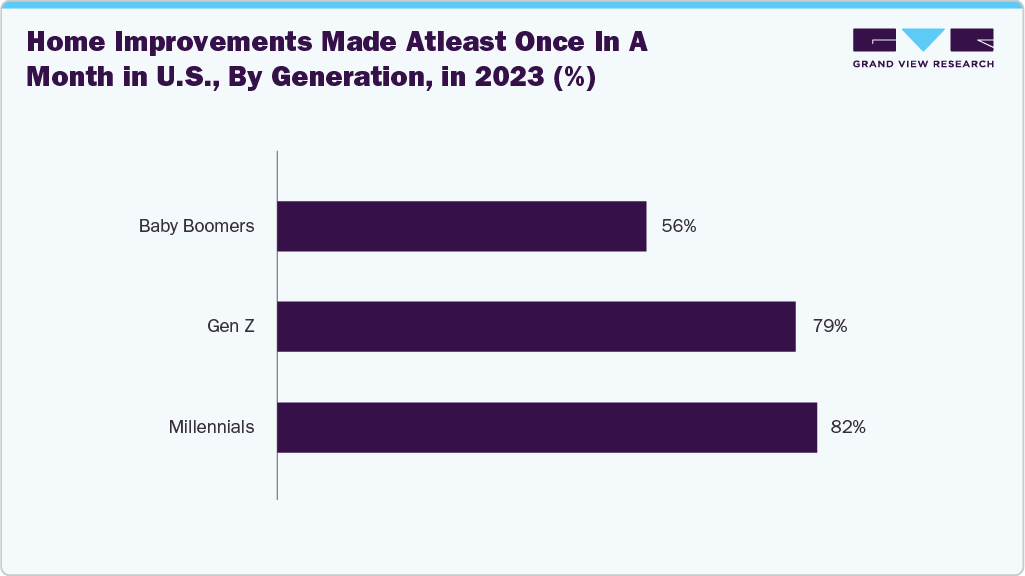
With extended periods spent at home due to work-from-home options, individuals sought to enhance their living environments, resulting in increased interest in home decor and renovations. This trend was particularly evident among millennials, many of whom identified as DIY enthusiasts. The desire for personalized and comfortable spaces drove consumers to undertake various projects, including the application of wallpapers, to transform their interiors.Over half (56%) of Baby Boomers renovated their homes in 2023, comprising the largest percentage of all generational groups who undertook renovations, according to the Houzz study.
 To learn more about this report, Download Free Sample Report
 In a study, among individuals, changes to the house exterior were most common, with 61% of homeowners doing some work on their garden, patio, or renovating the structure of the house. 58% of respondents also made improvements indoors, such as repainting walls, adding new flooring, or renovating their bathrooms. 44% of homeowners looked towards the future by introducing a tech improvement to their home. 34% made their home more environmentally friendly. This eco-conscious push was stronger among younger people, with 50% of Millennial and Gen Z respondents making steps towards making their homes better for the environment. That sentiment was echoed by only 36% of Gen X and 6% of Baby Boomer households.
Looking ahead, the industry is poised for continued growth, driven by evolving consumer preferences and technological advancements. The increasing demand for eco-friendly and sustainable products is influencing manufacturers to develop wallpapers made from recycled materials and non-toxic inks. As the emphasis on personalized and sustainable living spaces intensifies, the wallpaper industry is expected to adapt and innovate to meet these emerging consumer needs.
Trump’s Tariff Impact Analysis
The wallpaper industry is among the many industries that will be significantly impacted by U.S. President Trump's recent imposition of tariffs on Chinese imports, which can reach up to 145%. These tariffs affect a wide range of materials and products, leading to increased costs, supply chain disruptions, and strategic shifts in sourcing and project planning.
One of the most immediate and direct effects of tariffs is an increase in the costs of raw materials and finished goods. Many designs, especially digitally printed and textile-based varieties, rely on Chinese manufacturing due to cost efficiency and scale. In 2023, the leading exporters of wallpaper were China, Germany, and Belgium. The top importers were the United States, France, and Uzbekistan.
Moreover, tariffs on these imports increase wholesale and retail prices, making premium designs less accessible to average consumers. Chinese factories have traditionally been major suppliers not only of raw materials but also of finished home décor products like wallpaper, wall panels, and vinyl coatings. Alternative suppliers in Vietnam, India, and parts of Eastern Europe are being considered, but they may not yet match China's capacity or pricing, which could cause further disruption.
For the wallpaper industry, which has relied heavily on the scale and technology of Chinese printers and fabricators, rebuilding local infrastructure is costly and may result in higher long-term prices. This could potentially reshape the market's structure toward fewer, larger players with greater control over pricing and distribution.
Product Insights
Based on product, the vinyl segment led the market with the largest revenue share of 36.2% in 2025 and is expected to grow at the fastest CAGR over the forecast period. Vinyl wallpaper dominates the market owing to its durability, moisture resistance, ease of maintenance, and broad design versatility. The material is widely preferred in both residential and commercial environments because it can withstand frequent cleaning, high-traffic conditions, and varying humidity levels without compromising appearance. Advances in printing technologies have enabled manufacturers to offer vinyl wallpapers in a wide range of textures, patterns, colors, and customized designs that replicate the look of premium materials such as wood, stone, fabric, and concrete. Additionally, growing demand for cost-effective interior renovation solutions and increasing adoption of decorative wall coverings in hospitality, retail, healthcare, and residential applications continue to strengthen the segment’s market position and support its projected growth.
The non-woven wallpaper sales is expected to witness a CAGR of 5.5% over the forecast period. The growing trend for DIYs is one of the major factors boosting the demand for nonwoven wallpaper. These wallpapers can be pasted directly onto the wall and perfectly hide cracks in the wall. They are easy to remove, subsequently offering smoothness and an aesthetic look to the wall. Consumers in the market prefer nonwoven wallpapers as they support digital printing and effectively avoid the problem of molding.
End Use Insights
By end use, the commercial segment led the market with the largest revenue share of 52.2% in 2025, driven by extensive use across hotels, offices, restaurants, retail stores, healthcare facilities, educational institutions, and entertainment venues. Businesses increasingly utilize wallpaper as a cost-effective interior design solution to enhance aesthetics, reinforce brand identity, and create distinctive customer experiences. Compared to conventional paint, wallpaper offers greater design flexibility, durability, and ease of replacement, making it particularly suitable for high-traffic commercial environments. Furthermore, ongoing investments in commercial construction, hospitality expansion, office renovations, and retail modernization projects are driving sustained demand for decorative and functional wall coverings, reinforcing the segment’s dominant position in the global wallpaper market.
 To learn more about this report, Download Free Sample Report
 Wallpaper sales for residential applications are expected to grow at a CAGR of 4.7% from 2026 to 2033. An increase in internet penetration among the middle class, coupled with the rising use of smartphones and similar devices, is the key factor driving the popularity of online channels across the global industry. Additionally, the rising trend of offering trendy and aesthetic appeal to the walls is expected to offer key players the opportunity to broaden their product portfolio.
Regional Insights
North America dominated the Wallpaper market with the largest revenue share of 36.4% in 2025. North America accounted for the largest share of the wallpaper market due to strong residential renovation activity, rising spending on interior décor, and increasing consumer preference for customized wall coverings. Homeowners and commercial property owners are increasingly adopting wallpaper as a cost-effective solution to enhance aesthetics and create personalized interior spaces. The growing popularity of peel-and-stick wallpapers, supported by the DIY home improvement trend, has further expanded market penetration. Additionally, the presence of established home furnishing retailers, robust e-commerce channels, and increasing demand for premium and designer wallpapers continue to support regional market growth.
 To learn more about this report, Download Free Sample Report
 U.S. Wallpaper Market Trends
The Wallpaper market in the U.S. held the largest share, at about 81.3%, in the North America region in 2025. The U.S. dominates the North American wallpaper market owing to its large housing stock, high consumer expenditure on home remodeling, and strong demand for interior design products. Rising interest in personalized living spaces, accent walls, and luxury home décor has increased the adoption of wallpaper across residential applications. The commercial sector, including hospitality, retail, and office spaces, also contributes significantly to demand as businesses seek visually appealing interior environments. Furthermore, the widespread availability of digitally printed, eco-friendly, and removable wallpaper options has attracted a broader consumer base, reinforcing the country’s leading position within the regional market.
Europe Wallpaper Market Trends
The wallpaper market in Europe accounted for over 28% revenue share in 2025, owing to strong demand for premium interior decor, growing renovation activities, and widespread adoption of modern aesthetics across residential and commercial spaces. The region's mature real estate market, combined with a cultural preference for stylish and customizable interiors, has driven consistent investment in wallcovering solutions.
Asia Pacific Wallpaper Market Trends
The wallpaper market in the Asia Pacific is anticipated to witness the fastest CAGR of around 5.6% from 2026 to 2033. Asia Pacific is witnessing considerable growth in the construction sector owing to the rising population and urbanization. The region has competing brands that are adopting different strategies to increase their presence in the country. For instance, in May 2021, Sangetsu announced an agreement with Sanderson Design Group Plc to become the exclusive licensee of Morris & Co. wallpapers in Taiwan, Singapore, Korea, and Japan.
India wallpaper market is expected to grow at a CAGR of 7.1% during the forecast period. Driven by a significant consumer shift towards sustainable products, many wallpaper manufacturers in the country are adopting specialized, eco-friendly materials. For instance, UDC Homes, a major player in India, offers a range of plant-based wallpapers under the Nuance Collection.
Key Wallpaper Companies Insights
Key players operating in the wallpaper market are undertaking various initiatives to strengthen their presence and increase the reach of their products and services. Strategies such as expansion activities and partnerships are key in propelling the market growth.
Key Wallpaper Companies:
The following key companies have been profiled for this study on the wallpaper market.
-
Sangetsu Corporation
-
York Wallcoverings Inc.
-
Brewster Home Fashions LLC
-
F. Schumacher & Co.
-
A.S. Création Tapeten AG
-
Osborne & Little
-
The Romo Group
-
Grandeco
-
4Walls
-
Asian Paints
Competitive Benchmarking
Category
Operating Strategies
Competitive Edge
Weakness
Established Players (Sangetsu Corporation; York Wallcoverings Inc.; AS Creation Tapeten AG; F. Schumacher & Co.; Asian Paints)
- Expand product portfolios across vinyl, nonwoven, textured, designer, and customized wallcoverings while strengthening partnerships with architects, interior designers, real estate developers, and home improvement retailers.
- Invest in digital printing technologies, sustainable materials, and omnichannel distribution networks to meet global demand for residential and commercial renovations.
- Strong brand recognition, extensive design libraries, and well-established distribution networks across multiple geographies.
- Significant manufacturing capabilities, economies of scale, and long-standing relationships with contractors, developers, and retail channels enable consistent market penetration and premium product positioning.
- High exposure to fluctuations in raw material prices, housing market cycles, and construction activity.
- Larger organizations often face longer product development cycles and may be slower to adapt to rapidly changing interior design trends and consumer preferences.
Emerging & Design-Focused Players (Brewster Wallpaper Corporation; Osborne & Little; The Romo Group; Grandeco; 4Walls)
- Focus on premium designs, luxury interiors, customized wallcoverings, and trend-driven collections targeting residential renovation and high-end commercial projects.
- Leverage e-commerce platforms, designer collaborations, and digital marketing initiatives to strengthen brand visibility and capture demand from style-conscious consumers.
- Greater flexibility in responding to emerging décor trends, regional design preferences, and customization requirements.
- Strong expertise in design innovation, niche aesthetics, and premium product offerings that appeal to architects, interior designers, and affluent homeowners.
- Limited manufacturing scale and geographic reach compared to larger multinational competitors.
- Greater reliance on discretionary consumer spending and premium housing segments can increase vulnerability during economic slowdowns and periods of reduced renovation activity.
Recent Developments
- In June 2026, Sangetsu launched its FINE 2026–2029 wallpaper collection, featuring 771 designs across multiple styles and expanding its range of fire-resistant wallpapers for residential and non-residential applications. The launch followed the August 2025 introduction of its XSELECT Premium Selection collections, which emphasize material textures, international brands, and distinctive decorative patterns. These developments expanded Sangetsu's design portfolio across residential, office, and hospitality interiors.
-
In November 2025, The Romo Group presented new interior collections, including Aubin, a collection of small-scale prints and wallcoverings inspired by traditional block-printing techniques, and Elson, a collection centered on decorative stripes. The additions expanded its coordinated wallcovering and textile designs for residential interiors.
Wallpaper Market Report Scope
Report Attribute
Details
Market size in 2025
USD 2.0 billion
Estimated market size in 2026
USD 2.1 billion
Projected market size by 2033
USD 2.9 billion
Growth rate
CAGR of 5.0% from 2026 to 2033
Base year for estimation
2025
Historical data
2021 - 2024
Forecast period
2026 - 2033
Quantitative units
Revenue in USD million/billion and CAGR from 2026 to 2033
Report coverage
Revenue forecast, company ranking, competitive landscape, growth factors, and trends
Segments covered
Product, end use, region
Regional scope
North America; Europe; Asia Pacific; Central & South America; Middle East & Africa
Country scope
U.S.; Canada; Mexico; Germany; UK; France; Italy; Spain; China; Japan; India; South Korea; Australia & New Zealand; Brazil; South Africa
Key companies profiled
Sangetsu Corporation; York Wallcoverings Inc.; Brewster Home Fashions LLC; F. Schumacher & Co.; A.S. Création Tapeten AG; Osborne & Little; The Romo Group; Grandeco; 4Walls; Asian Paints
Customization scope
Free report customization (equivalent to 8 analyst working days) with purchase. Addition or alteration to country, regional & segment scope.
Pricing and purchase options
Avail customized purchase options to meet your exact research needs. Explore purchase options
Global Wallpaper Market Report Segmentation
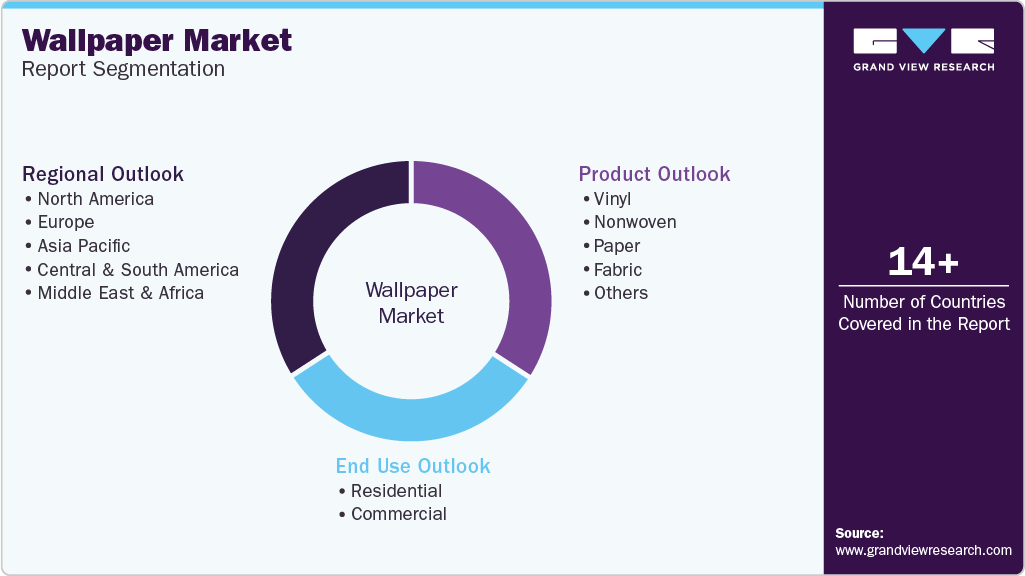
This report forecasts revenue growth at the global, regional, and country levels and provides an analysis of the latest industry trends and opportunities in each of the sub-segments from 2021 to 2033. For this study, Grand View Research has segmented the global wallpaper market report on the basis of product, end use, and region.
 To learn more about this report, Download Free Sample Report
 -
Product Outlook (Revenue, USD Million, 2021 - 2033)
-
Vinyl
-
Nonwoven
-
Paper
-
Fabric
-
Others
-
-
End Use Outlook (Revenue, USD Million, 2021 - 2033)
-
Residential
-
Commercial
-
-
Regional Outlook (Revenue, USD Million, 2021 - 2033)
-
North America
-
U.S.
-
Canada
-
Mexico
-
-
Europe
-
Germany
-
UK
-
Spain
-
Italy
-
France
-
-
Asia Pacific
-
China
-
India
-
Japan
-
South Korea
-
Australia & New Zealand
-
-
Central & South America
-
Brazil
-
-
Middle East & Africa
-
South Africa
-
Saudi Arabia
-
-
Research Methodology
The wallpaper market figures in this report are based on a proven research process that combines executive interviews with secondary research from proprietary databases, company filings, and recognized regulatory and institutional sources. Market size is built through value-chain sizing - reconciling supply-side and demand-side estimates - and triangulated with bottom-up and top-down approaches. Every estimate passes multiple levels of expert validation before publication, with each wallpaper segment quantified using the revenue-capture definitions in the table below.
Segment Definition
Segment - Product
Revenue capture definition
Vinyl
The scope covers vinyl-based wallpapers manufactured using PVC and related polymer materials for interior wall applications. It includes solid vinyl, vinyl-coated, and expanded vinyl wallpaper products available in rolls, sheets, and customized formats. Revenue generated from residential and commercial installations, replacements, and refurbishment projects is considered within this segment.
Nonwoven
The scope includes wallpapers produced from blends of natural and synthetic fibers bonded into nonwoven substrates. Coverage includes paste-the-wall products, removable wallpaper formats, digitally printed designs, and textured finishes. Market estimation incorporates sales through residential renovation, new construction, hospitality, office, and retail interior applications.
Paper
This segment covers wallpapers manufactured primarily from paper-based materials, including standard, embossed, printed, and specialty decorative paper wallpapers. The scope includes products used for interior wall decoration across residential and commercial settings. Revenue generated through direct sales, distributor channels, and project-based installations is included in the market assessment.
Fabric
The scope encompasses textile-based wallpapers manufactured using materials such as silk, linen, cotton, polyester, jute, and other woven or nonwoven fabrics. It includes luxury wall coverings, acoustic fabric wallpapers, and decorative textile wall solutions. Market sizing considers applications across premium residential, hospitality, commercial, and institutional interiors.
Others
This category includes wallpapers manufactured from alternative materials such as grasscloth, bamboo, cork, metallic foils, fiberglass, wood veneer, and other specialty substrates. The scope covers decorative, functional, and customized wall-covering solutions used across diverse end-use sectors. Revenue from niche and emerging wallpaper material technologies is included within this segment.
Segment - End Use
Revenue capture definition
Residential
The residential segment covers wallpaper installations across single-family homes, apartments, condominiums, villas, and other housing units. The scope includes applications in living rooms, bedrooms, kitchens, hallways, and home offices for both new construction and renovation activities. Revenue generated through retail purchases, interior design projects, and home improvement initiatives is considered.
Commercial
The scope includes wallpaper demand from commercial establishments, including offices, hotels, restaurants, retail stores, healthcare facilities, educational institutions, entertainment venues, and public buildings. It covers decorative, branding, acoustic, and functional wall-covering applications. Market estimates include revenues from new developments, refurbishment projects, and professional interior fit-out activities.
Estimation Model
Layer Title
Guiding Question
Description
Building Stock Layer
How many spaces could potentially use wallpaper?
Begin with the global stock of residential homes, apartments, offices, hospitality establishments, retail stores, healthcare facilities, and institutional buildings. Apply interior finishing and wall-covering demand indicators to identify spaces where wallpaper can serve as a decorative or functional wall treatment.
Renovation & Design Accessibility Layer
Who can realistically adopt wallpaper solutions?
Filter the eligible building stock using urbanization rates, housing completions, remodeling activity, disposable income levels, commercial fit-out investments, and access to interior décor products. This derives the addressable market exposed to wallpaper products through retail, distributor, and design channels.
Wallpaper Adoption Layer
Who actively chooses wallpaper over alternative wall finishes?
Apply wallpaper penetration rates across residential and commercial end users, accounting for consumer preferences, premium interior design trends, demand for customized décor, and replacement cycles. This converts the addressable base into active wallpaper purchasers.
Monetisation Layer
How much revenue is generated?
Multiply annual wallpaper demand by blended ASPs across vinyl, nonwoven, paper, fabric, and specialty wallpapers. Add revenue generated through premium designer collections and customized printing to estimate total market revenue.
Delivered Customizations
This report has been delivered with the following In-depth customizations
Client Request
Customization Delivered
Value Adds
Cross-Segmentation Analysis of Wallpaper Products, End Use & Regional Demand Patterns
Detailed cross-segmentation analysis of the wallpaper market across product categories (vinyl, nonwoven, paper, fabric, and others), mapped against residential and commercial applications across North America, Europe, Asia Pacific, Latin America, and the Middle East & Africa. The analysis evaluates demand patterns by renovation activity, interior design preferences, construction trends, and consumer adoption of premium decorative wallcoverings.
Identifies where vinyl continues to dominate due to durability and ease of maintenance, while nonwoven products gain traction through DIY-friendly application and digital printing compatibility. Also highlights growth in demand driven by hospitality, retail, offices, and healthcare projects tied to modern renovation and interior décor spending.
Brand Share Analysis / Competitive Benchmarking Across the Wallpaper Ecosystem
Comprehensive benchmarking of global wallpaper manufacturers and decorative surface brands, including Sangetsu Corporation, York Wallcoverings, Brewster Wallpaper Corporation, AS Creation, F. Schumacher, Osborne & Little, Romo Group, and Asian Paints. The assessment compares product portfolios, design capabilities, pricing architecture, geographic reach, sustainability initiatives, distribution strength, and premium versus mass-market positioning.
Helps distinguish volume-driven manufacturers from design-led premium brands competing through customization, heritage appeal, and sustainable design. The analysis also identifies competitive advantages in digital printing capabilities, exclusive collections, and retail distribution partnerships, creating opportunities for expansion.
Pricing, End-Use & Channel Opportunity Mapping
Assessment of wallpaper demand across value, mid-range, premium, and luxury price tiers, mapped against residential and commercial end uses. The study evaluates purchasing behavior across specialty décor retailers, home improvement stores, interior design channels, contractors, architects, and online platforms. Analysis includes project-based purchasing patterns, replacement cycles, demand for customization, and specification trends among contract buyers.
Identifies where premium and customized wallpaper command pricing power through unique designs, textures, and materials, while value-oriented products dominate mass-market channels. The assessment also highlights the growing influence of architects, interior designers, and design visualization tools in purchase decisions, enabling manufacturers to plan channel investments and go-to-market strategies.
Frequently Asked Questions About This Report
North America dominated the market with a 36.4% revenue share in 2025.
Asia Pacific is the fastest-growing region over the forecast period.
The vinyl wallpaper segment led the market with a 36.2% revenue share in 2025.
Commercial segment accounted for the largest revenue share of 52.2% in 2025.
The global wallpaper market size was valued at USD 2.0 billion in 2025 and is estimated at USD 2.1 billion for 2026.
The global wallpaper market is expected to grow at a CAGR of 5.0% from 2026 to 2033, reaching USD 2.9 billion by 2033
Key factors include growing demand for aesthetically appealing interior décor solutions, increasing residential renovation and remodeling activities, rising adoption of premium wall coverings in commercial spaces, expanding urbanization, and growing consumer preference for customizable and easy-to-install decorative wall solutions.
Key players include Sangetsu Corporation, York Wallcoverings Inc., Brewster Home Fashions LLC, F. Schumacher & Co., A.S. Création Tapeten AG, Osborne & Little, The Romo Group, Grandeco, 4Walls, and Asian Paints.
About the Author(s)
Homecare & Decor Research Team
Consumer Goods · Homecare & DecorThis report was authored by the homecare & decor research team at Grand View Research - comprising two research analysts, one senior research analyst, and one industry expert - with specialized expertise in the homecare & decor segment of the consumer goods industry. All findings are based on proprietary consumer goods databases, executive interviews, and regulatory analysis, subject to internal peer review prior to publication.
Last Updated:
Speak to Analyst

Customize this report to your needs - add regions, segments, or data points, with 20% free customization.
Or view our licence options:


ISO 9001:2015 & 27001:2022 Certified
We are GDPR and CCPA compliant! Your transaction & personal information is safe and secure. For more details, please read our privacy policy.


