
- Home
- »
- Next Generation Technologies
- »
-
Web 3.0 Market Size, Share And Trends Report, 2026-2033GVR Report cover

Web 3.0 Market (2026 - 2033)
Size, Share, & Trends Analysis Report By Blockchain Type (Private, Public, Consortium, Hybrid), By Application, By End Use (BFSI, Retail & E-commerce, Media & Entertainment, Pharmaceuticals), By Region, And Segment Forecasts
Market Size, 2025
$5.0BMarket Estimate, 2026
$7.5BMarket Forecast, 2033
$123.8BCAGR, 2026–2033
49.3%Web 3.0 Market Summary
The global Web 3.0 market size was valued at USD 5.0 billion in 2025 and is projected to grow from USD 7.5 billion in 2026 to USD 123.8 billion by 2033, at a CAGR of 49.3% from 2026 to 2033. North America dominated the market, accounting for the revenue share of 37.0% in 2025. The industry is poised for significant growth, driven by several key factors, including the increasing need for data privacy enabled by Web 3.0's decentralized identity and advancements in internet technology.
Key Market Trends & Insights
- By blockchain type: The public segment led the market with the largest revenue share of 56.0% in 2025.
- By application: The cryptocurrency segment accounted for the largest market revenue share in 2025.
- By end-use: The BFSI segment held the largest revenue share of over 36.0% in 2025.
Regional Highlights
- Largest regional market: North America (37.0% revenue share, 2025)
- Fastest regional market: Asia Pacific (Highest CAGR, 2026-2033)
Market Size & Forecast
- Market size in 2025: USD 5.0 Billion
- Estimated market size in 2026: USD 7.5 Billion
- Projected market size by 2033: USD 123.8 Billion
- CAGR (2026-2033): 49.3%
Prism AI by Grand View Research Free to tryAsk a question about the web 3.0 marketTry asking✓Every figure cited from GVR research Prefer the report? Download free sample →
In addition, the rapid adoption of digital assets such as cryptocurrencies, coupled with the ongoing expansion of 5G infrastructure and continued advancements toward 6G technologies, is expected to drive market growth.The growing adoption of digital assets and cryptocurrencies is creating strong synergies with the Web 3.0 ecosystem. The integration of blockchain technology, decentralized finance (DeFi), and non-fungible tokens (NFTs) into Web 3.0 applications is enabling new models for digital transactions, asset ownership, and value creation. This convergence is expected to accelerate adoption and foster innovation across industries, including finance, gaming, healthcare, media, and supply chain management.
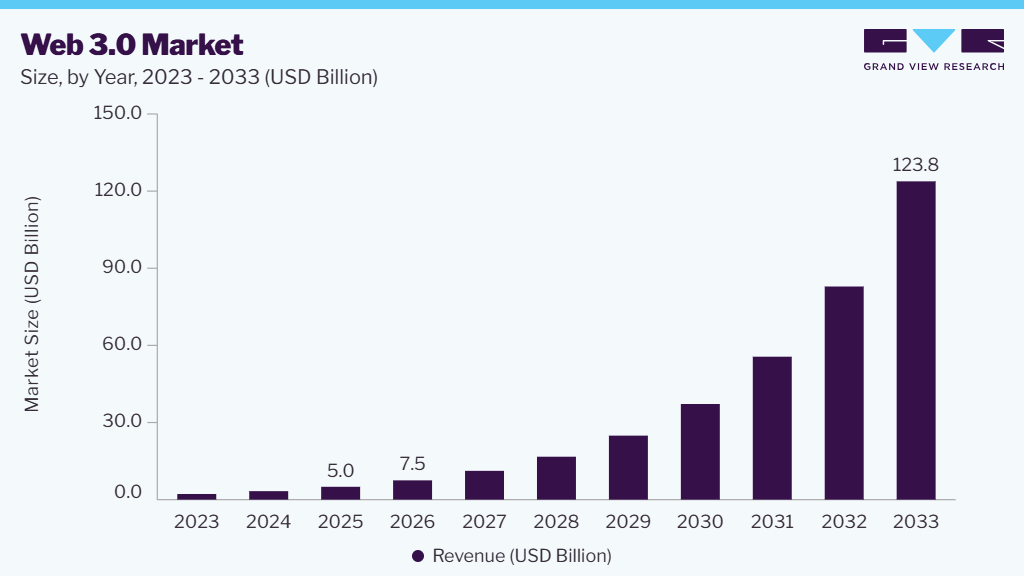 Source: Grand View Research, IR Documents, Primary Interviews, Paid DatabasesTo learn more about this report,
 Download Free Sample Report
Furthermore, increasing concerns regarding data ownership, privacy, and security are fueling interest in Web 3.0's decentralized identity solutions. Blockchain technology enables users to retain greater control over their personal data, shifting away from centralized platforms toward user-centric digital ecosystems. This trend is attracting both consumers and enterprises seeking enhanced privacy, transparency, and security in digital interactions.
Technologies such as artificial intelligence (AI), machine learning, big data analytics, and decentralized ledger technology are also expected to drive market growth by enabling more intelligent, secure, and efficient internet services. Within the Web 3.0 framework, these technologies improve operational efficiency, strengthen cybersecurity, support decentralized applications (dApps), enhance smart contract functionality, and facilitate secure peer-to-peer transactions. As a result, businesses and users increasingly benefit from a more transparent, interoperable, and resilient digital ecosystem.
Companies operating in the Web 3.0 and blockchain ecosystem are increasingly integrating AI into their platforms to strengthen their competitive position and improve user experiences. The combination of AI and blockchain enhances smart contract automation, fraud detection, predictive analytics, decentralized identity management, and operational efficiency across various applications. In addition, blockchain technology improves supply chain transparency, traceability, and security by providing immutable records and enabling real-time visibility throughout the value chain.
The growing adoption of cryptocurrencies and blockchain-based smart contracts to automate digital transactions is also anticipated to support market growth. Smart contracts enable secure, transparent, and automated execution of agreements without relying on centralized intermediaries, improving transaction efficiency while reducing costs. Moreover, governments across several countries are introducing regulatory frameworks for virtual assets and cryptocurrencies to enhance market transparency, strengthen investor protection, and encourage responsible innovation. For instance, in April 2026, Dubai’s Virtual Assets Regulatory Authority (VARA) issued detailed guidance on its Virtual Assets Issuance Rulebook, providing greater clarity on the issuance, disclosure, and distribution of virtual assets in the emirate.
Analyst Perspective
The Web 3.0 market is expected to witness robust growth over the forecast period, driven by the increasing adoption of decentralized technologies that enable secure, transparent, and user-centric digital interactions. Rising investments in blockchain infrastructure, decentralized finance (DeFi), decentralized applications (dApps), decentralized identity (DID), non-fungible tokens (NFTs), and tokenized digital assets are accelerating the adoption of Web 3.0 across industries, including financial services, gaming, healthcare, media, supply chain, and enterprise applications. Advancements in blockchain scalability through Layer 2 solutions, cross-chain interoperability, and enhanced smart contract functionality are improving the efficiency, performance, and practicality of decentralized ecosystems.
Blockchain Type Insights
The public segment led the market with the largest revenue share of 56.0% in 2025. The segment's growth is primarily driven by the increasing adoption of permissionless blockchain networks that enable transparent, secure, and decentralized participation without requiring approval from a central authority. Public blockchains support decentralized applications (dApps), decentralized finance (DeFi), non-fungible tokens (NFTs), digital asset tokenization, and smart contracts, making them the preferred infrastructure for many Web 3.0 ecosystems. Their open architecture encourages innovation, enhances interoperability, and enables developers to build scalable decentralized solutions for global users.
For instance, in May 2025, FIFA selected Avalanche to power its FIFA Blockchain, a custom Layer 1 network designed to support digital collectibles and large-scale fan engagement. This development highlights the growing adoption of public blockchain infrastructure for scalable Web 3.0 applications. Public blockchains also offer high transparency, strong security through decentralized consensus mechanisms, censorship resistance, and immutable transaction records, further supporting their widespread adoption.
The hybrid segment is anticipated to grow at a significant CAGR during the forecast period. Growth is driven by increasing enterprise demand for blockchain solutions that balance data privacy, regulatory compliance, and operational transparency. Hybrid blockchains combine the advantages of both public and private blockchain networks, allowing organizations to keep sensitive data on permissioned networks while selectively sharing information or verifying transactions on public blockchains. This architecture enables secure collaboration among multiple stakeholders while maintaining greater control over confidential information.
Furthermore, hybrid blockchains support smart contracts, improve operational efficiency, facilitate regulatory compliance, and are increasingly being adopted across industries such as healthcare, financial services, supply chain management, and government, where both transparency and data confidentiality are essential.
Application Insights
The cryptocurrency segment accounted for the largest market revenue share in 2025. The segment's growth is primarily driven by the increasing adoption of digital assets for payments, investments, decentralized finance (DeFi), cross-border transactions, and tokenized digital economies. Growing institutional participation, expanding blockchain infrastructure, and rising acceptance of cryptocurrencies by enterprises and financial institutions are further accelerating market growth.
In addition, cryptocurrencies enable secure, transparent, and decentralized peer-to-peer transactions without relying on centralized intermediaries, making them a fundamental component of the Web 3.0 ecosystem. The increasing integration of cryptocurrencies into decentralized applications (dApps), gaming platforms, digital marketplaces, and financial services is expected further to support the segment's growth over the forecast period.
The smart contracts segment is anticipated to grow at a significant CAGR during the forecast period. Growth is driven by the increasing adoption of blockchain-based automation, which enables secure, transparent, and self-executing digital agreements without intermediaries. Smart contracts provide immutable, traceable, and tamper-resistant transaction records while reducing operational costs, improving efficiency, and minimizing execution errors across industries such as financial services, supply chain management, healthcare, real estate, and digital identity.
For instance, in January 2025, Sony Group Corporation announced the launch of Soneium, an Ethereum Layer 2 blockchain platform designed to support creators, developers, and businesses in building decentralized applications and Web 3.0 services through smart contract functionality. This initiative highlights the expanding role of smart contract-enabled platforms in facilitating secure digital interactions and decentralized applications. As enterprises continue to automate business processes and deploy decentralized applications, the adoption of smart contracts is expected to accelerate significantly.
End Use Insights
The BFSI segment held the largest revenue share of 36.0% in 2025. The increasing demand for Web 3.0 blockchain technology in the banking and finance sector, driven by scalability, faster transaction speeds, and reduced processing costs, is a major factor driving segment growth. In addition, transactions enabled by Web 3.0 blockchain technology eliminate the need for third-party payment gateways, enabling faster financial communication.
For instance, in June 2025, Consensys announced the acquisition of Web3Auth to enhance MetaMask’s user experience and user safety. This development highlights the growing focus on secure wallet infrastructure, seamless onboarding, and safer digital asset interactions, which are expected to support broader adoption of Web 3.0 financial services. Moreover, Web 3.0 enables insurance companies to maintain decentralized data, thereby preventing cybercrime.
The retail & e-commerce segment is anticipated to grow at the fastest CAGR during the forecast period. Web 3.0 offers various benefits in the retail & e-commerce industry. These benefits include faster payments, reduced costs, increased transparency, and improved security, all of which are significant factors driving the segment's growth.
Moreover, Web 3.0 includes distributed ledger technology that enables retail companies to collaborate more easily and closely with supply chain partners, such as retailers, importers, and distributors.
Regional Insights
The North America Web 3.0 market held the largest revenue share of 37.0% in 2025. The growing adoption of Web 3.0 across various operating systems, including blockchain-based systems, is a major driver of the regional market's growth. At the same time, the presence of major blockchain solution providers such as Helium Systems Inc. and Web3 Foundation in the region is also accentuating regional growth. For instance, in April 2026, Antier announced the expansion of its global Web 3.0 consulting services to support next-generation digital economies. Such initiatives highlight the growing presence of blockchain and Web 3.0 solution providers that are driving adoption and innovation across the North American market.
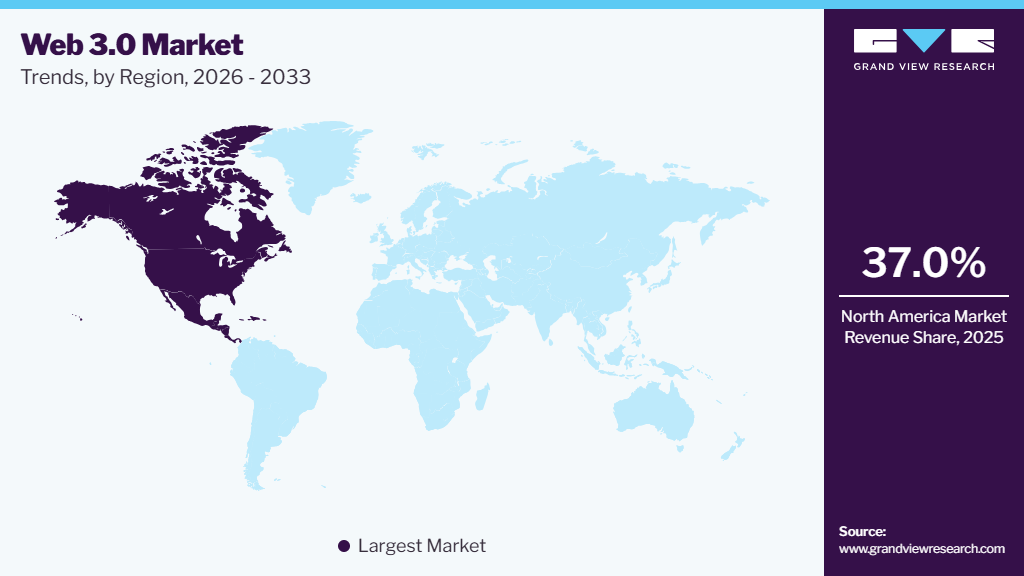 To learn more about this report, Download Free Sample Report
Asia Pacific Web 3.0 Market Trends
The Web 3.0 market in the Asia Pacific is projected to grow at the fastest CAGR during the forecast period. Growth is driven by increasing investments in blockchain infrastructure, supportive government initiatives, expanding digital asset ecosystems, and the rapid adoption of decentralized technologies across financial services, gaming, retail, and enterprise applications.
Countries such as Japan, Singapore, South Korea, Hong Kong, and China are actively promoting blockchain innovation through regulatory developments, enterprise adoption, and growing investments in Web 3.0 technologies. For instance, in July 2026, WebX 2026, one of Asia's largest blockchain and Web 3.0 conferences held in Tokyo, showcased the latest innovations in blockchain infrastructure, decentralized finance (DeFi), digital assets, artificial intelligence, and Web 3.0 applications while bringing together global technology companies, developers, investors, and policymakers. This highlights the region's growing role as a hub for Web 3.0 innovation and collaboration.
Furthermore, the rapid expansion of digital payments, e-commerce platforms, fintech ecosystems, and blockchain-enabled enterprise solutions is expected to accelerate the adoption of Web 3.0 technologies across the Asia-Pacific region, thereby supporting sustained market growth.
Key Web 3.0 Company Insights
Some of the key players operating in the market include Web3 Foundation, Polygon Labs, and Chainlink Labs.
-
Web3 Foundation is a technology foundation focused on advancing decentralized web technologies by developing blockchain infrastructure. It supports the Polkadot ecosystem by funding research, fostering innovation, and promoting interoperable, scalable, and decentralized Web 3.0 applications.
-
Polygon Labs develops blockchain scaling solutions for Ethereum, enabling developers to build fast, secure, and cost-efficient decentralized applications (dApps). Its portfolio includes Layer 2 technologies such as Polygon PoS, Polygon zkEVM, and AggLayer, supporting Web 3.0 applications across decentralized finance (DeFi), gaming, NFTs, and enterprise solutions.
Nova Labs, Inc. (Helium), Filecoin Foundation, Kusama, Ocean Protocol Foundation Ltd., ZelTechnologies Limited, Livepeer Foundation, and Kadena LLC are among the emerging market participants in the Web 3.0 space.
-
Nova Labs, Inc. (Helium) develops decentralized wireless network infrastructure that enables individuals and organizations to deploy hotspot devices supporting Internet of Things (IoT) connectivity and mobile network services through blockchain-based incentive mechanisms.
-
Filecoin Foundation supports the decentralized Filecoin network, which provides blockchain-based decentralized data storage and retrieval services. The platform enables secure, verifiable, and distributed storage solutions for Web 3.0 applications.
-
Kusama is an experimental blockchain network built using Substrate that serves as a scalable environment for developing and deploying decentralized applications and parachains before their deployment on the Polkadot network.
-
Ocean Protocol Foundation Ltd. develops a decentralized data-sharing infrastructure that enables individuals and organizations to securely exchange, monetize, and manage data assets while preserving privacy through blockchain technology.
Key Web 3.0 Companies
The following key companies have been profiled for this study on the web 3.0 market.
-
Web3 Foundation
-
Nova Labs, Inc., dba Helium.
-
Ocean Protocol Foundation Ltd.
-
Zeltechnologies
-
KUSAMA
-
Livepeer Foundation
-
Filecoin Foundation
-
Kadena LLC
-
Polygon Labs UI (Cayman) Ltd.
-
Chainlink Labs
Recent Developments
-
In June 2026, Blockworks announced the acquisition of Messari, bringing together two leading crypto data and market intelligence platforms. The acquisition aims to combine institutional-grade market intelligence, blockchain data, APIs, and disclosure infrastructure into a unified platform, highlighting the growing demand for trusted data, transparency, and AI-enabled analytics across the Web 3.0 ecosystem.
-
In June 2025, Aptos Labs and Jump Crypto unveiled Shelby, a high-performance decentralized object storage network designed to support Web 3.0 infrastructure and data-intensive decentralized applications. Built for AI workloads, video streaming, gaming, and other real-time applications, Shelby demonstrates ongoing advancements in scalable, low-latency decentralized storage solutions for next-generation Web 3.0 ecosystems.
Web 3.0 Market Report Scope
Report Attribute
Details
Market size in 2025
USD 5.0 billion
Estimated market size in 2026
USD 7.5 billion
Projected market size by 2033
USD 123.8 billion
Growth rate
CAGR of 49.3% from 2026 to 2033
Base year for estimation
2025
Historical data
2021 - 2024
Forecast period
2026 - 2033
Quantitative units
Revenue in USD billion and CAGR from 2026 to 2033
Report coverage
Revenue forecast, company market share, competitive landscape, growth factors, and trends
Segments covered
Blockchain type, application, end-use, region
Regional scope
North America; Europe; Asia Pacific; Latin America; MEA
Country scope
U.S.; Canada; Germany; UK; France; China; India; Japan; South Korea; Australia; Brazil; Mexico; Kingdom of Saudi Arabia ; UAE; South Africa
Key companies profiled
Web3 Foundation; Nova Labs, Inc.; dba Helium.; Ocean Protocol Foundation Ltd.; Zeltechnologies; KUSAMA; Livepeer Foundation.; Filecoin Foundation; Kadena LLC; Polygon Labs UI (Cayman) Ltd.; Chainlink Labs
Customization scope
Free report customization (equivalent up to 8 analysts working days) with purchase. Addition or alteration to country, regional & segment scope.
Pricing and purchase options
Avail of customized purchase options to meet your exact research needs. Explore purchase options
Global Web 3.0 Market Report Segmentation
This report forecasts revenue growth at global, regional, and country levels and provides an analysis of the latest industry trends and opportunities in each of the sub-segments from 2021 to 2033. For this study, Grand View Research has segmented the global Web 3.0 market report based on the blockchain type, application, end use, and region:
-
Blockchain Type Outlook (Revenue, USD Billion, 2021 - 2033)
-
Public
-
Private
-
Consortium
-
Hybrid
-
-
Application Outlook (Revenue, USD Billion, 2021 - 2033)
-
Cryptocurrency
-
Conversational AI
-
Data & Transaction Storage
-
Payments
-
Smart Contracts
-
Others
-
-
End Use Outlook (Revenue, USD Billion, 2021 - 2033)
-
BFSI
-
Retail & E-commerce
-
Media & Entertainment
-
Pharmaceuticals
-
IT & Telecom
-
Others
-
-
Regional Outlook (Revenue, USD Billion, 2021 - 2033)
-
North America
-
U.S.
-
Canada
-
-
Europe
-
UK
-
Germany
-
France
-
-
Asia Pacific
-
China
-
India
-
Japan
-
Australia
-
South Korea
-
-
Latin America
-
Brazil
-
Mexico
-
-
MEA
-
Saudi Arabia
-
UAE
-
South Africa
-
-
About the Author(s)
Next Generation Technologies Research Team
Technology · Next Generation TechnologiesThis report was authored by the next generation technologies research team at Grand View Research - comprising two research analysts, one senior research analyst, and one industry expert - with specialized expertise in the next generation technologies segment of the technology industry. All findings are based on proprietary technology databases, executive interviews, and regulatory analysis, subject to internal peer review prior to publication.
Last Updated:
Speak to Analyst

Customize this report to your needs - add regions, segments, or data points, with 20% free customization.
Or view our licence options:


ISO 9001:2015 & 27001:2022 Certified
We are GDPR and CCPA compliant! Your transaction & personal information is safe and secure. For more details, please read our privacy policy.


