
- Home
- »
- Next Generation Technologies
- »
-
Cryptocurrency Market Size & Share, Industry Report, 2033GVR Report cover

Cryptocurrency Market 2026 - 2033
Size, Share & Trends Analysis Report By Component (Hardware, Software), By Process (Mining, Transaction), By Type (Bitcoin, Ethereum, Bitcoin Cash, Litecoin, Ripple), By End-use, By Region, And Segment Forecasts
Market Size, 2025
$6.3BMarket Estimate, 2026
$7.0BMarket Forecast, 2033
$18.2BCAGR, 2026–2033
14.5%Cryptocurrency Market Summary
The global cryptocurrency market size was valued at USD 6.3 billion in 2025 and is projected to grow from USD 7.0 billion in 2026 to USD 18.2 billion by 2033, at a CAGR of 14.5% from 2026 to 2033. Asia Pacific held the largest share of 31.0% in the global cryptocurrency market in 2025. The increasing adoption of distributed ledger technology is expected to drive the growth of the cryptocurrency industry during the forecast period.
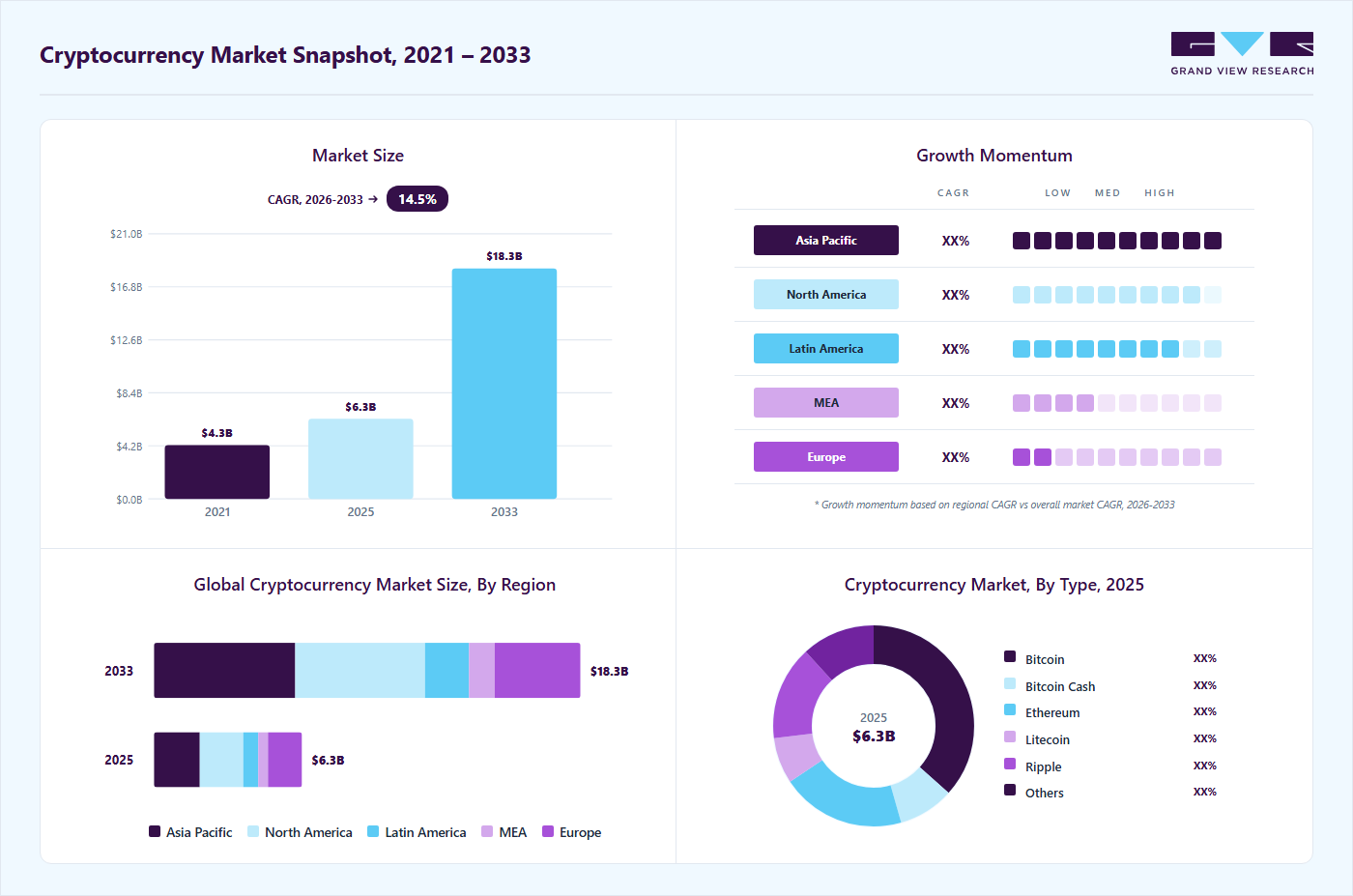 Source: Grand View Research, IR Documents, Primary Interviews, Paid DatabasesTo learn more about this report,
 Download Free Sample Report
 Key Market Trends & Insights
- By component: Hardware segment led the market with the largest revenue share of 81.2% in 2025.
- By hardware: Application-specific integrated circuit segment accounted for the largest market revenue share in 2025.
- By software: Exchange software accounted for the largest market revenue share in 2025.
Regional Highlights
- Largest regional market: Asia Pacific (31.0% revenue share, 2025)
- The cryptocurrency industry in the U.S. held the largest revenue share in 2025.
Market Size & Forecast
- Market size in 2025: USD 6.34 Billion
- Estimated market size in 2026: USD 7.0 Billion
- Projected market size by 2033: USD 18.2 Billion
- CAGR (2026-2033): 14.5%
Three ways to get this report
Buy it, customize it, or ask a question.Ask an Analyst
Analyst response in 1 business day
- AccessReport author, directly
- Reply timeWithin 1 working day
- No sales callDirect answer only
- FormatEmail reply
- CostFree, no cost
Get the Full Report
What the study covers
- FormatsPDF · Excel · Dashboard
- Timeline2026–2033 annual, 2025 base
- Coverage20+ countries, 5 regions
- Companies10+ key players profiled
Customize the Report
20% free customization
- IncludeCountries, segments, points
- TailorTo your product definition
- ExtendDeeper competitor detail
- OrA fully bespoke study
- Turnaround5–10 working days
Moreover, the increasing use of cryptocurrencies for cross-border remittances is expected to fuel market expansion by reducing consumer fees and exchange charges. Recent developments in Artificial Intelligence (AI) are expected to have a huge impact on the cryptocurrency industry. The rising popularity of AI-based cryptocurrency platforms has inspired several businesses to focus on the development of AI technology. For instance, in November 2024, VanEck launched a new exchange-traded note (ETN) focused on the Sui blockchain, expanding access to decentralized finance (DeFi) investments for European investors. This ETN is listed on Euronext Paris and Amsterdam, enabling investors to gain exposure to the SUI token without the need to purchase or hold it directly. The Sui blockchain, developed by Mysten Labs, is designed for high transaction speeds and scalability, enabling multiple transactions to be processed simultaneously, thereby addressing the limitations faced by older blockchains like Bitcoin and Ethereum.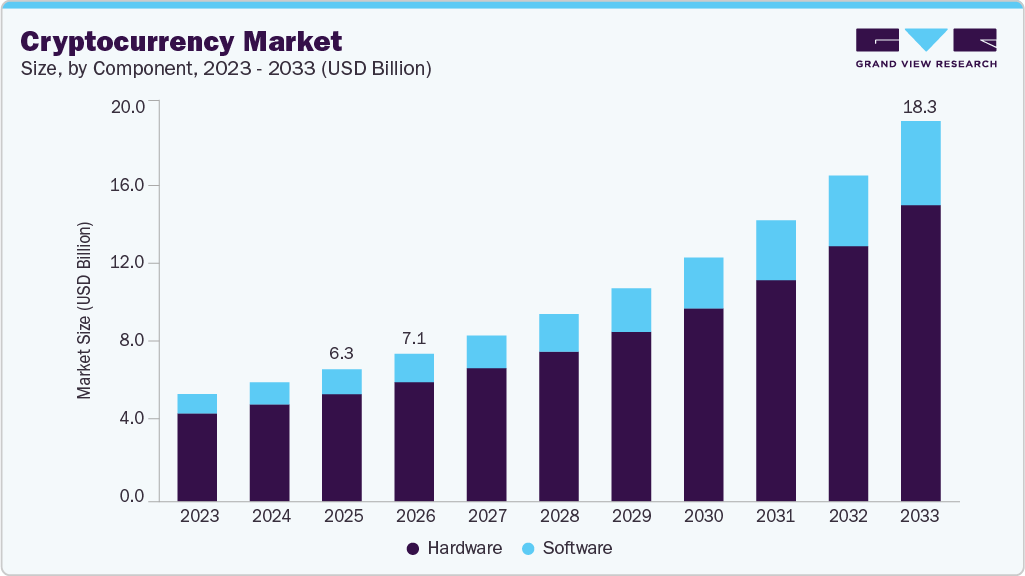 To learn more about this report, Download Free Sample Report
 The growing prominence of cryptocurrency as a decentralized asset class has drawn significant investment from private venture firms, contributing to the market's ongoing expansion. In November 2024, the cryptocurrency industry reached a remarkable milestone, with its total market capitalization hitting a record high of USD 3.2 trillion, according to CoinGecko. This surge in value reflects growing interest and investment in cryptocurrencies, driven by increased institutional adoption, advances in blockchain technology, and the expansion of decentralized finance (DeFi) platforms.
One of the key factors driving the growth of digital currency is the increasing number of businesses that now accept cryptocurrency as a legitimate payment method. In addition, the adoption of digital currency by major corporations such as Tesla Inc. and MasterCard Inc. is expected to drive industry growth. For instance, in November 2021, MasterCard Inc., a financial services company, allowed its network partners to enable their customers to purchase, trade, and hold digital currency using a digital wallet. Moreover, the business offered digital currency as a reward for the clients who participated in loyalty programs.
Government bodies across the globe are focusing on devising laws to regulate cryptocurrencies. The European Union has developed the Markets in Crypto Assets (MiCA) law to create a legal framework specifically designed for the crypto asset market. Additionally, in February 2022, the Indian government took a step towards legalizing cryptocurrency by announcing a 30.0% tax on any income generated from the transfer of digital currencies. Cryptocurrencies, such as Bitcoin, have been gaining traction in high-inflation countries, including Argentina, Zimbabwe, and Brazil, as their local currencies devalue.
Although Bitcoin is a cutting-edge financial technology, its growth is expected to be constrained by the lack of regulations and a unified standard for exchanging digital currency. Regulators from around the world are concerned about the use of cryptocurrencies for illicit purposes, which poses a significant barrier to the market's expansion. However, law enforcement agencies are making efforts to seize illegally acquired cryptocurrency, which bodes well for the market growth.
Market Dynamics
The increasing tokenization of real-world assets (RWAs) is set to drive growth in the cryptocurrency market by enabling fractional ownership and improving liquidity in traditionally illiquid asset classes such as real estate, bonds, commodities, and private equity. Through blockchain-based tokenization, ownership rights can be digitally represented and traded in smaller units, lowering entry barriers for retail investors while expanding access to alternative investments. The ability to streamline settlement processes, reduce reliance on intermediaries, and improve asset transparency is expected to strengthen blockchain's utility in financial ecosystems, creating additional demand for cryptocurrency-related infrastructure and smart contract platforms.
The growing institutional focus on tokenized assets demonstrates the increasing practical use of blockchain beyond speculative digital asset trading. In May 2025, the U.S. Securities and Exchange Commission (SEC) noted that tokenization can influence financial market activities, including asset issuance, transfer, settlement, and ownership management, while supporting applications such as tokenized real estate titles and intellectual property rights. In addition, the U.S. Department of the Treasury’s Treasury Borrowing Advisory Committee (TBAC) emphasized that tokenization can improve financial-market efficiency through programmable ownership structures, smart contracts, and atomic settlement mechanisms. Such developments indicate the increasing integration of blockchain with conventional financial assets, which is expected to support cryptocurrency market expansion during the forecast period.
The substantial energy consumption associated with cryptocurrency mining, particularly proof-of-work (PoW)-based blockchain networks, is restraining market growth. Mining activities require extensive computational resources to validate transactions and secure decentralized networks, leading to high electricity consumption and growing environmental concerns. Increasing scrutiny related to carbon emissions, electricity demand, and sustainability objectives is expected to create operational challenges for mining companies, particularly in regions with strict environmental policies and energy-efficiency regulations.
Government institutions are increasingly evaluating the environmental impact of cryptocurrency mining activities. According to the U.S. Energy Information Administration (EIA), cryptocurrency mining accounts for an estimated 0.6% to 2.3% of total electricity consumption in the U.S., raising concerns about power grid reliability and rising electricity demand. Furthermore, the White House Office of Science and Technology Policy highlighted the need to reduce greenhouse gas emissions linked to digital asset technologies and encouraged the transition toward lower-energy alternatives to energy-intensive mining practices. Such environmental scrutiny and regulatory pressure are anticipated to limit expansion opportunities for mining-intensive cryptocurrencies, thereby restraining broader market growth.
The increasing development of Central Bank Digital Currency (CBDC) infrastructure is expected to create substantial opportunities for the cryptocurrency market through the emergence of interoperability solutions, tokenized settlement systems, and blockchain-based financial infrastructure. As central banks increasingly explore programmable digital currencies, demand for secure digital custody systems, blockchain compliance tools, smart contract auditing, and cross-platform transaction capabilities is anticipated to rise. The expansion of CBDC ecosystems is expected to encourage collaboration between public financial institutions and private blockchain technology providers, creating growth opportunities for cryptocurrency-related service providers.
Several global financial institutions are actively advancing CBDC frameworks, creating a favorable environment for digital asset infrastructure expansion. The U.S. Federal Reserve has stated that a CBDC could enhance payment-system efficiency through secure digital transaction capabilities and improved settlement processes. In addition, the International Monetary Fund (IMF) introduced its CBDC Virtual Handbook to support policymakers on issues including financial stability, cross-border payments, and digital monetary systems. Similarly, the Bank for International Settlements (BIS) identified CBDCs and tokenized financial systems as critical components of the future monetary ecosystem, emphasizing interoperability and efficient settlement networks. These developments are expected to generate opportunities for cryptocurrency infrastructure providers as financial systems increasingly transition toward digitally integrated transaction models.
Market Concentration & Characteristics
The cryptocurrency market is moderately fragmented, with a mix of large cryptocurrency exchanges, blockchain infrastructure providers, mining hardware manufacturers, and digital asset service companies operating across global markets. Major companies such as Binance, Ripple, NVIDIA Corporation, and Advanced Micro Devices, Inc. hold notable market positions due to their strong technology capabilities, extensive customer bases, and broad cryptocurrency ecosystems. However, the market also includes several regional exchanges, blockchain startups, and specialized crypto service providers that compete by offering innovative services and niche blockchain applications.
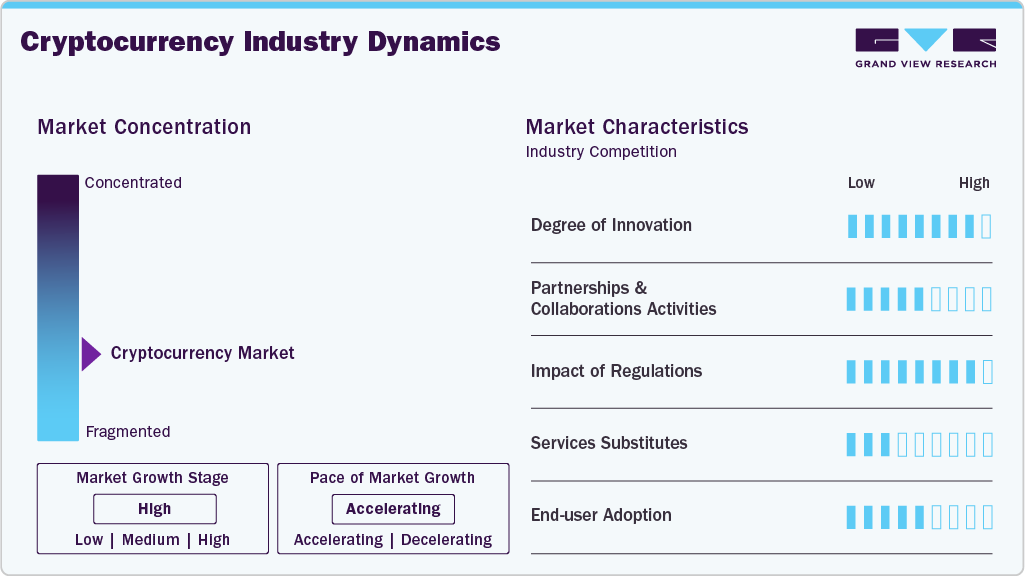 To learn more about this report, Download Free Sample Report
 The market is characterized by rapid technological innovation, increasing institutional participation, and growing adoption of blockchain-based financial solutions. Companies are focusing on expanding digital asset trading platforms, improving blockchain scalability, strengthening cybersecurity infrastructure, and developing institutional-grade custody and payment solutions to maintain competitiveness. In addition, evolving regulatory frameworks, increasing investments in decentralized finance (DeFi), and rising demand for cryptocurrency mining and blockchain computing infrastructure continue to drive strategic partnerships, product innovation, and moderate consolidation across the cryptocurrency industry.
Component Insights
The hardware segment led the market with the largest revenue share of 81.2% in 2025. Factors such as higher processing speed and reduced power consumption of cryptocurrency miners are expected to drive the growth of the hardware segment. The shifting consumer expectations have led many businesses to develop Bitcoin mining hardware. Hardware such as graphics processing units, which are fast, efficient, and stable, is needed to build mining devices. Such factors are projected to drive considerable growth in the industry during the forecast period.
The software segment is expected to grow at the fastest CAGR during the forecast period. The growth can be attributed to the increasing demand for software designed for the exchange and mining of cryptocurrencies. The development of software to manage the massive volume of data generated by cryptocurrencies is expected to support the segment's growth. Furthermore, the growing demand for cryptocurrencies around the globe has increased the demand for crypto wallets and crypto exchange software, which is expected to augment the segment growth.
Hardware Insights
The application-specific integrated circuit segment accounted for the largest share in 2025. Application-specific integrated circuits (ASICs) are electronic circuits designed explicitly for mining virtual currencies such as Bitcoin, Litecoin, and Ethereum. Several companies are adopting ASIC miners to mine cryptocurrency, driven by the growing need for low-energy devices. Additionally, ASICs require less maintenance and enable efficient use of energy, which is expected to support the growth of the segment.
The graphics processing unit segment is expected to grow at the fastest CAGR during the forecast period. The growth is attributed to the increasing demand for GPUs for cryptocurrency mining, as they offer high processing speeds and consume less power. Several cryptocurrency miners are encouraged to consider using GPUs for mining.
Software Insights
The exchange software segment accounted for the largest market revenue share in 2025. The use of exchange software is essential for completing cryptocurrency transactions since it facilitates the conversion of cryptocurrency coins to fiat currencies and vice versa. The growing development of crypto exchange software to enable seamless cryptocurrency trading is anticipated to aid the segment's growth. For instance, in March 2021, Openware Inc., a Fintech software company, launched a crypto-exchange software platform, Exchange Liquidity Network (ELN), named OpenDAX3. It is designed to provide enhanced exchange services, facilitating the trading of cryptocurrencies, assets, and security tokens.
The wallet segment is expected to register the fastest CAGR during the forecast period. The growth of the segment can be attributed to the increased usage of cryptocurrency wallets, as they offer consumers online tools for securely managing and storing blockchain assets. The ability to store and exchange various cryptocurrencies, including Bitcoin, Litecoin, and Ethereum, is made possible via multi-asset cryptocurrency wallets. In addition, several companies offering cryptocurrency wallet services are focusing on developing crypto wallets that enable users to send or receive cryptocurrencies via mobile applications. For instance, in January 2022, Robinhood, a cryptocurrency wallet service provider, launched its upcoming beta version of cryptocurrency wallets. The wallet is designed to enable its customers to trade, send, and receive cryptocurrencies using the Robinhood application.
Process Insights
The mining segment accounted for the largest share of market revenue in 2025. Blockchain transactions are validated and verified as part of the mining process. New coins are added to the current supply chain through mining activities. To provide cryptocurrency miners with a better mining experience, many businesses around the world are focusing on building and operating crypto mining farms. These crypto miner farms are well-positioned to run their mining operations, as they receive electricity from the public grid.
The transaction segment is expected to register the fastest CAGR during the forecast period. The need for high-performance transaction services among organizations is rising due the rapid technological advancements such as digitization and automation. As a result, many players worldwide are concentrating on creating Wallet as a Service (WaaS) to offer safe digital wallet choices for the businesses to carry out their transactions effectively to meet the demand for high-performance transactions. For instance, in November 2021, Crypto APIs, a blockchain development company, launched Wallet as a Service (WaaS) in partnership with Sepior, a Fintech company. WaaS was created to provide small & medium businesses, institutions, and enterprises with a secure and reliable multicurrency digital wallet for conducting cryptographic transactions.
Type Insights
The Bitcoin segment accounted for the largest market revenue share in 2025. Bitcoin is a virtual currency operating as a decentralized alternative payment method. The emergence of Bitcoin Exchange-Traded Funds (ETFs) is anticipated to increase the volume of global bitcoin trading during the forecast period. For instance, in May 2022, the Purpose Bitcoin ETF in Canada experienced the largest inflow of USD 207 million.
Ethereum is projected to grow at the fastest CAGR over the forecast period. Ethereum is an open-source software platform that enables users to develop a wide range of decentralized applications. Due to the proliferation of new projects on the Ethereum network, network traffic has increased considerably, directly related to the expansion of the Ethereum market. Smart contracts were initially applied to algorithm-based financial transactions with Ethereum.
On the blockchain network, smart contracts are written instructions that facilitate the execution of transactions. Ethereum's transition to proof-of-stake in September 2022 significantly reduced its energy consumption by eliminating energy-intensive proof-of-work mining. The network is now secured by validators who stake ETH, supporting a more energy-efficient blockchain infrastructure.
End-use Insights
The trading segment led the market with the largest revenue share of 28.72% in 2025. Trading in cryptocurrencies enables users to purchase, sell, and view their asset balances, as well as obtain deposit addresses. Several browser technology providers are forming alliances with blockchain technology firms to enable their clients to trade cryptocurrencies easily.
 To learn more about this report, Download Free Sample Report
 The retail & e-commerce segment is projected to grow at the fastest CAGR over the forecast period. The rising number of retail & e-commerce companies that are accepting cryptocurrencies as an official payment method is one of the major factors driving segment growth. Several cryptocurrency payment processors are forming strategic partnerships with e-commerce companies to boost the adoption of digital currencies for payments.
Regional Insights
The North America cryptocurrency market is anticipated to grow at a significant CAGR during the forecast period. The presence and concentration of prominent cryptocurrency farms such as Riot Blockchain, Marathon Digital, and Bitfarm make North America a promising market for cryptocurrency mining. Moreover, the increasing adoption of cryptocurrencies used for payments in malls and restaurants has created more growth opportunities for crypto miners in the region, which, in turn, is boosting the cryptocurrency industry in North America.
U.S. Cryptocurrency Market Trends
The U.S. cryptocurrency market accounted for the largest share of market revenue in North America in 2025. Major financial institutions and corporations in the U.S. are increasingly recognizing the potential of cryptocurrencies as a viable asset class. Investment firms, banks, and asset managers are including cryptocurrencies in their portfolios, driven by growing client demand and the desire to diversify investment offerings. This mainstream acceptance in the country drives growth of the cryptocurrency industry.
Europe Cryptocurrency Market Trends
The cryptocurrency market in Europe was identified as a lucrative region in 2025. The progressive regulatory landscape is driving the growth of the market. The European Union has introduced comprehensive regulations, such as the Markets in Crypto-Assets Regulation (MiCA), to standardize and legitimize the use of cryptocurrencies across member states. These regulations bring greater transparency and security, making it easier for companies to operate while increasing investors' confidence.
The UK cryptocurrency market is expected to grow at a rapid CAGR during the forecast period, due to the increasing interest of institutions in the cryptocurrency industry. Several prominent financial institutions and fintech companies are incorporating crypto assets into their portfolios, recognizing digital currencies as an alternative investment and a potential hedge against market volatility.
Asia Pacific Cryptocurrency Market Trends
Asia Pacific dominated the global cryptocurrency market with the largest revenue share of 31.0% in 2025 and is expected to grow at the fastest CAGR from 2026 to 2033. The presence of cryptocurrency-related startups and projects in the region drives the growth of the market. Countries such as South Korea and Hong Kong are investing heavily in blockchain research and development, and have developed infrastructure that facilitates the use of cryptocurrencies for various applications, including payments and smart contracts. This active innovation ecosystem, combined with strategic investments in cryptocurrency mining, is driving the growth of the cryptocurrency industry in the region.
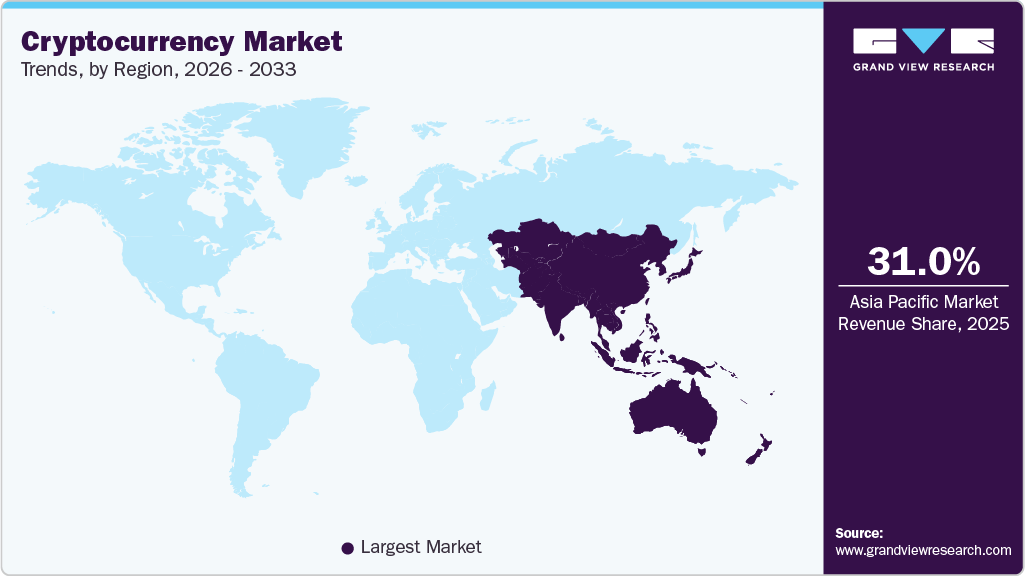 To learn more about this report, Download Free Sample Report
 The cryptocurrency market in Japan is expected to experience rapid growth in the coming years, driven by an increasing emphasis on blockchain and cryptocurrency innovation. The government actively promoted the development of blockchain technology through various initiatives and partnerships with private companies, fostering a favorable environment for crypto innovation.
The China cryptocurrency market held a substantial market share in 2025, owing to its dominating position in mining hardware production. Chinese manufacturers, particularly companies like Bitmain, are major suppliers of mining equipment used globally. The country’s advanced manufacturing capabilities and economies of scale allow Chinese companies to produce high-performance hardware that is in high demand for cryptocurrency mining operations across the globe, thereby driving the growth of the market.
Key Cryptocurrency Company Insights
Some of the key companies in the cryptocurrency industry include Advanced Micro Devices, Inc., Binance, Bitfury Group Limited, NVIDIA Corporation, and others. Organizations are focusing on increasing their customer base to gain a competitive edge in the industry. Therefore, key players are taking several strategic initiatives, such as mergers and acquisitions, and partnerships with other major companies.
-
Advanced Micro Devices is a semiconductor company with a significant presence in the cryptocurrency industry, primarily through its production of high-performance graphics processing units. Its Radeon GPUs have gained a reputation among cryptocurrency miners for efficiently handling the complex calculations required to mine digital currencies such as Bitcoin, Ethereum, and other altcoins. These GPUs are built to deliver excellent performance in parallel processing, which is essential for the high demands of cryptocurrency mining.
-
Binance is a cryptocurrency exchange ecosystem. Various solutions such as Binance Exchange, Binance Academy, Binance Charity, Binance Info, Binance Labs, Binance Launchpad, Binance Research, Binance Trust Wallet, and Binance Chain fall under the company Binance Holdings Ltd. All these solutions cater to different needs and requirements, which enable the smooth functioning and use of blockchain and cryptocurrency.
Key Cryptocurrency Companies:
The following are the leading companies in the cryptocurrency market. These companies collectively hold the largest market share and dictate industry trends.
- Advanced Micro Devices, Inc.
- Binance
- Bitfury Group Limited
- BitGo Holdings, Inc.
- Bitmain Technologies Holding Company
- Intel Corporation
- NVIDIA Corporation
- Ripple
- Xapo Holdings Limited
- Xilinx, Inc. (acquired by Advanced Micro Devices in 2022)
Competitive Benchmarking
Operating Strategies
Competitive Edge
Weaknesses
Mature Players: Binance; NVIDIA Corporation; Intel Corporation; Ripple; Bitmain Technologies Holding Company; Advanced Micro Devices, Inc.
- Focus on expanding cryptocurrency infrastructure through mining hardware, blockchain platforms, trading ecosystems, and enterprise blockchain solutions.
- Invest heavily in AI chips, high-performance GPUs, ASIC mining systems, and secure crypto transaction technologies.
- Strengthen market presence through partnerships, ecosystem expansion, and integration of digital asset services.
- Strong global brand recognition, large customer bases, and advanced technology infrastructure support market leadership.
- Ability to provide integrated cryptocurrency trading, mining, blockchain, and payment solutions across multiple regions.
- Significant investments in R&D and computing technologies improve scalability, processing power, and transaction efficiency.
- High exposure to cryptocurrency market volatility, regulatory uncertainties, and cybersecurity risks.
- Large-scale operations and compliance requirements increase operational complexity and costs.
- Dependence on crypto trading volumes and mining demand impacts revenue stability during market downturns.
Emerging Players: BitGo Holdings, Inc.; Bitfury Group Limited; Xapo Holdings Limited
- Focus on secure digital asset custody, blockchain infrastructure, crypto security, and specialized mining technologies.
- Develop cloud-based blockchain services, institutional crypto solutions, and digital asset management platforms.
- Expand through partnerships with financial institutions, fintech firms, and blockchain ecosystem providers.
- Greater flexibility and faster innovation in blockchain security, crypto custody, and digital asset solutions.
- Specialized technology offerings help attract institutional investors and enterprise blockchain users.
- Agile operational models support quicker adoption of emerging cryptocurrency technologies and trends.
- Limited global scale and smaller customer bases compared to major cryptocurrency leaders.
- Heavy dependence on external funding, crypto market sentiment, and institutional adoption trends.
- Regulatory changes and security concerns restrict expansion and affect long-term profitability.
Recent Developments
-
In December 2025, Binance launched Binance Junior, a new parent-supervised crypto savings account for children aged 6-17 years. The account allows parents to open, monitor, and control all activities, including funding the account and disabling it at any time. Children aged 13 and older (depending on local rules) can initiate transfers within strict daily limits. Still, trading and transfers to non-parent adults are restricted for safety reasons. Savings in the Junior account grow through Binance Flexible Simple Earn, ensuring exposure to crypto without trading risk. Binance aims to help families introduce children to financial literacy and digital-asset savings, while emphasising that crypto markets remain highly volatile and risky.
-
In November 2024, Ingenico and Crypto.com announced a significant partnership to revolutionize payment solutions for merchants worldwide by enabling cryptocurrency transactions. This collaboration introduced a "plug-and-play" system that enables Ingenico's merchants to seamlessly accept cryptocurrency payments while ensuring that funds are settled in local currencies, such as GBP, EUR, AUD, and USD, thereby mitigating the currency risk associated with cryptocurrency volatility.
-
In November 2024, Coinbase launched an Engineering Hub in Singapore in partnership with the Singapore Economic Development Board (EDB), aiming to enhance the local developer ecosystem and support blockchain innovation in the region. This initiative is designed to empower local engineers by providing them with essential resources and training, thereby fostering innovation and advancing Singapore's capabilities in blockchain technology.
Cryptocurrency Market Report Scope
Report Attribute
Details
Market size in 2025
USD 6.3 billion
Estimated market size in 2026
USD 7.0 billion
Projected market size by 2033
USD 18.2 billion
Growth rate
CAGR of 14.5% from 2026 to 2033
Base year for estimation
2025
Historical data
2021 - 2025
Forecast period
2026 - 2033
Quantitative units
Revenue in USD million/billion, and CAGR from 2026 to 2033
Report coverage
Revenue forecast, company ranking, competitive landscape, growth factors, and trends
Segments covered
Component, process, type, end-use, region
Regional scope
North America; Europe; Asia Pacific; Latin America; MEA
Country scope
U.S.; Canada; Mexico; Germany; UK; France; China; Japan; India; South Korea; Australia; Brazil; KSA; UAE; South Africa
Key companies profiled
Advanced Micro Devices, Inc.; Binance; Bitfury Group Limited; BitGo Holdings, Inc.; Bitmain Technologies Holding Company; Intel Corporation; NVIDIA Corporation; Ripple; Xapo Holdings Limited; Xilinx, Inc. (acquired by Advanced Micro Devices in 2022)
Customization scope
Free report customization (equivalent to up to 8 analyst working days) with purchase. Addition or alteration to country, regional & segment scope.
Pricing and purchase options
Avail customized purchase options to meet your exact research needs. Explore purchase options
Global Cryptocurrency Market Report Segmentation
This report forecasts revenue growth at global, regional, and country levels and provides an analysis of the latest industry trends in each of the sub-segments from 2021 to 2033. For this study, Grand View Research has segmented the global cryptocurrency market report based on component, process, type, end-use, and region.
-
Component Outlook (Revenue, USD Billion, 2021 - 2033)
-
Hardware
-
Central Processing Unit
-
Graphics Processing Unit
-
Application-Specific Integrated Circuit
-
Field Programmable Gate Array
-
-
Software
-
Mining Software
-
Exchange Software
-
Wallet
-
Payment
-
Others
-
-
-
Process Outlook (Revenue, USD Billion, 2021 - 2033)
-
Mining
-
Transaction
-
-
Type Outlook (Revenue, USD Billion, 2021 - 2033)
-
Bitcoin
-
Bitcoin Cash
-
Ethereum
-
Litecoin
-
Ripple
-
Others
-
-
End-use Outlook (Revenue, USD Billion, 2021 - 2033)
-
Banking
-
Gaming
-
Government
-
Healthcare
-
Retail & E-commerce
-
Trading
-
Others
-
-
Regional Outlook (Revenue, USD Billion, 2021 - 2033)
-
North America
-
U.S.
-
Canada
-
Mexico
-
-
Europe
-
Germany
-
UK
-
France
-
-
Asia Pacific
-
China
-
Japan
-
India
-
South Korea
-
Australia
-
-
Latin America
-
Brazil
-
-
Middle East and Africa (MEA)
-
KSA
-
UAE
-
South Africa
-
-
Delivered Customizations
This report has been delivered with the following In-depth customizations
Client Request
Customization Delivered
Value Adds
Blockchain & Digital Asset Ecosystem Study
Analysis of blockchain infrastructure trends
Competitive benchmarking of crypto exchanges and platforms
Evaluation of DeFi and Web3 developmentsSupported technology roadmap planning
Identified emerging ecosystem opportunitiesCryptocurrency Adoption Analysis
Country-level cryptocurrency adoption assessment
Analysis of retail and institutional participation
Regulatory framework comparisonIdentified high-growth crypto markets
Supported expansion and investment planningRegulatory & Compliance Assessment
Review of crypto taxation and compliance regulations
Analysis of AML/KYC requirements
Regional policy comparisonSupported regulatory compliance planning
Reduced operational and legal risksFrequently Asked Questions About This Report
The global cryptocurrency market size was estimated at USD 6.3 billion in 2025 and is expected to reach USD 7.0 billion in 2026.
The global cryptocurrency market is expected to grow at a compound annual growth rate of 14.5% from 2026 to 2033 to reach USD 18.2 billion by 2033.
The Asia Pacific dominated the cryptocurrency market with a share of 31.0% in 2025. The presence of cryptocurrency mining companies such as Ebang International Holdings, Inc., Bitmain Technologies Limited., Canaan, Inc., and others are expected to support the market growth in the region.
Key factors that are driving the market growth include high charges of cross-border remittance and transparency of distributed ledger technology.
Asia Pacific dominated with a 31.0% revenue share in 2025.
Application-specific integrated circuit segment accounted for the largest market revenue share in 2025.
Exchange software accounted for the largest market revenue share in 2025.
Hardware held the largest share (over 81.2%) in 2025 and is the fastest-growing model.
Some key players operating in the cryptocurrency market include Advanced Micro Devices, Inc., Binance, Bitfury Group Limited, BitGo Holdings, Inc., Bitmain Technologies Holding Company, Intel Corporation, NVIDIA Corporation, Ripple, Xapo Holdings Limited, and Xilinx, Inc. (acquired by Advanced Micro Devices in 2022).
About the Author(s)
Next Generation Technologies Research Team
Technology · Next Generation TechnologiesThis report was authored by the next generation technologies research team at Grand View Research - comprising two research analysts, one senior research analyst, and one industry expert - with specialized expertise in the next generation technologies segment of the technology industry. All findings are based on proprietary technology databases, executive interviews, and regulatory analysis, subject to internal peer review prior to publication.
Last Updated:
Speak to Analyst

Customize this report to your needs - add regions, segments, or data points, with 20% free customization.
Or view our licence options:


ISO 9001:2015 & 27001:2022 Certified
We are GDPR and CCPA compliant! Your transaction & personal information is safe and secure. For more details, please read our privacy policy.


