
- Home
- »
- Next Generation Technologies
- »
-
Web Development Market Size & Share Report, 2026-2033GVR Report cover
![Web Development Market (2026 - 2033)Report]()
Web Development Market (2026 - 2033)
Size, Share & Trends Analysis Report By Service Type, By Deployment (On-Premises, Cloud, Hybrid), By Enterprise Size (Large Enterprises, Small & Medium Enterprises), By End User, By Region, And Segment Forecasts
Market Size, 2025
$80.6BMarket Estimate, 2026
$86.9BMarket Forecast, 2033
$151.9BCAGR, 2026–2033
8.3%Web Development Market Summary
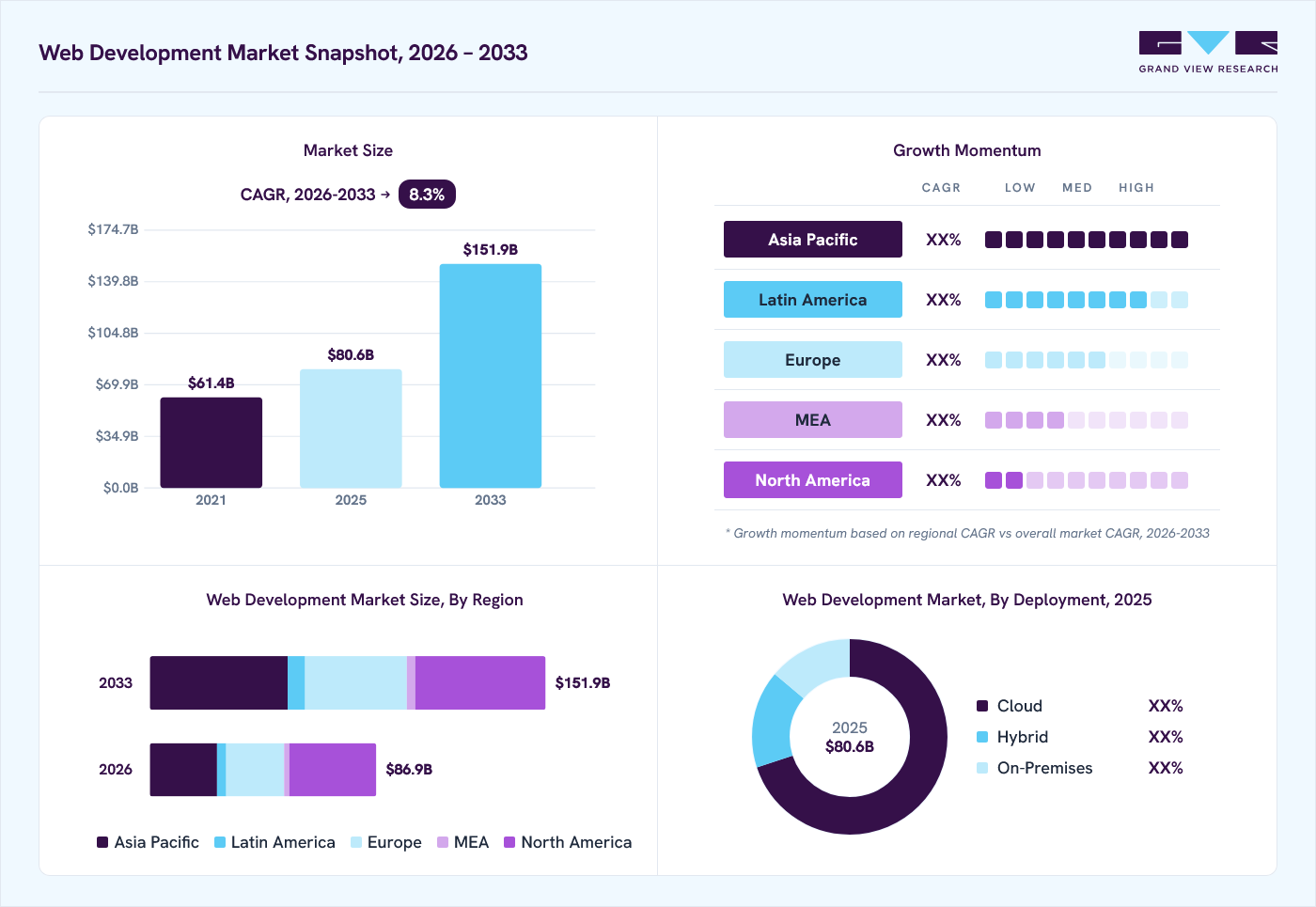
The global web development market size was valued at USD 80.6 billion in 2025 and is projected to grow from USD 86.9 billion in 2026 to USD 151.9 billion by 2033, at a CAGR of 8.3% from 2026 to 2033. North America dominated the market, accounting for a revenue share of 39.2% in 2025. This market expansion is driven by the growing adoption of AI-powered website development and headless architecture, as businesses increasingly prioritize personalized user experiences, faster content delivery, and scalable digital platforms across web and mobile channels.
Key Market Trends & Insights
- By service type: Web application development held the largest revenue share of 32.6% in 2025
- By deployment: Cloud segment held the largest market share of 69.9% in 2025
- By enterprise size: Large enterprises held the largest market share of 61.8% in 2025
- By end user: Retail & e-commerce held the largest market share of 30.2% in 2025
Regional Highlights
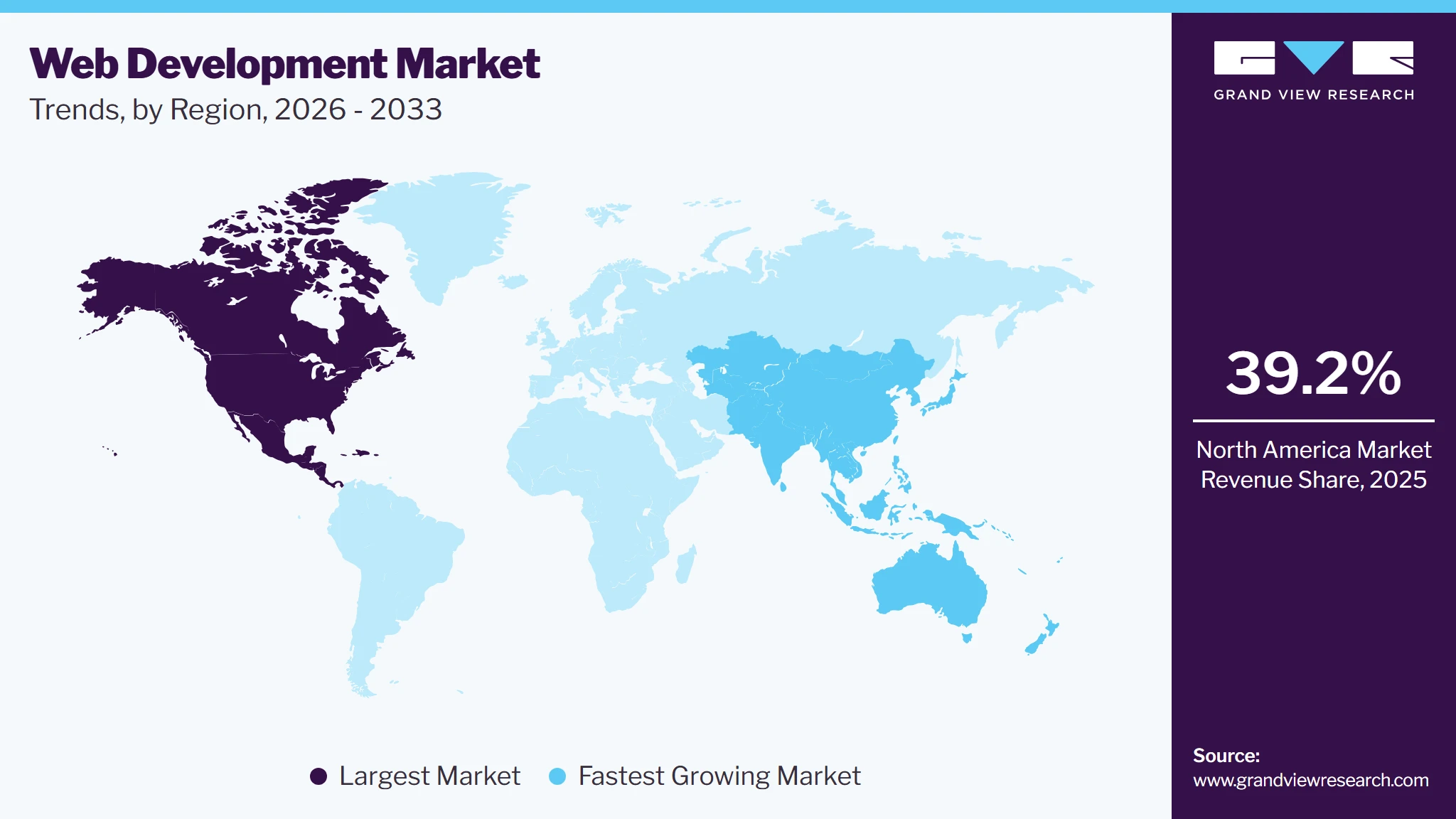
- Largest regional market: North America (39.2% revenue share, 2025)
- Fastest-growing regional market: Asia Pacific (fastest CAGR, 2026-2033)
- By country: The U.S. held the largest market share in 2025
Market Size & Forecast
- Market Size in 2025: USD 80.6 Billion
- Estimated Market Size in 2026: USD 86.9 Billion
- Projected Market Size by 2033: USD 151.9 Billion
- CAGR (2026-2033): 8.3%
Three ways to get this report
Buy it, customize it, or ask a question.Ask an Analyst
A direct answer, usually in 1 working day
- AccessReport author, directly
- Reply timeWithin 1 working day
- No sales callDirect answer only
- FormatEmail reply
- CostFree, no cost
Get the Full Report
What the study covers
- FormatsPDF · Excel · Dashboard
- Timeline2026–2033 annual, 2025 base
- Coverage20+ countries, 5 regions
- Companies10+ key players profiled
Customize the Report
20% free customization
- IncludeCountries, segments, points
- TailorTo your product definition
- ExtendDeeper competitor detail
- OrA fully bespoke study
- Turnaround5–10 working days
Organizations across industries are accelerating digital transformation initiatives to improve customer engagement and streamline business operations. A modern website has become a core business asset for attracting customers, enabling online transactions, and delivering digital services. Companies are also integrating websites with mobile applications, CRM systems, payment gateways, and customer support platforms to provide a seamless omnichannel experience. This has increased the need for custom web development, regular website upgrades, and performance optimization. As businesses continue to strengthen their digital presence, demand for professional web development services is expanding globally.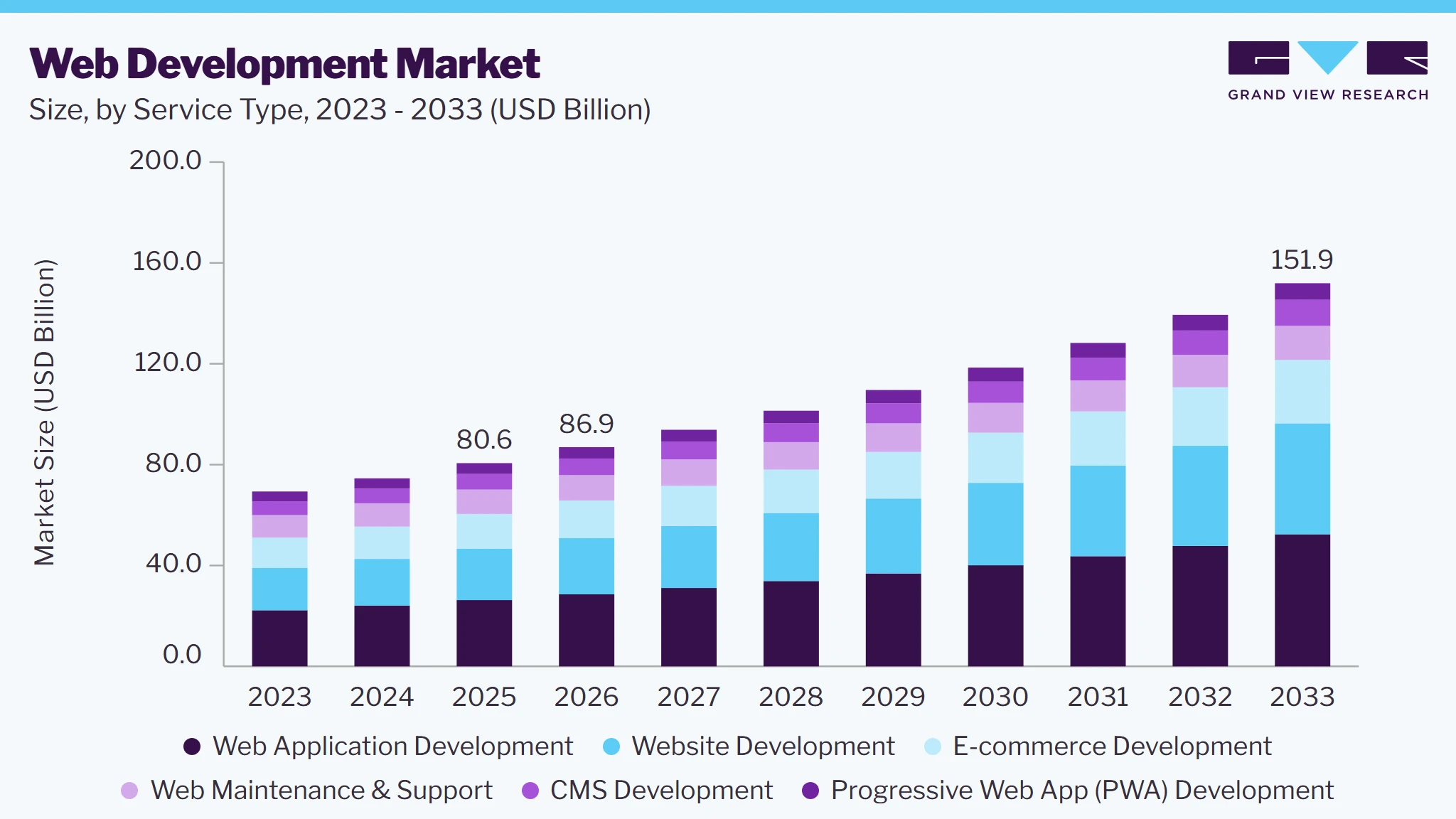
Businesses are increasingly adopting cloud-native architectures, AI-powered development tools, headless CMS platforms, and API-based frameworks to build scalable and high-performance websites and web applications. These technologies reduce development time, improve collaboration, and simplify maintenance while enabling faster deployment of new features. AI-driven capabilities such as code generation, chatbots, and personalized user experiences are also becoming standard in modern web projects. At the same time, enterprises are replacing legacy websites with secure, responsive, and cloud-based platforms. This technology shift continues to support the growth of the web development industry.
Furthermore, the increasing number of small and medium-sized enterprises (SMEs), startups, and online businesses is creating sustained demand for web development services. Businesses are investing in professional websites to improve brand visibility, reach new customers, and support online sales. The rapid expansion of e-commerce has further increased the need for secure payment integration, mobile-friendly interfaces, and user-focused website design. Many SMEs also require ongoing website maintenance, feature upgrades, and digital marketing integration to remain competitive. As digital commerce continues to grow across developed and emerging economies, demand for web development services is expected to remain strong.
Market Dynamics
Many organizations continue to operate websites built on outdated technologies that limit performance, security, and compatibility with modern digital tools. As customer expectations for fast, responsive, and personalized online experiences continue to rise, businesses are replacing legacy websites with modern platforms that offer greater scalability, flexibility, and improved user experience. This transition is increasing demand for professional web development, redesign, and migration services.
Website modernization also enables organizations to integrate cloud infrastructure, APIs, AI-powered features, and advanced analytics into their digital platforms. Enterprises are increasingly migrating from legacy content management systems to modern frameworks and headless architectures to simplify updates and support omnichannel content delivery. As digital transformation initiatives continue across industries, legacy system migration remains a key driver supporting the market growth.
The web development market is facing challenges due to the limited availability of professionals with expertise in modern frameworks, cloud technologies, cybersecurity, AI integration, and user experience design. As businesses demand more advanced, feature-rich, and scalable web applications, development projects have become increasingly complex and require multidisciplinary technical skills. These skills gap often makes it difficult for service providers to meet project timelines and maintain consistent quality.
Furthermore, organizations must continuously update websites to keep pace with evolving technologies, changing customer expectations, and security requirements, increasing development and maintenance costs. Small and medium-sized enterprises, in particular, may delay or reduce web development investments because of budget constraints and limited access to experienced development teams. These factors can slow project execution and act as a restraint on the overall market growth.
The growing preference for progressive web applications (PWAs) is creating a significant opportunity for the web development market as businesses seek fast, responsive, and cost-efficient digital solutions. PWAs combine the functionality of mobile applications with the accessibility of websites, enabling offline access, faster loading times, and improved user engagement without requiring users to install a native application. This makes them particularly attractive for e-commerce, retail, financial services, and media platforms aiming to improve customer experience across multiple devices.
Moreover, the integration of artificial intelligence into web development is expanding the scope of modern websites beyond static digital platforms. Businesses are incorporating AI-powered chatbots, personalized content recommendations, intelligent search, and automated customer support to enhance user interactions and improve conversion rates. As organizations increasingly invest in intelligent, scalable, and mobile-first web experiences, demand for advanced web development services is expected to create substantial growth opportunities for solution providers.
Market Concentration & Characteristics
The web development market demonstrates a high level of innovation as developers continuously adopt technologies such as artificial intelligence, headless CMS, progressive web applications (PWAs), cloud-native architectures, and low-code/no-code platforms. Businesses are also integrating automation, personalized user experiences, and API-driven ecosystems into modern websites and web applications. Continuous advancements in development tools and frameworks are accelerating innovation across the industry.
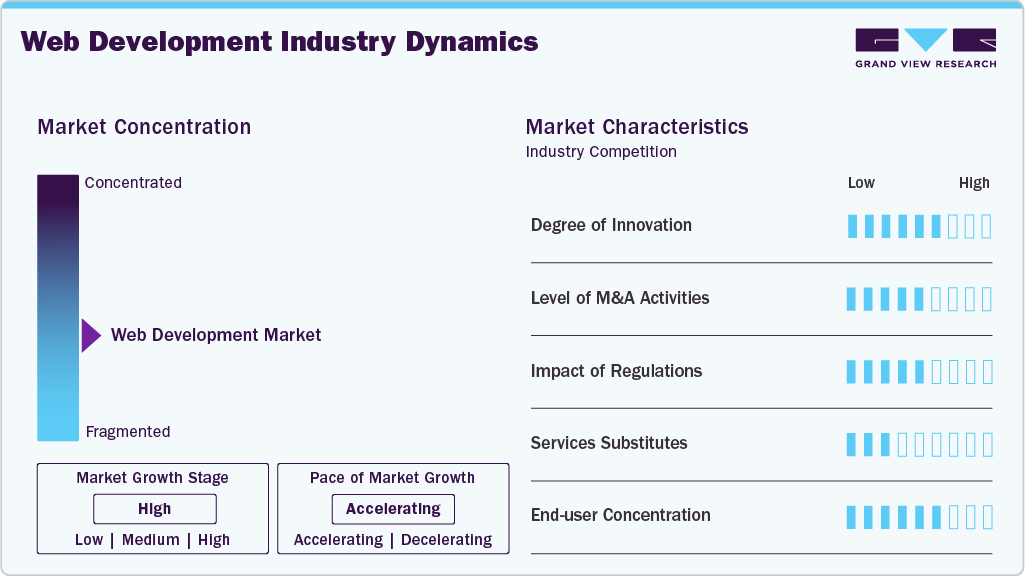
Although website builders and no-code/low-code platforms provide alternatives for basic website creation, they cannot fully replace professional web development services for complex enterprise applications and customized digital platforms. Large organizations continue to require tailored solutions, third-party integrations, advanced security, and scalable architectures that demand specialized development expertise. As a result, substitute services have only a limited impact on the broader market.
Analyst Perspective
The web development market is entering a phase where competitive differentiation is shifting beyond website creation toward delivering intelligent, scalable, and business-centric digital platforms. As enterprises accelerate digital transformation, demand is increasingly centered on cloud-native architectures, AI-enabled user experiences, API-first ecosystems, and secure, high-performance web applications that support continuous customer engagement. The strongest competitive advantage is expected to belong to service providers capable of combining web development with cloud, cybersecurity, analytics, automation, and long-term application management within a unified delivery model. As organizations view websites and web applications as core business infrastructure rather than standalone digital assets, providers offering integrated modernization, continuous optimization, and measurable business outcomes are expected to capture a larger share of enterprise spending.
Service Type Insights
The web application development segment led the web development industry in 2025, accounting for 32.6% of global revenue. The growing demand for digital business operations is driving investment in custom web application development across industries. Organizations are deploying web applications to manage customer relationships, automate workflows, support remote collaboration, and improve operational efficiency. As enterprises continue modernizing legacy systems, demand for advanced web application development services continues to increase. For instance, in June 2026, DreamHost expanded its Remixer platform into an AI-powered website and application builder capable of generating full-stack web applications, including frontend, backend, databases, and user authentication through conversational AI, reducing application development complexity for businesses.
The website development segment is expected to grow at the fastest CAGR during the forecast period. The expansion of e-commerce, digital marketing, and online customer acquisition has increased demand for professionally developed websites that deliver fast performance and seamless user experiences. Organizations are also integrating AI-based personalization, analytics, and content management capabilities into websites to improve customer interactions. Continuous website upgrades and redesign projects are supporting steady growth in website development services. For instance, in May 2026, GoDaddy introduced Airo for WordPress, an AI-powered platform that enables businesses and agencies to create, manage, and continuously improve WordPress websites through AI-assisted content creation, editing, and performance optimization within the native WordPress environment.
Deployment Insights
The cloud segment led the web development market with the largest revenue share of 69.9% in 2025, as organizations prioritize scalable, flexible, and centrally managed digital platforms. Cloud-based development environments simplify application updates, improve collaboration among distributed development teams, and support faster deployment cycles. Businesses also benefit from integrated security services, automated backups, and high application availability without extensive on-premises infrastructure. The increasing adoption of SaaS platforms, cloud-native applications, and AI-enabled web services continues to support demand for cloud-based web development solutions.
The hybrid segment is expected to grow at the fastest CAGR during the forecast period, as enterprises seek to combine the flexibility of cloud infrastructure with the control and compliance of on-premises environments. Organizations in regulated industries use hybrid architectures to manage sensitive workloads locally while deploying customer-facing applications and digital services in the cloud. This approach supports business continuity, improves system integration, and enables gradual modernization of legacy applications. Growing digital transformation initiatives and increasing demand for secure multi-environment application management continue to support the expansion of hybrid web development deployments.
Enterprise Size Insights
The large enterprises segment led the web development industry with the largest revenue share of 61.8% in 2025. Large enterprises are investing in advanced web development services to modernize legacy digital platforms and improve customer engagement across multiple channels. Their projects often involve complex system integration with ERP, CRM, cloud infrastructure, analytics, and cybersecurity solutions, creating demand for highly customized web applications. Organizations are also adopting AI-enabled features, headless architecture, and API-driven development to improve website performance and scalability.
The small & medium enterprises segment is expected to grow at the fastest CAGR during the forecast period, as these enterprises expand their digital presence to improve customer acquisition, online sales, and brand visibility, thereby increasing demand for affordable web development services. SMEs are adopting cloud-based website platforms, AI-assisted development tools, and low-code solutions to reduce implementation time and operating costs. Growing digital commerce and mobile internet usage are encouraging businesses to upgrade existing websites with responsive designs, secure payment integration, and SEO capabilities.
End User Insights
The retail & e-commerce segment led the web development market with the largest revenue share of 30.2% in 2025. Companies are investing in responsive websites, secure payment integration, personalized shopping experiences, and omnichannel platforms to improve customer engagement and conversion rates. Growing cross-border e-commerce and increasing mobile commerce activity are also driving demand for scalable and high-performance web applications. For instance, in August 2026, Hostinger introduced its Agentic AI Builder, enabling businesses to create AI-enabled websites, e-commerce platforms, SaaS applications, and digital storefronts with integrated backend functionality and marketing capabilities, supporting the next generation of web development for online businesses.
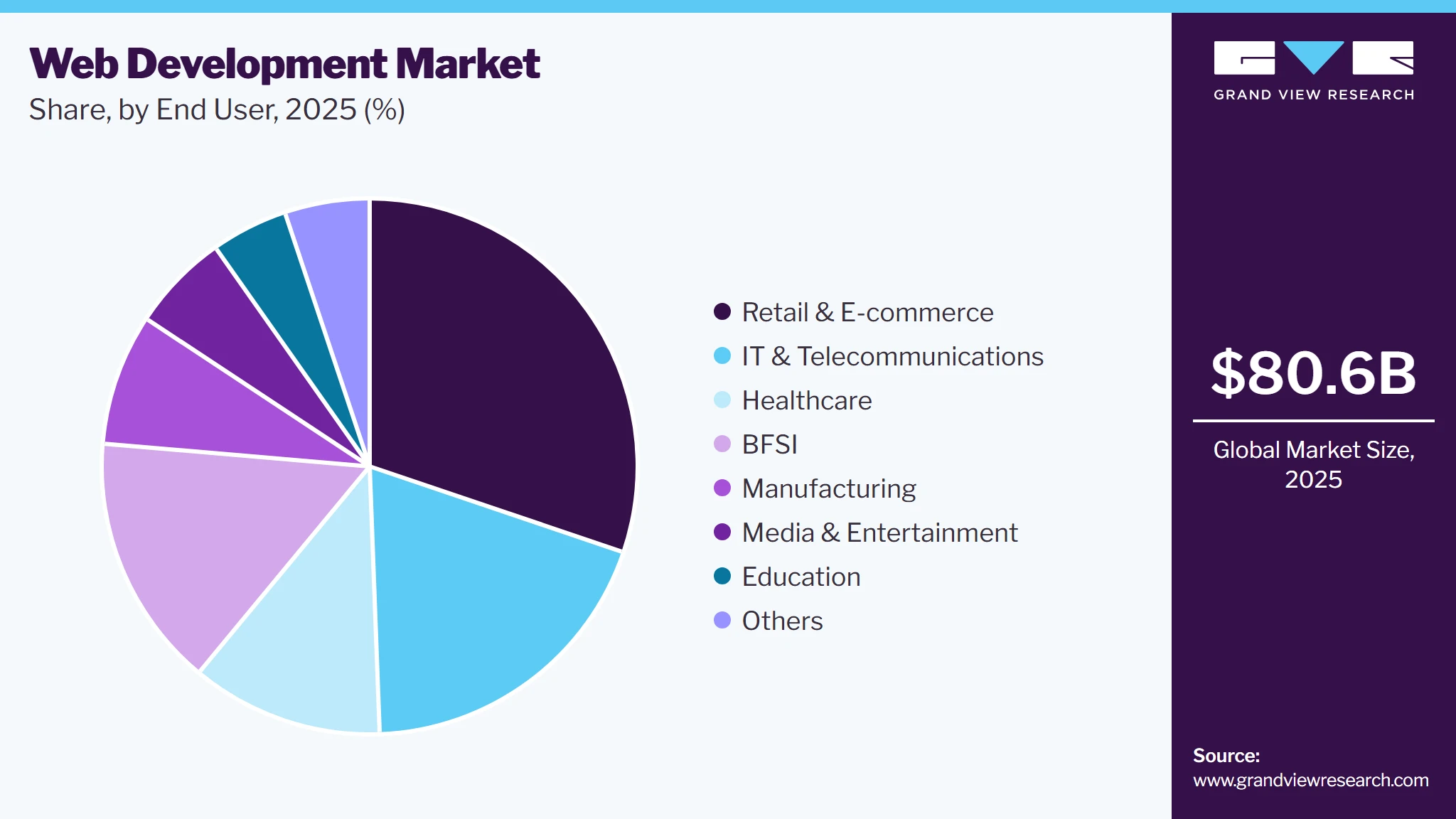
The healthcare segment is anticipated to exhibit the fastest CAGR over the forecast period. Healthcare organizations are increasing investments in web development to improve digital patient engagement, appointment scheduling, telehealth access, and secure patient portals. Modern healthcare websites are being integrated with electronic health records (EHRs), AI-powered virtual assistants, and online consultation platforms to simplify patient interactions and administrative workflows. Compliance with healthcare data privacy and cybersecurity standards is also driving demand for secure and customized web applications.
Regional Insights
North America dominated the web development market with the largest revenue share of 39.2% in 2025, due to high enterprise spending on digital transformation and continuous modernization of customer-facing platforms. Large organizations are investing in custom web applications, cloud-native architectures, and AI-enabled digital experiences to improve operational efficiency and customer engagement. The presence of a mature technology ecosystem and strong demand for enterprise-grade web solutions further supports market expansion.
U.S. Web Development Market Trends
The U.S. web development industry held the largest share of North America in 2025. The U.S. market growth is driven by the strong presence of technology companies, digital-first enterprises, and a highly developed e-commerce ecosystem that requires continuous website innovation. Organizations are investing in AI-powered web experiences, headless commerce platforms, advanced UX/UI design, and personalized digital services to maintain competitive differentiation. High demand for scalable enterprise portals, SaaS platforms, and digital customer engagement solutions continues to generate significant opportunities for web development service providers.
Europe Web Development Market Trends
Europe's web development industry is driven by stringent data privacy, cybersecurity, and digital accessibility regulations that require organizations to maintain secure and compliant websites. Businesses across industries are upgrading web platforms to align with GDPR, accessibility standards, and evolving digital compliance requirements. The region also benefits from increasing investments in digital public services and enterprise modernization initiatives across both public and private sectors.
Asia Pacific Web Development Market Trends
The Asia Pacific web development industry is expected to grow at the fastest CAGR over the forecast period. Asia Pacific is experiencing strong demand for web development services due to rapid digitalization, expanding internet penetration, and the growing number of startups and SMEs establishing an online presence. Governments and enterprises are increasing investments in digital infrastructure, cloud technologies, and digital public platforms, creating opportunities for modern web applications. Rising mobile internet usage and expanding digital economies across India, China, Southeast Asia, and other emerging markets continue to accelerate website and web application development.
Key Web Development Company Insights
Some key players in the web development market, such as Accenture plc, Capgemini SE, Globant S.A., and Cognizant Technology Solutions.
-
Accenture provides consulting, technology, engineering, operations, and digital services that support enterprise transformation across multiple industries. The company combines cloud, data, artificial intelligence, cybersecurity, and software engineering capabilities to develop scalable digital platforms and business applications. Its service portfolio includes custom web application development, digital experience design, cloud modernization, and enterprise integration. Accenture serves organizations across public and private sectors through end-to-end technology implementation and managed services.
-
Cognizant delivers digital engineering, application development, cloud, data, artificial intelligence, and IT consulting services to enterprises across diverse industries. The company supports organizations in modernizing applications, improving customer experiences, and optimizing business processes through technology-driven solutions. Its capabilities include web application development, software engineering, cloud migration, cybersecurity, and platform integration services. Cognizant also provides industry-specific digital solutions that enable organizations to build secure, scalable, and customer-focused digital ecosystems.
Key Web Development Companies
The following key companies have been profiled for this study on the web development market.
-
ACCENTURE PLC
-
Tata Consultancy Services (TCS)
-
Cognizant Technology Solutions
-
INFOSYS LIMITED
-
Capgemini SE
-
IBM Corporation
-
EPAM Systems, Inc.
-
Globant S.A.
-
Wipro Limited
-
HCLTech
Competitive Benchmarking
Category
Operating Strategies
Competitive Edge
Weakness
Established Players (Accenture plc; Capgemini SE; Infosys Limited; Tata Consultancy Services (TCS); Cognizant Technology Solutions)
- Focus on end-to-end digital transformation programs by combining web development with cloud, AI, cybersecurity, and application modernization services.
- Expand long-term enterprise engagements through managed services, global delivery models, and industry-specific digital solutions.
- Broad service portfolios supported by extensive technical expertise, global delivery capabilities, and established enterprise relationships.
- Ability to execute large-scale, multi-region web development projects with integrated consulting, implementation, and post-deployment support.
- Higher project costs and longer implementation cycles for customized enterprise engagements.
- Lower flexibility for small-scale projects due to standardized delivery processes and complex organizational structures.
Emerging Players (EPAM Systems, Inc.; Globant S.A.)
- Focus on agile development methodologies, digital engineering, cloud-native web applications, and AI-enabled user experiences.
- Strengthen market presence through innovation, strategic partnerships, and specialization in modern web technologies and design-led development.
- Faster project execution supported by agile teams and expertise in modern frameworks, headless architecture, and customer experience design.
- Strong capabilities in custom web application development, digital product engineering, and rapid technology adoption.
- Smaller enterprise client base and comparatively lower presence in large multi-country transformation programs.
- Limited service breadth and delivery scale compared with diversified global IT service providers.
Recent Developments
-
In July 2026, Globant formed a multi-year strategic partnership with Vercel to accelerate enterprise web application development through AI-powered delivery. The collaboration integrates Globant's AI Pods with Vercel's platform, enabling one-click deployment of AI-built applications and faster modernization of legacy front-end systems using Next.js.
-
In April 2026, Infosys announced a strategic collaboration with OpenAI to help enterprises accelerate AI-driven software development and application modernization. The collaboration integrates OpenAI’s models, including Codex, with Infosys Topaz Fabric to support AI-assisted engineering, legacy application modernization, and enterprise-scale AI deployment.
-
In April 2026, Accenture invested in Replit through Accenture Ventures and established a strategic collaboration to advance AI-driven software development for enterprise applications. The initiative integrates Replit's AI-powered software creation platform into enterprise engineering workflows, enabling development teams to build and refine web applications using natural language prompts and AI agents.
Web Development Market Report Scope
Report Attribute
Details
Market size value in 2025
USD 80.6 billion
Estimated market size in 2026
USD 86.9 billion
Projected market size by 2033
USD 151.9 billion
Growth Rate
CAGR of 8.3% from 2026 to 2033
Base Year
2025
Actual data
2021 - 2024
Forecast period
2026 - 2033
Quantitative units
Revenue in USD million/billion and CAGR from 2026 to 2033
Report coverage
Revenue forecast, company ranking, competitive landscape, growth factors, and trends
Segments covered
Service type, deployment, enterprise size, end user, region
Regional scope
North America; Europe; Asia Pacific; Latin America; MEA
Country scope
U.S.; Canada; Mexico; UK; Germany; France; China; India; Japan; South Korea; Australia; Brazil; Saudi Arabia; KSA; UAE
Key companies profiled
Accenture plc; Tata Consultancy Services (TCS); Cognizant Technology Solutions; Infosys Limited; Capgemini SE; IBM Corporation; EPAM Systems, Inc.; Globant S.A.; Wipro Limited; HCLTech
Customization scope
Free report customization (equivalent up to 8 analysts working days) with purchase. Addition or alteration to country, regional & segment scope.
Pricing and purchase options
Avail customized purchase options to meet your exact research needs. Explore purchase options
Global Web Development Market Report Segmentation
This report forecasts revenue growth at the global, regional, and country levels and provides an analysis of the latest industry trends in each of the sub-segments from 2021 to 2033. For this study, Grand View Research has segmented the global web development market report based on service type, enterprise size, deployment, end user, and region:
-
Service Type Outlook (Revenue, USD Million/Billion, 2021 - 2033)
-
Website Development
-
Web Application Development
-
E-commerce Development
-
CMS Development
-
Progressive Web App (PWA) Development
-
Web Maintenance & Support
-
-
Deployment Outlook (Revenue, USD Million/Billion, 2021 - 2033)
-
On-Premises
-
Cloud
-
Hybrid
-
-
Enterprise Size Outlook (Revenue, USD Million/Billion, 2021 - 2033)
-
Large Enterprises
-
Small & Medium Enterprises
-
-
End User Outlook (Revenue, USD Million/Billion, 2021 - 2033)
-
BFSI
-
Retail & E-commerce
-
IT & Telecommunication
-
Healthcare
-
Manufacturing
-
Media & Entertainment
-
Education
-
Others
-
-
Regional Outlook (Revenue, USD Million/Billion, 2021 - 2033)
-
North America
-
U.S.
-
Canada
-
Mexico
-
-
Europe
-
UK
-
Germany
-
France
-
-
Asia Pacific
-
China
-
India
-
Japan
-
Australia
-
South Korea
-
-
Latin America
-
Brazil
-
-
MEA
-
UAE
-
South Africa
-
KSA
-
-
Research Methodology
The web development market figures in this report are based on a proven research process that combines executive interviews with secondary research from proprietary databases, company filings, and recognized regulatory and institutional sources. Market size is built through value-chain sizing-reconciling supply-side and demand-side estimates-and triangulated with bottom-up and top-down approaches. Every estimate passes multiple levels of expert validation before publication, with each web development segment quantified using the revenue-capture definitions in the table below.
Segment Definition
Service Type
Revenue capture definition
Web Application Development
This segment captures revenue from custom web-based software, enterprise applications, and browser-based business solutions. It also includes application architecture, backend development, API integration, and testing services.
Website Development
Revenue is generated from designing, developing, and deploying business websites, corporate portals, and branded digital platforms. Income also includes UI/UX customization, front-end development, and website modernization projects.
CMS Development
This segment includes revenue from implementing and customizing content management systems for business websites. It covers template development, workflow configuration, plugin integration, and content migration services.
Progressive Web App (PWA) Development
Revenue is derived from developing web applications that deliver app-like functionality across browsers and mobile devices. Services include offline capabilities, push notifications, responsive interfaces, and performance optimization.
Web Maintenance & Support
This segment generates revenue from ongoing website monitoring, updates, security management, and technical support services. It also includes bug fixes, performance enhancements, backup management, and platform maintenance.
E-commerce Development
Revenue comes from developing online stores, digital marketplaces, and transaction-enabled commerce platforms. It includes payment gateway integration, shopping cart functionality, product catalog management, and order processing features.
Deployment
Revenue capture definition
Cloud
Revenue under the cloud segment is generated from web development projects hosted on public, private, or multi-cloud infrastructure. It includes cloud-native websites, web applications, hosting, deployment, maintenance, and cloud-based managed services.
On-Premises
This segment captures revenue from web development solutions deployed within an organization's own IT infrastructure to meet security, compliance, and operational requirements. It includes implementation, customization, integration, and ongoing support services.
Hybrid
The hybrid segment includes revenue from web development solutions that combine on-premises infrastructure with cloud environments for greater flexibility and workload distribution. It covers integration services, application modernization, deployment, and management across both environments.
Enterprise Size
Revenue capture definition
Large Enterprises
Large enterprises account for a significant share of the web development market as they invest in complex websites, enterprise web applications, customer portals, and ongoing platform modernization. Their spending is supported by continuous digital transformation initiatives, system integrations, and long-term maintenance services.
Small & Medium Enterprises
SMEs contribute a growing share of market revenue through investments in business websites, e-commerce platforms, and cloud-based web applications that strengthen their digital presence. Cost-effective development services, subscription-based platforms, and increasing online business adoption continue to support spending across this segment.
End User
Revenue capture definition
Retail & E-commerce
Revenue is generated from the development of e-commerce websites, online storefronts, payment integration, and ongoing website optimization services. Demand also includes platform upgrades, mobile commerce solutions, and digital customer experience enhancements.
Manufacturing
Revenue is derived from industrial websites, supplier portals, customer support platforms, and digital product catalogs. Companies also invest in web applications that connect production, sales, and supply chain operations.
Media & Entertainment
Revenue is generated from content streaming platforms, news portals, digital publishing websites, and subscription-based web services. Additional demand comes from interactive user experiences and content management solutions.
Education
Revenue is supported by the development of e-learning platforms, university websites, student portals, and virtual learning applications. Institutions also invest in content management systems and online assessment platforms.
Healthcare
Revenue comes from patient portals, telehealth websites, appointment management platforms, and healthcare information systems. Demand also includes secure web applications that support patient engagement and regulatory compliance.
BFSI
Revenue is captured through secure banking portals, insurance platforms, financial service websites, and digital onboarding solutions. Investments also include regulatory compliance, cybersecurity integration, and customer-facing web applications.
IT & Telecommunications
Revenue comes from enterprise web portals, SaaS platforms, customer self-service applications, and API-driven web solutions. Continuous demand for cloud-based applications and digital service platforms supports spending in this segment.
Others
Revenue is generated across sectors such as government, travel & hospitality, real estate, energy, and professional services through customized websites and enterprise web applications. Digital service delivery and customer engagement platforms contribute to spending across these industries.
Estimation Model
Layer Name
Key Questions
Description
Business Base Layer
Who requires web development services?
Identify the addressable business base by estimating the number of enterprises, SMEs, startups, public sector organizations, educational institutions, and digital-first businesses that require websites or web applications. This establishes the potential customer base for web development services.
Digital Adoption Layer
How many businesses invest in web development?
Apply digital transformation, website adoption, and application modernization rates to estimate the number of organizations investing in new website development, web applications, redesign projects, and maintenance services annually. This converts the addressable business base into active demand.
Service Demand Layer
Which web development services are purchased?
Measure the distribution of spending across website development, web application development, e-commerce platforms, CMS implementation, Progressive Web Applications (PWAs), and website maintenance. This reflects the adoption of different service categories across industries and enterprise sizes.
Monetization Layer
How much revenue is generated?
Apply the average project value, recurring maintenance contracts, managed services, and subscription-based development revenues across all service categories and regions. Aggregating these revenues provides the total addressable value of the global web development market.
Delivered Customizations
This report has been delivered with the following In-depth customizations
CLIENT REQUEST
CUSTOMIZATION DELIVERED
VALUE ADDS
Market Entry & Expansion Assessment
Regional demand sizing and forecasting
Customer segmentation and buying behavior analysis
Competitive landscape benchmarking
Regulatory and distribution channel assessment
Identified high-growth market opportunities
Supported go-to-market strategy development
Highlighted investment priorities and risks
Enabled data-driven expansion planning
Technology & Innovation Assessment
Emerging technology trend analysis
Innovation pipeline
Technology adoption readiness assessment
Ecosystem and partnership mapping
Identified future growth areas
Supported innovation roadmap planning
Evaluated commercialization potential
Strengthened strategic partnership decisions
Customer & End-User Insights Study
Consumer awareness and adoption analysis
Purchase decision journey mapping
Satisfaction and loyalty assessment
Usage pattern and pain-point evaluation
Revealed key adoption drivers and barriers
Supported customer-centric product development
Improved targeting and engagement strategy
Identified opportunities for retention and upselling
Frequently Asked Questions About This Report
The retail & e-commerce segment led the web development market with the largest revenue share of 30.2% in 2025.
The global web development market size was estimated at USD 80.6 billion in 2025 and is projected to grow from USD 86.9 billion in 2026
The global web development market is expected to grow at a compound annual growth rate of 8.3% from 2026 to 2033 to reach USD 151.9 billion by 2033
Web application development held the largest revenue share of 32.6% in 2025 while website development segment is expected to be the fastest-growing market.
North America dominated the web development market with a share of 39.2% in 2025.
This market expansion is driven by the growing adoption of AI-powered website development and headless architecture, as businesses increasingly prioritize personalized user experiences, faster content delivery, and scalable digital platforms across web and mobile channels.
Key players include Accenture plc; Tata Consultancy Services (TCS); Cognizant Technology Solutions; Infosys Limited; Capgemini SE; IBM Corporation; EPAM Systems, Inc.; Globant S.A.; Wipro Limited; HCLTech
Asia Pacific is the fastest-growing region over the forecast period.
The cloud segment led with a 69.9% revenue share in 2025, while hybrid is the significant growing segment.
About the Author(s)
Next Generation Technologies Research Team
Technology · Next Generation TechnologiesThis report was authored by the next generation technologies research team at Grand View Research - comprising two research analysts, one senior research analyst, and one industry expert - with specialized expertise in the next generation technologies segment of the technology industry. All findings are based on proprietary technology databases, executive interviews, and regulatory analysis, subject to internal peer review prior to publication.
Last Updated:
Speak to Analyst


Customize this report to your needs - add regions, segments, or data points, with 20% free customization.
Or view our licence options:


ISO 9001:2015 & 27001:2022 Certified
We are GDPR and CCPA compliant! Your transaction & personal information is safe and secure. For more details, please read our privacy policy.


