
- Home
- »
- Telecom Media & Technology
- »
-
Website Builder Market Size & Share Report, 2026-2035GVR Report cover

Website Builder Market (2026 - 2035)
Size, Share & Trends Analysis Report By Type (Desktop, Mobile), By Deployment (Cloud, On-premises), By End Use (Individual, Commercial), By Region, And Segment Forecasts
Market Size, 2025
$4.7BMarket Estimate, 2026
$5.3BMarket Forecast, 2035
$15.5BCAGR, 2026–2035
12.7%Website Builder Market Summary
The global website builder market size was valued at USD 4.7 billion in 2025 and is projected to grow from USD 5.3 billion in 2026 to USD 15.5 billion in 2035, at a CAGR of 12.7% from 2026 to 2035. North America dominated the market, accounting for a revenue share of 38.0% in 2025. The industry is experiencing sustained growth as organizations and individuals increasingly prioritize digital presence, online branding, and e-commerce capabilities. Website builders have evolved from simple drag-and-drop tools into comprehensive digital experience platforms that integrate artificial intelligence (AI), search engine optimization (SEO), analytics, customer relationship management (CRM), payment processing, and marketing automation.
Key Market Trends & Insights
- By type: The desktop segment held the largest market share in 2025.
- By deployment: The cloud segment held the largest market share of approximately 72.0% in 2025.
- By end use: The commercial segment held the largest market share of approximately 78.0% in 2025.
Regional Highlights
- Largest regional market: North America (38.0% revenue share, 2025)
- Fastest-growing regional market: Asia Pacific (highest CAGR, 2026-2035)
Market Size & Forecast
- Market size in 2025: USD 4.7 Billion
- Estimated market size in 2026: USD 5.3 Billion
- Projected market size by 2035: USD 15.5 Billion
- CAGR (2026-2035): 12.7%
Three ways to get this report
Buy it, customize it, or ask a question.Ask an Analyst
Analyst response in 1 business day
- AccessReport author, directly
- Reply timeWithin 1 working day
- No sales callDirect answer only
- FormatEmail reply
- CostFree, no cost
Get the Full Report
What the study covers
- FormatsPDF · Excel · Dashboard
- Timeline2026–2035 annual, 2025 base
- Coverage20+ countries, 5 regions
- Companies10+ key players profiled
Customize the Report
20% free customization
- IncludeCountries, segments, points
- TailorTo your product definition
- ExtendDeeper competitor detail
- OrA fully bespoke study
- Turnaround5–10 working days
Demand for website-building solutions has increased due to the growth in small and medium enterprises, freelancers, creators, and direct-to-consumer brands. Businesses require websites that allow them to shop online, book appointments, communicate with their customers, have multilingual support, and conduct multi-channel marketing. Website builders evolved with the help of artificial intelligence designs, automatic content creation, accessibility features, and security features. Consequently, businesses are in a better position to manage their professional websites. Pricing on a subscription basis has made websites cheaper for different businesses.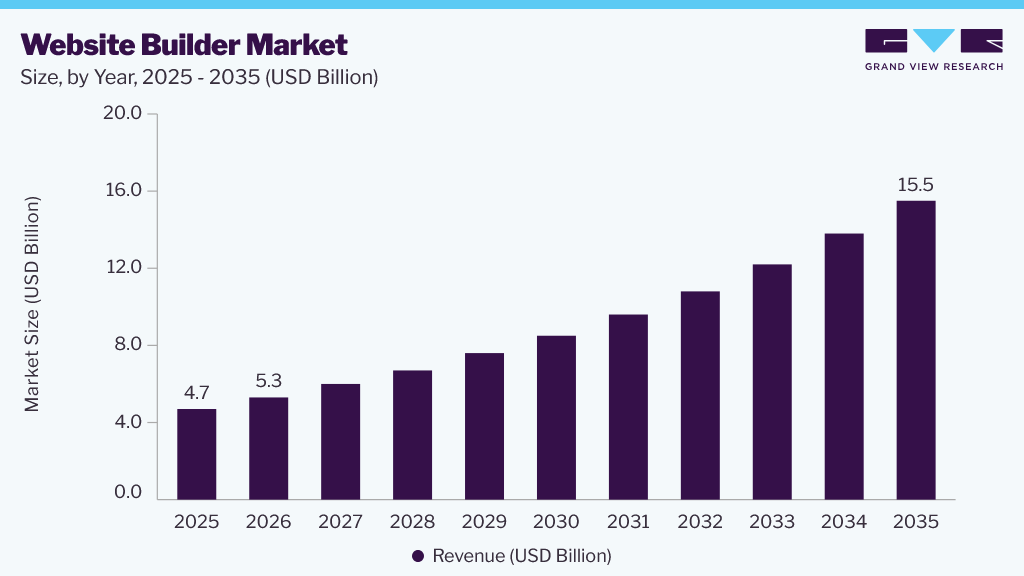 Source: Grand View Research, IR Documents, Primary Interviews, Paid DatabasesTo learn more about this report,
 Download Free Sample Report
Artificial intelligence is becoming a defining factor in market evolution. AI-assisted website design, custom design suggestions, automatic image optimization, chatbots, and SEO features are helping businesses increase their efficiency by reducing reliance on specialized development resources. Smartphone-compatible website features have also become a vital aspect for the company, as a significant portion of traffic worldwide comes through mobile phones. Companies keep integrating third-party apps, digital payment platforms, social commerce, and business tools into their ecosystems.
The industry is expected to benefit from accelerating digital transformation, expanding e-commerce adoption, and increasing demand for no-code and low-code development platforms. Continuous innovation in generative AI, website personalization, cybersecurity, and cloud-native architecture will further strengthen platform capabilities. Growing adoption among startups, educational institutions, nonprofits, and service-based businesses, combined with ongoing investments by leading technology providers, is expected to support long-term market expansion while fostering greater competition and product differentiation.
Analyst Perspective
The market is evolving into intelligent digital experience platforms that combine AI, automation, no-code development, e-commerce, marketing, SEO, analytics, and customer engagement capabilities. Growing adoption among SMEs, entrepreneurs, freelancers, and digital-native businesses is expected to sustain demand as organizations seek cost-effective solutions. AI-driven website creation, personalization, mobile optimization, and automated content generation are emerging as key areas of differentiation. Leading providers that integrate broader business functionality, strengthen cybersecurity, and expand third-party integrations are likely to gain a competitive advantage, while continued advances in generative AI and cloud technologies should support long-term growth.
Type Insights
The desktop segment accounted for the largest share in 2025, supported by continued demand for websites designed to deliver rich and comprehensive experiences on desktop and laptop devices. Website builders increasingly provide responsive design capabilities that enable businesses to create websites optimized for larger screens, complex layouts, high-resolution media, and feature-rich applications. The growing adoption of e-commerce platforms, enterprise portals, professional service websites, and content-intensive websites is sustaining demand for PC-oriented web experiences. In addition, advancements in AI-powered design, responsive layouts, performance optimization, content management, and third-party integrations are enabling website builders to deliver more sophisticated websites for PC users. Companies continue to introduce technologically enhanced features to improve desktop website functionality, customization, security, and user experience. In April 2025, Hosting platform WordPress.com launched a new AI website builder that allows anyone to create a functioning website using an AI chat-style interface. The feature, which was made available to WordPress users for free, is targeted at entrepreneurs, freelancers, bloggers, and others who need a professional online presence, the company says.
The mobile segment is anticipated to witness the fastest growth during the forecast period, driven by the rising adoption of smartphones and increasing demand for websites optimized for mobile users. Businesses, entrepreneurs, freelancers, influencers, and small enterprises are increasingly seeking website-building solutions that enable them to create mobile-friendly websites with responsive layouts, simplified navigation, fast loading speeds, and touch-optimized interfaces. The growing importance of mobile commerce, social media engagement, and mobile-first customer experiences is further increasing demand for websites designed specifically for smartphone users. Website builder providers are continuously enhancing their platforms with AI-powered mobile design, responsive templates, automated content optimization, mobile performance tools, and integrated commerce capabilities, enabling businesses to deliver more engaging and personalized experiences across smartphones.
Deployment Insights
The cloud segment dominated the market in 2025 with a share of approximately 72.0%, owing to its scalability, low cost of investment, automatic software upgrades, and ease of implementation. Cloud-based website builders enable businesses to create and manage websites without investing in dedicated infrastructure, while providing integrated functionalities such as hosting, SSL certificates, security, automated backups, and collaboration tools. Their growing adoption is supported by benefits including faster website deployment, remote accessibility, automatic feature updates, and seamless integration with third-party platforms such as payment gateways, customer relationship management (CRM) systems, and marketing applications. Furthermore, the increasing adoption of software-as-a-service (SaaS) solutions among SMEs and enterprises is driving demand for cloud-based website builders, as businesses seek flexible, cost-effective, and scalable digital solutions that minimize infrastructure requirements and reduce reliance on dedicated IT resources.
The on-premises segment is expected to witness the fastest growth during the forecast period as organizations operating in highly regulated industries increasingly prioritize data sovereignty, security, and compliance. Large enterprises, government agencies, financial institutions, and healthcare organizations often prefer on-premises website builder solutions to retain full control over sensitive data, infrastructure, and customization. Rising concerns regarding cybersecurity, privacy regulations, and integration with legacy IT systems are further supporting adoption. Additionally, hybrid digital strategies and the need for customized workflows, advanced governance, and internal hosting capabilities are encouraging investment in on-premises deployments among enterprises with stringent operational and regulatory requirements.
End Use Insights
The commercial segment dominated the market with a share of approximately 78.0% in 2025, due to the increasing need for efficient digital solutions that will help them build their online presence and reach more customers. With website builders, corporations, especially small and medium-sized enterprises, have an opportunity to develop a professionally designed site without the necessity of having any advanced technical knowledge or paying too much for the development process. Such functions as e-commerce features, SEO optimization, marketing solutions, analytics, and payment processing are motivating small businesses to use website builders. In addition, the increasing trend towards digitalization, the growth of online sales, and increasing competition motivate small firms to adopt website builders.
Rising emphasis on personalized customer experiences, faster content deployment, and the use of AI in website development are adding to the pace of adoption by enterprises. For instance, in May 2026, a San Francisco-based digital experience platform provider, Webflow, made its Answer Engine Optimization (AEO) product generally available to enterprise customers, enabling organizations to optimize website content for AI-powered search experiences and answer engines. In addition, enterprise-level website building tools, which allow role-based access and automate processes, are helping enterprises manage their digital operations without relying on web development procedures.
The individual user segment is expected to remain a significant contributor to the industry, supported by the growing need for affordable and easy-to-use solutions for creating personal websites, portfolios, blogs, online stores, and professional profiles. Freelancers, creators, influencers, students, and entrepreneurs increasingly use website builders to establish and manage their digital presence without requiring advanced coding skills. AI-powered design tools, customizable templates, drag-and-drop functionality, and integrated hosting are further simplifying website creation for individuals. The growing creator economy, freelance workforce, and personal branding trends are expected to sustain demand for intuitive, mobile-friendly, and cost-effective website-building platforms.
Regional Insights
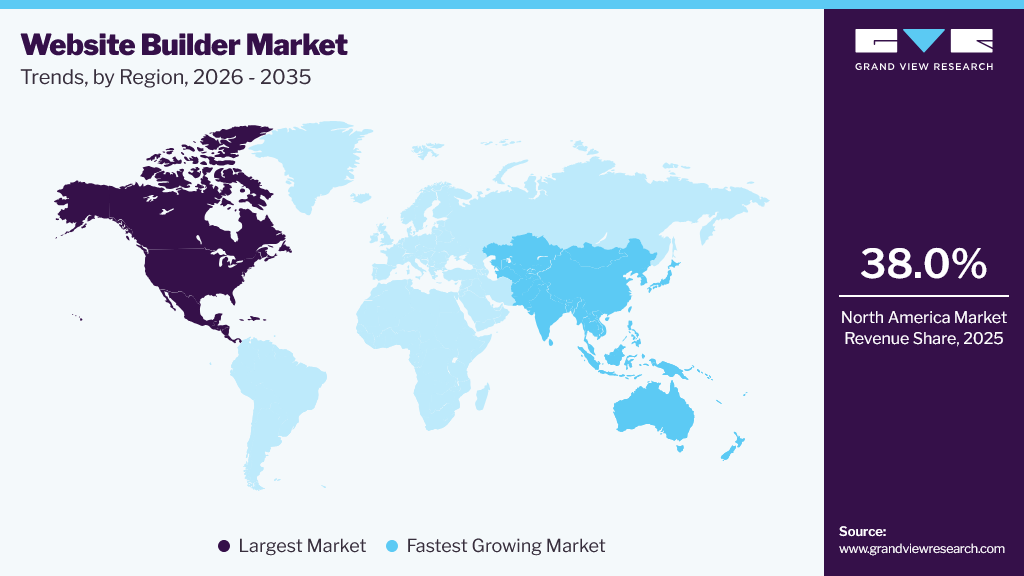
The North America website builder market led with a share of approximately 38.0% in 2025. The region’s dominance is attributed to the presence of technology vendors, the high level of cloud solution adoption, and the high digital infrastructure in the region. High adoption of online business, e-commerce, and digital marketing solutions by enterprises and SMEs has increased the need for website-building platforms. Some of the companies that are present in the region include Wix, Squarespace, and Webflow, and they keep on investing in website-building platforms with AI features and automation. There is also an increase in the adoption of no-code/low-code tools by enterprises.
 To learn more about this report, Download Free Sample Report
Asia Pacific Website Builder Market Trends
The website builder market in Asia Pacific is expected to witness the fastest growth during the forecast period, driven by rapid internet penetration, increasing smartphone adoption, expanding SME ecosystems, and rising digitalization initiatives across emerging economies such as India, China, and Southeast Asian countries. Growing demand among entrepreneurs, startups, and small businesses for cost-effective online solutions is encouraging the adoption of website builders. Furthermore, the expansion of e-commerce, digital payments, and cloud-based services is creating significant opportunities for market players. Government-led digital transformation programs and increasing awareness regarding online branding are further expected to strengthen the adoption of website-building platforms across the region.
Key Website Builder Companies Insights
The website builder market is highly competitive, with key players focusing on AI-powered design, no-code development, e-commerce integration, and enhanced customization capabilities. Companies such as Wix, Squarespace, Webflow, and Shopify are strengthening their platforms through feature enhancements, automation tools, and enterprise-focused solutions to improve user experience and market competitiveness. For instance, in January 2026, Wix launched Wix Harmony, the AI Website Builder that Merges Human and Artificial Intelligence. Wix Harmony uniquely combines vibe coding with Wix’s powerful visual editing capabilities, delivering the speed of AI generation together with pixel‑perfect design control and the reliability of Wix’s mature, production‑ready platform.
Key Website Builder Companies
The following key companies have been profiled for this study on the website builder market:
-
Wix
-
Squarespace
-
Shopify
-
WordPress.com
-
Webflow
-
GoDaddy
-
Hostinger
-
IONOS
-
Duda
-
Weebly
-
HubSpot
-
Elementor
-
Zoho
-
Jimdo
-
Web.com
Recent Developments
- In August 2024, Wix and Google expanded their strategic partnership to offer Wix Users Gemini for Workspace, which enabled Wix users to leverage the most advanced generative AI solution across Google Workspace. Gemini for Workspace is designed to streamline workflows, enhance creativity, and boost efficiency.
- In August 2024, Shopify expanded its collaboration with YouTube to help merchants integrate Shopify-powered stores with YouTube shopping features. This collaboration helped creators to link to their Shopify store on their channels.
Website Builder Market Report Scope
Report Attribute
Details
Market size in 2025
USD 4.7 billion
Estimated market size in 2026
USD 5.3 billion
Projected market size by 2035
USD 15.5 billion
Growth rate
CAGR of 12.7% from 2026 to 2035
Base year for estimation
2025
Historical data
2021 – 2024
Forecast period
2026 – 2035
Quantitative units
Revenue in USD billion, and CAGR from 2026 to 2035
Report coverage
Revenue forecast, company ranking, competitive landscape, growth factors, and trends
Segments covered
Type, deployment, end use, region
Regional scope
North America; Europe; Asia Pacific; Latin America; Middle East & Africa
Country scope
U.S.; Canada; Mexico; UK; Germany; France; Italy; Spain; China; Japan; India; Australia; South Korea; Brazil; Argentina; South Africa; Saudi Arabia; UAE
Key companies profiled
Wix; Squarespace; Shopify; WordPress.com; Webflow; GoDaddy; Hostinger; IONOS; Duda; Weebly; HubSpot; Elementor; Zoho; Jimdo; Web.com
Customization scope
Free report customization (equivalent to 8 analyst working days) with purchase. Addition or alteration to country, regional & segment scope.
Pricing and purchase options
Avail of customized purchase options to meet your exact research needs. Explore purchase options
Global Website Builder Market Report Segmentation
This report forecasts revenue growth at the global, regional, and country levels and provides an analysis of the latest industry trends and opportunities across each sub-segment from 2021 to 2035. For this study, Grand View Research has segmented the global website builder market report based on type, deployment, end use, and region:
-
Type Outlook (Revenue, USD Billion, 2021–2035)
-
Desktop
-
Mobile
-
-
Deployment Outlook (Revenue, USD Billion, 2021–2035)
-
Cloud
-
On-premises
-
-
End Use Outlook (Revenue, USD Billion, 2021–2035)
-
Individual
-
Commercial
-
Small and Mid-Sized Enterprises (SMEs)
-
Large Enterprises
-
-
-
Regional Outlook (Revenue, USD Billion, 2021 - 2035)
-
North America
-
U.S.
-
Canada
-
Mexico
-
-
Europe
-
UK
-
Germany
-
France
-
Italy
-
Spain
-
-
Asia Pacific
-
China
-
Japan
-
India
-
Australia
-
South Korea
-
-
Latin America
-
Brazil
-
Argentina
-
-
Middle East and Africa (MEA)
-
South Africa
-
Saudi Arabia
-
UAE
-
-
Frequently Asked Questions About This Report
The global website builder market size was valued at USD 4.7 billion in 2025 and is estimated at USD 5.3 billion for 2026.
The global website builder market is expected to grow at a CAGR of 12.7% from 2026 to 2035, reaching USD 15.5 billion.
North America dominated the market with approximately 38.0% revenue share in 2025.
The desktop builder segment accounted for the largest revenue share of approximately 58.0% in 2025.
Key players in the market include Wix, Squarespace, Shopify, WordPress.com, Webflow, GoDaddy, Hostinger, IONOS, Duda, Weebly, HubSpot, Elementor, Zoho, Jimdo, Web.com, and others.
About the Author(s)
Telecom Media & Technology Research Team
Industry · Telecom Media & TechnologyThis report was authored by the telecom media & technology research team at Grand View Research - comprising two research analysts, one senior research analyst, and one industry expert - with specialized expertise in the telecom media & technology segment of the industry industry. All findings are based on proprietary industry databases, executive interviews, and regulatory analysis, subject to internal peer review prior to publication.
Last Updated:
Speak to Analyst

Customize this report to your needs - add regions, segments, or data points, with 20% free customization.
Or view our licence options:


ISO 9001:2015 & 27001:2022 Certified
We are GDPR and CCPA compliant! Your transaction & personal information is safe and secure. For more details, please read our privacy policy.


