
- Home
- »
- Advanced Interior Materials
- »
-
Welded Plate And Block Heat Exchangers Market Report, 2033GVR Report cover

Welded Plate And Block Heat Exchangers Market (2026 - 2033)
Size, Share & Trends Analysis Report By End Use (Chemical, Food & Beverages, HVAC & Refrigeration, Oil & Gas, Pulp & Paper, Others), By Region, And Segment Forecasts
Market Size, 2025
$666.9MMarket Estimate, 2026
$706.1MMarket Forecast, 2033
$1,138.7MCAGR, 2026–2033
7.1%Market Size & Trends
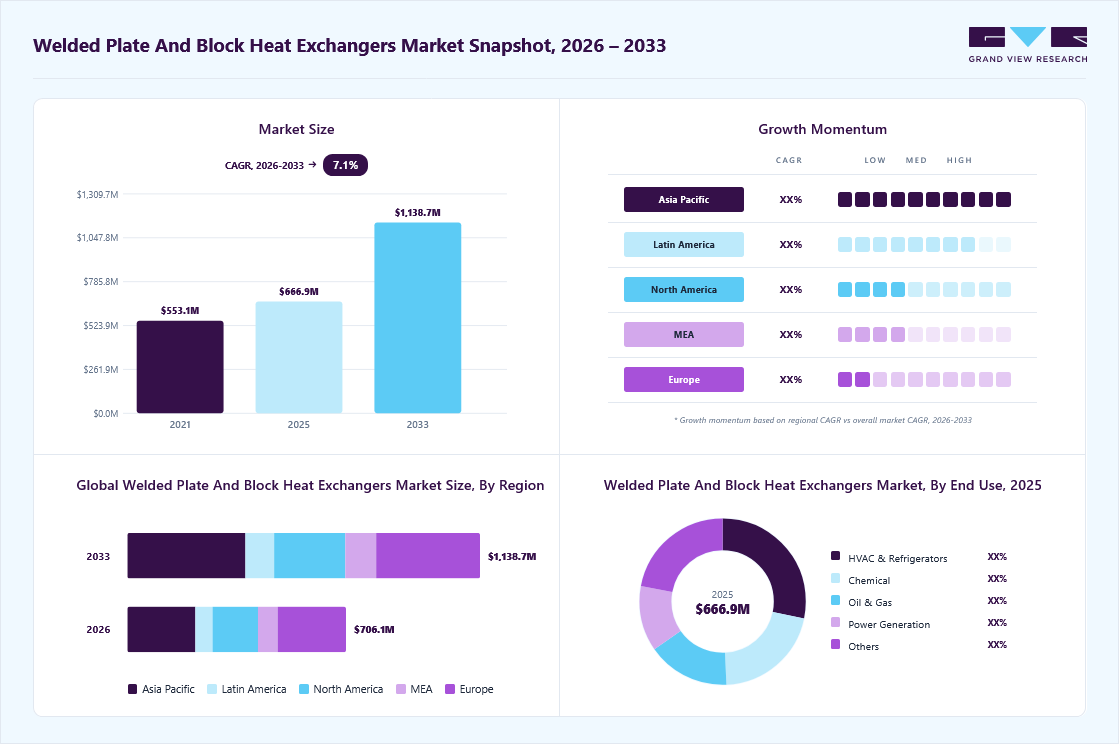
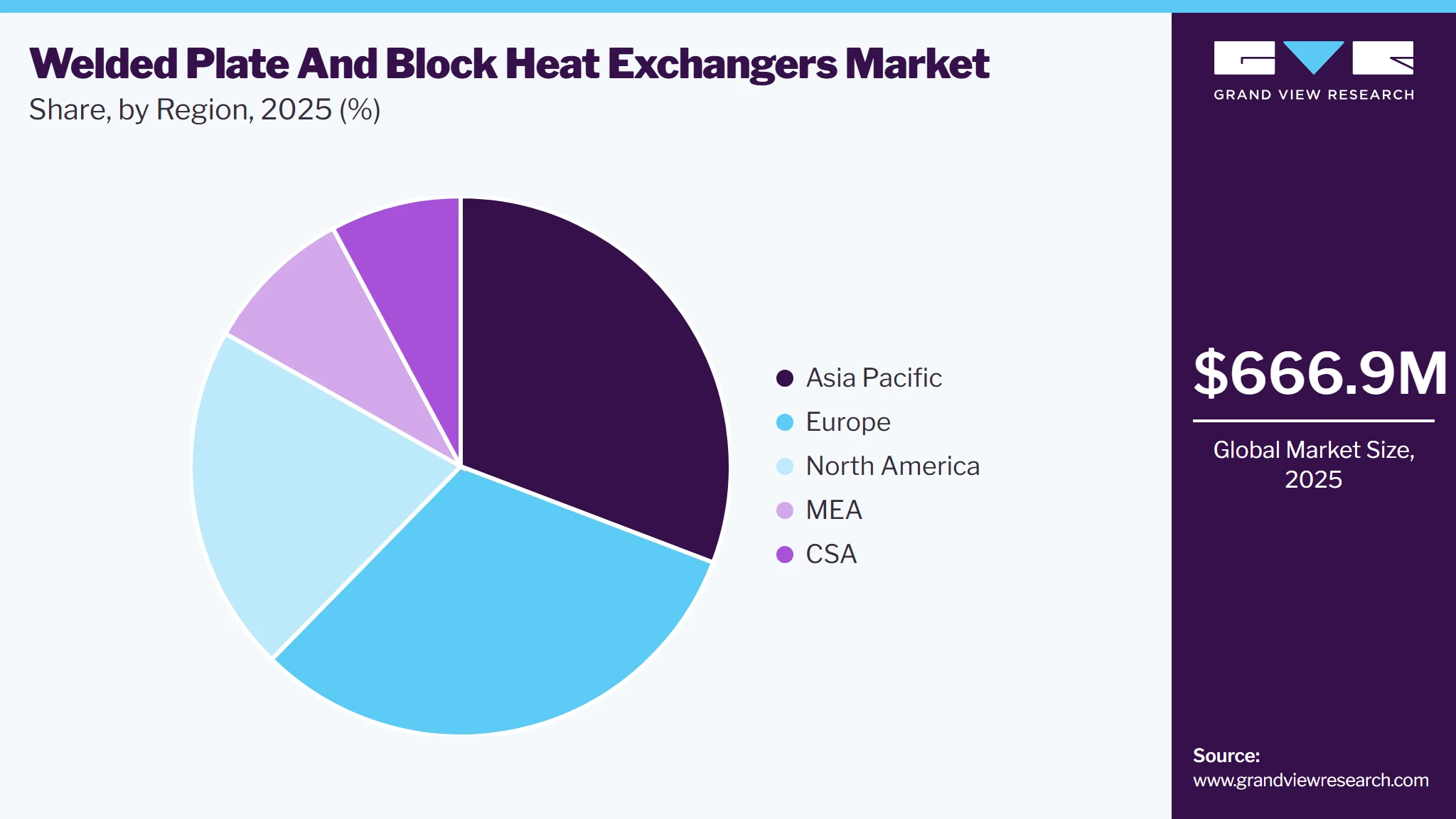
The global welded plate and block heat exchangers market size was valued at USD 666.9 million in 2025 and is projected to grow from USD 706.1 million in 2026 to USD 1,138.7 million by 2033, at a CAGR of 7.1% from 2026 to 2033. The market in Europe dominated with a revenue share of 31.5% in 2025. This growth can be attributed to the increasing demand for energy-efficient solutions across various industries. With companies seeking to reduce operational costs and enhance sustainability, adopting welded plate and block heat exchangers has become more prevalent. These heat exchangers are known for their superior thermal performance, allowing for effective heat transfer while minimizing energy losses. This trend is particularly strong in sectors such as HVAC, chemical processing, and power generation, where efficient thermal management is critical.
 Source: Grand View Research, IR Documents, Primary Interviews, Paid DatabasesTo learn more about this report,
 Download Free Sample Report
Key Market Trends & Insights
- By end use: HVAC & refrigerators segment held the largest market share of 28.2% in 2025.
- The chemical segment is anticipated to grow at a significant CAGR during the forecast period.
Regional Highlights
- Largest regional market: Europe (31.5% revenue share, 2025)
- Fastest-growing regional market: Asia Pacific (highest CAGR, 2026-2033)
- By country: Germany held the largest market share in 2025
Market Size & Forecast
- Market size in 2025: USD 666.9 Million
- Estimated market size in 2026: USD 706.1 Million
- Projected market size by 2033: USD 1,138.7 Million
- CAGR (2026-2033): 7.1%
Three ways to get this report
Buy it, customize it, or ask a question.Ask an Analyst
Analyst response in 1 business day
- AccessReport author, directly
- Reply timeWithin 1 working day
- No sales callDirect answer only
- FormatEmail reply
- CostFree, no cost
Get the Full Report
What the study covers
- FormatsPDF · Excel · Dashboard
- Timeline2026–2033 annual, 2025 base
- Coverage20+ countries, 5 regions
- Companies10+ key players profiled
Customize the Report
20% free customization
- IncludeCountries, segments, points
- TailorTo your product definition
- ExtendDeeper competitor detail
- OrA fully bespoke study
- Turnaround5–10 working days
In addition to energy efficiency benefits, technological advancements have also played a key role in the growth of the welded plate and block heat exchangers industry. Innovations in materials and manufacturing processes have led to the development of more compact and robust systems capable of operating under high pressures and temperatures. Moreover, eliminating gaskets in welded designs has enhanced reliability and reduced the need for maintenance, making these heat exchangers a preferable choice for numerous applications in industries such as petrochemicals and food processing.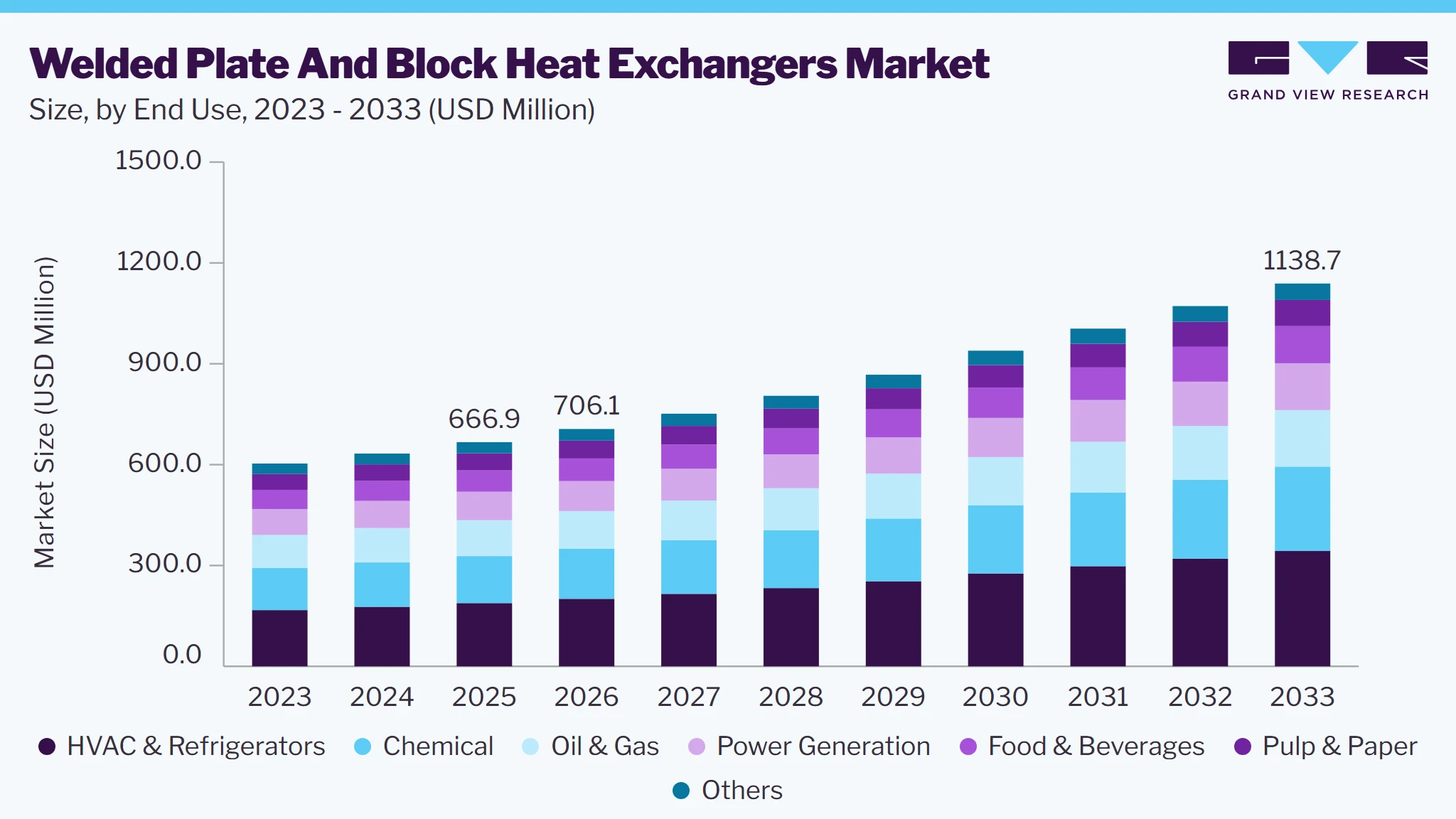 To learn more about this report, Download Free Sample Report
Industries such as food and beverage require efficient thermal management solutions for processes such as pasteurization and cooling, driving the need for these advanced heat exchangers. The power generation sector also benefits from their use in applications such as steam condensation and feedwater heating. With these industries continuing to expand and modernize their operations, the reliance on welded plate and block heat exchangers is expected to increase significantly, driving market growth.
Moreover, these systems are used to improve operational efficiency and lower overall energy consumption, aligning with global sustainability goals. With businesses prioritizing sustainable practices, the demand for welded plate and block heat exchangers is expected to surge. The growing emphasis on environment is encouraging industries to adopt more efficient thermal solutions that comply with strict regulations for reducing carbon emissions, which is expected to drive growth of the welded plate and block heat exchangers industry in the coming years.
Market Dynamics
The welded plate and block heat exchanger market is influenced by steady demand from process industries seeking higher thermal efficiency, enhanced operational reliability, and improved energy utilization in challenging operating environments. These heat exchangers are extensively used in applications involving high pressures, elevated temperatures, and corrosive media, making them well suited for industries such as chemical processing, oil & gas, petrochemicals, power generation, and emerging clean energy sectors. Growing emphasis on waste heat recovery, process intensification, and industrial decarbonization continues to strengthen market adoption, as manufacturers increasingly prioritize technologies that improve energy efficiency while reducing operating costs and emissions. Market growth is moderated by high fabrication costs, application-specific engineering requirements, and longer project execution cycles associated with customized industrial equipment.
The growing emphasis on industrial energy efficiency and process optimization continues to strengthen demand for welded plates and block heat exchangers across process industries. Their ability to provide high thermal efficiency while operating under elevated pressures, extreme temperatures, and corrosive process conditions makes them well suited for demanding industrial applications.
Increasing investments in waste heat recovery, refinery modernization, advanced chemical processing, and low-carbon industrial technologies are further encouraging the adoption of these heat exchangers, as manufacturers seek to improve energy utilization, enhance process reliability, and reduce overall operating costs without compromising operational performance.
The widespread adoption of welded plate and block heat exchangers is constrained by their high capital cost and the technical complexity associated with custom-engineered solutions. Manufacturing these systems require specialized materials, precision welding technologies, and stringent quality assurance processes, resulting in higher production costs than conventional heat exchanger designs.
Furthermore, application-specific engineering, extended procurement timelines, and specialized maintenance requirements can increase project complexity and ownership costs, limiting adoption among end users with budget constraints or less demanding process requirements.
The ongoing transition toward sustainable industrial operations presents significant growth opportunities for welded plate and block heat exchanger manufacturers. Increasing investments in hydrogen production, carbon capture and utilization, renewable fuels, and advanced process industries are creating demand for compact, high-performance heat transfer solutions capable of operating under challenging process conditions.
At the same time, continuous advancements in material technologies, welding techniques, and digital asset monitoring are improving equipment durability, operational efficiency, and maintenance planning. As industrial facilities increasingly prioritize lifecycle performance, energy optimization, and process reliability, demand is expected to shift toward application-engineered heat exchanger solutions that deliver long-term operational value and improved thermal performance.
Analyst Perspective
The welded plate and block heat exchangers market is witnessing steady growth as industries increasingly adopt compact, high-efficiency heat transfer solutions capable of operating under demanding process conditions. Demand is being driven by the chemical, oil & gas, power generation, food & beverage, pharmaceutical, and HVAC industries, where superior thermal performance, corrosion resistance, and space optimization are critical. Compared to conventional shell-and-tube heat exchangers, welded plate and block heat exchangers offer higher heat transfer efficiency, reduced footprint, and improved reliability for handling high-pressure, high-temperature, and aggressive process media. In addition, growing investments in energy efficiency, waste heat recovery, and industrial decarbonization are accelerating the replacement of traditional heat exchange systems with advanced welded designs. As process industries continue to modernize their operations and prioritize operational efficiency, manufacturers offering durable, high-performance, and application-specific welded plate and block heat exchangers are expected to benefit from sustained long-term market growth.
End-use Insights
Based on end use, the HVAC & refrigerators segment led the market with the largest revenue share of 28.2% in 2025, driven by urbanization and heightened awareness of indoor air quality. Industries focusing on sustainability have accelerated the adoption of energy-efficient climate control solutions, which, in turn, support the growth of advanced HVAC systems and refrigeration technologies. Consequently, the welded plate and block heat exchangers industry can benefit from this trend due to its alignment with efficient thermal management needs.
The chemical segment is anticipated to witness a significant CAGR during the forecast period. This growth can be attributed to the demand for advanced thermal management in chemical processes. With industries prioritizing energy efficiency, productivity, and compliance with stricter environmental regulations, welded plate and block heat exchangers are becoming essential for heat recovery and temperature control. This trend is expected to boost the market growth in the coming years.
Regional Insights
The North America welded plate and block heat exchangers market held a significant revenue share in 2025, driven by the presence of major industries such as oil & gas, chemical processing, and power generation. The focus on energy efficiency and technological advancements in this region further enhances the adoption of these heat exchangers. With companies investing in upgrading their infrastructure to comply with stringent environmental regulations, the demand for efficient thermal management solutions is expected to grow. Consequently, North America remains a key player in the welded plate and block heat exchangers industry.
 To learn more about this report, Download Free Sample Report
U.S. Welded Plate and Block Heat Exchangers Market Trends
The U.S. welded plate and block heat exchangers market led the regional market in 2025. This growth is attributable to significant investments in research & development that are fueling innovation in heat exchanger technologies. Growth in the manufacturing sector, particularly automotive and electronics, has also driven demand for efficient thermal management solutions. Moreover, the focus on renewable energy sources continues to create opportunities for effective heat exchange solutions within existing infrastructures.
Europe Welded Plate and Block Heat Exchangers Market Trends
Europe dominated the welded plate and block heat exchangers market with the largest revenue share of 31.5% in 2025. This dominance is driven by its robust industrial base and focus on sustainability. Germany, France, and the UK are among the key countries in the European market investing in advanced technologies to meet stringent environmental regulations and improve energy efficiency. The market for welded plate and block heat exchangers in Europe is set for continued growth with the European Union's emphasis on carbon reduction and ongoing advancements.
Germany welded plate and block heat exchangers market led the regional market in 2025. This growth is attributable to the strong industrial sector, especially in chemical processing and manufacturing. The focus on energy efficiency and sustainability has increased investments in advanced heat exchanger technologies. Furthermore, strict environmental regulations are encouraging the use of efficient thermal management solutions in multiple industries.
Asia Pacific Welded Plate and Block heat Exchangers Market Trends
The Asia Pacific welded plate and block heat exchangers market is anticipated to witness the highest CAGR during the forecast period. This growth can be attributed to increasing energy demand, coupled with substantial investments in infrastructure development, which are accelerating market growth. Expanding sectors such as oil & gas, chemicals, and power generation are key contributors to this trend. Moreover, a growing emphasis on sustainability and energy efficiency is increasing the adoption of advanced heat exchanger technologies.
China welded plate and block heat exchangers market led the regional market in 2025. This dominance is driven by rapid industrialization and urbanization. Significant investments in infrastructure in the country, particularly in the chemical and power generation sectors, have bolstered market growth. China's focus on energy efficiency and adherence to environmental regulations has further driven the adoption of advanced heat exchanger solutions, positioning the market for sustained growth in the coming years.
Key Welded Plate & Block heat Exchangers Company Insights
Key companies in the global welded plate and block heat exchangers industry include ALFA LAVAL, Tranter Inc., Kelvion Holding GmbH, Nexson, and others. These companies adopt various strategies to enhance their competitive edge. These include investing in research and development to innovate and improve product offerings, expanding their geographic presence through strategic partnerships and acquisitions, and focusing on sustainable practices to meet environmental regulations. Furthermore, companies emphasize customer engagement and tailored solutions to address specific needs while enhancing their distribution networks to ensure efficient product availability and support for construction projects worldwide.
-
ALFA LAVAL specializes in manufacturing welded plate and block heat exchangers, offering solutions that enhance thermal efficiency and durability. The company’s product portfolio caters to diverse industries, including energy, marine, and process industries, with a strong focus on sustainability and energy-saving technologies.
-
Nexson manufactures high-performance welded plate and block heat exchangers, focusing on delivering durable and efficient solutions for industries such as oil & gas, petrochemicals, and wastewater treatment. The company’s expertise lies in providing customized solutions to meet industry requirements.
Key Welded Plate & Block Heat Exchangers Companies
The following key companies have been profiled for this study on the welded plate & block heat exchangers market.
-
ALFA LAVAL
-
Tranter Inc.
-
Kelvion Holding GmbH
-
Nexson
-
SHINEHEAT CORP
-
AIC Inc.
-
API Heat Transfer
-
Shanghai Heat Transfer Equipment Co., Ltd.
-
HFM
-
Erivac Konsult AB
Competitive Benchmarking
Category
Operating Strategies
Competitive Edge
Weakness
Established Players (e.g., Alfa Laval, Kelvion Holding GmbH, Tranter Inc., Hisaka Works, Ltd., Barriquand Technologies Thermiques, FUNKE Wärmeaustauscher Apparatebau GmbH.)
- Focus on delivering high-performance, application-engineered heat exchanger solutions for demanding industrial processes.
- Invest in product innovation, advanced welding technologies, and material development to enhance thermal efficiency and equipment reliability.
- Strengthen customer relationships through global service networks, aftermarket support, and long-term maintenance agreements.
- Strong global brand recognition and extensive installed equipment base across process industries.
- Broad product portfolios with proven expertise in handling high-pressure, high-temperature, and corrosive applications.
- Well-established engineering capabilities, global manufacturing footprint, and comprehensive technical support.
- Premium pricing may reduce competitiveness in cost-sensitive projects.
- Longer engineering and delivery timelines for highly customized solutions.
- Large organizational structures may limit flexibility in addressing niche or low-volume customer requirements.
Emerging & Regional Players (e.g., Nexson Group, SHINEHEAT CORP., Shanghai Heat Transfer Equipment Co., Ltd. (SHT), AIC Inc., regional players)
- Compete by offering cost-effective and application-specific heat exchanger solutions tailored to regional industrial requirements.
- Expand market presence through localized manufacturing, engineering customization, and strategic partnerships with EPC contractors and industrial customers.
- Focus on strengthening product quality and technical capabilities while increasing participation in industrial expansion projects.
- Competitive pricing supported by lower manufacturing costs and regional supply chains.
- Greater flexibility in product customization and faster response to customer-specific project requirements.
- Growing presence in regional markets with increasing investments in process industries.
- Limited global brand recognition and international distribution networks.
- Smaller product portfolios and lower investment capacity for advanced research and development.
- Dependence on regional demand and comparatively limited aftermarket service infrastructure.
Recent Developments
-
In May 2023, Alfa Laval announced the expansion of its brazed plate heat exchanger production capacity across facilities in Italy, China, Sweden, and the U.S. This initiative aims to meet rising demand from the global energy transition, enhance manufacturing efficiency, and drive innovation in sustainable heat exchanger solutions.
-
In April 2024, Nexson acquired Thermowave GmbH to complement its product range and strengthen its position in the heat exchanger market. This acquisition was aimed at having an expanded product portfolio, enhanced market presence, and the ability to cater to a broader range of industries, including refrigeration, air conditioning, and chemical processing.
Welded Plate & Block Heat Exchangers Market Report Scope
Report Attribute
Details
Market size in 2025
USD 666.9 million
Estimated market size in 2026
USD 706.1 million
Projected market size by 2033
USD 1,138.7 million
Growth rate
CAGR of 7.1% from 2026 to 2033
Base year for estimation
2025
Historical data
2021 - 2024
Forecast period
2026 - 2033
Quantitative units
Revenue in USD million/billion and CAGR from 2026 to 2033
Report coverage
Revenue forecast, company ranking, competitive landscape, growth factors, and trends
Segments covered
End use, region
Regional scope
North America; Europe; Asia Pacific; Latin America; Middle East & Africa
Country scope
U.S.; Canada; Mexico; Germany; UK; France; Italy; Spain; Japan; China; India; Australia; South Korea; Brazil; Argentina; Saudi Arabia; South Africa; UAE
Key companies profiled
Alfa Laval, Kelvion Holding GmbH, Tranter Inc., Nexson Group, Hisaka Works, Ltd., Barriquand Technologies Thermiques, FUNKE Wärmeaustauscher Apparatebau GmbH, SHINEHEAT CORP., Shanghai Heat Transfer Equipment Co., Ltd. (SHT), AIC Inc.
Customization scope
Free report customization (equivalent up to 8 analysts' working days) with purchase. Addition or alteration to country, regional & segment scope.
Pricing and purchase options
Avail customized purchase options to meet your exact research needs. Explore purchase options
Global Welded Plate & Block Heat Exchangers Market Report Segmentation
This report forecasts revenue growth at global, regional, and country levels and analyzes the latest industry trends in each sub-segment from 2021 to 2033. For this study, Grand View Research has segmented the global welded plate and block heat exchangers market report based on end-use and region:
 To learn more about this report, Download Free Sample Report
-
End-use Outlook (Revenue, USD Million, 2021 - 2033)
-
Chemical
-
Food & Beverages
-
HVAC & Refrigerators
-
Oil & Gas
-
Power Generation
-
Pulp & Paper
-
Others
-
-
Regional Outlook (Revenue, USD Million, 2021 - 2033)
-
North America
-
U.S.
-
Canada
-
Mexico
-
-
Europe
-
Germany
-
UK
-
France
-
Italy
-
-
Asia Pacific
-
China
-
India
-
Japan
-
Australia
-
South Korea
-
-
CSA
-
Brazil
-
-
Argentina
-
MEA
-
UAE
-
KSA
-
-
Research Methodology
The welded plate and block heat exchangers market figures in this report are based on a proven research process that combines executive interviews with secondary research from proprietary databases, company filings, and recognized regulatory and institutional sources. Market size is built through value-chain sizing - reconciling supply-side and demand-side estimates - and triangulated with bottom-up and top-down approaches. Every estimate passes multiple levels of expert validation before publication, with each welded plate and block heat exchangers segment quantified using the revenue-capture definitions in the table below.
Segment Definition
End Use
Revenue Capture Definition
Chemical
Revenue generated from the sale of welded plate and block heat exchangers to companies engaged in chemical manufacturing, including bulk, specialty, and industrial chemical production facilities.
Food & Beverages
Revenue generated from the sale of welded plate and block heat exchangers to food and beverage manufacturers involved in the processing, production, and preservation of food and beverage products.
HVAC & Refrigerators
Revenue generated from the sale of welded plate heat exchangers to manufacturers, OEMs, and contractors serving commercial and industrial HVAC, refrigeration, and heat pump applications.
Oil & Gas
Revenue generated from the sale of welded plate and block heat exchangers to companies operating across upstream, midstream, and downstream oil and gas activities, including refineries and gas processing facilities.
Power Generation
Revenue generated from the sale of welded plate and block heat exchangers to utilities, independent power producers, and industrial facilities engaged in conventional and renewable power generation.
Pulp & Paper
Revenue generated from the sale of welded plate and block heat exchangers to pulp and paper manufacturers for use across pulp production, paper manufacturing, and related processing operations.
Others
Revenue generated from the sale of welded plate and block heat exchangers to end users across industries such as pharmaceuticals, mining & metals, marine, water & wastewater, and other industrial process sectors.
Estimation Model
Layer No.
Layer Name
Key Question
Description
01
Industrial Demand Base Layer
Where are welded plate and block heat exchangers required?
Analyze demand across chemical processing, oil & gas, power generation, food & beverage, pharmaceuticals, HVAC & refrigeration, pulp & paper, marine, and other industrial sectors.
02
Industrial Infrastructure & Process Plant Investment Layer
Where is new equipment demand being created?
Evaluate investments in chemical plants, refineries, petrochemical facilities, power plants, food processing facilities, pharmaceutical manufacturing, and industrial processing units.
03
Technology Adoption Layer
What proportion of process demand is fulfilled by welded plate and block heat exchangers?
Estimate technology penetration across industries based on process conditions, operating pressure, fluid characteristics, thermal efficiency requirements, and competition from shell-and-tube, gasketed plate, brazed plate, and spiral heat exchangers.
04
Revenue Generation Layer
How is market revenue generated ?
Segment demand by product type, material, pressure rating, application, and end-use industry. Apply adoption rates based on process temperature, pressure requirements, heat transfer efficiency, corrosion resistance, compactness, and fluid characteristics.
Delivered Customizations
This report has been delivered with the following In-depth customizations
Client Request
Customization Delivered
Value Adds
Competitive Benchmarking
Benchmarked leading welded plate and block heat exchanger manufacturers based on product portfolio strength, financial performance, technology capabilities, end-use industry focus, geographic presence, and strategic positioning, while differentiating established global players from emerging regional participants.
Provided a comprehensive assessment of the competitive landscape, enabling the client to evaluate market positioning, identify competitive advantages, and monitor evolving industry strategies.
Regional Segmentation
Refined regional analysis by evaluating industrial manufacturing activity, chemical and process industry concentration, energy infrastructure development, industrial modernization initiatives, and demand for high-performance heat transfer equipment across North America, Europe, Asia Pacific, Latin America, and Middle East & Africa.
Enabled identification of high-growth regional markets, industry demand centers, and investment priorities, supporting market expansion, regional targeting, and strategic business planning.
Opportunity Assessment
Assessed emerging growth opportunities across chemical processing, HVAC & refrigeration, oil & gas, power generation, food & beverages, and pulp & paper industries, while evaluating demand driven by energy-efficient thermal management, waste heat recovery, and process optimization initiatives.
Helped identify high-potential revenue opportunities by prioritizing end-use industries and application areas with strong long-term demand, supporting investment decisions and future growth strategies.
Frequently Asked Questions About This Report
The global welded plate and block heat exchangers market is expected to grow at a CAGR of 7.1% from 2026 to 2033, reaching USD 1,138.7 million by 2033.
The HVAC & refrigerators segment led the market with the largest revenue share of 28.2% in 2025.
Some key players operating in the welded plate and block heat exchangers market include Alfa Laval, Kelvion Holding GmbH, Tranter Inc., Nexson Group, Hisaka Works, Ltd., Barriquand Technologies Thermiques, FUNKE Wärmeaustauscher Apparatebau GmbH, SHINEHEAT CORP., Shanghai Heat Transfer Equipment Co., Ltd. (SHT), and AIC Inc.
The market in Europe dominated the welded plate and block heat exchangers market with the largest revenue share in 2025.
Germany held the largest share of the Europe welded plate and block heat exchangers market in 2025.
Key trends include increasing adoption of compact and high-efficiency heat exchangers, growing use of corrosion-resistant materials, rising integration of advanced manufacturing technologies, and expanding demand from renewable energy, hydrogen, and industrial decarbonization projects.
Key challenges include high capital costs, fluctuations in stainless steel and specialty alloy prices, complex manufacturing and welding processes, long equipment replacement cycles, and competition from alternative heat exchanger technologies in select applications.
Key factors include increasing demand for energy-efficient heat transfer solutions, rising investments in power generation and industrial processing facilities, growing adoption across chemical and petrochemical industries, expanding renewable energy projects, and stringent energy efficiency and emissions regulations
The global welded plate and block heat exchangers market size was valued at USD 666.9 million in 2025 and is estimated at USD 706.1 million for 2026.
About the Author(s)
Advanced Interior Materials Research Team
Advanced Materials · Advanced Interior MaterialsThis report was authored by the advanced interior materials research team at Grand View Research - comprising two research analysts, one senior research analyst, and one industry expert - with specialized expertise in the advanced interior materials segment of the advanced materials industry. All findings are based on proprietary advanced materials databases, executive interviews, and regulatory analysis, subject to internal peer review prior to publication.
Last Updated:
Speak to Analyst

Customize this report to your needs - add regions, segments, or data points, with 20% free customization.
Or view our licence options:


ISO 9001:2015 & 27001:2022 Certified
We are GDPR and CCPA compliant! Your transaction & personal information is safe and secure. For more details, please read our privacy policy.


