
- Home
- »
- Organic Chemicals
- »
-
White Oil Market Size, Share & Growth Report, 2026-2033GVR Report cover

White Oil Market (2026 - 2033)
Size, Share & Trends Analysis Report By Application (Adhesives, Agriculture, Food, Pharmaceutical, Personal Care, Textile, Polymers, Others), By Region (North America, Europe, Asia Pacific), And Segment Forecasts
Market Size, 2025
$2.4BMarket Estimate, 2026
$2.5BMarket Forecast, 2033
$3.6BCAGR, 2026–2033
5.0%White Oil Market Summary
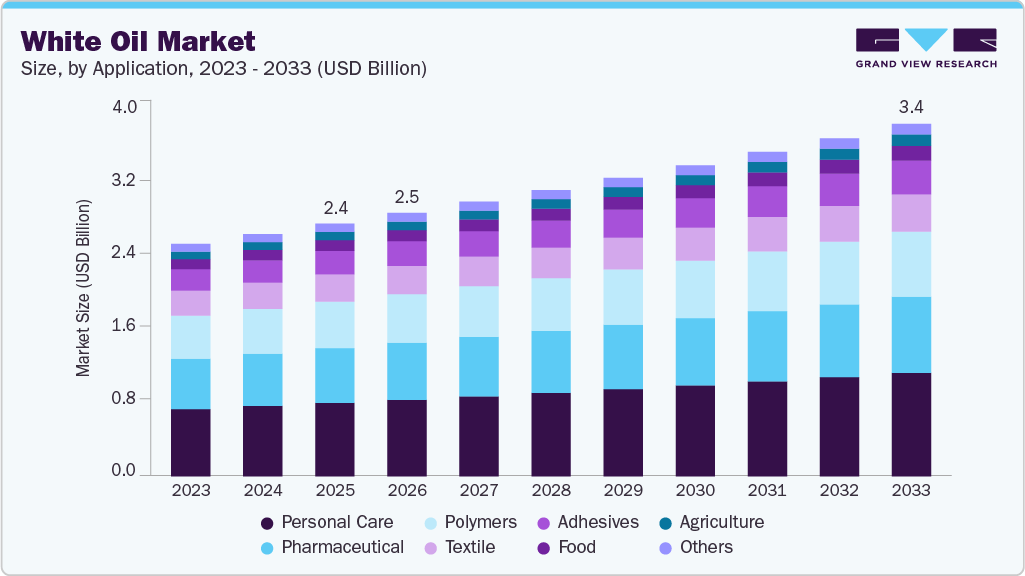
The global white oil market size was valued at USD 2.4 billion in 2025 and is projected to grow from USD 2.5 billion in 2026 to USD 3.6 billion by 2033, at a CAGR of 5.0% from 2026 to 2033. The market in Asia Pacific dominated with a revenue share of 53.3% in 2025. The global rise in skincare, haircare, and personal care products is fueling the demand for high-purity, safe white oils.
 Source: Grand View Research, IR Documents, Primary Interviews, Paid DatabasesTo learn more about this report,
 Download Free Sample Report
Key Market Trends & Insights
- By application: Personal care segment held the largest market share of 29.0% in 2025.
- The adhesives segment is expected to grow at the fastest CAGR of 5.3% during the forecast period.
Regional Highlights
- Largest regional market: Asia Pacific (53.3% revenue share, 2025)
- By country: China held the largest market share in 2025.
Market Size & Forecast
- Market size in 2025: USD 2.4 Billion
- Estimated market size in 2026: USD 2.5 Billion
- Projected market size by 2033: USD 3.6 Billion
- CAGR (2026-2033): 5.0%
Three ways to get this report
Buy it, customize it, or ask a question.Ask an Analyst
Analyst response in 1 business day
- AccessReport author, directly
- Reply timeWithin 1 working day
- No sales callDirect answer only
- FormatEmail reply
- CostFree, no cost
Get the Full Report
What the study covers
- FormatsPDF · Excel · Dashboard
- Timeline2026–2033 annual, 2025 base
- Coverage20+ countries, 5 regions
- Companies10+ key players profiled
Customize the Report
20% free customization
- IncludeCountries, segments, points
- TailorTo your product definition
- ExtendDeeper competitor detail
- OrA fully bespoke study
- Turnaround5–10 working days
Consumers increasingly prefer products with gentle, non-toxic ingredients, making white oil a key component in lotions, creams, and baby care products. White oil’s non-toxic and odorless nature makes it essential in pharmaceutical formulations (ointments, laxatives) and food processing (coatings, lubricants). Increasing healthcare awareness and food safety standards are driving the adoption of this technology across these sectors.
 To learn more about this report, Download Free Sample Report
Rapid urbanization and increasing disposable income in countries such as India, China, and Southeast Asian nations are driving growth in cosmetics, personal care, and pharmaceutical sectors. This creates a significant opportunity for white oil manufacturers to expand production and capture new markets, especially in regions with growing middle-class populations and evolving lifestyle trends.
Market Dynamics
The white oil market is growing and is supported by increasing demand from industries requiring highly refined, colorless, and odorless mineral oils that comply with stringent quality and safety standards. Rising consumption in pharmaceutical, personal care, and food processing applications continues to strengthen market demand, driven by expanding healthcare access, evolving consumer preferences, and higher spending on premium hygiene products. Industrial applications such as adhesives, polymers, textiles, and agriculture also contribute to market expansion by utilizing white oil for lubrication, processing, and formulation purposes. Manufacturers are investing in advanced refining technologies and production efficiency to meet evolving regulatory requirements and enhance product purity. However, fluctuations in crude oil prices and the high cost of refining can influence production economics and pricing strategies.
The increasing consumption of pharmaceutical formulations and personal care products is a primary driver of the white oil market. White oils are extensively utilized as inactive ingredients, emollients, lubricants, and processing aids in products such as ointments, creams, lotions, baby oils, cosmetics, and medicinal preparations due to their exceptional purity, chemical stability, and compliance with stringent pharmacopeia standards. Growing healthcare expenditure, expanding access to medicines, and rising consumer awareness regarding personal hygiene and wellness are accelerating the demand for high-quality white oils across developed and emerging economies. Additionally, the growing preference for premium skincare and cosmetic products continues to reinforce consumption in this segment.
Manufacturers are responding to this demand by expanding production capacities, enhancing refining technologies, and introducing pharmaceutical- and cosmetic-grade white oils that meet increasingly rigorous regulatory and quality requirements. The continuous launch of innovative personal care formulations and the expansion of the global pharmaceutical manufacturing sector are creating sustained demand for highly refined white oils.
High production costs associated with extracting and purifying beta glucan while preserving functional properties. Manufacturing high-purity white oil requires specialized processing technologies, stringent quality control measures, and carefully selected oat raw materials to ensure consistent molecular weight, viscosity, and biological performance. Variations in oat quality caused by agricultural conditions, seasonal fluctuations, and supply chain disruptions can further affect production efficiency and increase operational costs. These factors collectively raise the overall cost of finished ingredients compared with conventional dietary fibers, limiting widespread adoption in cost-sensitive application.
Rapid industrialization across emerging economies presents a significant opportunity for the white oil market, particularly in sectors such as adhesives, polymers, textiles, and agriculture. Increasing manufacturing activities, infrastructure development, and rising investments in downstream processing industries are generating greater demand for specialty lubricants and processing oils that deliver consistent performance and operational efficiency. White oil's inert nature, high purity, and compatibility with a wide range of industrial formulations make it an attractive choice for manufacturers seeking reliable raw materials.
The expansion of domestic manufacturing capabilities and favorable industrial policies in developing countries are encouraging investments in specialty chemical production and value-added applications. Rising demand for high-performance industrial products, coupled with improving quality standards, is expected to increase the adoption of premium-grade white oils across multiple end-use industries. Companies that strengthen regional distribution networks, develop application-specific product portfolios, and invest in localized production facilities are likely to benefit from the growing industrial demand and enhance their competitive positioning in these high-growth markets.
Market Concentration & Characteristics
The white oil market is moderately concentrated, with a mix of global and regional players dominating different segments. Major companies hold significant shares in high-purity grades used for pharmaceuticals and cosmetics, while smaller regional manufacturers cater to industrial and lubricant applications. This concentration ensures a steady supply and competitive pricing in key regions.
 To learn more about this report, Download Free Sample Report
The white oil industry is highly quality-driven, with strict regulatory standards for purity, safety, and compliance, especially in cosmetics, pharmaceuticals, and food applications. Growth is closely tied to industries, technological advancements in refining processes, and the increasing preference for non-toxic, sustainable products, making innovation and compliance key differentiators for market players.
Analyst Perspective
The white oil market is driven by rising demand from pharmaceutical, personal care, and food processing industries that require high-purity mineral oils. Manufacturers are increasingly investing in advanced refining technologies to meet stringent quality and regulatory standards while expanding specialty-grade product offerings. Industrial applications in polymers, adhesives, textiles, and agriculture are further broadening the market's growth potential. Emerging economies continue to create new opportunities through expanding manufacturing activities and rising consumption of value-added products. Companies that focus on product quality, regulatory compliance, and application-specific innovation are expected to strengthen their competitive position in the evolving global white oil market.
Application Insights
By application, personal care held a dominant position, contributing 29.0% of total revenue in 2025, as high-purity, odorless, and non-toxic oils are critical for lotions, creams, baby oils, and hair care products, ensuring product safety and effectiveness, while strong and sustained consumer demand for skincare and hygiene products drives large-scale, consistent adoption across the sector, reinforcing its dominance in the market.
The adhesives segment is expected to grow at the fastest CAGR of 5.3% during the forecast period, driven by rising demand for industrial and construction adhesives that require low-viscosity, high-purity oils for performance and stability. The expansion of manufacturing and infrastructure projects, particularly in emerging markets, is accelerating adoption. Companies are leveraging white oil’s functional properties to enhance product efficiency and compliance with industrial standards.
Regional Insights
Asia Pacific dominated the white oil market with the highest revenue share of 53.3% in 2025, as the expansion of the cosmetics, pharmaceuticals, and food processing industries directly increases demand for high-purity white oil. Industrial growth and higher production capacities in these sectors are driving consumption. Companies are adopting advanced refining technologies to meet quality requirements. Continuous innovation in end-use products sustains market growth.
China dominated the Asia Pacific white oil market in 2025. This can be attributed to the demand from the cosmetics, pharmaceutical, and food industries. Industrial-scale production and strict quality compliance are key growth factors. Companies are investing in high-purity refining technologies to meet industry standards. Market expansion is supported by strong demand for safe and effective products.
 To learn more about this report, Download Free Sample Report
North America White Oil Market Trends
The growth of the North America white oil industry is propelled by stringent regulatory standards across pharmaceuticals, food, and personal care products, creating strong demand for high-purity, refined oils. This regulatory-driven requirement ensures consistent adoption by manufacturers and underpins market stability. The expansion of applications in medical formulations and cosmetic products further fuels consumption, while companies continue to invest in certified production facilities to maintain quality, compliance, and a competitive positioning.
U.S. White Oil Market Trends
In the U.S., demand for white oil is primarily driven by the pharmaceutical and medical manufacturing sectors, where high-purity oils are essential for product safety and efficacy. The growing use of white oil in personal care and baby care products further supports stable market growth. To meet stringent regulatory requirements, manufacturers are investing in advanced purification processes, ensuring consistent product quality and compliance across all applications.
Europe White Oil Market Trends
Regulatory and sustainability mandates across the pharmaceutical and personal care sectors strongly influence the Europe white oil industry. High-purity, premium-grade oils are crucial for meeting stringent EU quality standards. Industrial demand further supports market growth, particularly in applications requiring consistent performance. Companies are investing in eco-friendly processing innovations to enhance efficiency and maintain a competitive advantage.
The Germany white oil market is expected to witness demand, fueled by the country’s leading pharmaceutical and specialty chemical sectors. Companies rely on high-grade oils to comply with strict EU purity and safety standards. Industrial processes and personal care product formulations also contribute significantly to market consumption. Continuous investment in refining and production capabilities ensures a consistent supply and product excellence.
Latin America White Oil Market Trends
White oil consumption in Latin America is rising due to expanding applications in cosmetics, pharmaceuticals, and industrial sectors. Manufacturers are scaling production to address specific industry needs. The use of white oil in food processing, particularly as a release agent, adds further demand. Emphasis on maintaining consistent quality ensures compliance with industrial standards and supports market growth.
Middle East & Africa White Oil Market Trends
The Middle East and Africa represent a significant growth region for white oil, driven by expansion in healthcare, pharmaceuticals, and personal care sectors. Industrial applications, such as lubricants and rust-preventive products, also contribute to the rising demand. Companies are upgrading production capabilities to comply with stringent regulatory and quality standards. The increasing adoption of high-purity oils supports a wide range of end-use industries across the region.
Key White Oil Company Insights
ExxonMobil and Chevron dominate the white oil market due to their large-scale production, advanced purification technologies, and strong global presence in pharmaceuticals, cosmetics, and industrial sectors.
-
ExxonMobil is a leading producer of high-purity white oils, serving pharmaceutical, cosmetic, food, and industrial sectors globally. The company leverages its advanced refining technologies and large-scale production capabilities to ensure consistent quality and compliance with stringent industry standards. Its strong global presence and brand reputation make it a key player in the market.
-
Chevron produces high-quality white oils for diverse applications, including pharmaceuticals, personal care, and industrial uses. The company emphasizes advanced purification processes and robust supply chains to meet global regulatory requirements. Its established market presence and technological expertise position it as a dominant player in the white oil industry.
Key White Oil Companies
The following key companies have been profiled for this study on the white oil market.
-
ExxonMobil Corporation
-
Chevron Corporation
-
Shell plc
-
APAR Industries Ltd.
-
Savita Oil Technologies Limited
-
Gandhar Oil Refinery (India) Limited
-
Bharat Petroleum Corporation Limited
-
Raj Petro
-
Velvex
-
Eastern Petroleum Pvt. Ltd.
Competitive Benchmarking
Category
Operating Strategies
Competitive Edge
Weakness
Established Players (ExxonMobil Corporation, Chevron Corporation, Shell plc, Bharat Petroleum Corporation Limited, APAR Industries Ltd., Savita Oil Technologies Limited)
- Invest in advanced refining and purification technologies to produce premium-grade white oils.
- Maintain integrated global supply chains with long-term feedstock sourcing and extensive distribution networks.
- Expand product portfolios to serve pharmaceutical, food, personal care, and industrial applications.
- Focus on regulatory compliance, sustainability initiatives, and continuous process optimization to improve operational efficiency.
- Strong brand recognition and long-standing customer relationships across multiple industries.
- Large-scale refining infrastructure ensures consistent product quality and reliable supply.
- Extensive research and development capabilities support product innovation and regulatory compliance.
- Broad international sales and distribution networks enable access to diversified end-use markets.
- High capital expenditure requirements for maintaining advanced refining facilities and compliance standards.
- Complex organizational structures can slow strategic decision-making and product commercialization.
- Greater exposure to fluctuations in global crude oil prices and international supply chain disruptions.
- Higher operating costs may reduce pricing flexibility in highly competitive regional markets.
Emerging Players (Gandhar Oil Refinery (India) Limited, Raj Petro, Velvex, Eastern Petroleum Pvt. Ltd.)
- Target regional and niche markets with application-specific white oil grades.
- Strengthen relationships with domestic distributors and industrial customers to increase market penetration.
- Expand manufacturing capacity incrementally in response to growing demand.
- Emphasize cost-efficient production and flexible operations to remain competitive in local markets.
- Greater flexibility in addressing customized customer requirements and smaller order volumes.
- Faster response to regional market demand and changing customer preferences.
- Competitive pricing supported by lower operational complexity and localized manufacturing.
- Strong understanding of domestic regulatory frameworks and regional industry requirements.
- Limited international presence and comparatively smaller distribution networks.
- Lower investment capacity for advanced refining technologies and product development.
- Greater dependence on regional demand and local customer base for revenue generation.
- Limited brand visibility in highly regulated pharmaceutical and food-grade international markets.
Recent Developments
- In June 2025, Brenntag SE expanded its distribution partnership with ExxonMobil Corporation for white oils across EMEA (extending to Iberia, the Netherlands & Israel) under GMP‑compliant supply.
White Oil Market Report Scope
Report Attribute
Details
Market size in 2025
USD 2.4 billion
Estimated market size in 2026
USD 2.5 billion
Projected market size by 2033
USD 3.6 billion
Growth rate
CAGR of 5.0% from 2026 to 2033
Base year for estimation
2025
Historical data
2021 - 2024
Forecast period
2026 - 2033
Quantitative units
Revenue in USD billion/million, Volume in Kilotons and CAGR from 2026 to 2033
Report coverage
Revenue forecast, company ranking, competitive landscape, growth factors, and trends
Segments covered
Application, region
Regional scope
North America; Europe; Asia Pacific; Latin America; and Middle East & Africa
Country scope
U.S.; Canada; Germany; UK; France; Italy; Spain; China; India; Japan; South Korea; Brazil; Argentina; Saudi Arabia; South Africa
Key companies profiled
ExxonMobil Corporation; Chevron Corporation; Shell plc; APAR Industries Ltd.; Savita Oil Technologies Limited; Gandhar Oil Refinery (India) Limited; Bharat Petroleum Corporation Limited;Raj Petro; Velvex; Eastern Petroleum Pvt. Ltd.
Customization scope
Free report customization (equivalent up to 8 analysts' working days) with purchase. Addition or alteration to country, regional & segment scope.
Pricing and purchase options
Avail customized purchase options to meet your exact research needs. Explore purchase options
Global White Oil Market Report Segmentation
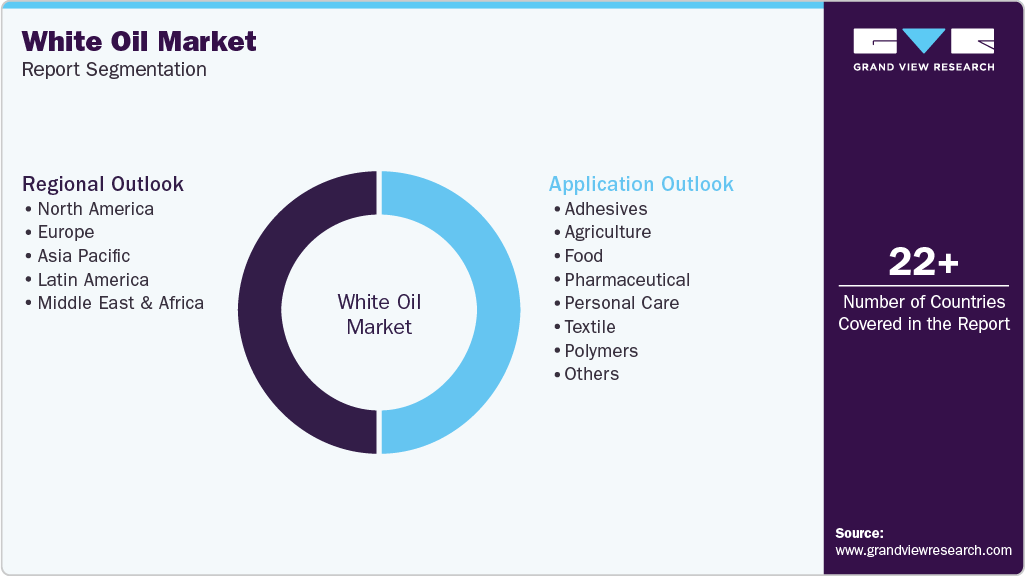
This report forecasts revenue growth at the global, regional, and country levels and provides an analysis of the latest industry trends in each of the sub-segments from 2021 to 2033. For this study, Grand View Research has segmented the global white oil market report based on application and region.
 To learn more about this report, Download Free Sample Report
-
Application Outlook (Volume, Kilotons; Revenue, USD Million, 2021 - 2033)
-
Adhesives
-
Agriculture
-
Food
-
Pharmaceutical
-
Personal Care
-
Textile
-
Polymers
-
Others
-
-
Regional Outlook (Volume, Kilotons; Revenue, USD Million, 2021 - 2033)
-
North America
-
U.S.
-
Canada
-
Mexico
-
-
Europe
-
Germany
-
UK
-
Italy
-
Spain
-
France
-
-
Asia Pacific
-
China
-
Japan
-
South Korea
-
India
-
-
Latin America
-
Brazil
-
Argentina
-
-
Middle East & Africa
-
Saudi Arabia
-
South Africa
-
-
Research Methodology
The white oil market figures in this report are based on a proven research process that combines executive interviews with secondary research from proprietary databases, company filings, and recognized regulatory and institutional sources. Market size is built through value-chain sizing - reconciling supply-side and demand-side estimates - and triangulated with bottom-up and top-down approaches. Every estimate passes multiple levels of expert validation before publication, with each white oil segment quantified using the revenue-capture definitions in the table below.
Segment Definition
Segment - Application
Revenue capture definition
Adhesives
Revenue is generated from the utilization of white oil as a plasticizer, processing aid, and viscosity modifier in hot-melt and pressure-sensitive adhesive formulations. Its ability to improve flexibility, processability, and long-term stability supports demand across packaging, woodworking, construction, and industrial assembly applications.
Agriculture
Market revenue is derived from the supply of white oil for agricultural sprays, crop protection formulations, and horticultural applications where it functions as a carrier and pest control agent. Increasing emphasis on improving crop productivity and minimizing pest-related losses continues to support product adoption.
Food
Commercial value is created through the use of food-grade white oil in food processing, bakery equipment lubrication, release agents, and food-contact applications requiring high purity and regulatory compliance. Growth in processed food production and stringent food safety standards contribute to sustained market expansion.
Pharmaceutical
Revenue is captured from pharmaceutical-grade white oil incorporated into ointments, creams, laxatives, medicinal formulations, and drug manufacturing processes. Consistent demand for high-purity excipients, coupled with expanding pharmaceutical production and healthcare expenditure, strengthens revenue generation in this segment.
Personal Care
Industry income originates from the incorporation of white oil in skincare, haircare, baby care, cosmetics, and personal hygiene products where it provides emollient, moisturizing, and protective properties. Rising consumer spending on premium beauty and wellness products continues to drive commercial growth.
Textile
Financial returns are generated through the application of white oil as a lubricant and processing medium in textile manufacturing, including fiber production, spinning, knitting, and finishing operations. Increasing textile output and the need for efficient processing technologies support ongoing demand.
Polymers
Market earnings stem from the use of white oil as a processing aid, extender, and plasticizer in polymer compounds, thermoplastic elastomers, and rubber products. Expanding production of flexible plastics, automotive components, and consumer goods continues to reinforce market opportunities.
Other Applications
Revenue is supported by the deployment of white oil across industrial lubricants, specialty chemicals, electrical insulation, and precision manufacturing applications requiring excellent chemical stability and low toxicity. Continuous product innovation and diversification into niche industrial uses contribute to long-term market development.
Estimation Model
Layer Name
Key Question
Description
Raw Material & Production Layer
What forms the supply base?
Examine the global production ecosystem for white oil, including crude oil sourcing, base oil refining, hydro-processing, hydrogenation, and advanced purification technologies used to manufacture pharmaceutical-, food-, and technical-grade white oils. The assessment covers feedstock availability, refining capacity, manufacturing infrastructure, technological advancements, supplier networks, quality certification requirements, and key production hubs supporting global supply.
Application Adoption Layer
Where is white oil utilized?
Analyze the adoption of white oil across major end-use industries, including pharmaceuticals, personal care, food processing, adhesives, agriculture, textiles, polymers, and other industrial applications. Market penetration is supported by increasing demand for high-purity processing oils, stringent regulatory compliance, product safety requirements, superior chemical stability, and expanding industrial and consumer product manufacturing.
Consumption Intensity Layer
How much white oil is utilized?
Evaluate white oil consumption across principal application sectors by assessing formulation inclusion levels, industrial production volumes, manufacturing output, replacement cycles, and regional demand trends. The analysis estimates annual utilization in pharmaceutical preparations, cosmetic formulations, food processing, agricultural products, polymer compounds, textile processing, adhesive manufacturing, and other specialty industrial applications across key global markets.
Revenue Layer
How is market revenue generated?
Market revenue is generated through the refining, formulation, distribution, and commercialization of white oil grades supplied to pharmaceutical manufacturers, personal care companies, food processors, adhesive producers, polymer manufacturers, textile processors, and agricultural formulators. Business growth is influenced by expanding end-use industries, investments in advanced refining technologies, evolving regulatory standards, premium product offerings, supply chain efficiency, and increasing demand for high-purity specialty mineral oils across domestic and international markets.
Delivered Customizations
This report has been delivered with the following In-depth customizations
Client Request
Customization Delivered
Value Adds
Regional Segmentation
The study delivers detailed country-level analysis across major white oil markets, covering crude oil feedstock availability, refining infrastructure, production capacity, consumption patterns, regulatory framework, import-export trends, and demand across pharmaceutical, personal care, food, adhesives, agriculture, textile, polymer, and other industrial applications.
Enables stakeholders to identify high-potential regional markets, evaluate supply chain capabilities, understand demand dynamics, benchmark competitive positioning, and develop market expansion strategies aligned with regulatory requirements and investment opportunities.
Competitive Benchmarking
The report provides an in-depth evaluation of historical and current trade patterns for white oil, including imports, exports, leading producing and consuming countries, refining capacities, feedstock sourcing, pricing trends, distribution networks, and global supply chain dynamics. The analysis also examines market concentration, supply dependencies, and cross-border trade flows of pharmaceutical-, food-, and industrial-grade white oils.
Supports sourcing and procurement decisions by identifying reliable production hubs, assessing supply chain resilience, mitigating trade-related risks, diversifying supplier portfolios, evaluating export opportunities, and strengthening strategic planning through enhanced visibility into global market movements.
Opportunity Assessment
The study presents a comprehensive assessment of growth opportunities across pharmaceutical-, food-, technical-, and cosmetic-grade white oils, along with major application sectors including pharmaceuticals, personal care, food processing, adhesives, agriculture, textiles, polymers, and specialty industrial uses. It further evaluates opportunities arising from expanding healthcare demand, premium personal care products, industrial development, and advancements in refining and purification technologies.
Assists organizations in prioritizing high-growth application segments, identifying attractive investment areas, aligning product portfolios with evolving industry requirements, strengthening innovation strategies, and maximizing long-term business potential through differentiated, high-purity white oil offerings.
Frequently Asked Questions About This Report
The personal care segment led with a 29.0% revenue share in 2025.
The global white oil market is expected to grow at a CAGR of 5.0% from 2026 to 2033, reaching USD 3.6 billion by 2033.
Asia Pacific dominated with a 53.2% revenue share in 2025.
The global white oil market size was valued at USD 2.4 billion in 2025 and is estimated at USD 2.5 billion for 2026.
Some key players operating in the white oil market include ExxonMobil Corporation, Chevron Corporation, Shell plc, APAR Industries Ltd., Savita Oil Technologies Limited, Gandhar Oil Refinery (India) Limited, Bharat Petroleum Corporation Limited, Raj Petro, Velvex, Eastern Petroleum Pvt. Ltd.
The rise in skincare, haircare, and personal care products globally is fueling the need for high-purity, safe white oils. Consumers increasingly prefer products with gentle, non-toxic ingredients, making white oil a key component in lotions, creams, and baby care products.
The adhesives segment is the fastest-growing over the forecast period.
Asia Pacific is the fastest growing region with a CAGR of 5.3% in the forecast period. Strong growth is supported by rapid industrialization, expanding pharmaceutical and personal care manufacturing, and increasing demand for high-purity white oils across developing economies in the region.
About the Author(s)
Organic Chemicals Research Team
Bulk Chemicals · Organic ChemicalsThis report was authored by the organic chemicals research team at Grand View Research - comprising two research analysts, one senior research analyst, and one industry expert - with specialized expertise in the organic chemicals segment of the bulk chemicals industry. All findings are based on proprietary bulk chemicals databases, executive interviews, and regulatory analysis, subject to internal peer review prior to publication.
Last Updated:
Speak to Analyst

Customize this report to your needs - add regions, segments, or data points, with 20% free customization.
Or view our licence options:


ISO 9001:2015 & 27001:2022 Certified
We are GDPR and CCPA compliant! Your transaction & personal information is safe and secure. For more details, please read our privacy policy.


