
- Home
- »
- Next Generation Technologies
- »
-
Wholesale Banking Market Size, Growth Report, 2026-2033GVR Report cover

Wholesale Banking Market (2026 - 2033)
Size, Share & Trends Analysis Report By Services (Cash Management, Trade Finance, Treasury Services, Advisory Services), By Enterprise Size (Large Enterprises, Small and Medium Enterprises), By End Use, By Region, And Segment Forecasts
Market Size, 2025
$5.1TMarket Estimate, 2026
$5.3TMarket Forecast, 2033
$7.6TCAGR, 2026–2033
5.2%Wholesale Banking Market Summary
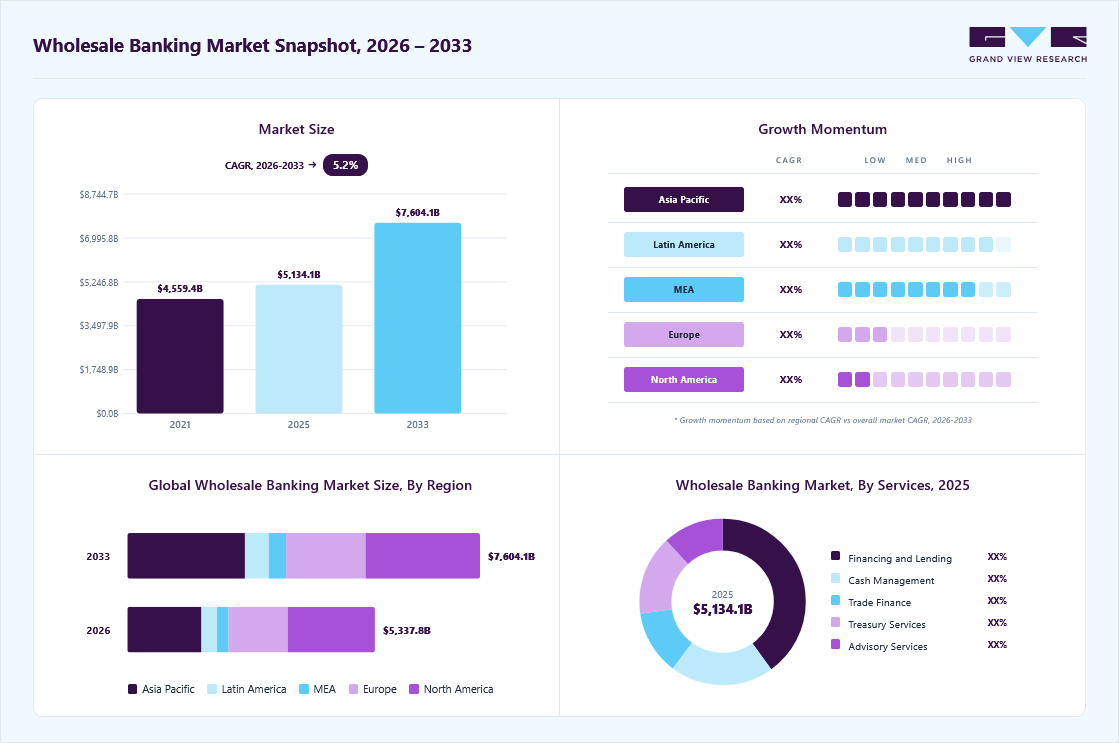
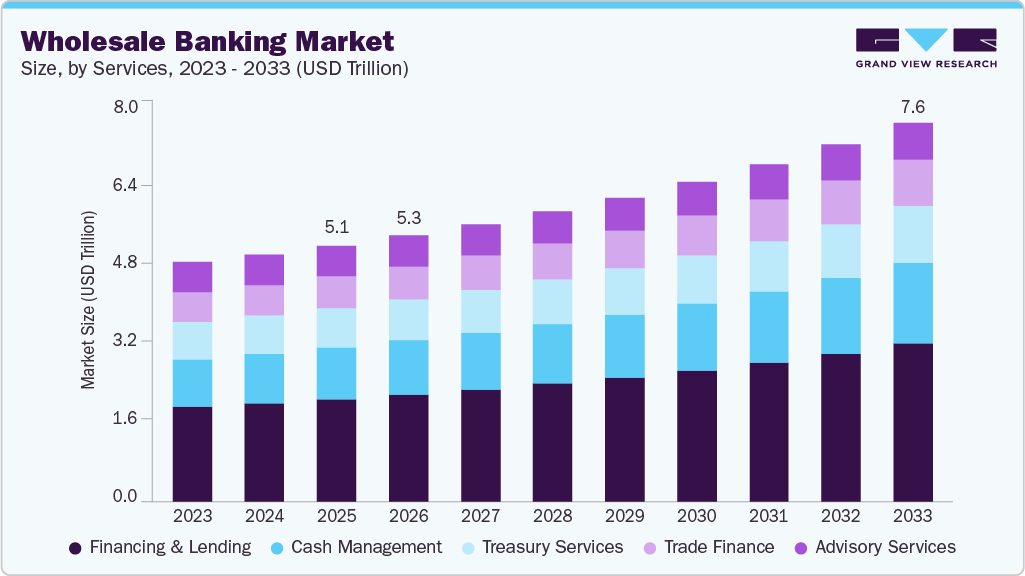
The global wholesale banking market size was valued at USD 5.1 trillion in 2025 and is projected to grow from USD 5.3 trillion in 2026 to USD 7.6 trillion by 2033, at a CAGR of 5.2% from 2026 to 2033. North America dominated the global market, accounting for the largest revenue share of 35.6% in 2025. The market growth can be attributed to rising demand for large-scale corporate financing, with solutions such as syndicated loans, project financing, and treasury services supporting business expansion and infrastructure development.
 Source: Grand View Research, IR Documents, Primary Interviews, Paid DatabasesTo learn more about this report,
 Download Free Sample Report
Key Market Trends & Insights
- By services: Financing and lending segment accounted for the largest share of 40.00% in 2025.
- By enterprise size: Large enterprises segment held the largest market share in 2025.
- By end use: Corporates segment dominated the market in 2025.
Regional Highlights
- Largest regional market: North America (35.6% revenue share, 2025)
- By country: The U.S. wholesale banking industry is a major contributor to the global market.
Market Size & Forecast
- Market size in 2025: USD 5.1 Trillion
- Estimated market size in 2026: USD 5.3 Trillion
- Projected market size by 2033: USD 7.6 Trillion
- CAGR (2026-2033): 5.2%
Prism AI by Grand View Research Free to tryAsk a question about the wholesale banking marketTry asking✓Every figure cited from GVR research Prefer the report? Download free sample →The market growth can also be attributed to the growing integration of cash management and liquidity solutions, as corporations increasingly rely on centralized treasury systems and real-time payment capabilities to optimize working capital and manage global financial operations more effectively. Additionally, increasing cross-border trade and international investments are emphasizing the need for wholesale banking services, as a growing volume of complex financial transactions is managed through these channels.
 To learn more about this report, Download Free Sample Report
Technological advancements such as AI, cloud banking, and blockchain are significantly transforming the wholesale banking landscape. AI is increasingly used for applications such as fraud detection, risk management, and process automation, enabling faster operations and reduced costs while also improving client engagement through predictive analytics and intelligent virtual assistants. Additionally, cloud technology is becoming essential, with banks progressively migrating their systems to cloud-based infrastructure to improve flexibility and cost efficiency. This transition enables faster deployment of new services, improved operational agility, quicker transaction processing, and seamless integration with third-party applications. Furthermore, blockchain technology is being leveraged to increase the speed and cost-efficiency of transactions, particularly in cross-border payments and trade finance.
Another major trend in the wholesale banking market is the growing emphasis on sustainability-focused financing, where borrowers increasingly seek funding linked to environmental and social performance metrics. Financial institutions are offering instruments such as sustainability-linked loans and green bonds, in which interest rates or terms are tied to the borrower’s ability to meet predefined ESG (Environmental, Social, and Governance) targets, such as reducing carbon emissions or improving energy efficiency. This approach aligns financing with global sustainability goals and also incentivizes companies to adopt responsible business practices, thereby integrating financial performance with measurable positive impact.
Regulatory standards are essential to ensuring transparency and financial stability in the wholesale banking market. Regions are implementing stricter rules on capital adequacy, liquidity, and compliance to reduce systemic risks and strengthen financial institutions. For instance, in April 2026, U.S. regulators, including the Federal Reserve, FDIC, and OCC, introduced revised Basel III Endgame proposals to update risk-based capital calculations and buffer requirements for large banks. These changes are designed to improve financial stability and ensure banks maintain adequate capital to manage potential risks. Additional regulations, such as anti-money laundering (AML) and know-your-customer (KYC) requirements, are widely enforced to improve governance, increase transparency, and prevent financial crime in wholesale banking.
The wholesale banking market faces several challenges that may limit its growth. Increasingly complex regulations are a major concern, as banks must meet evolving global standards for capital adequacy, risk management, and cross-border transactions. These requirements raise operational costs and compliance burdens. Additionally, the digitalization of banking services heightens cybersecurity risks. Higher reliance on digital platforms and interconnected systems makes wholesale banks more vulnerable to cyberattacks, data breaches, and financial fraud, thereby undermining client trust and operational stability.
Services Insights
The financing and lending segment accounted for the largest share of 40.00% in 2025. The segment growth is attributed to increased demand for large-scale corporate financing and expanding global trade and infrastructure investments. Corporations require significant capital for mergers and acquisitions, capacity expansion, and major infrastructure projects, leading to higher adoption of syndicated loans and project financing solutions. Furthermore, growth in international trade and cross-border operations is also increasing the need for working capital and trade-related financing, as companies depend on wholesale banks to manage transactions and liquidity across multiple regions.
The cash management segment is expected to grow at the fastest CAGR of 6.0% during the forecast period. The segment’s growth is driven by the need for real-time liquidity management and the digitalization of financial operations, prompting corporations to adopt advanced treasury solutions. These solutions enable organizations to optimize cash flow, improve working capital efficiency, and gain real-time visibility into global financial positions, which improves decision-making and operational control. Additionally, the adoption of digital payment systems and integrated banking platforms is increasing demand for automated cash management services. These technologies enable faster, more secure transactions, reduce manual processes, and improve financial accuracy.
Enterprise Size Insights
The large enterprises segment held the largest market share in 2025. The segment growth is propelled by extensive global operations, high transaction volumes, and complex financial structures that require advanced, integrated banking solutions. These organizations depend on wholesale banking services, including syndicated loans, structured financing, treasury and cash management, trade finance, and risk mitigation, to manage large-scale operations across multiple regions. Large enterprises also maintain long-standing relationships with major financial institutions, which provide access to customized financial products and advisory services. Their strong financial position and ongoing need for capital to support mergers and acquisitions, infrastructure investments, and global expansion reinforce the segment’s dominance.
The small and medium enterprises segment is expected to grow at a significant CAGR during the forecast period. The segment growth is attributed to increasing digital transformation and improved access to credit. The rapid expansion of digital banking platforms and fintech collaborations has simplified lending processes, enabling SMEs to access financial services more efficiently and at lower costs. Additionally, improved access to credit through tailored financial products such as working capital financing and invoice discounting is supporting business expansion and operational efficiency. Thus, SMEs are increasingly adopting wholesale banking solutions, thereby accelerating the growth of this segment within the wholesale banking market.
End Use Insights
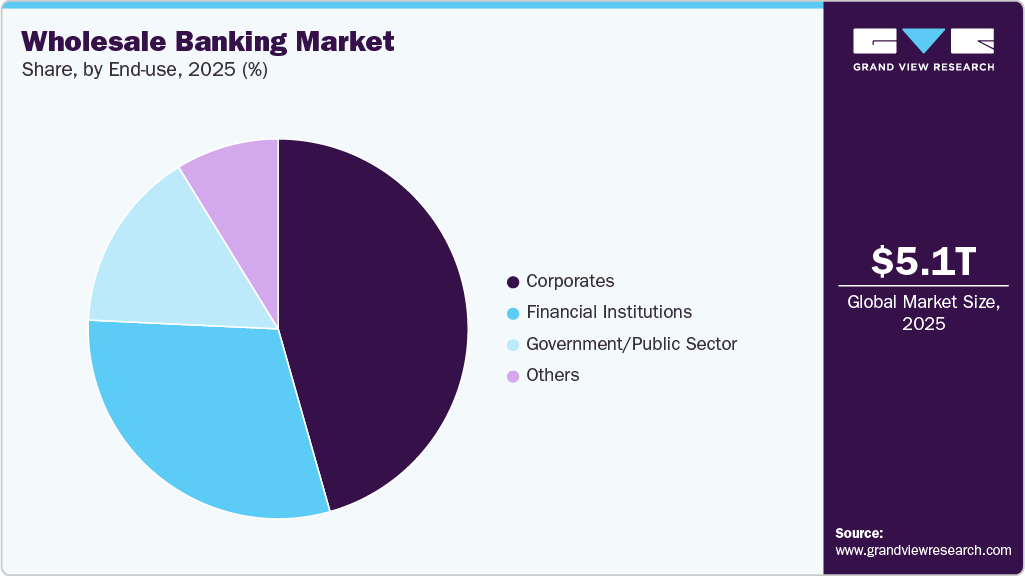
The corporates segment dominated the market in 2025. The segment growth is propelled by the rising demand for large-scale financing, treasury management, and trade finance services to support complex business operations and global expansion strategies. Corporations require comprehensive wholesale banking solutions to manage liquidity, optimize cash flows, and facilitate cross-border transactions, particularly in sectors such as manufacturing, energy, and infrastructure. In addition, increasing merger and acquisition activities and capital-intensive projects have further strengthened the reliance of corporates on wholesale banking services, thus contributing to the segment’s dominant position in the market.
 To learn more about this report, Download Free Sample Report
The financial institutions segment is projected to grow at the fastest CAGR of 5.6% over the forecast period. The segment growth is supported by the increasing demand for interbank transactions and capital market activities, as financial institutions seek efficient mechanisms for funding and liquidity management. Financial institutions such as commercial banks, insurance companies, asset management firms, and non-banking financial companies are increasingly engaging with wholesale banks to access capital, optimize balance sheet structures, and participate in large-scale financial transactions. Furthermore, the growing complexity of global financial markets, driven by heightened trading activity in derivatives, foreign exchange, and fixed-income instruments, underscores the need for specialized wholesale banking services.
Regional Insights
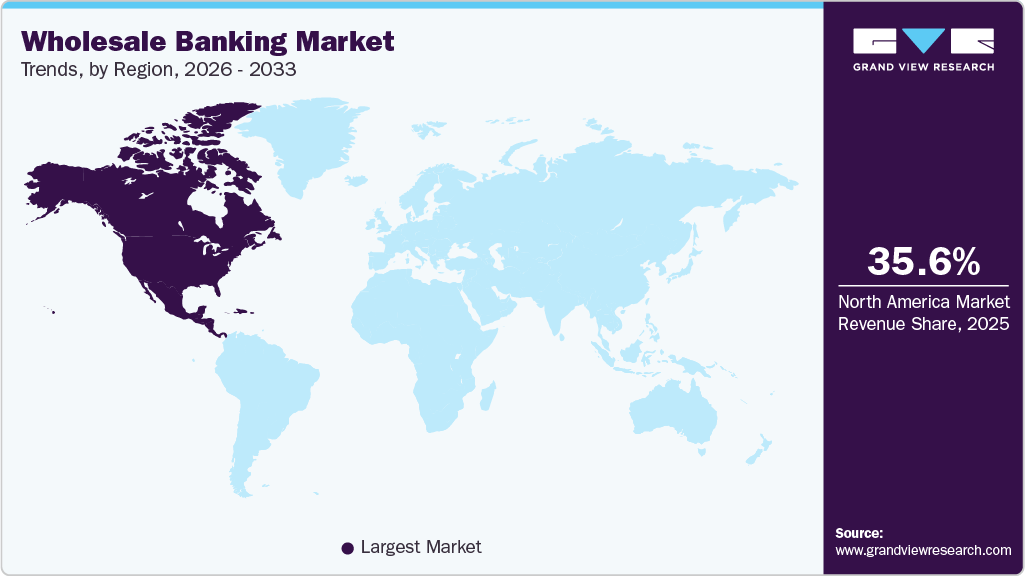
The North America wholesale banking industry held a dominant position in 2025, accounting for a share of 35.60%. The region’s growth is driven by the presence of well-established financial institutions such as JPMorgan Chase & Co., Bank of America, and Citigroup Inc., along with highly developed capital markets and strong demand for corporate financing and advisory services. The region further benefits from a high concentration of multinational corporations and institutional investors, which significantly increases the demand for wholesale banking services. Additionally, the rapid adoption of advanced digital technologies, including AI-driven analytics and real-time payment systems, is improving operational efficiency and client service in the region.
 To learn more about this report, Download Free Sample Report
U.S. Wholesale Banking Market Trends
The wholesale banking industry in the U.S. held a dominant position in 2025. The country's well-developed capital markets support large volumes of debt and equity issuance, as well as mergers and acquisitions, thereby driving demand for investment banking and advisory services. Additionally, the need for corporate financing among large enterprises, particularly for expansion, restructuring, and infrastructure investments, further emphasizes the adoption of wholesale banking solutions, such as syndicated lending and treasury services, thereby supporting market growth.
Asia Pacific Wholesale Banking Market Trends
The wholesale banking industry in the Asia Pacific is anticipated to grow at the fastest CAGR of 6.8% during the forecast period. The region’s growth is propelled by rapid economic expansion, rising cross-border trade, and increasing demand for corporate financing across emerging economies such as India and South Korea. The region is further attesting strong growth in infrastructure development and foreign direct investments, which are significantly increasing the need for trade finance and treasury services. Moreover, the growing adoption of digital banking technologies such as AI, cloud computing, blockchain, and real-time payment systems, along with supportive government initiatives to promote financial inclusion and capital market development, is further accelerating market growth across the Asia Pacific.
The China wholesale banking industry held a substantial market share in 2025. The country's major state-owned banks, such as Industrial and Commercial Bank of China and Agricultural Bank of China, along with high levels of industrial and infrastructure financing, have significantly contributed to market growth. Additionally, China’s extensive involvement in global trade and large-scale infrastructure and development initiatives has increased demand for trade finance, foreign exchange, and syndicated lending services, thereby supporting sustained growth in the wholesale banking sector.
The wholesale banking industry in India is expected to grow rapidly in the coming years. The country's growth is driven by strong domestic economic performance, business formalization, and increased corporate investment. Major government infrastructure projects in transportation and urban development are raising demand for project financing and long-term credit. Additionally, India’s digital financial ecosystem, supported by platforms such as Unified Payments Interface (UPI), is improving wholesale banking efficiency through real-time transactions and better liquidity management.
Europe Wholesale Banking Market Trends
The wholesale banking industry in Europe was identified as a lucrative region in 2025. The region’s growth is propelled by strong regulatory frameworks and increasing demand for sustainable and corporate financing solutions. Robust regulatory standards across the region are ensuring stronger risk management and financial stability, thereby improving investor confidence and encouraging participation in wholesale banking activities. For instance, in January 2025, the region implemented the EU Capital Requirements Regulation III, which strengthens capital adequacy and risk management standards for banks, ensuring they maintain sufficient capital buffers and resilience against financial shocks and ultimately supporting the stability and credibility of the wholesale banking sector. Moreover, the rising focus on sustainability is driving demand for green financing instruments, sustainability-linked loans, and ESG-aligned investment solutions, as corporates increasingly seek funding that supports environmental and social objectives while maintaining financial performance.
The UK wholesale banking industry held a substantial market share in 2025. The country's strong capital markets and high level of investment banking activity are driving demand for wholesale banking services. Furthermore, ongoing digital transformation initiatives and fintech collaborations are enhancing operational efficiency and enabling banks to deliver more innovative and client-focused wholesale banking services.
The wholesale banking industry in Germany is expected to grow rapidly in the coming years, supported by the country’s export-oriented economy and rising demand for trade finance and foreign exchange services. As German companies expand international trade in sectors such as automotive, machinery, and industrial manufacturing, they require banking solutions for cross-border transactions, currency risk management, and efficient payment processing. This sustained global trade activity drives corporations to rely on wholesale banks for services such as letters of credit and export financing.
Key Wholesale Banking Company Insights
Some of the key companies in the wholesale banking market include JPMorgan Chase & Co., Bank of America, Citigroup Inc., and others. Organizations are focusing on increasing their customer base to gain a competitive edge in the industry. Therefore, key players are taking several strategic initiatives, such as mergers and acquisitions, and partnerships with other major companies.
-
JPMorgan Chase & Co. is one of the world’s most diversified financial institutions. The company operates a wholesale banking division through its Corporate & Investment Bank (CIB) segment, offering services such as investment banking, treasury services, commercial banking, and markets & securities services. It serves a broad range of clients, including corporations, governments, financial institutions, and institutional investors across more than 100 markets globally. The company is known for its strong balance sheet, technological innovation, and global reach, and plays a critical role in capital markets, trade finance, and liquidity management.
-
Bank of America is a financial institution offering a comprehensive range of banking, investment, asset management, and risk management services to individuals, businesses, and large corporations. The company operates wholesale banking through its Global Banking and Global Markets divisions, offering services such as corporate lending, treasury and cash management, investment banking, and capital markets solutions. The bank serves corporations, governments, and institutional clients worldwide, delivering integrated financial solutions across a wide range of asset classes.
Key Wholesale Banking Companies:
The following key companies have been profiled for this study on the wholesale banking market.
- JPMorgan Chase & Co.
- Bank of America
- Citigroup Inc.
- Goldman Sachs
- Morgan Stanley
- HSBC Holdings plc
- BNP Paribas
- Barclays
- Deutsche Bank
- Mitsubishi UFJ Financial Group
Recent Developments
-
In April 2026, Sumitomo Mitsui Banking Corporation made India a separate global division and received initial approval to establish a wholly owned subsidiary as part of its expansion strategy. The move included a planned investment of USD 7 billion, with a strong focus on strengthening its wholesale banking operations while leveraging partnerships to expand retail access. This development reflected the bank’s growing confidence in India’s economic potential, supported by evolving regulatory frameworks and its broader global strategic realignment.
-
In November 2025, Intellect Design Arena Ltd. collaborated with Bank Albilad to accelerate the bank’s digital transformation in wholesale banking. The partnership leveraged Intellect’s eMACH.ai platform to deliver advanced cash management solutions tailored to evolving business needs in the Kingdom. This initiative marked a significant step in modernizing corporate banking operations, improving efficiency, and enhancing customer experience, in alignment with Saudi Arabia’s Vision 2030 objectives of economic diversification and innovation-led growth.
Wholesale Banking Market Report Scope
Report Attribute
Details
Market size in 2025
USD 5.1 Trillion
Estimated market size in 2026
USD 5.3 trillion
Projected market size by 2033
USD 7.6 trillion
Growth rate
CAGR of 5.2% from 2026 to 2033
Base year for estimation
2025
Historical data
2021 - 2025
Forecast period
2026 - 2033
Quantitative units
Revenue in USD million/billion and CAGR from 2026 to 2033
Report coverage
Revenue forecast, company ranking, competitive landscape, growth factors, and trends
Segments covered
Services, enterprise size, end use, region
Regional scope
North America; Europe; Asia Pacific; Latin America; MEA
Country scope
U.S.; Canada; Mexico; Germany; UK; France; China; Japan; India; South Korea; Australia; Brazil; KSA; UAE; South Africa
Key companies profiled
JPMorgan Chase & Co.; Bank of America; Citigroup Inc.; Goldman Sachs; Morgan Stanley; HSBC Holdings plc; BNP Paribas; Barclays; Deutsche Bank; Mitsubishi UFJ Financial Group
Customization scope
Free report customization (equivalent up to 8 analysts working days) with purchase. Addition or alteration to country, regional & segment scope.
Pricing and purchase options
Avail customized purchase options to meet your exact research needs. Explore purchase options
Global Wholesale Banking Market Report Segmentation
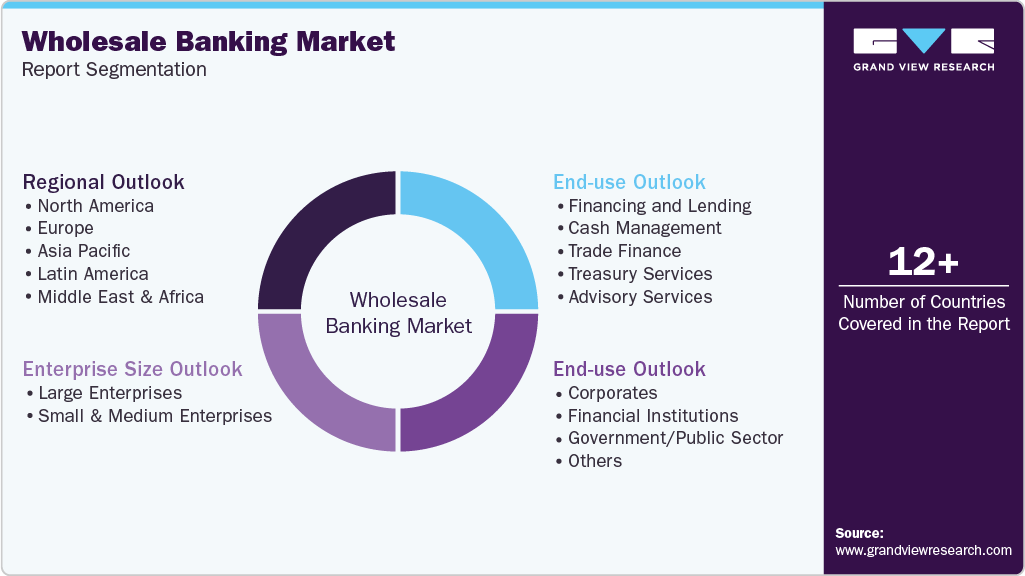
This report forecasts revenue growth at global, regional, and country levels and provides an analysis of the latest industry trends in each of the sub-segments from 2021 to 2033. For this study, Grand View Research has segmented the global wholesale banking market report based on services, enterprise size, end use, and region:
 To learn more about this report, Download Free Sample Report
-
Services Outlook (Revenue, USD Billion, 2021 - 2033)
-
Financing and Lending
-
Cash Management
-
Trade Finance
-
Treasury Services
-
Advisory Services
-
-
Enterprise Size Outlook (Revenue, USD Billion, 2021 - 2033)
-
Large Enterprises
-
Small and Medium Enterprises
-
-
End Use Outlook (Revenue, USD Billion, 2021 - 2033)
-
Corporates
-
Financial Institutions
-
Government/Public Sector
-
Others
-
-
Regional Outlook (Revenue, USD Billion, 2021 - 2033)
-
North America
-
U.S.
-
Canada
-
Mexico
-
-
Europe
-
Germany
-
UK
-
France
-
-
Asia Pacific
-
China
-
Japan
-
India
-
South Korea
-
Australia
-
-
Latin America
-
Brazil
-
-
Middle East and Africa (MEA)
-
KSA
-
UAE
-
South Africa
-
-
Frequently Asked Questions About This Report
North America dominated with a 35.6% revenue share in 2025.
The large enterprises segment held the largest revenue share in 2025.
Corporates segment held the largest share in 2025, while financial institutions is the fastest-growing segment.
The financing and lending segment accounted for the largest share of 40.0% in 2025. The segment’s growth is attributed to increased demand for large-scale corporate financing and expanding global trade and infrastructure investments.
Key players include JPMorgan Chase & Co.; Bank of America; Citigroup Inc.; Goldman Sachs; Morgan Stanley; HSBC Holdings plc; BNP Paribas; Barclays; Deutsche Bank; Mitsubishi UFJ Financial Group.
The market growth can be attributed to rising demand for large-scale corporate financing, with solutions such as syndicated loans, project financing, and treasury services supporting business expansion and infrastructure development.
The global wholesale banking market size was valued at USD 5.1 trillion in 2025 and is estimated at USD 5.3 trillion for 2026.
The global wholesale banking market is expected to grow at a CAGR of 5.2% from 2026 to 2033, reaching USD 7.6 trillion by 2033.
About the Author(s)
Next Generation Technologies Research Team
Technology · Next Generation TechnologiesThis report was authored by the next generation technologies research team at Grand View Research - comprising two research analysts, one senior research analyst, and one industry expert - with specialized expertise in the next generation technologies segment of the technology industry. All findings are based on proprietary technology databases, executive interviews, and regulatory analysis, subject to internal peer review prior to publication.
Last Updated:
Speak to Analyst

Customize this report to your needs - add regions, segments, or data points, with 20% free customization.
Or view our licence options:


ISO 9001:2015 & 27001:2022 Certified
We are GDPR and CCPA compliant! Your transaction & personal information is safe and secure. For more details, please read our privacy policy.


