
- Home
- »
- Next Generation Technologies
- »
-
WAN Optimization Market Size, Share & Trends Report, 2033GVR Report cover
![Wide Area Network Optimization Market (2026 - 2033)Report]()
Wide Area Network Optimization Market (2026 - 2033)
Size, Share & Trends Analysis Report By Component (Solution, Services), By Deployment Type (Cloud-based, On-premise), By Enterprise Size, By Vertical, By Region, And Segment Forecasts
Market Size, 2025
$1.9BMarket Estimate, 2026
$2.1BMarket Forecast, 2033
$3.5BCAGR, 2026–2033
8.0%WAN Optimization Market Summary
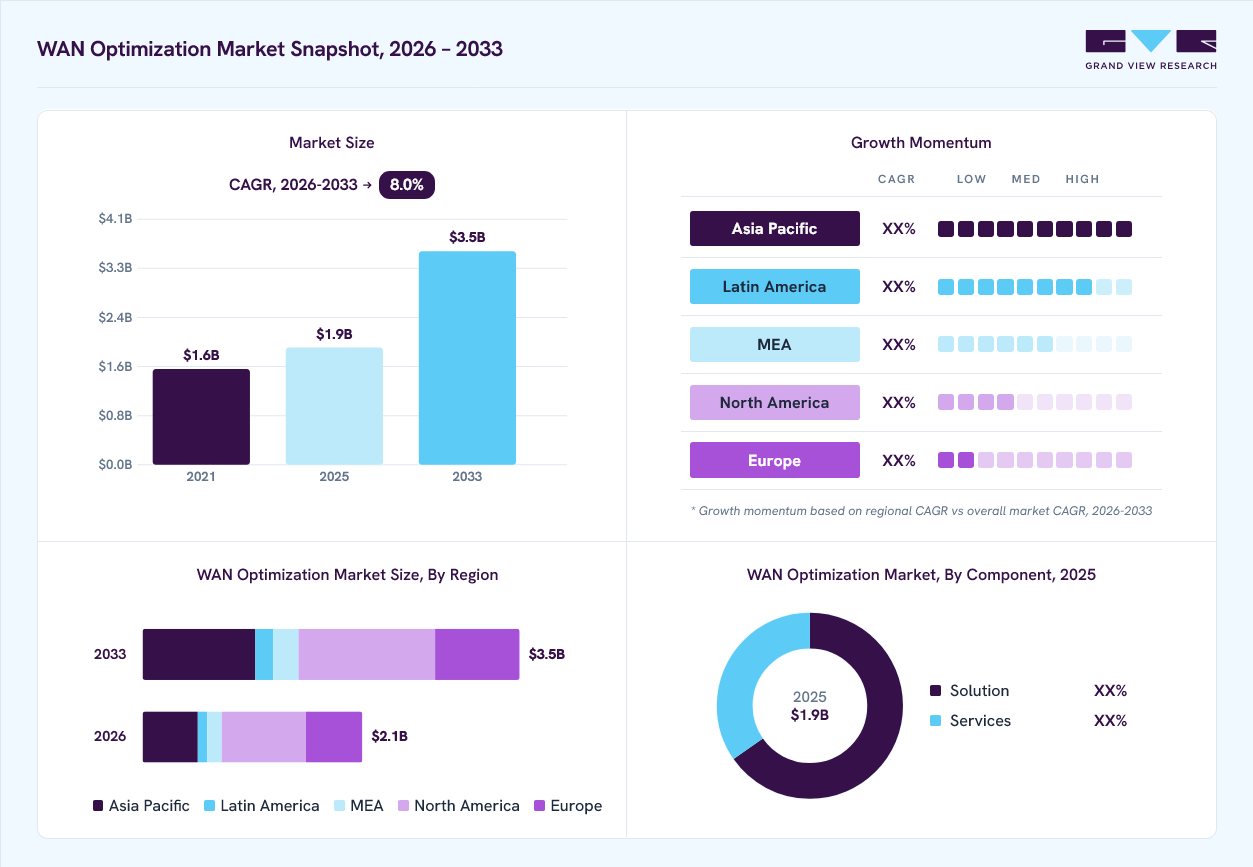
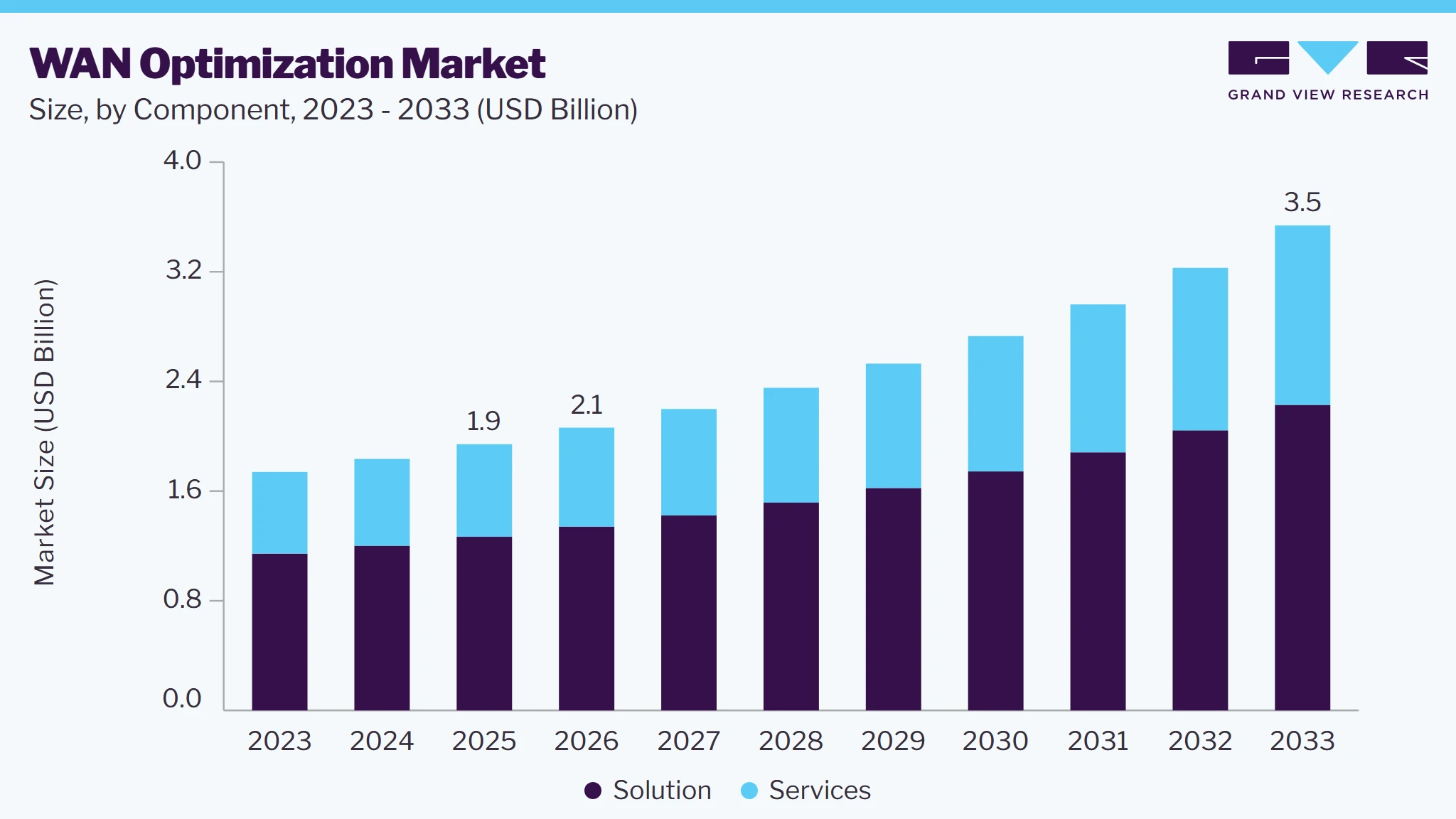
The global wide area network (WAN) optimization market size was valued at USD 1.9 billion in 2025 and is projected to grow from USD 2.1 billion in 2026 to USD 3.5 billion by 2033, at a CAGR of 8.0% from 2026 to 2033. North America dominated the market, accounting for the largest revenue share of 38.9% in 2025. Increasing data volumes across distributed networks are accelerating the adoption of WAN optimization solutions to maintain application performance and improve bandwidth efficiency.
Key Market Trends & Insights
- By component: Solution component segment led the market and accounted for 65.2% share in 2025.
- By deployment type: On-premise segment led the market and accounted for 58.5% share in 2025.
- By enterprise size: Large enterprises segment accounted for the largest share of global revenue in 2025.
- By verticals: BFSI segment accounted for the largest market revenue share in 2025.
Regional Highlights
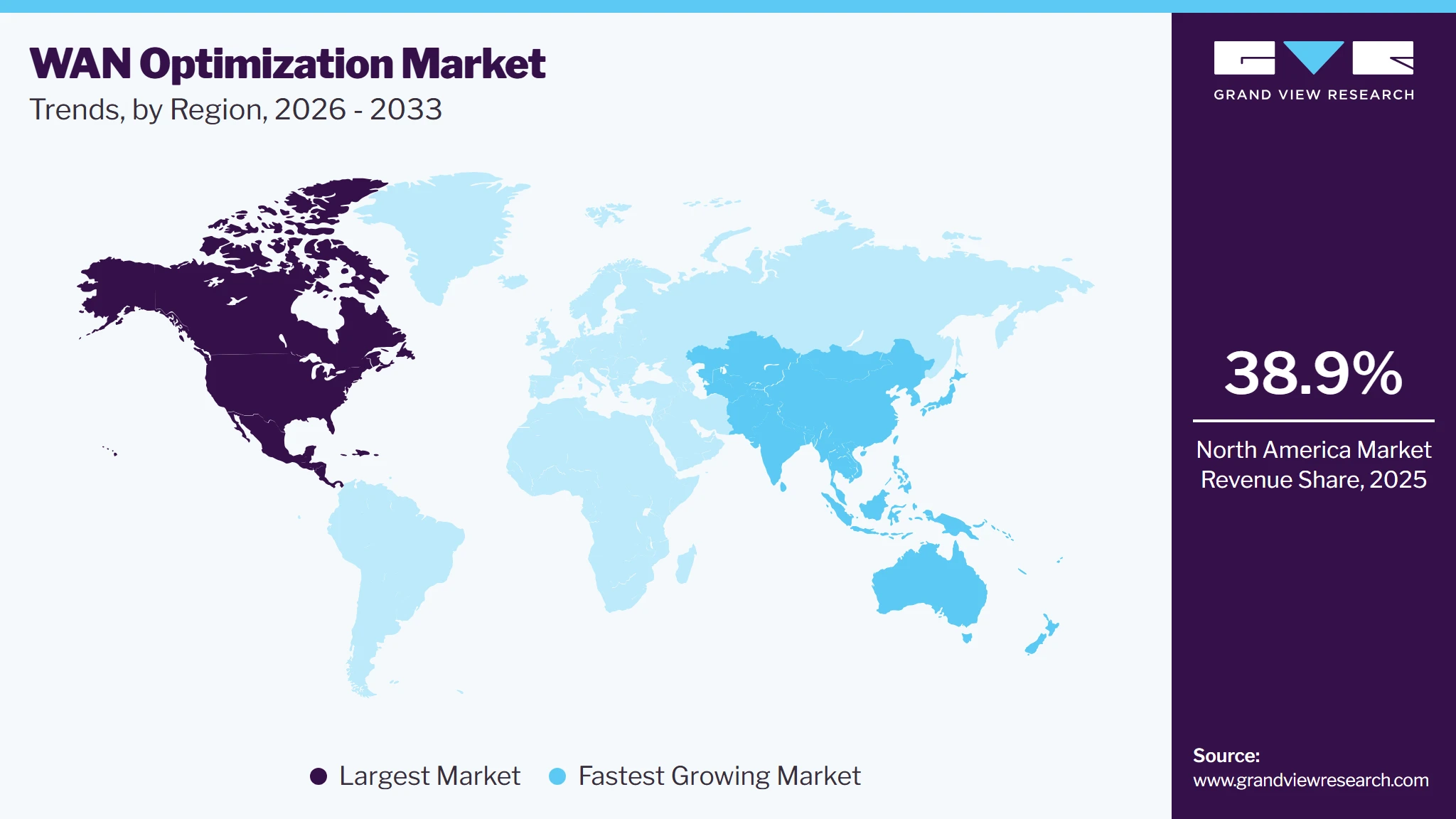
- Largest regional market: North America (38.9% revenue share, 2025)
- Fastest-growing regional market: Asia Pacific (highest CAGR, 2026-2033)
- By country: The U.S. held the largest share of North America in 2025.
Market Size & Forecast
- Market size in 2025: USD 1.9 Billion
- Estimated market size in 2026: USD 2.1 billion
- Projected market size by 2033: USD 3.5 Billion
- CAGR (2026-2033): 8.0%
The increasing demand for efficient network performance and secure data transmission is driving the adoption of advanced WAN optimization solutions. Growing encrypted traffic has reduced the effectiveness of traditional compression and deduplication techniques. Furthermore, modern solutions focus on latency, packet loss, jitter, and traffic flow to improve network efficiency. These capabilities help enterprises manage traffic and prioritize critical applications without decrypting sensitive data. Thus, the need for secure, efficient network performance is driving growth in the WAN optimization market.The growing adoption of cloud-based WAN optimization is a technology trend in the market. Enterprises are increasingly moving applications and data to cloud environments, driving the need for faster, more reliable connectivity. Cloud-based solutions improve data transfer and reduce dependence on physical network appliances. Furthermore, cloud deployment provides greater flexibility to manage changing network requirements. This shift toward cloud-based optimization is supporting the adoption of scalable WAN optimization solutions.
The increasing standardization of SD-WAN services is influencing the WAN optimization market. ITU-T recommendations guide network connectivity, service management, and performance. This standardization improves interoperability across different network technologies and makes WAN optimization easier to integrate with SD-WAN environments. As enterprises increasingly adopt SD-WAN, the need for compatible, manageable WAN optimization solutions is growing.
Maintaining consistent performance across different network connections is a challenge for WAN optimization. Enterprises often use MPLS, broadband, 5G, and internet connections with different speeds and reliability. These variations make it difficult to maintain stable network performance across all locations, increasing the complexity of WAN optimization solutions.
Market Dynamics
The WAN optimization market is experiencing steady growth as enterprises expand cloud adoption, hybrid work environments, and geographically distributed operations. Organizations increasingly require faster, more reliable connectivity for cloud applications while optimizing bandwidth utilization and reducing network latency. The market is also evolving from standalone optimization appliances toward software-defined, cloud-managed, and AI-enabled networking platforms that combine performance optimization with intelligent traffic management.
The rapid migration of enterprise applications to public cloud, private cloud, and Software-as-a-Service (SaaS) platforms has significantly increased the volume of traffic across wide-area networks. As organizations operate multiple branch offices, remote workforces, and distributed data centers, maintaining consistent application performance has become increasingly challenging due to latency, packet loss, and bandwidth constraints. These operational challenges are driving enterprises to prioritize network performance optimization as a critical component of digital transformation strategies.
WAN optimization solutions improve application responsiveness by reducing redundant data transfers, compressing traffic, optimizing TCP performance, and intelligently prioritizing business-critical applications. These capabilities enable organizations to maximize existing bandwidth capacity, deliver consistent user experiences across distributed locations, and support cloud workloads without requiring proportional investments in network infrastructure. As cloud dependency continues to grow, demand for WAN optimization solutions is expected to accelerate across both enterprise and managed networking environments.
The deployment of WAN optimization solutions can entail high upfront costs, particularly for enterprises that require multiple optimization appliances, software licenses, network upgrades, and integration with existing infrastructure. Additional costs may arise from professional services, configuration, testing, maintenance, and employee training. These financial and operational requirements can make adoption more challenging for organizations with limited IT budgets or relatively small distributed networks.
The restraint is particularly relevant among SMEs and cost-sensitive organizations that may prioritize basic connectivity or cloud-based networking services over dedicated optimization infrastructure. Complex integration with legacy WAN environments can also increase deployment time and require specialized technical expertise. As a result, higher implementation costs can delay purchasing decisions, encourage gradual deployment, and limit the adoption of advanced WAN optimization solutions in price-sensitive segments.
The increasing complexity of enterprise networks is creating significant opportunities for intelligent, cloud-delivered WAN optimization solutions. Organizations are seeking networks capable of automatically detecting congestion, predicting application performance issues, and dynamically adjusting traffic policies without extensive manual intervention. The adoption of AI-driven analytics, centralized orchestration, and cloud-native networking is enabling a new generation of adaptive WAN optimization platforms.
This opportunity is expected to generate substantial growth in software subscriptions, managed services, and cloud-based optimization deployments. Vendors offering integrated solutions that combine optimization, observability, automation, and secure connectivity are well-positioned to capture long-term enterprise investments. As organizations continue to expand hybrid cloud infrastructure and remote operations, AI-enabled WAN optimization is expected to become a foundational capability in next-generation enterprise networking architectures.
Market Concentration & Characteristics
The WAN optimization market is moderately fragmented due to the presence of numerous global and specialized technology providers offering traditional WAN optimization, SD-WAN, cloud-based optimization, and managed networking solutions for enterprises with distributed network infrastructures. Companies are focusing on expanding software capabilities, developing cloud-native optimization platforms, and integrating application acceleration, traffic management, network monitoring, and security functionalities. As enterprises increasingly adopt cloud applications and distributed networking architectures, market participants continue to compete through solution performance, scalability, deployment flexibility, network integration, and cost efficiency rather than market concentration.
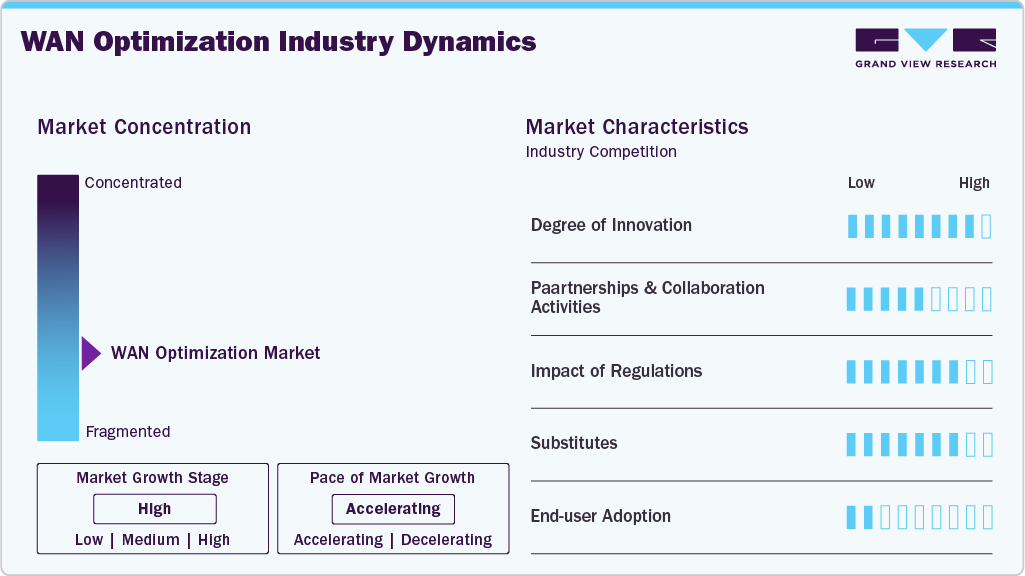
Moderate market concentration is further supported by the strong presence of established companies such as Cisco Systems, Inc., Riverbed Technology LLC., Fortinet, Inc., and ARYAKA NETWORKS, INC., which continue to strengthen their market positions through platform development, portfolio expansion, strategic partnerships, and integration of WAN optimization with SD-WAN and secure networking technologies. At the same time, companies including Versa Networks, Inc., FatPipe Inc., and SANGFOR TECHNOLOGIES are expanding their presence by offering specialized solutions in optimization, SD-WAN, application performance, and cloud networking. Market participants primarily compete on application performance, bandwidth optimization, network scalability, cloud integration, security, automation, deployment flexibility, and managed services, thereby maintaining the moderately fragmented nature of the WAN optimization market.
Analyst Perspective
The WAN optimization market is evolving from bandwidth acceleration toward intelligent application-aware networking that supports cloud-first enterprise environments. Growing reliance on SaaS applications, hybrid work, and distributed operations continues to strengthen demand for optimized network performance and efficient bandwidth utilization. AI-driven traffic management, centralized orchestration, and cloud-managed networking platforms are reshaping the competitive landscape and increasing the value of software-based deployments. Future investments are expected to focus on integrated networking architectures that combine optimization, automation, observability, and secure connectivity through subscription-based delivery models.
Component Insights
The solution components segment accounted for 65.2% of the largest share of global revenue in 2025. This segment is bifurcated into Traditional WAN and SD-WAN, with growing demand for efficient management of distributed enterprise networks supporting segment expansion. Organizations operating multiple offices, remote locations, and cloud-connected environments require solutions that can maintain application performance while managing increasing network traffic. This demand is encouraging the adoption of both conventional optimization technologies and software-defined approaches according to existing infrastructure and network modernization requirements. As enterprises continue to expand distributed operations, demand for network optimization solutions is expected to increase.
The services component segment is projected to grow at the fastest CAGR over the forecast period. This segment is bifurcated into advisory services, implementation & integration, and training & support, with rising complexity of WAN deployments creating opportunities for specialized services. Organizations increasingly require external expertise to assess network requirements, integrate optimization technologies, and ensure effective configuration across existing infrastructure. Ongoing training and technical support further help enterprises maintain network performance and resolve operational issues after deployment. Consequently, increasing deployment complexity is creating opportunities for service providers across the market.
Deployment Type Insights
The on-premises segment accounted for 58.5% of the largest share of global revenue in 2025. The on-premise segment is gaining traction among large enterprises that require greater control over network infrastructure, data, and security policies. Local deployment allows organizations to manage WAN optimization within their existing IT environments and maintain tighter control over network operations. Moreover, the need for dedicated hardware, installation, maintenance, and technical resources increases the overall deployment cost.
The cloud-based deployment type segment is projected to grow at the fastest CAGR over the forecast period. The cloud-based segment is experiencing increasing adoption as organizations seek more flexible and scalable approaches to network optimization. The model allows enterprises to manage traffic across branch offices, remote users, and cloud applications through centralized platforms. Lower dependence on physical infrastructure also supports faster deployment and easier expansion as network requirements change. Moreover, the growing shift toward cloud-based enterprise networks is expected to drive strong growth in cloud-based WAN optimization.
Enterprise Size Insights
The large enterprises segment accounted for the largest share of global revenue in 2025, supported by the growing complexity of enterprise networks, with large organizations managing multiple branches, data centers, cloud environments, and high volumes of business-critical traffic. Such network structures require advanced optimization to maintain application performance and efficient bandwidth utilization. The availability of centralized management and scalable optimization capabilities further supports adoption. Moreover, large enterprises are expected to remain a key revenue contributor to the WAN Optimization Market.
The SMEs segment is expected to grow at a significant CAGR over the forecast period. The segment is gaining traction as SMEs increasingly adopt cloud applications and distributed connectivity while seeking cost-effective network performance solutions. Limited IT resources encourage the use of simplified, cloud-based, and managed WAN optimization offerings that reduce deployment and maintenance requirements. Flexible subscription models also allow smaller organizations to scale network capabilities according to their operational needs. As digital adoption among SMEs continues to increase, demand for WAN optimization solutions is expected to strengthen.
Vertical Insights
The BFSI segment accounted for the largest market revenue share in 2025. The segment is supported by the increasing digitalization of banking and financial services, which is generating higher volumes of data traffic across branches, data centers, and cloud applications. WAN optimization helps improve application performance and maintain reliable connectivity for digital banking, transaction processing, and financial applications. The need for consistent network performance across geographically distributed operations further supports adoption. Moreover, continued expansion of digital financial services is expected to drive demand for WAN optimization solutions.
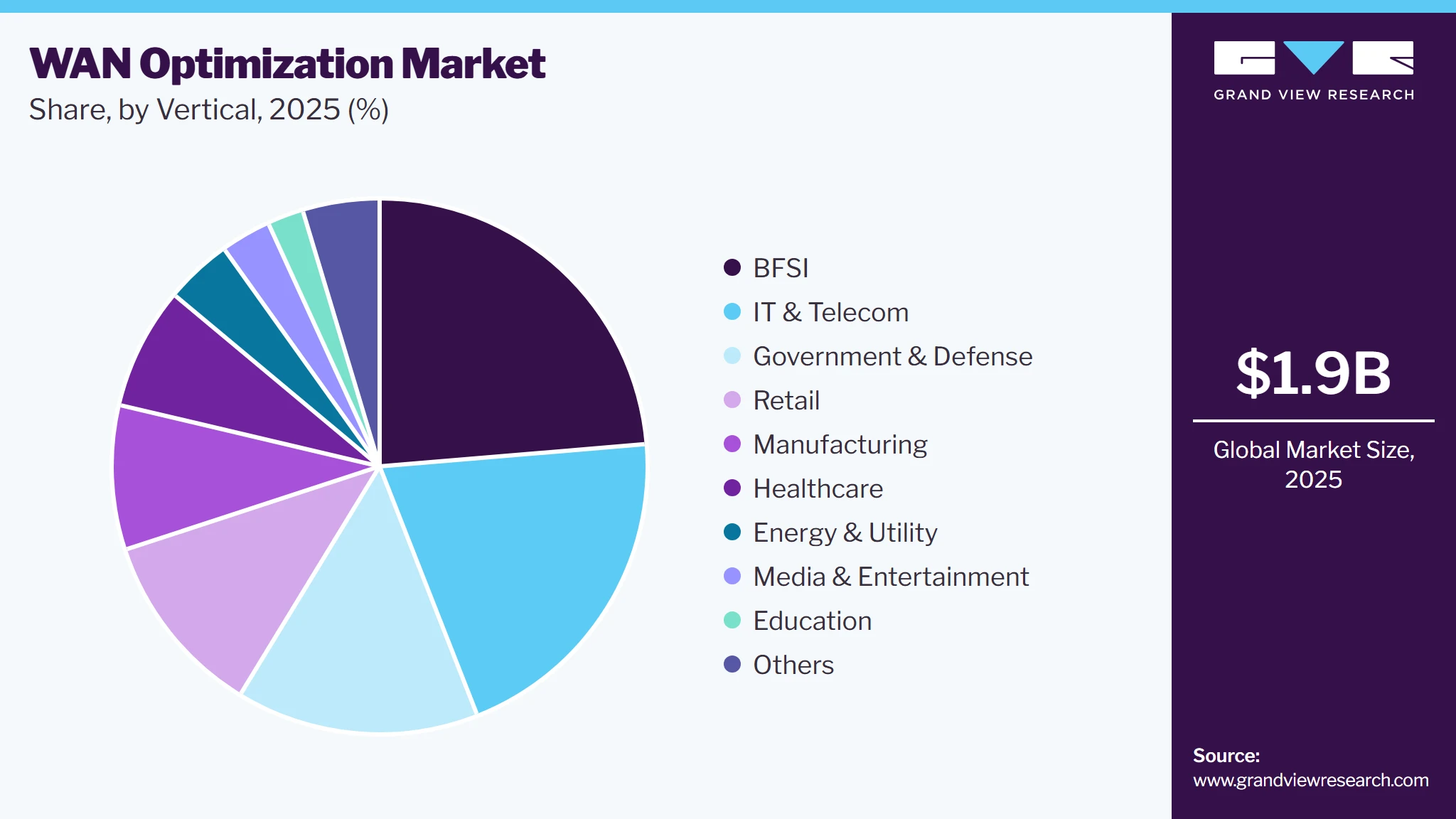
The healthcare segment is projected to grow at the fastest CAGR over the forecast period, driven by the growing adoption of digital healthcare applications and distributed healthcare infrastructure, which increases the need for reliable network performance. WAN optimization helps improve connectivity for electronic health records, telehealth platforms, medical applications, and data exchange across healthcare facilities. This supports faster access to critical information and more consistent application performance.
Regional Insights
North America wide area network optimization market led the global market and accounted for 38.9% of the global revenue in 2025. The increasing demand for reliable connectivity across distributed enterprise networks is driving the growth of the market. Enterprises connect branches, data centers, and cloud environments while managing growing application traffic. This is increasing demand for solutions that improve application performance and network efficiency.
U.S. Wide Area Network Optimization Market Trends
The U.S. wide area network (WAN) optimization market is held the largest market share. The growing integration of WAN optimization with SD-WAN and SASE is a trend in the U.S. Modern platforms combine intelligent traffic management, security, cloud connectivity, and application optimization. This integration manages distributed networks through centralized and cloud-managed architectures.
Asia Pacific Wide Area Network Optimization Market Trends
The Asia Pacific wide area network (WAN) optimization market is projected to grow at the fastest CAGR over the forecast period. The growing adoption of multiple WAN access technologies is shaping the WAN optimization trend across the region. Enterprises are combining broadband, 5G, LTE, and other connectivity options to link branches with the cloud and headquarters. This is encouraging intelligent traffic selection and optimization across heterogeneous networks.
The China WAN optimization market held a dominant share in the Asia Pacific market. The expansion of intelligent WAN infrastructure is creating new opportunities for WAN optimization. This development is increasingly focused on handling rising video traffic, digitalization, and intelligent-computing workloads. This network solution can optimize traffic and maintain consistent application performance.
The Japan wide area network (WAN) optimization market is expected to grow at a significant CAGR over the forecast period. The growing emphasis on reliable, standardized enterprise connectivity is driving WAN technology development in Japan. Modern SD-WAN architectures support multiple WAN connections and centralized management across enterprise locations. This modern technology can improve traffic management and network performance.
Europe Wide Area Network Optimization Market Trends
The Europe wide area network (WAN) Optimization market poised significant growth from 2026 to 2033. The expansion of multicloud and distributed digital infrastructure is creating opportunities for WAN optimization across Europe. Enterprises are increasingly connecting cloud, branch, and remote environments, all of which require reliable and efficient network performance. This creates opportunities for optimization solutions that improve connectivity across multiple cloud and enterprise locations.
The UK WAN optimization market is driven by the growing adoption of multi-region cloud services is creating opportunities in the market. Government guidance published in February 2025 highlights the use of cloud regions outside the UK to improve resilience and capacity. This expansion can increase demand for solutions that maintain reliable connectivity across geographically distributed cloud environments.
The Germany wide area network (WAN) optimization market held a substantial share in the Europe market. The increasing digitalization of manufacturing operations is driving demand for advanced WAN connectivity in Germany. German businesses are expanding cloud-based operations and digital production processes across different locations. This expansion is increasing the need to maintain reliable application performance across distributed networks.
Key Wide Area Network Optimization Company Insights
Key players operating in the WAN optimization market include Cisco Systems, Inc., Riverbed Technology LLC., Fortinet, Inc., Broadcom, FatPipe Inc., Versa Networks, Inc., ARYAKA NETWORKS, INC., SANGFOR TECHNOLOGIES., Equinix Inc. and NTT Global Networks. Key players in the WAN optimization market are expanding their portfolios with cloud-based, SD-WAN-integrated, and AI-enabled network optimization solutions while strengthening partnerships with enterprises, telecom operators, and cloud service providers. Companies are focusing on improving application performance, reducing latency, enhancing network security, optimizing bandwidth utilization, and supporting the growing demand for distributed enterprise networks, cloud applications, remote operations, and digital services.
-
Cisco Systems, Inc. is a technology company that offers networking, security, observability, collaboration, and AI-enabled solutions. Its networking portfolio includes SD-WAN solutions that provide connectivity, application performance optimization, multicloud capabilities, analytics, automation, and security. The company’s strategy focuses on integrating networking and security, expanding AI-powered networking and automation, and providing centralized management across enterprise, cloud, and distributed environments.
-
Riverbed Technology LLC. is a technology company that offers AI-powered observability, application acceleration, network performance, cloud observability, application observability, and digital experience solutions. The company’s strategy focuses on unifying observability with AI, using causal, predictive, generative, and agentic AI to identify, prevent, and resolve IT issues and move organizations toward autonomous IT operations.
Key Wide Area Network Optimization Companies
The following key companies have been profiled for this study on the wide area network (WAN) optimization market:
-
Cisco Systems, Inc.
-
Riverbed Technology LLC.
-
Fortinet, Inc.
-
Broadcom
-
FatPipe Inc.
-
Versa Networks, Inc.
-
ARYAKA NETWORKS, INC.
-
SANGFOR TECHNOLOGIES.
-
Equinix Inc.
-
NTT Global Networks
Competitive Benchmarking
Operating Strategies
Competitive Edge
Weaknesses
Mature Players: Cisco Systems, Inc.; Riverbed Technology LLC.; Fortinet, Inc.; ARYAKA NETWORKS, INC.
- Mature players in the WAN optimization market are focus on expanding comprehensive WAN portfolios by combining optimization with SD-WAN, SASE, network security, cloud connectivity, and application performance management.
- Mature players gain a competitive advantage through strong enterprise customer bases, extensive networking portfolios, established technical infrastructure, global presence, and the ability to provide integrated networking solutions across complex environments.
- These companies often face challenges related to broad product portfolios can increase solution complexity and deployment requirements, while higher costs may make some offerings less attractive to cost-sensitive customers.
Emerging Players: Versa Networks, Inc.; FatPipe Inc.; Sangfor Technologies
- Emerging players in the WAN optimization market are focusing on specialized optimization capabilities, cloud-native architectures, flexible deployment models, and targeted solutions for distributed enterprises.
- Emerging players gain market traction through greater flexibility, focused technology offerings, faster product development, simplified deployment, and competitive pricing can help these players address specific customer requirements.
- Emerging players face limitations due to smaller customer bases, limited global reach, fewer resources for large-scale deployments, and lower brand recognition can restrict penetration into highly complex enterprise environments.
Recent Developments
-
In July 2025, ARYAKA NETWORKS, INC. partnered with TD SYNNEX Corporation., a global distributor and solutions aggregator for the IT ecosystem, to expand its Unified SASE as a Service to more enterprise customers globally. The solution combines networking, security, and observability to support distributed and multi-cloud environments. The partnership is expected to strengthen the company's market reach and drive demand for secure, optimized enterprise networks.
-
In June 2025, FatPipe Inc. introduced Total Security 360, combining SD-WAN and cybersecurity into a single platform. It integrates firewall, intrusion prevention, antivirus, DDoS protection, and data loss prevention. The platform supports cloud and on-premise deployment, helping SMEs simplify network management and improve security.
Wide Area Network Optimization Market Report Scope
Report Attribute
Details
Market size in 2025
USD 1.9 billion
Estimated market size in 2026
USD 2.1 billion
Revenue forecast in 2033
USD 3.5 billion
Growth rate
CAGR of 8.0% from 2026 to 2033
Base year for estimation
2025
Historical data
2021 - 2024
Forecast period
2026 - 2033
Quantitative units
Revenue in USD billion, and CAGR from 2026 to 2033
Report coverage
Revenue forecast, company ranking, competitive landscape, growth factors, and trends
Segments covered
Component, deployment type, enterprise size, vertical, region
Regional scope
North America; Europe; Asia Pacific; Latin America; MEA
Country scope
U.S.; Canada; Mexico; Germany; UK; France; China; Japan; India; South Korea; Australia; Brazil; KSA; UAE; South Africa
Key companies profiled
Cisco Systems, Inc.; Riverbed Technology LLC.; Fortinet, Inc.; Broadcom; FatPipe Inc.; Versa Networks, Inc.; ARYAKA NETWORKS, INC.; SANGFOR TECHNOLOGIES.; Equinix Inc.; NTT Global Networks
Customization scope
Free report customization (equivalent up to 8 analysts working days) with purchase. Addition or alteration to country, regional & segment scope.
Pricing and purchase options
Avail customized purchase options to meet your exact research needs. Explore purchase options
Global Wide Area Network Optimization Market Report Segmentation
The report forecasts revenue growth at global, regional, and country levels and provides an analysis of the latest industry trends in each of the sub-segments from 2021 to 2033. For the purpose of this study, Grand View Research has segmented the global wide area network (WAN) optimization market report based on component, deployment type, enterprise size, vertical, and region.
-
Component Outlook (Revenue, USD Billion, 2021 - 2033)
-
Solution
-
Traditional WAN
-
SD-WAN
-
-
Services
-
Advisory Services
-
Implementation & Integration
-
Training & Support
-
-
-
Deployment Type Outlook (Revenue, USD Billion, 2021 - 2033)
-
Cloud-based
-
On-premise
-
-
Enterprise Size Outlook (Revenue, USD Billion, 2021 - 2033)
-
Large Enterprises
-
SMEs
-
-
Vertical Outlook (Revenue, USD Billion, 2021 - 2033)
-
BFSI
-
Healthcare
-
IT & Telecom
-
Manufacturing
-
Retail
-
Media & Entertainment
-
Government & Defense
-
Education
-
Energy & Utility
-
Others
-
-
Regional Outlook (Revenue, USD Billion, 2021 - 2033)
-
North America
-
U.S.
-
Canada
-
Mexico
-
-
Europe
-
Germany
-
UK
-
France
-
-
Asia Pacific
-
China
-
India
-
Japan
-
South Korea
-
Australia
-
-
Latin America
-
Brazil
-
-
Middle East & Africa (MEA)
-
UAE
-
Kingdom of Saudi Arabia (KSA)
-
South Africa
-
-
Research Methodology
The WAN optimization market figures in this report are based on a proven research process that combines executive interviews with secondary research from proprietary databases, company filings, and recognized regulatory and institutional sources. Market size is built through value-chain sizing-reconciling supply-side and demand-side estimates-and triangulated with bottom-up and top-down approaches. Every estimate passes multiple levels of expert validation before publication, with each WAN optimization segment quantified using the revenue-capture definitions in the table below.
Segment Definition
Segment - Component
Revenue capture definition
Solution
The segment revenue is generated from the sale and licensing of WAN optimization hardware, software, virtual appliances, subscriptions, and integrated platforms designed to improve WAN performance, reduce bandwidth consumption, accelerate applications, and optimize network traffic. The segment includes solutions such as Traditional WAN and SD-WAN.
Traditional WAN: The segment revenue is generated from hardware appliances, virtual optimization software, perpetual and subscription licenses, protocol acceleration, compression, caching, and traffic optimization solutions deployed across conventional WAN infrastructure.
SD-WAN: The segment revenue is generated from SD-WAN software subscriptions, virtual edge platforms, cloud-managed networking licenses, application-aware routing, centralized orchestration, and integrated WAN optimization functionality.
Services
The segment revenue is generated from professional and technical services associated with WAN optimization, including consulting, network assessment, implementation, integration, configuration, training, maintenance, technical support, and managed optimization services. The segment includes services such as advisory services, implementation & integration, and training & support.
Advisory Services: The segment revenue is generated from network assessment, WAN architecture consulting, optimization strategy development, technology evaluation, and digital transformation advisory engagements.
Implementation & Integration: The segment revenue is generated from solution deployment, configuration, migration, SD-WAN integration, network testing, policy implementation, and enterprise infrastructure integration services.
Training & Support: The segment revenue is generated from technical training, maintenance contracts, software updates, managed support, troubleshooting, and ongoing optimization services.
Segment - Deployment Type
Revenue capture definition
Cloud-based
The segment revenue is generated from subscription-based WAN optimization software, cloud-managed networking platforms, virtual network functions, SaaS optimization services, and managed cloud optimization solutions.
On-premise
The segment revenue is generated from physical appliances, enterprise-installed optimization software, perpetual licenses, maintenance agreements, and customer-managed WAN optimization infrastructure.
Segment - Enterprise Size
Revenue capture definition
Large Enterprises
The segment revenue is generated from enterprise-wide WAN optimization deployments, software licenses, appliances, subscriptions, integration projects, and long-term support contracts for organizations with extensive branch networks and data centers.
SMEs
The segment revenue is generated from cloud subscriptions, entry-level optimization appliances, managed networking services, implementation services, and support solutions purchased by small and medium-sized enterprises.
Segment - Vertical
Revenue capture definition
BFSI
The segment revenue is generated from WAN optimization solutions supporting secure connectivity between branches, payment systems, cloud applications, and financial data centers.
Healthcare
The segment revenue is generated from optimization solutions deployed for electronic health records, medical imaging, telehealth, hospital networks, and distributed healthcare facilities.
IT & Telecom
The segment revenue is generated from WAN optimization software, managed services, and networking solutions supporting cloud infrastructure, telecom operations, and distributed enterprise connectivity.
Manufacturing
The segment revenue is generated from optimization solutions connecting factories, warehouses, production facilities, ERP systems, and industrial applications across multiple sites.
Retail
The segment revenue is generated from WAN optimization deployments supporting retail stores, distribution centers, e-commerce platforms, and omnichannel business operations.
Media & Entertainment
The segment revenue is generated from solutions optimizing large file transfers, digital content distribution, streaming applications, and collaborative media production workflows.
Government & Defense
The segment revenue is generated from secure WAN optimization infrastructure, software, integration, and support services for government agencies and defense organizations.
Education
The segment revenue is generated from WAN optimization solutions supporting digital classrooms, campus connectivity, research networks, and online learning platforms.
Energy & Utility
The segment revenue is generated from optimization solutions connecting substations, control centers, renewable energy assets, utility operations, and remote industrial facilities.
Others
The segment revenue is generated from WAN optimization solutions deployed across transportation, logistics, hospitality, professional services, construction, and other commercial industries.
Estimation Model
Layer Name
Key Question
Description
Enterprise & Network Base
How many organizations require WAN optimization?
The estimation begins by assessing enterprises with distributed branches, data centers, remote locations, and cloud-connected infrastructure. The analysis considers enterprise size, network complexity, and geographic distribution to identify the addressable customer base.
Technology Adoption
How widely are WAN optimization solutions being adopted?
This layer evaluates the penetration of Traditional WAN, SD-WAN, cloud-based, and on-premise optimization solutions. Adoption is assessed across enterprise sizes and industry verticals based on network requirements and digital transformation activities.
Revenue per Deployment
How much revenue is generated from each deployment?
Revenue is estimated based on solution licenses, subscriptions, hardware, implementation, integration, advisory, training, and support services. Pricing varies according to deployment type, enterprise scale, solution complexity, and service requirements.
Market Revenue & Forecast
What is the total market value and future growth?
The final layer aggregates revenue across components, deployment types, enterprise sizes, and verticals. Historical adoption, cloud migration, SD-WAN penetration, and enterprise networking investments are considered to estimate the market size and forecast future growth.
Delivered Customizations
This report has been delivered with the following In-depth customizations
Client Request
Customization Delivered
Value Adds
Regional WAN Optimization Market Opportunity Assessment
Country/region-wise market sizing and forecasts
Analysis of demand, adoption trends, and regulatory landscape
Identification of high-growth regions and investment hotspots
Identified region-specific growth opportunities
Supported expansion and go-to-market strategy
Enabled informed regional investment decisions
Cross-Segmentation Analysis for the WAN Optimization Market
Criss-cross market analysis by component, deployment type, enterprise size, vertical
Demand and adoption assessment across key segments
Segment attractiveness and growth potential benchmarking
Identified high-potential market segments
Supported targeted component positioning and marketing strategy
Improved customer and segment prioritization
Competitive Benchmarking and Strategic Positioning in the WAN Optimization Market
Benchmarking of key competitors across components, pricing, partnerships, and innovation
Comparative assessment of market share, capabilities, and strategies
Analysis of competitive strengths, gaps, and differentiation areas
Identified competitive white spaces and growth gaps
Supported strategic positioning and differentiation
Enabled data-driven competitive strategy development
Frequently Asked Questions About This Report
Key factors that are driving the market growth include rapidly growing adoption of advanced network and application performance solutions across enterprises and speedy deployment of virtualized next generation 5G network infrastructure worldwide.
The solution segment led with a 65.2% revenue share in 2025, while the services segment is the fastest-growing.
The on-premises segment led with a 58.5% revenue share in 2025, while the cloud-based segment is the fastest-growing.
The large enterprises segment held the largest revenue share in 2025, while the SMEs segment is the fastest-growing.
Key players include Some key players operating in the wide area network optimization market include Cisco Systems, Inc., HPE (Silver Peak), Riverbed Technology, Citrix Systems, Inc., Fortinet, Vmware Inc., Broadcom (Symantec Enterprise), FatPipe Networks Inc., Versa Networks, Inc, Exinda, Blue Coat System, Infovista Corporation, NTT Communications, Aryaka Networks, Inc., Circadence Corporation, and Array Networks, Inc.
The global wide area network optimization market size was valued at USD 1.9 billion in 2025 and is estimated at USD 2.1 billion for 2026.
The global wide area network optimization market is expected to grow at a CAGR of 8.0% from 2026 to 2033, reaching USD 3.5 billion by 2033.
North America dominated with a 38.9% revenue share in 2025.
Asia Pacific is the fastest-growing region over the forecast period.
About the Author(s)
Next Generation Technologies Research Team
Technology · Next Generation TechnologiesThis report was authored by the next generation technologies research team at Grand View Research - comprising two research analysts, one senior research analyst, and one industry expert - with specialized expertise in the next generation technologies segment of the technology industry. All findings are based on proprietary technology databases, executive interviews, and regulatory analysis, subject to internal peer review prior to publication.
Last Updated:
Speak to Analyst


Customize this report to your needs — add regions, segments, or data points, with 20% free customization.
Or view our licence options:


ISO 9001:2015 & 27001:2022 Certified
We are GDPR and CCPA compliant! Your transaction & personal information is safe and secure. For more details, please read our privacy policy.


