
- Home
- »
- Medical Devices
- »
-
Reimbursement Policy Impact On Diabetic Foot Ulcer MarketGVR Report cover
![Impact Report]()
Impact Analysis Of Reimbursement Policy Changes In The Diabetic Foot Ulcer Treatment Market
Analysis Objectives
This analysis examines the evolution and substance of CMS reimbursement policy changes affecting skin substitute grafts used in diabetic foot ulcer (DFU) treatment between 2024 and 2026 and assesses their downstream commercial and clinical implications. Specifically, this assessment seeks to:
-
Trace the sequence and substance of CMS reimbursement policy changes (2024-2026) affecting skin substitute grafts used in diabetic foot ulcer treatment.
-
Evaluate the impact of these policy shifts on end users - patients and healthcare providers - in terms of treatment access, documentation burden, and care economics.
-
Assess the strategic and financial impact on manufacturers of skin substitute and wound care products, including market consolidation and R&D implications.
-
Translate these findings into actionable strategic recommendations for stakeholders navigating the new reimbursement landscape.
This analysis draws on Grand View Research’s (GVR) U.S. Healthcare Facility Mapping & Intelligence Platform, an integrated analytics ecosystem designed to help healthcare stakeholders-including providers, payers, investors, and life sciences organizations-transform complex healthcare data into actionable strategic insights.
The Rising Clinical and Financial Burden of Diabetic Foot Ulcers
The diabetic foot ulcer treatment market has grown into one of healthcare's most significant chronic wound segments. As of 2025, 589 million adults globally live with diabetes (IDF, 2025), with 15.0%-25.0% at risk of developing a DFU during their lifetime. In the U.S. alone, the CDC estimates that untreated DFUs lead to amputation in up to 25.0% of cases - making effective wound care a critical public health priority.
Skin substitutes - including allografts, amniotic membrane products, and bioengineered tissue - are advanced products used when standard wound care fails. Medicare Part B spending on these products escalated from USD 256.0 million in 2019 to over USD 10.0 billion in 2024, a nearly 40-fold increase in five years. This spending surge was driven by premium, ASP-based pricing structures across more than 75 products on the market, many lacking strong clinical evidence - An environment CMS characterized as ripe for policy correction.

Reimbursement Policy Changes
Phase 1 - November 2024: CMS Issues Final Local Coverage Determinations (LCDs)
On November 14, 2024, CMS - through all seven Medicare Administrative Contractors (MACs) released final LCDs for skin substitute grafts and CTPs for DFU and Venous Leg Ulcer (VLU) treatment, initially set for implementation February 12, 2025. Key provisions included:
-
Coverage restricted only to wounds showing less than 50.0% area reduction after 4 weeks of standard care (debridement, offloading, infection control).
-
Only 17 products with randomized controlled trial (RCT) evidence approved for DFU; 5 products for VLU - down from 75+ products previously reimbursed.
-
Maximum 8 applications per episode; 16-week treatment window.
-
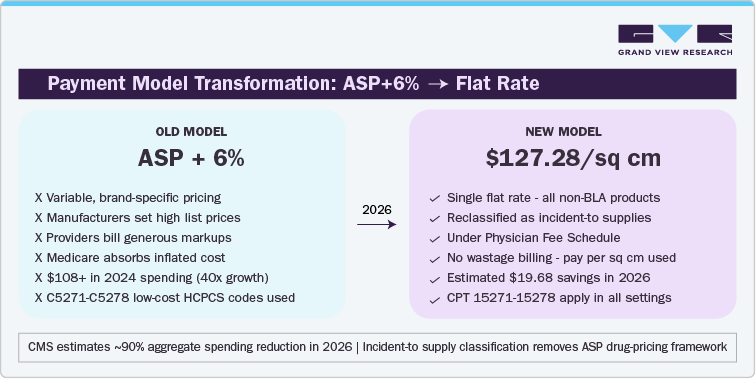
Proposed flat payment rate of USD 127.14/cm² replacing individual ASP-based pricing for non-FDA BLA-licensed products.
Phase 2 - January to April 2025: Political Intervention & Repeated Delays
Following the change in Administration, CMS paused implementation of the finalized Local Coverage Determinations (LCDs) for skin substitute grafts and cellular and tissue-based products (CTPs) used in diabetic foot ulcers (DFUs) and venous leg ulcers (VLUs). The original effective date was first delayed by 60 days (from February 12 to April 13, 2025) and was subsequently postponed to January 1, 2026, to allow additional policy review and stakeholder engagement. CMS also invited manufacturers and clinical organizations to submit peer-reviewed publications and other high-quality clinical evidence by November 1, 2025, enabling the MACs to reassess product coverage before implementation. During this period, the proposed reforms also became the subject of political debate, with concerns raised publicly about the potential impact on patient access to advanced wound care therapies.
Phase 3 - December 24, 2025: LCD Withdrawal & CY 2026 Fee Schedule
CMS withdrew the LCDs entirely effective immediately - restoring broad product access. However, the CY 2026 Medicare Physician Fee Schedule remained operative, introducing structural payment reforms:
-
Flat rate of USD 127.28/cm² for all non-FDA BLA-licensed skin substitutes in office/outpatient settings.
-
Two-tier classification (High-Cost / Low-Cost) under the Hospital Outpatient Prospective Payment System (OPPS).
-
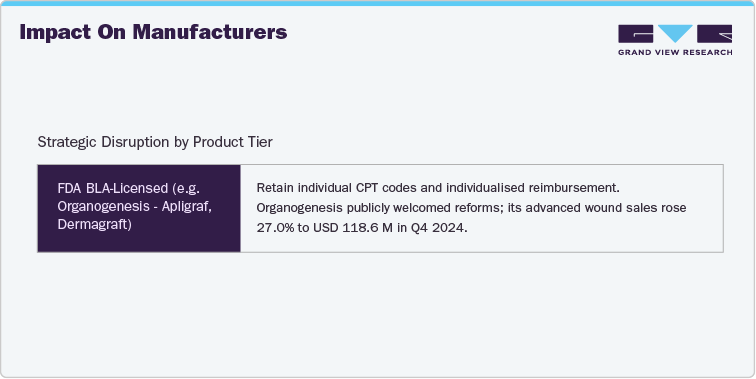
Only FDA BLA-licensed products retain individual CPT billing codes and individualized reimbursement rates from 2026.
CMS-Approved Products: The RCT-Evidenced Short List
The 17 products below represent the only skin substitutes that met CMS's evidence threshold - all have been tested in randomised controlled clinical trials (RCTs) with statistically significant results for DFU healing. Five of these 17 are also approved for venous leg ulcer (VLU) treatment. These products span diverse biological origins - amniotic membrane allografts, bioengineered living-cell constructs, acellular dermal matrices, cryopreserved placental membranes, collagen scaffolds, and even an intact fish skin xenograft.
Following the December 2025 LCD withdrawal, all other skin substitute products may also be used for DFU/VLU - but they will be reimbursed at the same flat rate (USD 127.28/cm²) as the products on this list, without the clinical credibility these 17 products carry.
Product Name
Manufacturer
Product Type
Affinity
Organogenesis
Amniotic membrane allograft
AmnioBand (aka Guardian)
MTF Biologics
Amniotic membrane allograft
Apligraf (formerly GraftSkin)
Organogenesis
Bioengineered living cell construct
DermACELL AWM, Porous
LifeNet Health
Acellular dermal matrix (ADM)
Derma-Gide
StimLabs / Geistlich
Acellular collagen matrix
Dermagraft
Organogenesis
Bioengineered living cell construct
Epicord
MiMedx
Amniotic membrane allograft
EpiFix
MiMedx
Amniotic membrane allograft
FlexHD / AllopatchHD
MTF Biologics
Acellular dermal matrix (ADM)
Grafix Stravix Prime PL
Smith+Nephew
Cryopreserved placental membrane
GraftJacket
Stryker
Acellular dermal matrix (ADM)
Kerecis Omega3 / MariGen
Kerecis (Coloplast)
Intact fish skin (xenograft)
NuShield
Organogenesis
Amniotic membrane allograft
Oasis Wound Matrix
Smith+Nephew
Fetal bovine collagen matrix (SIS)
Omnigraft Dermal Regeneration Matrix
Integra LifeSciences
Collagen-GAG scaffold
PriMatrix Dermal Repair Scaffold
Integra LifeSciences
Fetal bovine collagen matrix
TheraSkin
LifeNet Health
Split-thickness skin allograft
Impact on End Users
Impact on Patients: The LCD withdrawal is a short-term win for patients - clinicians can now select any clinically appropriate skin substitute without being confined to 17 products. For Medicare beneficiaries (over 18% of Part B enrollees over 65 have diabetes), treatment access is broadly preserved.
Ongoing risks remain. If USD 127.28/cm² falls below a product's cost of goods, providers discontinue offering those products, indirectly narrowing patient choice. Advocacy investigations have also highlighted cases where aggressive profit-driven wound care contributed to the suffering of elderly patients - a concern driving continued Medicare audit pressure even post-LCD withdrawal.
Impact on Healthcare Providers: Providers face a transformed economic model. The flat-rate payment eliminates the margin differential that previously incentivised use of premium products. Providers must re-evaluate product economics and maintain rigorous documentation: 4-week standard care records, weekly wound measurements, and offloading compliance. Medicare advantage plans require prior authorisation (PA) for all skin substitute applications nationwide. In six WISeR pilot states (AZ, NJ, OH, OK, TX, WA), pre-service authorisation applies to Traditional Medicare from January 2026.
Impact on Manufacturers
Conclusion
The diabetic foot ulcer (DFU) treatment market is entering a new era in which Medicare reimbursement is guided by clinical evidence, patient outcomes, and value-based care rather than product price alone. While the withdrawal of the proposed Local Coverage Determinations (LCDs) maintained patient access to a broad range of skin substitute products, the CY 2026 Medicare payment reforms introduced a standardized reimbursement model that is expected to reshape the competitive landscape. The manufacturers will need to differentiate through strong clinical evidence, product effectiveness, regulatory compliance, and cost-efficient manufacturing rather than premium pricing strategies.
Despite these reimbursement changes, the DFU treatment market is expected to continue expanding, driven by rising global diabetes prevalence, an aging population, and growing demand for advanced wound care solutions. Companies that invest in high-quality clinical studies, regulatory pathways such as FDA Biologics License Applications (BLAs), and operational efficiency will be better positioned for long-term growth. Likewise, healthcare providers that maintain accurate documentation, comply with evolving CMS reimbursement requirements, and adopt evidence-based treatment practices will be better equipped to sustain reimbursement and improve patient outcomes.
Taken together, these policy reforms mark a meaningful shift toward a more transparent, evidence-driven, and sustainable reimbursement environment for the diabetic foot ulcer treatment market one that stakeholders across the value chain should factor into near-term planning and longer-term portfolio strategy.
-


Customize this report to your needs - add regions, segments, or data points, with 20% free customization.
Or view our licence options:


ISO 9001:2015 & 27001:2022 Certified
We are GDPR and CCPA compliant! Your transaction & personal information is safe and secure. For more details, please read our privacy policy.


