- Home
- »
- Market Trend Reports
- »
-
Rivaroxaban (Xarelto) Market: Facing The Patent Cliff And Strategic Opportunities
![Rivaroxaban (Xarelto) Market: Facing The Patent Cliff And Strategic OpportunitiesReport]()
Rivaroxaban (Xarelto) Market: Facing The Patent Cliff And Strategic Opportunities
- Published: Sep, 2025
- Report ID: GVR-MT-100426
- Format: PDF/Excel databook
- No. of Pages/Datapoints: 110
- Report Coverage: 2024 - 2030
Report Overview
Rivaroxaban, marketed as Xarelto, has been a leading treatment in the anticoagulant market, widely used for conditions such as atrial fibrillation, deep vein thrombosis, and pulmonary embolism. With its proven clinical efficacy, Xarelto has maintained a strong market presence globally. However, as the patent for the drug expires, the market is facing a significant shift. The entry of generic alternatives will challenge the brand’s market share, presenting both risks and opportunities for stakeholders. This article examines the current dynamics of the Xarelto market, focusing on the implications of the patent expiration and the forecasted trends in the coming years.
Key Report Deliverables
-
Analyze the Rivaroxaban (Xarelto) market landscape, detailing its current size, growth drivers, and key industry trends particularly considering the upcoming patent expiration.
-
Forecast market growth by projecting future trends, highlighting emerging opportunities, and assessing potential risks to growth.
-
Identify regulatory and market barriers, providing insights into challenges that could impact future market expansion and product development.
-
Concurrent Competitive Landscape, identifying key players, examining both direct and indirect competitors within the market, their strategic moves, and the distribution of market share to understand competitive positioning.
-
Regulatory Barriers, identify key regulatory challenges related to biosimilar entry and their potential impact on market expansion.
-
Strategic Implications, evaluating strategic moves for Bayer, Johnson & Johnson, and competitors, including innovation, pricing strategies, and geographic expansion.
Current Market Scenarios
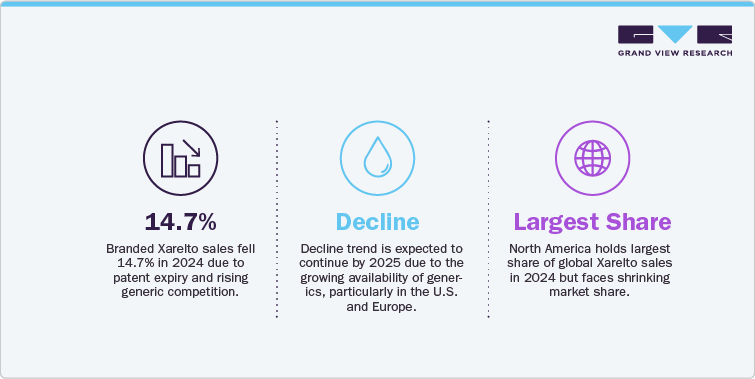
The Rivaroxaban (Xarelto) market is currently undergoing significant changes, primarily due to the expiration of its patent. In 2024, the primary patent for Xarelto expired, opening the door for generic alternatives. This is a critical turning point for Bayer and Johnson & Johnson, as the introduction of generics will bring about increased competition, particularly in price-sensitive markets and emerging economies. As a result, sales of branded Xarelto have already seen a decline, with a reported 14.7% drop in 2024, amounting to approx. USD 4.1 billion in revenue. This trend is expected to continue by 2025 due to the growing availability of generics, particularly in the U.S. and Europe.
Xarelto faces strong competition from other oral anticoagulants, such as Apixaban (Eliquis) and Dabigatran (Pradaxa), marketed by Pfizer and Bristol-Myers Squibb, respectively. While Xarelto remains a leading treatment for non-valvular atrial fibrillation (NVAF) and deep vein thrombosis (DVT)/pulmonary embolism (PE), its market share is expected to decrease as generic versions become more accessible, particularly in developed markets. However, Xarelto is likely to maintain a significant presence in certain regions due to its proven effectiveness, once-daily dosing, and strong physician preference.
North America remains the largest market for Xarelto in 2024. However, with generics entering the market, this share is expected to decline in the coming years. The Asia-Pacific region offers growth opportunities, especially as generics become available in India, China, and Southeast Asia, where healthcare infrastructure is improving and the prevalence of thrombotic conditions is rising.
Xarelto continues to benefit from FDA and EMA approvals for stroke prevention in atrial fibrillation, DVT/PE treatment, and secondary cardiovascular prevention. Ongoing clinical studies are exploring new indications, particularly in chronic coronary artery disease (CAD) and chronic kidney disease patients. However, the rising pricing pressure from generics and the increasing demand for cost-effective treatments in healthcare systems will likely speed up the shift towards generic options in both developed and emerging markets.
Rivaroxaban (Xarelto) market is at a pivotal stage, influenced by patent expiration and the growing availability of generic alternatives. While the drug continues to hold a strong market position, its future will depend on its ability to adapt to the competitive landscape, capitalize on new indications, and respond to pricing pressures. Understanding these trends will be crucial for businesses looking to remain competitive in this evolving market.
Market Dynamics
Rivaroxaban's broad clinical efficacy and expanding indications drive ongoing global demand.
The primary driver for the Rivaroxaban (Xarelto) market is its established clinical efficacy in treating a wide range of thrombotic conditions, including non-valvular atrial fibrillation (NVAF), deep vein thrombosis (DVT), and pulmonary embolism (PE). This broad clinical profile continues to sustain its strong demand globally. Furthermore, as the aging population increases, the prevalence of cardiovascular diseases and stroke is expected to rise, creating ongoing demand for effective anticoagulation therapies. Healthcare system advancements in emerging markets, coupled with the expanding indication range, offer continued growth for Xarelto even as the patent expiration draws nearer. The ongoing regulatory approvals for new indications, such as for chronic kidney disease and coronary artery disease (CAD), are likely to create additional demand and maintain Xarelto's relevance in the evolving anticoagulant landscape.
Patent expiry, generics, market access, and regulatory hurdles limit Xarelto’s growth.
One of the key restraints impacting the Rivaroxaban (Xarelto) market is the impending patent expiration, which is expected to bring pricing pressures and increase competition from generic alternatives. As generic versions of Xarelto are poised to enter key markets, particularly in North America and Europe, this will create a significant challenge for Bayer and Johnson & Johnson in retaining their market share. In addition, the complexity of market access barriers in emerging markets could slow down the widespread adoption of Xarelto, particularly where pricing and reimbursement policies remain restrictive. Regulatory challenges surrounding biosimilar approval processes also represent a risk, potentially delaying the entry of generics and complicating the competitive landscape.
Xarelto’s growth opportunities lie in new indications, markets, and partnerships.
Despite the challenges posed by generics, significant opportunities lie ahead for Rivaroxaban in new indications and geographic markets. The expansion of Xarelto’s use in treating chronic kidney disease (CKD) and coronary artery disease (CAD) could provide a substantial revenue boost, especially if these indications receive broader acceptance. Furthermore, the growing healthcare infrastructure in emerging markets like China, India, and Latin America presents an untapped opportunity, particularly as disease prevalence in cardiovascular conditions increases. Bayer's ability to leverage strategic partnerships, innovative formulations, and collaborations could also play a pivotal role in maintaining Xarelto’s leadership, while tailoring pricing strategies to suit cost-sensitive markets may drive further adoption.
Xarelto's future is shaped by patient-centricity, real-world evidence, expansion, and digital health.
Several trends are shaping the future of the Rivaroxaban (Xarelto) market. A notable trend is the shift towards patient-centric solutions, with an increasing focus on drugs offering convenience, such as Xarelto’s once-daily dosing. This trend is likely to continue as healthcare providers look for therapies that improve patient adherence and treatment outcomes. Another key trend is the growing emphasis on real-world evidence (RWE) and post-market surveillance data, which are expected to play an increasingly important role in the regulatory and reimbursement landscape. As competition intensifies, pharmaceutical companies, including Bayer, are expected to prioritize geographic expansion, particularly in low and middle-income countries, to secure market share as generics become more prevalent. Finally, digital health tools and patient monitoring systems are likely to become more integrated with therapies like Xarelto, enhancing patient management and presenting new market avenues for companies willing to innovate beyond traditional drug offerings.


Competitive Landscape
The competitive landscape of the Rivaroxaban (Xarelto) market is becoming increasingly dynamic as both direct and indirect competitors play significant roles. Apixaban (Eliquis), marketed by Pfizer and Bristol-Myers Squibb, has emerged as one of the strongest rivals to Xarelto, particularly in stroke prevention for non-valvular atrial fibrillation (NVAF). Apixaban's once-daily dosing regimen and lower risk of major bleeding events have made it the preferred choice among healthcare providers and patients. Dabigatran (Pradaxa), a direct thrombin inhibitor from Boehringer Ingelheim, also remains a notable player, especially due to its specific reversal agent, idarucizumab, which enhances its safety profile in emergency situations. However, Dabigatran's twice-daily dosing regimen and higher cost present challenges when compared to once-daily alternatives like Xarelto. Another significant competitor is Edoxaban (Savaysa), marketed by Daiichi Sankyo, which, although holding a smaller market share, is gaining traction due to its lower cost and once-daily dosing, making it an attractive option in cost-sensitive healthcare systems.
In addition to these direct competitors, Warfarin (Coumadin), a long-established anticoagulant from Merck, still holds a position in the market, especially in certain patient populations due to its affordability and long-standing use. However, Warfarin's need for frequent INR monitoring and dietary restrictions limit its appeal in long-term management. Similarly, Low-Molecular-Weight Heparins (LMWHs), produced by several companies including Pfizer (Fragmin) and Sanofi (Clexane), continue to be widely used in hospital settings for short-term anticoagulation therapy, particularly during transitions to long-term anticoagulation.
With the expiration of Xarelto's patent, the market is also seeing the entry of generic versions of rivaroxaban, which is expected to intensify price competition, especially in developed markets such as the U.S. and Europe. Key players in the generic market include Lupin Pharmaceuticals, Taro Pharmaceuticals, Sandoz (Novartis), Apotex, and Sciegen Pharmaceuticals. The entry of biosimilars for other DOACs, such as Apixaban and Dabigatran, is also anticipated, which could further alter the competitive landscape by leading to price reductions across the entire DOAC class.
In response to these competitive pressures, key branded DOAC market players like Bayer and Johnson & Johnson are adapting their strategies by differentiating their products. They are focusing on expanding indications for Xarelto, such as in chronic kidney disease (CKD) and coronary artery disease (CAD), to create new revenue streams and maintain market relevance. Additionally, they are embracing value-based pricing models to stay competitive while ensuring access to treatment. Innovating with new formulations, such as fixed-dose combinations or extended-release versions, is another strategy being explored to differentiate their products and retain patient loyalty.
The growing presence of generics and biosimilars will undoubtedly affect revenue streams, particularly in cost-sensitive regions. As competition from generics intensifies, Bayer and Johnson & Johnson will need to focus on offering differentiated products, expanding into new therapeutic areas, and adapting to the evolving regulatory landscape to maintain their market share and remain competitive in the increasingly crowded anticoagulant market.
North America Rivaroxaban (Xarelto) Market
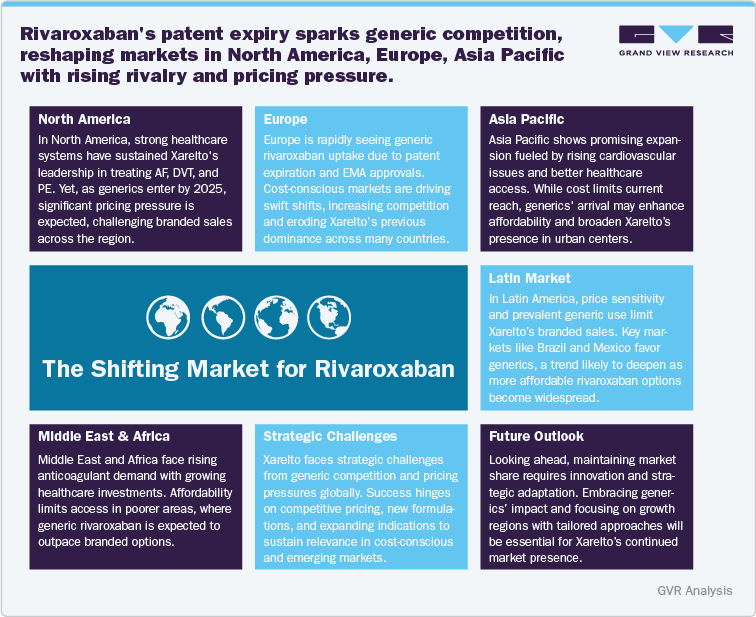
North America Rivaroxaban (Xarelto) market remains the largest, driven by high healthcare spending, advanced healthcare infrastructure, and a growing aging population. The United States holds the largest share of the market, with Xarelto being widely prescribed for stroke prevention in atrial fibrillation, deep vein thrombosis (DVT), and pulmonary embolism (PE). However, the market is facing significant pressure as the expiration of Xarelto's patent opens the door to generic alternatives, which are expected to drive down prices. Despite this, Xarelto benefits from strong brand recognition, a proven safety profile, and physician preference. The availability of reversal agents and a once-daily dosing regimen contribute to its continued demand, but the increasing affordability of generics will challenge its market share. The U.S. market, in particular, is likely to experience rapid penetration of generic rivaroxaban by 2025, further intensifying competition.
Europe Rivaroxaban (Xarelto) Market
Europe rivaroxaban (Xarelto) market continues to be a dominant player in the anticoagulant market, but its market leadership is under threat due to the patent expiration and the availability of generic versions. Europe is a diverse market with varying pricing regulations and reimbursement structures across countries, which impacts the accessibility of branded drugs like Xarelto. In regions such as Germany, France, and the UK, Xarelto is widely prescribed, particularly for stroke prevention in non-valvular atrial fibrillation (NVAF) and treatment of DVT/PE. However, the entry of generic rivaroxaban in Europe will have a significant impact on branded sales, particularly in countries with cost-conscious healthcare systems. The European Medicines Agency’s (EMA) approval of biosimilars and generics will likely speed up the erosion of Xarelto’s market share, especially in countries with high generic penetration, such as Italy and Spain.
Asia Pacific Rivaroxaban (Xarelto) Market
Asia Pacific rivaroxaban (Xarelto) market presents significant growth opportunities for Rivaroxaban (Xarelto), as the demand for anticoagulants rises due to increasing rates of cardiovascular diseases and stroke in aging populations. Countries like China, India, and Japan are witnessing a higher incidence of thrombotic disorders, driving the need for effective treatments. However, Xarelto’s market penetration in these regions is lower compared to North America and Europe, primarily due to cost barriers and access issues. Despite these challenges, Xarelto is gaining traction in urban centers where healthcare infrastructure is improving. The rise of generic alternatives in these regions is expected to further affect the branded Xarelto sales, as generic drug penetration in countries like India and China increases. Regulatory approval for generic versions of rivaroxaban in emerging markets will likely accelerate this shift, making the drug more accessible in cost-sensitive environments.
Latin America Rivaroxaban (Xarelto) Market
Latin America rivaroxaban (Xarelto) faces a competitive landscape that is influenced by both high local demand for anticoagulants and cost constraints in many countries. Countries such as Brazil and Mexico represent key markets for Xarelto, where the prevalence of atrial fibrillation, DVT, and PE is rising. However, in this region, generic drugs are widely used, and pricing is a critical factor influencing healthcare decisions. Xarelto has struggled to maintain significant market share in lower-income countries, where generic alternatives and affordable treatment options are more attractive to both healthcare providers and patients. Regulatory approval for generics and biosimilars in Latin American countries will likely contribute to further competition, making it essential for branded drugs to compete not only on clinical efficacy but also on cost-effectiveness. Additionally, in countries with more developed healthcare systems, such as Argentina and Chile, there are still opportunities for Xarelto to maintain its leadership position in the market.
Middle East and Africa Rivaroxaban (Xarelto) Market
Middle East and Africa rivaroxaban (Xarelto) is seeing slow but steady growth, particularly in urban healthcare settings where medical infrastructure is improving. Countries like Saudi Arabia, the UAE, and South Africa represent key markets for Xarelto due to rising healthcare investments and an increasing focus on treating cardiovascular diseases. However, the region faces significant challenges in terms of affordability and access to branded medications like Xarelto, with many countries relying heavily on generic alternatives. While the use of Xarelto is growing, particularly in private healthcare sectors, its penetration remains low in public healthcare systems due to the cost burden of branded drugs. Moreover, regulatory hurdles and price sensitivity in many African nations continue to restrict the wider adoption of high-cost treatments. However, as healthcare accessibility improves and the market for chronic disease treatments expands, Xarelto could see long-term growth in the region, especially as local healthcare markets mature.
Analyst Perspective
The Rivaroxaban (Xarelto) market is facing significant challenges with the patent expiration, leading to increased competition from generic alternatives. While its strong clinical profile and once-daily dosing maintain demand, price pressures and the rise of generics will likely erode market share. Growth in emerging markets remains a key opportunity, but cost barriers persist.
Case Study (Recent Engagement): Keytruda Patent-Cliff & Price-Erosion Impact Model
PROJECT OBJECTIVE
To evaluate the potential revenue, price, and patient access implications of Keytruda’s 2028 patent cliff, incorporating biosimilar entry dynamics, country-specific adoption curves, and Merck’s lifecycle defense strategies (remarkably the subcutaneous formulation). The goal was to provide the client with a transparent, scenario-based model to anticipate outcomes and inform strategy.
GVR SOLUTION
-
Built a bottom-up commodity-flow and analogue-based model, anchored on Merck’s $29.5B Keytruda sales in 2024.
-
Integrated jurisdictional LOE timelines (EU mid-2028, U.S. 2028-2029 pending litigation outcomes).
-
Modeled biosimilar adoption S-curves calibrated to oncology antibody analogues (EU faster via tenders, U.S. slower via contracting).
-
Applied price-erosion benchmarks (EU -15-30% Yr-1, deepening to -45-60% by Yr-3; U.S. -10-25% net decline over same horizon).
-
Layered lifecycle defenses (SC uptake assumptions of 25-40% of innovator units, combo refresh, contracting) to quantify buffers.
-
Delivered outputs as a dynamic Excel scenario tool and a management-ready PPT deck with revenue bridges, sensitivity tornadoes, and SC migration visuals.
IMPACT FOR CLIENT
-
Enabled the client to quantify downside vs. defense-optimized revenue trajectories:
-
Base case: 30-40% global revenue decline by Year-3 post-LOE.
-
Downside: 45-55% decline in tender-heavy markets.
-
Defense-optimized: Contained erosion to ~-20-25% with strong SC adoption.
-
-
Gave the client a clear view of which markets drive early erosion (EU) and where strategic contracting or SC migration can preserve share (U.S.).
-
Equipped decision-makers with a playbook of watch-points (tender concentration, litigation outcomes, SC IP coverage, combo pipeline) to guide commercial strategy.
-
Provided a transparent methodology that could be presented to boards/investors with evidence-backed assumptions
WHY THIS MATTERS
-
Keytruda is the world’s best-selling cancer drug, representing nearly one-third of Merck’s revenue.
-
Patent expiry will reshape both Merck’s earnings profile and global oncology access dynamics.
-
Payers and governments stand to benefit from biosimilar entry through lower costs, but manufacturers need to manage cliff risk while capturing upside from lifecycle innovations.
-
Understanding how quickly revenues erode and how patient access expands post-biosimilar is critical for:
-
Biopharma companies (strategic planning, pipeline prioritization).
-
Investors (valuing Merck’s cash flows beyond 2028).
-
Payers and policymakers (budgeting for oncology drug spend).
-
-
A robust patent cliff model helps clients navigate the dual challenge of price erosion and patient expansion, ensuring strategies are grounded in real-world benchmarks.
![gvr icn]()
GET A FREE SAMPLE
![gvr icn]()
This FREE sample includes market data points, ranging from trend analyses to market estimates & forecasts. See for yourself.
![gvr icn]()
NEED A CUSTOM REPORT?
We can customize every report - free of charge - including purchasing stand-alone sections or country-level reports, as well as offer affordable discounts for start-ups & universities.
Contact us now to get our best pricing.
![esomar icon]()
ESOMAR certified & member
![ISO]()
ISO Certified
We are GDPR and CCPA compliant! Your transaction & personal information is safe and secure. For more details, please read our privacy policy.




We are committed towards customer satisfaction, and quality service.
Client Testimonials

"The quality of research they have done for us has been excellent..."
ISO Certified