
- Home
- »
- Advanced Interior Materials
- »
-
Welding Personal Protective Equipment Market Report, 2033GVR Report cover

Welding Personal Protective Equipment Market (2026 - 2033)
Size, Share & Trends Analysis Report By Product (Head Protection, Eye Protection, Face Protection, Protective Clothing), By End Use (Construction, General Manufacturing, Heavy Manufacturing), By Region, And Segment Forecasts
Market Size, 2025
$3.9BMarket Estimate, 2026
$4.1BMarket Forecast, 2033
$6.3BCAGR, 2026–2033
6.2%Welding Personal Protective Equipment Market Summary
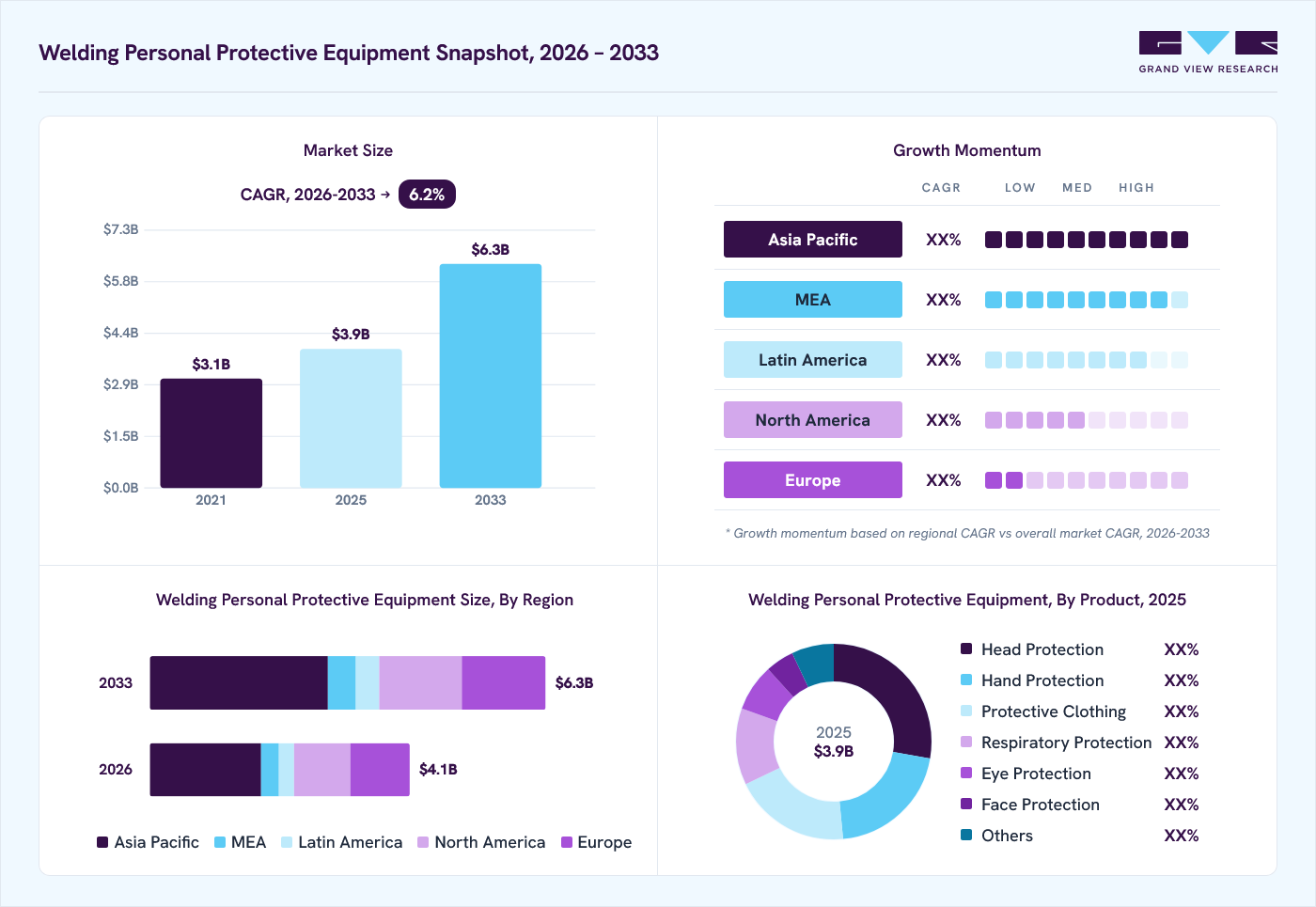
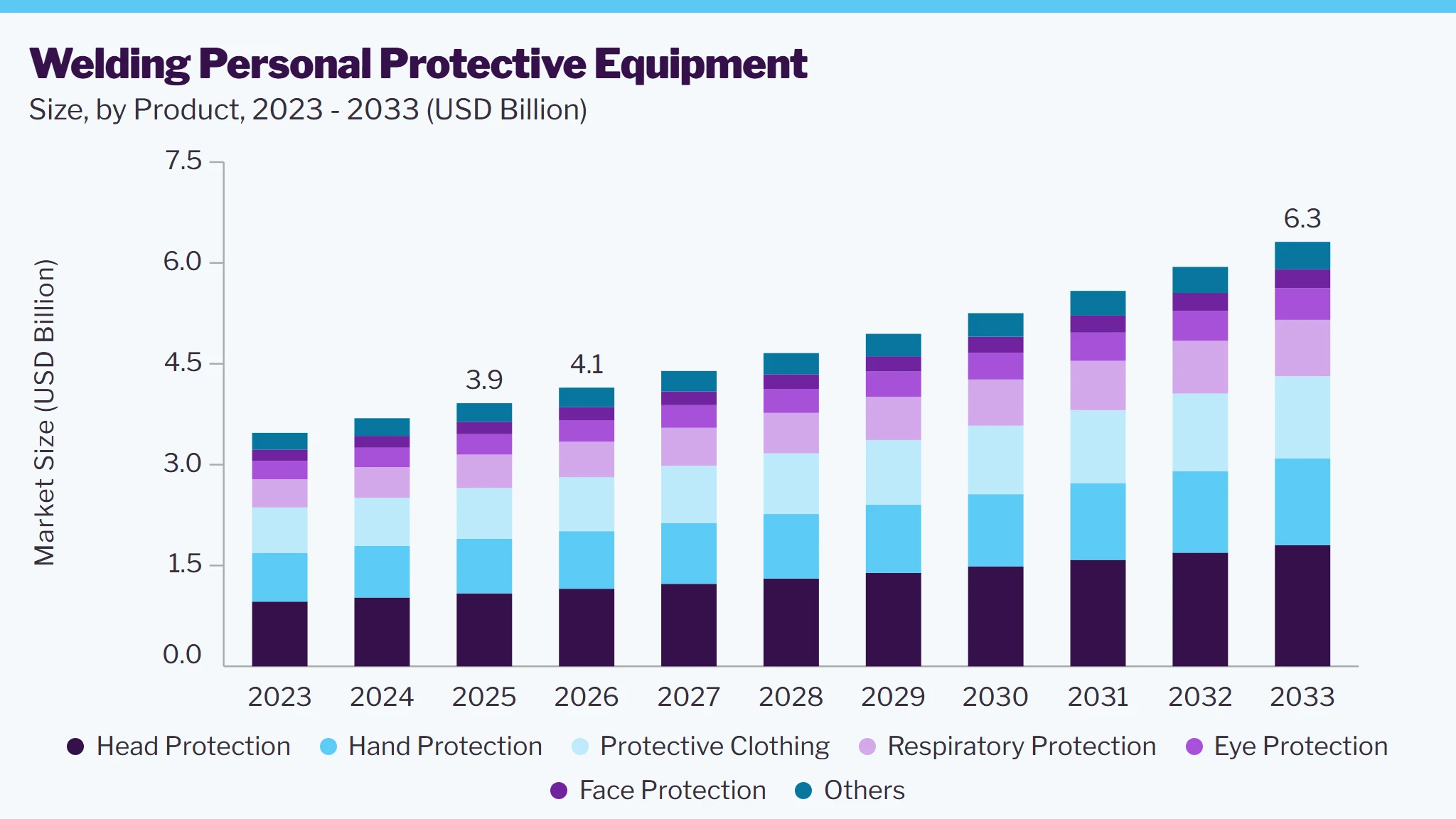
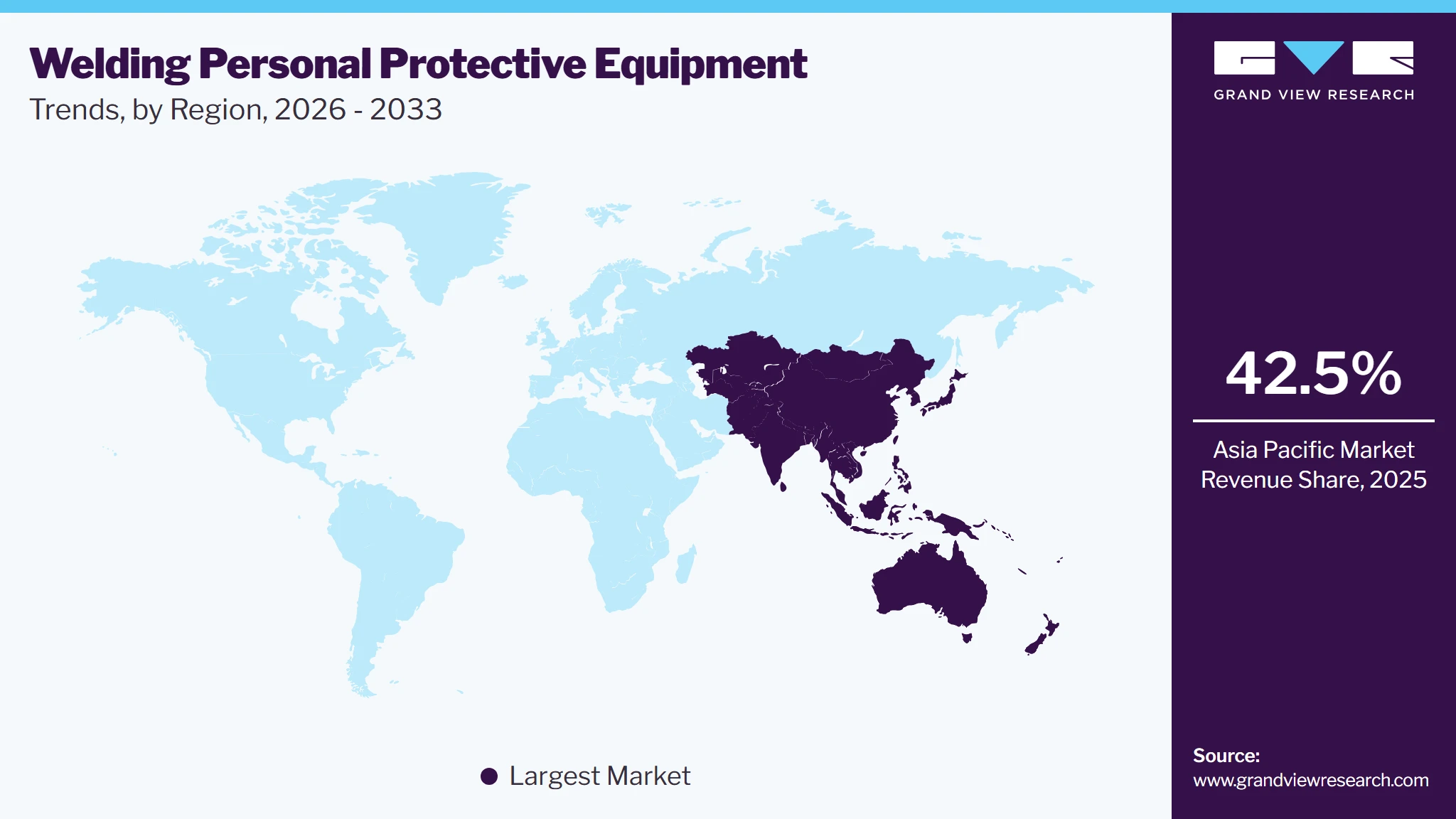
The global welding personal protective equipment market size was valued at USD 3.9 billion in 2025 and is projected to grow from USD 4.1 billion in 2026 to USD 6.3 billion by 2033, at a CAGR of 6.2% from 2026 to 2033. The market in Asia Pacific dominated with a revenue share of 42.5% in 2025. Expansion of manufacturing facilities and infrastructure projects increases the number of welding operations, creating greater requirements for protective clothing, helmets, footwear, gloves, and respiratory protection.
 Source: Grand View Research, IR Documents, Primary Interviews, Paid DatabasesTo learn more about this report,
 Download Free Sample Report
Key Market Trends & Insights
- By product: Head protection segment held the largest market share of 27.7% in 2025.
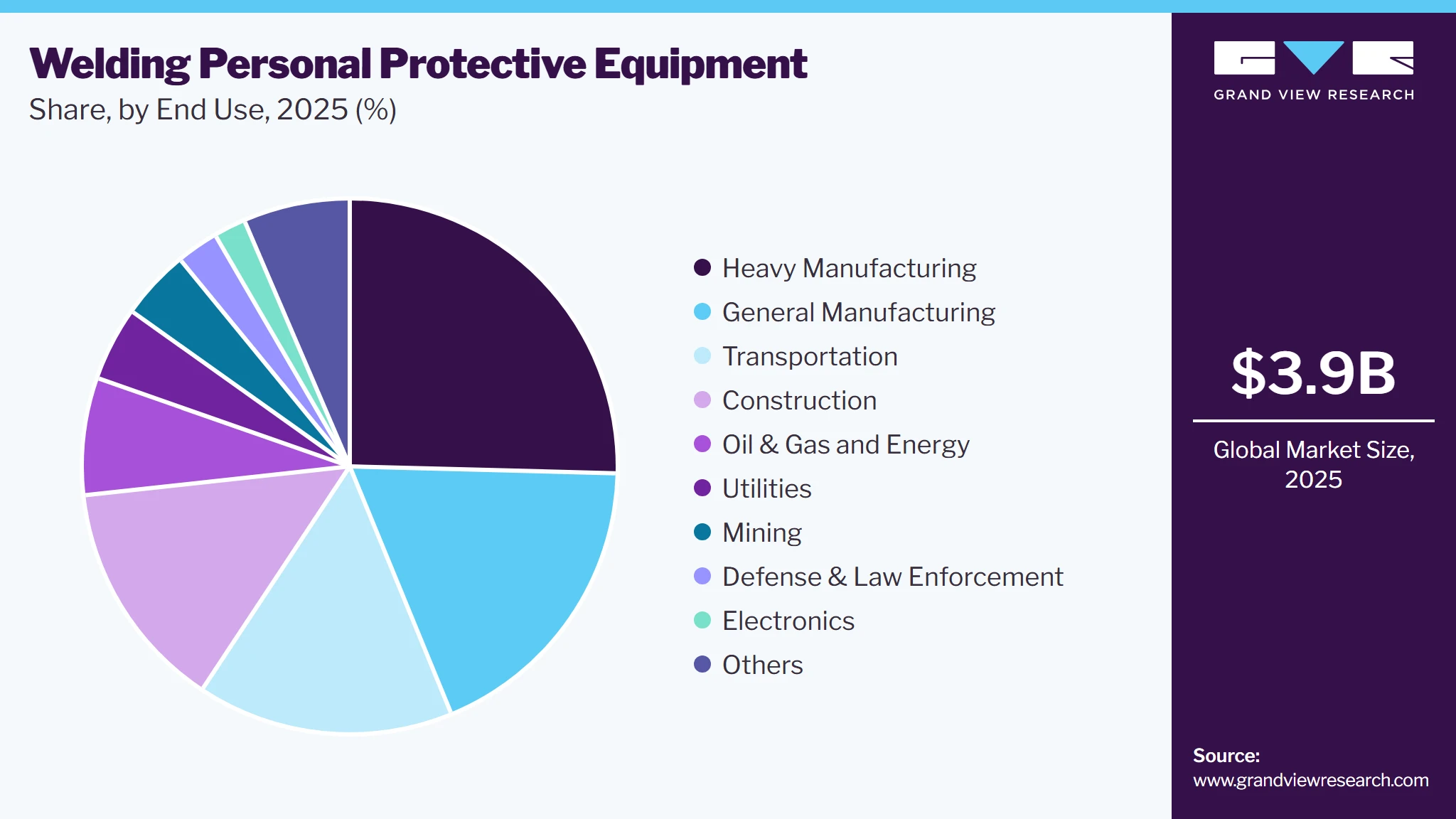
- By end use: Heavy manufacturing segment held the largest market share of 26.0% in 2025.
Regional Highlights
- Largest regional market: Asia Pacific (42.5% revenue share, 2025)
- By country: China held the largest market share in 2025
Market Size & Forecast
- Market size in 2025: USD 3.9 Billion
- Estimated market size in 2026: USD 4.1 Billion
- Projected market size by 2033: USD 6.3 Billion
- CAGR (2026-2033): 6.2%
GVR research-powered AIAsk Prism AI about the welding personal protective equipment marketGet cited answers from GVR research on market growth, segments, regulations and forecasts.Start with✓ Source-linked answers ✓ Market-specific context ✓ Traceable figuresExplore Prism AI ↗Growing industrial production in emerging economies further supports PPE consumption as welding applications expand across manufacturing and construction environments. Increasing enforcement of occupational safety regulations is driving the adoption of welding personal protective equipment. Welders face hazards, including ultraviolet radiation, sparks, molten metal, heat, fumes, and flying particles, which require employers to provide appropriate protective equipment. Compliance with workplace safety standards encourages organizations to replace inadequate or outdated PPE with certified helmets, protective clothing, gloves, respiratory protection, and other equipment designed to address welding-specific hazards.
 To learn more about this report, Download Free Sample Report
Market Dynamics
Increasing welding activities across the construction, automotive, shipbuilding, infrastructure, energy, and metal fabrication industries are driving demand for personal protective equipment for welders. Industrial development in emerging economies is further expanding the use of welding across manufacturing and construction. As welding operations increase, employers require appropriate PPE to protect against exposure to sparks, radiation, and molten metal.
The relatively high cost of advanced welding personal protective equipment can restrain market growth, particularly among small contractors and cost-sensitive industrial users. Products incorporating auto-darkening lenses, specialized heat-resistant materials, advanced respiratory filtration, and ergonomic designs generally require higher investment than basic protective equipment. Budget limitations may encourage some users to continue using conventional or lower-cost products. In price-sensitive markets, purchasing decisions can therefore prioritize initial acquisition costs over advanced protection, durability, and technological features.
The development of smart and connected welding PPE presents an opportunity for market expansion. Manufacturers can integrate sensors, digital controls, monitoring capabilities, and connected technologies into helmets and other protective equipment to provide additional information about workplace conditions and equipment usage. Advanced materials can also improve comfort, visibility, heat resistance, and durability while reducing product weight. Growing interest in workplace monitoring and worker safety creates opportunities for differentiated PPE solutions that combine protection with digital functionality.
Varying occupational safety standards and certification requirements across countries create challenges for welding personal protective equipment manufacturers. Products may need to satisfy different specifications for welding helmets, protective clothing, gloves, footwear, and respiratory protection, depending on the target market. Compliance requires product testing, certification, documentation, and continuous monitoring of regulatory changes. These requirements can increase development and certification costs while complicating international product launches. Manufacturers must maintain consistent product performance while adapting designs and certifications to regional requirements.
Market Concentration & Characteristics
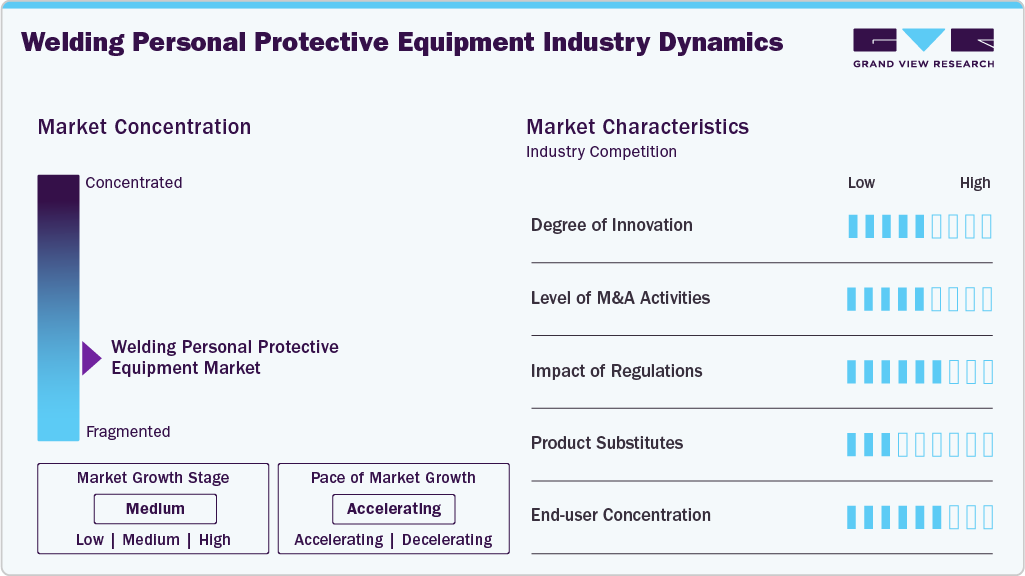
The welding personal protective equipment industry is fragmented, with numerous global, regional, and specialized manufacturers competing across product categories. Companies offer welding helmets, gloves, protective clothing, footwear, respiratory protection, and other equipment with varying specifications and price points. Market participants differentiate through product design, safety certifications, material technologies, ergonomics, distribution networks, and application-specific solutions. The presence of established PPE manufacturers alongside smaller specialized suppliers contributes to the fragmented competitive structure.
 To learn more about this report, Download Free Sample Report
Manufacturers are developing lightweight welding helmets, auto-darkening lenses, advanced filtration systems, heat-resistant materials, and ergonomically designed protective clothing. The integration of sensors, digital controls, and connected technologies is also expanding across specialized products. Material innovations are improving durability while reducing equipment weight and worker fatigue during extended welding operations.
Regulations are shaping the global market by establishing requirements for worker protection against radiation, heat, molten metal, and mechanical hazards. Standards covering welding helmets, footwear, and respiratory protection influence product design, testing, certification, and performance specifications. Occupational safety requirements encourage employers to provide compliant PPE and replace inadequate equipment. Regulatory differences across countries also influence manufacturers' certification strategies and product development.
Analyst Perspective
The global welding PPE market is expected to expand as construction, general manufacturing, heavy manufacturing, transportation, oil & gas, energy, mining, utilities, electronics, healthcare, fire & EMS, and defense and law enforcement increase welding-related activities. Market development will depend on PPE Product, workplace exposure levels, safety requirements, material technologies, product comfort, certification requirements, replacement cycles, and adoption of advanced protective solutions.
Product Insights
The head protection segment led the market with the largest revenue share of 27.7% in 2025, driven by the essential need for welding helmets and related equipment in welding operations. Welders face exposure to ultraviolet and infrared radiation, sparks, and flying particles, making head protection fundamental to workplace safety. High usage frequency, established safety requirements, and regular replacement needs contribute to its significant market position.
The respiratory protection segment is expected to grow at the fastest CAGR during the forecast period, as awareness of welding fumes and airborne contaminants increases among employers and workers. Welding processes can generate metal fumes and gases requiring appropriate respiratory protection, particularly in enclosed or inadequately ventilated workplaces. Increasing adoption of respirators and powered air-purifying respirators, alongside improvements in filtration efficiency, comfort, and airflow, is supporting segment expansion.
End Use Insights
The heavy manufacturing segment dominated the market with the largest revenue share of 26.0% in 2025, due to extensive welding activities in machinery, metal fabrication, industrial equipment, and large-scale manufacturing operations. Workers require protection from heat, and sparks during frequent welding processes. High workforce requirements, continuous production activities, and regular PPE replacement contribute to substantial consumption across heavy manufacturing facilities.
 To learn more about this report, Download Free Sample Report
The utilities segment is projected to grow at the fastest CAGR of 7.1% during the forecast period, as electricity, water, gas, and infrastructure operators undertake equipment maintenance, fabrication, and repair activities requiring welding. Expansion and modernization of utility infrastructure increase welding requirements for pipelines, structural components, storage systems, and power-generation equipment. These operations create demand for helmets, protective clothing, gloves, respiratory protection, and other welding PPE to address occupational hazards.
Regional Insights
The Asia Pacific welding personal protective equipment (PPE) market held the largest revenue share of 42.5% in 2025 and is anticipated to grow at the fastest CAGR during the forecast period, due to the expansion of automotive manufacturing across the region. Vehicle production involves extensive welding for body structures, chassis, components, and assemblies, creating substantial requirements for worker protection. Increasing automotive manufacturing capacity in countries such as China, India, Japan, and South Korea supports demand for welding helmets, gloves, protective clothing, and respiratory protection. The expansion of vehicle production facilities, therefore, contributes to regional consumption of welding PPE.
 To learn more about this report, Download Free Sample Report
The welding PPE market in China accounted for the largest market revenue share in the Asia Pacific in 2025, supported by its large-scale construction equipment manufacturing industry. Production of excavators, cranes, loaders, industrial machinery, and other heavy equipment involves extensive welding of structural and mechanical components. These operations generate recurring requirements for worker protection during fabrication and assembly. Continued manufacturing of construction and industrial equipment is therefore supporting demand for welding personal protective equipment across Chinese factories and associated metal fabrication facilities.
The India welding personal protective equipment market is anticipated to grow at a significant CAGR during the forecast period, primarily due to expansion of infrastructure construction. Development of roads, bridges, railways, airports, and urban infrastructure requires extensive fabrication and welding of structural steel and metal components. Increasing infrastructure construction and associated fabrication requirements are therefore supporting demand for welding helmets, gloves, protective clothing, footwear, and respiratory protection across India.
North America Welding Personal Protective Equipment Market Trends
The welding personal protective equipment market in North America has a well-established metal fabrication and industrial manufacturing base. Welding is widely used for producing and maintaining machinery, structural components, transportation equipment, and industrial systems. This sustained industrial activity creates recurring requirements for various useful products. The presence of established workplace safety practices also supports consistent PPE procurement across industrial facilities and welding-intensive workplaces
U.S. Welding Personal Protective Equipment Market Trends
The welding personal protective equipment market in the U.S. is growing due to continued investment in infrastructure maintenance and modernization. Welding is required across bridges, transportation systems, utilities, industrial facilities, and public infrastructure, generating demand for protective equipment among workers engaged in fabrication, repair, and maintenance. These applications require protection against sparks, heat, and radiation, supporting the consumption of welding helmets, gloves, protective clothing, and respiratory equipment across infrastructure-related welding operations.
Europe Welding Personal Protective Equipment Market Trends
The welding personal protective equipment market in Europe is expected to grow rapidly, due to the region’s strong emphasis on industrial automation and advanced manufacturing. Welding remains an important process in machinery, automotive, engineering, and metalworking industries, while increasingly automated production environments require PPE suited to modern welding operations. Manufacturers and industrial users are adopting protective equipment with improved visibility, ergonomics, and compatibility with changing production processes. This transition toward advanced manufacturing supports continued demand for specialized welding PPE.
The Germany welding PPE market represents one of the prominent European markets supported by its extensive machinery and equipment manufacturing industry. Welding is widely applied in the production of industrial machinery, fabricated components, production equipment, and engineered systems. The scale of this manufacturing activity creates recurring requirements for helmets, gloves, protective clothing, and respiratory protection among welding personnel. Continued production of complex industrial equipment therefore supports demand for welding PPE across German manufacturing facilities and metalworking operations.
The welding personal protective equipment market in UK is growing due to ongoing shipbuilding and marine engineering activities. Welding is essential for fabricating and maintaining vessels, offshore structures, and associated metal components, creating requirements for specialized worker protection. Continued activity in marine manufacturing and vessel maintenance, therefore, supports demand for welding PPE within the UK industrial sector.
Middle East & Africa Welding Personal Protective Equipment Market Trends
The welding personal protective equipment in the Middle East and Africa is expected to grow at a substantial CAGR of 6.7% during the forecast period, due to expansion of water infrastructure. Desalination facilities, water treatment plants, pipelines, storage systems, and distribution networks require extensive fabrication and welding of metallic structures and piping. Workers involved in construction and maintenance require suitable protection against welding hazards. Increasing investment in water supply and treatment infrastructure, particularly in water-stressed markets, is therefore creating additional demand for welding personal protective equipment across the region.
Saudi Arabia is expected to grow in the welding personal protective equipment market primarily due to expansion of industrial manufacturing under economic diversification initiatives. Development of machinery, fabricated metal products, industrial equipment, and manufacturing facilities increases the requirement for welding and metalworking activities. Continued development of non-hydrocarbon manufacturing capacity is therefore supporting demand for welding personal protective equipment across Saudi Arabia’s industrial sector.
Latin America Welding Personal Protective Equipment Market Trends
The welding personal protective equipment market in Latin America is growing, due to expanding mining activities. Mining operations require welding for the fabrication, repair, and maintenance of heavy machinery, processing equipment, structural components, and supporting infrastructure. These activities expose workers to welding hazards and create requirements for appropriate protective equipment. Increasing mining operations across the region, therefore, support demand for welding helmets, gloves, protective clothing, footwear, and respiratory protection used during maintenance and fabrication activities.
The Brazil welding personal protective equipment market is expected to grow rapidly, due to its expanding automotive production industry. Automotive manufacturing involves extensive welding during vehicle body, chassis, component, and assembly production. Growth in vehicle manufacturing creates additional requirements for workers performing welding and related fabrication activities. Increasing automotive production capacity, therefore, supports the consumption of welding PPE across Brazil's manufacturing sector.
Key Welding Personal Protective Equipment Company Insights
Some of the key players operating in the market include 3M, Lincoln Electric, Protective Industrial Products (PIP), MSA Safety Incorporated, and Miller Electric.
-
3M has a global distribution network comprising retailers, wholesalers, dealers, distributors, and jobbers, supporting the availability of its personal protective equipment across international markets. Its PELTOR business provides protective products for hearing, communication, eye, head, and face protection, including equipment for welding environments. The company’s broad PPE portfolio and established distribution infrastructure enable it to serve industrial customers requiring protection against welding-related hazards.
-
PIP Global operates across specialized PPE verticals, including PIP Export for international sourcing and Processing Solutions, alongside U.S. manufacturing capabilities for customized safety products. In May 2025, PIP completed the acquisition of Honeywell’s PPE business, adding brands including UVEX, North, and Howard Leight.
Key Welding Personal Protective Equipment Companies
The following key companies have been profiled for this study on the global welding personal protective equipment market.
-
3M0
-
MSA Safety Incorporated
-
Lincoln Electric
-
ESAB
-
Miller Electric
-
Ansell Ltd.
-
Uvex Safety Group
-
Delta Plus Group
-
MCR Safety
-
Protective Industrial Products (PIP)
-
Drägerwerk AG & Co. KGaA
-
COFRA S.r.l.
-
Lakeland Industries, Inc.
-
JSP Ltd.
-
Portwest
Competitive Benchmarking
Category
Operating Strategies
Competitive Edge
Weakness
Established Players (e.g., 3M, MSA Safety Incorporated, Lincoln Electric, Miller Electric, Ansell Ltd., Uvex Safety Group, Delta Plus Group, MCR Safety, Protective Industrial Products (PIP))
- Expand through global distributors, industrial safety dealers, direct sales, and established customer relationships to serve welding-intensive industries.
- Develop application-specific PPE, strengthen certification capabilities, and broaden portfolios across welding helmets, gloves, protective clothing, footwear, and respiratory protection.
- Recognized brands, broad PPE portfolios, established distribution networks, extensive certification capabilities, and long-standing industrial customer relationships.
- Global manufacturing and sourcing capabilities support supply across multiple geographic markets.
- Large organizational structures and extensive product portfolios can increase operational complexity and slow product development decisions.
- Higher manufacturing, compliance, certification, and distribution costs may increase product prices in price-sensitive markets.
Emerging & Regional Players (e.g., Lakeland Industries, Inc., JSP Ltd., Portwest)
- Focus on specialized welding PPE designed for specific hazards, applications, and regional requirements.
- Build market presence through regional distributors, industrial partnerships, online sales channels, and direct customer engagement, while developing lightweight, ergonomic products.
- Flexible operations enable faster responses to customer requirements and specialized product development.
- Regional market knowledge, shorter decision-making processes, competitive pricing, and customized solutions can support differentiation.
- Smaller manufacturing and distribution networks can restrict geographic coverage and access to large international customers.
- Limited financial and technical resources may constrain investment in advanced materials, certifications, research and development, automation, and technical support.
Recent Developments
-
In June 2026, voestalpine Böhler Welding expanded its welding protection portfolio with the LaserGuard series and Safe Guard Air and Safe Vision Air helmets. The new protection solutions are designed for demanding welding and grinding environments. The products focus on improving worker safety, comfort, and operational efficiency, strengthening the company’s offering of specialized protective equipment for challenging workplace conditions.
-
In October 2025,Miller Electric launched a PPE line designed specifically for women working in welding trades. The range includes tailored flame-resistant jackets and fitted MIG and TIG gloves designed to improve fit, mobility, dexterity, and comfort. The launch addresses the need for appropriately sized welding PPE for a diverse workforce, providing alternatives to oversized equipment while maintaining protection during welding operations.
Welding Personal Protective Equipment Market Report Scope
Report Attribute
Details
Market size in 2025
USD 3.9 billion
Estimated market size in 2026
USD 4.1 billion
Projected market size by 2033
USD 6.3 billion
Growth rate
CAGR of 6.2% from 2026 to 2033
Base year for estimation
2025
Historical data
2021 - 2024
Forecast period
2026 - 2033
Quantitative units
Revenue in USD billion, Volume in Units, and CAGR from 2026 to 2033
Report coverage
Revenue forecast, company ranking, competitive landscape, growth factors, and trends
Segments covered
Product, end use, region.
Regional scope
North America; Europe; Asia Pacific; Latin America; Middle East & Africa
Country scope
U.S.; Canada; Mexico; UK; Germany; France; Italy; Spain; Russia; Scandinavia; China; Japan; India; Australia; South Korea; Indonesia; Thailand; Malaysia; Brazil; Argentina; UAE; Saudi Arabia; South Africa
Key companies profiled
3M; MSA Safety Incorporated; Lincoln Electric; ESAB; Miller Electric; Ansell Ltd.; Uvex Safety Group; Delta Plus Group; MCR Safety; Protective Industrial Products (PIP); Drägerwerk AG & Co. KGaA; COFRA S.r.l.; Lakeland Industries, Inc.; JSP Ltd.; Portwest
Customization scope
Free report customization (equivalent up to 8 analysts working days) with purchase. Addition or alteration to country, regional & segment scope.
Pricing and purchase options
Avail customized purchase options to meet your exact research needs. Explore purchase options
Global Welding Personal Protective Equipment Market Report Segmentation
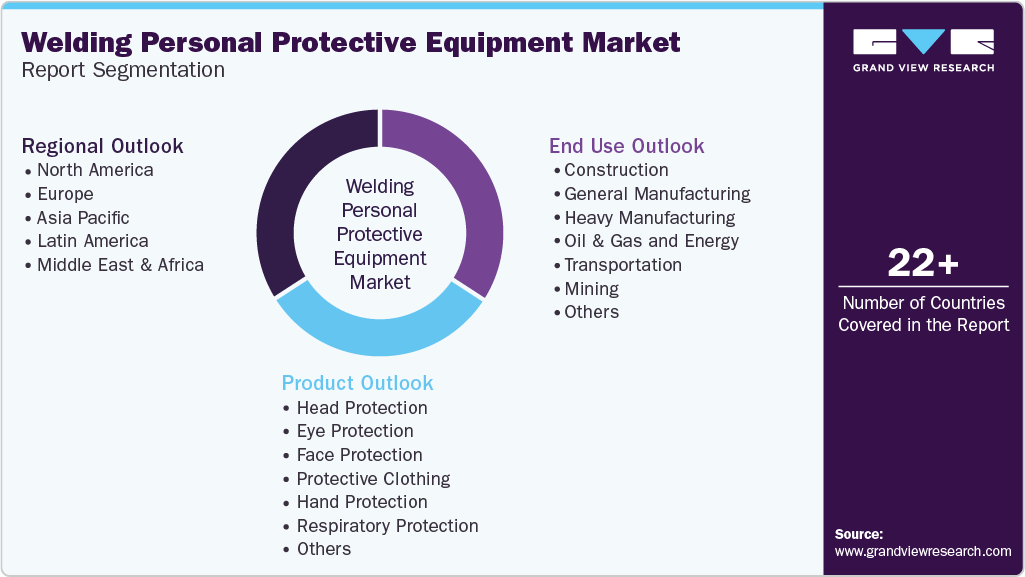
This report forecasts revenue growth at global, regional, and country levels and provides an analysis of the latest industry trends in each of the sub-segments from 2021 to 2033. For this study, Grand View Research has segmented the global welding personal protective equipment market report based on product, end use, and region.
 To learn more about this report, Download Free Sample Report
-
Product Outlook (Volume, Units; Revenue, USD Billion, 2021 - 2033)
-
Head Protection
-
Eye Protection
-
Face Protection
-
Protective Clothing
-
Hand Protection
-
Respiratory Protection
-
Others
-
-
End Use Outlook (Volume, Units; Revenue, USD Billion, 2021 - 2033)
-
Construction
-
General Manufacturing
-
Heavy Manufacturing
-
Oil & Gas and Energy
-
Transportation
-
Mining
-
Utilities
-
Electronics
-
Healthcare
-
Fire & EMS
-
Defense & Law Enforcement
-
Others
-
-
Regional Outlook (Volume, Units; Revenue, USD Billion, 2021 - 2033)
-
North America
-
U.S.
-
Canada
-
Mexico
-
-
Europe
-
Germany
-
Spain
-
France
-
Italy
-
UK
-
Russia
-
Scandinavia
-
-
Asia Pacific
-
China
-
India
-
Japan
-
Australia
-
South Korea
-
Indonesia
-
Thailand
-
Malaysia
-
-
Latin America
-
Brazil
-
Argentina
-
-
Middle East and Africa
-
Saudi Arabia
-
UAE
-
South Africa
-
-
Research Methodology
The welding personal protective equipment marketfigures in this report are based on a proven research process that combines executive interviews with secondary research from proprietary databases, company filings, and recognized regulatory and institutional sources. Market size is built through value-chain sizing-reconciling supply-side and demand-side estimates-and triangulated with bottom-up and top-down approaches. Every estimate passes multiple levels of expert validation before publication, with each welding personal protective equipment segment quantified using the revenue-capture definitions in the table below.
Segment Definition
Product
Revenue Capture Definition
Head Protection
Revenue is captured from sales of welding helmets, auto-darkening helmets, and head protective equipment used during welding operations.
Eye Protection
Revenue is generated from welding safety glasses, goggles, filters, and specialized eyewear that protect workers from radiation and particles.
Face Protection
Revenue is derived from welding face shields and protective visors designed to protect faces against sparks, heat, and molten metal.
Protective Clothing
Revenue is captured through sales of flame-resistant jackets, aprons, sleeves, trousers, and other welding protective garments.
Hand Protection
Revenue is obtained from welding gloves designed to provide heat, abrasion, cut, spark, and molten-metal protection.
Respiratory Protection
Revenue is generated from respirators, powered air-purifying respirators, filters, and other equipment that protect workers from welding fumes.
Others
Revenue is derived from welding footwear, hearing protection, protective accessories, and other specialized PPE products.
End Use
Revenue Capture Definition
Construction
Revenue is generated from PPE supplied to workers engaged in structural welding, fabrication, installation, and construction-related activities.
General Manufacturing
Revenue is generated from PPE purchases for welding operations in general industrial manufacturing and fabrication.
Heavy Manufacturing
Revenue is derived from PPE used during welding machinery, industrial equipment, structural components, and heavy fabricated products.
Transportation
Revenue is captured from PPE supplied for welding activities in automotive, railway, aerospace, marine, and transportation equipment manufacturing.
Oil & Gas and Energy
Revenue is generated from PPE used in the welding, fabrication, maintenance, and repair of energy infrastructure and equipment.
Mining
Revenue is generated from PPE used for welding, maintenance, repair, and fabrication activities across mining operations and equipment.
Utilities
Revenue is generated from PPE supplied for welding activities, including power, water, gas, and utility infrastructure maintenance.
Electronics
Revenue is derived from specialized welding PPE used in electronics manufacturing, equipment fabrication, assembly, and related operations.
Healthcare
Revenue is generated from welding PPE used for maintenance, equipment fabrication, facility construction, and supporting industrial activities.
Fire & EMS
Revenue is generated from protective equipment used by emergency personnel engaged in welding, equipment maintenance, fabrication, and repair activities.
Defense & Law Enforcement
Revenue is obtained from welding PPE used for equipment manufacturing, maintenance, repair, fabrication, and specialized operational support.
Others
Revenue is generated from welding PPE supplied to industries and applications outside the specified end-use categories.
Estimation Model
Layer Name
Key Question
Description
Industrial End-Use Demand Layer
Where is the demand for welding personal protective equipment generated?
Assess demand across construction, general manufacturing, heavy manufacturing, transportation, oil & gas and energy, mining, utilities, electronics, healthcare, fire & EMS, defense & law enforcement, and other industries. Demand is evaluated based on welding activity, workforce exposure, production volumes, infrastructure development, fabrication requirements, workplace hazards, safety requirements, and PPE replacement cycles.
Welding Activity & Workforce Demand Layer
Where is the demand for welding personal protective equipment created?
Evaluate welding-intensive operations, workforce requirements, fabrication facilities, maintenance activities, infrastructure projects, manufacturing capacity, and equipment replacement across major end-use industries. The assessment considers welding frequency, number of exposed workers, operating environments, welding processes, working conditions, and replacement of existing PPE to determine overall protection requirements.
Product Adoption Layer
Which welding personal protective equipment products are being purchased?
Analyze demand across head protection, eye protection, face protection, protective clothing, hand protection, respiratory protection, and other PPE. Adoption is assessed based on welding hazards, protection requirements, workplace conditions, regulatory standards, welding processes, exposure levels, product specifications, comfort requirements, and application-specific safety needs.
Revenue Conversion Layer
How is market revenue estimated?
Convert estimated welding personal protective equipment demand into annual revenue based on product sales values across defined Product, end-use, and geographic segments. Revenue estimates incorporate products sold directly by manufacturers and through distributors, dealers, industrial safety suppliers, retailers, OEMs, and other sales channels.
Delivered Customizations
This report has been delivered with the following In-depth customizations
Client Request
Customization Delivered
Value Adds
Competitive Benchmarking
A comprehensive benchmarking assessment was conducted across welding personal protective equipment manufacturers, covering head protection, eye protection, face protection, protective clothing, hand protection, respiratory protection, product certifications, material technologies, application coverage, geographic presence, distribution capabilities, product development, and market positioning.
Enables comparison of product portfolios, protection capabilities, certification coverage, application suitability, customization capabilities, distribution networks, technical support, and supplier positioning to support competitive analysis and strategic planning.
Regional Segmentation
A detailed regional assessment was conducted across North America, Europe, Asia Pacific, Latin America, and the Middle East & Africa, examining welding personal protective equipment demand across construction, general manufacturing, heavy manufacturing, transportation, oil & gas and energy, mining, utilities, electronics, healthcare, fire & EMS, defense & law enforcement, and other applications. Industrial activity, workforce requirements, safety practices, and PPE replacement requirements were considered.
Helps stakeholders identify regional demand variations, evaluate end-use potential, assess PPE adoption patterns, and identify geographic markets with greater demand for welding personal protective equipment.
Opportunity Assessment
Growth opportunities were evaluated across major end-use industries, with emphasis on occupational safety requirements, workforce exposure to welding hazards, advanced protective materials, product ergonomics, respiratory protection, automated welding environments, replacement demand, and expansion of welding-intensive industrial activities.
Supports identification of addressable growth areas, product development priorities, investment opportunities, application expansion potential, and strategies for strengthening market presence.
Frequently Asked Questions About This Report
The heavy manufacturing segment dominated the global market in 2025 holding 26.0% market share.
Asia Pacific dominated the global welding personal protective equipment market, accounting for the largest revenue share of 42.5% in 2025.
The respiratory protection segment is projected to grow at a CAGR of 6.8% during the forecast period.
Key trends shaping the welding personal protective equipment market include lightweight PPE designs, enhanced ergonomics, auto-darkening welding helmets, advanced respiratory protection, improved heat-resistant materials, connected safety technologies, customized products, and growing demand for sustainable protective materials.
India is projected to register the fastest growth in the welding personal protective equipment market.
3M, MSA Safety Incorporated, Lincoln Electric, ESAB, Miller Electric, Ansell Ltd., Uvex Safety Group, Delta Plus Group, MCR Safety, Protective Industrial Products (PIP), Drägerwerk AG & Co. KGaA, COFRA S.r.l., Lakeland Industries, Inc., JSP Ltd., Portwest
The global welding personal protective equipment market size was valued at USD 3.9 billion in 2025 and is estimated at USD 4.1 billion for 2026.
The global welding personal protective equipment market is expected to grow at a CAGR of 6.2% from 2026 to 2033, reaching USD 6.3 billion by 2033.
Key factors driving the welding personal protective equipment market include increasing demand for worker safety, stringent occupational safety standards, rising welding activities across industries, greater awareness of welding hazards, PPE replacement requirements, and adoption of advanced protective products offering improved comfort, durability, and protection.
About the Author(s)
Advanced Interior Materials Research Team
Advanced Materials · Advanced Interior MaterialsThis report was authored by the advanced interior materials research team at Grand View Research - comprising two research analysts, one senior research analyst, and one industry expert - with specialized expertise in the advanced interior materials segment of the advanced materials industry. All findings are based on proprietary advanced materials databases, executive interviews, and regulatory analysis, subject to internal peer review prior to publication.
Last Updated:
Speak to Analyst

Customize this report to your needs - add regions, segments, or data points, with 20% free customization.
Or view our licence options:


ISO 9001:2015 & 27001:2022 Certified
We are GDPR and CCPA compliant! Your transaction & personal information is safe and secure. For more details, please read our privacy policy.


