
- Home
- »
- Advanced Interior Materials
- »
-
Durable Gloves Market Size, Share And Trends Report, 2033GVR Report cover

Durable Gloves Market (2026 - 2033)
Size, Share & Trends Analysis Report By Material (Natural Rubber/Latex, Nitrile, Leather, Nylon, Vinyl), By Type (Mechanical Gloves, Chemical Handling), By End Use (Construction, Manufacturing, Oil & Gas), By Region, And Segment Forecasts
Market Size, 2025
$14.2BMarket Estimate, 2026
$15.3BMarket Forecast, 2033
$26.3BCAGR, 2026–2033
8.1%Durable Gloves Market Summary
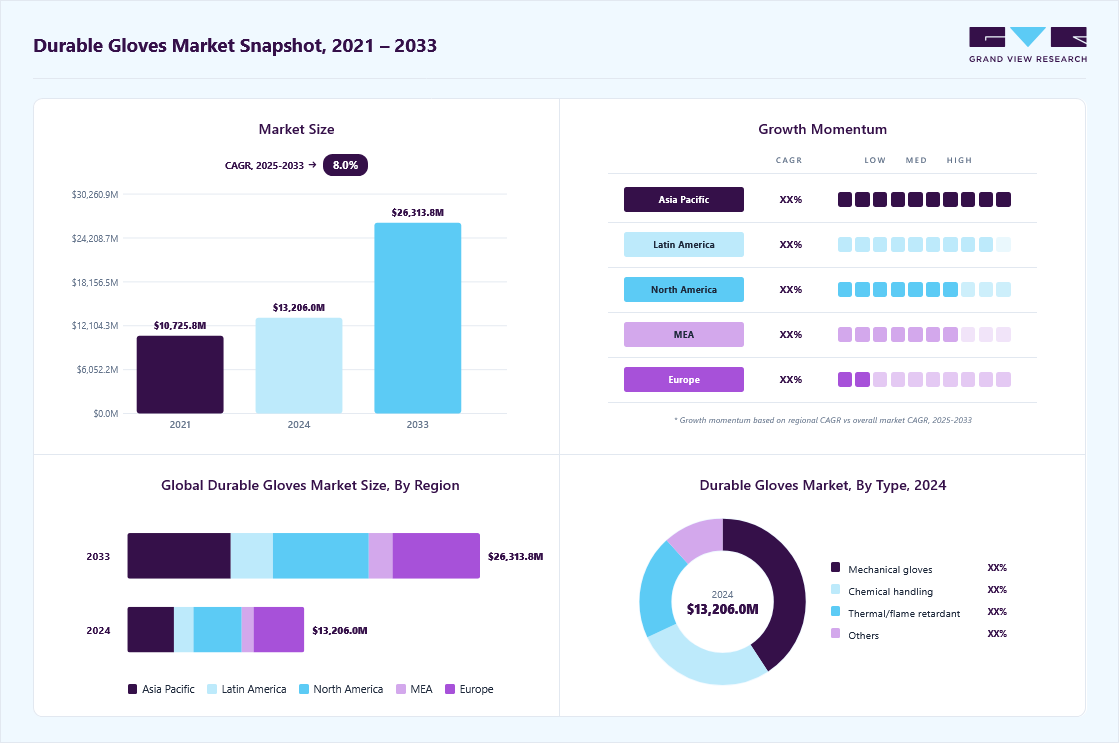
The global durable gloves market size was valued at USD 14.2 billion in 2025 and is projected to grow from USD 15.3 billion in 2026 to USD 26.3 billion by 2033, at a CAGR of 8.1% from 2026 to 2033. Europe dominated the market, accounting for a revenue share of 28.2% in 2025.The durable gloves market is being propelled by stricter workplace safety mandates across key sectors such as oil & gas, automotive, construction, and heavy manufacturing.
 Source: Grand View Research, IR Documents, Primary Interviews, Paid DatabasesTo learn more about this report,
 Download Free Sample Report
 Key Market Trends & Insights
- By material: Nitrile segment held the largest market share of 36.1% in 2025.
- By type: Mechanical gloves segment dominated the market, with a revenue share of 40.7% in 2025.
- By end use: Manufacturing segment held the largest revenue share of 17.8% in 2025.
Regional Highlights
- Largest regional market: Europe (28.2% revenue share, 2025)
- Fastest-growing regional market: Asia Pacific (highest CAGR, 2026-2033)
- By country: Germany held the largest market share in 2025.
Market Size & Forecast
- Market size in 2025: USD 14.2 Billion
- Estimated market size in 2026: USD 15.3 Billion
- Projected market size by 2033: USD 26.3 Billion
- CAGR (2026-2033): 8.1%
Three ways to get this report
Buy it, customize it, or ask a question.Ask an Analyst
A direct answer, usually in 1 working day
- AccessReport author, directly
- Reply timeWithin 1 working day
- No sales callDirect answer only
- FormatEmail reply
- CostFree, no cost
Get the Full Report
What the study covers
- FormatsPDF · Excel · Dashboard
- Timeline2026–2033 annual, 2025 base
- Coverage20+ countries, 5 regions
- Companies10+ key players profiled
Customize the Report
20% free customization
- IncludeCountries, segments, points
- TailorTo your product definition
- ExtendDeeper competitor detail
- OrA fully bespoke study
- Turnaround5–10 working days
Standards set by agencies such as OSHA, ANSI, and EN require employers to provide hand protection against risks including cuts, impacts, chemicals, and heat. Growing corporate focus on minimizing injuries and compensation costs has further reinforced the adoption of durable protective gloves.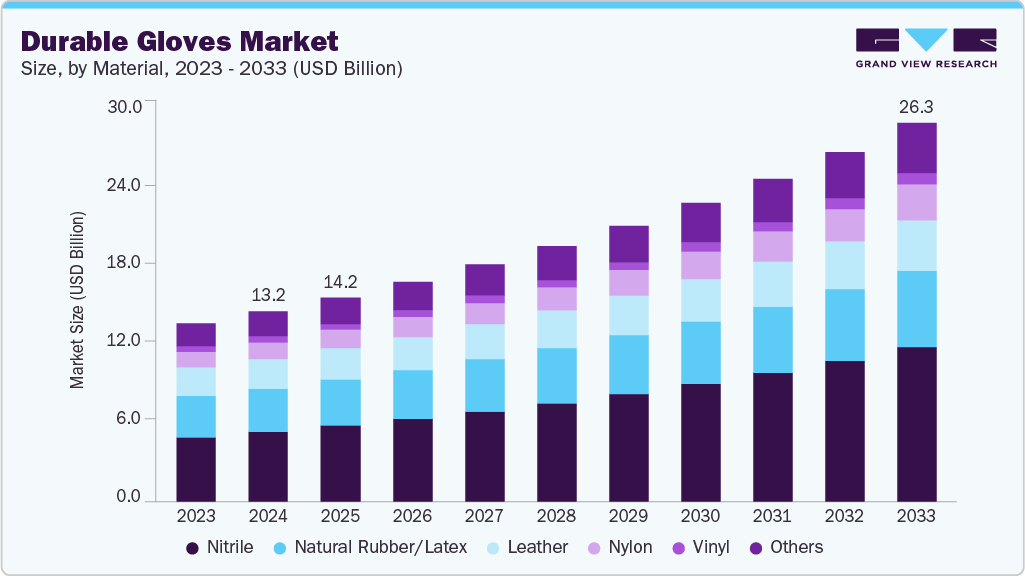 To learn more about this report, Download Free Sample Report
 Another factor stimulating growth is the integration of advanced materials and designs in glove manufacturing. The use of high-strength fibers, thermoplastic reinforcements, and innovative coatings is delivering gloves that are not only long-lasting but also comfortable and flexible. With industries increasingly relying on automation and heavy equipment, the need for specialized, durable gloves to handle diverse operational hazards is steadily rising.
Market Dynamics
The global durable gloves market is influenced by stringent occupational safety regulations across industries such as manufacturing, construction, oil & gas, chemicals, and pharmaceuticals, where compliance with OSHA, EN, and ISO standards mandates the use of protective hand gear. Rising industrialization and expansion of heavy-duty operations are increasing worker exposure to mechanical, thermal, and chemical hazards, thereby strengthening demand for high-performance gloves with enhanced cut resistance, durability, and comfort. Rapid advancements in material technology, such as nitrile formulations, high-strength synthetic fibers, and coated fabrics, are improving product performance and extending service life, further accelerating adoption. Growing emphasis on workplace safety culture, along with rising awareness of injury prevention and associated cost savings, is also encouraging widespread usage across both developed and emerging economies. Additionally, the shift toward specialized gloves tailored for application-specific needs in sectors like automotive, pharmaceuticals, and electronics is reshaping product innovation.
The durable gloves market is primarily driven by the sustained expansion of industrial and infrastructure-related activities across key sectors such as manufacturing, construction, oil & gas, chemicals, and power generation. These industries inherently involve high exposure to mechanical, thermal, and chemical hazards, which necessitate the use of certified hand protection solutions.
Increasing investments in large-scale infrastructure development projects and the ongoing establishment of new production facilities are further amplifying the need for occupational safety equipment. In addition, stricter enforcement of workplace safety standards across developed and emerging economies is reinforcing mandatory adoption of durable gloves, thereby supporting steady and long-term market growth.
A major restraint impacting the durable gloves market is the fluctuation in raw material prices, particularly for nitrile, latex, and specialized synthetic fibers. These materials are highly sensitive to global supply-demand dynamics, petrochemical price movements, and geopolitical factors, which can lead to unpredictable cost structures for manufacturers. Such volatility directly affects production planning, pricing strategies, and overall profitability.
Furthermore, reliance on concentrated supply chains for certain raw materials increases vulnerability to disruptions, thereby creating additional operational challenges for market participants.
The evolving focus on workplace digitization and safety monitoring is creating opportunities for smart protective durable gloves equipped with sensors for tracking environmental exposure, hand movement, and worker health indicators. These innovations are aligned with broader Industry 4.0 trends and are expected to enhance safety compliance and operational efficiency.
Simultaneously, increasing environmental concerns and regulatory pressures are driving demand for sustainable alternatives, including biodegradable and recyclable glove materials. This shift toward eco-friendly product development is opening new avenues for differentiation, brand positioning, and long-term market expansion.
Market Concentration & Characteristics
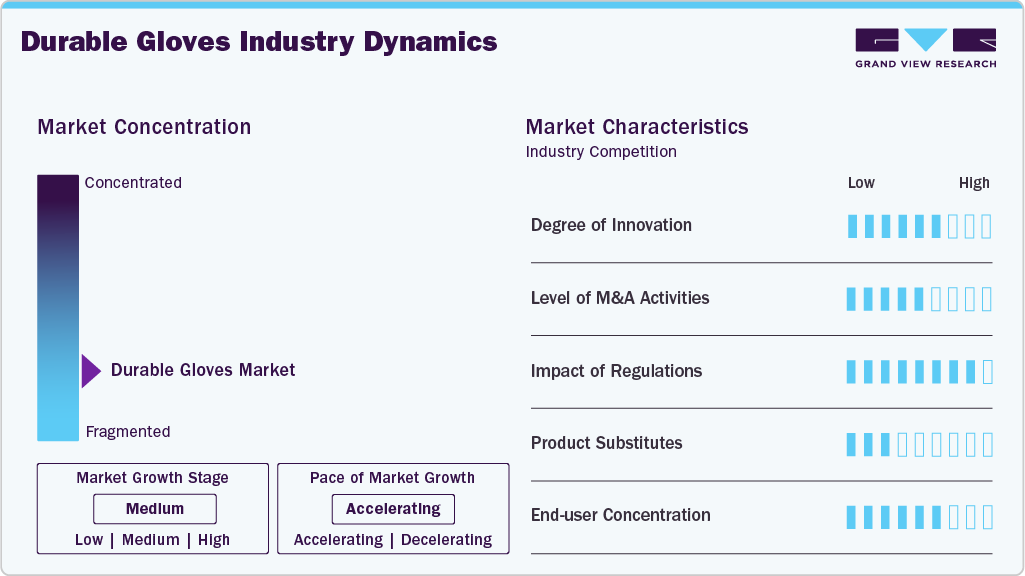
The durable gloves industry is moderately fragmented, with a mix of global safety leaders and numerous regional players. Companies such as Ansell, MCR Safety, and Kimberly-Clark hold notable shares through strong product portfolios and compliance with international safety standards. However, local manufacturers continue to compete aggressively by offering cost-effective options for industrial use. This balance between multinational dominance and regional competition keeps the market fragmented rather than fully concentrated.
The durable gloves industry experiences a high level of innovation, driven by the need for improved safety, comfort, and durability. Manufacturers continuously develop advanced materials such as cut-resistant fibers, chemical-resistant coatings, and impact-absorbing technologies. Ergonomic designs and enhanced grip features are also becoming standard. This focus on product enhancement helps companies differentiate themselves in a competitive market.
 To learn more about this report, Download Free Sample Report
 The market serves a diverse range of end users, including construction, manufacturing, oil & gas, and chemical industries. No single sector dominates demand, although heavy industrial and manufacturing applications contribute significantly. This wide user base spreads risk and ensures stable market growth. Companies often tailor products to meet specific industry requirements, enhancing customer loyalty.
Strict regulatory standards strongly influence the durable gloves market, with agencies such as OSHA, EN, and ANSI setting mandatory safety requirements. Compliance ensures higher product adoption in workplaces and reduces liability for employers. Regulatory oversight encourages innovation in protective features and quality assurance. Overall, regulations drive both market growth and product reliability.
Analyst Perspective
The durable gloves market is expected to register sustained growth, driven by increasing industrialization, stringent occupational safety regulations, and rising investments in worker protection across high-risk industries. Growing demand from manufacturing, construction, oil & gas, chemicals, mining, and transportation sectors continues to support market expansion, as employers prioritize compliance with workplace safety standards and operational risk mitigation. Product innovation remains a key competitive differentiator, with manufacturers focusing on advanced materials, enhanced cut and chemical resistance, ergonomic designs, and improved durability to address evolving end-user requirements. Furthermore, rapid industrial development in emerging economies, increasing adoption of application-specific protective solutions, and the gradual integration of sustainable materials are expected to create favorable growth opportunities over the forecast period, supporting the long-term development of the durable gloves market.
Material Insights
Based on material, the Nitrile gloves led the market with the largest revenue share of 36.1% in 2025 due to their excellent chemical resistance, puncture strength, and durability. They provide a reliable alternative to latex, avoiding allergy concerns while maintaining high performance. Industries such as chemical processing, oil & gas, and manufacturing heavily rely on nitrile gloves for daily operations. Their versatility and consistent quality make them the preferred choice across multiple industrial applications.
Nylon gloves are witnessing rapid growth because of their lightweight structure, flexibility, and comfort during prolonged use. They are often combined with coatings such as polyurethane or nitrile to enhance grip and cut resistance. The rise in applications requiring dexterity, such as electronics assembly and precision manufacturing, is driving demand. Increasing adoption in industrial sectors emphasizes both productivity and worker safety.
Type Insights
Based on type, the mechanical gloves segment led the market with the largest revenue share of 40.7% in 2025, due to their wide use in construction, manufacturing, and automotive sectors. They provide excellent protection against cuts, abrasions, and impacts while ensuring comfort for prolonged work. High demand is driven by industries handling heavy machinery and sharp tools. Their versatility and robust performance make them the most adopted type globally.
Thermal and flame-retardant gloves are experiencing rapid growth owing to increased safety requirements in high-heat and fire-prone industries. Sectors like metalworking, welding, and oil & gas are increasingly adopting these gloves to protect workers from burns and extreme temperatures. Advanced materials and improved insulation are enhancing both safety and usability. Rising awareness of occupational hazards is driving market expansion for this segment.
End Use Insights
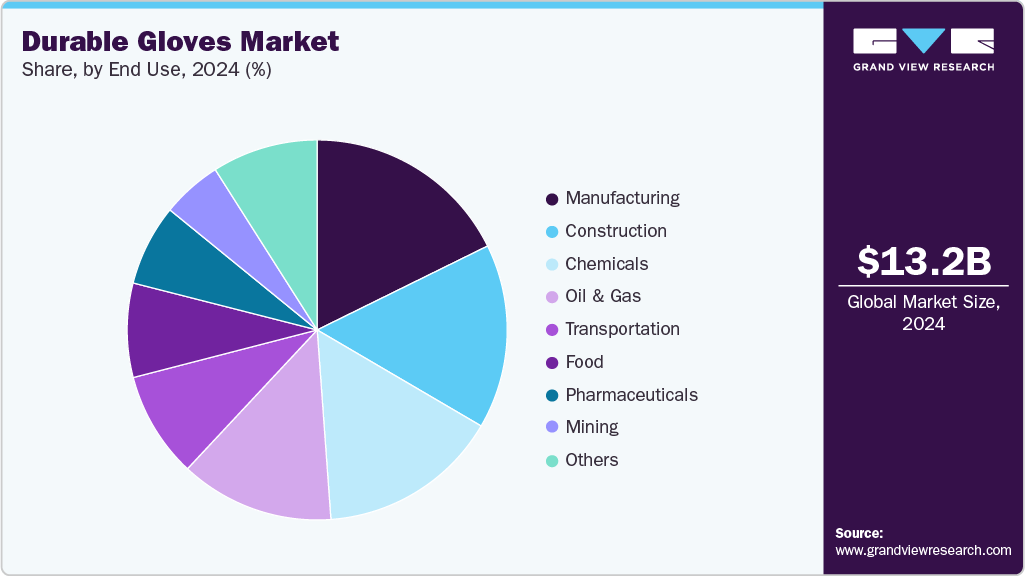
Based on end use, the manufacturing segment led the market with the largest revenue share of 17.8% in 2025, due to its high exposure to mechanical, chemical, and thermal hazards. Workers in automotive, machinery, and metal fabrication heavily rely on protective gloves to prevent injuries. Continuous industrial growth and strict safety standards reinforce the demand. This sector remains the largest consumer of mechanical and chemical-resistant gloves globally.
 To learn more about this report, Download Free Sample Report
 The pharmaceutical industry is emerging as the fastest-growing end-use segment for durable gloves. Handling chemicals, solvents, and laboratory equipment requires gloves that offer both chemical resistance and dexterity. Increasing pharmaceutical manufacturing and strict hygiene standards are driving the adoption of specialized gloves. Growth in research labs and biotech facilities further supports this rising demand.
Regional Insights
North America shows steady growth with CAGR of 8.0% due to the presence of large-scale manufacturing, oil & gas, and automotive industries. Strict OSHA regulations and emphasis on workplace safety drive consistent demand. Advanced product innovation, including cut-resistant and impact gloves, supports market expansion. The focus on industrial compliance and quality standards sustains long-term growth in the region.
U.S. Durable Gloves Market Trends
The U.S. dominates the North American durable gloves market due to its large industrial base, including manufacturing, oil & gas, and construction sectors. Strict OSHA safety regulations drive consistent adoption of mechanical, chemical-resistant, and thermal gloves. Advanced product innovation and premium quality standards further strengthen market leadership. High awareness of workplace safety ensures sustained demand across industries.
Canada is witnessing steady growth in durable gloves demand, driven by expansion in manufacturing, mining, and chemical industries. Increasing regulatory compliance and focus on worker protection are boosting adoption. The country is also investing in advanced materials and ergonomic glove designs. Rising industrial activities and safety initiatives contribute to consistent market expansion.
Europe Durable Gloves Market Trends
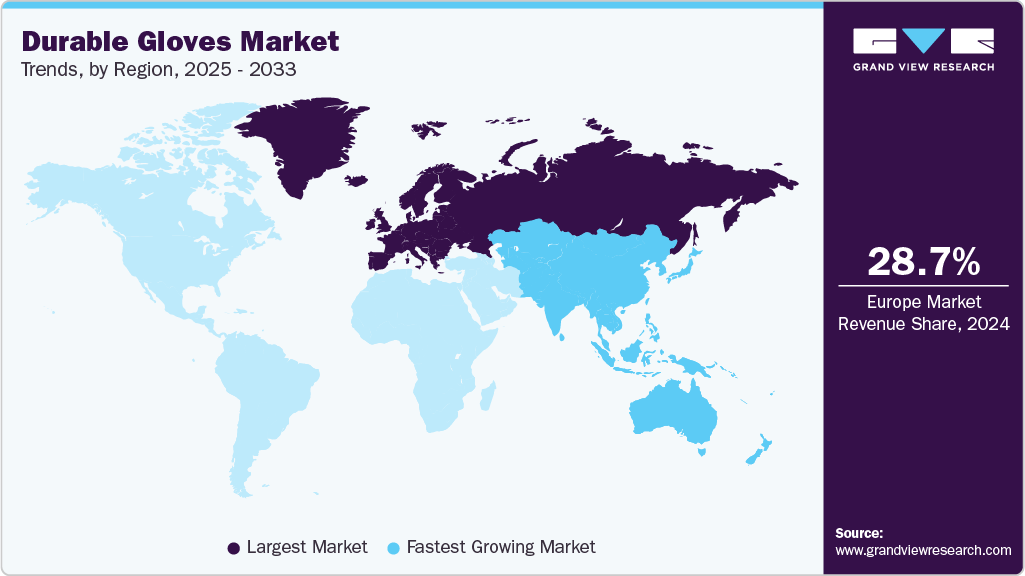
Europe dominated the durable gloves market with the largest revenue share of 28.2% in 2025, due to strict occupational safety regulations and high industrialization in countries like Germany, France, and the UK. Well-established manufacturing and chemical sectors drive demand for mechanical, chemical-resistant, and thermal gloves. Strong compliance with EN and ISO standards ensures widespread adoption. Industrial safety awareness and premium product preference reinforce market leadership in the region.
 To learn more about this report, Download Free Sample Report
 The durable gloves market in Germany held the largest share in the Europe region in 2025. Germany dominates the European durable gloves market due to its strong industrial and manufacturing sectors, including automotive, metal fabrication, and chemical industries. Strict adherence to EU and EN safety standards drives widespread use of mechanical, chemical-resistant, and thermal gloves. High focus on worker safety and quality ensures consistent market demand. Advanced product innovation and industrial compliance further reinforce Germany’s leading position.
The UK is experiencing steady growth in durable gloves demand, driven by expanding construction, manufacturing, and chemical sectors. Increasing workplace safety regulations and compliance with EU and national standards are encouraging adoption. Rising awareness of occupational hazards is prompting industries to invest in high-quality protective gloves. Growth is further supported by the adoption of ergonomic and technologically advanced glove solutions.
Asia Pacific Durable Gloves Market Trends
Asia Pacific is the fastest-growing market for durable gloves, driven by rapid industrialization, expanding manufacturing hubs, and urban infrastructure projects in countries such as China, India, and Vietnam. Increasing investments in worker safety and the adoption of advanced materials are fueling growth. The region also benefits from cost-competitive manufacturing and rising exports of protective gloves. The industrial and construction sectors are the primary consumers of durable gloves here.
China dominates the Asia Pacific durable gloves market due to its large-scale industrial base, including manufacturing, automotive, and chemical sectors. Rapid urbanization and infrastructure development drive high demand for mechanical, chemical-resistant, and thermal gloves. Strong domestic production capabilities and export-oriented manufacturing strengthen its market leadership. Regulatory focus on worker safety and compliance further supports adoption.
India is witnessing significant growth in durable gloves demand, fueled by expansion in construction, manufacturing, and pharmaceuticals. Increasing awareness of occupational safety and stricter compliance standards are encouraging adoption of high-quality protective gloves. Investments in industrial automation and infrastructure projects are creating new opportunities. Rising local production and import of advanced gloves support market expansion.
Middle East & Africa Durable Gloves Market Trends
The Middle East and Africa market is expanding due to growth in oil, gas, and heavy industry operations, particularly in the Gulf region. Rising safety standards and adoption of durable gloves for chemical, thermal, and mechanical protection are driving demand. Industrialization and infrastructure projects are key growth factors. Local and regional manufacturers are increasingly supplying specialized protective gloves to meet industrial needs.
Saudi Arabia is witnessing growth in the durable gloves market due to expansion in oil, gas, construction, and industrial sectors. Increasing emphasis on workplace safety and compliance with international standards is driving adoption. Industrial projects and infrastructure development create steady demand for mechanical, chemical-resistant, and thermal gloves. Rising investments in protective equipment and local distribution channels further support market growth.
Latin America Durable Gloves Market Trends
Latin America is witnessing gradual growth owing to increasing industrial activity and infrastructure development in countries such as Brazil and Mexico. The adoption of durable gloves is rising in the manufacturing, chemical, and construction sectors. Regulatory frameworks are improving, enhancing worker safety awareness. Cost-effective sourcing and regional production contribute to steady market expansion.
Argentina’s durable gloves market is expanding due to increasing industrial activity in manufacturing, construction, and chemical sectors. Rising awareness of workplace safety and adoption of international safety standards are boosting demand. Local industries are investing in high-quality mechanical and chemical-resistant gloves for employee protection. Growth is further supported by infrastructure projects and government initiatives promoting industrial safety.
Key Durable Gloves Company Insights
Some of the key players operating in the market include Ansell Ltd, Superior Glove, and Newell Co.
-
Ansell Ltd specializes in high-performance protective solutions, focusing on industrial, healthcare, and chemical-resistant gloves. Its product portfolio includes mechanical, chemical, thermal, and cut-resistant gloves designed for demanding work environments. The company emphasizes innovation, incorporating advanced materials such as Kevlar and nitrile coatings for durability and safety. Ansell serves multiple sectors including oil & gas, automotive, and pharmaceuticals. Its global presence allows it to deliver specialized safety solutions tailored to regional regulatory standards.
-
Superior Glove is a leading manufacturer of disposable gloves, primarily nitrile, latex, and vinyl, for medical, industrial, and consumer use. The company emphasizes large-scale production with advanced automation to maintain high-quality standards. Top Glove focuses on meeting global regulatory requirements, including FDA and ISO certifications. Its operations span multiple continents, catering to healthcare, food processing, and industrial sectors. The company invests in R&D to enhance glove performance, comfort, and sustainability.
Key Durable Gloves Companies
The following key companies have been profiled for this study on the durable gloves market.
-
Ansell Ltd
-
Superior Glove
-
Newell Co.
-
Unigloves (UK) Limited
-
Youngstown Glove Company
-
Uvex Safety Group
-
The Glove Company
-
Delta Plus Group
-
Atlantic Safety Products
-
MCR Safety
-
NITRAS
-
3M
-
SHOWA CORPORATION
-
PIP
-
United Glove
Competitive Benchmarking
Category
Operating Strategies
Competitive Edge
Weakness
Established Players (e.g., Ansell Ltd., SHOWA Corporation, Protective Industrial Products (PIP), MCR Safety, Uvex Safety Group, Delta Plus Group)
- Maintain diversified portfolios across mechanical, chemical-resistant, thermal, and specialty durable gloves.
- Invest in advanced material technologies, product innovation, and global manufacturing capabilities.
- Strengthen market position through strategic acquisitions, global distribution networks, and long-term industrial supply agreements.
- Strong global brand recognition with comprehensive industrial glove portfolios.
- Broad regulatory certifications and well-established relationships with multinational industrial customers.
- Extensive manufacturing footprint and integrated global supply chains enabling consistent product availability.
- Higher manufacturing and operational costs than regional competitors.
- Greater exposure to raw material price volatility and global supply chain disruptions.
- Premium pricing can restrict penetration in highly price-sensitive markets.
Emerging & Regional Players (e.g., Superior Glove, Youngstown Glove Company, United Glove, NITRAS, The Glove Company, regional players)
- Focus on niche industrial applications and customer-specific glove solutions.
- Expand through regional distribution partnerships, product customization, and industry-focused offerings.
- Strengthen market presence by addressing specialized end-user requirements and regional demand.
- High flexibility in product development and customization for specific industrial applications.
- Competitive pricing and quicker response to regional market requirements.
- Strong relationships with regional distributors and industrial customers in target markets.
- Limited global manufacturing footprint and distribution network compared to multinational companies.
- Lower investment capacity for large-scale R&D and advanced material innovation.
- Higher dependence on regional markets and limited diversification across end-use industries.
Recent Developments
-
In July 2025, Dyneema has launched its third-generation Diamond 3.0 fiber, creating lighter protective gloves that are 40% lighter than previous models. The new fiber provides significantly higher cut resistance, offering six times the protection of standard HPPE gloves. Its single-yarn design enhances comfort, dexterity, and flexibility without the need for reinforcement. Additional features include improved coating adhesion and compatibility with touchscreen devices, making it suitable for industrial tasks.
-
In November 2024, Ansell has launched the AlphaTec 53-002 and 53-003 gloves, designed for advanced chemical protection using MICROCHEM technology. These gloves meet EN ISO 374-1:2016 standards, with most chemicals achieving high breakthrough times. The 53-003 model features a nylon liner, providing mechanical protection and heat resistance up to 100°C. They are suitable for demanding industrial and chemical-handling applications.
Durable Gloves Market Report Scope
Report Attribute
Details
Market size in 2025
USD 14.2 billion
Estimated market size in 2026
USD 15.3 billion
Projected market size by 2033
USD 26.3 billion
Growth rate
CAGR of 8.1% from 2026 to 2033
Base year for estimation
2025
Historical data
2021 - 2024
Forecast period
2026 - 2033
Quantitative units
Revenue in USD billion and CAGR from 2026 to 2033
Report coverage
Revenue forecast, company ranking, competitive landscape, growth factors, and trends
Segments covered
Material, type, end use, region
Regional scope
North America; Europe; Asia Pacific; Latin America; Middle East & Africa
Country scope
U.S.; Canada; Mexico; Germany; UK; France; Italy; Russia; Spain; Japan; China; India; Australia; South Korea; Thailand; Indonesia; Malaysia; Brazil; Argentina; Saudi Arabia; South Africa; UAE
Key companies profiled
Ansell Ltd., SHOWA Corporation, Protective Industrial Products (PIP), MCR Safety, Uvex Safety Group, Superior Glove, Delta Plus Group, NITRAS, Youngstown Glove Company, United Glove.
Customization scope
Free report customization (equivalent up to 8 analysts' working days) with purchase. Addition or alteration to country, regional & segment scope.
Pricing and purchase options
Avail customized purchase options to meet your exact research needs. Explore purchase options
Global Durable Gloves Market Report Segmentation
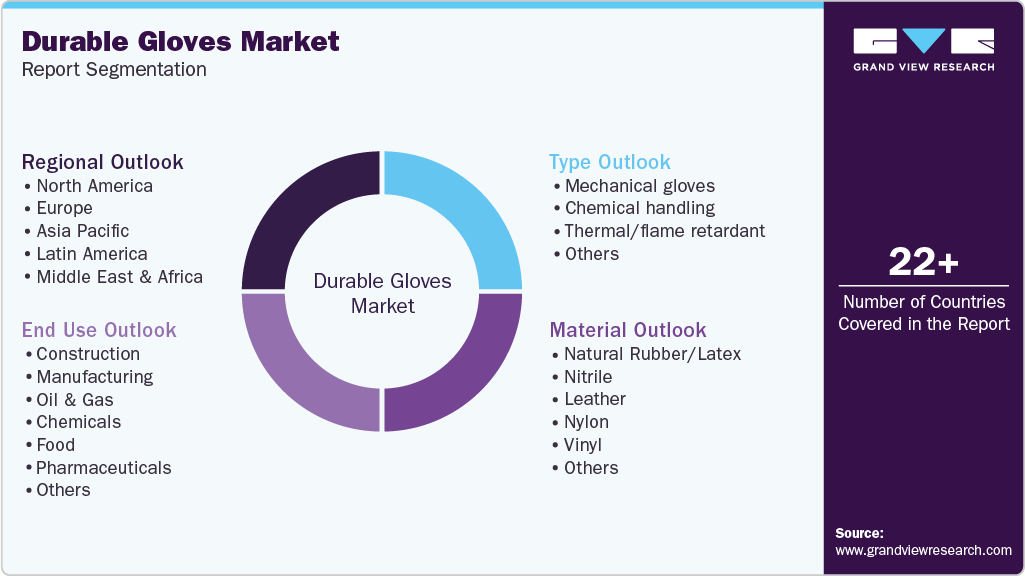
This report forecasts revenue growth at global, regional, and country levels and provides an analysis of the latest industry trends in each of the sub-segments from 2021 to 2033. For this study, Grand View Research has segmented the global durable gloves market report based on material,type, end use and region.
 To learn more about this report, Download Free Sample Report
 -
Material Outlook (Revenue, USD Million, 2021 - 2033)
-
Natural Rubber/Latex
-
Nitrile
-
Leather
-
Nylon
-
Vinyl
-
Others
-
-
Type Outlook (Revenue, USD Million, 2021 - 2033)
-
Mechanical gloves
-
Chemical handling
-
Thermal/flame retardant
-
Others
-
-
End Use Outlook (Revenue, USD Million, 2021 - 2033)
-
Construction
-
Manufacturing
-
Oil & Gas
-
Chemicals
-
Food
-
Pharmaceuticals
-
Transportation
-
Mining
-
Others
-
-
Regional Outlook (Revenue, USD Million, 2021 - 2033)
-
North America
-
U.S.
-
Canada
-
Mexico
-
-
Europe
-
France
-
Germany
-
Italy
-
Russia
-
Spain
-
UK
-
-
Asia Pacific
-
China
-
India
-
Japan
-
South Korea
-
Indonesia
-
Australia
-
Thailand
-
Malaysia
-
-
Latin America
-
Brazil
-
Argentina
-
-
Middle East and Africa
-
Saudi Arabia
-
UAE
-
South Africa
-
-
Research Methodology
The durable gloves market figures in this report are based on a proven research process that combines executive interviews with secondary research from proprietary databases, company filings, and recognized regulatory and institutional sources. Market size is built through value-chain sizing - reconciling supply-side and demand-side estimates - and triangulated with bottom-up and top-down approaches. Every estimate passes multiple levels of expert validation before publication, with each durable gloves segment quantified using the revenue-capture definitions in the table below.
Segment Definition
Segment - Material
Revenue Capture Definition
Natural Rubber/Latex
Revenue is generated from sales of durable gloves produced using natural rubber or latex, primarily serving applications requiring flexibility, comfort, and moderate protection in general industrial and maintenance activities.
Nitrile
This segment captures revenue from sales of synthetic nitrile-based gloves offering high resistance to chemicals, oils, and punctures, widely adopted across industrial, automotive, and chemical handling applications.
Leather
Revenue is derived from sales of leather-based durable gloves used in heavy-duty operations requiring abrasion and mechanical protection, particularly in construction, welding, and material handling.
Nylon
This segment represents revenue from sales of lightweight nylon gloves used for precision handling and light protection applications in assembly, electronics, and inspection tasks.
Vinyl
Revenue is generated from sales of cost-effective vinyl gloves used in low-risk environments where basic protection and economic efficiency are key requirements.
Others
This includes revenue from sales of advanced and blended materials designed for specialized applications requiring enhanced performance, such as multi-hazard resistance or extreme condition usage.
Segment - Type
Revenue Capture Definition
Mechanical Gloves
Revenue is captured from sales of durable gloves designed to protect against cuts, abrasions, impacts, and punctures in high-risk industrial and construction environments.
Chemical Handling Gloves
This segment generates revenue from sales of durable gloves engineered for resistance against corrosive chemicals, solvents, and hazardous substances across chemical, pharmaceutical, and oil & gas industries.
Thermal/Flame Retardant Gloves
Revenue is derived from sales of durable gloves providing protection against heat and flame exposure, primarily used in welding, foundries, and high-temperature industrial operations.
Others
This segment includes specialized durable gloves for niche applications such as electrical protection, anti-vibration, and multi-risk industrial environments.
Segment - End Use
Revenue Capture Definition
Construction
Revenue is generated from sale of durable gloves used in infrastructure and building activities involving mechanical and physical hazards.
Manufacturing
This segment captures revenue from sales of industrial production environments requiring hand protection during assembly, machining, and maintenance operations.
Oil & Gas
Revenue is driven by sales of glove usage across upstream and downstream operations involving exposure to chemicals, hydrocarbons, and harsh working conditions.
Chemicals
This segment revenue is generated from sales of protective gloves used in chemical processing and handling environments requiring high resistance to hazardous substances.
Food
Revenue is captured from sales of gloves used in food processing and handling applications focused on hygiene and contamination prevention.
Pharmaceuticals
This segment includes revenue from sales of gloves used in controlled production and laboratory environments requiring contamination control and product safety.
Transportation
Revenue is generated from the automotive, logistics, and aviation sectors for maintenance, assembly, and handling operations.
Mining
This segment captures revenue from sales of heavy-duty gloves used in mining operations involving abrasive materials and extreme working conditions.
Others
This includes revenue from sales of durable gloves in utilities, defense, and municipal applications requiring diverse protective glove solutions.
Estimation Model
Layer Name
Key Question
Description
Industrial Demand Base Layer
Which industries generate demand for durable gloves?
Quantify demand across construction, manufacturing, oil & gas, chemicals, mining, food processing, pharmaceuticals, transportation, and other industrial sectors. Assess workforce engaged in hazardous operations, hand protection requirements, and industry-specific glove usage to establish the addressable market.
Product Adoption & Consumption Layer
What is the consumption of durable gloves across industries?
Evaluate durable glove adoption by material, protection type, and end-use industry. Analyze usage intensity, replacement frequency, operational practices, and compliance with occupational safety requirements to estimate annual glove consumption across regions.
Supply-side Manufacturing & Sales Layer
How is market demand fulfilled?
Assess the competitive supply landscape by evaluating production capacities, manufacturing output, product portfolios, contract manufacturing, geographic presence, distribution networks, and import-export trade flows.
Market Revenue Validation Layer
How is total market revenue established?
Establish market revenue by consolidating manufacturer sales, financial disclosures, shipment data, distributor revenues, and trade statistics. Cross-validate estimates across materials, glove types, end-use industries, and regions using both demand-side consumption and supply-side sales to ensure comprehensive market sizing.
Delivered Customizations
This report has been delivered with the following In-depth customizations
Client Request
Customization Delivered
Value Adds
Competitive Benchmarking
Benchmarked leading durable glove manufacturers based on product portfolio, manufacturing capabilities, financial strength, geographic presence, end-use industry focus, and strategic positioning, while differentiating established and emerging market participants.
Enabled assessment of the competitive landscape, market positioning, product differentiation, and competitive strategies across the core durable gloves market.
Regional Segmentation
Refined regional analysis by evaluating industrial activity, workforce concentration, occupational safety regulations, PPE adoption, and manufacturing presence across North America, Europe, Asia Pacific, Latin America, and the Middle East & Africa.
Identified high-growth regions, demand centers, and regulatory-driven opportunities to support expansion and investment strategies.
Opportunity assessment
Assessed growth opportunities across manufacturing, construction, oil & gas, chemicals, mining, transportation, food processing, and pharmaceuticals, while evaluating demand for high-performance, ergonomic, and sustainable durable gloves.
Identified high-potential application areas and innovation opportunities, supporting product development and long-term revenue growth strategies.
Frequently Asked Questions About This Report
The global durable gloves market, in terms of revenue, is expected to grow at a compound annual growth rate of 8.1% from 2026 to 2033,reaching USD 26.3 billion by 2033.
Mechanical gloves currently lead the durable gloves market and accounted for a share of 40.7% in 2025, due to their wide use in construction, manufacturing, and automotive sectors. They provide excellent protection against cuts, abrasions, and impacts while ensuring comfort for prolonged work.
Asia Pacific is anticipated to be one of the fastest-growing regional markets over the forecast period.
The manufacturing segment held the largest revenue share of 17.8% in 2025.
Nitrile segment held the largest market share of 36.1% in 2025 while nylon gloves segment is second fastest growing market.
The global durable gloves market size was estimated at USD 14.2 billion in 2025 and is estimated at USD 15.3 billion in 2026.
The global durable gloves market is driven by strict workplace safety regulations, rapid industrialization, and technological advancements in high-performance materials. Rising awareness of worker protection and compliance with international standards further boosts demand.
Europe dominated the durable gloves market with the largest revenue share of 28.2% in 2025.
Some of the key players operating in the global durable gloves market include Ansell Ltd, Superior Glove, Newell Co., Unigloves (UK) Limited, Youngstown Glove Company, Uvex Safety Group, The Glove Company, Delta Plus Group, Atlantic, Safety Products, MCR Safety, NITRAS, 3M, SHOWA CORPORATION, PIP, United Glove.
About the Author(s)
Advanced Interior Materials Research Team
Advanced Materials · Advanced Interior MaterialsThis report was authored by the advanced interior materials research team at Grand View Research - comprising two research analysts, one senior research analyst, and one industry expert - with specialized expertise in the advanced interior materials segment of the advanced materials industry. All findings are based on proprietary advanced materials databases, executive interviews, and regulatory analysis, subject to internal peer review prior to publication.
Last Updated:
Speak to Analyst

Customize this report to your needs - add regions, segments, or data points, with 20% free customization.
Or view our licence options:


ISO 9001:2015 & 27001:2022 Certified
We are GDPR and CCPA compliant! Your transaction & personal information is safe and secure. For more details, please read our privacy policy.


