
- Home
- »
- Advanced Interior Materials
- »
-
Hand Protection Equipment Market Size, Share Report, 2033GVR Report cover

Hand Protection Equipment Market (2026 - 2033)
Size, Share & Trends Analysis Report By Product (Disposable, Durable), By Material (Natural Rubber/Latex, Nitrile Gloves, Neoprene), By End-use (Construction, Healthcare), By Region, And Segment Forecasts
Market Size, 2025
$30.0BMarket Estimate, 2026
$32.5BMarket Forecast, 2033
$57.3BCAGR, 2026–2033
8.4%Hand Protection Equipment Market Summary
The global hand protection equipment market size was valued at USD 30.0 billion in 2025 and is projected to grow from USD 32.5 billion in 2026 to USD 57.3 billion by 2033, at a CAGR of 8.4% from 2026 to 2033. North America dominated the market, accounting for a revenue share of 32.1% in 2025. The rising demand is attributed to the increasing concerns about hand hygiene and the product's efficiency during the COVID-19 pandemic in various end-use industries.
 Source: Grand View Research, IR Documents, Primary Interviews, Paid DatabasesTo learn more about this report,
 Download Free Sample Report
Key Market Trends & Insights
- By product: Disposable gloves segment led the market with the largest revenue share of 52.7% in 2025.
- By material: Nitrile segment led the market with the largest revenue share of 36.0% in 2025.
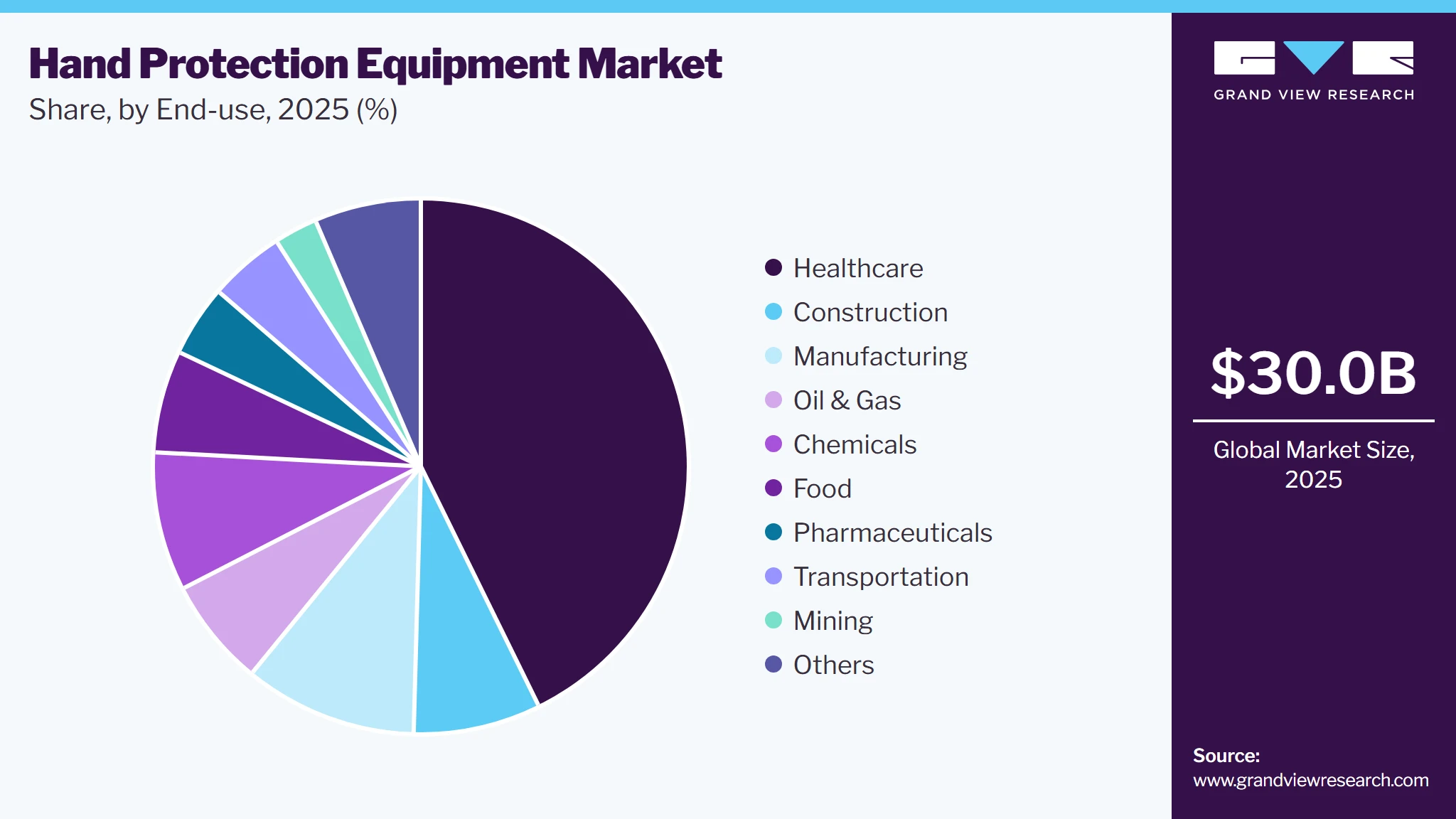
- By end-use: Healthcare segment led the market with the largest revenue share of 42.7% in 2025.
Regional Highlights
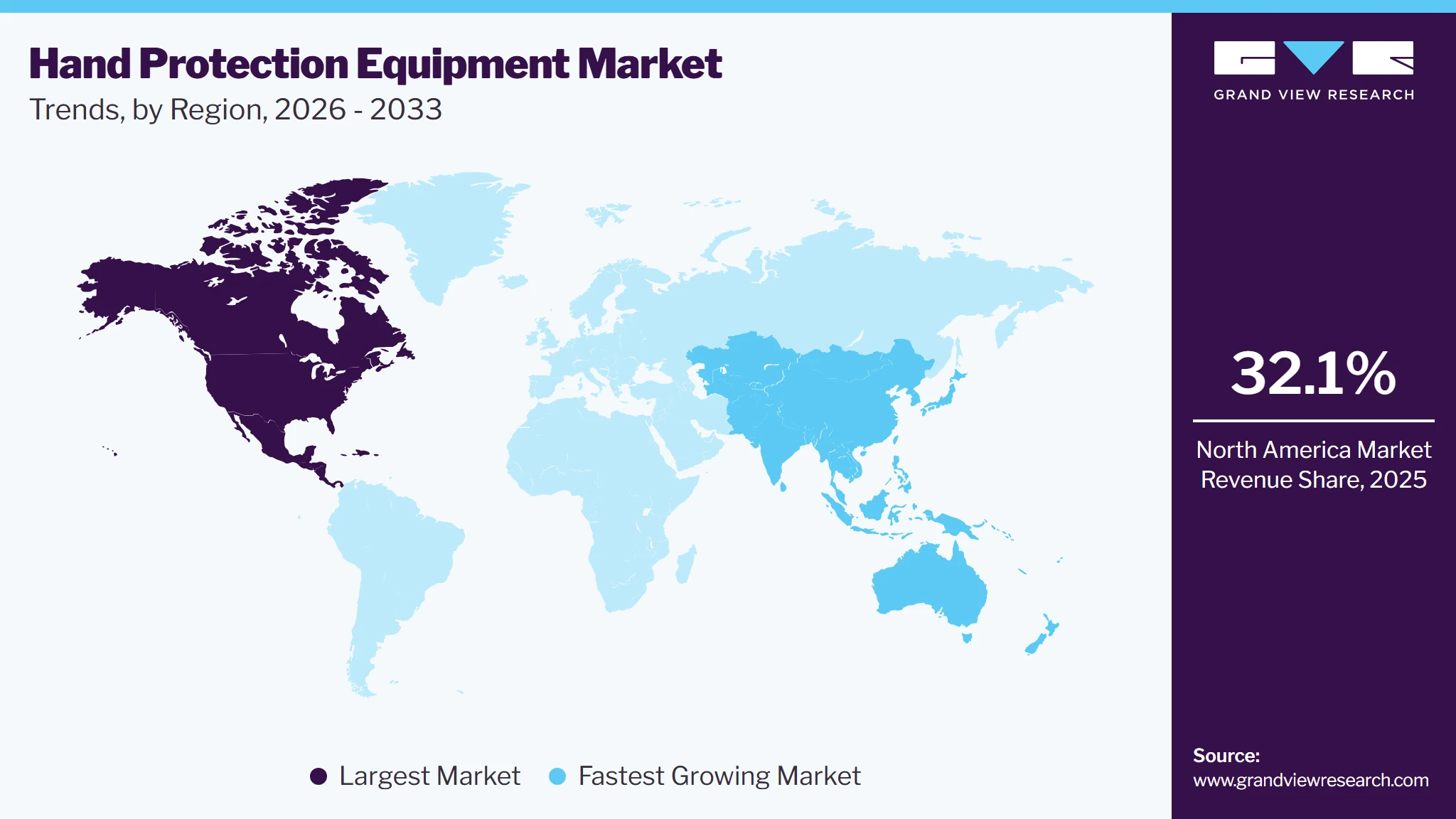
- Largest regional market: North America (32.1% revenue share, 2025)
- Fastest-growing regional market: Asia Pacific (highest CAGR, 2026-2033)
- By country: The U.S. held the largest market share in 2025.
Market Size & Forecast
- Market size in 2025: USD 30.0 Billion
- Estimated market size in 2026: USD 32.5 Billion
- Projected market size by 2033: USD 57.3 Billion
- CAGR (2026-2033): 8.4%
Three ways to get this report
Buy it, customize it, or ask a question.Ask an Analyst
Analyst response in 1 business day
- AccessReport author, directly
- Reply timeWithin 1 working day
- No sales callDirect answer only
- FormatEmail reply
- CostFree, no cost
Get the Full Report
What the study covers
- FormatsPDF · Excel · Dashboard
- Timeline2026–2033 annual, 2025 base
- Coverage20+ countries, 5 regions
- Companies10+ key players profiled
Customize the Report
20% free customization
- IncludeCountries, segments, points
- TailorTo your product definition
- ExtendDeeper competitor detail
- OrA fully bespoke study
- Turnaround5–10 working days
The second wave of COVID-19 caused a shortage of hand protection equipment in hospitals and industries, such as manufacturing and construction. In response, many manufacturers ramped up production to address the supply-demand gap.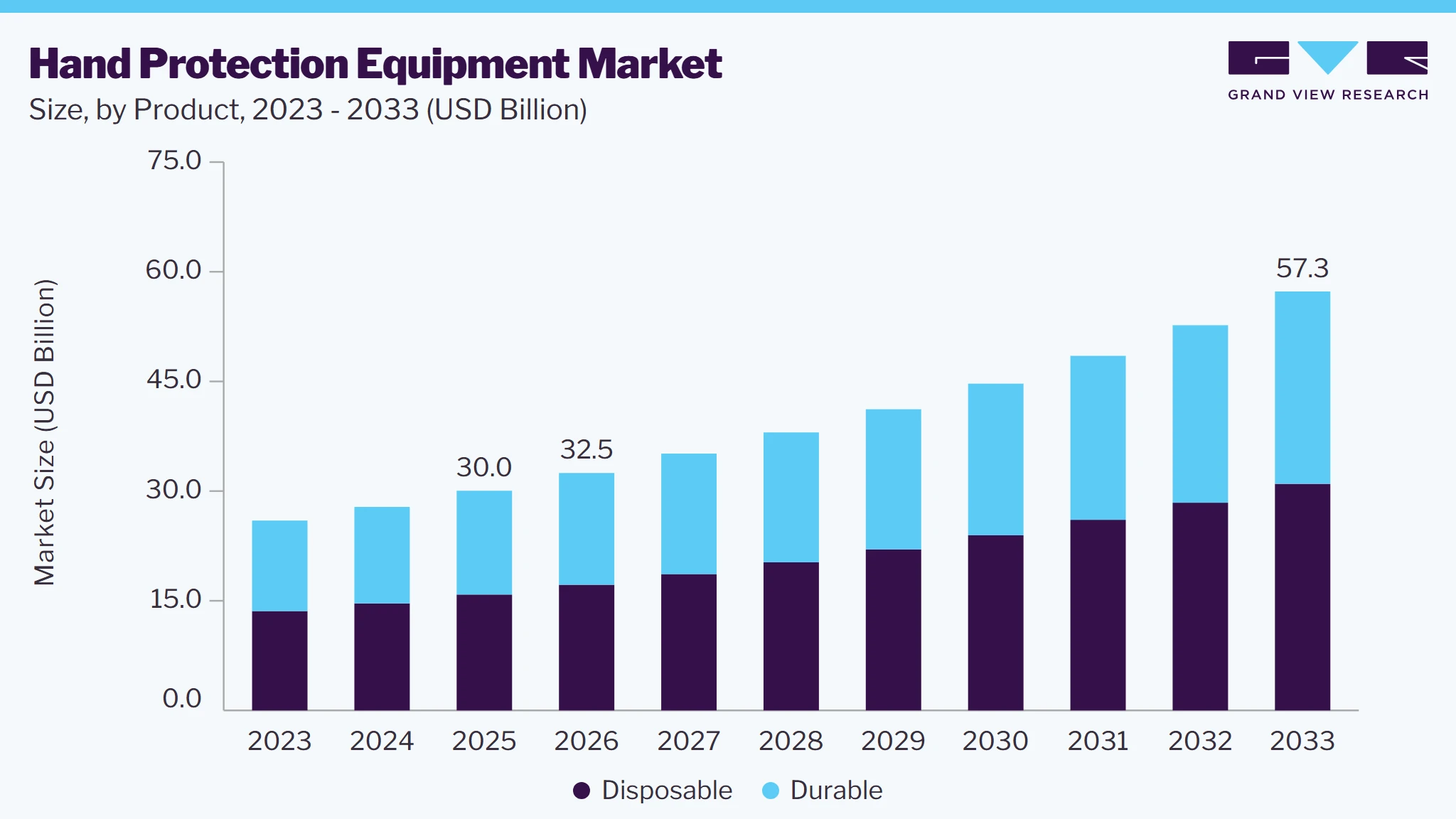 To learn more about this report, Download Free Sample Report
Strict government regulations regarding the health and safety of doctors, nurses, and working professionals have prompted workers to use these products to protect against health hazards and healthcare-associated infections. These gloves have excellent chemical and tear resistance, tactility, & flexibility, which makes them ideal for use in areas with direct contact with chemicals, microbes, and physiological fluids. The industry is an amalgamation of global and regional players with a broad product portfolio, restricting new players from entering the market.
Hand protection gloves ensure worker safety and are crucial in manufacturing, construction, healthcare, and chemical industries. These gloves are made from different materials, each designed to protect against specific risks. They are available in various styles, such as disposable gloves for single-use and reusable gloves intended for prolonged use. The choice of gloves depends on the particular hazards found in the workplace. Leading companies are innovating advanced hand protection equipment with flash protection to safeguard against electrical hazards and expand market reach.
Market Dynamics
The global hand protection equipment market is driven by stringent occupational health and safety regulations, rising industrialization, and increasing workforce safety requirements across manufacturing, construction, oil & gas, chemicals, mining, healthcare, and food processing industries. Regulatory compliance and corporate investments in personal protective equipment continue to accelerate the adoption of advanced hand protection solutions capable of mitigating mechanical, chemical, thermal, and biological hazards. Continuous advancements in material technologies, including high-performance fibers, engineered coatings, and ergonomic product designs, are enhancing product performance, durability, and user comfort, thereby expanding applications across diverse industrial environments. In addition, sustained industrial expansion in emerging economies, coupled with rising demand for application-specific and environmentally sustainable protective solutions, is expected to reinforce long-term market growth.
The hand protection equipment market is primarily driven by stringent occupational health and safety regulations that mandate the use of certified personal protective equipment across manufacturing, construction, oil & gas, chemicals, mining, healthcare, food processing, and other industrial sectors. Increasing industrialization, infrastructure development, and expansion of manufacturing facilities have led to a larger workforce operating in environments exposed to mechanical, chemical, thermal, electrical, and biological hazards.
Consequently, employers are placing greater emphasis on workplace risk mitigation, regulatory compliance, and employee well-being by adopting advanced hand protection solutions. Furthermore, growing awareness of the economic impact of occupational injuries, including productivity losses, compensation costs, and operational disruptions, continues to support sustained demand for high-performance hand protection equipment.
Volatility in the prices of key raw materials, including nitrile, natural rubber, leather, aramid fibers, and other engineered synthetic materials, remains a significant restraint for the hand protection equipment market. Fluctuations in raw material costs, driven by changing petrochemical prices, supply-demand imbalances, and geopolitical uncertainties, increase manufacturing expenses and create pricing pressure across the value chain.
In addition, disruptions in global supply chains and dependence on specialized material suppliers can affect production schedules, inventory availability, and procurement strategies. These challenges may limit the affordability of premium hand protection products, particularly in price-sensitive markets, while reducing profit margins for manufacturers.
Continuous advancements in material science and product engineering present significant growth opportunities for the hand protection equipment market. Manufacturers are increasingly developing lightweight, ergonomic, and application-specific hand protection solutions that offer enhanced cut resistance, chemical protection, thermal insulation, impact resistance, and wearer comfort without compromising dexterity.
Growing demand from industries with specialized safety requirements, including electronics, pharmaceuticals, automotive, and food processing, is encouraging innovation in performance-oriented glove technologies. Additionally, the increasing adoption of smart hand protection equipment incorporating sensor-based monitoring capabilities, along with the development of sustainable and recyclable materials, is creating new avenues for product differentiation and value creation.
Analyst Perspective
The global hand protection equipment market is anticipated to demonstrate sustained growth over the forecast period, underpinned by increasingly stringent occupational health and safety regulations, rising industrial workforce participation, and the growing emphasis on mitigating workplace injuries across high-risk industries. Market expansion is supported by the widespread adoption of disposable and reusable protective gloves across manufacturing, construction, chemicals, oil & gas, mining, healthcare, pharmaceuticals, food processing, and transportation, where regulatory compliance and worker protection remain integral to operational continuity. Industry participants are increasingly investing in advanced material technologies, ergonomic product engineering, and application-specific hand protection solutions to enhance mechanical, chemical, thermal, and biological hazard resistance while improving user comfort and productivity.
Product Insights
Based on product, the disposable gloves segment led the market with the largest revenue share of 52.7% in 2025. Durable gloves are mainly used in the construction and manufacturing industries to avoid injuries from burns, cuts, and hazardous chemicals. Previously restricted to the industrial, construction, and healthcare sectors, durable gloves are now accessible to the general population, propelling their demand. Reduced need for frequent replacements helps decrease waste, making them a more eco-friendly option and saving money in the long run due to fewer replacements.
The disposable hand protection equipment segment is expected to grow at the fastest CAGR of 8.5% over the forecast period. These gloves are mainly used in the food and healthcare industries to protect against the transmission of infection. The COVID-19 pandemic caused a rise in demand and a shortage in the supply of disposable gloves. The rising awareness of healthcare-associated infections and increasing demand for disease control drive the product demand. The lower costs of disposable gloves are anticipated to offer them a competitive advantage in short-duration industrial projects. The COVID-19 pandemic had surged the demand for gloves by almost three times. Furthermore, the demand for gloves has increased due to easier access to e-commerce platforms and high pharmacy stocks.
Material Insights
Based on material, the nitrile segment led the market with the largest revenue share of 36.0% in 2025. The demand for these products was relatively high as they are flexible, comfortable to wear, and ideal for handling sensitive applications, such as medical procedures and surgeries. These gloves are essential in light manufacturing for precise tasks, protecting workers in assembly lines, and cleaning services as they safeguard against chemicals, and the beauty industry uses them for hair dyeing, nail care, and skincare procedures.
The neoprene segment is expected to grow at the fastest CAGR of 9.1% over the forecast period, fueled by their excellent resistance to chemicals, oils, and solvents, making them ideal for hazardous environments. Their durability ensures long-lasting protection against abrasion, tearing, and punctures. Furthermore, flexible and comfortable, they maintain dexterity while offering water and thermal protection. Neoprene is used in industries such as chemical and pharmaceutical for handling hazardous substances, oil and gas for exposure to oils, automotive for repairs, and construction for heavy machinery tasks, combining protection and flexibility.
End-use Insights
Based on end-use, the healthcare segment led the market with the largest revenue share of 42.7% in 2025. Hand protection is essential in preventing infections in healthcare settings such as hospitals and clinics. Specialized gloves, such as nitrile or chemo-rated types, protect workers handling hazardous drugs and chemotherapy agents. Strict safety regulations require protective gear for both worker and patient safety. With an aging population and advances in medical procedures, the demand for hand protection in healthcare is increasing, ensuring sterility and safety during surgeries, treatments, and daily caregiving tasks.
 To learn more about this report, Download Free Sample Report
The pharmaceutical sector is estimated to grow at the fastest CAGR of 9.0% over the forecast period, as employees in the pharmaceutical industry face various on-the-job hazards as they come in contact with hazardous chemicals, solvents, and drugs. As the pharmaceutical industry evolves with new drug formulations, including biologics, the need for hand protection increases to handle potent compounds safely. Maintaining sterility and preventing cross-contamination during manufacturing processes is crucial. With the growing global demand for pharmaceutical products, the handling of active ingredients has risen, further driving the need for protective gloves and PPE to ensure safety and product purity.
Regional Insights
North America dominated the hand protection equipment market with the largest revenue share of 32.1% in 2025, owing to increasing healthcare expenditures and rising awareness of healthcare-acquired infections. The rising prevalence of chronic conditions in individuals aged 65-74 is boosting the demand for hand protection equipment. As the aging population faces higher rates of illnesses such as diabetes and arthritis, stricter safety regulations and greater healthcare demand further drive growth in the North American PPE market.
 To learn more about this report, Download Free Sample Report
U.S. Hand Protection Equipment Market Trends
The hand protection equipment market in the U.S. held the largest share in the North America region in 2025. As healthcare systems evolve, there is a stronger focus on improving safety standards and providing quality protective gear for healthcare workers. Hospitals and clinics are upgrading hand protection to meet stricter regulations. Meanwhile, industrialization in the U.S. is increasing workplace exposure to chemical, mechanical, and thermal hazards, driving the demand for advanced hand protection solutions to ensure worker safety.
Asia Pacific Hand Protection Equipment Market Trends
The Asia Pacific hand protection equipment market is expected to grow at the fastest CAGR of 9.2% over the forecast period due to increasing concerns regarding hygiene across the healthcare industry, which is expected to positively impact the market growth. The increasing workforce, strict government regulations, and strict labor laws, coupled with expansion in healthcare institutions, are expected to drive the industry. Stringent restrictions on medical drug research and workplace conditions in the healthcare and pharmaceutical industries are anticipated to grow the industry.
The hand protection equipment market in China led the Asia Pacific market with the highest revenue share in 2025. China's rapid industrialization, particularly in manufacturing, construction, and mining sectors, has heightened workplace hazards, creating a greater need for enhanced safety measures, including hand protection equipment. The country's economic growth has also fueled increased investments in infrastructure and industrial projects, further driving the demand for protective gear. The impact of COVID-19 has also amplified the need for hand protection across various sectors as hygiene and safety standards become more critical.
Europe Hand Protection Equipment Market Trends
Europe hand protection equipment market held a substantial market share in 2025. European public health campaigns emphasize hygiene and boost hand protection demand in industries and among the general public. Strict occupational safety regulations require personal protective equipment (PPE), pushing industries to adopt hand protection solutions. These factors collectively drive the growth of the hand protection equipment market in Europe.
Germany hand protection equipment market dominated the European market with the highest revenue share in 2025. Germany's economic growth, driven by the automotive, chemicals, and manufacturing sectors, has increased workplace hazards, requiring enhanced safety measures, including hand protection. Infrastructure and industrial investments have further boosted demand for protective equipment, contributing to the expansion of industries that rely on such gear for worker safety.
Key Hand Protection Equipment Company Insights
Key companies in the global hand protection equipment market include Top Glove Corporation Bhd, Hartalega Holdings Berhad, Superior Glove, and Adenna LLC, among others. Top companies prioritize developing advanced gloves with enhanced materials and protection features, such as cut or chemical resistance. Strategic partnerships with other PPE manufacturers and industries help expand product offerings, improve distribution channels, and access new markets.
-
Top Glove Corporation Bhd is headquartered in Malaysia. The company specializes in producing a wide range of gloves, including latex, nitrile, vinyl, and surgical gloves. It serves various healthcare, food, automotive, and industrial sectors.
-
Hartalega Holdings Berhad is headquartered in Kuala Lumpur, Malaysia. It produces nitrile gloves used in healthcare, industrial, and food sectors. The company operates state-of-the-art facilities and has a significant presence in international markets, exporting to over 50 countries.
Key Hand Protection Equipment Companies:
The following key companies have been profiled for this study on the hand protection equipment market.
-
Top Glove Corporation Bhd
-
Hartalega Holdings Berhad
-
Superior Glove
-
Adenna LLC
-
MCR Safety
-
Atlantic Safety Products
-
Ammex Corp.
-
KCWW
-
Sempermed
-
Halyard
Competitive Benchmarking
Category
Operating Strategies
Competitive Edge
Weakness
Established Players (e.g., Top Glove Corporation Bhd, Hartalega Holdings Berhad, Superior Glove, MCR Safety, Ansell, Sempermed)
- Expand global manufacturing capacity and strengthen vertically integrated production to improve supply reliability and cost efficiency.
- Invest in advanced glove technologies, sustainable materials, and premium hand protection solutions to address evolving industrial and healthcare requirements.
- Strengthen long-term customer relationships through broad distribution networks, regulatory compliance, and diversified product portfolios across multiple end-use industries.
- Strong global brand recognition supported by extensive manufacturing capabilities and international distribution networks.
- Comprehensive product portfolios covering disposable, reusable, chemical-resistant, cut-resistant, heat-resistant, and specialty hand protection equipment.
- Significant investments in product innovation, quality certifications, automation, and regulatory compliance enable consistent product performance and market leadership.
- High exposure to fluctuations in raw material prices, labor costs, and global supply chain disruptions.
- Large-scale operations increase fixed costs and reduce flexibility in responding to rapid shifts in regional demand.
- Greater dependence on mature markets and pricing pressure from regional manufacturers offering lower-cost alternatives.
Emerging & Regional Players (e.g., Adenna LLC, Atlantic Safety Products, AMMEX Corporation, Halyard., regional players)
- Focus on selected geographic markets and niche end-use industries through specialized hand protection products and responsive customer support.
- Expand distribution partnerships and private-label manufacturing to increase market penetration while optimizing operational costs.
- Differentiate through application-specific glove solutions, faster product development, and flexible production capabilities.
- Greater operational flexibility enables quicker responses to changing customer requirements and regional market trends.
- Strong customer relationships within targeted industries supported by customized product offerings and responsive technical support.
- Ability to compete effectively in niche applications through specialized products and competitive pricing.
- Limited global manufacturing capacity and geographic presence compared with established multinational competitors.
- Lower investment capacity for large-scale research and development, automation, and production expansion.
- Higher dependence on third-party suppliers or contract manufacturing may affect cost competitiveness and supply continuity.
Recent Developments
-
In December 2024,Superior Glove, a global leader in safety gloves and sleeves, chose High Point, North Carolina, for its first U.S. manufacturing facility. The company plans to invest significantly, creating over 100 jobs over the next five years and boosting local economic growth.
-
In May 2024, KARAM Safety, a global leader in PPE and fall protection, acquired Midas Safety India, enhancing its product range. This acquisition strengthens KARAM's market position by combining fall protection expertise with Midas Safety India's hand protection offerings.
Hand Protection Equipment Market Report Scope
Report Attribute
Details
Market size value in 2025
USD 30.0 billion
Estimated market size in 2026
USD 32.5 billion
Projected market size by 2033
USD 57.3 billion
Growth rate
CAGR of 8.4% from 2026 to 2033
Base year for estimation
2025
Historical data
2021 - 2024
Forecast period
2026 - 2033
Quantitative units
Revenue in USD billion and CAGR from 2026 to 2033
Report coverage
Revenue forecast, company ranking, competitive landscape, growth factors, and trends
Segments covered
Product, material, end-use, region
Regional scope
North America; Europe; Asia Pacific; Latin America; Middle East & Africa
Country scope
U.S.; Canada; Mexico; France; Germany; Italy; Russia; Spain; UK; China; India; Japan; South Korea; Indonesia; Australia; Thailand; Malaysia; Brazil; Argentina; Saudi Arabia; UAE; South Africa
Key companies profiled
Top Glove Corporation Bhd, Hartalega Holdings Berhad, Superior Glove, Adenna LLC, MCR Safety, Atlantic Safety Products, Ammex Corp., KCWW, Sempermed, and Halyard
Customization scope
Free report customization (equivalent up to 8 analysts' working days) with purchase. Addition or alteration to country, regional & segment scope.
Pricing and purchase options
Avail customized purchase options to meet your exact research needs. Explore purchase options
Global Hand Protection Equipment Market Report Segmentation
This report forecasts revenue growth at global, regional, and country levels and analyzes the latest industry trends in each sub-segment from 2021 to 2033. For this study, Grand View Research has segmented the global hand protection equipment market report based on product, material, end-use, and region.
 To learn more about this report, Download Free Sample Report
-
Product Outlook (Revenue, USD Million; 2021 - 2033)
-
Disposable
-
Durable
-
-
Material Outlook (Revenue, USD Million; 2021 - 2033)
-
Natural rubber/latex
-
Nitrile gloves
-
Neoprene
-
Vinyl gloves
-
Others
-
-
End-use Outlook (Revenue, USD Million; 2021 - 2033)
-
Construction
-
Manufacturing
-
Oil & Gas
-
Chemicals
-
Food
-
Pharmaceuticals
-
Healthcare
-
Transportation
-
Mining
-
Others
-
-
Regional Outlook (Revenue, USD Million; 2021 - 2033)
-
North America
-
U.S.
-
Canada
-
Mexico
-
-
Europe
-
France
-
Germany
-
Italy
-
Russia
-
Spain
-
UK
-
-
Asia Pacific
-
China
-
India
-
Japan
-
South Korea
-
Indonesia
-
Australia
-
Thailand
-
Malaysia
-
-
Latin America
-
Argentina
-
Brazil
-
-
Middle East & Africa
-
Saudi Arabia
-
UAE
-
South Africa
-
-
Research Methodology
The hand protection equipment market figures in this report are based on a proven research process that combines executive interviews with secondary research from proprietary databases, company filings, and recognized regulatory and institutional sources. Market size is built through value-chain sizing—reconciling supply-side and demand-side estimates—and triangulated with bottom-up and top-down approaches. Every estimate passes multiple levels of expert validation before publication, with each hand protection equipment segment quantified using the revenue-capture definitions in the table below.
Segment Definition
Segment - Product
Revenue Capture Definition
Disposable
Revenue captured under this segment includes sales of single-use hand protection equipment designed for short-duration tasks requiring hygiene, contamination control, and protection against low to moderate workplace hazards.
Durable
Revenue captured under this segment includes sales of reusable hand protection equipment engineered for extended service life and protection against mechanical, thermal, chemical, and abrasion-related hazards.
Segment - Material
Revenue Capture Definition
Natural Rubber/Latex
Revenue captured under this segment includes sales of hand protection equipment manufactured primarily from natural rubber latex, offering high elasticity, comfort, dexterity, and tactile sensitivity.
Nitrile
Revenue captured under this segment includes sales of nitrile-based hand protection equipment known for superior puncture resistance, chemical protection, durability, and latex-free properties.
Leather
Revenue captured under this segment includes sales of leather hand protection equipment designed to provide abrasion resistance, durability, heat protection, and mechanical strength.
Nylon
Revenue captured under this segment includes sales of nylon-based hand protection equipment offering flexibility, dexterity, breathability, and lightweight mechanical protection.
Vinyl
Revenue captured under this segment includes sales of vinyl hand protection equipment intended for low-risk applications requiring economical, single-use protection against contaminants and light chemicals.
Others
Revenue captured under this segment includes sales of hand protection equipment manufactured from alternative materials such as polyurethane, polyethylene, butyl rubber, PVC-coated fabrics, leather, aramid fibers (e.g., Kevlar), cotton, cut-resistant yarns, aluminized fabrics, and composite materials.
Segment - End Use
Revenue Capture Definition
Construction
Revenue captured under this segment includes sales of hand protection equipment supplied for residential, commercial, and infrastructure construction activities.
Manufacturing
Revenue captured under this segment includes sales of hand protection equipment used across discrete and process manufacturing industries, including automotive, machinery, electronics, metal fabrication, plastics, packaging, and consumer goods production.
Oil & Gas
Revenue captured under this segment includes sales of hand protection equipment utilized in upstream, midstream, and downstream oil & gas operations.
Chemicals
Revenue captured under this segment includes sales of hand protection equipment used in chemical manufacturing, processing, storage, laboratory operations, and material handling.
Food
Revenue captured under this segment includes sales of hand protection equipment supplied to food processing, packaging, catering, restaurants, beverage manufacturing, and food service operations.
Pharmaceuticals
Revenue captured under this segment includes sales of hand protection equipment used in pharmaceutical manufacturing, biotechnology, research laboratories, quality control, and sterile production environments.
Healthcare
Revenue captured under this segment includes sales of hand protection equipment supplied to hospitals, clinics, diagnostic laboratories, ambulatory surgical centers, dental facilities, nursing homes, and other healthcare institutions.
Transportation
Revenue captured under this segment includes sales of hand protection equipment used across logistics, warehousing, aviation, railways, ports, shipping, and commercial vehicle maintenance operations.
Mining
Revenue captured under this segment includes sales of hand protection equipment utilized in surface and underground mining operations, mineral processing facilities, and quarrying activities.
Others
Revenue captured under this segment includes sales of hand protection equipment supplied to industries not separately classified, including utilities, agriculture, telecommunications, marine, waste management, municipal services, laboratories, janitorial services, and general industrial maintenance.
Estimation Model
Layer Name
Key Question
Description
Workplace Safety Demand Layer
Where is hand protection equipment required?
Quantify workers exposed to occupational hand injury risks across construction, manufacturing, oil & gas, chemicals, food processing, pharmaceuticals, healthcare, transportation, mining, and other industrial sectors. Model workforce size, employment intensity, and job functions require hand protection equipment.
Hazard & Protection Requirement Layer
Which workers require hand protection equipment?
Assess the proportion of workers requiring protective gloves based on exposure to mechanical, chemical, thermal, biological, electrical, and abrasion hazards. Incorporate occupational safety regulations, workplace risk assessments, PPE mandates, and industry-specific protection requirements.
Product Utilization Layer
What share of the eligible workforce utilizes hand protection equipment?
Estimate hand protection equipment utilization by end-use industry, product category (disposable and durable), material type, hazard profile, application, and replacement frequency. Account for differences in PPE compliance, workplace safety practices, and glove usage intensity across industries and regions.
Revenue Conversion Layer
How is market revenue generated?
Estimate annual shipments of hand protection equipment by product type, material, end-use industry, and region. Quantify revenues generated exclusively from the sale of new hand protection equipment supplied through manufacturers, distributors, industrial suppliers, and retail channels.
Delivered Customizations
This report has been delivered with the following In-depth customizations
Client Request
Customization Delivered
Value Adds
Competitive Benchmarking
Benchmarked leading hand protection equipment manufacturers based on product portfolio, manufacturing capabilities, regulatory compliance, geographic presence, and strategic positioning, while distinguishing established and emerging market participants.
Enabled benchmarking of market leaders, identification of competitive differentiation, and assessment of strategic positioning across the value chain.
Regional Segmentation
Refined regional analysis by evaluating industrial workforce, occupational safety regulations, manufacturing activity, healthcare demand, and PPE adoption across North America, Europe, Asia Pacific, Latin America, and Middle East & Africa.
Identified high-growth regional markets and demand drivers, supporting market prioritization and regional expansion strategies.
Opportunity assessment
Assessed growth opportunities across healthcare, manufacturing, construction, chemicals, oil & gas, mining, food processing, and transportation, with emphasis on disposable and durable hand protection equipment.
Identified high-potential growth segments and emerging demand areas, supporting investment prioritization and long-term market strategy.
Frequently Asked Questions About This Report
The global hand protection equipment market size was estimated at USD 30.0 billion in 2025 and is expected to be USD 32.5 billion in 2026.
The global hand protection equipment market, in terms of revenue, is expected to grow at a compound annual growth rate of 8.4% from 2026 to 2033 to reach USD 57.3 billion by 2033.
Asia Pacific is anticipated to be one of the fastest-growing regional markets over the forecast period, driven by rapid industrialization, expanding healthcare infrastructure, increasing manufacturing activities, and strengthening workplace safety regulations.
The disposable gloves segment led the market with the largest revenue share of 52.7% in 2025.
The nitrile segment accounted for the largest revenue share of 36.0% in 2025.
The healthcare segment led the market with the largest revenue share of 42.7% in 2025.
North America dominated the hand protection equipment market with the largest revenue share of 32.1% in 2025.
Some of the key players operating in the hand protection market include Top Glove Corporation Bhd; Hartalega Holdings; Superior Glove; Adenna LLC; MCR Safety.; Atlantic Safety Products; Ammex Corporation; Ansell Ltd, Sempermed USA, Inc., Halyard Health, Inc., Medline Industries, LP., Cardinal Health, Kossan Rubber Industries Bhd, Globus (Shetland) Ltd
Key factors include stringent workplace safety regulations, rising awareness of occupational hand injury prevention, increasing demand from healthcare and manufacturing industries, and growing adoption of high-performance protective gloves with enhanced comfort, durability, and chemical resistance.
About the Author(s)
Advanced Interior Materials Research Team
Advanced Materials · Advanced Interior MaterialsThis report was authored by the advanced interior materials research team at Grand View Research - comprising two research analysts, one senior research analyst, and one industry expert - with specialized expertise in the advanced interior materials segment of the advanced materials industry. All findings are based on proprietary advanced materials databases, executive interviews, and regulatory analysis, subject to internal peer review prior to publication.
Last Updated:
Speak to Analyst

Customize this report to your needs - add regions, segments, or data points, with 20% free customization.
Or view our licence options:


ISO 9001:2015 & 27001:2022 Certified
We are GDPR and CCPA compliant! Your transaction & personal information is safe and secure. For more details, please read our privacy policy.


