
- Home
- »
- Research
- »
-
3D Printing In Mining Market Size, Share Report 2026-2033GVR Report cover

3D Printing In Mining Market (2026 - 2033)
Size, Share & Trends Analysis Report By Material (Metals, Polymers, Composites, Ceramics & Geopolymers), By End-use (Mining Companies, Equipment OEM, Service Providers), By Region, And Segment Forecasts
Market Size, 2025
$263.2MMarket Estimate, 2026
$290.8MMarket Forecast, 2033
$672.1MCAGR, 2026–2033
12.7%3D Printing In Mining Market Summary
The global 3d printing in mining market size was valued at USD 263.2 million in 2025 and is projected to grow from USD 290.8 million in 2026 to USD 672.1 million by 2033, at a CAGR of 12.7% from 2026 to 2033. The market in Asia Pacific dominated with a revenue share of 47.6% in 2025. The adoption of 3D printing in the mining industry is driven by the need to enhance operational efficiency and reduce costs.
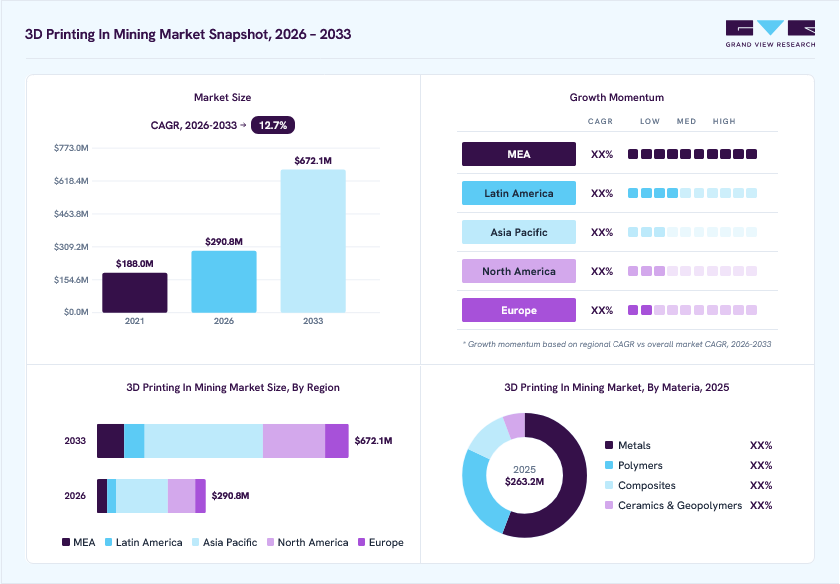 Source: Grand View Research, IR Documents, Primary Interviews, Paid DatabasesTo learn more about this report,
 Download Free Sample Report
 Key Market Trends & Insights
- By material: Metals segment held the largest market share of 55.7% in 2025.
- By end use: Mining companies segment held the largest market share of 55.0% in 2025.
Regional Highlights
- Largest regional market: Asia Pacific (47.6% revenue share, 2025)
- Fastest-growing regional market: Middle East & Africa (highest CAGR, 2026-2033)
- By country: China held the largest market share in 2025
Market Size & Forecast
- Market size in 2025: USD 263.2 Million
- Estimated market size in 2026: USD 290.8 Million
- Projected market size by 2033: USD 672.1 Million
- CAGR (2026-2033): 12.7%
Three ways to get this report
Buy it, customize it, or ask a question.Ask an Analyst
A direct answer, usually in 1 working day
- AccessReport author, directly
- Reply timeWithin 1 working day
- No sales callDirect answer only
- FormatEmail reply
- CostFree, no cost
Get the Full Report
What the study covers
- FormatsPDF · Excel · Dashboard
- Timeline2026–2033 annual, 2025 base
- Coverage20+ countries, 5 regions
- Companies10+ key players profiled
Customize the Report
20% free customization
- IncludeCountries, segments, points
- TailorTo your product definition
- ExtendDeeper competitor detail
- OrA fully bespoke study
- Turnaround5–10 working days
Mining operations often rely on complex, customized parts for machinery and equipment. Traditional manufacturing methods can be time-consuming and expensive to produce these parts. 3D printing allows companies to produce components on demand, minimizing downtime and inventory costs while ensuring precise customization for specific machinery requirements.Sustainability and material optimization are becoming increasingly important in mining, and 3D printing addresses both concerns effectively. Unlike traditional subtractive manufacturing methods, which often generate significant waste, additive manufacturing uses only the material needed to create a part. This reduces scrap material and helps mining companies lower their environmental impact. As regulations and stakeholder expectations push the mining sector toward greener practices, the ability to adopt environmentally responsible manufacturing methods enhances the appeal of 3D printing. The reduced material consumption and energy efficiency associated with additive manufacturing also contribute to cost savings, further supporting its adoption in mining operations.
 To learn more about this report, Download Free Sample Report
 Technological innovations in 3D printing are expanding the possibilities for its application in mining. Advanced methods, including metal additive manufacturing and high-strength polymer printing, allow the production of durable, heat-resistant, and wear-resistant components suitable for harsh mining environments. These developments ensure critical parts, such as wear plates, drill components, and replacement machinery, can withstand extreme conditions while maintaining performance over time. The durability and precision of 3D-printed components reduce maintenance frequency and extend the lifespan of machinery, contributing to operational efficiency and lowering long-term costs for mining companies.
The mining sector’s growing need for rapid prototyping and design flexibility also drives the adoption of 3D printing. Mining equipment and tools are often redesigned to optimize performance, address site-specific challenges, or improve safety. 3D printing allows engineers to quickly produce prototypes and iterate on designs without the long production cycles associated with conventional methods. This capability accelerates innovation and allows companies to experiment on-site with new designs and testing procedures. By shortening the time from concept to implementation, 3D printing supports continuous improvement in mining operations and encourages the development of customized solutions tailored to unique operational needs.
Remote and challenging mining locations present significant logistical challenges, particularly in sourcing replacement parts and critical equipment. 3D printing provides the ability to manufacture components on-site, reducing reliance on external suppliers and complex transportation networks. This on-demand production capability ensures that mining operations can continue without delays caused by supply chain disruptions. 3D printing increases operational resilience, improves equipment uptime, and enhances overall productivity by enabling the local production of essential parts. The ability to maintain uninterrupted operations in remote sites makes 3D printing an increasingly vital technology in the mining sector.
Market Dynamics
The 3D printing in mining market is experiencing significant growth as mining companies increasingly adopt additive manufacturing technologies to improve operational efficiency, reduce equipment downtime, and optimize inventory management. Technology enables on-demand production of spare parts, tooling, and equipment components directly at mining sites, reducing dependence on lengthy supply chains. Growing digitalization initiatives, automation trends, and the need for cost-effective maintenance solutions are further supporting market expansion. As mining operations move toward Industry 4.0 practices, the adoption of 3D printing is expected to accelerate across both surface and underground mining activities.
A major factor driving the growth of 3D printing in mining market is the increasing need for rapid production of spare parts and replacement components. Mining operations often face significant production losses when critical equipment remains idle due to part shortages or long procurement lead times. 3D printing enables mining companies to manufacture components on demand, reducing inventory costs and minimizing operational disruptions. The technology also supports the production of customized parts for specialized mining equipment, improving maintenance efficiency and asset utilization.
Additionally, remote mining locations often face logistical challenges in sourcing replacement components. By deploying additive manufacturing capabilities closer to mining sites, companies can shorten supply chains, improve equipment availability, and lower transportation costs. These benefits are encouraging greater investment in 3D printing technologies across the mining sector.
Despite its advantages, the adoption of 3D printing in mining is constrained by the high capital investment required for industrial-grade printers, software, and skilled personnel. Many mining companies, particularly small and medium-sized operators, may find the implementation costs prohibitive. Furthermore, not all mining equipment components can currently be manufactured using additive manufacturing technologies due to material performance requirements, size constraints, and certification standards. The limited availability of specialized metal powders and mining-grade materials can also restrict broader adoption. Concerns regarding the long-term durability and reliability of certain printed components in harsh mining environments further present challenges to market growth.
The growing transition toward smart mining and digital transformation presents substantial opportunities for 3D printing in mining market. Mining companies are increasingly integrating advanced technologies such as automation, artificial intelligence, digital twins, and predictive maintenance into their operations. 3D printing complements these initiatives by enabling rapid prototyping, customized component manufacturing, and decentralized production models.
Analyst Perspective
The 3D printing in mining market is expected to witness steady growth as mining companies increasingly leverage additive manufacturing to enhance equipment availability, reduce maintenance costs, and strengthen supply chain efficiency. The technology's ability to enable on-demand production of spare parts, minimize downtime, and support digital mining initiatives makes it a valuable tool for modern mining operations. While challenges related to capital investment and material limitations remain, ongoing advancements in metal printing technologies and growing adoption of smart mining practices are expected to drive long-term market expansion.
Drivers, Opportunities & Restraints
The 3D printing market in mining is primarily driven by the need to enhance operational efficiency and reduce costs associated with traditional manufacturing methods. Mining equipment often requires complex and customized parts, and 3D printing allows companies to produce these components on demand, reducing lead times and minimizing downtime. The ability to rapidly manufacture precise replacement parts ensures uninterrupted operations and lowers overall maintenance expenses.
Significant opportunities exist in adopting 3D printing for sustainable and resource-efficient practices. Compared to conventional methods, additive manufacturing reduces material waste and energy consumption, supporting environmentally friendly mining operations. In addition, the technology enables rapid prototyping and design flexibility, allowing companies to innovate equipment designs, optimize processes, and tailor solutions for challenging or remote mining sites. On-site manufacturing of critical parts further opens avenues for operational resilience and cost savings.
Despite its advantages, the adoption of 3D printing in mining faces certain restraints. High initial investment costs for 3D printing equipment and materials can be a barrier, particularly for smaller mining operations. Limited availability of skilled personnel to operate and maintain advanced 3D printing systems also restricts widespread implementation. Moreover, material properties and production speed constraints for certain large-scale or highly specialized components can limit the applicability of 3D printing for all mining equipment needs.
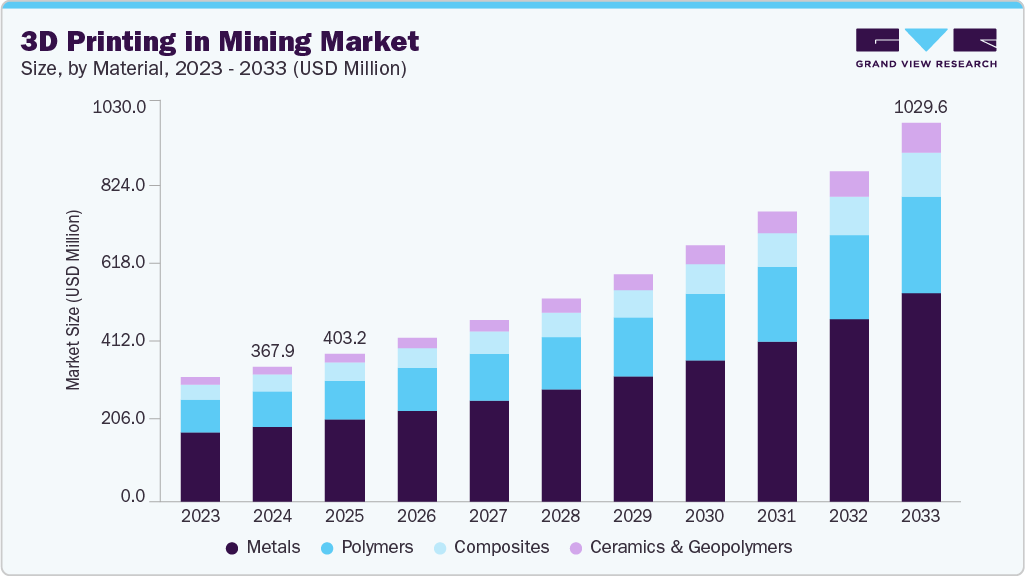
Material Insights
Based on material, the metal segment led the market with the largest revenue share of 55.7% in 2025, driven by technological advancements and increasing demand for complex, high-performance components. Innovations such as developing low-cost metal 3D printing technologies, like Micro-Plasma Metal Additive Manufacturing (MP-MAM) by IIT Indore, are making metal 3D printing more accessible and cost-effective. This technology enables the production of high-quality metal components at reduced costs, benefiting sectors such as aerospace, healthcare, and industrial tooling.
The ceramics & geopolymers segment is anticipated to register the fastest CAGR over the forecast period due to technological advancements and increasing demand for high-performance and durable components. Ceramics are valued for their heat resistance, strength, and wear resistance, making them suitable for aerospace, automotive, and healthcare industries. Advances in 3D printing techniques allow for the fabrication of complex ceramic structures with high precision, enabling manufacturers to produce customized parts efficiently and cost-effectively. The rising need for lightweight and resilient components in industrial applications also drives the adoption of ceramic materials in 3D printing.
End-use Insights
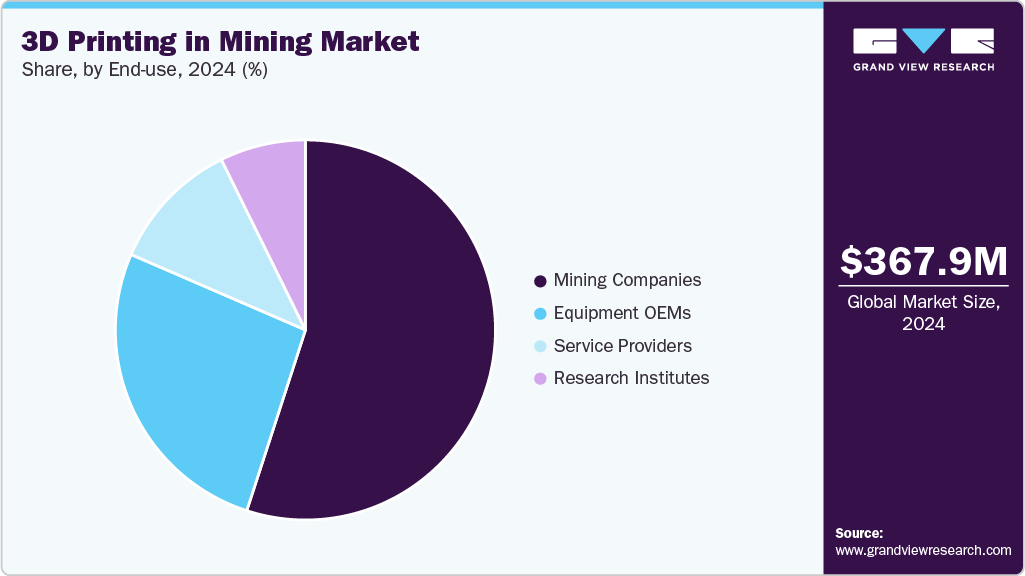
Based on end use, the mining companies segment led the market with the largest revenue share of 55.0% in 2025. Mining companies increasingly leverage additive manufacturing to produce spare parts on-site, reducing dependency on lengthy supply chains and minimizing downtime. This capability is particularly beneficial in remote mining locations, where traditional procurement methods can lead to extended operational delays. By enabling rapid prototyping and on-demand production, 3D printing enhances equipment maintenance efficiency and supports continuous operations.
 To learn more about this report, Download Free Sample Report
 Service providers is anticipated to grow significantly over the forecast period. Companies like TheSteelPrinters provide end-to-end metal 3D printing services, focusing on producing critical spare parts such as pump components and cooling casings. Their approach includes part identification, design optimization, and rapid manufacturing, significantly reducing lead times and minimizing downtime risks for mining operations. Similarly, firms like Zeal 3D offer rapid prototyping and on-site production of mining components, utilizing technologies such as FDM, SLS, and SLM.
Regional Insights
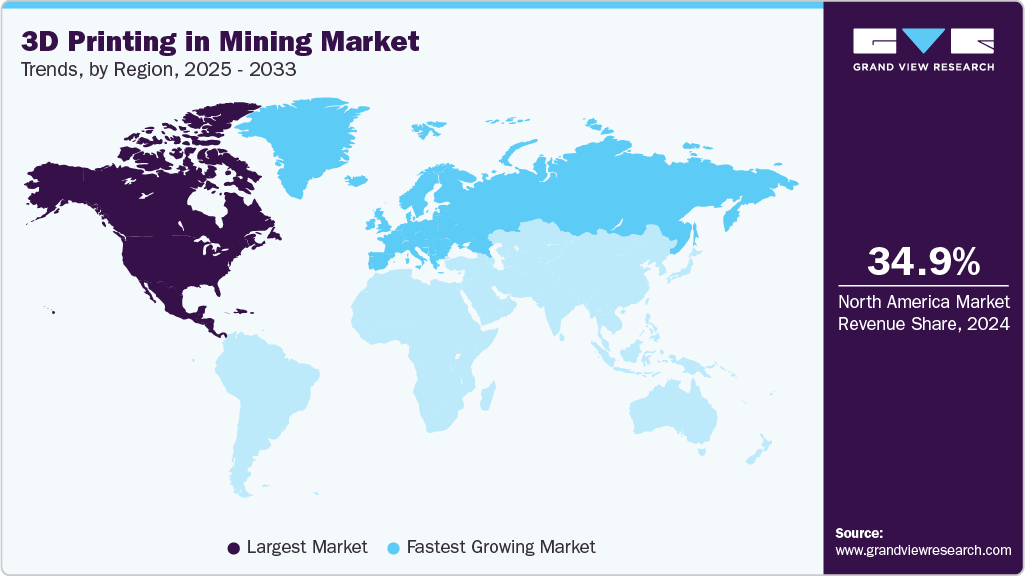
North America 3D printing in mining market accounted for the revenue share of 25.2% in 2025, driven by several key factors. Technological advancements in additive manufacturing have enabled the production of complex, durable components tailored to the specific needs of mining operations. These innovations allow for rapid prototyping and the creation of parts that can withstand the harsh conditions prevalent in mining environments.
 To learn more about this report, Download Free Sample Report
 U.S. 3D Printing in Mining Market Trends
The 3D printing in mining industry in the U.S. is propelled by several key factors. Technological advancements in additive manufacturing have enabled the production of complex, durable components tailored to the specific needs of mining operations. These innovations allow rapid prototyping and the creation of parts that can withstand the harsh conditions in mining environments.
Asia Pacific 3D Printing in Mining Market Trends
Asia Pacific dominated the 3D printing in mining market with the largest revenue share of 47.6% in 2025. The demand for customized solutions has reduced material waste and manufacturing delays, further boosting the adoption of 3D printing technologies. Government initiatives and investments play a crucial role in promoting the use of 3D printing within the region. Countries like China, Japan, and South Korea have established programs to advance manufacturing technologies, including 3D printing.
Europe 3D Printing in Mining Market Trends
The Europe 3D printing in mining industry growth is driven by a combination of technological innovation and strong industrial support. Advances in additive manufacturing have enabled the production of complex, high-performance components tailored to the specific demands of mining operations. This allows mining companies to rapidly prototype and produce parts capable of withstanding harsh operating conditions, reducing downtime and improving operational efficiency. In addition, a mature industrial base in countries such as Germany, France, and the U.K. has facilitated the integration of 3D printing technologies across mining equipment manufacturing and maintenance activities.
Middle East & Africa 3D Printing in Mining Market Trends
The Middle East and Africa (MEA) 3D printing in mining industry is expected to grow at the fastest CAGR of 14.8% during the forecast period, driven by the adoption of 3D printing technologies. One of the primary catalysts for this growth is the increasing demand for cost-effective and efficient manufacturing solutions. 3D printing enables the production of complex, durable components tailored to the specific needs of mining operations, reducing material waste and manufacturing delays. This capability particularly benefits regions with limited or costly traditional manufacturing infrastructure. In addition, the rise in mining activities across the MEA region, coupled with a push towards modernization and technological advancement, has spurred the integration of additive manufacturing into mining operations.
Latin America 3D Printing in Mining Market Trends
The 3D printing in mining industry in Latin America is largely driven by increasing regulatory requirements and government initiatives aimed at sustainable mining. Countries such as Brazil, Chile, Peru, and Mexico have introduced stricter environmental laws that require mining companies to restore land, manage water resources, and prevent soil erosion after mining activities. Compliance with these regulations creates a strong demand for professional rehabilitation services. Growing public awareness of environmental impacts and pressure from local communities further motivates mining operators to implement structured land restoration and ecological conservation practices.
Key 3D Printing in Mining Company Insights
Some of the key players operating in the market include Sandvik Mining and Rock Solutions, Boliden AB, and others.
-
Sandvik Mining and Rock Solutions is a global leader in providing equipment, tools, and service solutions for the mining and construction industries. Headquartered in Sweden, the company specializes in rock drilling, excavation, and material handling solutions. Its operations span more than 130 countries, serving underground and surface mining sectors. In the 3D printing space for the mining market, Sandvik offers metal additive manufacturing solutions designed to produce complex parts with high precision and durability. These offerings include wear-resistant components for drills, crushers, and other mining equipment, which help extend service life and reduce downtime.
-
Boliden AB is a Swedish mining and smelting company focused on the exploration, extraction, and processing of base and precious metals, including copper, zinc, lead, gold, and silver. The company operates mines and smelters in Sweden, Finland, and Ireland, with a strong emphasis on sustainable practices, resource efficiency, and minimizing environmental impact. Boliden’s strategy revolves around securing long-term value from its mineral resources through innovative technologies and efficient production processes, making it one of the leading players in the European mining sector.
Key 3D Printing In Mining Companies
The following key companies have been profiled for this study on the 3D printing in mining market.
-
AML3D
-
Boliden AB
-
Caterpillar Inc.
-
Epiroc
-
FLSmidth
-
Fortescue Metals Group
-
Global3D
-
Nornickel
-
Sandvik Mining and Rock Solutions
-
TheSteelPrinters
Competitive Benchmarking
Operating Strategies
Competitive Edge
Weaknesses
Established Players (Sandvik Mining and Rock Solutions, Boliden AB, FLSmidth, Caterpillar Inc., Epiroc)
- Integrate 3D printing technologies into mining equipment manufacturing, maintenance, and spare parts production.
- Focus on digital mining solutions, predictive maintenance, and supply chain optimization through additive manufacturing.
- Invest in R&D to develop application-specific metal and polymer components for harsh mining environments.
- Leverage global service networks to deploy on-demand manufacturing capabilities across mining operations.
- Strong global presence and established customer relationships across the mining value chain.
- Extensive technical expertise, engineering capabilities, and financial resources.
- Ability to integrate 3D printing with automation, digital twins, and smart mining platforms.
- Large installed equipment base creating recurring demand for printed replacement parts.
- High capital investment requirements for scaling additive manufacturing operations.
- Long qualification and certification processes for critical mining components.
- Dependence on cyclical mining capital expenditure and commodity market conditions.
- Complex integration of new manufacturing technologies into existing operational workflows.
Emerging Players (Fortescue Metals Group, Nornickel, TheSteelPrinters, AML3D, Global3D)
- Focus on niche additive manufacturing applications such as spare parts, wear-resistant components, and rapid prototyping for mining operations.
- Develop customized 3D printing solutions to address equipment downtime and remote-site logistics challenges.
- Collaborate with mining companies and OEMs to validate new materials and manufacturing processes.
- Expand capabilities through technology partnerships and application-specific service offerings.
- Greater flexibility in developing customized solutions for specific mining requirements.
- Faster adoption of emerging additive manufacturing technologies and materials.
- Ability to provide localized and on-demand production services.
- Strong focus on innovation and application development in mining environments.
- Limited production scale and geographic reach compared to large multinational players.
- Lower brand recognition and customer penetration across global mining markets.
- Resource constraints may limit investment in large-scale commercialization and expansion.
- Reliance on strategic partnerships and pilot projects to drive market adoption.
Recent Development
- In June 2024, Materialise and ArcelorMittal Powders signed a memorandum of understanding (MOU) to advance metal additive manufacturing by combining software and steel powder metallurgy expertise. The collaboration aims to optimize laser powder bed fusion (LPBF) technology, enhancing productivity and quality across metal 3D printing processes. As part of the agreement, ArcelorMittal will integrate Materialise’s next-generation build processor software to fine-tune printing parameters and streamline data flow between digital design and manufacturing systems, ensuring higher precision and efficiency in production.
3D Printing In Mining Market Report Scope
Report Attribute
Details
Market definition
The market size represents the total annual value of metal and other powders used in manufacturing 3D components for mining sector
Market size in 2025
USD 263.2 million
Estimated market size in 2026
USD 290.8 million
Projected market size by 2033
USD 672.1 million
Growth rate
CAGR of 12.7% from 2026 to 2033
Base year for estimation
2025
Historical data
2021 - 2024
Forecast period
2026 - 2033
Quantitative units
Revenue in USD million and CAGR from 2026 to 2033
Report coverage
Revenue forecast, company ranking, competitive landscape, growth factors, and trends
Segments covered
End Use, material, region
Regional scope
North America; Europe; Asia Pacific; Latin America; Middle East & Africa
Country scope
U.S.; Canada; Mexico; Germany; UK; France; China; India; Japan; Brazil; Saudi Arabia, UAE
Key companies profiled
Sandvik Mining and Rock Solutions; Boliden AB; FLSmidth; Caterpillar Inc.; Epiroc; Fortescue Metals Group; Nornickel; TheSteelPrinters; AML3D; Global3D
Customization scope
Free report customization (equivalent up to 8 analysts' working days) with purchase addition or alteration to country, regional & segment scope.
Pricing and purchase options
Avail customized purchase options to meet your exact research needs. Explore purchase options
Global 3D Printing in Mining Market Report Segmentation
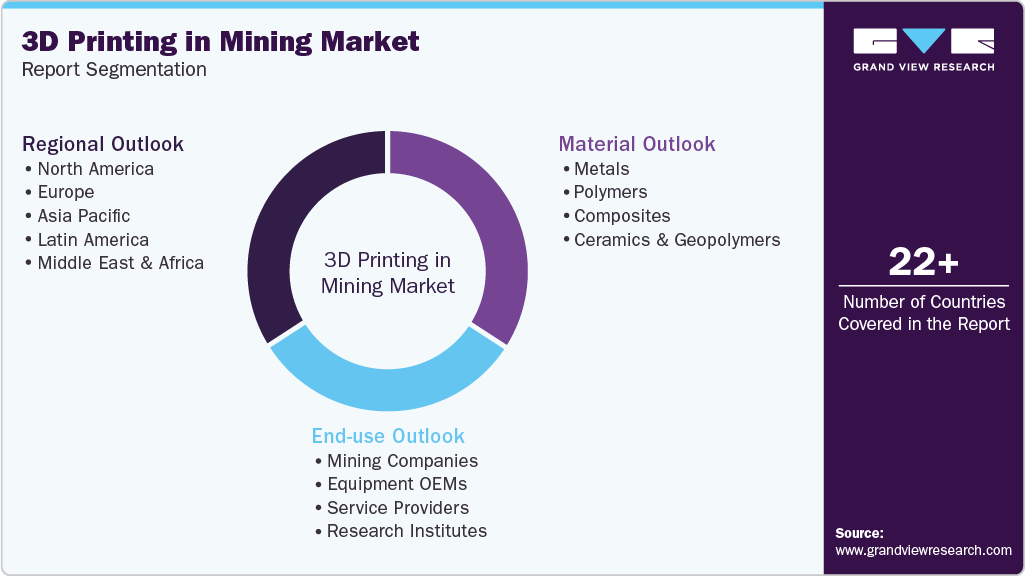
This report forecasts revenue growth at global, regional, and country levels and provides an analysis of the latest industry trends in each of the sub-segments from 2021 to 2033. For this study, Grand View Research has segmented the global 3D printing in mining market report based on material, end-use, and region.
 To learn more about this report, Download Free Sample Report
 -
Material Outlook (Revenue, USD Million, 2021 - 2033)
-
Metals
-
Polymers
-
Composites
-
Ceramics & Geopolymers
-
-
End-use Outlook (Revenue, USD Million, 2021 - 2033)
-
Mining Companies
-
Equipment OEMs
-
Service Providers
-
Research Institutes
-
-
Regional Outlook (Revenue, USD Million, 2021 - 2033)
-
North America
-
U.S.
-
Canada
-
Mexico
-
-
Europe
-
Germany
-
UK
-
France
-
-
Asia Pacific
-
China
-
India
-
Japan
-
-
Latin America
-
Brazil
-
-
Middle East & Africa
-
Saudi Arabia
-
UAE
-
-
Research Methodology
The 3d printing in mining market figures in this report are based on a proven research process that combines executive interviews with secondary research from proprietary databases, company filings, and recognized regulatory and institutional sources. Market size is built through value-chain sizing-reconciling supply-side and demand-side estimates-and triangulated with bottom-up and top-down approaches. Every estimate passes multiple levels of expert validation before publication, with each 3d printing in mining segment quantified using the revenue-capture definitions in the table below.
Segment Definition
Material
Revenue Capture Definition
Metals
This segment includes metal-based powders used in 3D printing for mining applications, such as stainless steel, tool steel, titanium, aluminum, and nickel alloys. Revenue is generated from the sale of metal powders, wires, and printed components used for manufacturing wear parts, equipment components, tooling, and maintenance applications in mining operations.
Polymers
This segment comprises polymer powders used in additive manufacturing, including thermoplastics and engineering polymers. Revenue is derived from the sale of polymer feedstocks and printed parts utilized for prototyping, tooling, protective components, housings, and non-structural mining equipment applications.
Composites
This segment includes composite powders reinforced with carbon fiber, glass fiber, or other strengthening agents used in 3D printing for mining. Revenue is generated from the sale of composite feedstocks and printed components that require enhanced strength-to-weight ratios, durability, and wear resistance for mining operations.
Ceramics & Geopolymers
This segment consists of ceramic and geopolymer powders used in additive manufacturing for specialized mining applications. Revenue is generated from the sale of materials and printed components designed for high-temperature, abrasion-resistant, and chemically resistant environments encountered in mining and mineral processing operations.
End Use
Revenue Capture Definition
Mining Companies
Revenue generated from the consumption of 3D printing powders, including metals, polymers, composites, and ceramics & geopolymers, utilized by mining companies for on-site spare part production, equipment maintenance, repair applications, tooling, and operational efficiency improvements across mining operations.
Equipment OEMs
Revenue generated from the consumption of 3D printing powders, including metals, polymers, composites, and ceramics & geopolymers, by original equipment manufacturers (OEMs) for product development, prototyping, component manufacturing, customization, and production of mining equipment and replacement parts.
Service Providers
Revenue generated from the consumption of 3D printing powders, including metals, polymers, composites, and ceramics & geopolymers, by additive manufacturing service providers delivering design, prototyping, part production, repair, refurbishment, and engineering services to mining companies and equipment manufacturers.
Research Institutes
Revenue generated from the consumption of 3D printing powders, including metals, polymers, composites, and ceramics & geopolymers, by research institutions, universities, and innovation centers conducting material research, process development, prototype fabrication, testing, and mining-related additive manufacturing studies.
Estimation Model
Layer Name
Key Question
Description
Mining Operations Demand Base Layer
What forms the demand base?
Identify demand for 3D printing powders, including metals, polymers, composites, and ceramics & geopolymers, generated across surface and underground mining operations. Analyze the impact of mining production activities, equipment maintenance requirements, spare parts replacement cycles, wear component consumption, operational downtime costs, and digitalization initiatives on material demand. This layer establishes the total addressable demand for additive manufacturing materials within the global mining sector.
Material Supply & Technology Infrastructure Layer
Where are 3D printing solutions produced and supplied from?
Estimate the supply of 3D printing powders, including metals, polymers, composites, and ceramics & geopolymers, based on production capacities, raw material availability, distribution networks, and regional supply chains. Analyze the role of material manufacturers, additive manufacturing technology providers, service bureaus, and engineering partners in supporting mining applications. Evaluate supply-demand dynamics, material availability, and technological advancements influencing material adoption across mining operations globally.
Application Adoption Intensity Layer
How extensively is 3D printing used in mining?
Analyze the intensity of material consumption across applications such as spare parts manufacturing, equipment maintenance, tooling, rapid prototyping, wear component production, inventory optimization, and customized equipment solutions. Evaluate usage based on mine size, equipment fleet, maintenance frequency, production complexity, operational criticality, and technology maturity. Material consumption intensity varies by mining type, commodity produced, operational scale, and regional adoption of additive manufacturing technologies.
Revenue Layer
How is market revenue generated?
Market revenue is quantified based on the consumption value of 3D printing powders, including metals, polymers, composites, and ceramics & geopolymers, utilized across mining applications. Revenue generation is driven by material demand from spare parts production, equipment maintenance, tooling, rapid prototyping, wear component manufacturing, and customized mining equipment applications. Material consumption is influenced by additive manufacturing adoption rates, production volumes, component complexity, maintenance requirements, and operational scale across mining companies, OEMs, service providers, and research institutions. Increasing investments in mining automation, digital transformation, localized manufacturing, and supply chain optimization are expected to support market growth.
Delivered Customizations
This report has been delivered with the following In-depth customizations
Client Request
Customization Delivered
Value Adds
Technology Adoption & Implementation Analysis
Comprehensive assessment of 3D printing adoption across mining companies, equipment OEMs, service providers, and research institutions. Evaluation of deployment models, implementation challenges, technology maturity, and application-specific use cases in mining operations.
Enabled stakeholders to identify adoption trends, benchmark implementation strategies, and evaluate the readiness of different mining segments for additive manufacturing integration.
Supply Chain & Spare Parts Optimization Analysis
Detailed evaluation of the role of 3D printing in spare parts production, inventory reduction, maintenance optimization, remote-site manufacturing, and supply chain resilience across mining operations.
Supported decision-making related to operational efficiency improvements, downtime reduction strategies, and cost optimization through decentralized manufacturing capabilities.
Opportunity Assessment
Identification of growth opportunities across spare parts manufacturing, equipment maintenance, rapid prototyping, wear-resistant components, customized tooling, and digital mining initiatives. Analysis of emerging applications enabled by advancements in metal additive manufacturing and Industry 4.0 technologies.
Assisted in prioritizing high-growth application areas, identifying future revenue opportunities, and aligning business strategies with the evolving digital transformation of the mining industry.
Frequently Asked Questions About This Report
Asia Pacific dominated the 3D printing in mining market with the largest revenue share of 47.6% in 2025.
China dominated the Asia Pacific market with a revenue share of 38.1% in 2025.
The Middle East & Africa are expected to register the fastest CAGR of 14.8% over the forecast period.
Based on end use, the mining companies segment led the market with the largest revenue share of 55.0% in 2025.
The global 3d printing in mining market size was valued at USD 263.2 million in 2025 and is estimated at USD 290.8 million for 2026.
The 3D printing in mining market is driven by the growing need for on-demand spare parts production, reduced equipment downtime, and increasing adoption of digital manufacturing technologies across mining operations.
The global 3d printing in mining market is expected to grow at a CAGR of 12.7% from 2026 to 2033, reaching USD 672.1 million by 2033.
The metals segment led with a 55.7% revenue share in 2025, while the ceramics & geopolymers segment is the fastest-growing.
Some of the key vendors in the global 3D printing in mining market are Sandvik Mining and Rock Solutions; Boliden AB; FLSmidth; Caterpillar Inc.; Epiroc; Fortescue Metals Group; Nornickel; TheSteelPrinters; AML3D; Global3D, among others.
About the Author(s)
Research Research Team
· ResearchThis report was authored by the research research team at Grand View Research - comprising two research analysts, one senior research analyst, and one industry expert - with specialized expertise in the research segment of the industry. All findings are based on proprietary databases, executive interviews, and regulatory analysis, subject to internal peer review prior to publication.
Last Updated:
Speak to Analyst

Customize this report to your needs - add regions, segments, or data points, with 20% free customization.
Or view our licence options:


ISO 9001:2015 & 27001:2022 Certified
We are GDPR and CCPA compliant! Your transaction & personal information is safe and secure. For more details, please read our privacy policy.


